Tag Archives: Heinrich A. Wieschhoff

Valuing the Evidence of Harold Julien

With gratitude to Susan Williams for her most recent essay, published in The Yale Review, “Revisiting Dag Hammarskjold’s Mysterious Death”, here is a larger selection of international papers from my archive, 19-27 September 1961. Harold Julien was the only survivor of the Albertina crash, and for too long his testimony has been undervalued and deliberately suppressed, it is time to take his evidence seriously.

From her essay: “In 2019, new information emerged relating to Julien’s stay in the Ndola hospital, provided by the government of Zimbabwe to the current U.N. inquiry. This fresh information reveals that Rhodesian authorities actively sought to prevent Julien’s statements from being made public. A senior Rhodesian intelligence official instructed Julien’s medical superintendent that “no one of his hospital staff must talk about this,” in relation to Julien’s statements that he had seen sparks in the sky. The superintendent and another doctor were warned about “the security angle” and asked “to make sure that none of their staff talked.

Justice Othman views this new evidence as significant. In his view, “a general undervaluing of the evidence of Harold Julien…may have affected the exhaustiveness of the earlier inquiries’ consideration of the possible hypotheses.”

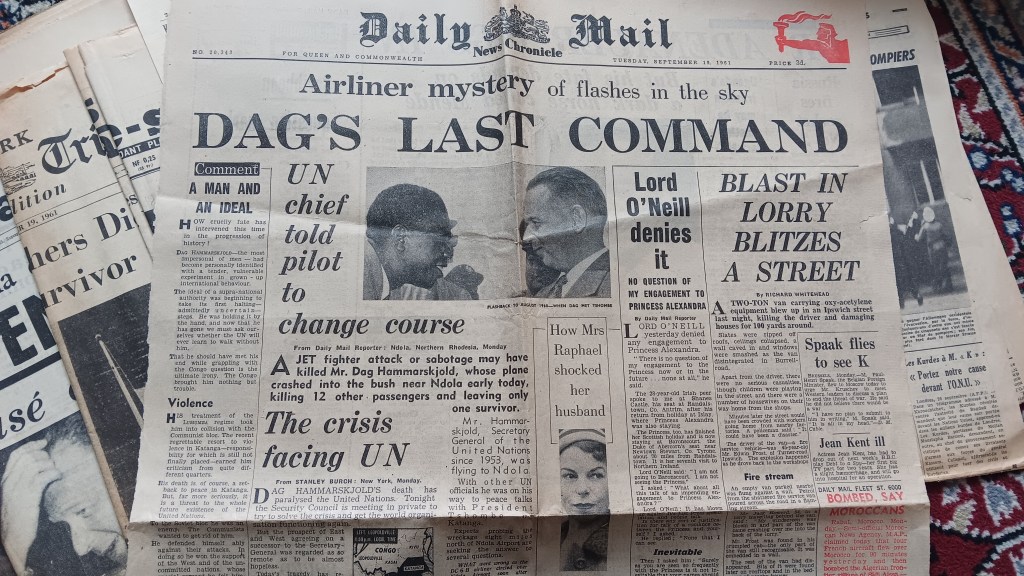
Daily Mail, 19 December 1961 “Airline mystery of flashes in the sky – Dag’s last command – UN chief told pilot to change course”
Daily Mail, September 19 “Sergeant Harold Julian, of the United States, a security guard on the plane, who was the lone survivor, said there was a series of explosions in the plane. Sergeant Julian, lying seriously injured and burned in Ndola Hospital, also said Mr. Hammarskjold changed his mind about landing at Ndola and told the pilot to alter course for another destination.” […] “Police in Ndola saw a huge flash in the sky just before the crash. […] “Officials of Transair, the Swedish charter company which owned the plane, said in Leopoldville that they believed the aircraft was shot down by a Katanga jet fighter. A UN spokeman said he could not definitely rule out sabotage or shooting down as the cause of the crash. He said Mr. Hammarskjold was flying at night to avoid the two jet planes in Katanga’s Air Force which for days have been straffing UN troops and bombing their airfields.”
Daily Mail, September 19 ” “Overdue procedure” was started. Checks were made at Congolese and Rhodesian towns. At dawn an all-out search began. But an African charcoal burner was the first man to find the smouldering wreckage. Then the pilot of a Rhodesian Air Force Provost plane saw the DC-6 and guided rescuers to the scene.”

From Williams’ essay: “[…]the 1961-62 official inquiries concluded that the first sighting of the crash site was at 3:10 p.m. on September 18 by a RRAF pilot flying overhead; at around the same time, there was a report of a sighting by the two aforementioned charcoal burners. Following these reports, police vehicles and ambulances were immediately sent to the site.

But a mass of evidence has emerged that shows that many people knew that the plane had crashed – and where – long before it was officially located. Indeed, the crash site was reported to the Northern Rhodesian authorities between 9:00 and 9:30 a.m. by Timothy Kankasa. Some charcoal burners had come across the burning plane in the morning and, in great concern, rushed to tell him. The men reported the crash to him, rather than to the police, because they mistrusted and feared the white authorities.”

Daily Mail, September 19 “Colonel Don Gaylor, U.S. Air Attache in Pretoria, who flew over the area helping to guide search parties, said he believed the crash took place between 12:30 a.m. and 1 a.m. It seemed clear that the pilot was making a direct approach to the airfield when he crashed, said Colonel Gaylor.”

From Williams’ essay: “[…] Colonel Don G. Gaylor […] was sent to Ndola on September 15 by the Pentagon.[…] Gaylor was one of three U.S. air attaches who are known to have flown to Ndola airport during the period of September 15-18. […] According to a letter Gaylor wrote to an official Swedish investigator in 1994 (a letter I was recently sent by Hans Kristian Simensen, a Norwegian researcher who, like me, is assisting Justice Othman on a voluntary basis), Gaylor was in the control tower at Ndola airport on the night of September 17-18, waiting for Hammarskjold’s aircraft. The letter states that after the plane failed to arrive, he and his crew prepared for takeoff at first light to look for a crash site. Gaylor wrote that he spotted the wreckage shortly after dawn and immediately contacted the “Ndola rescue frequency and gave them the map coordinates of the site.” His letter adds: “Then I circled the site for a considerable period to give the ground party a point of reference.” This account is consistent with Gaylor’s memoir.”

“It should be noted that there is a discrepancy between this claim by Gaylor and a report by Matlick to the U.S. Secretary of State on September 22, which states that Gaylor had wanted to search in the morning but was not allowed to do so by the Rhodesian civil authorities. Matlick adds that Gaylor flew the second aircraft to spot the crash site in the afternoon, following a sighting by a RRAF aircraft; this was echoed by Squadron Leader John Mussell in his testimony to the Rhodesian Board of Investigation.

“Without further documentary evidence, we cannot resolve these conflicting pieces of evidence, or verify Gaylor’s claim that he found the crash site shortly after dawn. This makes it all the more important to obtain and study the report that Gaylor said he sent to the Pentagon: “My report to my superiors in the Pentagon was acknowledged with some accolades.”

Daily Express, September 19 “…The survivor is identified as an American sergeant with the UNO forces, Harold Julian[sic]. He is severly burned. His report of explosions in the plane supports the theory of sabotage. Another theory is that it was shot down by a jet fighter from Katanga. […] Practically all the bodies were burned. Only Mr. Hammarskjold was immediately recognisable. Incredibly Sergeant Julian was still alive. He had lain all those hours in agony. Tonight hospital doctors give him a a “fair” chance of life.”

From Williams’ essay: “On Tuesday, September 19, the day after Julien had been taken to the hospital, he was “slightly better.” Though “still dangerously ill,” he was expected to survive. A day later, he was reported as “holding his own.”

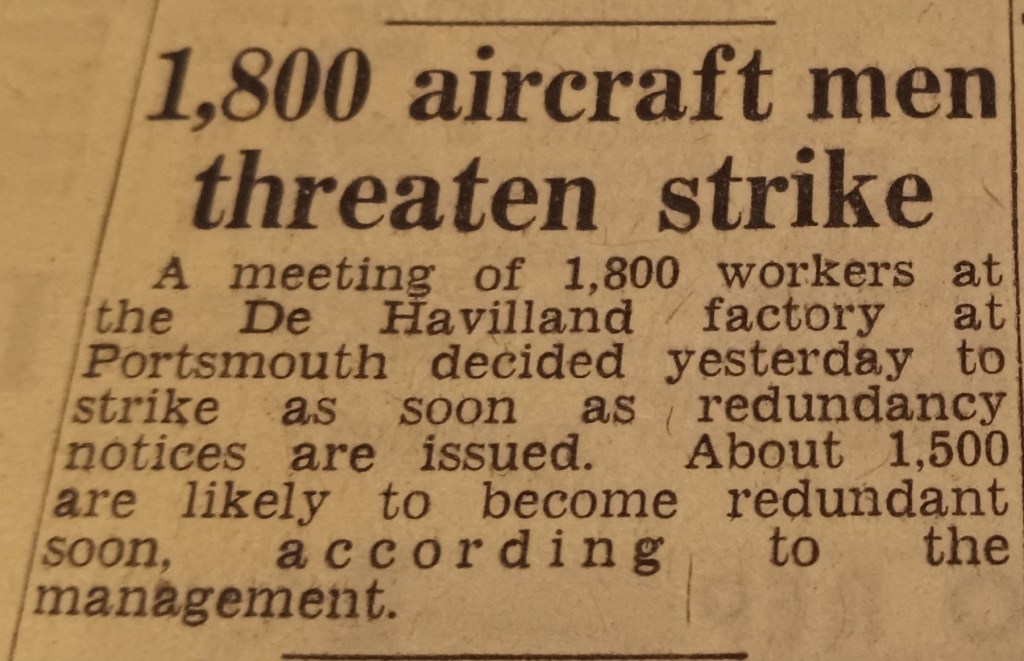
Daily Express, 19 September, page 2. “1,800 aircraft men threaten strike. A meeting of 1,800 workers at the De Havilland factory at Portsmouth decided yesterday to strike as soon as redundancy notices are issued. About 1,500 are likely to become redundant soon, according to the management.”

From Susan Williams’ book “Who Killed Hammarskjold?”, pages 186 and 187:

“[Bo] Virving stated that there were five [De Havilland] Doves in service of the Katangese air force in September 1961 at Kolwezi and Jadotville airports. They could stay airborne for three or four hours and their speed could match that of Hammarskjold’s DC6 in level flight; and in a dive from above they could increase their speed. It would be possible for the crew of the Dove to drop a small explosive device on to an aircraft below, then pull out of the dive. Virving had developed this theory about a Dove because on the day that Hammarskjold’s body was flown out to Sweden, he had seen a Dove at Ndola airport and discovered that it had a hole in its floor, which was apparently used for aerial photography. A man could lie there, he realized, telling the pilot ‘right, left, up, down’ and at a given moment let fall a small projectile.

“The theory that a Dove could be used in this way was later confirmed by Mercenary Commander, the memoir of the mercenary Jerry Puren[…]

“The Rhodesian Commission of Inquiry Report acknowledged that a Dove with bombing capacity was found in September 1961 at Ndola–but after the crash. ‘One De Havilland Dove belonging to the Katanga Government,’ it stated, ‘was after the 18th September armed by removing a door and placing a machine gun on the floor to fire through the opening.’ The Dove had not, it stated, been at Ndola on the day of the crash, but elsewhere: ‘On 17th September this and possibly another were in the hands of the United Nations at Elisabethville. Three Doves were then in the Republic of South Africa undergoing examination.’

“A Dove plane at Ndola also caused consternation at the British Embassy in Leopoldville in the week after the crash of the Albertina. Ambassador Riches sent a telegram to the Foreign Office on 24 September 1961, reporting that, according to Matlick, the U.S. Air Attache in Leopoldville who had just returned from Ndola, a Dove aircraft with Katangan air force markings had taken off from Ndola for Kolwezi the day before, carrying mercenaries. He had given this information to the UN, who had passed it on to Riches. ‘Report could do us serious damage here,’ warned Riches to London.

“Virving’s suspicions about the use of a Dove against the Albertina were heightened when he went to Elisabethville in 1962 and found that the Katangese Doves had disappeared during the August 1961 UN action to expel mercenaries. Significantly, their logbooks had been left behind. Then Virving found the Pretoria workshop where the Doves would normally have been serviced and sought information ‘for historical purposes’; but after two years’ wait he was told that no information could be given.”

Daily Express, September 19. Not everyone in the press was singing the praises of Hammarskjold, certainly not George Gale, who seems to be not only a white supremacist and supporter of the Federation of Rhodesia and Nyasaland, but also a homophobe. He writes of Hammarskjold: “He loved mountains and had good paintings on his austere walls. He read poetry, especially the writings of Rilke and of T.S. Eliot.”
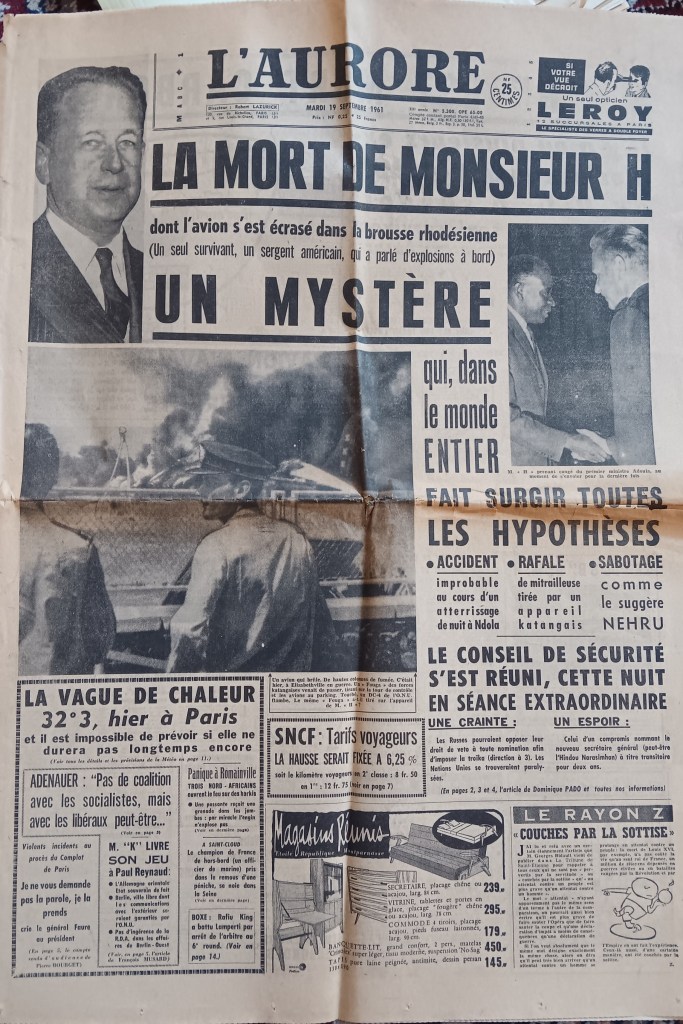
L’AURORE, September 19 “The Death of Mr. H, whose plane crashed in the Rhodesian bush(only one survivor, who spoke of explosions on board).”
L’AURORE September 19 “A burning plane. Tall columns of smoke. This was yesterday, in Elisabethville at war. A Fouga of the Katangese forces had just passed, shooting at the control tower, and at the planes in the parking lot. Hit, a United Nations DC-4 burns. Did the same Fouga shoot at Mr. H’s aircraft?”
L’AURORE September 19. The headline erroneously reports: “Mr. H is burned to death in his airplane tomb in Rhodesia” […] “There were several explosions before the crash of the Swedish DC-6, recounts the sole survivor”
International Edition of The NYT, September 19. This article refers to Colonel Don Taylor, which is a typo for Don Gaylor, saying that he “circled the wreck area until ground parties reach it shortly after 3 P.M.” On the front page of this edition of the NYT, it reports “Lone Survivor Reports Explosions on Flight to Tshombe Talks” and that “Officials quoted Mr. Julian[sic] as having said that Mr. Hammarskjold had changed his mind about landing at Ndola and that he had told the pilot to alter course for another destination. Moments later, according to the injured man, there was a series of explosions aboard the plane. Hospital authorities said Mr. Julian was in serious condition.”
International Edition of the NYT, September 19
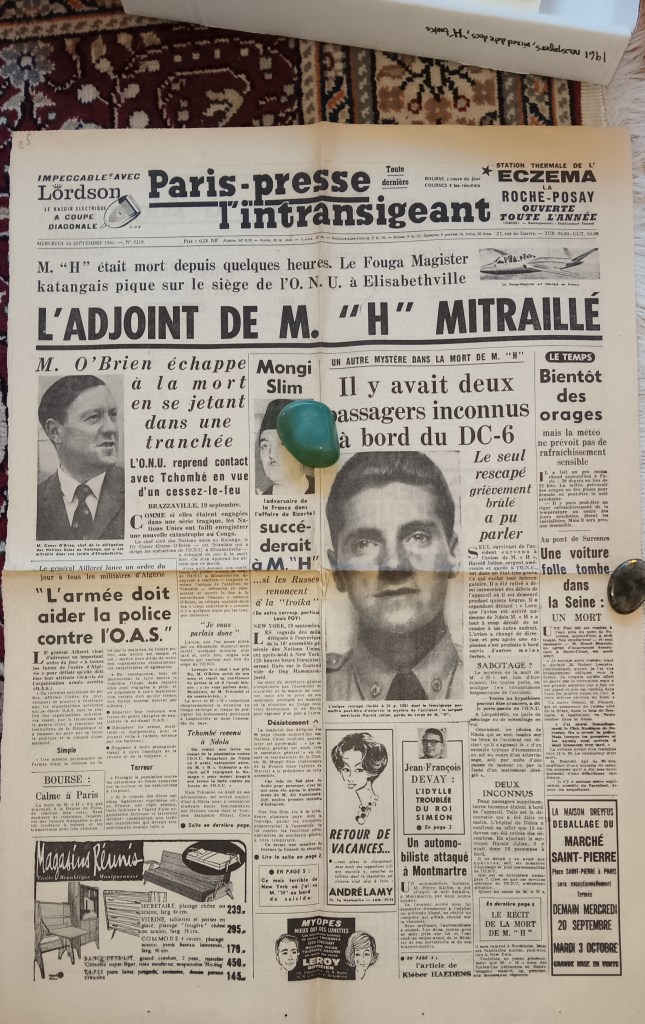
Paris-presse l’intransigeant, September 19. This publication does not mention Harold Julien by name or the testimony he gave to hospital staff in Ndola, reporting only that “Another person not yet identified was found seriously injured.”
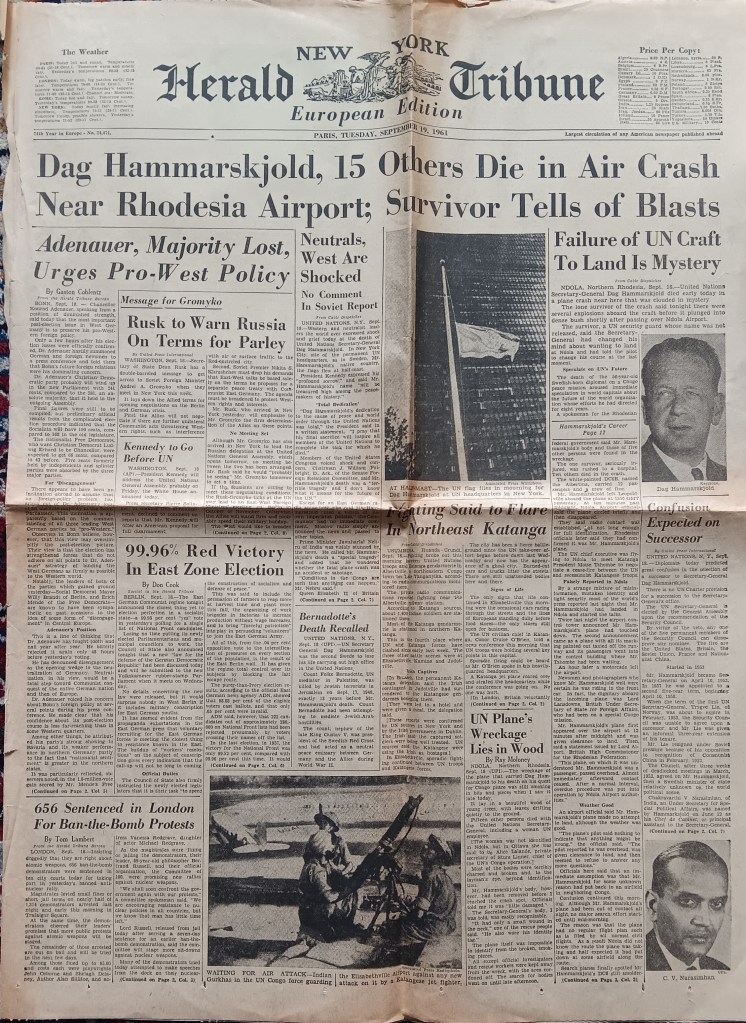
European Edition of the New York Herald Tribune, September 19
European Edition of the New York Herald Tribune, September 19. This article reports the testimony of Harold Julien, without mentioning his name, only that he was “a UN security guard whose name was not released.”
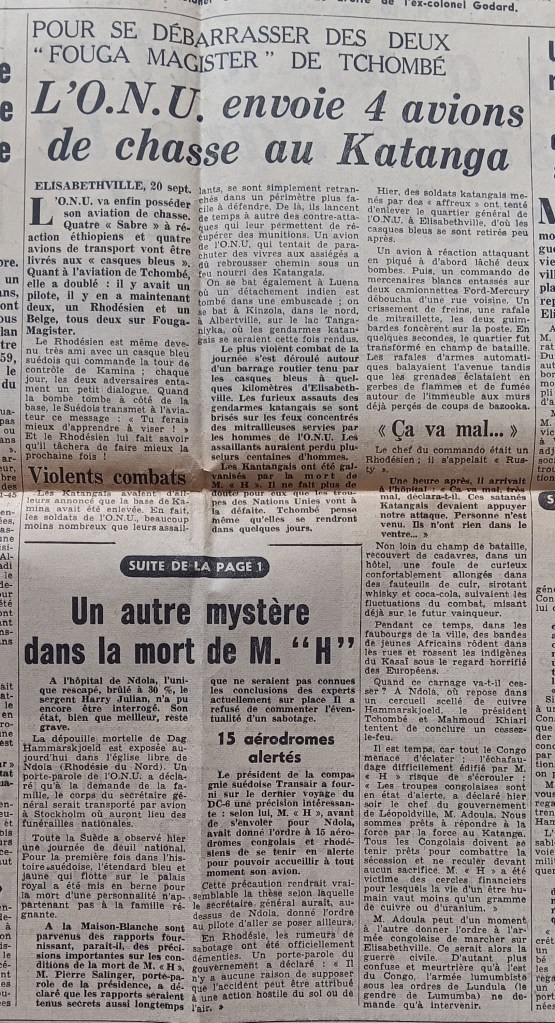
Paris-presse l’intransigeant, September 20. Headline: “Mr. H had been dead a few hours. The Katangese Fouga Magister attacks the headquarters of the O.N.U. in Elisabethville.” Text below photo: “The Fouga-Magister is made in France.”
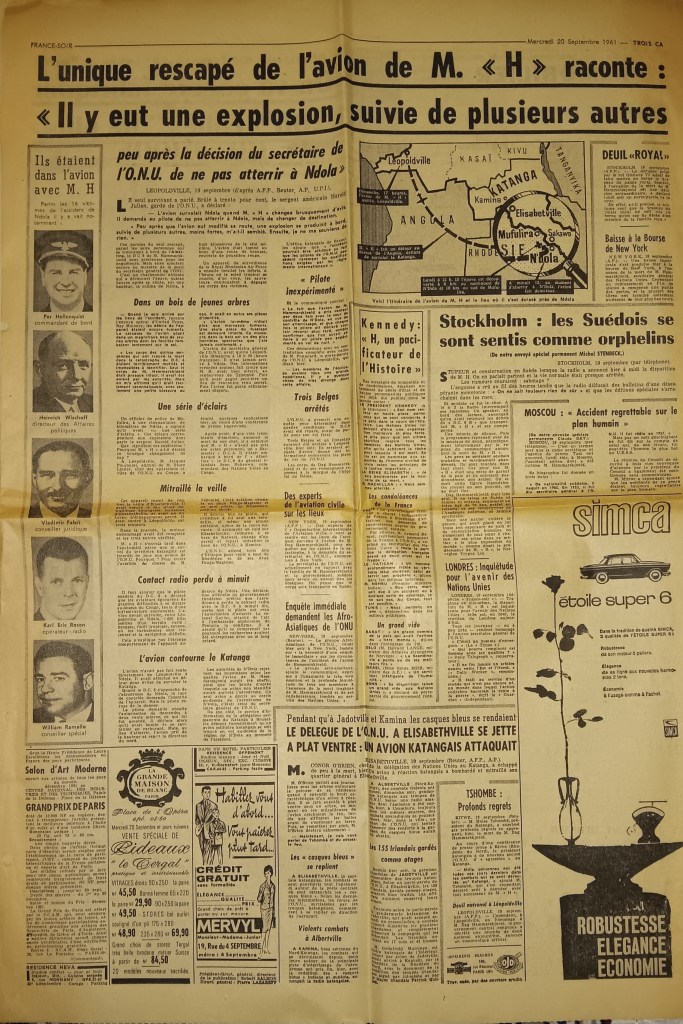
France-Soir, September 20
France-Soir, September 20. Rarely seen photos of Captain Per Hallonquist and Karl Erik Rosen.
France-Soir, September 20 “Three Belgians and a Congolese were reportedly arrested in Leopoldville yesterday evening. They would be accused of having given information concerning flight plans of the O.N.U.”
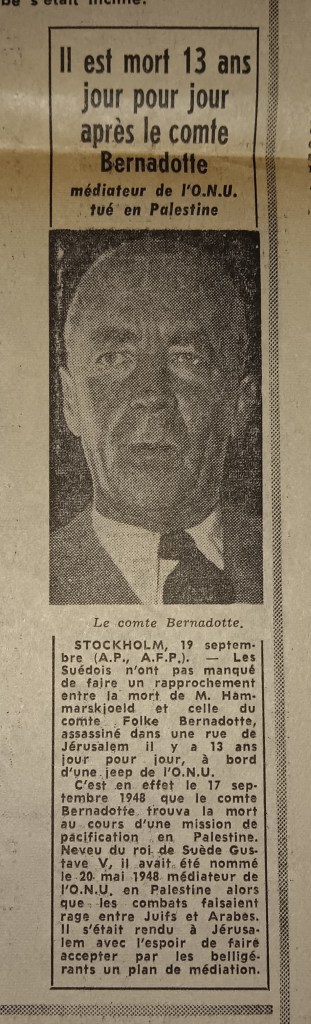
France-Soir, September 20. Many papers reported on the assassination of Swedish diplomat Count Folke Bernadotte, which happened exactly 13 years earlier in Gaza, 17 September 1948. And yet another eerie coincidence, Alice Lalande – the only woman on board the Albertina – was Bernadotte’s personal secretary.
International Edition of the NYT, September 20. Dag must have been bored to death of the overt and covert attacks on his sexuality and private life, on the job and in the press. But this was an era when being accused of homosexuality was akin to being accused of being a communist – Roy Cohn would understand! ”Mr. Hammarskjold did not like to talk about himself a great deal. He had an idea that he had been fixed forever in the public mind as a man with an alpenstock in one hand and a volume of T.S. Eliot’s works in the other. “That’s not a picture of me,” he said. “It is a caricature. Everywhere I go, mountains, mountains, T.S. Eliot. Believe me, I am sick of mountains and poetry talk.”
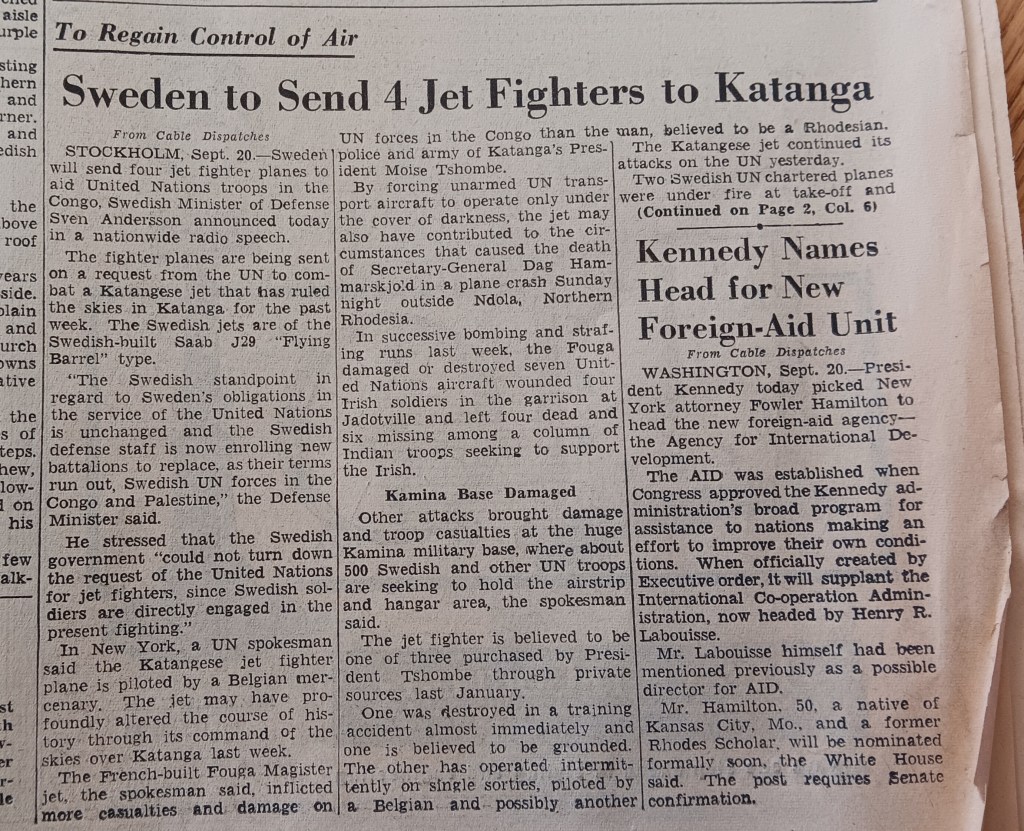
European Edition of the New York Herald Tribune, September 21. “The French-built Fouga Magister jet, the spokesman said, inflicted more casualties and damage on UN forces in the Congo than the police and army of Katanga’s President Moise Tshombe. By forcing unarmed UN transport aircraft to operate only under the cover of darkness, the jet may also have contributed to the circumstances that caused the death of Secretary-General Dag Hammarskjold in a plane crash Sunday night outside Ndola, Northern Rhodesia. In successive bombing and strafing runs last week, the Fouga damaged or destroyed seven United Nations aircraft, wounded four Irish soldiers in the garrison at Jadotville and left four dead and six missing among a column of Indian troops seeking to support the Irish.”
European Edition of the New York Herald Tribune, September 21
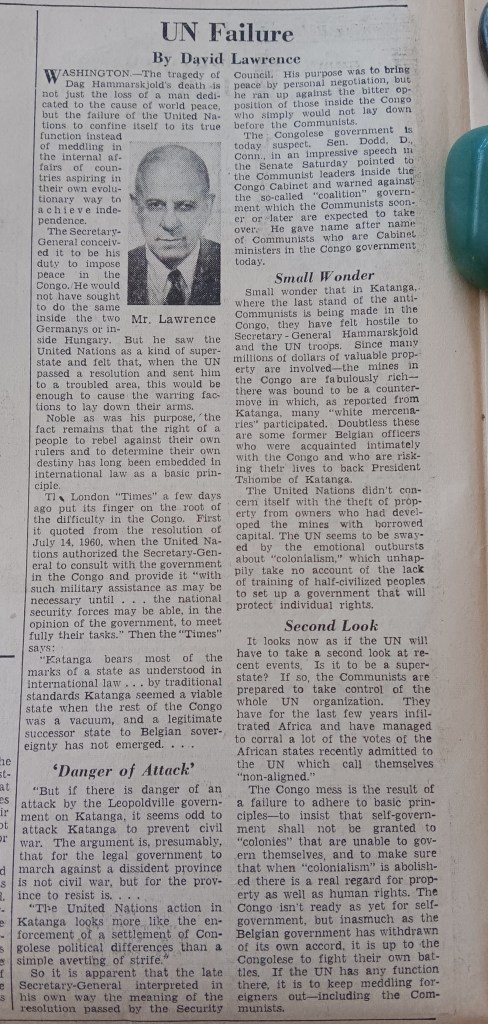
European Edition of the New York Herald Tribune, September 21. David Lawrence, yet another white supremacist who had nothing good to say about the United Nations or Dag Hammarskjold.
European Edition of the New York Herald Tribune, September 21. On the same page, next to David Lawrence, is this thoughtful and sad salute to Dag Hammarskjold from Walter Lippmann: “If the world is not ready for what Hammarskjold felt compelled to try in the Congo, it is also true, I hate to say, that this present world is not ready for the kind of man Hammarskjold was. He was a Western man in the highest traditions of political excellence in the West. Khrushchev says that Hammarskjold was not neutral in the Congo, and that there is no such thing as a neutral man. Hammarskjold was in fact the embodiment of the noblest Western political achievement — that laws can be administered by judges and civil servants who have their first allegiance to the laws, and not to the personal, their class, or even their national interests. No such political ideal is believed to be possible or is regarded as tolerable in the Marxist world. The ideal is not very well understood in most of the rest of the world, and there is no use pretending that such public servants are not very rare indeed. So there are times, as now in this hour of our grief and shock, when the ideal seems to belong to things that are passing away.”
Paris-presse l’intransigeant, September 21 “At the Ndola hospital, the only survivor, 30% burned, Sgt. Harold Julian[sic], has not yet been able to be questioned. His condition, although improved, remains serious.”
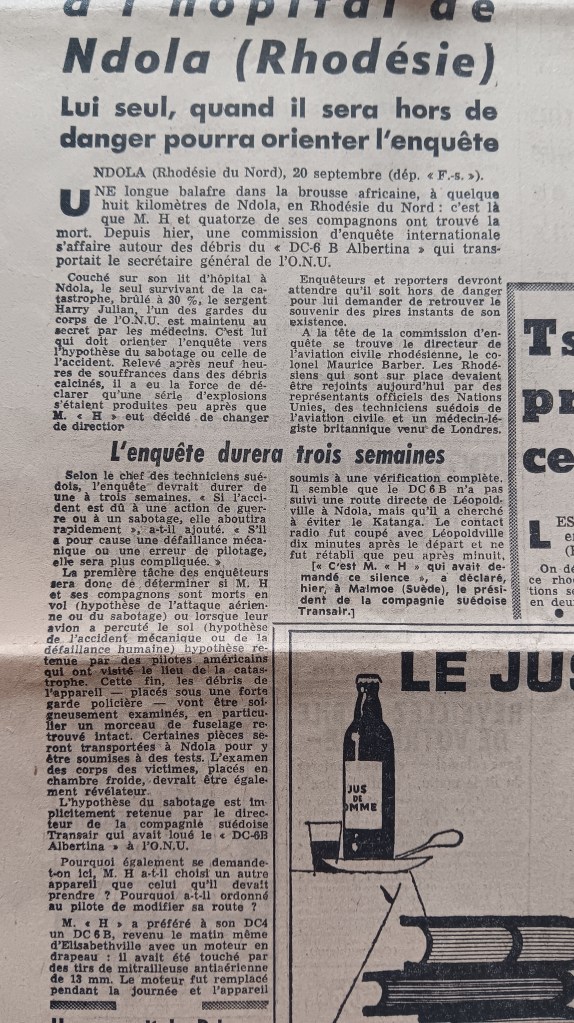
France-Soir, September 21 Headline: “The survivor of Mr. H’s plane is incommunicado at the Ndola hospital (Rhodesia)” […] “Lying on his hospital bed in Ndola, the only survivor of the disaster, 30% burned, Sergeant Harry Julian[sic], one of the UNO bodyguards, is kept secret by doctors.” A rare photo of Mrs. Julien, caption says: “The wife of the sole survivor of Mr. H’s plane. Miami, 20 September (AP) — Mrs. Julian, 37 years, is the wife of the sole survivor of the DC-6 crash with Mr. H in Rhodesia. Mrs. Julian, who works for an advertising agency in Miami in the United States, only learned yesterday that her husband, Harry Julian, 37 years, one of Mr. H’s bodyguards, was on the plane.”

From Williams’ essay: “Maria Julien arrived in Ndola on Thursday, September 22, and was with Harry on the final day and night of his life. He was sedated and did not speak much. But she knew he was fully in his senses, because he asked about a chain that he had sent to her to be repaired — a chain to a medallion of St. Christopher, the patron saint of travelers. They were both devout Catholics, and Maria had called a priest to her husband’s bedside.

“But on the morning of the next day, her husband died — despite the expectation that he would survive. This was five days after the crash. The coroner’s summary report listed the cause as “Renal failure due to extensive burns following aircraft accident.”

[…]

“As Sgt. Julien was the only person left to describe what has happened on the flight, his recollections should have been crucial to the investigations of the Rhodesian Commission. But the commission discounted Julien’s statements to the nurses, writing: “No attention need be paid to remarks, later in the week, about sparks in the sky. They either relate to the fire after the crash, or a symptom of his then condition.” Even Julien’s comment about the plane having blown up, made to police inspector Allen, was not given serious attention.

“The senior medical staff at the hospital dismissed Julien’s recollections of the crash as the ramblings of a sick man; his reference to “sparks in the sky” was attributed to uraemia. But Dr. Lowenthal took a different view. He stated that Julien’s recollections were spoken during a plasma transfusion and before an injection of pethidine, which means that Julien had not been sedated at the time. Lowenthal felt so strongly about the need to establish this truth that he participated in the Rhodesian hearings as a volunteer witness; he insisted that when Julien spoke about the crash, he was “lucid and coherent.”

France-Soir, September 21 “Only he, when he is out of danger, will be able to guide the investigation.”
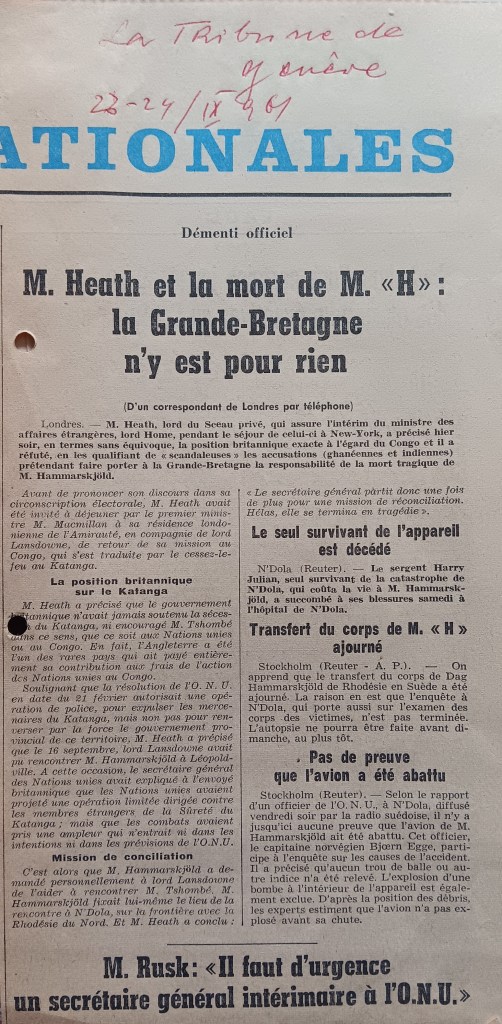
Tribune de Geneve, September 21. “Three months in hospital for the sole survivor of Hammarskjold’s plane. Sergeant Harry Julian[sic], seriously injured in the crash of the plane transporting Secretary-General Hammarskjold, and the only survivor of the disaster, will have to stay in hospital for at least three months. It will not be for ten or fifteen days before we will be able to know if he is really out of danger.”
France -Soir, September 21 “The only survivor of Mr. H’s plane is delirious and cannot be questioned.”
Tribune de Geneve, September 23-24 “The only survivor of the plane has died”
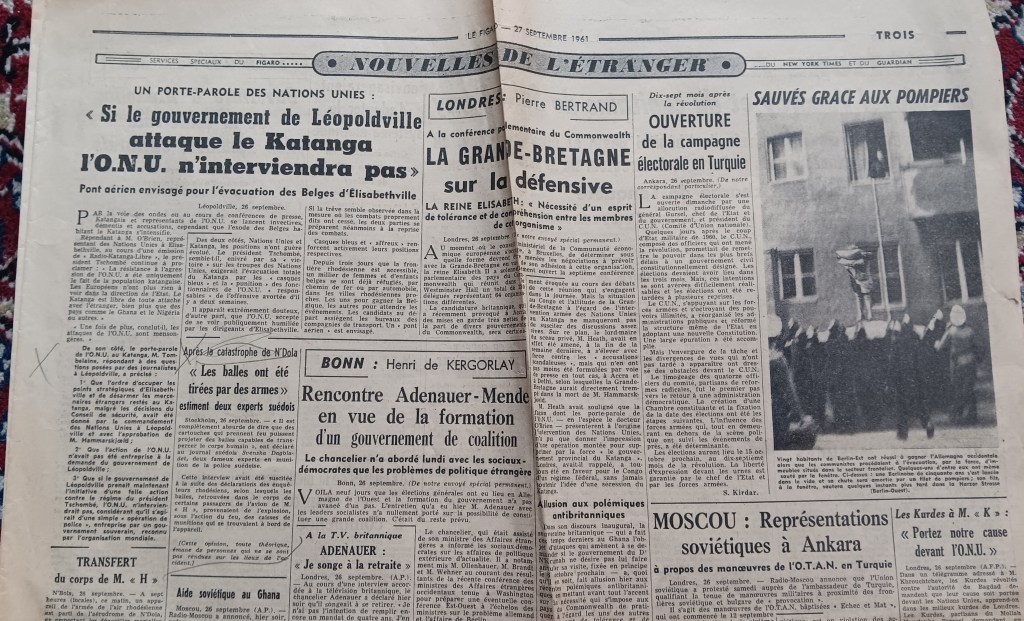
Le Figaro, September 27
Le Figaro, September 27 “After the Ndola disaster. The bullets were fired by weapons, say two Swedish experts.” […] “It is completely absurd to say that cartridges that catch fire can project bullets capable of piercing the human body” declared two famous ammunition experts from the Swedish police to Svenksa Dagbladet. This interview was prompted following statements by Rhodesian investigators, according to which, the bullets, found in the body of certain passengers of Mr. H’s plane, came from the explosion, under the action of fire, boxes of ammunition which were on board the aircraft. (This opinion, entirely theoretical, comes from people who did not go to the scene of the accident.)”

In honor of Dr. Martin Luther King’s birthday today, here is some encouragement from him: “I believe that unarmed truth and unconditional love will have the final word in reality. This is why right, temporarily defeated, is stronger than evil triumphant.”

Thank you, Hynrich Wieschhoff!

With gratitude, “The Elusive Truth About the Death of Dag Hammarskjold”, written for PassBlue by the son of Heinrich A. Wieschhoff. I’m sharing it here in full so everyone will read this, and know how the relatives truly feel about the UN investigation.

“My clock radio clicked on. The morning news bulletin announced that United Nations Secretary-General Dag Hammarskjöld’s plane was missing.

It was Sept. 18, 1961. I was 16.

Over the next hours, my mother and sisters and I learned that Mr. Hammarskjöld, accompanied by Dad and 14 others, had flown from Leopoldville, in the Congo, to Northern Rhodesia (now Zambia); that the plane, a DC-6, had not landed at Ndola, its destination; that an unexplained 15 hours went by after the airliner passed over the Ndola airport and before its wreckage was found lying not far from the runway; that all on board save one were dead.

My father, Heinrich A. Wieschhoff, was one of Mr. Hammarskjöld’s political advisers. Their party was headed for talks with the head of the breakaway Congo province of Katanga in hopes of quieting the fighting that had broken out between UN peacekeeping troops and the largely mercenary-led forces backing Katanga’s secession. It was a dramatic moment in the history of this mineral-rich country — a year after it gained independence from Belgium and quickly became embroiled in a violent quagmire involving the interests of not only Belgium but also France, South Africa, the Soviet Union, Britain and the United States.

Days after the crash, we learned that the sole survivor had died. Now there was no one to shed light on what had occurred. My family’s experience was lived in one wrenching way or another by the families of the 15 other victims. The particulars were different; the pain was the same — and only worsened because no one could tell us why the plane had gone down.

From the outset, there were legitimate concerns about the possibility of foul play. Within months of the crash, three inquests were held in rapid succession. The report of a UN commission, relying to a large degree on groundwork done by the-then Rhodesian Federation, was inconclusive, as was a report by the federal civil aviation body. The report of a commission empaneled by the Federation arrived, by a curious turn of logic, at the convenient conclusion that the event was an accident.

At first we assumed the UN would be vigilant in looking for new clues and dogged in running them to ground, and for years that seemed to be the case. Dad’s UN associates fielded our questions about the results of the original investigations and new allegations of wrongdoing promptly and graciously.

Once those associates left the UN, however, I gradually began having doubts that anyone in a leadership position cared much, if at all. One exception was Jan Eliasson, the deputy secretary-general under Ban Ki-moon, who was seemingly alone in advocating a serious look at the death of his idol and fellow Swede, Mr. Hammarskjöld.

The UN’s public posture toward Mr. Hammarskjöld drips with veneration — naturally. Yet when it comes to actually unraveling the circumstances of his death, a certain callousness prevails, despite high-sounding pronouncements to the contrary. In my experience, concern about the other 15 victims is even lower.

One byproduct of this indifference has been a coming together of nearly all the families of the deceased. Partly as a result, I have sensed that the UN is paying more attention to their interests, at least in its public comments. Privately, I still encounter telltale signs that the organization views the search for answers as a housekeeping matter.

For instance, when a group of the relatives sent the UN Secretariat a copy of a letter thanking the UN members sponsoring a recent resolution bearing on the crash, the response was a form letter from the public inquiries team stating that “the matter you raise is one of domestic jurisdiction, and does not fall within the competence of the United Nations.”

In 2011, the inquiry hit a turning point. Susan Williams, who had no prior connection to the crash, published “Who Killed Hammarskjöld? The UN, the Cold War and White Supremacy in Africa.” A sobering probe of information that the three post-crash inquests did not have, or had but failed to consider properly, it presented the UN with a chance to dig deep.

Dr. Williams, a historian and senior research fellow at the University of London, did not identify a likely cause of the disaster, but she did present a number of startling claims, including that US intelligence services allegedly eavesdropped as an unidentified plane attacked Mr. Hammarskjöld’s during its landing approach.

The book sparked hope that the UN would finally give the crash its due. First, however, a group of private citizens established a pro bono commission of four jurists to evaluate her findings. In 2013, they determined that significant new evidence could justify reopening the UN’s original investigation.

The stage was set, at long last, to bring this unhappy affair to a definitive close. Unfortunately, instead of insisting that further exploration be unlinked from the agendas of individual member states, and Secretary-General Ban be given a free hand to deal with the crash as he saw fit, the office of the secretary-general solicited the views of certain members of the Security Council. Predictably, influential members signaled their lack of enthusiasm for a full-fledged re-opening of the investigation.

In other words, the UN ducked — in my view, avoiding discomfiting questions about the roles of Belgium, France, South Africa, the Soviet Union, Britain and the US in events related to the crash, and possibly about the UN’s own handling of its original investigation and subsequent new evidence as well.

What followed was five years (and counting) of a piecemeal, woefully ineffective process fashioned to give the impression of rigor. Through resolutions organized by Sweden, the General Assembly first relegated the crash to a “panel of experts” for yet another assessment of new information (2014), then to an “eminent person,” the former chief justice of Tanzania, Mohamed Chande Othman, for follow-up (2016).

The resolutions asked member states to search their archives for relevant material and to declassify sensitive records, namely intelligence and military files. But genuine cooperation from the key players has been slow and halting. Russia and the US, as of a recent date, failed to comply fully with the General Assembly’s resolutions, and South Africa and Britain appeared bent on frustrating the process altogether. To my knowledge, the UN has rarely generated information on its own, so that leaves Chief Justice Othman to rely heavily on private sources.

As far as I am aware, the Secretariat has not engaged at a high level with recalcitrant member states to get them to adhere to the General Assembly resolutions. It has done little to publicize the activities of the chief justice. It has been slow to fully declassify its own archives and still refuses to release some documents.

In their Dag Hammarskjöld Lectures, in Uppsala, Sweden (Mr. Hammarskjöld’s home base), Secretaries-General Ban and António Guterres each mentioned the search for the truth about the crash but at the tail end of their presentations, almost as an afterthought. Instead of taking a meaningful stand, they repeated the hollow refrain: the UN was doing all it could do to find answers and member states should comply with the call to declassify relevant records.

Equally revealingly is the fact that in 2017, Secretary-General Guterres’s office sought to end the Judge Othman probe. Thanks to Sweden’s insistence, the General Assembly renewed his appointment. Did the secretary-general tip his hand last year when, rather than appear in person before the General Assembly, he sent a subordinate to present Judge Othman’s interim report?

His findings were impressive, especially considering his meager support. For his current engagement of about 15 months, Judge Othman has only himself and an assistant, working part time and in different countries, on a budget so small that nearly a third will go toward translating his reports into the UN’s official languages.

The opportunity presented by Dr. Williams and the jurists’ commission still stands. And we may learn more from Judge Othman’s final report, due this summer. I worry, though, that unless that report or a new sense of purpose by the UN can pry the facts out of Britain, the US and other key states, what happened and why will once again fade unanswered into the past.”

United for Justice

Today, my thoughts return to the status of the Hammarskjold investigation, and to all the relatives around the world who are waiting for the truth to unfold. Last week, on November 19, the United Nations General Assembly adopted by consensus the resolution which “urges all member states…to release any relevant records in their possession and to provide to the Secretary-General relevant information related to the death of Dag Hammarskjold.”

There were 74 co-sponsors to the resolution, including Zambia, Slovakia, the Czech Republic, Sweden, Haiti, South Africa, Ireland, Canada, Belgium, Germany, and France. Every nationality of those who died in 1961 has been represented, with one very notable exception: The United States. It is for this very reason I write today, I will not be silent in my support, because American citizens died for peace, and they and Vlado deserve the respect of their country.

In a statement made by Swedish Ambassador Olof Skoog, who introduced the resolution to the President of the UN General Assembly, he said “The pursuit of bringing clarity to the circumstances of the incident is particularly important to the families of all 16 victims – some of whom are present today – but also to the UN as an organization and it should remain so also for all of us as we try to come together to continue the work left unfinished by his premature death.”

It was a little more than a year ago that I was first contacted by one of the relatives, who has been instrumental in gathering us all over the world, and uniting us together to send group letters and emails to UN members in support of this investigation. Many have also written personally to UN members and heads of state to make our appeal, myself included, and I am thankful to those who were kind to respond. It gave me a lot of hope to receive a letter in reply from Swedish State Secretary for Foreign Affairs Annika Soder, dated November 20, 2014, the day after the new Swedish Government decided to take the initiative to table the resolution to support the Hammarskjold investigation.

What has not been fully appreciated by the public, and is not being reported in the news anywhere, is the quiet, behind-the-scenes efforts of all the relatives that have united for justice, and who have been paying close attention to the progress of the investigation. It’s not just my family and a handful of others that are speaking up – there are a total 105 relatives that are committed in standing together in support, so we cannot be dismissed as just a few conspiracy theorists. There are relatives to represent every person who died in the crash, with the only exception being Alice Lalande of Canada; though many people, not only the relatives, did all they could to find family that could speak up on her behalf.

I haven’t written much about the investigation recently, but I want to express today how extremely proud I am to belong to this group of dedicated and courageous people, and to be able to give them my support here, it is truly an honor.

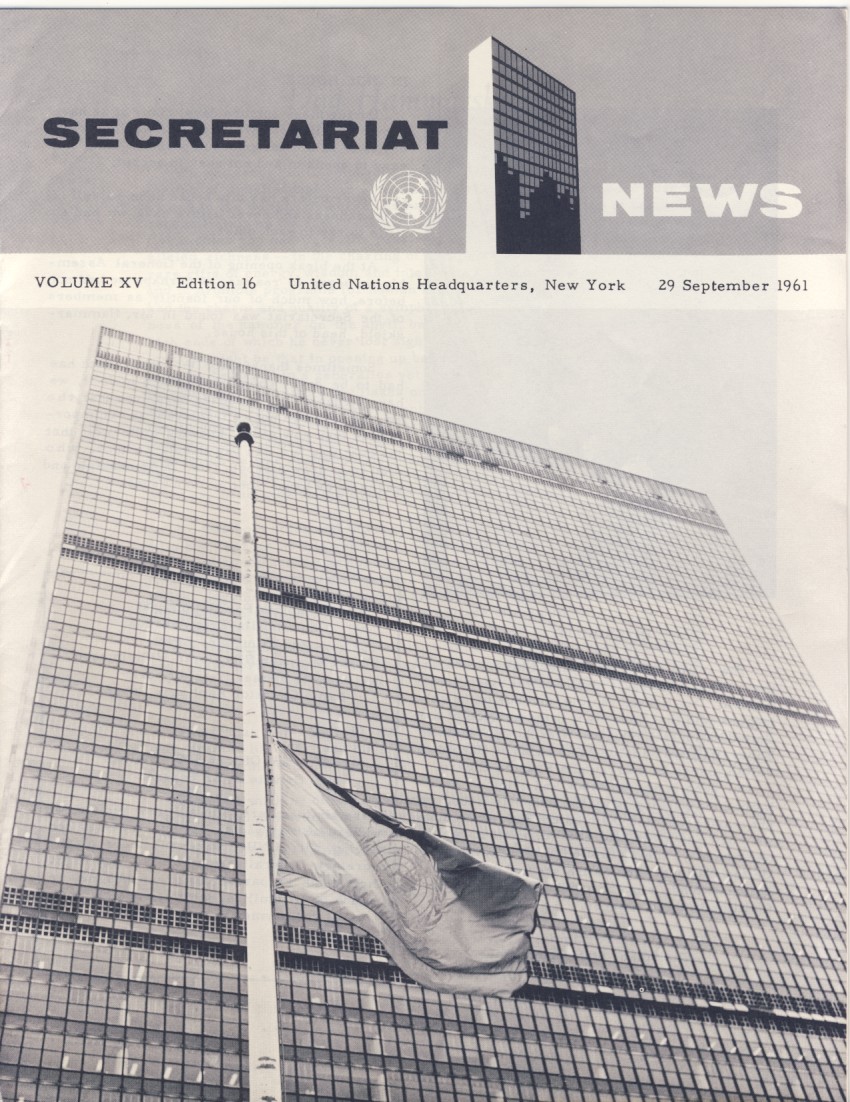
Secretariat News, 29 September 1961

Secretariat News September 1961 cover

Secretariat News September 1961 p2
IN TRIBUTE
The entire staff of the United Nations mourns the sudden and tragic death of the Secretary-General, Dag Hammarskjold, and our other colleagues who lost their lives in the service of the United Nations: Heinrich A. Wieschhoff, Vladimir Fabry, William Ranallo, Alice Lalande, Harold M. Julien, Serge L. Barrau and Francis Eivers.

Our deep sense of shock and grief on hearing of their passing is all the deeper because we knew and respected them as colleagues; because we knew, admired and shared, each in his or her own way, their devotion to the ideals of the United Nations. The entire staff of the Organization extends sincere condolences to their families in their sadness.

R.V. Klein, Chairman, Staff Committee

IN THIS HOUSE
During these somber days, many of us have known a feeling of unreality. The world’s tragedy is to us a most grievous personal loss, not easy to speak of and not easy to accept.

Never before has this house been so full of quiet sadness and never before have we had so little to say to each other.

At the bleak opening of the General Assembly we began to realize, as perhaps we had not before, how much of our identity as members of the Secretariat was found in Mr. Hammarskjold, head of this house.

Sometimes thankful for the work which has had to be done, sometimes unable to do it, we have struggled to persuade ourselves that the routine jobs are not so irrelevant and unimportant as they now seem, knowing quite well that the best way we can pay tribute to those who died is to draw strength from their example and carry on as usual–better than usual.

——————————————————————————————–

Captain Per Hallonquist
Captain Nils-Eric Aarhreus
2nd Pilot Lars Litton
Flight Engineer Nils Goran Wilhelmsson
Air Purser Harald Noork
Radio Operator Karl Erik Rosen
and
Warrant Officer S.O. Hjelte
Private P.E. Persson

These six members of the air crew and the two soldiers of the Swedish 11th Infantry Battalion serving with the ONUC were members of the Secretary-General’s team on his last flight. Their death is part of our great loss and we include their families, their friends and their countrymen in our thoughts.
Secretariat News September 1961 p3
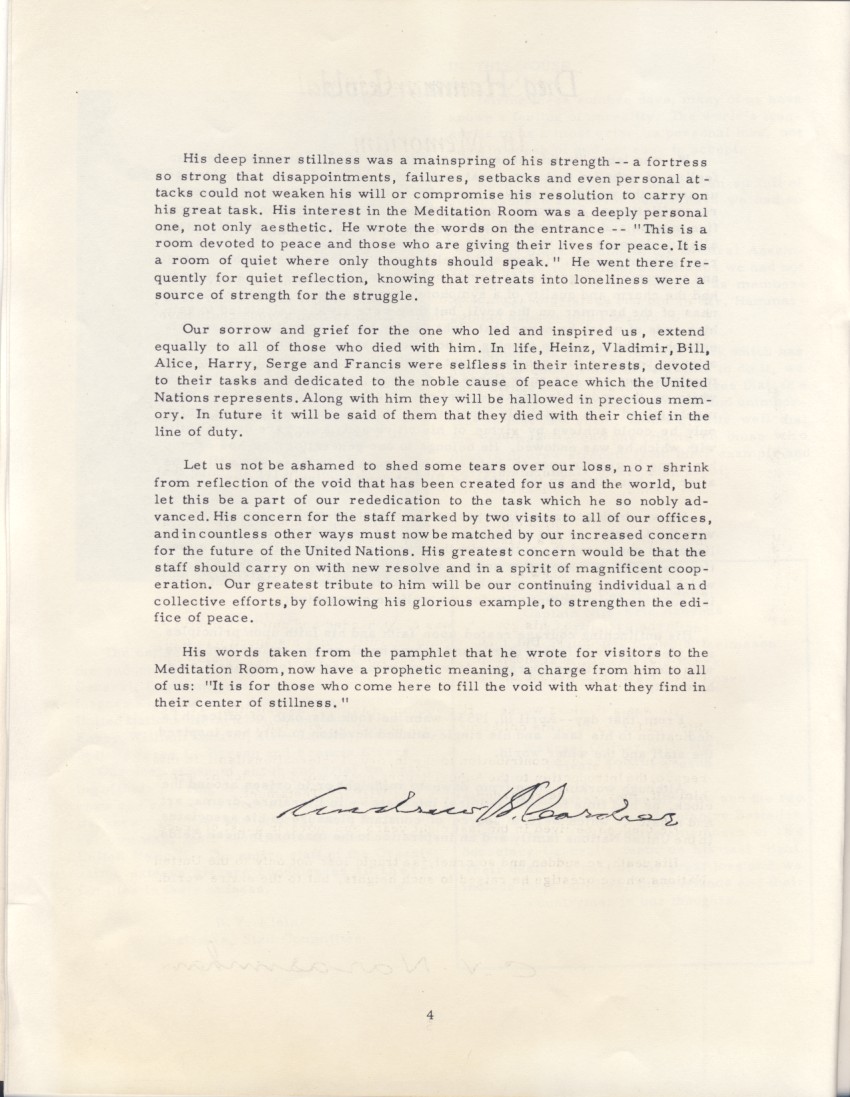
Secretariat News September 1961 p4
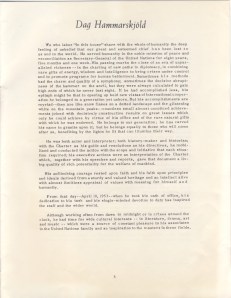
Dag Hammarskjold

We who labor “in this house” share with the whole of humanity the deep feeling of unbelief that our great and esteemed chief has been lost to us and to the world. He served humanity in the noble mission of peace and reconciliation as Secretary-General of the United Nations for eight years, five months and one week. His passing marks the close of an era of unparalleled richness — in the charting of new paths in diplomacy, in combining rare gifts of energy, wisdom and intelligence to bring crises under control and to promote programs for human betterment. Sometimes his methods had the charm and quality of a symphony; sometimes the decisive abruptness of the hammer on the anvil, but they were always calculated to gain high ends of which he never lost sight. If he had accomplished less, his epitaph might be that in opening up bold new vistas of international cooperation he belonged to a generation yet unborn. But his accomplishments are myriad–they are like snowflakes on a dotted landscape and the glistening white on the mountain peaks–countless small almost unnoticed achievements joined with decisively constructive results on great issues which only he could achieve by virtue of his office and of the rare natural gifts with which he was endowed. He belongs to our generation; he has carved his name in granite upon it; but he belongs equally to those who will come after us, benefiting by the lights he lit that can illumine their way.

He was both actor and interpreter; both history-maker and historian; with the Charter as his guide and resolutions as his directives, he mobilized and conducted the action with the scope and initiative that each situation required; his executive actions were an interpretation of the Charter which, together with his speeches and reports, gave the document a living quality of rich potentiality for the welfare of mankind.

His unflinching courage rested upon faith and his faith upon principles and ideals derived from a sturdy and valued heritage and an intellect alive with almost limitless appraisal of values with meaning for himself and humanity.

From that day–April 10, 1953–when he took his oath of office, his dedication to the task and his single-minded devotion to duty has inspired the staff and the wider world.

Although working often from dawn to midnight or in crises around the clock, he had time for wide cultural interests — in literature, drama, art and music — which were a source of constant pleasure to his associates in the United Nations family and an inspiration to the masters in these fields.

His deep inner stillness was a mainspring of his strength — a fortress so strong that disappointments, failures, setbacks and even personal attacks could not weaken his will or compromise his resolution to carry on his great task. His interest in the Meditation Room was a deeply personal one, not only aesthetic. He wrote the words on the entrance — “This is a room devoted to peace and those who are giving their lives for peace. It is a room of quiet where only thoughts should speak.” He went there frequently for quiet reflection, knowing that retreats into loneliness were a source of strength for the struggle.

Our sorrow and grief for the one who led and inspired us, extend equally to all those who died with him. In life, Heinz, Vladimir, Bill, Alive, Harry, Serge and Francis were selfless in their interests, devoted to their tasks and dedicated to the noble cause of peace which the United Nations represents. Along with him they will be hallowed in precious memory. In future it will be said of them that they died with their chief in the line of duty.

Let us not be ashamed to shed some tears over our loss, nor shrink from reflection of the void that has been created for us and the world, but let this be a part of our rededication to the task which he so nobly advanced. His concern for the staff marked by two visits to all of our offices, and in countless other ways must now be matched by our increased concern for the future of the United Nations. His greatest concern would be that the staff should carry on with new resolve and in a spirit of magnificent cooperation. Our greatest tribute to him will be our continuing individual and collective efforts, by following his glorious example, to strengthen the edifice of peace.

His words taken from the pamphlet that he wrote for visitors to the Meditation Room, now have a prophetic meaning, a charge from him to all of us: “It is for those who come here to fill the void with what they find in their center of stillness.”

— Andrew Cordier

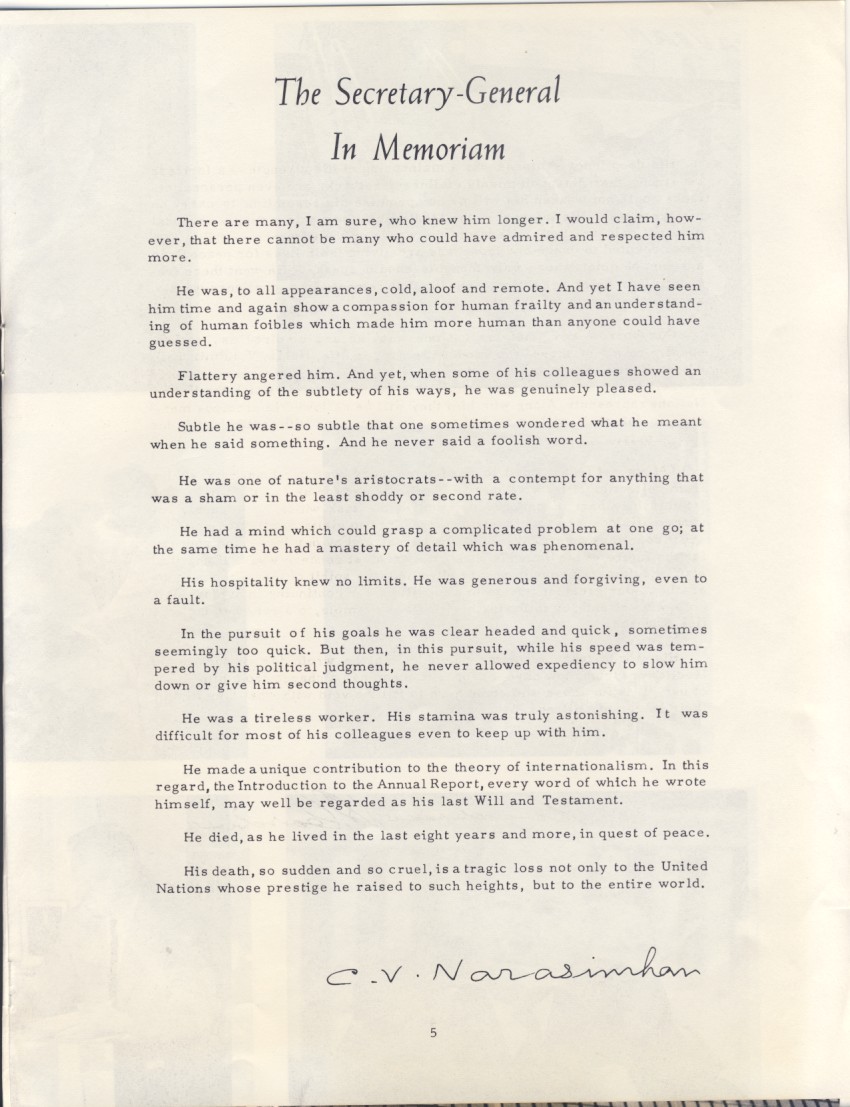
Secretariat News September 1961 p5
The Secretary-General
In Memoriam

There are many, I am sure, who knew him longer. I would claim, however, that there cannot be many who could have admired and respected him more.

He was, to all appearance, cold, aloof and remote. And yet I have seen him time and again show a compassion for human frailty and an understanding of human foibles which made him more human than anyone could have guessed.

Flattery angered him. And yet, when some of his colleagues showed an understanding of the subtlety of his ways, he was genuinely pleased.

Subtle he was–so subtle that one sometimes wondered what he meant when he said something. And he never said a foolish word.

He was one of nature’s aristocrats–with a contempt for anything that was a sham or in the least shoddy or second rate.

He had a mind which could grasp a complicated problem at one go; at the same time he had a mastery of detail which was phenomenal.

His hospitality knew no limits. He was generous and forgiving, even to a fault.

In the pursuit of his goals he was clear headed and quick, sometimes seemingly too quick. But then, in this pursuit, while his speed was tempered by his political judgement, he never allowed expediency to slow him down or give him second thoughts.

He was a tireless worker. His stamina was truly astonishing. It was difficult for most of his colleagues even to keep up with him.

He made a unique contribution to the theory of internationalism. In this regard, the Introduction to the Annual Report, every word of which he wrote himself, may well be regarded as his last Will and Testament.

He died, as he lived in the last eight years and more, in quest of peace.

His death, so sudden and so cruel, is a tragic loss not only to the United Nations whose prestige he raised to such heights, but to the entire world.

—C. V. Narasimhan
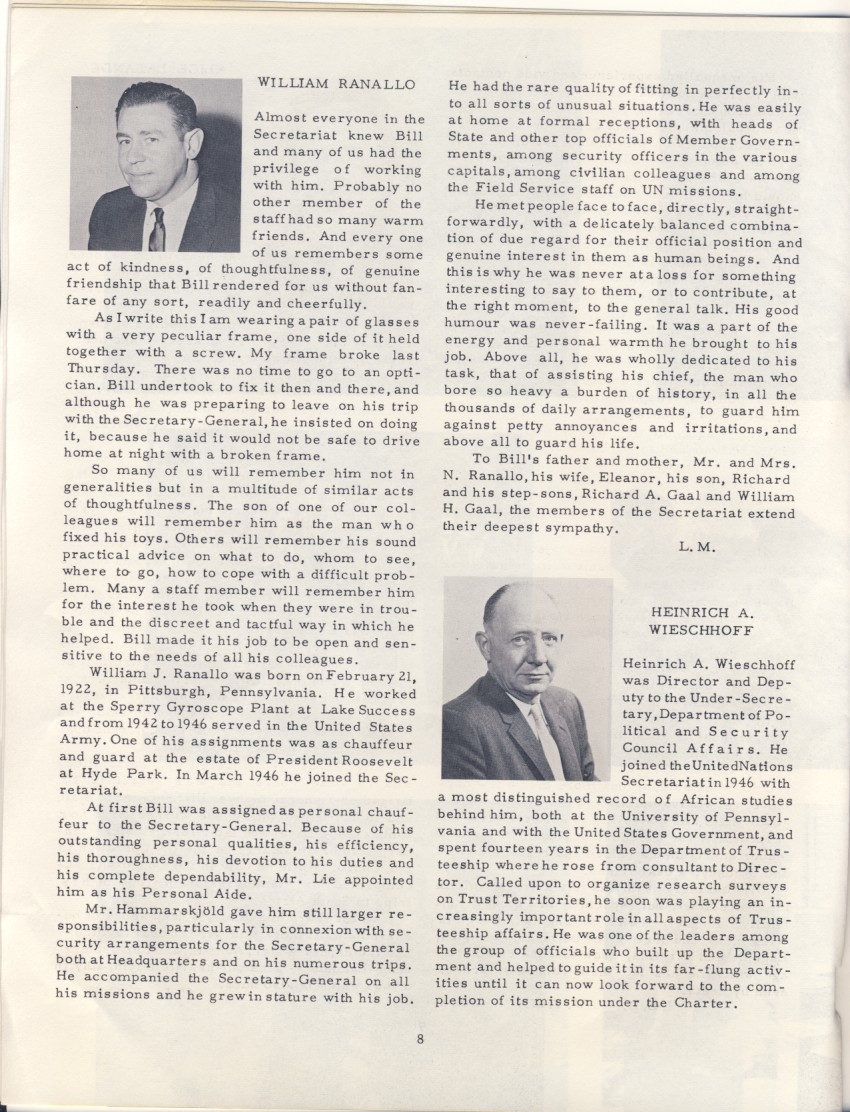
Secretariat News September 1961 p8
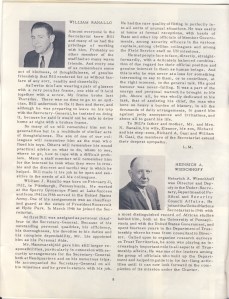
WILLIAM RANALLO

Almost everyone in the Secretariat knew Bill and many of us had the privilege of working with him. Probably no other member of the staff had so many warm friends. And every one of us remembers some act of kindness, of thoughtfulness, of genuine friendship that Bill rendered for us without fanfare of any sort, readily and cheerfully.

As I write this I am wearing a pair of glasses with a very peculiar frame, one side of it held together with a screw. My frame broke last Thursday. There was no time to go to an optician. Bill undertook to fix it then and there, and although he was preparing to leave on his trip with the Secretary-General, he insisted on doing it, because he said it would not be safe to drive home at night with a broken frame.

So many of us will remember him not in generalities but in a multitude of similar acts of thoughtfulness. The son of one of our colleagues will remember him as the man who fixed his toys. Others will remember his sound practical advice on what to do, whom to see, where to go, how to cope with a difficult problem. Many a staff member will remember him for the interest he took when they were in trouble and the discreet and tactful way in which he helped. Bill made it his job to be open and sensitive to the needs of all his colleagues.

William J. Ranallo was born on February 21, 1922, in Pittsburgh, Pennsylvania. He worked at the Sperry Gyroscope Plant at Lake Success and from 1942 to 1946 served in the United States Army. One of his assignments was as chauffeur and guard at the estate of President Roosevelt at Hyde Park. In March 1946 he joined the Secretariat.

At first Bill was assigned as personal chauffeur to the Secretary-General. Because of his outstanding personal qualities, his efficiency, his thoroughness, his devotion to his duties and his complete dependability, Mr. Lie appointed him as his Personal Aide.

Mr. Hammarskjold gave him still larger responsibilities, particularly in connexion with security arrangements for the Secretary-General both at Headquarters and on his numerous trips. He accompanied the Secretary-General on all his missions and he grew in stature with his job. He had a rare quality of fitting in perfectly into all sorts of unusual situations. He was easily at home at formal receptions, with heads of State and other top officials of Member Governments, among security officers in the various capitals, among civilian colleagues and among the Field Service staff on UN missions.

He met people face to face, directly, straight-forwardly, with a delicately balanced combination of due regard for their official position and genuine interest in them as human beings. And this is why he was never at a loss for something interesting to say to them, or to contribute, at the right moment, to the general talk. His good humour was never-failing. It was a part of the energy and personal warmth he brought to his job. Above all, he was wholly dedicated to his task, that of assisting his chief, the man who bore so heavy a burden of history, in all the thousands of daily arrangements, to guard him against petty annoyances and irritations, and above all to guard his life.

To Bill’s father and mother, Mr. and Mrs. N. Ranallo, his wife, Eleanor, his son, Richard and his step-sons, Richard A. Gaal and William H. Gaal, the members of the Secretariat extend their deepest sympathy.

HEINRICH A. WIESCHHOFF

Heinrich A. Wieschhoff was Director and Deputy to the Under-Secretary, Department of Political and Security Council Affairs. He joined the United Nations Secretariat in 1946 with a most distinguished record of African studies behind him, both at the University of Pennsylvania and with the United States Government, and spent fourteen years in the Department of Trusteeship where he rose from consultant to Director. Called upon to organize research surveys on Trust Territories, he soon was playing an increasingly important role in all aspects of Trusteeship affairs. He was one of the leaders among the group of officials who built up the Department and helped to guide it in its far-flung activities until it can now look forward to the completion of its mission under the Charter.

His unequaled experience and wide contacts with African political leaders led him to be called upon increasingly with regard to the political problems that would arise for the United Nations in connexion with the accession of many African colonies to independent Statehood. It was therefore natural that the Secretary-General should turn to him in connexion with African affairs as that continent, with its many problems, burst into the forefront of world politics. He accompanied Mr. Hammarskjold on most of his trip through Africa in the winter of 1960. Subsequently, he was appointed Director of the Department of Political and Security Council Affairs.

Mr. Wieschhoff became one of the Secretary-General’s most intimate political advisers on Africa, assisting in the formulation of Congo policies and other African questions in regard to which political responsibilities devolved upon the the Secretary-General.

Mr. Wieschhoff was wholly devoted to the United Nations and to the cause of peace. He had a brilliantly sharp and penetrating mind which he applied not only to the analysis of political processes, but also to creative political action in conformity with the purposes and principles of the Charter.

He was a scholar, a man subject to the discipline involved in the pursuit of truth in the way of the scholar. The scholar’s discipline is sometimes stern and this was typical of Wieschhoff. He was an exacting taskmaster, particularly towards himself. He was always on guard against any kind of falsity or pretense. This at times caused him to be falsely judged as cynical. Those who knew him well saw beneath the gruff exterior, the man of high principle and lofty ideals. Many of us who were fortunate enough to enjoy his personal friendship will never forget his charm and kindness.

He worked a regular seven-day and seven-evening week, seldom took more than a few days’ leave, yet always maintained his dynamism, his good spirits, and his ability to act creatively and purposefully for the cause of peace. He was a leader among men, a valued and respected chief, and to many, a dear friend.

His untimely death has left a tragic void in the Secretariat, but especially in a closely knit family. In their hour of anguish, Virginia Wieschhoff and their three children, Heinrich, Eugenia and Virginia, know that the rich heritage which he has left them cannot be erased even by death.

Secretariat News September 1961 p9
ALICE LALANDE

Throughout her many years with the United Nations, most of them spent in the field, Alice never allowed hard work, physical hardship, or personal danger disturb her serene conviction that the job at hand must be done: now and well.

To those who worked with her, she will remain a source of inspiration as the devoted, self-possessed and unobtrusively efficient colleague that she was. For her many friends, the memory of a delicate, understanding and warm human being lives on. Who could forget her quiet smile, her ready response to a witty remark, the gay sparkle in her eyes?

Alice traveled the world in service of the United Nations. As secretary to Count Folke Bernadotte, UN Mediator in Palestine, she was on the Island of Rhodes and the borders of Syria and Lebanon when the armistice agreements were signed in 1948. She worked in Palestine for General Riley, UNTSO Chief of Staff, and for his successor, General Vagn Bennike. At the first and second UN International Conferences on the Peaceful Uses of Atomic Energy in Geneva, Alice was secretary to Professor Whitman, the first Secretary-General, and to Dr. Eklund, the second. She also served with the Department of Economic and Social Affairs at Headquarters, at UNESCO in Paris, and as an Administrative Assistant with the Preparatory Commission and first General Conference of the International Atomic Energy Agency in Vienna.

Alice is also remembered with warm affection in Gaza where she was secretary to Brigadier-General Rikhye, UNEF Chief of Staff, and in the Congo where she worked first for Ambassador Dayal and later for Dr. Sture Linner, Officer-in-Charge of the UN Operation in the Congo. While on duty in the Congo she accompanied Mr. Hammarskjold on one of his trips to South Africa.

We all share her family’s deep sense of bereavement. To those who were so dear to Alice–her father, her sister, Annette, and her brother, Abbé Lalande — goes our heartfelt sympathy in a loss which is also ours.

Secretariat News September 1961 p10
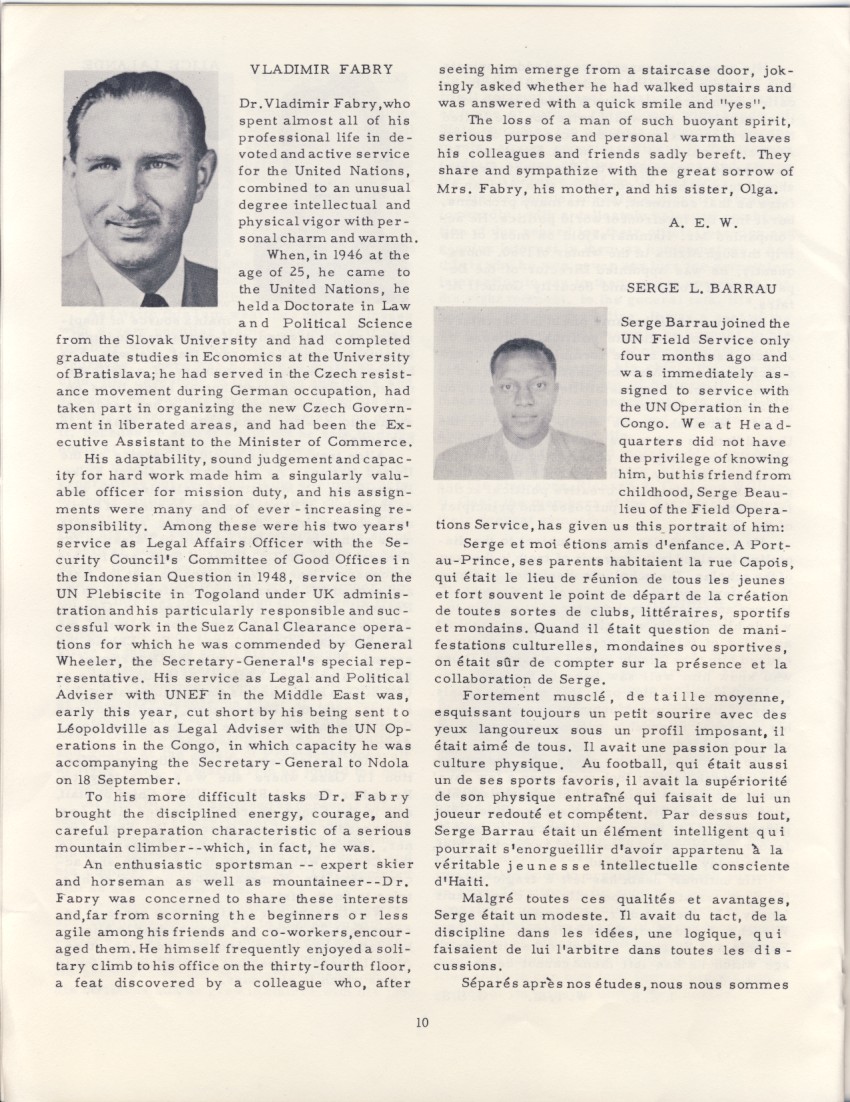
VLADIMIR FABRY

Dr. Vladimir Fabry, who spent almost all of his professional life in devoted and active service for the United Nations, combined to an unusual degree intellectual and physical vigor with personal charm and warmth.

When, in 1946 at the age of 25, he came to the United Nations, he held a Doctorate in Law and Political Science from the Slovak University and had completed graduate studies in Economics at the University of Bratislava; he had served in the Czech resistance movement during German occupation, had taken part in organizing the new Czech Government in liberated areas, and had been the Executive Assistant to the Minister of Commerce.

His adaptability, sound judgement and capacity for hard work made him a singularly valuable officer for mission duty, and his assignment were many and of ever-increasing responsibility. Among these were his two years’ service as Legal Affairs Officer with the Security Council’s Committee of Good Offices in the Indonesian Question in 1948, service on the UN Plebiscite in Togoland under UK administration and his particularly responsible and successful work in the Suez Canal Clearance operations for which he was commended by General Wheeler, the Secretary-General’s special representative. His service as Legal and Political Adviser with UNEF in the Middle East was, early this year, cut short by his being sent to Léopoldville as Legal Adviser with the UN Operations in the Congo, in which capacity he was accompanying the Secretary-General to Ndola on 18 September.

To his more difficult tasks Dr. Fabry brought the disciplined energy, courage, and careful preparation characteristic of a serious mountain climber–which, in fact, he was.

An enthusiastic sportsman — expert skier and horseman as well as mountaineer — Dr. Fabry was concerned to share these interests and, far from scorning the beginners or less agile among his friends and co-workers, encouraged them. He himself frequently enjoyed a solitary climb to his office on the thirty-fourth floor, a feat discovered by a colleague who, after seeing him emerge from a staircase door, jokingly asked whether he had walked upstairs and was answered with a quick smile and “yes”.

The loss of a man of such buoyant spirit, serious purpose and personal warmth leaves his colleagues and and friends sadly bereft. They share and sympathize with the great sorrow of Mrs. Fabry, his mother, and his sister, Olga.

SERGE L. BARRAU

Serge Barrau joined the UN Field Service only four months ago and was immediately assigned to service with the UN Operation in the Congo. We at Headquarters did not have the privilege of knowing him, but his friend from childhood, Serge Beaulieu of the Field Operations Service, has given us this portrait of him:
[Translated from French-T.B.]
Serge and I were childhood friends. In Port-au-Prince, his parents lived on the Rue Capois, which was the meeting place for all young people and very often the point of departure for the creation of all kinds of clubs, literary, sports and worldly. When it came to cultural events, sports or worldly, it was safe to rely of the presence and collaboration of Serge.

Strong-muscled, medium-sized, always a little smile drawn with languorous eyes under an imposing profile, he was loved by all. He had a passion for physical fitness. In football, which was also one of his favorite sports, he had the physical superiority which resulted in making him a feared and competent player. Above all, Serge Barrau was an intelligent element that could boast to have belonged to the true conscious intellectual youth of Haiti.

In spite of all these qualities and advantages, Serge was modest. He had tact, discipline in ideas, logic, which made him the arbiter in all discussions.

Separated after our studies, we met again in May this year on mission for the United Nations Organization, in Léopoldville. We had so much to say on that day. He told me about his activities in New York, his stay in the US Army where he performed his military service, his travels in Asia, particularly in Japan, where he received the baptism of fire, during a particularly dangerous drive, of moving crawling under machine gun fire, wherein the slightest imprudence can cost you your life; this training, he told me, this is my pass to the Congo. He was happy to be at the UN, to see me and to know Africa, the Africa of our ancestors.

It did not take long to prove his abilities in the UN Security Office where, newly arrived, he was assigned as assistant-investigator responsible for protecting the United Nations staff in trouble with the police.

Serge did not talk much, he did not trust himself to everyone, but he had an ideal, he wanted the initials of his name to be an example of courage and virtue to youth entire. That’s why I take pleasure in repeating his phrase which has become a reality.

S.B. – Serge Barrau – Servir bien

All his friends and colleagues express deep sympathy to Serge’s mother and father, Mr. and Mrs. Joseph Barrau, and to his brothers and sisters in their great loss.

Secretariat News September 1961 p11
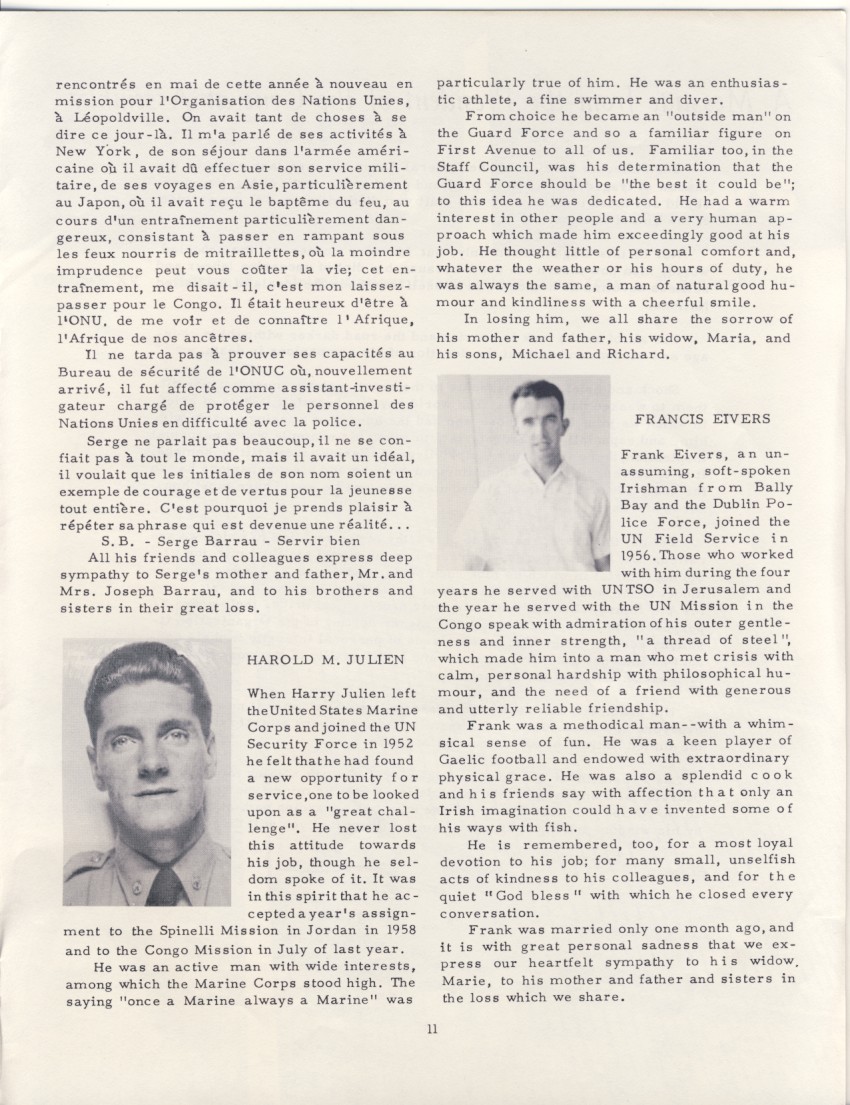
HAROLD M. JULIAN

When Harry Julien left the United States Marine Corps and joined the UN Security Force in 1952 he felt that he had found a new opportunity for service, one to be looked upon as a “great challenge”. He never lost this attitude towards his job, though he seldom spoke of it. It was in this spirit that he accepted a years’ assignment to the Spinelli Mission in Jordan in 1958 and to the Congo Mission in July of last year.

He was an active man with wide interests, among which the Marine Corps stood high. The saying “once a Marine always a Marine” was particularly true of him. He was an enthusiastic athlete, a fine swimmer and diver.

From choice he became an “outside man” on the Guard Force and so a familiar figure on First Avenue to all of us. Familiar too, in the Staff Council, was his determination that the Guard Force should be “the best it could be”; to this idea he was dedicated. He had a warm interest in other people and a very human approach which made him exceedingly good at his job. He thought little of personal comfort and, whatever the weather or his hours of duty, he was always the same, a man of natural good humour and kindliness with a cheerful smile.

In losing him, we all share the sorrow of his mother and father, his widow, Maria, and his sons, Michael and Richard.

FRANCIS EIVERS

Frank Eivers, an unassuming, soft-spoken Irishman from Bally Bay and the Dublin Police Force, joined the UN Field Service in 1956. Those who worked with him during the four years he served with UNTSO in Jerusalem and the year he served in the UN Mission in the Congo speak with admiration of his outer gentleness and inner strength, “a thread of steel”, which made him into a man who met crisis with calm, personal hardship with philosophical humour, and the need of a friend with generous and utterly reliable friendship.

Frank was a methodical man–with a whimsical sense of fun. He was a keen player of Gaelic football and endowed with extraordinary physical grace. He was also a splendid cook and his friends say with affection that only an Irish imagination could have invented some of his ways with fish.

He is remembered, too, for a most loyal devotion to his job; for many small, unselfish acts of kindness to his colleagues, and for the quiet “God bless” with which he closed every conversation.

Frank was married only one month ago, and it is with great personal sadness that we express our heartfelt sympathy to his widow, Marie, to his mother and father and sisters in the loss which we share.
Secretariat News September 1961 p12
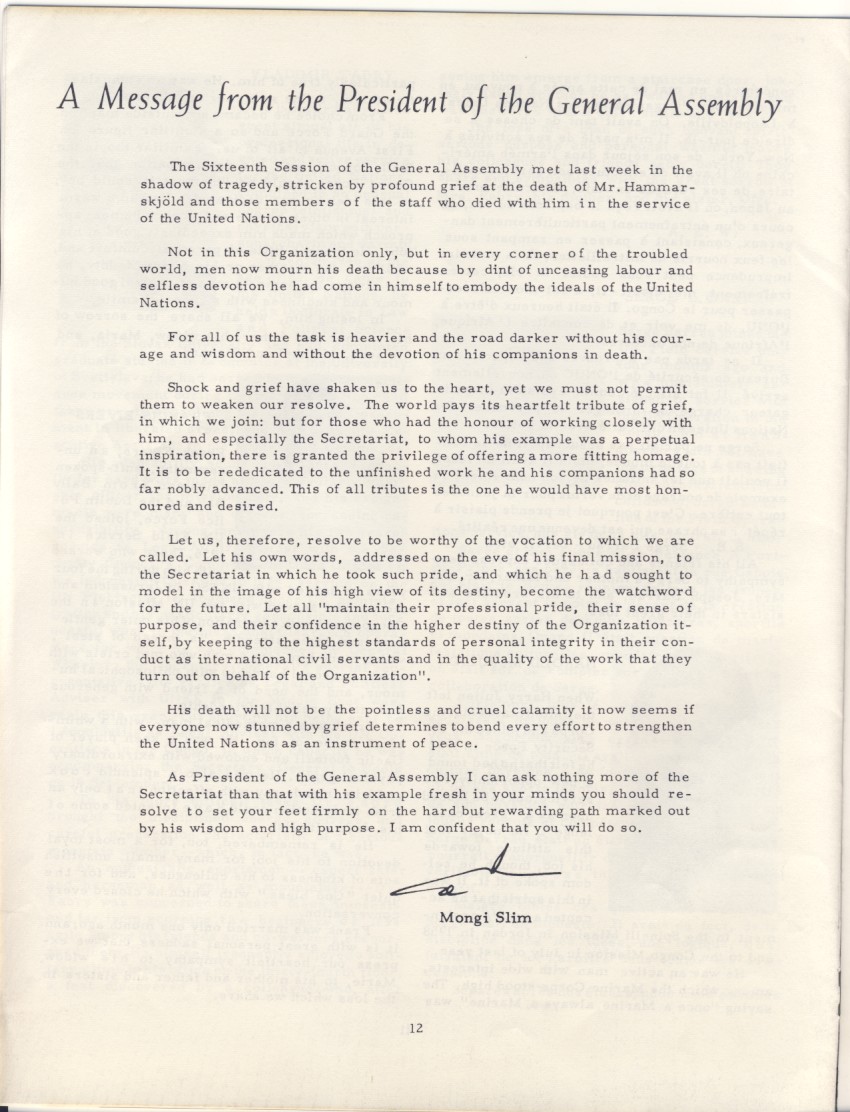
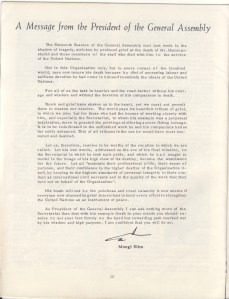
A MESSAGE FROM THE PRESIDENT OF THE GENERAL ASSEMBLY

The Sixteenth Session of the General Assembly met last week in the shadow of tragedy, stricken by profound grief at the death of Mr. Hammarskjold and those members of the staff who died with him in the service of the United Nations.

Not in this Organization only, but in every corner of the troubled world, men now mourn his death because by dint of unceasing labour and selfless devotion he had come in himself to embody the ideals of the United Nations.

For all of us the task is heavier and the road darker without his courage and wisdom and without the devotion of his companions in death.

Shock and grief have shaken us to the heart, yet we must not permit them to weaken our resolve. The world pays its heartfelt tribute of grief, in which we join: but for those who had the honour of working closely with him, and especially the Secretariat, to whom his example was a perpetual inspiration, there is granted the privilege of offering a more fitting homage. It is to be rededicated to the unfinished work he and his companions had so far nobly advanced. This of all tributes is the one he would have most honouored and desired.

Let us, therefore, resolve to be worthy of the vocation to which we are called. Let his own words, addressed on the eve of his final mission, to the Secretariat in which he took such pride, and which he had sought to model in the image of his high view of its destiny, become the watchword for the future. Let all “maintain their professional pride, their sense of purpose, and their confidence in the higher destiny of the Organization itself, by keeping to the highest standards of personal integrity in their conduct as international civil servants and in the quality of the work that they turn out on behalf of the Organization”.

His death will not be the pointless and cruel calamity it now seems if everyone now stunned by grief determines to bend every effort to strengthen the United Nations as an instrument of peace.

As President of the General Assembly I can ask nothing more of the Secretariat than that with his example fresh in your minds you should resolve to set your feet firmly on the hard but rewarding path marked out by his wisdom and high purpose. I am confident that you will do so.
—Mongi Slim

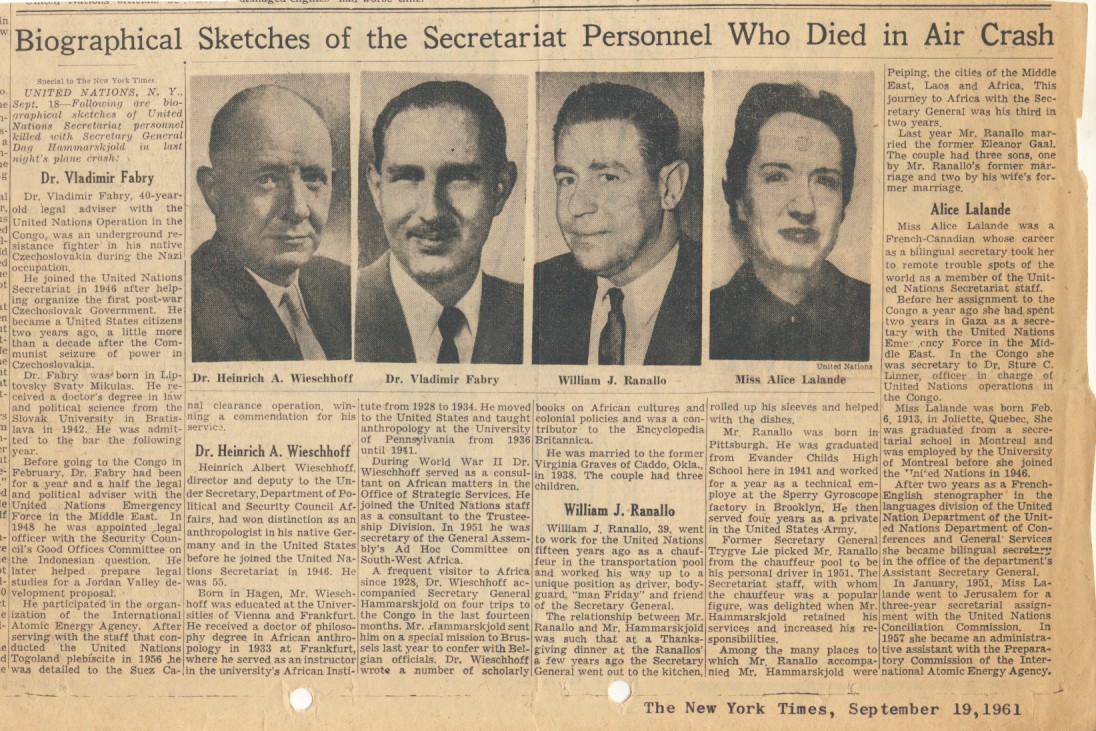
“Biographical Sketches of the Secretariat Personnel Who Died in Air Crash”

Here is a 19 September 1961 article from the New York Times, paying tribute to Heinrich A. Weischhoff, Vladimir Fabry, William J. Ranallo, and Alice Lalande – but no mention of the other passengers who perished. The full article is transcribed below.
NYT Obituaries 1961

United Nations, N.Y., Sept. 18–Following are biographical sketches of United Nations Secretariat personnel killed with Secretary General Dag Hammarskjold in last night’s plane crash:

Dr. Vladimir Fabry
Dr. Vladimir Fabry, 40-year-old legal adviser with the United Nations Operation in the Congo, was an underground resistance fighter in his native Czechoslovakia during the Nazi occupation.

He joined the United Nations Secretariat in 1946 after helping organize the first post-war Czechoslovak Government. He became a United States citizen two years ago, a little more than a decade after the Communist seizure of power in Czechoslovakia.

Dr. Fabry was born in Liptovsky Svaty Mikulas. He received a doctor’s degree in law and political science from the Slovak University in Bratislava in 1942. He was admitted to the bar the following year.

Before going to the Congo in February, Dr. Fabry had been for a year and a half the legal and political adviser with the United Nations Emergency Force in the Middle East. In 1948 he was appointed legal officer with the Security Council’s Good Offices Committee on the Indonesian question. He later helped prepare legal studies for a Jordan Valley developing proposal.

He participated in the organization of the International Atomic Energy Agency. After serving with the staff that conducted the United Nations Togoland plebiscite in 1956 he was detailed to the Suez Canal clearance operation, winning a commendation for his service.

Dr. Heinrich A. Wieschhoff

Heinrich Albert Wieschhoff, director and deputy to the Under Secretary, Department of Political and Security Council Affairs, had won distinction as an anthropologist in his native Germany and in the United States before he joined the United Nations Secretariat in 1946. He was 55.

Born in Hagen, Mr. Wieschhoff was educated at the University of Vienna and Frankfurt. He received a doctor of philosophy degree in African anthropology in 1933 at Frankfurt, where he served as an instructor in the university’s African Institute from 1928 to 1934. He moved to the United States and taught anthropology at the University of Pennsylvania from 1936 until 1941.

During World War II Dr. Wieschhoff served as a consultant on African matters in the Office of Strategic Services. He joined the United Nations staff as a consultant to the Trusteeship Division. In 1951 he was secretary of the General Assembly’s Ad Hoc Committee on South-West Africa.

A frequent visitor to Africa since 1928, Dr. Wieschhoff accompanied Secretary General Hammarskjold on four trips to the Congo in the last fourteen months. Mr. Hammarskjold sent him on a special mission to Brussels last year to confer with Belgian officials. Dr. Wieschhoff wrote a number of scholarly books on African cultures and colonial policies and was a contributor to the Encyclopedia Britannica.

He was married to the former Virginia Graves of Caddo, Okla., in 1938. The couple had three children.

William J. Ranallo

William J. Ranallo, 39, went to work for the United Nations fifteen years ago as a chauffeur in the transportation pool and worked his way up to a unique position as driver, bodyguard, “man Friday” and friend of the Secretary General.

The relationship between Mr. Ranallo and Mr. Hammarskjold was such that at a Thanksgiving dinner at the Ranallo’s a few years ago the Secretary General went out to the kitchen, rolled up his sleeves and helped with the dishes.

Mr. Ranallo was born in Pittsburgh. He was graduated from Evander Childs High School here in 1941 and worked for a year as a technical employee at the Sperry Gyroscope factory in Brooklyn. He then served four years as a private in the United States Army.

Former Secretary General Trygve Lie picked Mr. Ranallo from the chauffeur pool to be his personal driver in 1951. The Secretariat staff, with whom the chauffeur was a popular figure, was delighted when Mr. Hammarskjold retained his services and increased his responsibilities.

Among the many places to which Mr. Ranallo accompanied Mr. Hammarskjold were Peiping, the cities of the Middle East, Laos and Africa. This journey to Africa with the Secretary General was his third in two years.

Last year Mr. Ranallo married the former Eleanor Gaal. The couple had three sons, one by Mr. Ranallo’s former marriage and two by his wife’s former marriage.

Alice Lalande

Miss Alice Lalande was a French-Canadian whose career as a bilingual secretary took her to remote trouble spots of the world as a member of the United Nations Secretariat staff.

Before her assignment to the Congo a year ago she had spent two years in Gaza as a secretary with the United Nations Emergency Force in the Middle East. In the Congo she was secretary to Dr. Sture C. Linner, officer in charge of United Nations operations in the Congo.

Miss Lalande was born Feb. 6, 1913, in Joliette, Quebec. She was graduated from a secretarial school in Montreal and was employed by the University of Montreal before she joined the United Nations in 1946.

After two years as a French-English stenographer in the languages division of the United Nations Department of Conferences and General Services she became bilingual secretary in the office of the department’s Assistant Secretary General.

In January, 1951, Miss Lalande went to Jerusalem for a three-year secretarial assignment with the United Nations Conciliation Commission. In 1957 she became an administrative assistant with the Preparatory Commission of the International Atomic Energy Agency.