Tag Archives: India

Valuing the Evidence of Harold Julien

With gratitude to Susan Williams for her most recent essay, published in The Yale Review, “Revisiting Dag Hammarskjold’s Mysterious Death”, here is a larger selection of international papers from my archive, 19-27 September 1961. Harold Julien was the only survivor of the Albertina crash, and for too long his testimony has been undervalued and deliberately suppressed, it is time to take his evidence seriously.

From her essay: “In 2019, new information emerged relating to Julien’s stay in the Ndola hospital, provided by the government of Zimbabwe to the current U.N. inquiry. This fresh information reveals that Rhodesian authorities actively sought to prevent Julien’s statements from being made public. A senior Rhodesian intelligence official instructed Julien’s medical superintendent that “no one of his hospital staff must talk about this,” in relation to Julien’s statements that he had seen sparks in the sky. The superintendent and another doctor were warned about “the security angle” and asked “to make sure that none of their staff talked.

Justice Othman views this new evidence as significant. In his view, “a general undervaluing of the evidence of Harold Julien…may have affected the exhaustiveness of the earlier inquiries’ consideration of the possible hypotheses.”

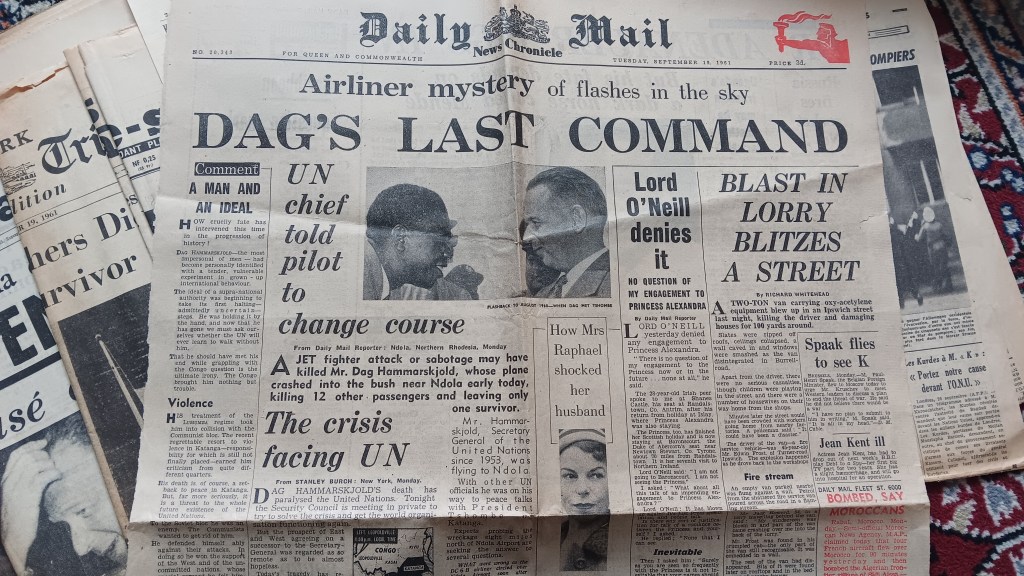
Daily Mail, 19 December 1961 “Airline mystery of flashes in the sky – Dag’s last command – UN chief told pilot to change course”
Daily Mail, September 19 “Sergeant Harold Julian, of the United States, a security guard on the plane, who was the lone survivor, said there was a series of explosions in the plane. Sergeant Julian, lying seriously injured and burned in Ndola Hospital, also said Mr. Hammarskjold changed his mind about landing at Ndola and told the pilot to alter course for another destination.” […] “Police in Ndola saw a huge flash in the sky just before the crash. […] “Officials of Transair, the Swedish charter company which owned the plane, said in Leopoldville that they believed the aircraft was shot down by a Katanga jet fighter. A UN spokeman said he could not definitely rule out sabotage or shooting down as the cause of the crash. He said Mr. Hammarskjold was flying at night to avoid the two jet planes in Katanga’s Air Force which for days have been straffing UN troops and bombing their airfields.”
Daily Mail, September 19 ” “Overdue procedure” was started. Checks were made at Congolese and Rhodesian towns. At dawn an all-out search began. But an African charcoal burner was the first man to find the smouldering wreckage. Then the pilot of a Rhodesian Air Force Provost plane saw the DC-6 and guided rescuers to the scene.”

From Williams’ essay: “[…]the 1961-62 official inquiries concluded that the first sighting of the crash site was at 3:10 p.m. on September 18 by a RRAF pilot flying overhead; at around the same time, there was a report of a sighting by the two aforementioned charcoal burners. Following these reports, police vehicles and ambulances were immediately sent to the site.

But a mass of evidence has emerged that shows that many people knew that the plane had crashed – and where – long before it was officially located. Indeed, the crash site was reported to the Northern Rhodesian authorities between 9:00 and 9:30 a.m. by Timothy Kankasa. Some charcoal burners had come across the burning plane in the morning and, in great concern, rushed to tell him. The men reported the crash to him, rather than to the police, because they mistrusted and feared the white authorities.”

Daily Mail, September 19 “Colonel Don Gaylor, U.S. Air Attache in Pretoria, who flew over the area helping to guide search parties, said he believed the crash took place between 12:30 a.m. and 1 a.m. It seemed clear that the pilot was making a direct approach to the airfield when he crashed, said Colonel Gaylor.”

From Williams’ essay: “[…] Colonel Don G. Gaylor […] was sent to Ndola on September 15 by the Pentagon.[…] Gaylor was one of three U.S. air attaches who are known to have flown to Ndola airport during the period of September 15-18. […] According to a letter Gaylor wrote to an official Swedish investigator in 1994 (a letter I was recently sent by Hans Kristian Simensen, a Norwegian researcher who, like me, is assisting Justice Othman on a voluntary basis), Gaylor was in the control tower at Ndola airport on the night of September 17-18, waiting for Hammarskjold’s aircraft. The letter states that after the plane failed to arrive, he and his crew prepared for takeoff at first light to look for a crash site. Gaylor wrote that he spotted the wreckage shortly after dawn and immediately contacted the “Ndola rescue frequency and gave them the map coordinates of the site.” His letter adds: “Then I circled the site for a considerable period to give the ground party a point of reference.” This account is consistent with Gaylor’s memoir.”

“It should be noted that there is a discrepancy between this claim by Gaylor and a report by Matlick to the U.S. Secretary of State on September 22, which states that Gaylor had wanted to search in the morning but was not allowed to do so by the Rhodesian civil authorities. Matlick adds that Gaylor flew the second aircraft to spot the crash site in the afternoon, following a sighting by a RRAF aircraft; this was echoed by Squadron Leader John Mussell in his testimony to the Rhodesian Board of Investigation.

“Without further documentary evidence, we cannot resolve these conflicting pieces of evidence, or verify Gaylor’s claim that he found the crash site shortly after dawn. This makes it all the more important to obtain and study the report that Gaylor said he sent to the Pentagon: “My report to my superiors in the Pentagon was acknowledged with some accolades.”

Daily Express, September 19 “…The survivor is identified as an American sergeant with the UNO forces, Harold Julian[sic]. He is severly burned. His report of explosions in the plane supports the theory of sabotage. Another theory is that it was shot down by a jet fighter from Katanga. […] Practically all the bodies were burned. Only Mr. Hammarskjold was immediately recognisable. Incredibly Sergeant Julian was still alive. He had lain all those hours in agony. Tonight hospital doctors give him a a “fair” chance of life.”

From Williams’ essay: “On Tuesday, September 19, the day after Julien had been taken to the hospital, he was “slightly better.” Though “still dangerously ill,” he was expected to survive. A day later, he was reported as “holding his own.”

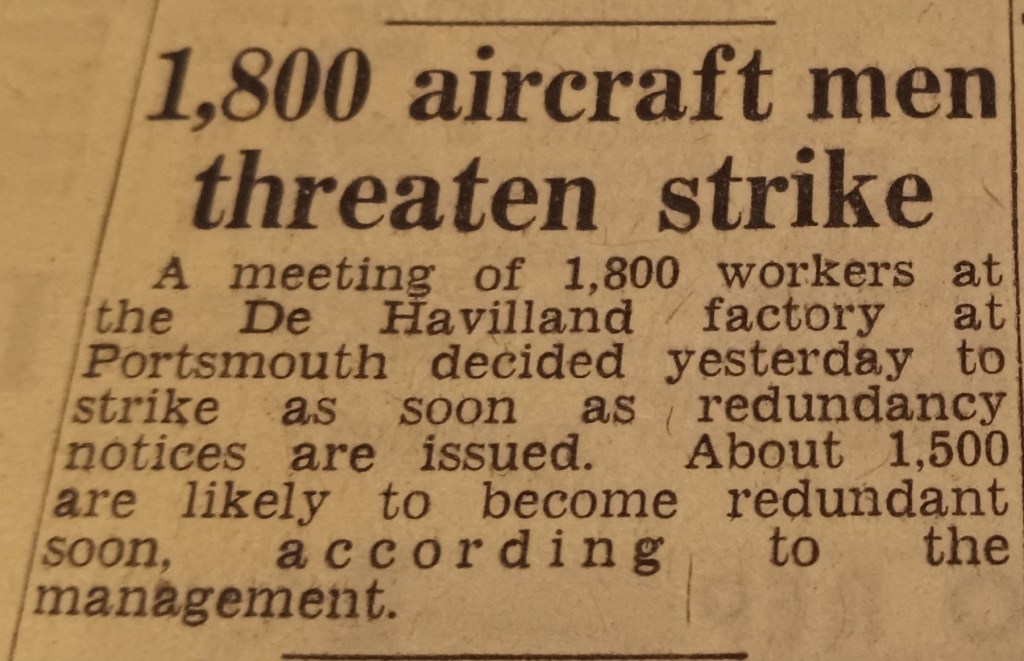
Daily Express, 19 September, page 2. “1,800 aircraft men threaten strike. A meeting of 1,800 workers at the De Havilland factory at Portsmouth decided yesterday to strike as soon as redundancy notices are issued. About 1,500 are likely to become redundant soon, according to the management.”

From Susan Williams’ book “Who Killed Hammarskjold?”, pages 186 and 187:

“[Bo] Virving stated that there were five [De Havilland] Doves in service of the Katangese air force in September 1961 at Kolwezi and Jadotville airports. They could stay airborne for three or four hours and their speed could match that of Hammarskjold’s DC6 in level flight; and in a dive from above they could increase their speed. It would be possible for the crew of the Dove to drop a small explosive device on to an aircraft below, then pull out of the dive. Virving had developed this theory about a Dove because on the day that Hammarskjold’s body was flown out to Sweden, he had seen a Dove at Ndola airport and discovered that it had a hole in its floor, which was apparently used for aerial photography. A man could lie there, he realized, telling the pilot ‘right, left, up, down’ and at a given moment let fall a small projectile.

“The theory that a Dove could be used in this way was later confirmed by Mercenary Commander, the memoir of the mercenary Jerry Puren[…]

“The Rhodesian Commission of Inquiry Report acknowledged that a Dove with bombing capacity was found in September 1961 at Ndola–but after the crash. ‘One De Havilland Dove belonging to the Katanga Government,’ it stated, ‘was after the 18th September armed by removing a door and placing a machine gun on the floor to fire through the opening.’ The Dove had not, it stated, been at Ndola on the day of the crash, but elsewhere: ‘On 17th September this and possibly another were in the hands of the United Nations at Elisabethville. Three Doves were then in the Republic of South Africa undergoing examination.’

“A Dove plane at Ndola also caused consternation at the British Embassy in Leopoldville in the week after the crash of the Albertina. Ambassador Riches sent a telegram to the Foreign Office on 24 September 1961, reporting that, according to Matlick, the U.S. Air Attache in Leopoldville who had just returned from Ndola, a Dove aircraft with Katangan air force markings had taken off from Ndola for Kolwezi the day before, carrying mercenaries. He had given this information to the UN, who had passed it on to Riches. ‘Report could do us serious damage here,’ warned Riches to London.

“Virving’s suspicions about the use of a Dove against the Albertina were heightened when he went to Elisabethville in 1962 and found that the Katangese Doves had disappeared during the August 1961 UN action to expel mercenaries. Significantly, their logbooks had been left behind. Then Virving found the Pretoria workshop where the Doves would normally have been serviced and sought information ‘for historical purposes’; but after two years’ wait he was told that no information could be given.”

Daily Express, September 19. Not everyone in the press was singing the praises of Hammarskjold, certainly not George Gale, who seems to be not only a white supremacist and supporter of the Federation of Rhodesia and Nyasaland, but also a homophobe. He writes of Hammarskjold: “He loved mountains and had good paintings on his austere walls. He read poetry, especially the writings of Rilke and of T.S. Eliot.”
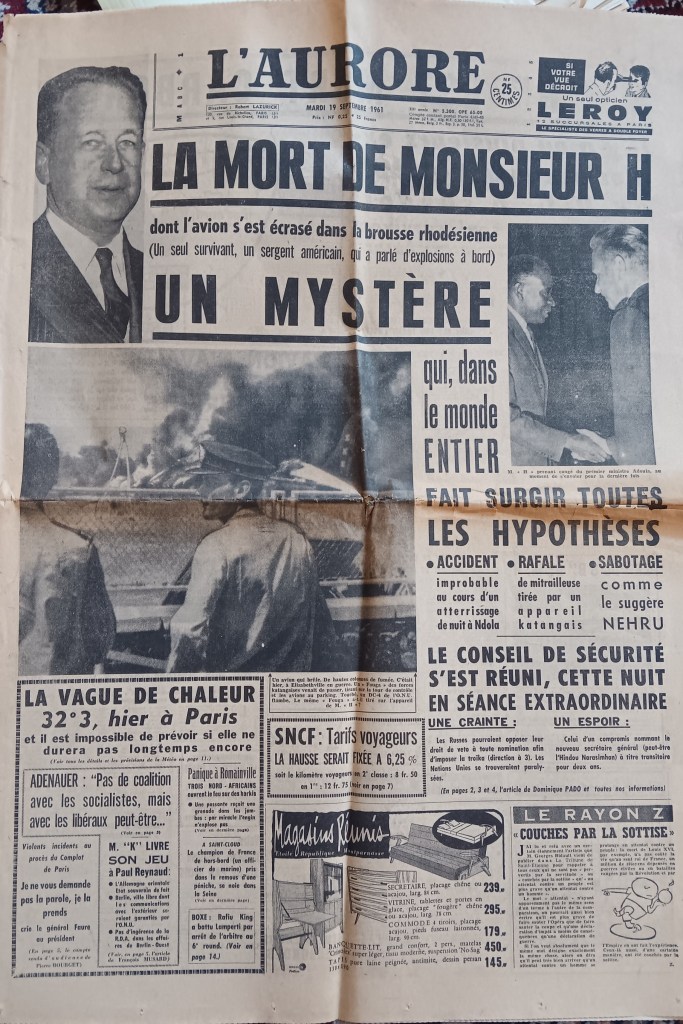
L’AURORE, September 19 “The Death of Mr. H, whose plane crashed in the Rhodesian bush(only one survivor, who spoke of explosions on board).”
L’AURORE September 19 “A burning plane. Tall columns of smoke. This was yesterday, in Elisabethville at war. A Fouga of the Katangese forces had just passed, shooting at the control tower, and at the planes in the parking lot. Hit, a United Nations DC-4 burns. Did the same Fouga shoot at Mr. H’s aircraft?”
L’AURORE September 19. The headline erroneously reports: “Mr. H is burned to death in his airplane tomb in Rhodesia” […] “There were several explosions before the crash of the Swedish DC-6, recounts the sole survivor”
International Edition of The NYT, September 19. This article refers to Colonel Don Taylor, which is a typo for Don Gaylor, saying that he “circled the wreck area until ground parties reach it shortly after 3 P.M.” On the front page of this edition of the NYT, it reports “Lone Survivor Reports Explosions on Flight to Tshombe Talks” and that “Officials quoted Mr. Julian[sic] as having said that Mr. Hammarskjold had changed his mind about landing at Ndola and that he had told the pilot to alter course for another destination. Moments later, according to the injured man, there was a series of explosions aboard the plane. Hospital authorities said Mr. Julian was in serious condition.”
International Edition of the NYT, September 19
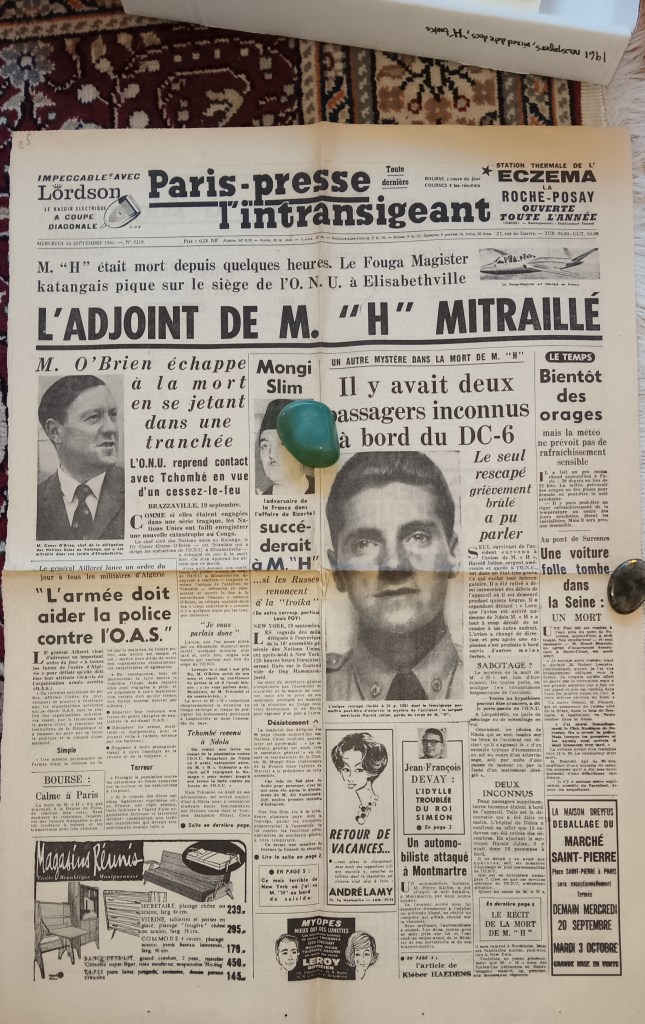
Paris-presse l’intransigeant, September 19. This publication does not mention Harold Julien by name or the testimony he gave to hospital staff in Ndola, reporting only that “Another person not yet identified was found seriously injured.”
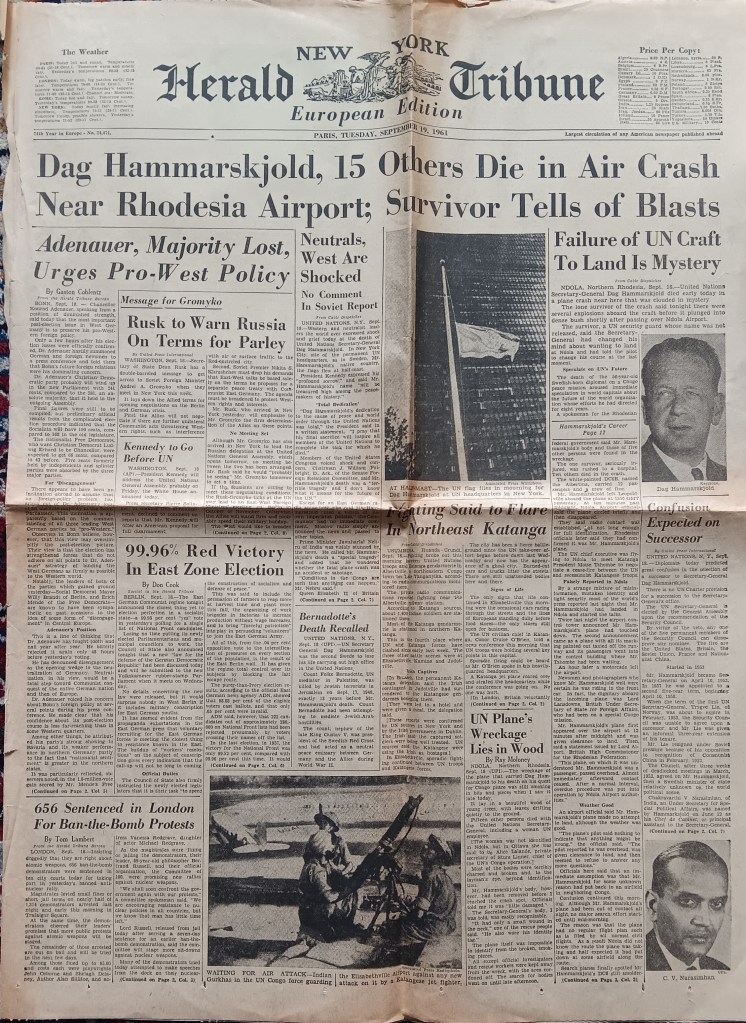
European Edition of the New York Herald Tribune, September 19
European Edition of the New York Herald Tribune, September 19. This article reports the testimony of Harold Julien, without mentioning his name, only that he was “a UN security guard whose name was not released.”
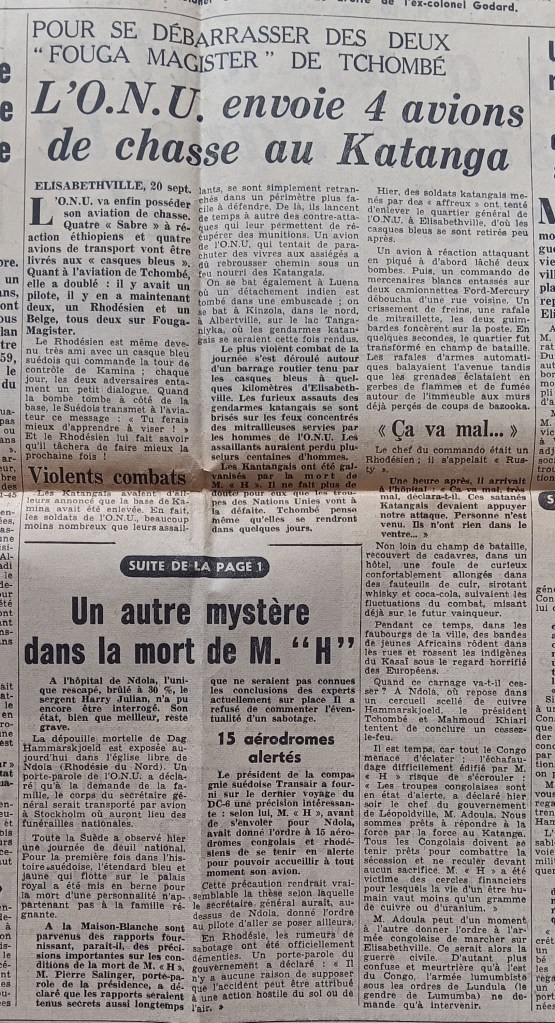
Paris-presse l’intransigeant, September 20. Headline: “Mr. H had been dead a few hours. The Katangese Fouga Magister attacks the headquarters of the O.N.U. in Elisabethville.” Text below photo: “The Fouga-Magister is made in France.”
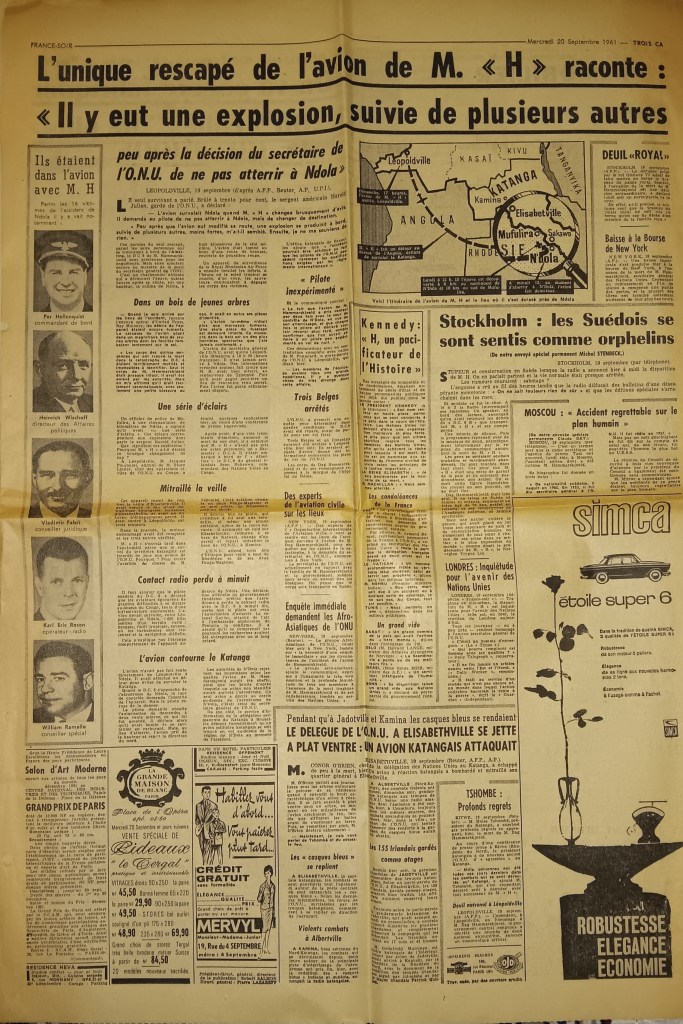
France-Soir, September 20
France-Soir, September 20. Rarely seen photos of Captain Per Hallonquist and Karl Erik Rosen.
France-Soir, September 20 “Three Belgians and a Congolese were reportedly arrested in Leopoldville yesterday evening. They would be accused of having given information concerning flight plans of the O.N.U.”
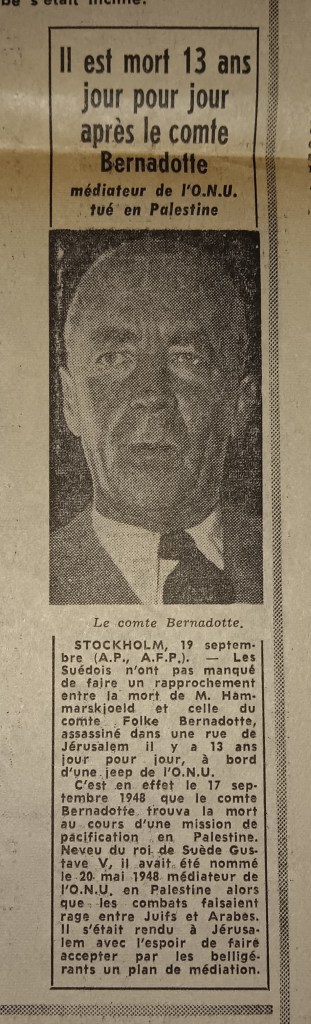
France-Soir, September 20. Many papers reported on the assassination of Swedish diplomat Count Folke Bernadotte, which happened exactly 13 years earlier in Gaza, 17 September 1948. And yet another eerie coincidence, Alice Lalande – the only woman on board the Albertina – was Bernadotte’s personal secretary.
International Edition of the NYT, September 20. Dag must have been bored to death of the overt and covert attacks on his sexuality and private life, on the job and in the press. But this was an era when being accused of homosexuality was akin to being accused of being a communist – Roy Cohn would understand! ”Mr. Hammarskjold did not like to talk about himself a great deal. He had an idea that he had been fixed forever in the public mind as a man with an alpenstock in one hand and a volume of T.S. Eliot’s works in the other. “That’s not a picture of me,” he said. “It is a caricature. Everywhere I go, mountains, mountains, T.S. Eliot. Believe me, I am sick of mountains and poetry talk.”
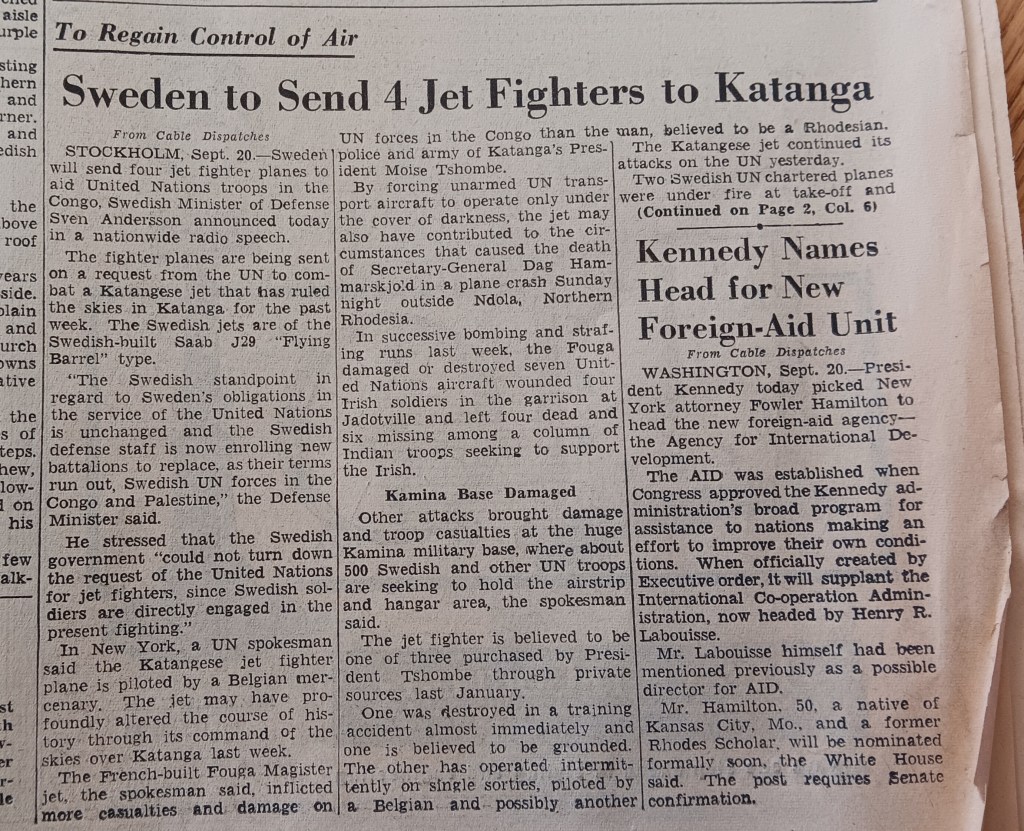
European Edition of the New York Herald Tribune, September 21. “The French-built Fouga Magister jet, the spokesman said, inflicted more casualties and damage on UN forces in the Congo than the police and army of Katanga’s President Moise Tshombe. By forcing unarmed UN transport aircraft to operate only under the cover of darkness, the jet may also have contributed to the circumstances that caused the death of Secretary-General Dag Hammarskjold in a plane crash Sunday night outside Ndola, Northern Rhodesia. In successive bombing and strafing runs last week, the Fouga damaged or destroyed seven United Nations aircraft, wounded four Irish soldiers in the garrison at Jadotville and left four dead and six missing among a column of Indian troops seeking to support the Irish.”
European Edition of the New York Herald Tribune, September 21
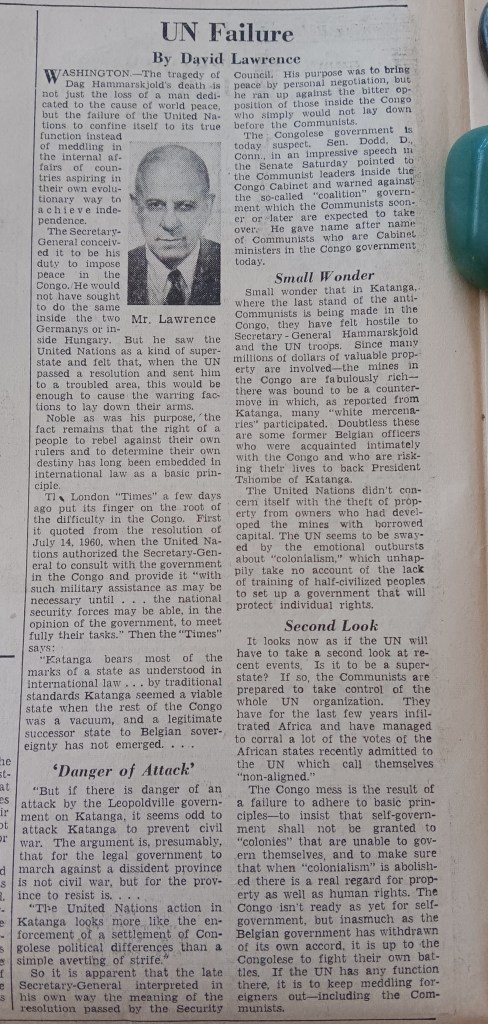
European Edition of the New York Herald Tribune, September 21. David Lawrence, yet another white supremacist who had nothing good to say about the United Nations or Dag Hammarskjold.
European Edition of the New York Herald Tribune, September 21. On the same page, next to David Lawrence, is this thoughtful and sad salute to Dag Hammarskjold from Walter Lippmann: “If the world is not ready for what Hammarskjold felt compelled to try in the Congo, it is also true, I hate to say, that this present world is not ready for the kind of man Hammarskjold was. He was a Western man in the highest traditions of political excellence in the West. Khrushchev says that Hammarskjold was not neutral in the Congo, and that there is no such thing as a neutral man. Hammarskjold was in fact the embodiment of the noblest Western political achievement — that laws can be administered by judges and civil servants who have their first allegiance to the laws, and not to the personal, their class, or even their national interests. No such political ideal is believed to be possible or is regarded as tolerable in the Marxist world. The ideal is not very well understood in most of the rest of the world, and there is no use pretending that such public servants are not very rare indeed. So there are times, as now in this hour of our grief and shock, when the ideal seems to belong to things that are passing away.”
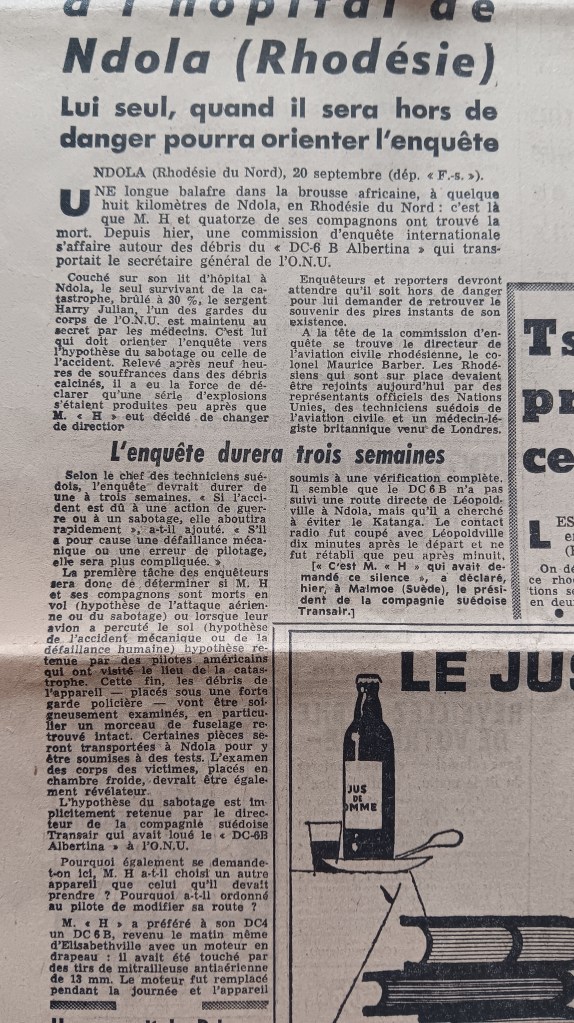
Paris-presse l’intransigeant, September 21 “At the Ndola hospital, the only survivor, 30% burned, Sgt. Harold Julian[sic], has not yet been able to be questioned. His condition, although improved, remains serious.”
France-Soir, September 21 Headline: “The survivor of Mr. H’s plane is incommunicado at the Ndola hospital (Rhodesia)” […] “Lying on his hospital bed in Ndola, the only survivor of the disaster, 30% burned, Sergeant Harry Julian[sic], one of the UNO bodyguards, is kept secret by doctors.” A rare photo of Mrs. Julien, caption says: “The wife of the sole survivor of Mr. H’s plane. Miami, 20 September (AP) — Mrs. Julian, 37 years, is the wife of the sole survivor of the DC-6 crash with Mr. H in Rhodesia. Mrs. Julian, who works for an advertising agency in Miami in the United States, only learned yesterday that her husband, Harry Julian, 37 years, one of Mr. H’s bodyguards, was on the plane.”

From Williams’ essay: “Maria Julien arrived in Ndola on Thursday, September 22, and was with Harry on the final day and night of his life. He was sedated and did not speak much. But she knew he was fully in his senses, because he asked about a chain that he had sent to her to be repaired — a chain to a medallion of St. Christopher, the patron saint of travelers. They were both devout Catholics, and Maria had called a priest to her husband’s bedside.

“But on the morning of the next day, her husband died — despite the expectation that he would survive. This was five days after the crash. The coroner’s summary report listed the cause as “Renal failure due to extensive burns following aircraft accident.”

[…]

“As Sgt. Julien was the only person left to describe what has happened on the flight, his recollections should have been crucial to the investigations of the Rhodesian Commission. But the commission discounted Julien’s statements to the nurses, writing: “No attention need be paid to remarks, later in the week, about sparks in the sky. They either relate to the fire after the crash, or a symptom of his then condition.” Even Julien’s comment about the plane having blown up, made to police inspector Allen, was not given serious attention.

“The senior medical staff at the hospital dismissed Julien’s recollections of the crash as the ramblings of a sick man; his reference to “sparks in the sky” was attributed to uraemia. But Dr. Lowenthal took a different view. He stated that Julien’s recollections were spoken during a plasma transfusion and before an injection of pethidine, which means that Julien had not been sedated at the time. Lowenthal felt so strongly about the need to establish this truth that he participated in the Rhodesian hearings as a volunteer witness; he insisted that when Julien spoke about the crash, he was “lucid and coherent.”

France-Soir, September 21 “Only he, when he is out of danger, will be able to guide the investigation.”
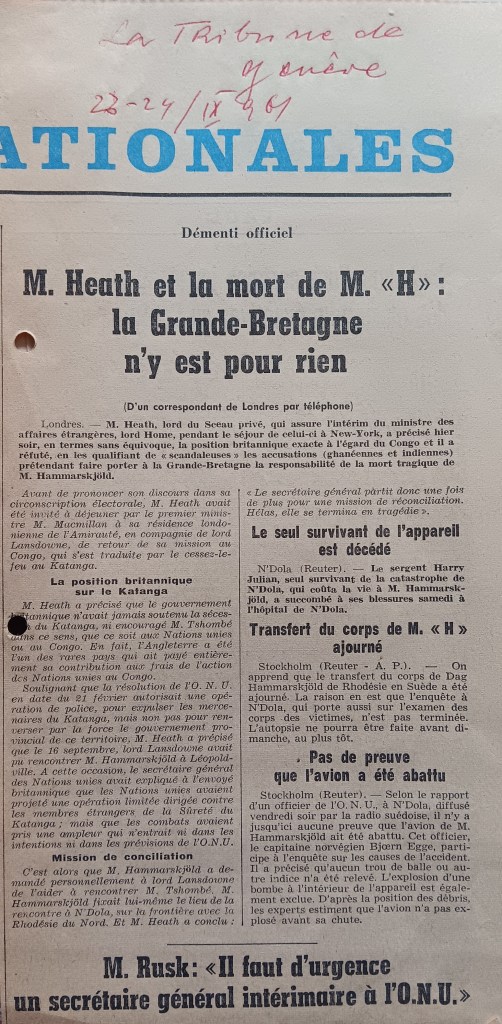
Tribune de Geneve, September 21. “Three months in hospital for the sole survivor of Hammarskjold’s plane. Sergeant Harry Julian[sic], seriously injured in the crash of the plane transporting Secretary-General Hammarskjold, and the only survivor of the disaster, will have to stay in hospital for at least three months. It will not be for ten or fifteen days before we will be able to know if he is really out of danger.”
France -Soir, September 21 “The only survivor of Mr. H’s plane is delirious and cannot be questioned.”
Tribune de Geneve, September 23-24 “The only survivor of the plane has died”
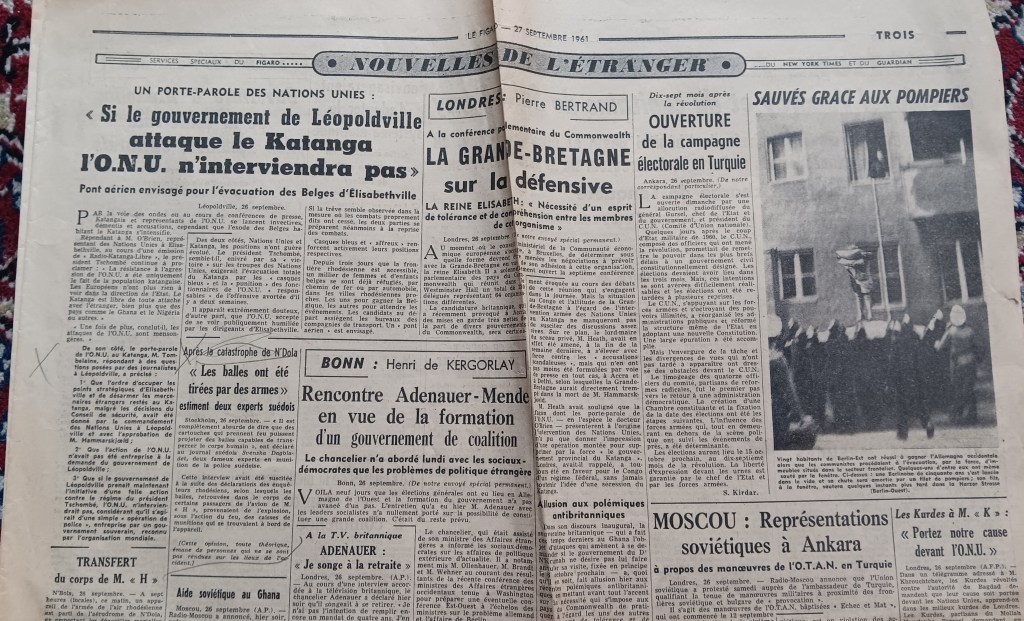
Le Figaro, September 27
Le Figaro, September 27 “After the Ndola disaster. The bullets were fired by weapons, say two Swedish experts.” […] “It is completely absurd to say that cartridges that catch fire can project bullets capable of piercing the human body” declared two famous ammunition experts from the Swedish police to Svenksa Dagbladet. This interview was prompted following statements by Rhodesian investigators, according to which, the bullets, found in the body of certain passengers of Mr. H’s plane, came from the explosion, under the action of fire, boxes of ammunition which were on board the aircraft. (This opinion, entirely theoretical, comes from people who did not go to the scene of the accident.)”

In honor of Dr. Martin Luther King’s birthday today, here is some encouragement from him: “I believe that unarmed truth and unconditional love will have the final word in reality. This is why right, temporarily defeated, is stronger than evil triumphant.”

From the Archive of Sir Roy Welensky, 1961

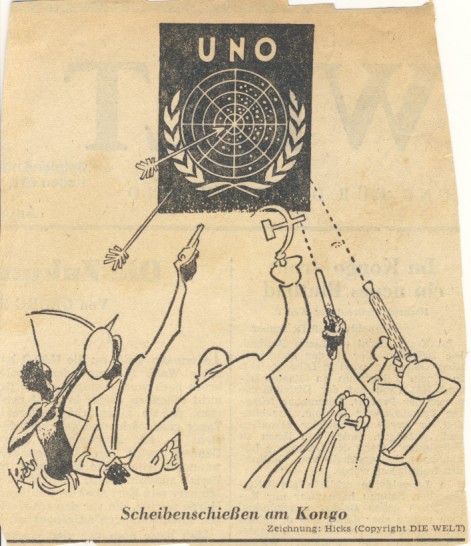
Congo political cartoon
“Target shooting at the Congo” (DIE WELT clipping from Fabry archive)

Back in January, I posted one of three letters that were sent to me from the Archive of Sir Roy Welensky, the last Prime Minister of the Federation of Rhodesia and Nyasaland; written by High Commissioner of South Africa, H.L.T. Taswell, and marked “TOP SECRET”. Since they don’t appear to be available anywhere else, I decided to publish the other two letters here today, in full (emphasis mine).

12th October, 1961

TOP SECRET

SECRETARY FOR EXTERNAL AFFAIRS.
PRETORIA

The Federation and the Katanga

At Sir Roy’s request, I had an interview with him this morning.

He told me that there were certain things he would like to have brought to the notice of our Prime Minister. One of them was that he had had a talk about ten days ago with Tshombe. The interview took place at Sir Roy’s request and Tshombe was flown to the airport at Salisbury with two Katanga Ministers. They spoke for about five hours in secrecy.

While he did not always think too much of the black man as a statesman, Sir Roy said, he was greatly impressed with Tshombe’s ability and sincerity. Sir Roy told Tshombe he had arranged the meeting because he felt there were certain points he wished to stress and hoped he would take his advice.

Sir Roy told him that it was impossible for him to try to fight the whole Afro-Asian bloc on his own and that it was essential to avoid a further clash with the U.N. which could be disastrous particularly with Nehru, his greatest enemy, doing everything he could to crush the Katanga completely.

The Katanga was the first setback the Afro-Asian bloc had suffered in Africa and it was therefore essential that he, Tshombe, should do all he could to capitalize on it. He must play his cards extremely well. As a start, it was most desirable that he should have talks with Adoula and reach a Congo settlement. He suggested that he should insist that all outsiders, including the United Nations, be excluded from the talks. Furthermore, any agreement reached with Adoula should be on a phased basis. No irrevocable step should be taken and each successive phase of a settlement should only be put into operation when each previous step had been carried out in an entirely satisfactory manner. Sir Roy hoped too that Tshombe would move in the direction of a federation in which a certain degree of autonomy would be retained by the Katanga.

Tshombe accepted this advice with much gratitude and since his return it appears that he has been working in this direction.

In so far as the United Kingdom and the Katanga were concerned, Sir Roy said his tactics all along had been to keep the United Kingdom fully informed on how he viewed developments. He had given them advance warning all along of trouble and had forecast developments with accuracy.

The United Kingdom, however, had preferred to close their eyes to all this and to let the United Nations go ahead unchecked.

When the Indians moved into the Elisabethville Post Office last month and the fighting started, Sir Roy delivered an ultimatum to the United Kingdom. He said that regardless of what the Federation’s legal position might be he was going to aid Tshombe. The Federal Air Force was at the alert and unless the United Kingdom took steps at once to the check the United Nations he was ordering the RRAF into action.

“While Tshombe and I could not have taken on the world we could have cleared up that U.N. bunch in no time. And that, ‘he smiled’ would really have started something.”

This ultimatum infuriated the United Kingdom and Sir Roy’s public statement that the British were going back on assurances they had given regarding the Katanga so incensed Mr. Sandys that he said he would have no further dealings with Sir Roy.

Driven into a corner, however, and fearful of the consequences for themselves of any federal armed intervention, the United Kingdom brought pressure to bear on the United Nations and the United States for a cease fire.

Since then Sir Roy has been pressing a reluctant U.K. to take further action by supplying them with information on the U.N. violations of the ceasefire and their military build up. He has been asking the United Kingdom what justification there is for example for the bringing in of Canberra bombers and jet fighters when the Katanga has only one Fouga jet trainer. The United Kingdom are now finally reacting favourably to all this and their influence on the Americans and U.N. is discernible.

In this connection, he mentioned that a further U.N. attack on Tshombe was expected this past week-end but it had not materialized. The danger of such an attack, incidentally, was the motive behind the issue of Sir Roy’s statement last Saturday. The text was telegraphed to you.

We believe that O’Brien’s recall for consultation is imminent and that he is unlikely to return to the Congo.

While Tshombe and his regime are by no means out of the woods, Sir Roy believes that they now have a reasonable chance of survival.

Touching on the Indians, Sir Roy said that one of the main reasons for their use was that other troops, particularly the Tunisians, had shown themselves to be extremely faint hearted. When the action started in the Katanga, the Tunisians had refused to leave Leopoldville.

Sir Roy, however, does not underestimate Indian motives. Referring to the report of an agreement between Lumumba and [Rajeshwar] Dayal for the settlement of two million Indians in the Congo, he stated that he had heard that documentary proof of this was available but he had not yet been able to lay his hands on it.

Referring to the Indian military build-up, he said he hoped we fully appreciated the grave danger it presented to us as far as S.W.A. was concerned.

His security people had information that a further contingent of Indian troops had arrived at Dar-es Salaam on October 8th on an American transport ship. The name of the vessel was something like “Blatchford”.

Touching on the question of foreign mercenaries, Sir Roy mentioned that the Federation had taken a man by the name of Browne off one of the two Dove aircraft that came up from South Africa recently on their way to the Katanga.

Sir Roy said they have proof that Browne was working for both sides – the U.N. and the Katanga. This is the man Col. Zinn spoke to the Commandant-General about when he visited South Africa recently.

After the interview I asked Federal security what they knew against him specifically. They replied that the white Katanga security people had long suspected Browne of double dealings. Also, when he was taken prisoner of the U.N., along with other mercenaries, earlier this year he was released “almost in a matter of minutes” while the others were detained. As a personality too federal security have no time for him and do not trust him in the least. His British passport was impounded by the United Kingdom High Commissioner here and he has been declared a prohibited immigrant by the Federal Government. He may since have made his way into the Katanga.

On the subject of Dag Hammarskjoeld’s [sic] death, Sir Roy said that he was preparing to have an enquiry take place under the chairmanship of the Chief Justice of the Federation, Sweden and I.C.A.O. would be invited to attend and he hoped to obtain another judge from a neutral country such as Switzerland. He would insist that the enquiry be a public one as there were certain things he felt should come out in the open and not be hushed up.

Hammarskjoeld’s plane left Leopoldville in such secrecy that even the United Nations Commander there did not have details of the flight. The plane had sufficient petrol on board when it started out for 13 hours flight. When it was over Ndola it still had sufficient fuel for another 8 hours. The plane had taken a round about route to avoid Katanga. There were 7 guards on board and a large quantity of ammunition. The general impression gained was that all were greatly afraid of an attack by the Katanga jet. The plane circled Ndola but did not ask for permission to land. There is reason to believe that the pilot may even had made a mistake in the altitude of Ndola and confused it with that of a place with a similar name in Angola.

Hammarskjoeld’s bag of documents was intact and could not be opened as it had a special locking device. Various parties tried their best to gain control of the bag. It was finally handed to the U.N. Representative. The Swedish Minister in South Africa was one of those who made strong endeavours to secure it. The Minister, Sir Roy said, gave the impression here of being an unpleasant character who required watching.

Turning to the Federation’s own present position, Sir Roy seemed very heartened by the removal of McLeod as Colonial Secretary and by the increasing feeling among Conservatives that the British Government should go more slowly in its African policy and that the interests of the white man should be protected.

The situation in Northern Rhodesia was also improving. Kaunda was being more and more discredited and his campaign of violence had backfired on him considerably. The Northern Rhodesia Government was distributing posters showing the damage done to schools and this was having a telling effect on the the Chiefs. The United Federal Party was now actively backing Katilungu of the A.N.C. with funds and helping him in his campaign. He was following closely behind Kaunda on his tour through parts of Northern Rhodesia and meeting with considerable success.

Although Heinriche and the Campbell, Booker Carter group were also backing Katilungu Anglo-American’s position was not very clear. Rhodesia’s Selection Trust, it seemed, did not approve of the idea at all. They had backed Kaunda very strongly, Sir Roy added, and Kaunda was also McLeod’s choice as leader of Northern Rhodesia.

He remarked incidentally that neither Anglo-American nor RST contributed financially to the United Federal Party any longer. (In a recent report I commented that I had heard these companies had recently restored their support. The information was given to me by an opposition M.P.)

Sir Roy did not touch on Dr. Banda directly. He just nodded his head and smiled when I commented that Banda would find himself very isolated if Katilungu were to come to terms with the United Federal Party. Sir Roy just did not seem to worry what happened to Banda.

During my interview I referred to our desire to overfly Federal territory in order to map our border. Sir Roy’s reaction was “Of course you can. Go ahead”. At the request of the Secretary for External Affairs here I have, however, put the request in writing and hope to have a formal reply shortly.

On defence generally Sir Roy did not say anything special but he gave me to understand that he would like to see Mr. Caldicott visit South Africa shortly.

Sir Roy said that he thought our Minister’s statement at the U.N. was a very sound one indeed and that Afro Asian reaction showed that body up in its true light. I gave Sir Roy a full copy of the Minister’s statement.

While one has gained the impression all along here that the Federal Prime Minister has been Tshombe’s main champion, the additional information Sir Roy gave me today shows just what lengths he was prepared to go to help the Katanga. But for the great pressure he brought to bear on the United Kingdom I think Katanga would have collapsed by now – and the U.N. and the Indians would no doubt have had more time to devote to S.W.A.

We can be extremely thankful that our Federal buffer to the north has as capable and resolute a Prime Minister as Sir Roy. We can be glad too that he has as skilled and well informed a Secretary for External Affairs as Mr. F.N.N. Parry. Both, moreover, show an exceptional amount of goodwill towards our country.

H.L.T. Taswell
High Commissioner

——————————————————————————————————-

2nd December, 1961

TOP SECRET

SECRETARY FOR FOREIGN AFFAIRS
PRETORIA

The Federation and the Dangers Ahead.

“The wind of change speech which Macmillan made in Cape Town was originally to have been made by Butler but it was postponed because of Strijdom’s death.”

That is what Sir Roy told me in the strictest confidence when I had an interview with him this morning. He asked too that the information be passed only to the Prime Minister, our Minister of Foreign Affairs and yourself.

He revealed this piece of information while talking about the great dangers facing Southern Africa.

Sir Roy, as you know, has just recently returned from London and Lisbon. Salazar, he said, is a worried, disillusioned and perturbed man who finds it extremely difficult to understand why his friends have turned against him.

“I am not disillusioned by Britain’s attitude” Sir Roy went on “I have known the British too long. If they tell you one thing now you can be almost certain that they mean exactly the opposite.

“A few weeks before McLeod was switched to another cabinet post I was assured” Sir Roy continued “that no such change was contemplated. Now I am assured that Macmillan will fight the next election. That just about convinces me that he will shortly resign in favour of Butler.”

Macmillan, Sir Roy added, has aged about five years mentally since he last saw him and will accordingly not be able to hold the reins of government much longer.

The present British trend to get out of Africa as quickly as possible is nothing new, he continued, it has been part of a plan for several years. Men like Lennox-Boyd and Home who developed such close and sound personal relations with people in British territories in Africa have been deliberately pushed aside. The British Government do not want people in top positions who have given firm assurances abroad which it would now be embarrassing for them to withdraw. The British want their hands free.

It was at this stage of the conversation that Sir Roy mentioned the wind of change speech in Cape Town.

Shortly before this he had said that “we in this country are on our own. I fully realize that.” He added that there was a tremendous danger of Southern Africa being cut off altogether of arms. The United Kingdom, he said, were selling fighter aircraft to the Federation at top prices. America on the other hand was supplying Yugo Slavia [sic] with aircraft at a nominal price of $10,000 each. Russia was now giving Migs to African states free of charge in order to help them in their struggle for freedom.

In the face of all this he went on, he was disgusted to see that Denmark had just refused to supply any further arms to Portugal. He deplored Israel’s action in voting for sanctions against us and added “I hope your Prime Minister is bending every possible effort to produce an atomic bomb in South Africa.”

Sir Roy stated that during he recent visit to London he had accused the British Government of deliberately going against the white man in Africa and of letting the Federation down at every turn. He told them too that he knew from information he had received in London that they were trying to put obstacles in the way of supplying arms to South Africa and, in turn, to stop the Federation from obtaining anything from the South.

The British Government hotly denied all this.

At present, Sir Roy went on, he could draw all he wanted from Kenya and Aden. Those bases would, however, one day close down and the only British base left in Africa would be the Federation.

It is interesting to speculate at this point whether Sir Roy’s strong remarks in London could not have had some bearing on the favourable negotiations which our Commandant-General and our Secretary for Defence were able to conduct in London recently.

Turning to the Indians in the Katanga, Sir Roy said that he had someone sitting in Dar-es-Salaam and watching troop movements. It was quite clear that more Indians were going into the Katanga than were coming out. Apart from the question of build up of U.N. strength it seemed probable that many Indians were being moved into the Congo as settlers. He confirmed that Indians were making an economic survey and taking an intense interest in mines.

“There is a great deal on the military side which I would like our Minister of Defence to discuss with your people urgently” Sir Roy went on “and I hope he can get down to see you very shortly. I don’t think this matter should be delayed too long.”

Turning to the Federation’s internal affairs Sir Roy remarked that economically the situation was much better than it had been expected to be at this time. Politically too the position looked hopeful.

A month or two ago Sir Roy declared that provided agreement could be reached internally with the constituent territories there would be little need for a review of the Federal Constitution. The British Government would be presented with a fait accompli and have to accept it as such.

I asked Sir Roy what progress he was making in this direction. He replied that Banda had already indicated his willingness to meet him after Maudlin’s present visit was over.

In so far as Northern Rhodesia was concerned Kaunda had already had a talk with Roberts, the leader of the United Federal Party there. Sir Roy has little time for Kaunda personally, however, he has reason to believe that Kaunda was at one time in an asylum and is mentally unstable. He doubts if he has full control of UNIP.

Barotseland, Sir Roy feels, is very much on his side and adamantly opposed to falling under a black nationalist government in Northern Rhodesia. The Federal authorities have provided the territory with a legal adviser to keep it fully informed and advise it on tactics when talking to the British Government.

Expressing confidence that it would eventually be possible to reach an agreement Sir Roy concluded “we will have no Congo here and if Britain tries to force one on us we will defend ourselves at gunpoint.”

This interview was one I had asked for prior to going on leave. As I entered his room, however, Sir Roy remarked that he presumed I had come in response to his request. When I explained that I had not, he said “but I told my people I wanted to see you. How is it these things go wrong?”

Looking back on my talk with him, I would say that Sir Roy is much more worried about the current dangers to the Federation than he cared to admit.

If the Katanga collapses, the Federation will be on its own. If attacked from outside it is very doubtful how long the Federation will be able to hold out on its own. Every effort will no doubt be made to hold the line of rail Northern Rhodesia and the Copperbelt and Southern Rhodesia.

With internal unrest fomented by the UNIP in Northern Rhodesia and by the NDP in Southern Rhodesia, to say nothing of trouble from Banda and from the dissident white elements, the position could be extremely difficult. Our buffer in the North could easily disappear leaving the path open for an attack on South West Africa and ourselves.

I should accordingly not be surprised to find that Mr. Caldicott’s proposed visit to South Africa, is to learn what our attitude is likely to be in the event of an attack on the Federation.

The following is the latest information available on the make up of the Federation’s population—

Whites: S.R. 220,610/ N.R. 74,600/ Nys. 8,730/ Total 303,940
Asians: S.R. 6,990/ N.R. 7,740/ Nys. 10,580/ Total 25,310
Others: S.R. 10,540/ N.R. 1,910/ Nys. 1,500/ Total 13,950
Blacks: S.R. 2,920,000/ N.R. 2,410,000/ Nys. 2,880,000/ Total 8,210,000
———————————————————————–
Total: S.R. 3,158,140/ N.R. 2,494,250/ Nys. 2,900,810/ Total 8,553,200

In assessing the problems which face the Federation one must not underestimate the drive, determination and dynamic personality of Sir Roy who stand head and shoulders about all other politicians in this country.

H.L.T. Taswell
High Commissioner