“Rudolf Frastacky – chief representative of the Union of Small Farmers’ Mutual Savings Banks and one of the significant figures in the Agrarian Movement from the end of the thirties and first half of the forties, was one of the personalities from Slovak economic and political life, who spent the rest of his life in exile, because of the changed political conditions after February 1948.”
[…]
“His position in companies representing Slovak sugar abroad enabled him to make regular business trips abroad, especially to Switzerland. As one of the representatives of the civil wing of the anti-fascist struggle during the Second World War, he used his legal trips abroad to establish courier contacts with foreign resistance elements. Together with Jaromir Kopecky, a member of the Czechoslovak legation to the League of Nations in Geneva, he built on Swiss soil one of the most intensive and widest links between the leadership of the domestic resistance on one side and the Czechoslovak government in exile in London on the other.”
The undersigned Rudolf Frastacky, elected Vice President of the the Slovak National Council and the National Government, and President of the Official Slovak-Swiss Society, currently exiled in Toronto, where he is President of the Council of Free Slovakia in Canada, willingly declares:
I have known Dr. Pavel Fabry through his public activities since my younger years. His self-sacrificing contribution to the consolidation of the situation after World War 1, especially in the eastern part of Slovakia, was widely recognized, and this fact is also highlighted in books from this era. The Slovak encyclopedia (page 37) also commends this activity.
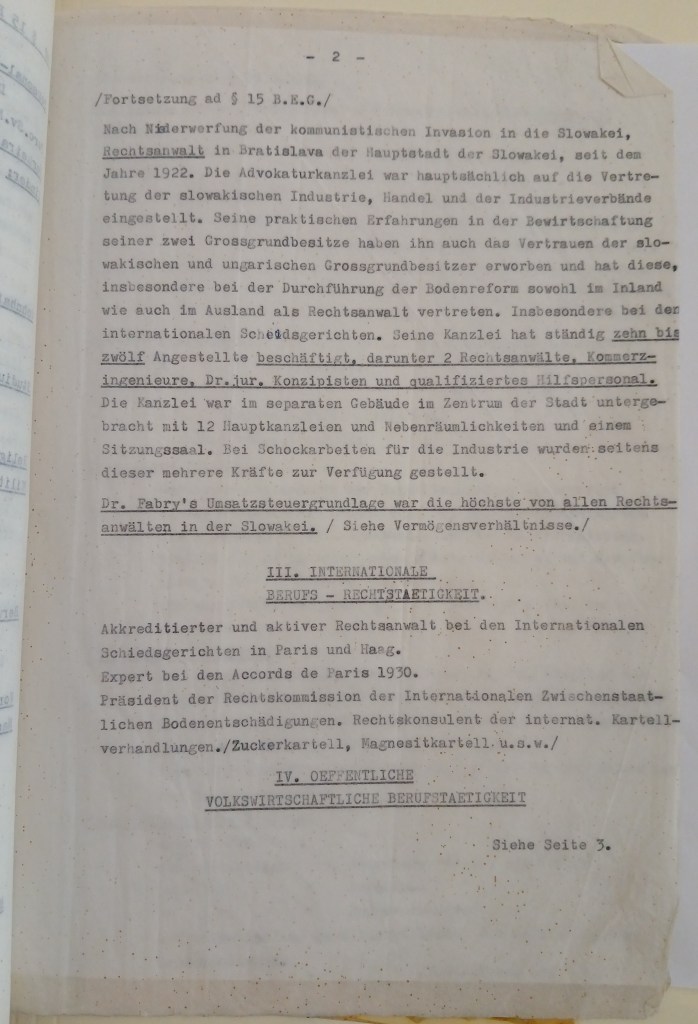
In particular, in the suppression of the Hungarian-Communist invasion under the leadership of Bela Kun and the notorious Rakosi, Dr. Fabry rendered great service as plenipotentiary commissioner of the government at the Eastern High Command of Slovakia, and since that time he has been considered an eminent enemy of communism.
After leaving government service, he devoted himself to his legal career, particularly representing industry, especially the agricultural sector. As Vice-President of the Foreign Affairs Committee of the Industrial Federation, he endeavored to comply with the wishes of the Swiss delegation in the trade agreements, particularly with regard to quotas for industrial agricultural products.
For the industry under his leadership as President of the association, he always imported the machinery, refrigeration systems, boilers, etc., from Switzerland.
When I founded the Slovak-Swiss Society, my ambition was to win Dr. Pavel Fabry’s cooperation, not only for the reasons mentioned above regarding his economic activities, but mainly because it was generally known that he was actually of Swiss descent, as his ancestors immigrated to what was then Upper Hungary – now Slovakia – and they themselves, as well as their descendants, played a considerable role in economic life, as well as spiritual and ecclesiastical life.
Dr. Fabry naturally took on this role with enthusiasm and self-sacrifice and was spontaneously elected as active vice president of this society – again for the reasons stated above. He hosted the society free of charge in his own premises in Tolstojgasse [Tolstoy Lane, Vienna, Austria], and the society’s written agenda was maintained by him or one of his employees. He contributed large sums (tens of thousands) to the budget. During visits by prominent Swiss personalities from the economic and scientific world, he made his house and his property available to the guests in Slovakia in order to fully achieve the goals of their trips, as these personalities always acknowledged with gratitude.
He placed particular emphasis on economic relations and supported them with all his might. I will give one example among others. When a shortage of malt arose in Switzerland in 1946/47, he ensured that the Slovak breweries provided large quantities of malt and malted barley from their own reserves in order to supplement the quotas for Switzerland.
Even if I cannot cite all his deeds, which he carried out in the context of his above-mentioned activity, I can declare with a clear conscience that Switzerland can be proud of this loyalty to the homeland of his ancestors.
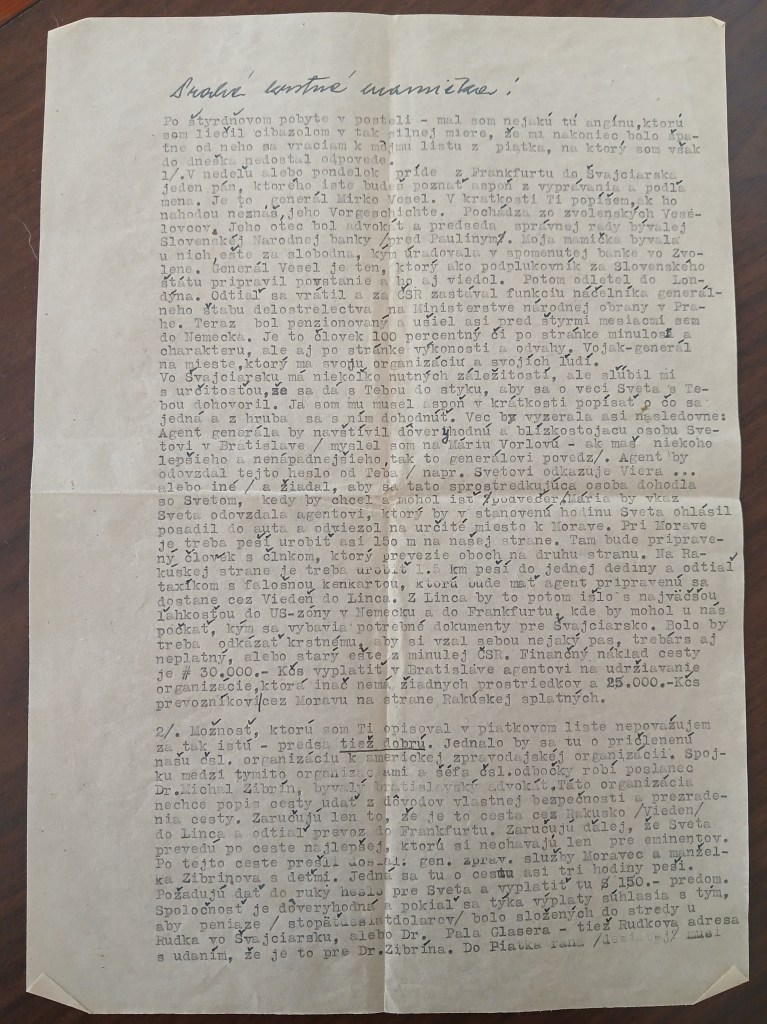
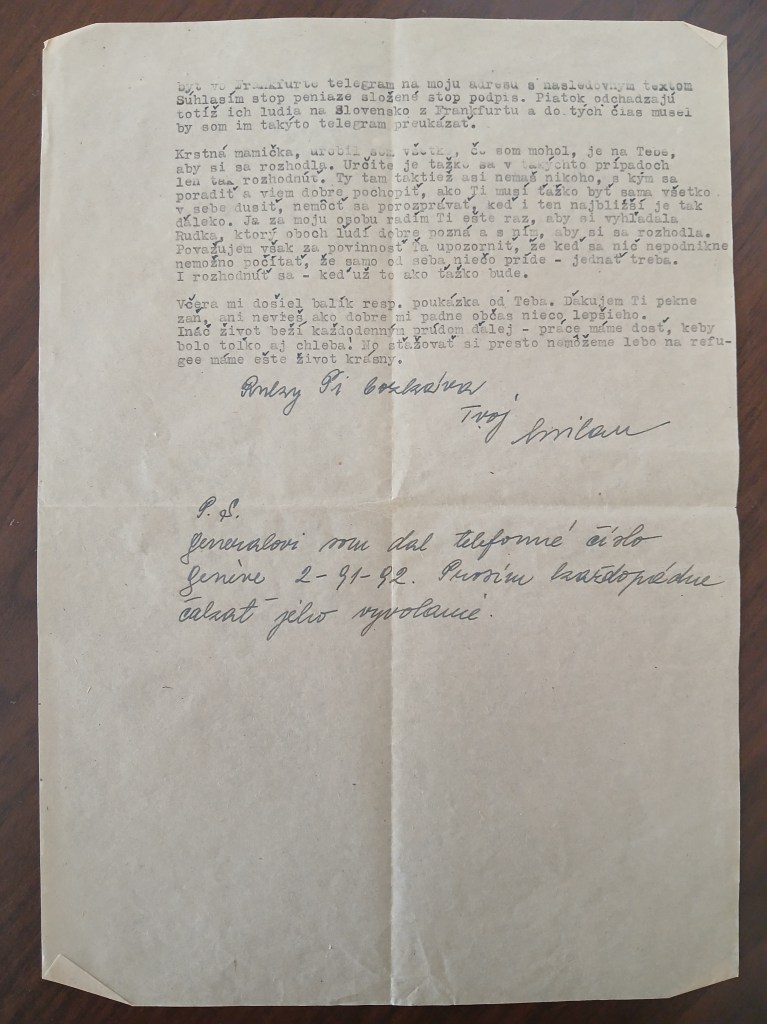
Thanks to Miroslav Kamenik for translating this letter from Milan Fabry to his godparents Pavel and Olga/Maminka Fabry, and for research assistance, narrowing down the date of this letter to “8-12/1948.” Milan is giving explicit instructions to Maminka to help “Sveto” escape Czechoslovakia, using the same route as General Frantisek Moravec – famous for his role in the assassination of Nazi architect Reinhard Heydrich in Prague. Another new discovery, with Miroslav’s help, is that “Sveto” is another name for Pavel – likely a code name!
Dear Godmother!
After a quarter of a week in bed – I had some kind of angina, which I treated with cibazol so badly that I ended up feeling sick from it – I return to my letter from Friday, to which I have not received an answer to today.
1/ On Sunday or Monday, a gentleman will arrive from Frankfurt to Switzerland, whom you will surely know at least from his story and by name. He is General Mirko Vesel. I will briefly describe his background, if you do not know him. He comes from the Vesel family in Zvolen. His father was a lawyer and chairman of the board of directors of the former Slovak National Bank /before Pauliny/. My mother used to stay with them, when she was still single, while she worked in the aforementioned bank in Zvolen. General Vesel is the one who, as a lieutenant colonel under the Slovak State, prepared the uprising and led it. Then he flew to London. From there he returned and for Czechoslovakia held the position of Chief of the General Staff of Artillery at the Ministry of National Defense in Prague. He has now been retired and fled here to Germany about four months ago. He is a 100 percent man, both in terms of his past and character, but also in terms of his performance and courage. A soldier-general in his place, who has his own organization and his own people. He has several urgent matters in Switzerland, but he promised me with certainty that he would get in touch with you to discuss the matter of the Sveto with you. I had to at least briefly describe to him what was going on and roughly make a deal with him. The matter would look something like this: The general’s agent would visit a trustworthy and close person to Sveto in Bratislava /I was thinking of Mária Vorlová – if you have someone better and more discreet, tell the general/. The agent would give this person a password from you /e.g. Sveto is referred to by Viera… or something else/ and ask that this intermediary person agree with Sveto when he would like to and could go /early evening/. Mária would give Sveto’s message to the agent, who would call Sveto at the appointed hour, put him in a car and drive him to a certain place near Morava (MK: river Morava). Near Morava, you have to walk about 150m on our side. There will be a person with a boat ready to take both of them to the other side. On the Austrian side, it is necessary to walk 1.5 km to a village and from there, by taxi with a fake kenkarta (MK: ID card), which the agent will have ready, he will get to Linz via Vienna. From Linz, it would then be very easy to go to the US zone in Germany and to Frankfurt, where he could wait with us until the necessary documents for Switzerland are processed. It would be necessary to instruct the godfather (MK: he talks about Sveto, but not sure about “krstný” as godfather of Milan) to take a passport with him, perhaps even an invalid one, or an old one from the former Czechoslovakia. The financial cost of the trip is 30,000 CZK to be paid in Bratislava to the agent for the maintenance of the organization, which otherwise has no funds, and 25,000 CZK to be paid to the ferryman across Moravia on the Austrian side.
2/ I do not consider the possibility that I described to you in Friday’s letter to be so certain – but still a good one. This would involve our Czechoslovak organization being affiliated with an American intelligence organization. The liaison between these organizations and the head of the Czechoslovakbranch is made by MP Dr. Michal Zibrín, a former Bratislava lawyer. This organization does not want to give a description of the route for reasons of its own security and revealing the route. They only guarantee that it is a route through Austria /Vienna/ to Linz and from there a transfer to Frankfurt. They further guarantee that they will take Sveto along the best route, which they reserve only for eminent persons. The following have so far traveled this route: General of the Intelligence Service Moravec and Zibrín’s wife with their children. This is a journey of about three hours on foot. They demand that a password be given to Sveto and that USD150 be paid in advance. The company is trustworthy and as far as payment is concerned, they agree that the money (one hundred and fifty dollars) should be deposited by Wednesday with Rudek in Switzerland, or Dr. Pal Glaser – also Rudek’s address with the indication that it is for Dr. Zibrin. By Friday morning (ten o’clock) there must be a telegram in Frankfurt to my address with the following text: I agree stop money deposited stop signature. Their people are leaving for Slovakia from Frankfurt on Friday and by then I would have to show them such a telegram.
Godmother, I did everything I could, it’s up to you to decide. It’s certainly hard to make a decision in such cases. You probably don’t have anyone there to consult with either, and I can understand how hard it must be for you to stifle everything inside yourself, unable to talk, when even the closest person is so far away. For my part, I advise you once again to seek out Rudek, who knows both people well, and to make a decision with him. However, I consider it my duty to warn you that if nothing is done, you can’t count on something coming by itself – you need to act. And decide – no matter how difficult it is.
Yesterday I received a package or voucher from you. Thank you very much for it, you don’t even know how good something better sometimes feels. Otherwise, life goes on as usual – we have enough work, if only there was as much bread! But we can’t complain because we still have a beautiful life as refugees.
Hand kisses Your Milan
P.S. I gave to general the phone number to Genéve 2-91-92. Please wait for his call.
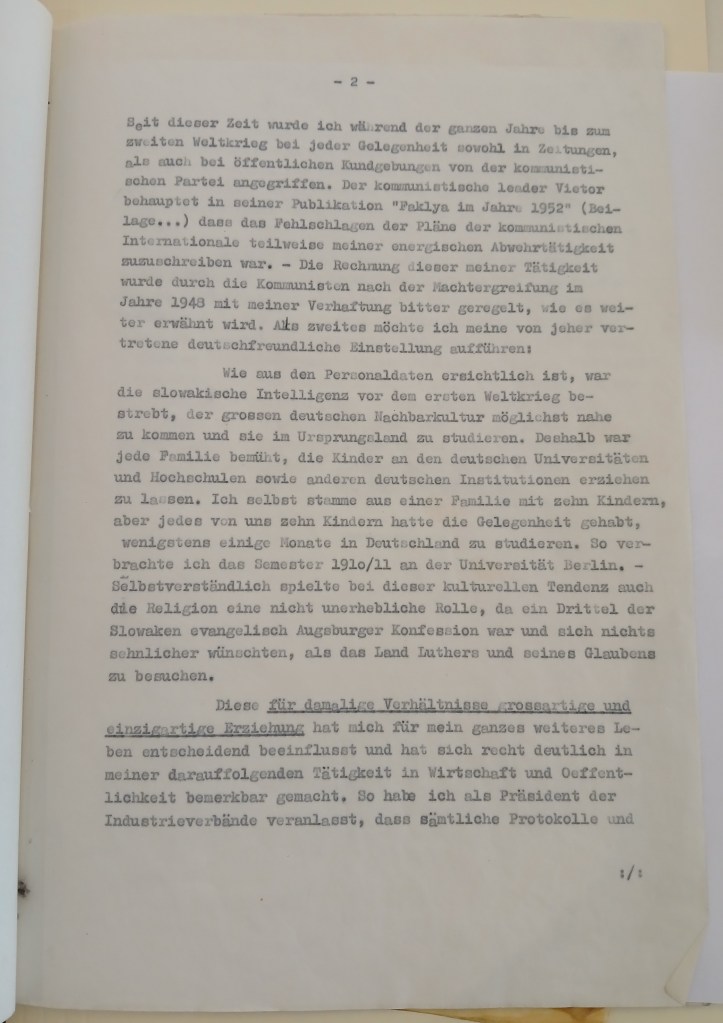
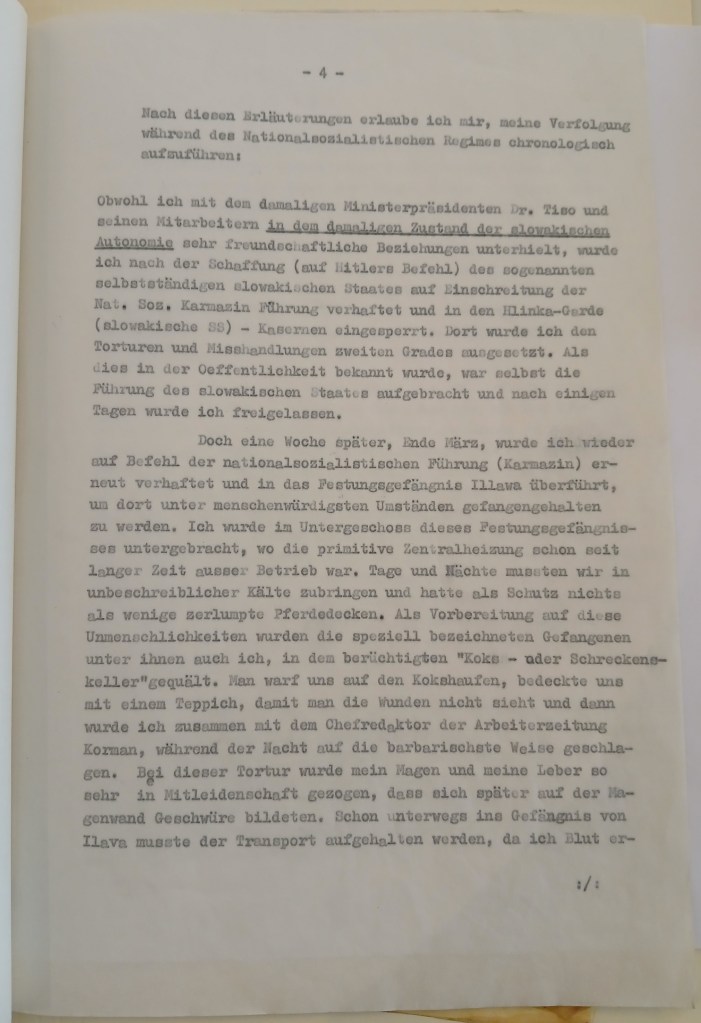
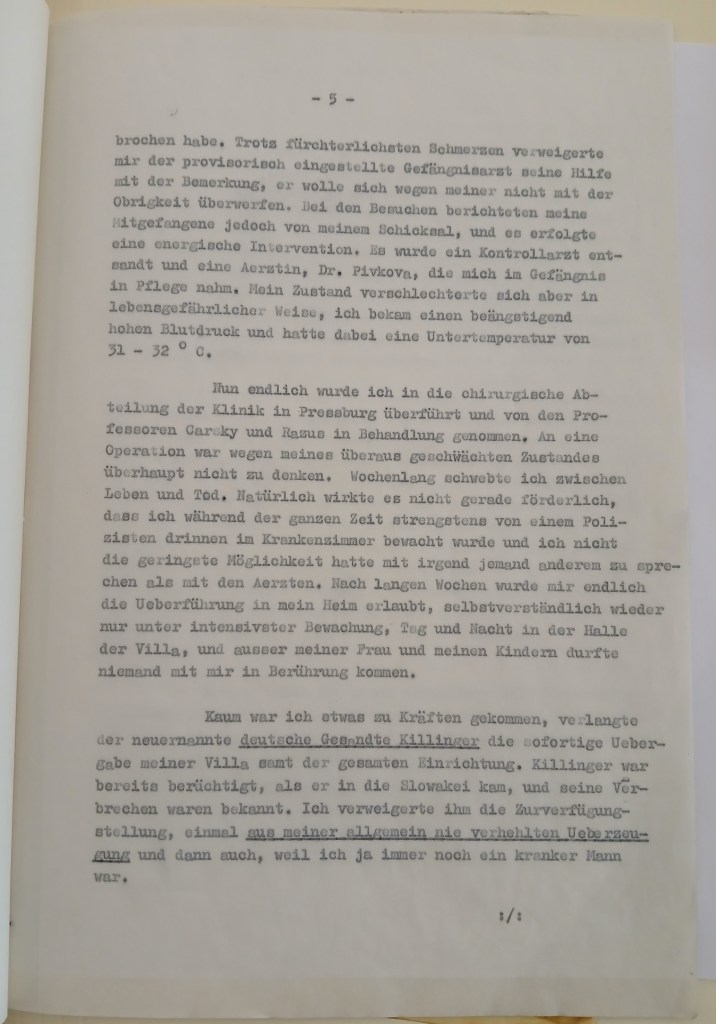
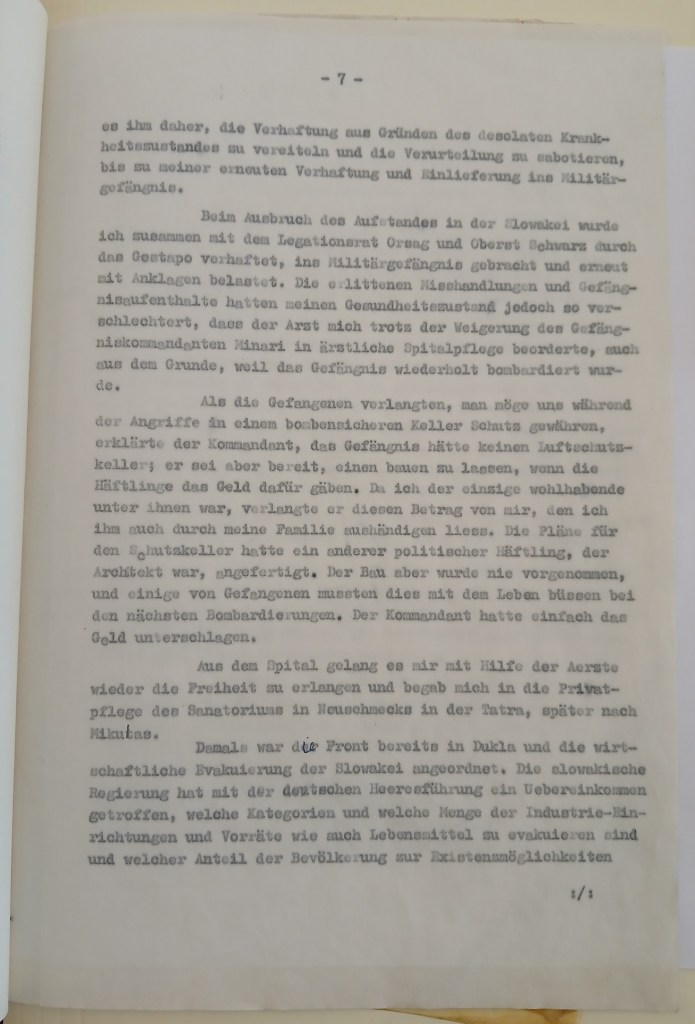
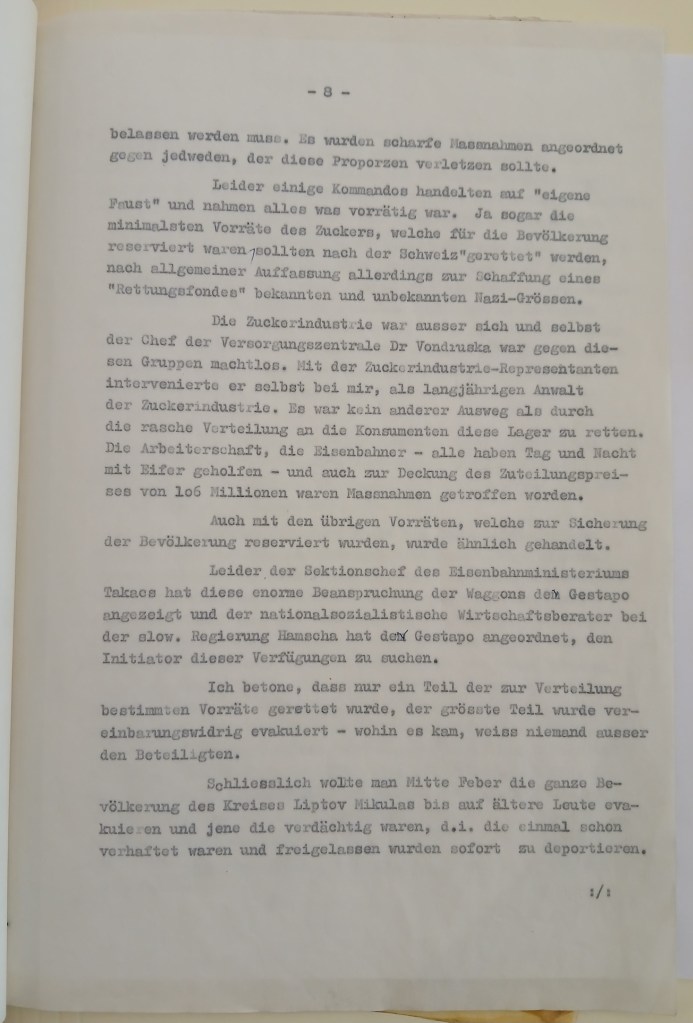
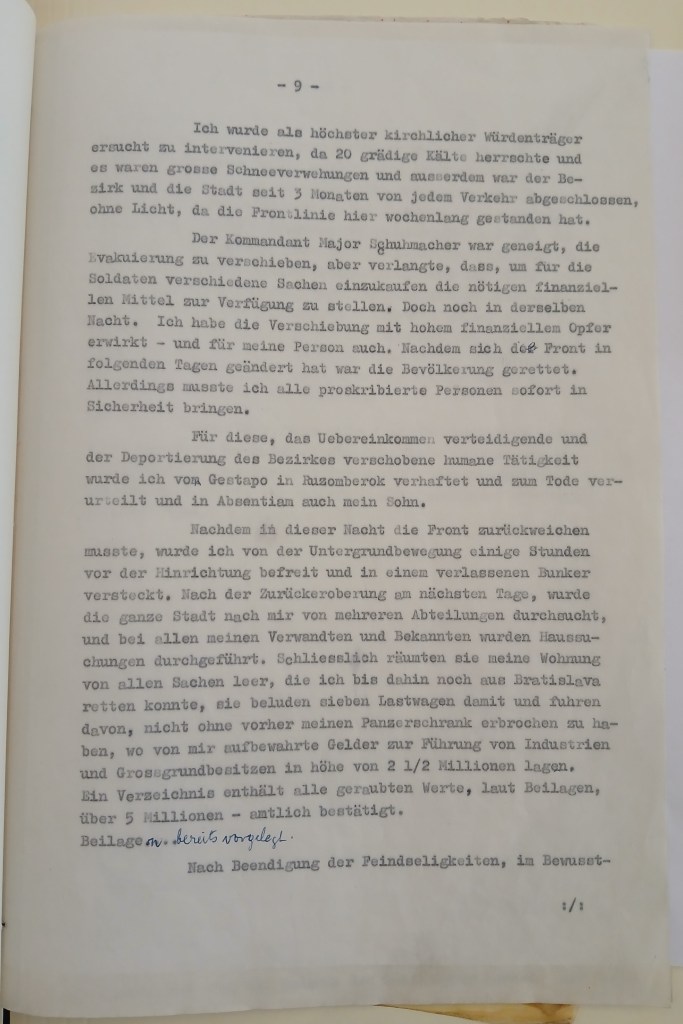
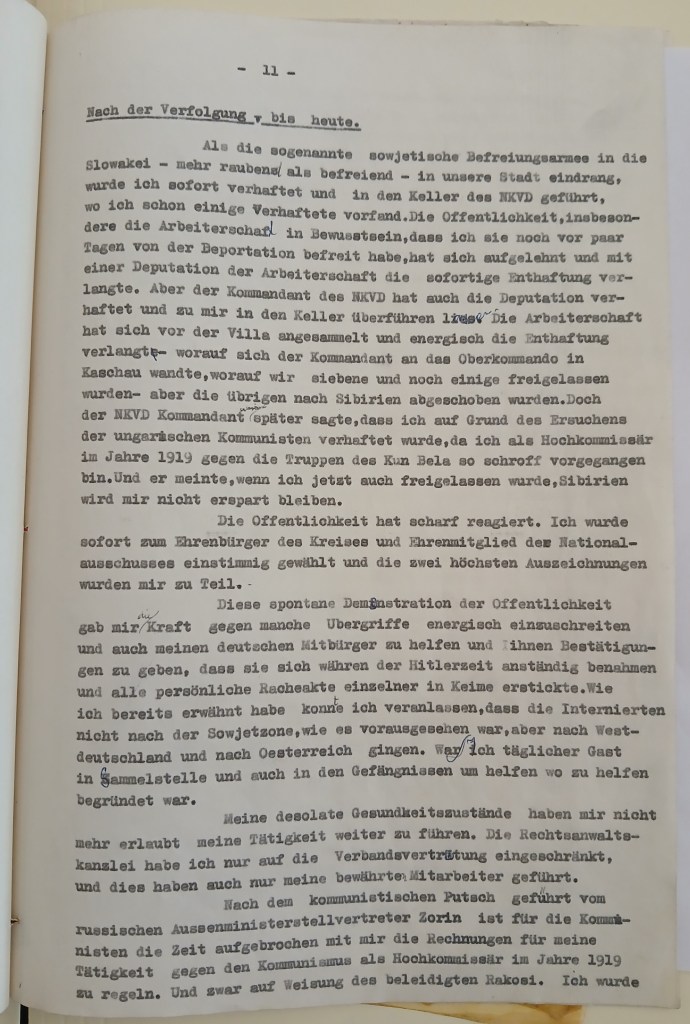
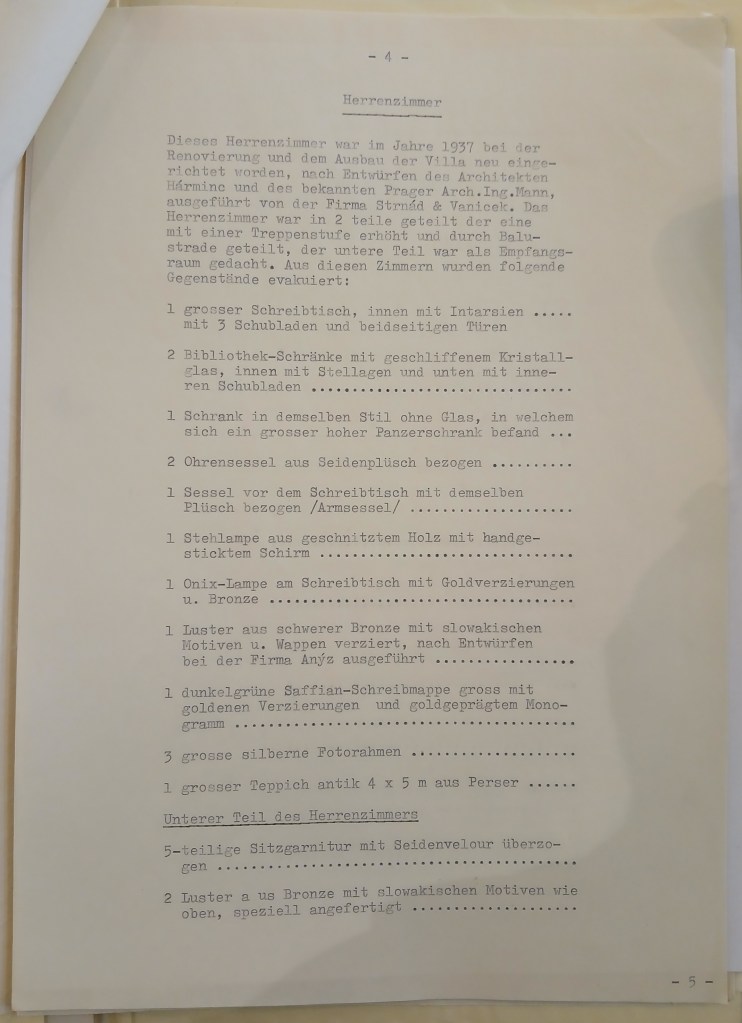
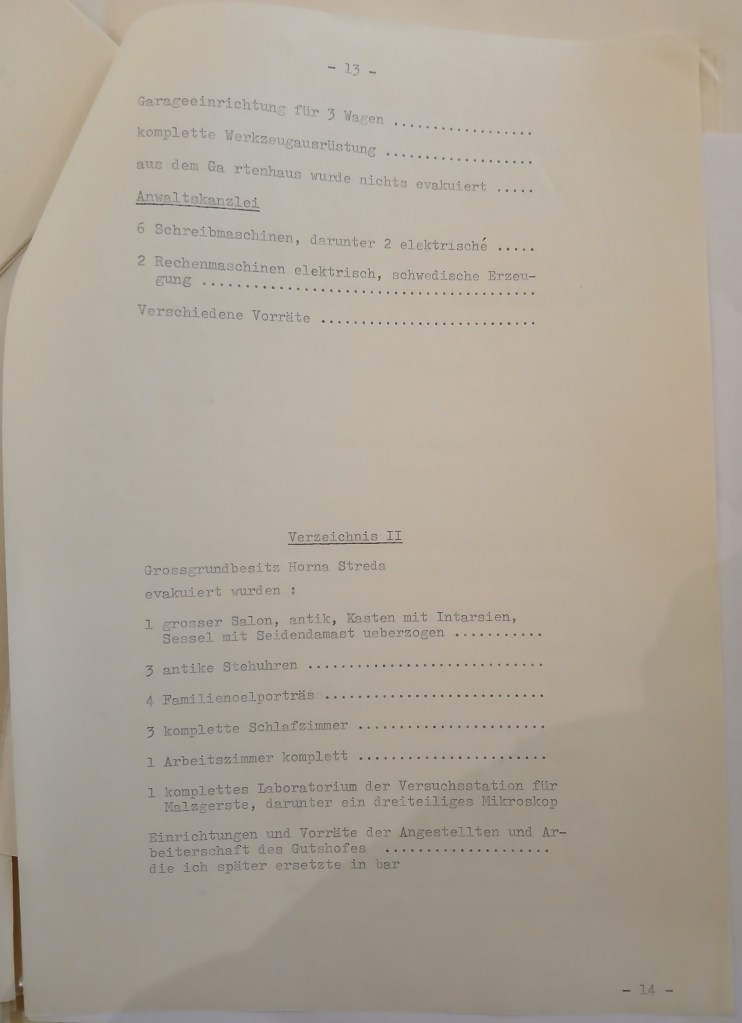
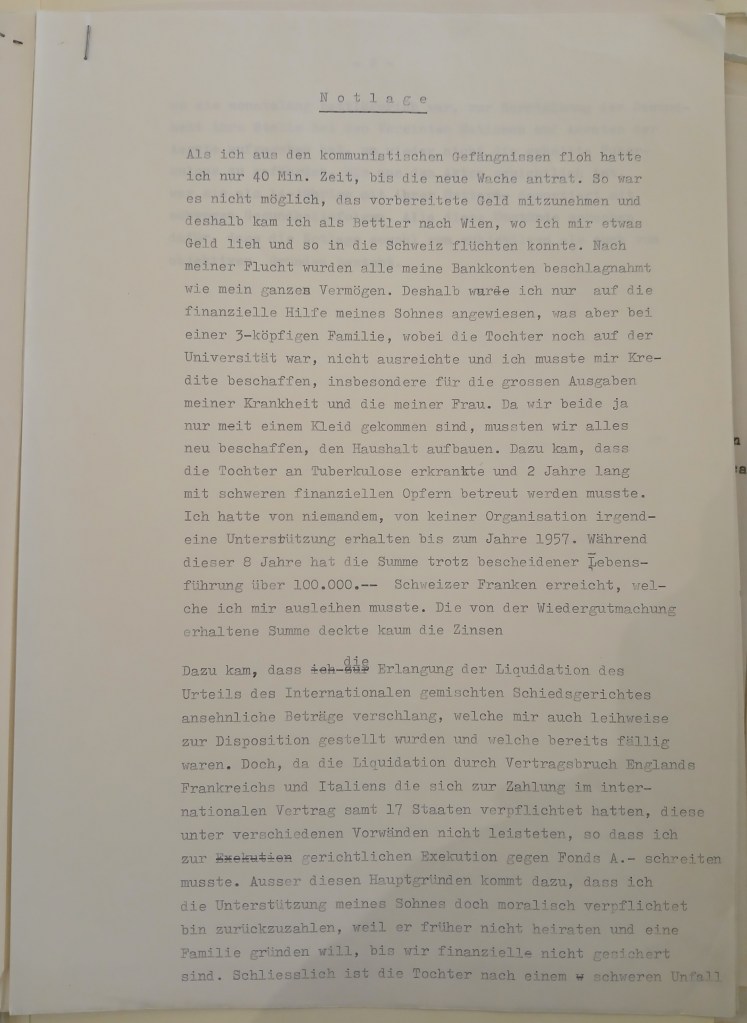
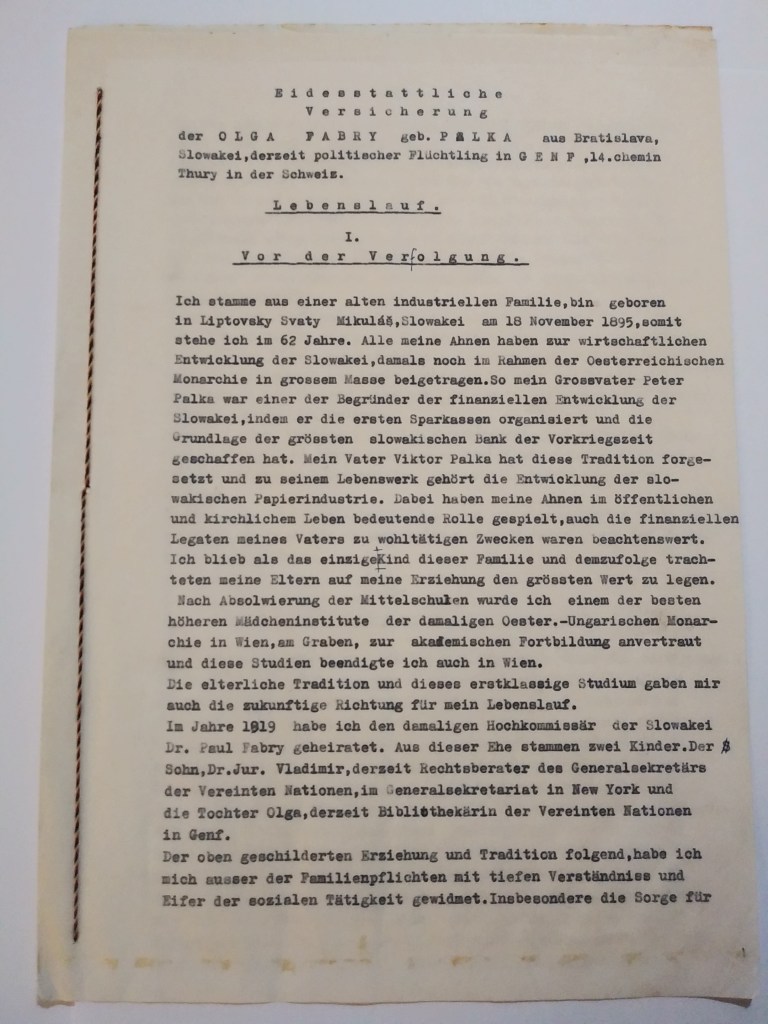
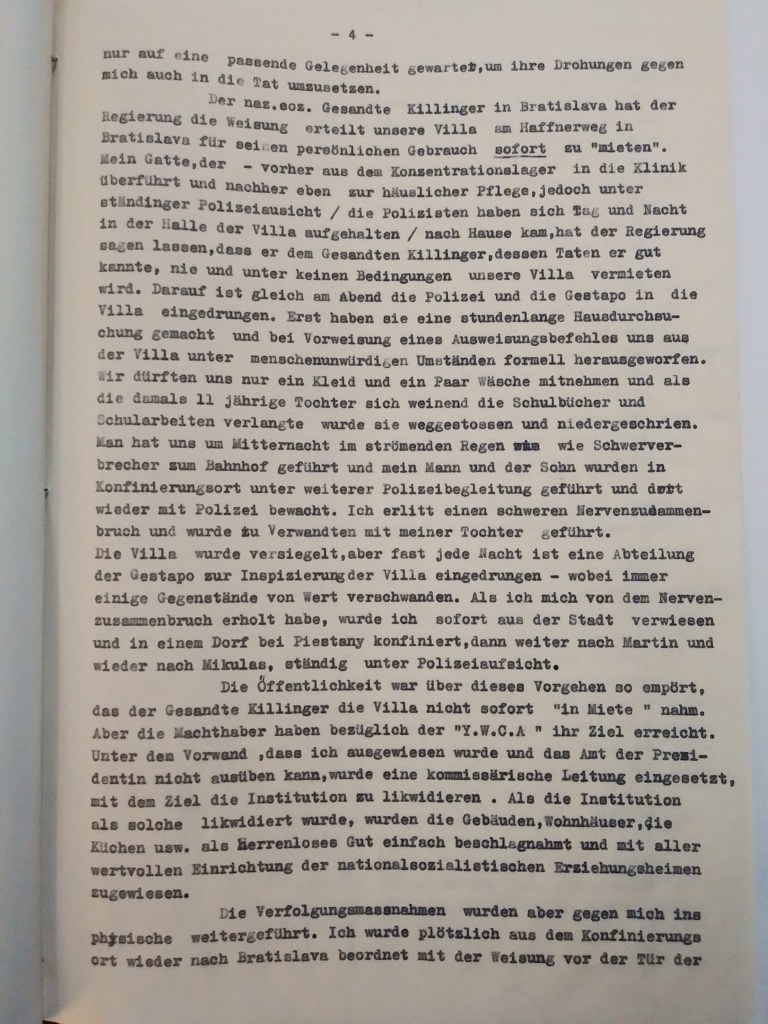
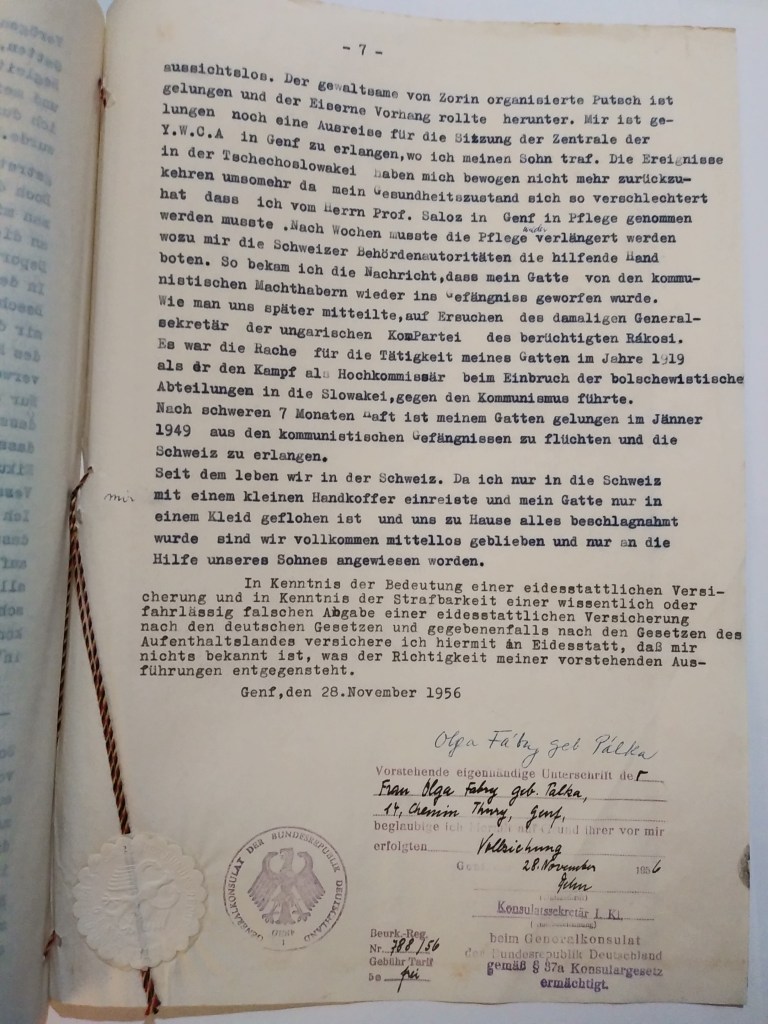
For the past 6 days, I have been translating the 1956 testimony of Grandma Fabry from German to English, which was not easy since I am not fluent in German. The urgency of war has pushed me to act quickly. I want everyone in Slovakia to know what our Grandmother went through when the Russian communist leaders stole our family home in Bratislava in the coup of 1948. She resisted with all her might against both Nazis and communist oppressors for years, she did not give in.
My husband Victor and I have already donated the family home in Bratislava as a national gift to the people of Slovakia, and I have demanded no more accommodation for Putin and his mafia, but I will repeat myself for the third time. I am calling on the President of Slovakia, Zuzana Caputova, and Slovak Prime Minister, Edvard Heger, to expel all diplomats from the Russian embassy immediately! Take heed of Grandma Fabry’s story, the cruelty she endured, do not delay to stop Putin! Stand united with Ukraine and fight back!!
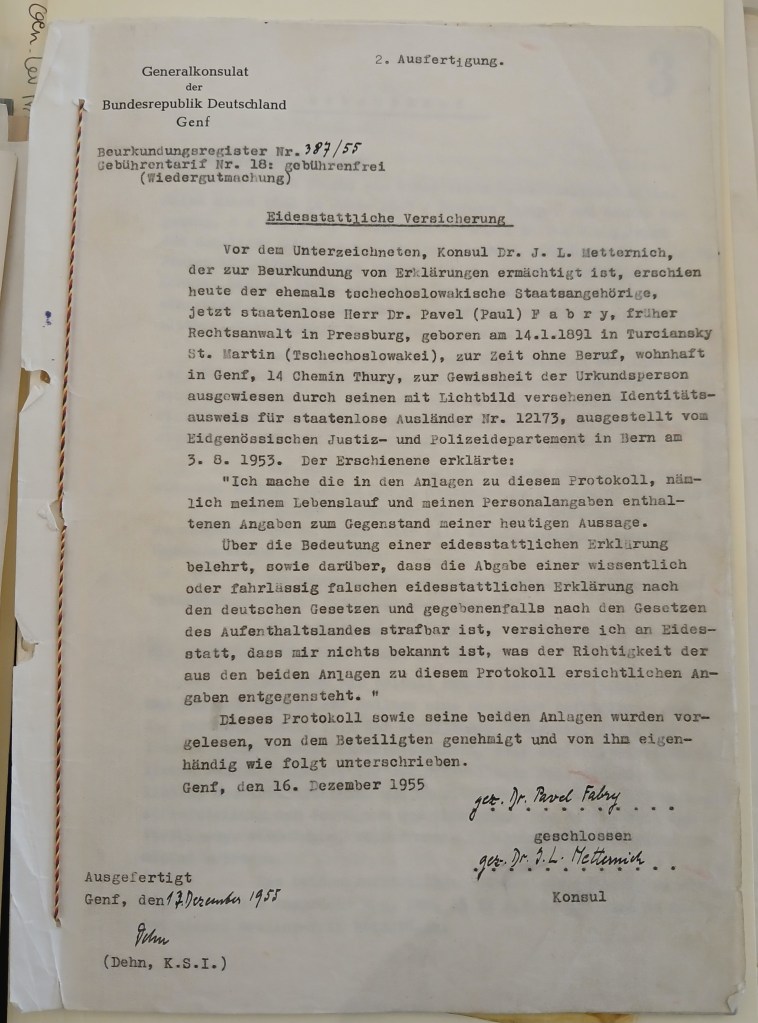
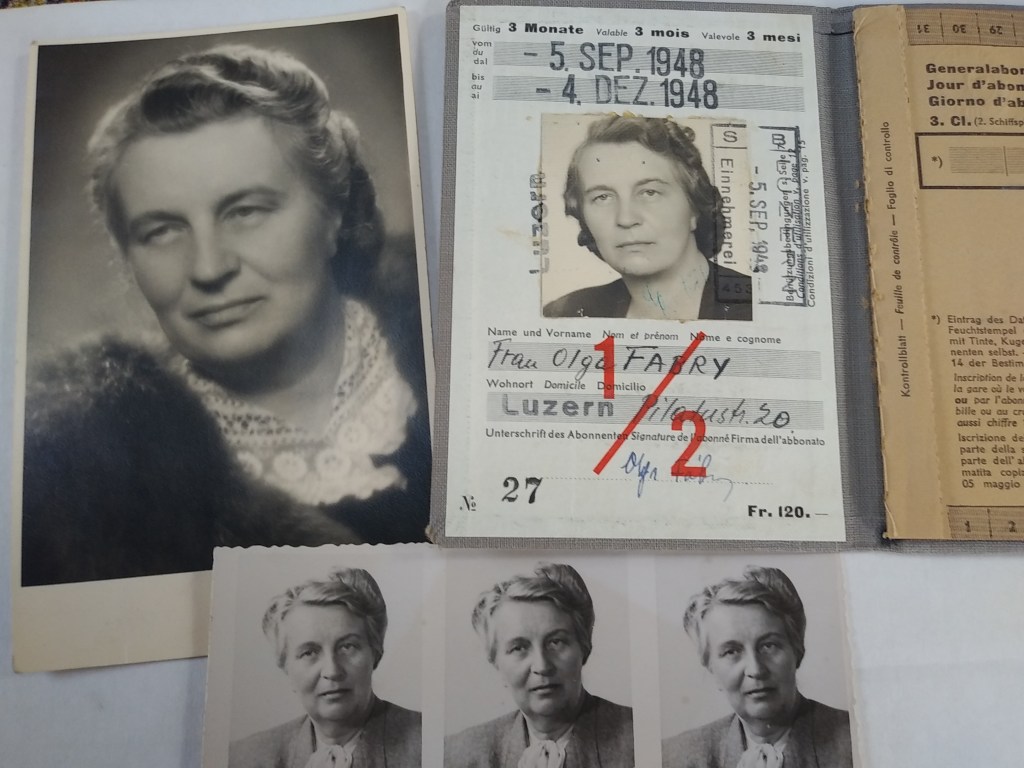
Affidavit of Olga Fabry nee Palka from Bratislava, Slovakia, currently political refugee in Geneva, 14 Chemin Thury in Switzerland.
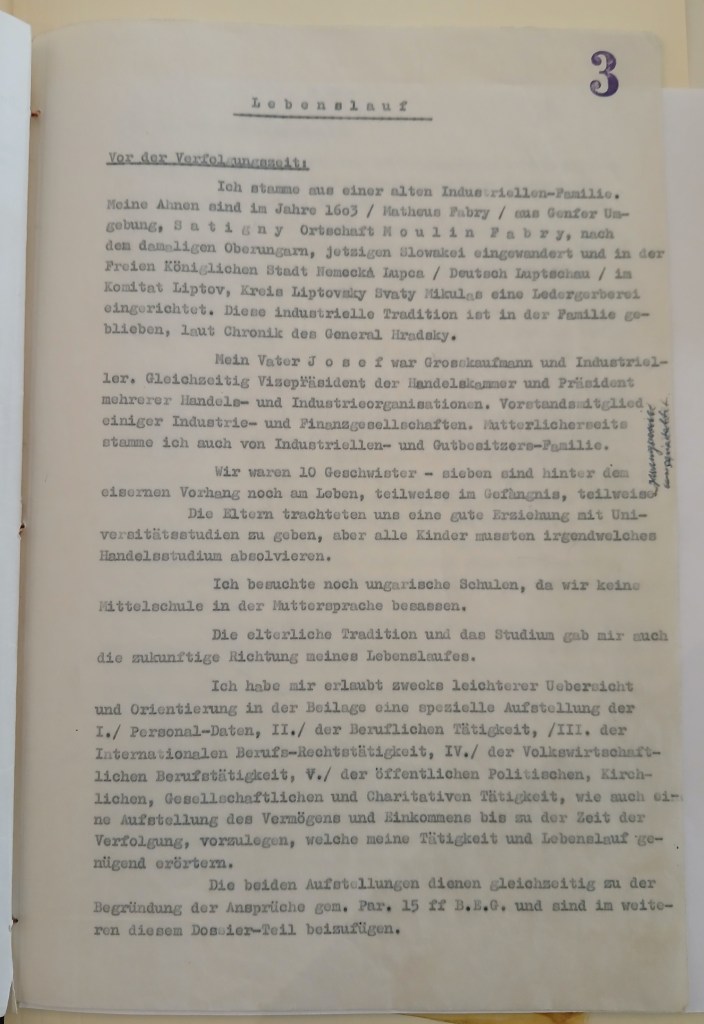
Curriculum Vitae I. Before the Persecution
I come from an old industrial family, I was born in Liptovsky Svaty Mikulas, Slovakia on November 18, 1895, so I am 62 years old. All of my ancestors made a major contribution to the economic development of Slovakia, at that time still within the framework of the Austrian monarchy. My Grandfather, Peter Palka, was one of the founders of financial development in Slovakia, organizing the first savings banks and laying the foundations of the largest pre-war Slovak bank. My father, Viktor Palka, continued this tradition and his life’s work includes the development of the Slovak paper industry. My ancestors played an important role in public and church life, and my father’s bequests for charitable purposes were also noteworthy. I was the only child in this family, and therefore my parents tried to place the greatest value on my upbringing.
After completing secondary school, I was sent to one of the best higher institute for girls of the then Austro-Hungarian monarchy in Vienna, in the Graben, for further academic training, and I completed these studies in Vienna. My parents tradition and this first class education gave me the future direction for my C.V.
In 1919, I met the then High Commissioner of Slovakia, Dr. Pavel Fabry, and got married. There are two children from this marriage. The son, Dr. Jur. Vladimir, currently Legal Advisor to the Secretary-General of the United Nations, and the daughter, Olga, currently a librarian at the United Nations in Geneva.
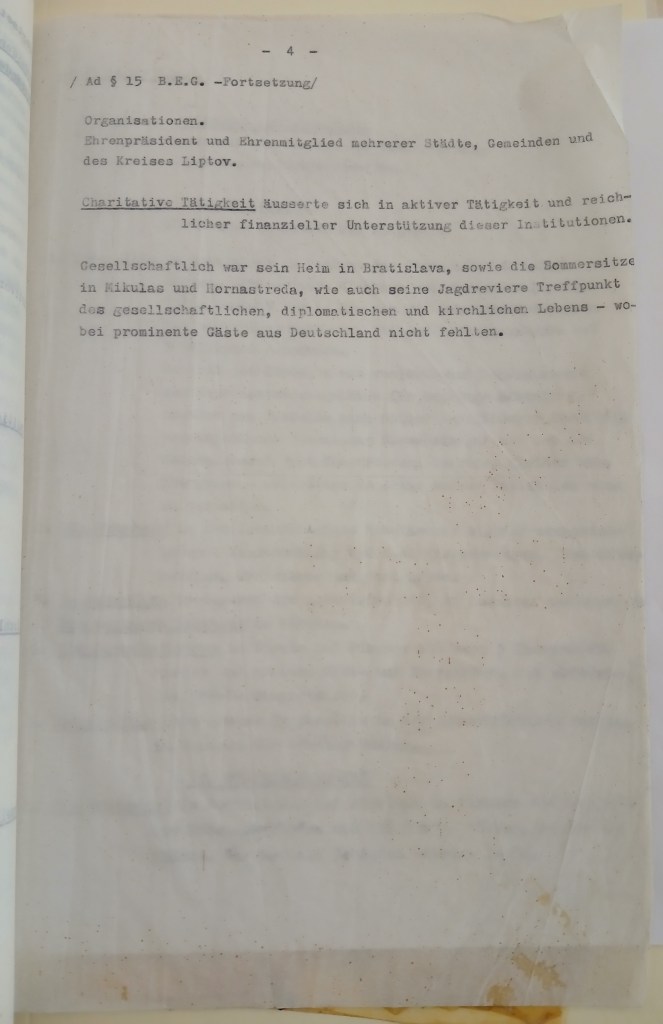
Following the tradition and education described above, I devoted myself to social activities with deep understanding and zeal. In particular, concern for working girls, who had to work outside of their parent’s home, has become my life goal. The World Organization of the Young Women’s Christian Association, the Y.W.C.A., was my example. With the help and advice of this organization, I co-founded the Slovak Y.W.C.A. First I served on the select committee and later as President. Or course, this was an honorary position without salary and without any income. I kept this position until I was expelled from Bratislava by the Nazi rulers. Under my presidency, several dormitories and catering kitchens were built, where the working girls, regardless of faith or nationality, were given accommodation and board or boarding for a very small fee, which did not even cover the management. Several hundred girls were carefully looked after every day. In addition to this activity, I was a board member of several social institutions. My own financial resources at that time allowed me to support these institutions financially. In fulfilling my family duties and the above mentioned social work, I was hit by the surprise attack on Slovakia by the Hitler regime.
II. During the Persecution
My husband, who in his public activities was one of the most zealous advocates of the democratic creed, was of course a thorn in the side of the dictatorial rulers and, as was well known, he was the first Slovak to be arrested by the Nazi regime and, with some interruptions – due to serious illness and damage to health – was held for almost two years in concentration camps, deportations, confinement under police guard, etc. As a faithful wife, I had to bear these persecutions with double concern. With the changing arrests he was always dragged out of sleep at night, and I had to run around for days – even weeks – just to find out which prison or concentration camp he is in, or where he was deported again.
My mental anguish was indescribable and I was repeatedly subjected to hours long interrogations, often at night. The frequent house searches were always intentionally carried out at night. Until my health reserves were available to me, I endured all this nerve-wracking bullying with courage and self-sacrifice – but these constant debilitating shocks meant that I often suffered nervous breakdowns after inhumane interrogations and examinations, and only the self-sacrificing care of the board of the University clinic, of Prof. Dr. Derer and his colleagues, was able to prevent the worst. After the severe attacks I suffered, I had to stay in bed for days – even weeks – and endure the regime’s repeated harassment. In this state, exhausted by mental suffering, I was then struck by the direct personal persecution of the Nazi rulers.
As I stated in the first part of my C.V., I was President of the Y.W.C.A. Institutions that provided housing and board for the working girls. These houses and kitchens were modernly furnished for both accommodation and catering for a capacity of more than a thousand girls a day, and the Nazi rulers wanted to get hold of them for their Nazi “educational center”. As President, I resisted with all my might – supported by the public and the hundreds of working girls who enjoyed the benefits of our institutions – to make these social houses available to the devastating anti-social activity of Nazis. I was, for this reason, subjected to several harsh investigations in the Ministry of the Interior, and even at the institutions night searches were carried out, to unearth any material against the institution, but without any success. I stayed strong.
The accounts were then blocked under impossible charges, whereupon I, together with my husband, provided the necessary financial resources, and the girls also helped with the collection. Naturally I have the resentment of those in power, not just on my husband, but directly concentrated on me. I was threatened with stricter measures, but true to my commitments I made with the working girls, I did not back down. That is why those in power were just waiting for a suitable opportunity to carry out their threats against me.
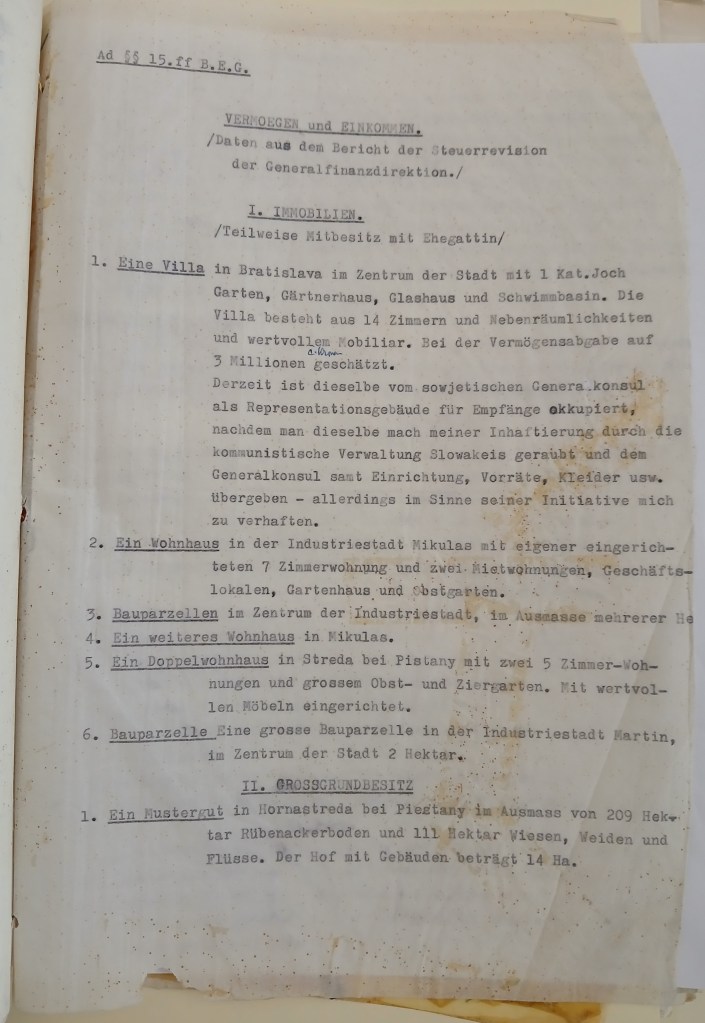
The Nazi envoy Killinger in Bratislava instructed the government to immediately “rent” our villa on Haffnerova in Bratislava for his personal use. My husband, who was previously transferred from the concentration camp to the clinic just to be cared for at home, but under constant police surveillance (the policemen were in the hall of the villa day and night), let the government know that he will never, under any conditions, rent our villa to Ambassador Killinger – whose deeds he knew well. The police and the Gestapo broke into the villa that same evening.
First they searched the house for hours and, upon presentation of an expulsion order, formally kicked us out of the villa under inhumane conditions. We were only allowed to take one dress and one pair of underwear with us, and when my daughter, who was 11 years old at the time, was crying and demanding her school books and school work, she was pushed away and shouted down. At midnight, in the pouring rain, we were led to the train station like criminals, and my husband and son were taken away to the confinement location with additional police escort and again guarded with police.
I suffered a severe nervous breakdown and was taken to relatives with my daughter. The villa was sealed, but every night a Gestapo detachment came in to inspect the villa – whereby some items of value always disappeared. When I recovered from the nervous breakdown, I was immediately expelled from the city and confined in a village near Piestany, then on to Martin and again to Mikulas, under constant police surveillance. The public was so outraged by this action, that the envoy Killinger did not immediately “rent” the villa. But those in power had achieved their goal regarding the Y.W.C.A. Under the pretext that I was expelled and cannot exercise the office of President, a provisional management was set up with the aim of liquifying the institution. When the institution was liquified as such, the buildings, kitchens, etc., were simply confiscated as unclaimed property, and assigned to the Nazis reformatory with all the valuable furnishings.
However, the persecution measures against me continued to be physical. I was suddenly ordered back to Bratislava from the place of confinement with the instruction to wait in front of the door of the villa, until I received further instructions. I waited there under the supervision of a Gestapo policeman in the bitter cold from morning to night. Tired from the night’s journey, I could not even stand on my feet in my weakened condition, and when our gardener offered me a chair from the garden shed, he was shouted down by the Gestapo police officers. I was ordered back the next day to the front door of the villa, but received no instruction until evening. This was repeated for some days. In the severe December cold, my feet became frostbitten and I contracted muscle and vein inflammation, so that the doctors stepped in energetically and I had to be transferred into medical care.
Then a Gestapo officer appeared and told me that if I rented the villa immediately, I will be given all the things from the villa, except for the furniture, and I can return to Bratislava. But I had to stand by my husband’s decision. I was threatened with more severe “measures” besides confinement. The outrage against the envoy [Killinger] was so great on the part of the population, that he was transferred to Yugoslavia[Romania – T.B.], because his “Femegerichte”[?] were found out in Bratislava. After his departure I was informed that I can return to Bratislava, however, my husband continued to be confined with our son.
How cynically they wanted to increase my mental and physical suffering, I have to mention that the Minister of the Interior, when he left me standing for days in front of the villa, gave a radio speech in which he made the most humiliating spot about me personally, saying, among other things:
“If you want to see a little repeat of the wailing of the Jews at the Wailing Wall of Jerusalem, go to the front of the Fabry villa on Haffnerova, there you will see a woman, one of the most stubborn opponents of the National Socialist Order, leaning against the wall of the villa, crying, lamenting.”
Yes, they even directed mobs in front of the villa who laughed at me!
Of course I did not cry, although the cold during the hours brought tears to my eyes. I could not look forward to returning to the villa.
The repeated arrests of my husband, his inhumane persecution, plus my persecution, the constant humiliation, seizure of assets, the political trials against my husband, fines of Millions, etc., and this with all humiliating accompanying circumstances, my nerves and my whole state of health were so badly damaged by the public scorn, that I was ordered by specialists to the sanatorium in the Tatra mountains. After long weeks there was a temporary improvement.
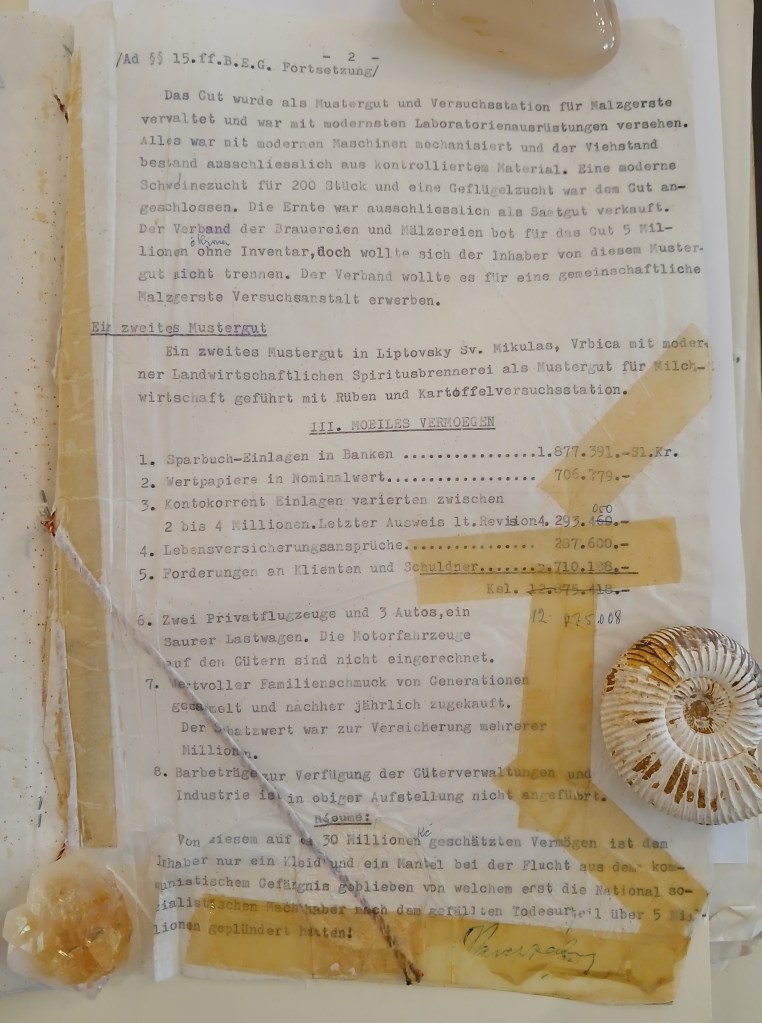
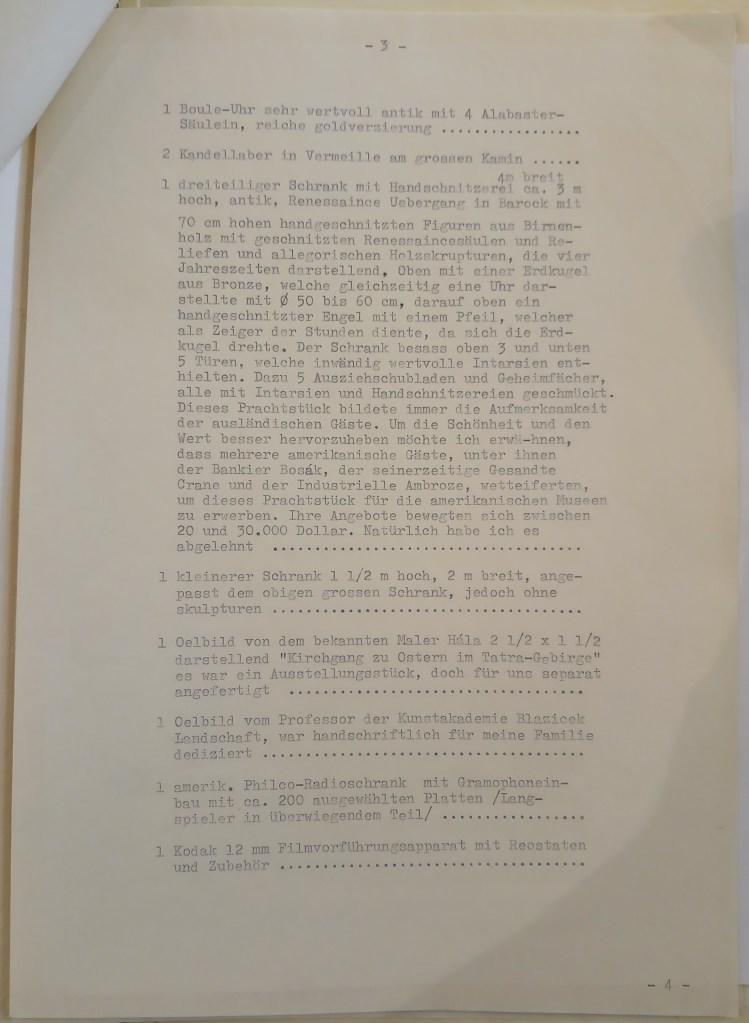
But the cup of torment was not yet fully exhausted, when I heard the news that my husband was sentenced to death for providing assistance to the people to be deported, and for thwarting the deportation of the residents of the district. In the radio broadcasts, our whole family was subjected to the basest abuse, and finally I had to escape from the threat of arrest and danger to my life, on the coldest night of March 1944, to a remote forest village, spending hours wading in snowdrifts between two moving fronts. It is only thanks to the compassionate care of the villagers that I stayed alive. Perhaps the later news that my husband was freed by the resistance movement during the changing battles for the town of Mikulas, and taken to a safe hiding place, gave me back my life back. I had to learn quite apathetically with the same news that the Gestapo, after the death sentence, confiscated all of our mobile assets onto several trucks and were taken away. All valuables deposited in the bank safes and precious jewelry collected from generations. After the front had been moved, I was again transferred to the sanatorium in the Tatras for weeks of care.
III. After the Persecution
Both our home in Mikulas, as well as the villa, were badly damaged by bombardments and plundered by the retreating troops. The reaction of the four hard years had changed my state of health more and more intensively. I went to Switzerland to be with my daughter who was studying in Lausanne at the time, but already in Zurich I had to be taken care of by Prof. Dr. Frey.
After returning[to Bratislava], I had to watch as the Bolshevik tendency is gaining ground in seven-league boots. The fight against the danger was hopeless because of the incomprehensible attitude of the West. The violent coup organized by [Valerian] Zorin succeeded and the Iron Curtain rolled down. I managed to make another trip for the Y.W.C.A. Headquarters meeting in Geneva, where I met my son. The events in Czechoslovakia had persuaded me not to return, all the more so since my health had deteriorated so much that I had to be taken care of by Prof. Dr. Saloz in Geneva. After weeks, the care had to be extended again, for which the Swiss authorities offered me a helping hand.
So then I got the news that my husband was thrown back into prison by the communist rulers. As we were later told, at the request of the then Secretary-General of the Hungarian Communist Party, the notorious [Matyas] Rakosi. It was revenge for my husband’s actions in 1919, when he fought against communism as High Commissioner, when the Bolshevik detachments broke into Slovakia. After 7 difficult months in prison, my husband managed to escape from the communist prison, in January 1949, and to get to Switzerland. Since then we live in Switzerland.
Since I entered Switzerland with only a small suitcase, and my husband fled in only a dress [Pavel Fabry disguised himself in a nun’s dress to escape. T.B], and everything from our home was confiscated, we have remained completely penniless, and relied only on the help of our son.






















 Vlado
Vlado 