Here are more newspapers from New York, from September 19, 1961 to May 3, 1962, which support the evidence of the only survivor of the Albertina, Sgt. Harry Julien. For context of these events, please read Susan Williams’ most recent essay, published in The Yale Review, “Revisiting Dag Hammarskjold’s Mysterious Death”. Part one of this series can be found here.
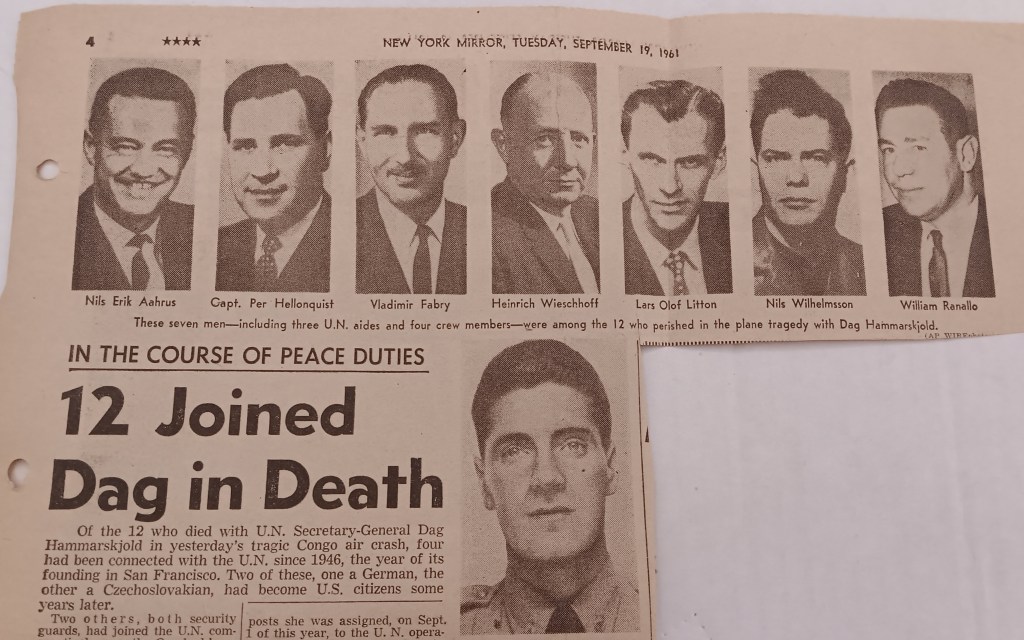
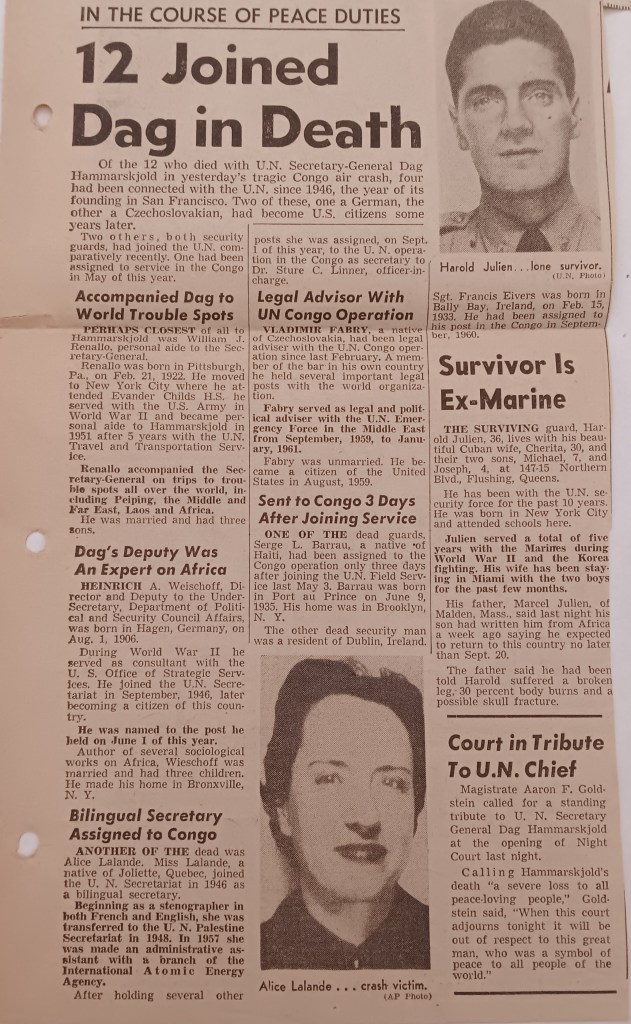
The NYT, 19 September 1961. From article “Hostile Jet Cited in Crash”: “Jacques Poujoulat, personal assistant to Dr. Sture C. Linner, chief of the United Nations mission in the Congo, described the circumstances off the ill-fated flight. He said he “could not answer” when he was asked whether the possibilty that the plane might have been shot down could be ruled out. He declared, however, that the United Nations had been “unable to make daylight flights” because of constant attacks by enemy jet aircraft. He said that the timing of the Secretary General’s night flight to Northern Rhodesia was “at least partly” because of the attacks by enemy aircraft.”The NYT, 19 September 1961. “[Poujoulat] said that seven hours after the plane took off from Leopoldville yesterday an “unidentified aircraft” flew over Ndola airport and that at about the same time the police reported a “flash in the sky.”The NYT, 19 September 1961. “The jet fighter has been the greatest single threat to the United Nations troops in Katanga, the pilot, who flies two planes alternately, has been strafing and bombing United Nations forces in Elisabethville, Kamina and Jadotville every day. United Nations officials believe that one of the two planes is being reloaded and refueled while the other is in action. The United Nations announced yesterday that three Ethiopian jet fighters were “on their way” to Katanga to oppose enemy fighter planes. Today it was learned from qualified sources that the planes had not arrived because British authorities in Uganda had refused to let them make a refueling stop.”New York Herald Tribune, 19 September 1961. From article “Survivor Says Blasts Shook Plane”: “The wreck was reported first spotted by a Negro charcoal burner, then by a Royal Rhodesian Air Force crew. It was still smouldering when a ground search party arrived in mid-afternoon.”New York Mirror, 19 September 1961New York Mirror, 19 September 1961. Col. Don Taylor is a typo for Col. Don Gaylor, who was sent to Ndola by the Pentagon on September 15. “Col. Don Taylor[sic], U.S. air attache in Pretoria, South Africa, who circled the wreck area until ground parties arrived, said it seemed obvious the plane was making an approach to Ndola Airport when it crashed about six miles away. Taylor said it looked to him as though the pilot misjudged the height and that the plane’s undercarriage caught in tree tops.”
From Susan Williams’ essay: “One other aspect of Gaylor’s involvement is worth noting. After the Albertina failed to land, a team of Norwegian U.N. soldiers flew to Ndola to assist in the search. Their aircraft was parked near Gaylor’s DC-3. Because of white Rhodesians’ hostility to U.N. personnel, they were not allowed to enter the airport terminal. So Gaylor’s crew invited them on board to get some food. To the surprise of U.N. soldiers, they discovered that the American plane was packed with highly sophisticated radio equipment.
“We know from other testimony that the U.S. Embassy in Leopoldville was communicating with Ndola via a U.S. aircraft, which presumably was Gaylor’s DC-3. And that may explain an intriguing aspect of the story, namely that Edmund A. Gullion, the U.S. ambassador in the Congo, sent a cable to Washington on the morning of September 18 that explicity referred to the possibility that the plane was shot down. “Hammarskjold’s plane believed lost in vicinity Rhodesian border near Ndola,” the cable read. “There is possibility he was shot down by single pilot who has harassed U.N. operations and who has been identified by one usually reliable source as van Riesseghel, Belgian, who accepted training lessons with so-called Katangan Air Force.” (The ambassador’s communique included an error — the name of the pilot in question was Jan van Risseghem.)”
New York Mirror, 19 September 1961New York Mirror, 19 September 1961The NYT, 20 January 1962. “NDOLA, Northern Rhodesia, Jan. 19 (Reuters) — Two planes passed over Ndola shortly before Mr. Hammarskjold and fifteen other persons died in the air crash near here, a witness told an inquiry here today. T. J. Kankasa, an African municipal official, told the Rhodesian federal inquiry that one of the planes had its lights on and appeared to be a transport while the other was a “smaller aircraft without lights.” “It seemed as if the smaller plane was beaming lights on the large aircraft,” he said.”
From Susan Williams’ book, “Who Killed Hammarskjold?”, pages 107 and 109: “The UN Commission supplemented its findings by employing a consultant named Hugo Blandori to carry out some background research in Ndola.” […] “Blandori included in his memorandum some observations on the appearance of Bo Virving at the Commission hearings. Virving, he reported, had put forward the theory that the Albertina had been shot down or forced down by a plane above it. He based his theory primarily on the statements of African witnesses and told Blandori that he believed the Rhodesian authorities had suppressed their evidence.
“It was Blandori’s view that the Africans giving testimony had no experience of aircraft, so didn’t know what they were talking about. But this was not the case. For one thing, the witnesses lived very near the airport and had daily experience of the comings and goings of planes; and for another, some of them, such as Timothy Kankasa, had worked with planes during the Second World War[as a signalman].”
Who was Hugo Blandori? According to this article by Jerry Dumas, “Hugo Blandori [was an] F.B.I. agent and also a YMCA regular, who died beside me on the Y handball court”. And according to this article about Anne Cioffi, who was his former secretary, Blandori was an F.B.I. agent who later became a private investigator, but I don’t know when exactly that change happened. From the article:
“I used to babysit his kids,” she said.
One day Blandori told her he needed a secretary and she took the job.
“He taught me every angle of his business,” she said, adding that was unusual in those days because women weren’t often afforded such opportunities.
Cioffi said Blandori was affiliated with former FBI agents who did private investigating all over the world and, with her as his secretary, specialized in pre-employment screenings.
“Years ago you could do that,” she said.
The company also conducted insurance and fraud investigations, and occasionally cheating-spouse cases.
“I didn’t like those very much,” said Cioffi.
She said the two worked together until the day Blandori went to play handball in Greenwich and died of a heart attack.
“He was only 50,” she said.
Cioffi said Blandori’s widow knew nothing about the business so Cioffi ran the business herself until another former FBI agent bought it.
[…]
She said her husband, Carmine, and all her connections from her time with Blandori encouraged her to get her own private investigator’s license, so that’s what she did.
“I had my own office in Norwalk,” she said saying she did a lot of work for former FBI agents and even worked on a case or two for Interpol.
“It worked out very well.”
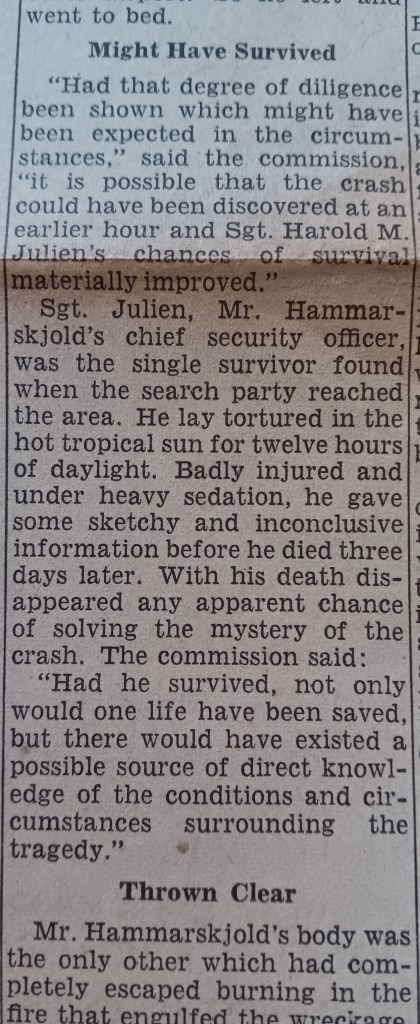
The NYT, 3 May 1962, “Cause of Hammarskjold Crash Still a Mystery as Inquiry Ends”: “[…] Dr. M. Frei-Sulzer, a Swiss police official, who was appointed by the commission to examine the wreckage of the Secretary General’s plane, which crashed near Ndola, Northern Rhodesia, attributed the disaster to the plane’s low altitude as it approached the airfield at Ndola after it had been cleared by the tower for landing.” [note: The Albertina was equipped with radar!] […] “Dr. Frei-Sulzer reported that “the only abnormal fact was the dangerously low altitude of the aircraft in relation to the airport elevation, probably due to human failure.” Dr. Frei-Sulzer is chief of the scientific department of the Zurich police and professor of science at the University of Zurich.” […] “The commission, which was appointed by the General Assembly last October, completed its report in Geneva March 8, three weeks before Dr. Frei-Sulzer submitted his findings to it.” […] “The [UN] commission criticized Rhodesian authorities for the fact that the wreckage was not found until fifteen hours after the crash. It said that Harold Julien, a United Nations guard who died several days after the crash, would have had a better chance for survival if the Rhodesians had shown more diligence. A report by the Royal Medical Board of Sweden said that a post-mortem indicated that, contrary to reports at the time, the Secretary General “lived for a certain period of time after the crash.” It said that he was the only person aboard the plane who had completely escaped burns.” […] “The Rhodesian and Swedish doctors agreed that bullets found in bodies of Mr. Hammarskjold’s guards had been exploded by the fire that consumed the wreckage and had not been fired from a weapon. Their finding were supplemented by Dr. Frei-Sulzer, who reported that there were no bullet holes in the plane and no evidence of explosives that would have been needed for a time bomb or other means of sabotaging the plane. However, the United Nations Commission examined at length the question whether a Fouga Magister fighter plane of the Katanga forces, “which had been operating against the United Nations in Katanga,” or some other plane [note: De Havilland Dove], had shot down the United Nations craft. It noted the reports of the Rhodesian inquiry board that the plane did not have sufficient range to fly from its base at Kolwezi and that the pilot had stated that it was on the ground on the night of the tragedy.”
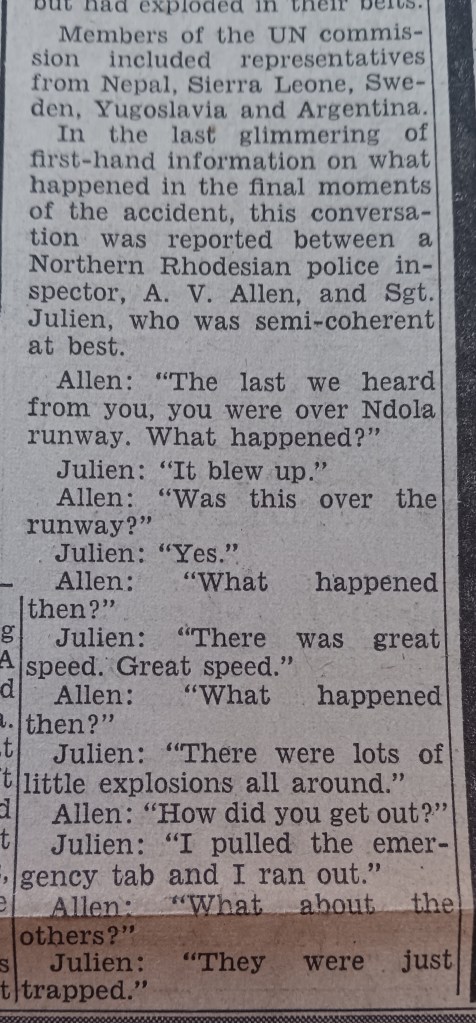
New York Herald Tribune, 3 May 1962, This article continues the narrative of down-playing and discounting the testimony of Sgt. Harry Julien, “Dag’s Death Probe: Still a Whodunit”: “Sgt. Harold Julien, Mr. Hammarskjold’s chief security officer, was the single survivor found when the search party reached the area. He lay tortured in the hot tropical sun for twelve hours of daylight. Badly injured and under heavy sedation, he gave some sketchy and inconclusive information before he died three days later. With his death disappeared any apparent chance of solving the mystery of the crash.” New York Herald Tribune, 3 May 1961. From the same article, “Dag’s Death Probe”: […]In the last glimmering of first-hand information on what happened in the final moments of the accident, this conversation was reported between a Northern Rhodesian police inspector, A. V. Allen, and Sgt. Harold Julien who was semi-coherent at best. Allen: “The last we heard from you, you were over Ndola runway. What happened?” Julien: “It blew up.” Allen: “Was this over the runway?” Julien: “Yes.” Allen: “What happened then?” Julien: “There was great speed. Great speed.” Allen: “What happened then?” Julien: “There were lots of little explosions all around.” Allen: “How did you get out?” Julien: “I pulled the emergency tab and I ran out.” Allen: “What about the others?” Julien: “They were just trapped.”




 Vlado
Vlado 