
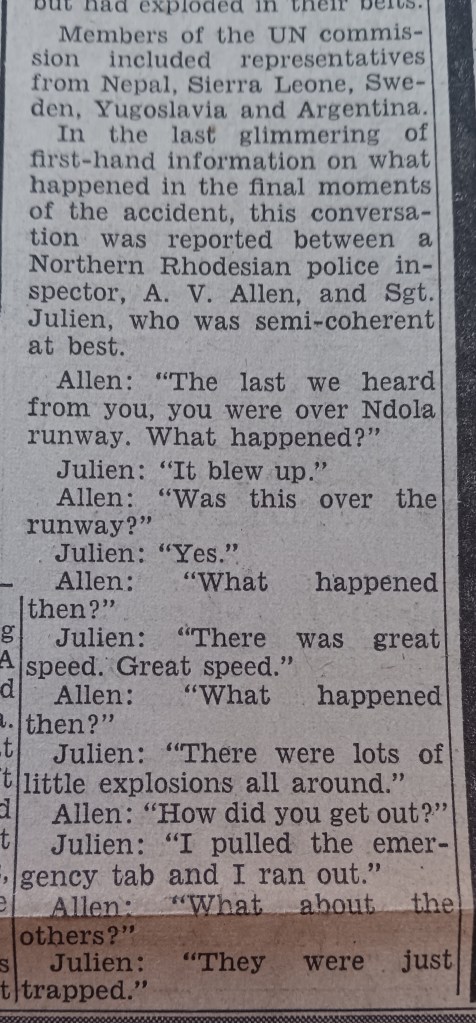
In September 2021, I posted Joe Majerle’s analysis of the Albertina crash here for everyone to read. He has revised his analysis, dated 7 June 2023, “based on information found in the personal files of the late Bo Virving, Chief Engineer of Transair Sweden, A.B., made available by his son, Bjorn Virving.” I am sharing this in connection to the testimony of Sgt. Harold Julien – and, also, to stress the importance of Bo Virving’s documents and observations. From Majerle’s analysis, pages 25-26:
“THE PRECIPITATING EVENT“
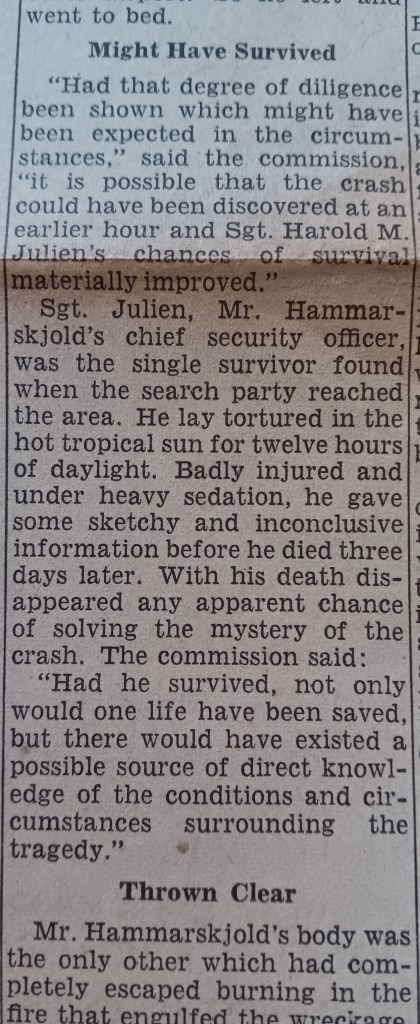
“To my observation, in the study of aircraft accidents throughout the course of my life, there is almost always a precipitating event that sets off a chain of actions, reactions, counteractions, etc. that result in the crashed aircraft somewhere on the surface of earth. In this case, it is known from Annex II that the captain communicated to Ndola tower that all was well and within minutes the aircraft was being incinerated with its own wing fuel and that fifteen of the sixteen occupants’ lives has ended, and that the last would succumb in less than a week. That person, Sgt. [Harold] Julien, was the only eyewitness to the crash.
“To my experience, eyewitness testimony is considered evidence in a court of law, at least in this country. I am unfamiliar with Rhodesian law in the 1960’s, but in the USA in the 1960’s Sgt. Julien’s statements would have been considered evidence in a crash investigation. Since there is no other actual evidence to the contrary, and testimony of ground observers about the airport over-flight and entry to the instrument approach procedure are insufficiently conclusive to determine externally what the precipitating event was, it seems logical to me that Sgt. Julien’s statements, as brief as they are, are the only thing that can be considered as evidence in a search for the cause of the chain of events leading to the crash.
“In the UN Commission report, par. 129., Senior Inspector Allen testified to the UN Commission that he spoke with Sgt. Julien and asked him three questions; 1.”What happened? He said: ‘It blew up’.” 2.”Was this over the runway? And he said ‘yes’. 3.”What happened then? And he replied: ‘There was great speed – great speed’.”
“It blew up–“
“–over the runway”
“I have read all three of these reports several times and still don’t understand the reluctance of the investigators, including the UN and the Swedish observers, to not make those six words the central point, the number one item on the list of where to begin to find the truth about what happened. Especially from the standpoint of determining whether or not there is fault to be assigned to the flight crew.
“Assuming Sgt. Julien was belted into any seat in the forward cabin, looking out the side window on whichever side he was sitting on, he may or may not have had a view of the lighted runway and the town of Ndola but it is likely that the captain would have informed the passengers that they had arrived overhead Ndola and would be setting up to land there. It would have been the last thing he could identify location-wise and anywhere in that vicinity for him would be “over the runway”. I don’t know if Inspector Allen was deliberately trying to trip him up or why he asked him if it was over the runway when he knew that the aircraft had overflown the runway and not blown up there, but, it seems to me, it was an unusual question to ask a person in Sgt. Julien’s condition. What I am getting at here is that Sgt. Julien knew where the runway was and that the aircraft had blown up. They sound like lucid answers to me, and not as though he was thinking about horses or submarines, for example.
“In my view, in light of all the data and evidence of all of the pages of all the reports and the information displayed in all of the images of all the photographs in the UN file, the only thing I can see that qualifies as a precipitating event is Sgt. Julien’s: “It blew up”.
“And he was the only one left that was there when it happened.”
As I pointed out in part two of this series, Hugo Blandori was a “retired” FBI agent, turned private investigator, who was hired by the UN as a consultant to this investigation. It is extremely upsetting to me that an FBI agent was involved, not only because of the racist history of that organization, but because of the role the FBI played during the McCarthy witch-hunt on United Nations staff members in 1953. Trygve Lie, the first UN Secretary-General, gave the FBI carte blanche of headquarters “for the convenience”, and it was his successor Dag Hammarskjold who protected his staff and kicked out the FBI by November 1953. Within every organization, including the UN, there have always been members who are actively working against the good that that organization is trying to achieve, and that is how I believe Hugo Blandori got the job of consultant. This is also how Dr. Max Frei-Sulzer – a Swiss police official that believed Hitler’s diaries were real – was appointed by the UN commission to examine the wreckage of the Secretary-General’s plane, and “who reported that there were no bullet holes in the plane and no evidence of explosives that would have been needed for a time bomb or other means of sabotaging the plane”. In my view, the contributions of Blandori and Frei-Sulzer are not just highly suspect, they discredit the investigation – I believe intentionally so!
This is why I am grateful for Bo Virving (and his son, Bjorn!), who was the smartest man on the scene in Ndola – an honest man – who saved important documents from the investigation, convinced that the crash was not an accident and that African witnesses testimony were deliberately ignored.
From Virving’s documents, “Memoranda submitted by Mr. Hugo Blandori, Consultant”, 21 February 1962, pages 8-9:
“Mr. Virving, in his appearance before the Commission, presented a theory wherein he claimed that aircraft SE-BDY had been shot down or forced down by a plane above it. He based his theory primarily on the statements of African witnesses that had been interviewed in Ndola. I talked with Mr. Virving at length after his appearance before the Commission, but he could not elaborate nor could he suggest any ways and means of confirming his beliefs. He made it known that the Rhodesian authorities had sought to suppress those witnesses whose testimonies were embarrassing to the Rhodesians and to emphasize those who vindicated their stand.
“Virving stated that he was limited in his movements and was unable to undertake an independent investigation to further his theory.”
From pages 9-10, Blandori writes this about the African witnesses:
“Concerning African witnesses, I wish to point out that it is most difficult to distinguish from their testimony what is truth and what is fiction or imagination. There were so many inconsistencies and discrepancies in their stories that to have believed them would refute the testimony of other witnesses who are generally reliable.
[…]
“As a consequence, I am of the opinion that the testimony of the African witnesses to the effect that they saw one or more small crafts flying along with SE-BDY just prior to its crash, has to be accepted with a grain of salt.”
From “Report of the UN Commission of Investigation, 1962” p.46, par.143:
“Mr. Virving, a Transair official, put before the Commission a theory that SE-BDY might have been attacked and shot down by a plane armed with rockets. This theory was based in part on an analysis of the statements of various witnesses concerning their observations of planes and of flashes in the sky. No substantial evidence was submitted in support of this theory and the Commission is of the opinion that most of the phenomena referred to by Mr. Virving are susceptible of other and more logical explanations. The Commission also consulted rocket experts with ONUC who expressed considerable doubt concerning the possibility of such an attack. Finally, as already noted, no signs of a pre-crash explosion or traces of a rocket were found in the wreckage.”
From Susan Williams’ “Who Killed Hammarskjold?”, 2016 edition, chapter 7, p. 99:
“All these [African] witnesses were challenged by the Federal examiner. Afterwards, Bo Virving followed [Dickson] Buleni and [Davidson] Simango from the court and interviewed them privately about what they had seen. They repeated their claim that they had seen two aircraft and not just one but were reluctant to talk too much to Virving, as they were being observed by a white police officer. According to Virving, their answers were reliable and tallied exactly with his own technical calculations.”
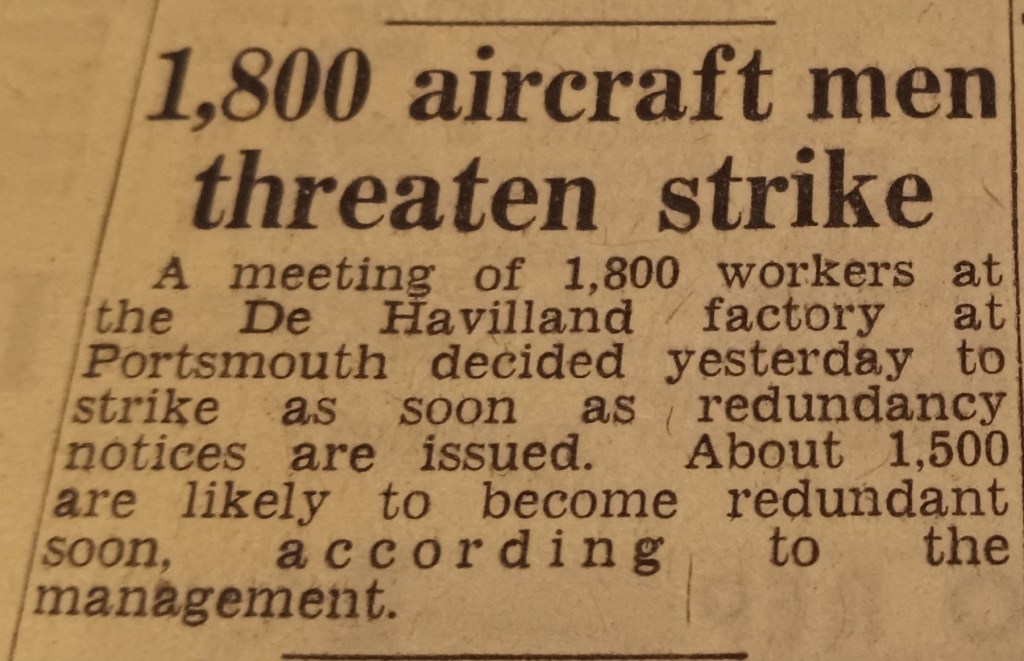
Back in January 2014, I wrote here that I was convinced that the Albertina was shot down by Fouga Magisters. I am still convinced it was shot down, but I was wrong to believe it was a Fouga. I was misdirected by all the reports in the newspapers I was looking at, and I think that was the point – that these reports on Fougas were a red herring in the press. Bo Virving’s observations led him to believe that the Albertina was shot down by a Dove, and his theory rings true for me. From “Who Killed Hammarskjold?”, chapter 15, pages 185-187:
“Bo Virving had gathered ‘overwhelming evidence’, believed [George Ivan] Smith, that Hammarskjold’s plane was ‘forced down and crashed as a result of actions from an unidentified aircraft’. This evidence was carefully explored in a series of programmes about Hammarskjold which were produced by Gunnar Mollerstedt and shown on Swedish television. Mollerstedt had spent a year gathering material–including the interviews with Timothy Jiranda Kankasa and Dickson Buleni.
“Virving stated that there were five Doves in service in the Katangese air force in September 1961 at Kolwezi and Jadotville airports. They could stay airborne for three or four hours and their speed could match that of Hammarskjold’s DC6 in level flight; and in a dive from above they could increase their speed. It would be possible for the crew of the Dove to drop a small explosive device on to an aircraft below, then pull out of the dive. Virving had developed this theory about a Dove because on the day that Hammarskjold’s body was flown out to Sweden, he had seen a Dove at Ndola airport and discovered that it had a hole in its floor, which was apparently used for aerial photography. A man could lie there, he realized, telling the pilot ‘right, left, up, down’ and at a given moment let fall a small projectile.
“The theory that a Dove could be used in this way was later confirmed by Mercenary Commander, the memoir of the mercenary Jerry Puren–which was published six years after Mollerstedt’s programme. With evident pride, Puren describes in this book his technique of dropping bombs through a hole in the floor of a Dove aeroplane, by means of a rack system rigged along the fuselage. The racks were fitted to take bombs of 12.5 kg, which were despatched one at a time through the hatch in the floor when a lever was pulled. A bombing crew consisted of a pilot, a bomb aimer and a bombardier; usually Puren flew on these bombing missions with his friend Max Glasspole, the gum-chewing Canadian pilot, or the Hungarian pilot Sandor Gurkitz–both of whom were at Ndola airport on 17-18 September 1961, when he arrived that afternoon from South Africa. According to Puren, 12.5 kg bombs were turned out by Union Miniere workshops by the thousand; each had a contact fuse in the tail section which unwound and armed the bomb when lobbed from the aircraft.
“The Rhodesian Commission of Inquiry Report acknowledged that a Dove with a bombing capacity was found in September 1961 at Ndola–but after the crash. ‘One De Havilland Dove belonging to the Katanga Government,’ it stated, ‘was after the 18th September armed by removing a door and placing a machine gun on the floor to fire through the opening.’ The Dove had not, it stated, been at Ndola on the day of the crash, but elsewhere: ‘On 17th September this and possibly another were in the hands of the United Nations at Elisabethville. Three Doves were then in the Republic of South Africa undergoing examination.'”
[…]
“Virving’s suspicions about the use of a Dove against the Albertina were heightened when he went to Elisabethville in 1962 and found that the Katangese Doves had disappeared during the August 1961 UN action to expel mercenaries [Operation Rum Punch]. Significantly, their logbooks had been left behind. Then Virving found the Pretoria workshop where the Doves would normally have been serviced and sought information ‘for historical purposes’; but after two years’ wait he was told that no information could be given.”
Jerry Puren was one of the 79 mercenaries working for Katanga that uncle Vlado had arrested during Operation Rum Punch–he was also in the bar at Ndola airport the night of 17-18 September 1961, waiting for Hammarskjold’s plane to arrive. I believe that he was one of the men flying the Dove that shot down the Albertina. It wasn’t just glory he was after, it was personal revenge against Vlado and the UN for arresting him. From page 225-226 of “Who Killed Hammarskjold?”:
“[…]Puren’s behaviour at Ndola airport that evening seems totally out of character: for even though ‘excitement ran high, history was unfolding, and we were right on the spot,’ as he himself writes, he and fellow mercenary pilot Glasspole (who was also at Ndola airport) decided to have an early night:
Shortly after 22h00 there was a rustle of excitement among the chilled gathering. Several people claimed they had heard the sound of an aircraft’s engine, others said they saw lights disappearing low in the west. We saw nothing. Eventually Glasspole and I looked at each other, shrugged our shoulders and returned to our welcoming beds at the Savoy Hotel.
“This is a very different Jerry Puren from the man of action described in the rest of his memoir: who fearlessly, for example, escaped the UN after his capture during Rumpunch, disguised as a priest.”
[…]
“Puren’s and Glasspole’s unlikely early night at Ndola does make me wonder about the Dove found by Bo Virving at Ndola airport the following day–with a hole in the bottom, through which Puren and Glasspole had become adept at dropping bombs on to Baluba villages. Furthermore, Puren was rewarded by Tshombe just a few days after this episode, by being made Chief of Operations of the Katangese Air Force, at an impromptu parade.
“One intriguing aspect of Puren’s mercenary career is that he later became involved in the failed Seychelles invasion in 1981, with which SAIMR was apparently associated.”
Lastly, in connection to mercenaries and Doves, this brief interview with author and journalist Maurin Picard:


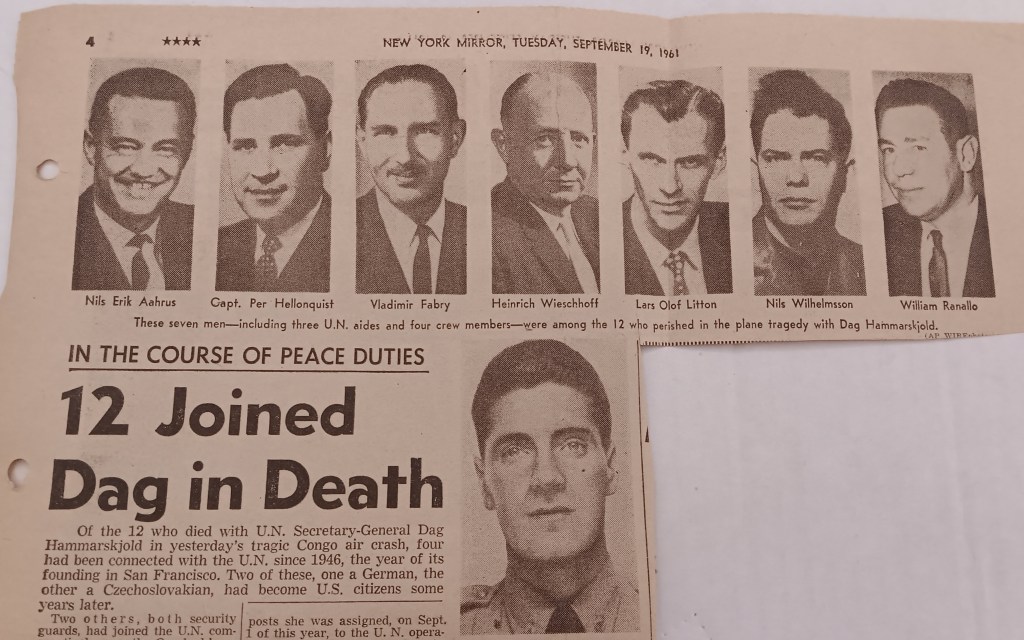
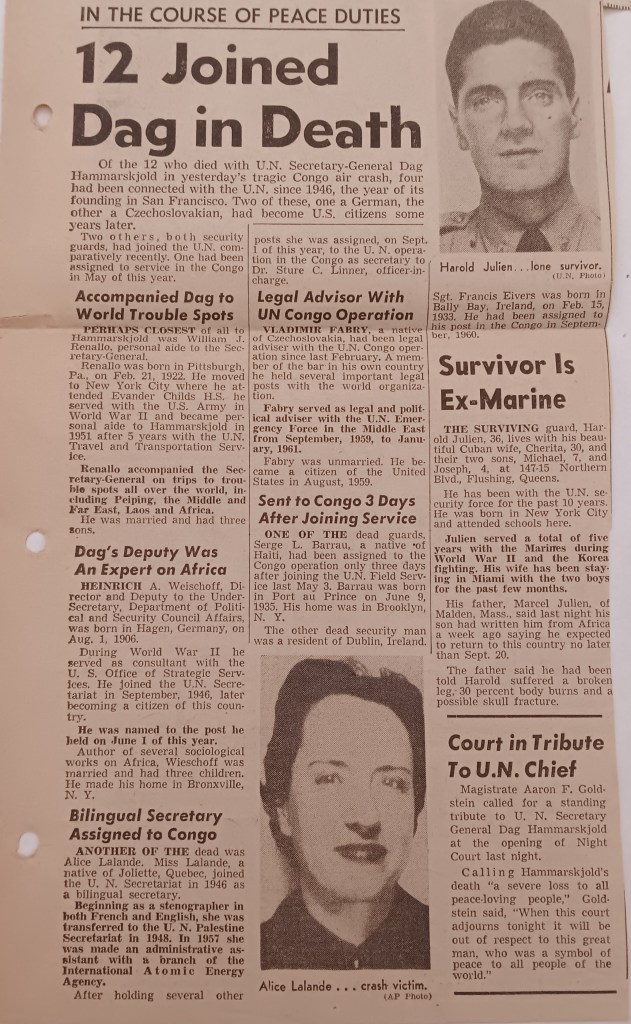


 Vlado
Vlado 