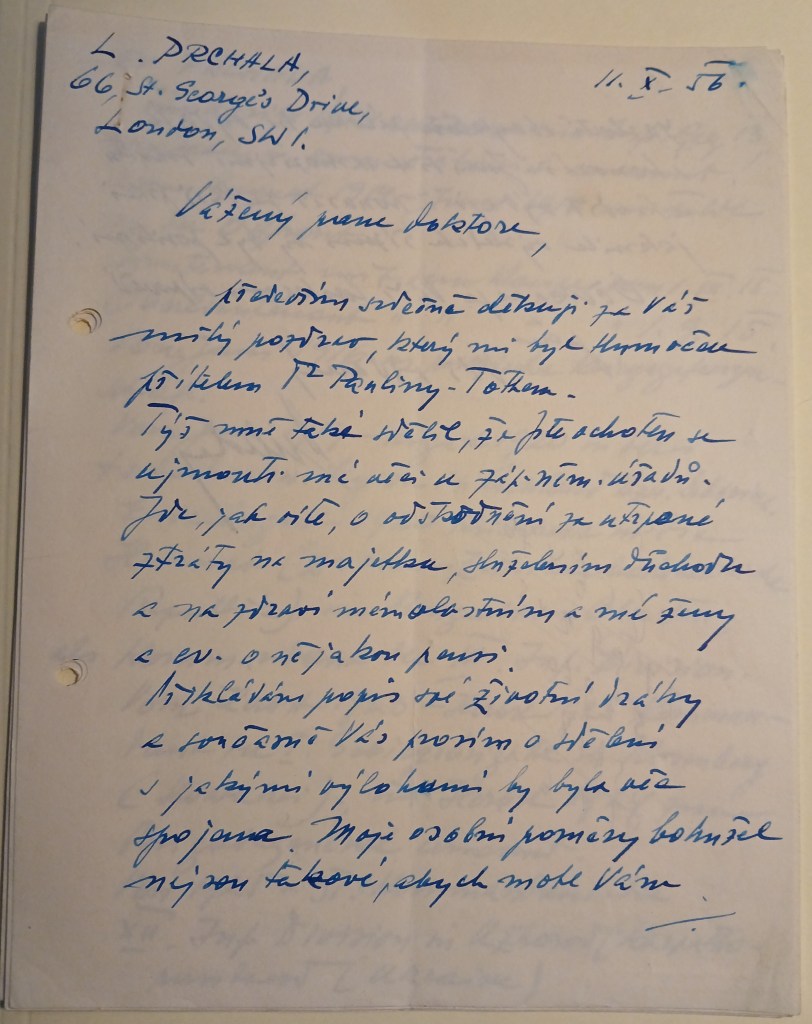
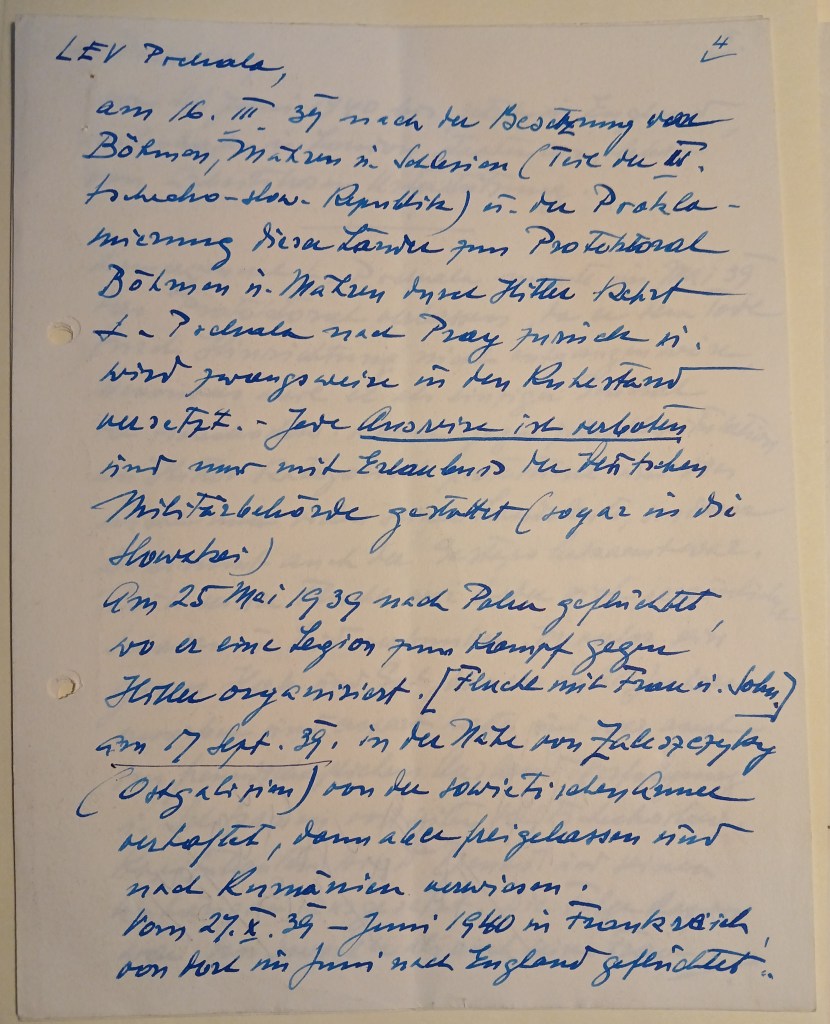
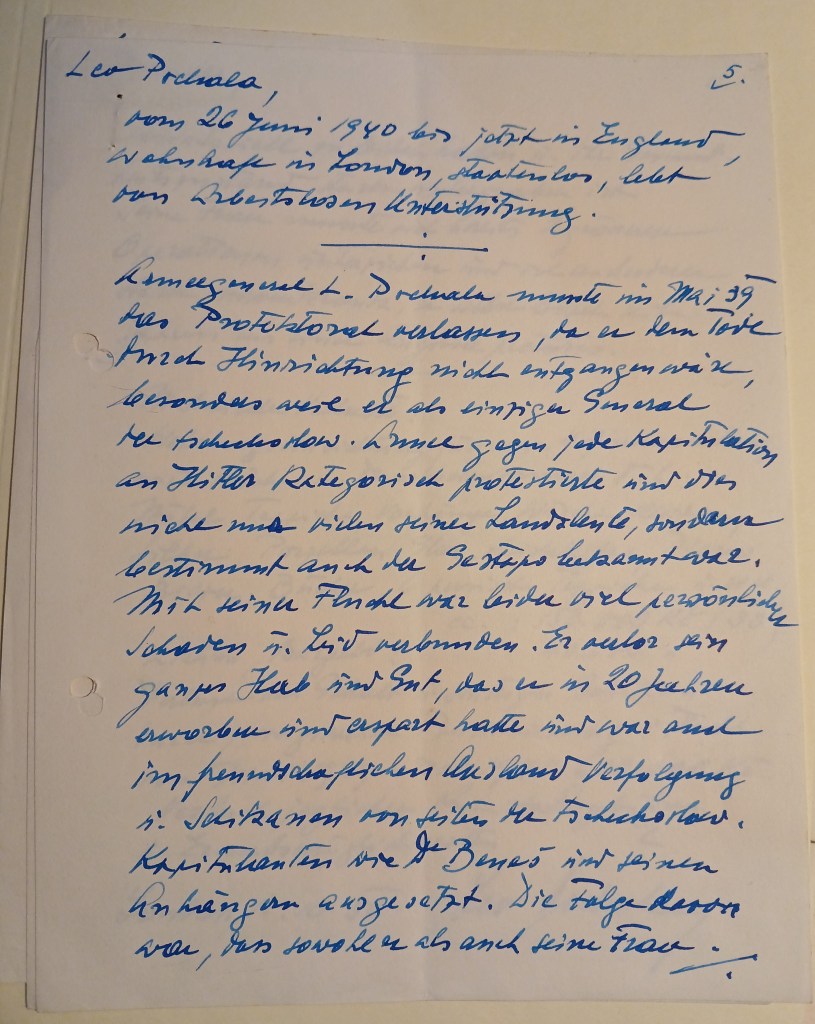
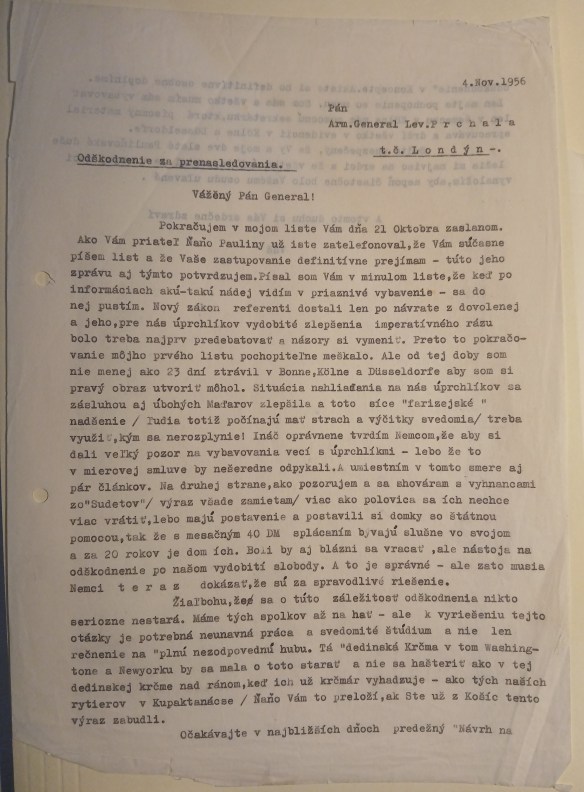
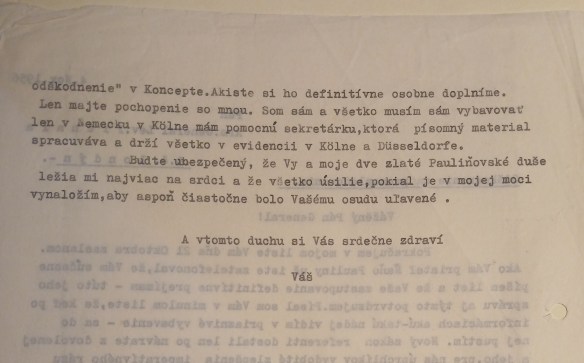
Happy birthday to Czechoslovak politician and Army General Lev Prchala, born on 23 March 1892! He sent this handwritten letter and his Curriculum Vitae to Pavel Fabry in 1956 from London, where he was living in exile. I have included the typewritten response from Pavel confirming that he will represent General Prchala for “Compensation for Persecution”.
*Update 14 May 2025: This post has been moved to the top of the page, the previous post was deleted. My sincere appreciation to Miroslav Kamenik, who kindly sent me his translation of Gen. Prchala’s letter and C.V., which I have transcribed here – thank you!
“11 Oct 1956 Dear Doctor, First of all, let me kindly thank you for your warm greetings forwarded to me by our friend Dr. Pauliny-Toth. He also stated you were ready to take care about my case by West-German offices. As you know, it is about a compensation for losses suffered in my property, service pension [MK – soldier], health of myself and my wife and possible some kind of pension. Attached is my CV as well, let me kindly ask you about the estimated costs related with my case. My personal circumstances are not such that I could send you the usual fee and advance payment for expenses. Of course, I am ready to cover your fee and all costs when the result of my case will be positive [MK – i.e. from future profit]. Awaiting your kind reply, Yours faithfully, Prchala”
“C.V.
*23 March 1892 [born] in Polska Ostrava, Frydek area, Silesia [MK – Empire of Austria-Hungary]
Roman Catholic, married with Lucie Seebode *9 August 1901 Kuokkala Finland, resident in St. Petersburg (Russia), evangelical
Children – son Ladislav Vladimir *5 Feb 1920 in Batarejnaja, Siberia (Russia), now resident in Buenos Aires, Argentina; daughter Lucie Marie *29 July 1921, died 9 Oct 1936 in Kosice [MK – Slovakia today]
Education – Gymnazium [MK – classic high school] with exam; 4 semesters of Law in Vienna; Military school in Paris 1921-23
April 1914 – activated in Inf. Regiment 13 in Krakow [MK – Cracovia, Poland today], sergeant.
August 1914 till June 1916 in the field/ eastern front of WWI
Since June 1916 in Russian captivity, in rank of lieutenant
June 1917 till August 1920 in Czechoslovak legion in Russia (or Siberia), then returned to newly established Czechoslovakia in rank of Colonel, as the commander of the III. Czechoslovak division in Russia [MK – in charge of retreating battles, towards to Vladivostok]
Autumn 1923 till autumn 1925 commander of the 1st mountain brigade in Ruzomberok [MK – Slovakia today], since autumn 1924 in rank of Brigade General
1925 till 1931 Commander of the XII. Inf. Division in Uzhorad [MK – or Uzhhorod, in Ruthenia/Subcarpathian Ukraine/Russia in Czechoslovak times, now part of Ukraine], since 1927 in rank of Division General
Autumn 1931 till autumn 1933 Deputy Chief of Staff in Prague
Nov 1933 till 1938 Army Commander in Kosice [MK – Provincial/Land’s military commander in Slovakia +Ruthenia], since January 1935 in rank of Army General [MK – highest rank]
September 1938 Commander of IV. Army in Brno in time of Munich [MK – expected attack from 3rd Reich, Prchala in the area of most expected fights]
Since 5 October 1938 till till 19 January 1939 Commander of Army in Slovakia
19 Jan 1939 appointed minister of the II. Czechoslovak Republic for Subcarpathia [MK – 1 of 3 ministers of this part of CZ]
16 March 1939, after 15th when Czechoslovakia had been occupied by Germans, Lev Prchala turns back to Prague to newly established so-called Protektorat Bohmen und Mahren and has been forced into retirement. It is prohibited to leave the Protektorat, possible only with special approval by German Military office.
25 May 1939 fled secretly to Poland, with wife and son, where he organized the Czechoslovak Legion for the fight against Hitler.
17 September 1939 arrested by Soviets in eatern Galicia [MK – most probably Zalishchyky in todays Ukraine, history was not very kind in/to this area…], then released and passed to Romania.
27 October 1939 till June 1940 in France, in June fled to England – since 26 June 1940 in UK, living in London [MK – next words not fully legible, probably meaning “stateless, on state support”, this corresponds with the date of Prchala’s naturalization officially done by UK in 1961]
Army general had to escape from Protektorat in May 1939 in order to avoid capture/avoid death by execution, because he was the only General of Czechoslovak army strongly against the capitulation to Hitler, well known to the people of Czech lands, and Gestapo as well. Many personal damages and harm are connected to the escape. He left all his belongings which he had acquired and saved in 20 years, and was exposed to persecution and harassment by the Czechoslovak capitulators like Dr. Benes and his followers, even in friendly foreign countries. The result is not only material but also in the matter of the failing health, including his wife. She had to pass two operations and suffers nervous disease [MK-?], he suffers from angina pectoris.
Material losses: Four room flat + kitchen + office equipment: furniture, carpets, clothes, silver, porcelain, glass incl. Crystal glass, piano, paintings, books, 6 Persian carpets – 150,000Kc [MK – Czechoslovak Crowns in 1938 prices] and 40,000Kc in shares and cash.
Losses due to the forced retirement between May 1939 and May 1945 about 600,000Kc [MK – other potential losses unknown, not legible]
I am a bit slow in posting the latest Hammarskjold investigation news, but here is the link to the 2022 UN report from Judge Othman, which was released at the beginning of November. Many thanks to Judge Othman, and to all “individual researchers and non-State entities” who have been responsible for providing “almost all new information generated between 2020 and 2022”. From page 9 of the report: “Despite the decrease in the amount of information identified by Member States, the amount and quality of new information provided by individuals and non-State entities highlights that additional information is highly likely to exist in Key Member States’ records and archives.” As a reminder, those “Key Member States” are South Africa, United Kingdom, and the United States. From page 34 of the report: “…a small number of Member States, which have been identified as being almost certain to hold relevant information, appear to have been the least willing to provide further disclosure.”
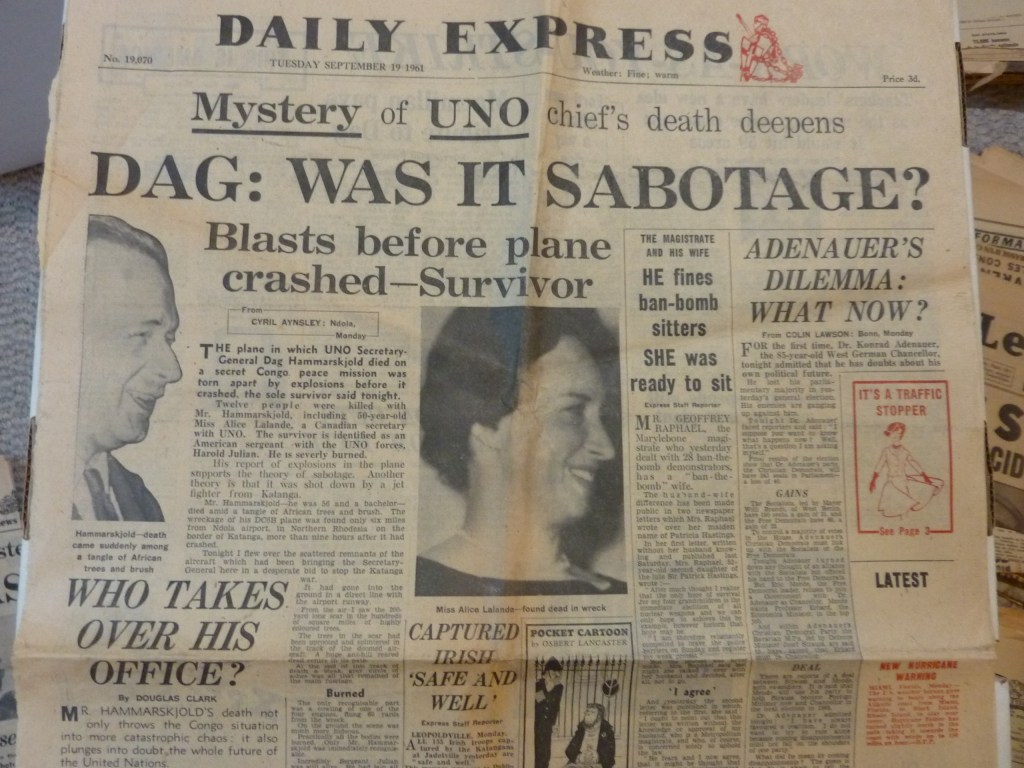
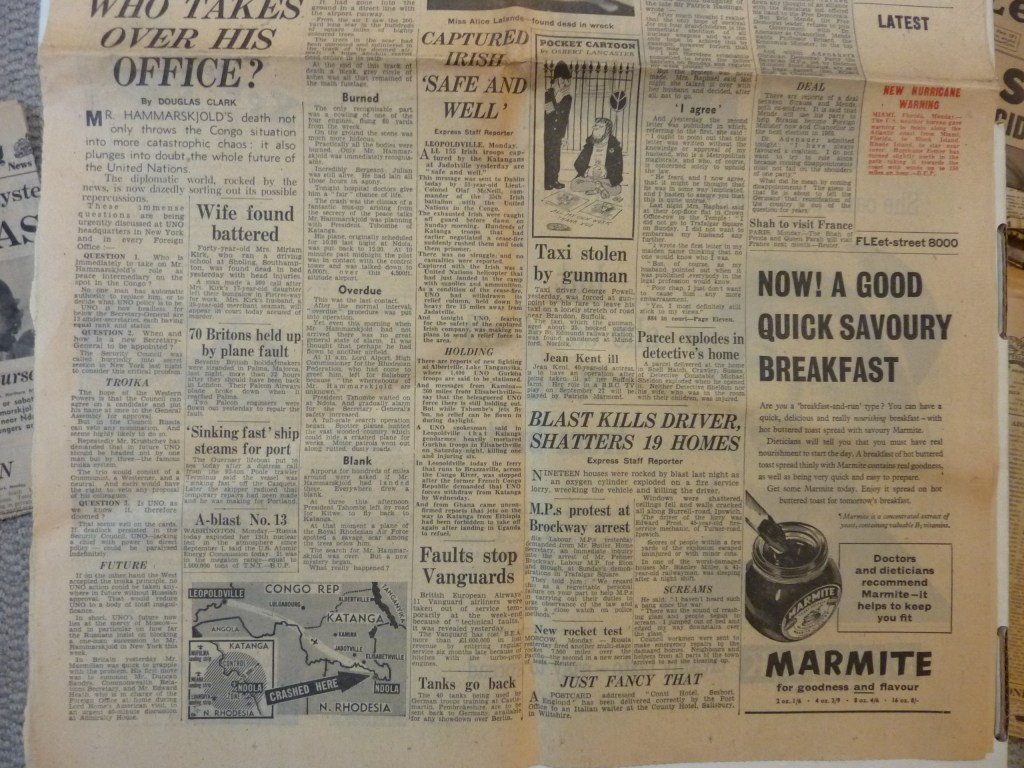
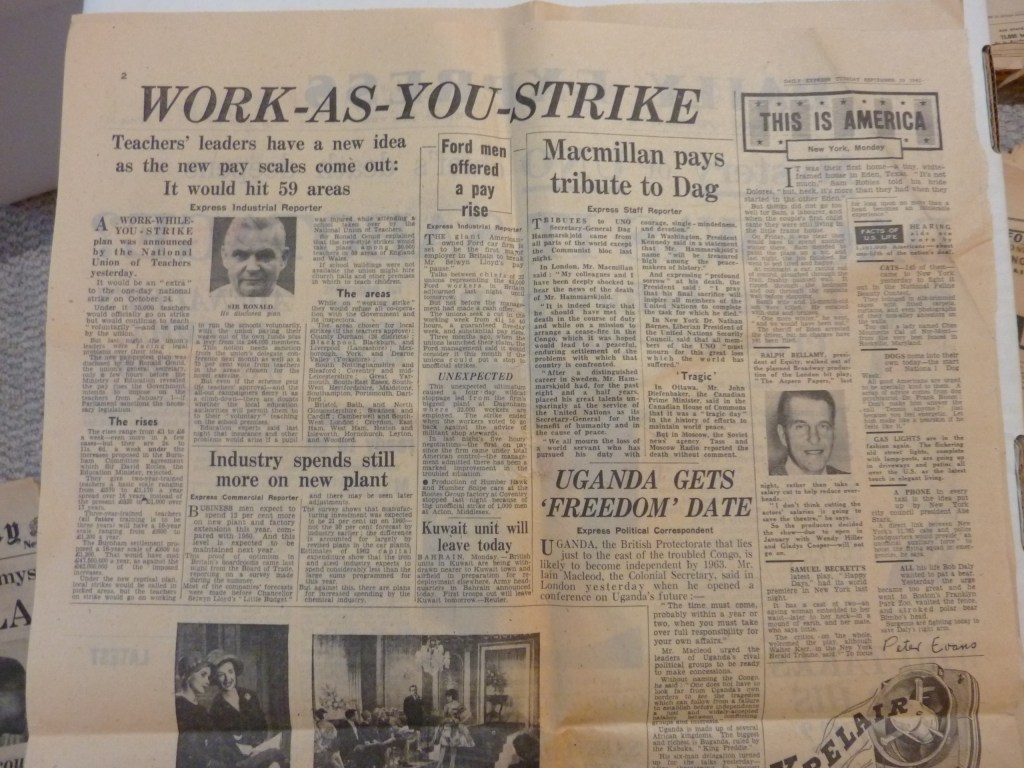
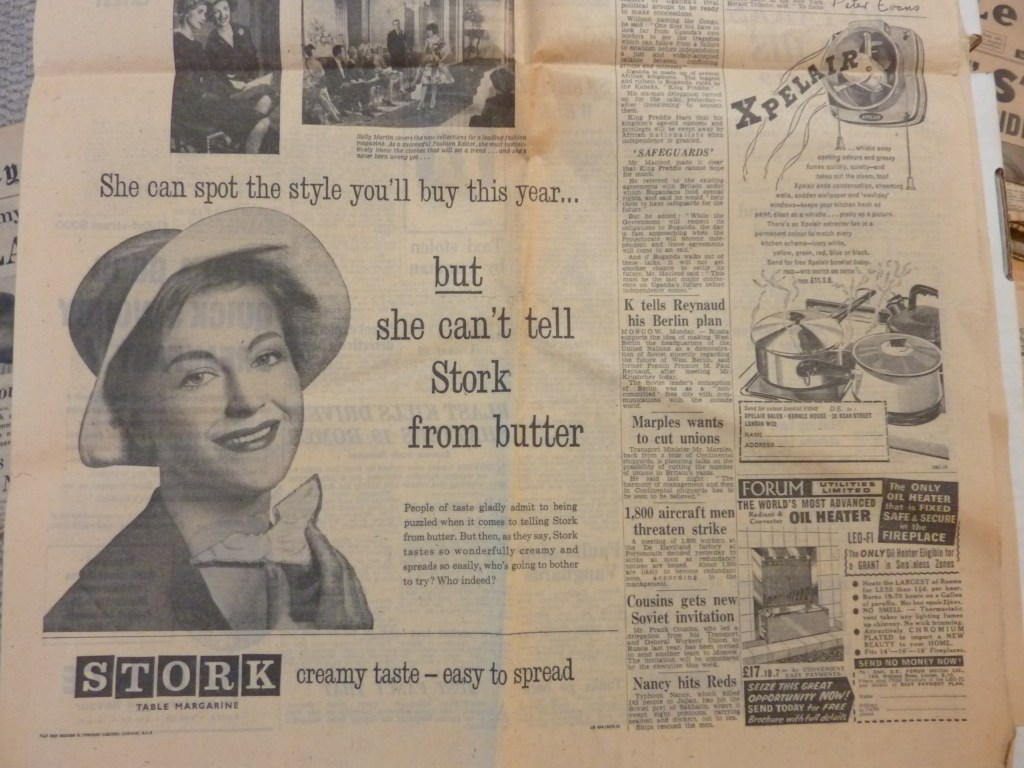
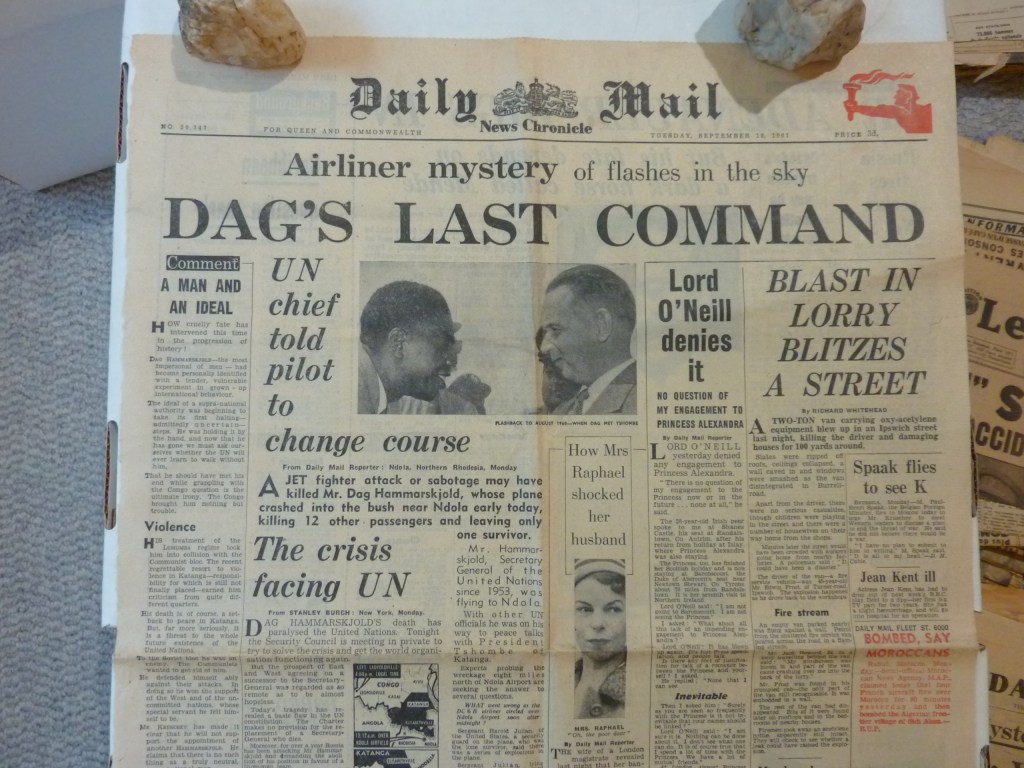
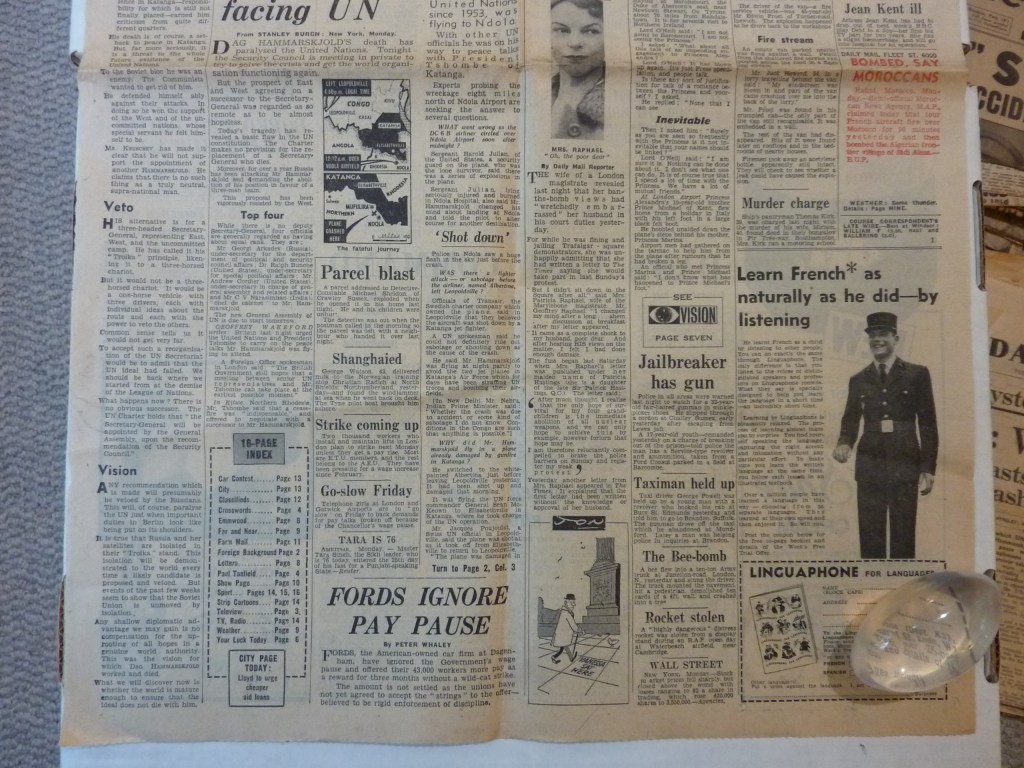
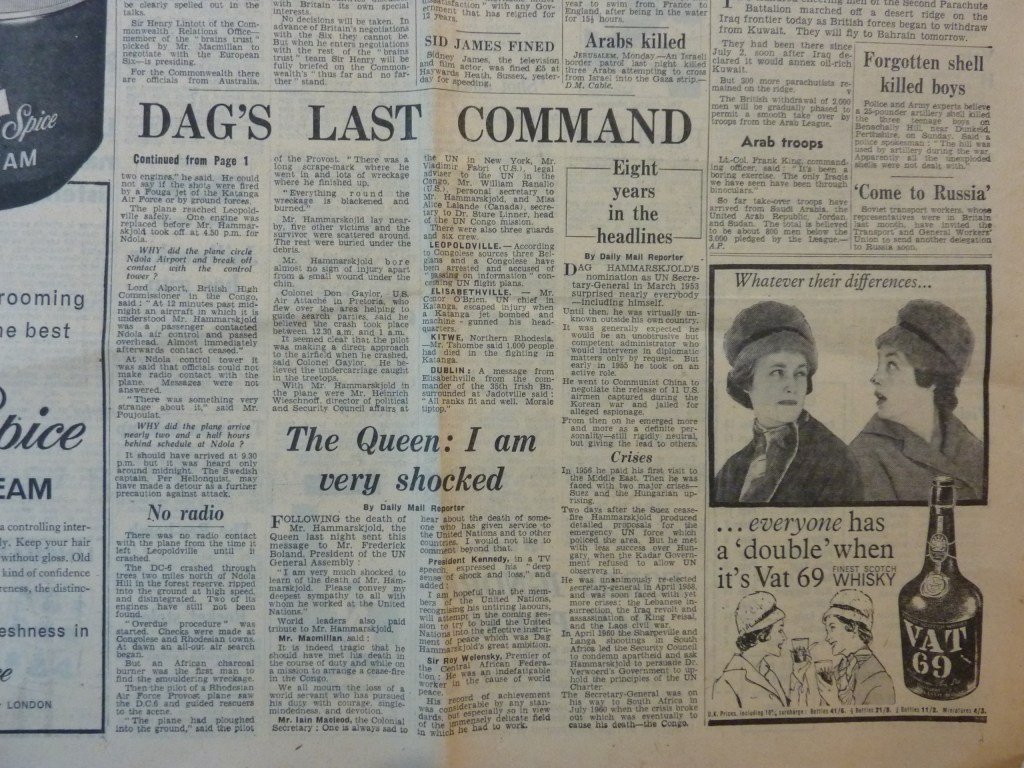
From the Fabry archive, I have recently discovered a new stack of international newspapers from the 19th-27th of September 1961. Here are two papers from London, both from the 19th of September:
This paper has a different photo of Alice Lalande I have not seen before.It is interesting to note that “1,800 aircraft men threaten strike” was at the De Havilland factory in Portsmouth, makers of the De Havilland Dove that were supplied to the air force of Katanga, Avikat, in 1961.From George Gale: “And above all [Hammarskjold] had the Congo itself, this vast land filled with ignorant and bewildered tribes untutored in the art of governing themselves, on which to experiment, with which he and his servants could learn the craft of rule.” I find it funny that the Daily Express “OPINION” column is not written by anyone in particular.This article mentions that “…an African[Black] charcoal burner was the first man to find the smouldering wreckage.”
Many thanks to Madame Rime, and to Maurin Picard for this interview and supporting the Hammarskjold investigation, and to David Glaser for promoting this blog and the life of Vlado Fabry – merci beaucoup to all who have contributed to this site!
Interview with Monique Rime Cégel
3 May 2020
Switzerland
Summary
– Monique Cégel, 83, was Vladimir Fabry’s secretary in Leopoldville in 1961
– She worked at the Hotel Le Royal between December 1960 and January 1962
– She knew Alice Lalande and Harold Julien very well
– She was working extra hours on 17 September 1961
– She typed Dag Hammarskjöld’s last message to Paul Henri Spaak, requesting Belgium to stop « van Riessenghem »
– She remembers there were serious doubts about UN communications being intercepted
– Vladimir Fabry did most of the research regarding Katanga mercenaries during the summer of 1961
– She remembers Dag Hammarskjöld’s collaborators tried to deter him from flying unescorted
– She does not think Sture Linnér was intended to fly along, as he had to stay in Leopoldville to liaise and work proper transmissions
– She flew to Ndola with Mahmoud Khiary on 19 September 1961 to type the ceasefire agreement with Moise Tshombe
– She saw the crash site right above her plane window prior to landing and was horrified
– She recalls smoldering debris and the « long line » of burnt forest
– She found a very hostile atmosphere in Northern Rhodesia
– She met a very disdainful Lord Alport
– She was not allowed to join Mahmoud Khiary at the hospital to visit Harold Julien
* * *
I was Vladimir Fabry’s secretary, at the Hotel Le Royal, Leopoldville (Congo).
I worked there for the UN mission in Congo from December 1960 to January 1962, as secretary detached from the Atomic Agency (IAEA) in Vienna.
I kept working for the UN in Geneva until 1976, mostly through freelancing contracts. Then my husband and I moved to the city of Bulle.
I met my husband in 1961 in Congo!
He was a representative for major Swiss companies of the time, including Schindler and Vega, and was selling chemical products to the university of Lovanium.
I became a Swiss citizen, after getting married with him.
I was French (and I still am), and was born in Paris.
* Sunday 17 September 1961
At the Hotel Le Royal, we had an office adjacent to the one occupied by Sture Linnér.
On the day Dag Hammarskjöld took off from Leopoldville, that Sunday, I was not supposed to work.
But, as Fabry’s secretary, and since he only worked with me, they sent some military staff in a Jeep to pick me up and bring me back to Le Royal.
They found me sitting at a cafe terrace, since I believe they always kept an eye on us for safety.
I went back to my office and worked all afternoon, until the plane departed.
* Vladimir Fabry
That day, when I arrived at my office, Vladimir Fabry immediately requested to dictate some telegrams. I spent the whole afternoon doing that: typing messages, then bringing them to the « Chiffre » for them to be coded accordingly with the recipient’s identity.
By the time I was finished, they were getting ready to leave for the airport.
Before leaving, Vladimir Fabry was so thrilled.
Happy as a kid who was just offered a new toy.
Albeit a very reserved character, he was practically jumping on his feet.
He came into my office and said excitingly:
« Monique, I am leaving with the Secretary-General! I am trusting you with my car keys! »
He had to be very happy, for he would never have done such a thing otherwise.
His car was an official UN vehicle.
He told me I could use all the time during his absence.
God knows Leopoldville is a very large town, with great distances between the various locations.
I used the car until, of course, I handed it back to the UN, since Fabry never returned.
I remember seeing their cars leaving Le Royal in convoy.
I went through these events with an innocent mind as I could only partially grasp what was going.
I would mostly type messages dictated by Fabry, messages that were generally meant for New York.
The last message I typed from them was dictated by M. Hammarskjöld himself. The recipient was Paul-Henri Spaak.
(nota: the Belgian Foreign Minister)
But I cannot remember its content (nota: requesting Belgian assistance to put an end to the criminal deeds of a mercenary pilot named « van Riessenghem »).
I was so intimidated that I must have skipped two or three words he dictated.
I had never met Hammarskjöld and I was so young then (nota : she was 24).
I saw Dag Hammarskjöld every day between 13 and 17 September 1961, since he occupied Sture Linnér’s office.
* Can you recall Hammarskjöld’s state of mind?
I remember he was not very agreeable. He seemed really sad, not at all in a communicative mood. « You do this, this has to be done ». We were in the midst of a serious crisis with Katanga, obviously.
* Were there long sleepless nights at Le Royal?
I did not spend those ones with them, but I had a similar experience during the previous months. When you are assigned to someone high ranking, you did not count your days and your nights. With all the crises we went through, there were many sleepless nights at Le Royal.
* Harold Julien
I knew Harold Julien very well, as he was the Chief Security Officer in Leopoldville. Being M. Fabry’s secretary, I was granted the use of a car.
This in turn created some serious trouble, because we were taken hostage with a Swiss colleague of mine by Mobutu’s troops for 24 hours. The time was around end January or early February 1961.
They had spotted my car, I believe, due to the UN flags on it, and surrounded our house with two small armoured cars. There were rumors that the UN was bent on disarming the Congolese National Army. And we had been poorly inspired to move in a house across the street from Mobutu’s barracks along the river – a magnificent location, it was indeed.
Then the witchhunt began against all UN staff.
This is the only time in my life I was really scared.
I called the French embassy asking for their help, as I was a French citizen. Their answer was very … kind: « you work for the UN, hence you are no longer considered as a French citizen for us. There is nothing we can do for you ».
Since my colleague was Swiss, she called the Swiss embassy and they immediately answered. « Yes of course, we will come and rescue you ».
They arranged for a motorized convoy of Swiss people, with friends and colleagues of my future husband, led by the Red Cross delegate M. Olivet, who was killed another day.
(nota: Georges Olivet, 34, was killed in an ambulance on 12 December 1961, amidst heavy fighting in Elisabethville, Katanga)
They parlayed with Mobutu’s soldiers, who pretty quickly removed their blockade and let us go free.
* Saturday 16 September, Lord Lansdowne meets Dag Hammarskjöld. Did you get word of a stormy exchange?
No, I do not remember that gentleman.
I did not hear anything, although I was there that day and was working in the nearby room. If there had been loud voices, a shouting match,
I would have heard something.
But it does not mean it did not take place, as my memory could be failing me.
There were indeed many high ranking visitors in Sture Linnér’s office, and I did not always necessarily get a look at them.
* Did Dag Hammarskjöld’s collaborators try to deter him from flying unescorted?
That is true, since I remember I heard about it.
They did try to deter him.
There were rumors that they were « waiting » for him in Katanga. There were Tshombe’s two Fougas.
(nota: in September 1961, the UN still believed two remaining Fouga were operational, as there was actually only one left, « 93 », the other one bing grounded awaiting spare parts)
When we heard about the crash, we immediately thought: « Tshombe’s Fougas did it ».
Personnally, I just could not imagine such a thing: who would want to shoot down the UN Secretary General?
I really thought this was just an accident, at least until after I left Congo early 1962.
If I had known … I was so scared in the air. I could never have boarded a plane.
But since I had no clue of what happened, I departed very easily when told to, without any further stress.
* Was Sture Linnér supposed to join the mission and fly along with Dag Hammarskjöld, as he later commented?
I was not at Ndjili airport but I would be surprised if he was intending to fly with them. It was logical for him to stay in Leo and liaise. That would be surprising if true.
Alice Lalande, she had to be part of the travelling party, since she was in charge of sensitive equipments, these Enigma machines. Besides, the Secretary-General needed an assistant like her. In her daily job, Alice was handing over paperwork to all the secretaries. She was a perfectly bilingual Canadian.
* Did Dag Hammarskjöld know that UN communications were intercepted?
I do not know, but it was a serious question for everyone in Leopoldville.
I had worked for weeks with Vladimir Fabry on the issue of the « frightfuls », these mercenaries.
I made dozens of photocopies from these documents that had been somehow collected and that had to do with these mercenaries. Vladimir Fabry worked a great deal on this issue. We did an extensive research on these documents. I am sorry that I did not have enough political awareness, to show an interest in the content of these documents.
* Monday 18 September 1961
Personnally, I did not get word of the crash when I arrived at the office on the next day. The other secretaries were doing a funny face, which was a bit intriguing. I made it late to the office due my long working hours on Sunday. I thought there was a dreadful atmosphere, but nobody told me anything. They did not dare tell me what had happened, probably because I was working so closely with M. Fabry. I only found out the same evening when I came home and my future husband told me: « did you hear what happened to Hammarskjöld ? »
* The crash site
When Mahmoud Khiary took off for Ndola, I came along.
(nota: on Tuesday 19 September 1961, in order to negotiate a ceasefire with Moïse Tshombé, as it was theoretically the case for Dag Hammarskjöld two days earlier)
I boarded the plane with him. If I had known the crash was foul play, I would never have come along with Khiary. This was so sudden, that I did not have the time to bring any equipment, not even a typing machine, as Alice Lalande had done.
We departed for Ndola. Prior to landing, while flying low over the forest, we managed to see the crash site from up close
(nota: the whole area was forested back then)
This memory will stay with me forever.
We spotted the wreckage, these scattered debris of an aircraft, what was left of it. This long line of burnt forest. It was terrible. I am still emotional about it, as I speak. I happened to realize the people I knew so well were only charred remains by now.
Alice Lalande, to begin with, who was basically my boss.
The security officers, such as Harold Julien.
I remember Alice’s dress with the flowery design. It sent cold shivers down my spine when I realized the plane had crashed and burnt that way. I though My God, she must have burnt so quickly. It was terrifying.
* Ndola, 19 September 1961
When we arrived in Ndola, there was this man, Lord Alport, welcoming us – so to say – at the airport. He was very cold. An extremely disagreeable character, very full of himself and every inch a British aristocrat. Still he invited our delegation for lunch in his home. I was just a secretary sitting at the end of the table with the security officers, but I found him disdainful towards us .
(nota : Khiary was not particularly welcome, since Tshombe had notified Linnér he agreed to negotiate a ceasefire with anyone but Khiary, whom he deemed responsible for launching Operation Morthor on 13 September 1961 – which is at least partially true)
Our mission was not very welcome.
Then we headed for the actual ceasefire negotiations with Moïse Tshombe, but I did not directly take part in the negotiations. The British mission there lent me a typing machine, whose keyboards had none of the French accents, which made my task very dfficult. I did however type all the ceasefire documents.
We stayed two or three days in Ndola.
Mahmoud Khiary and the delegation visited Harold Julien in the hospital. I was not allowed to join them.
1961 was a terrible year in my life. Annus horribilis, as the Queen Mother would say.
There was my being taken hostage, then Hammarskjöld’s crash, then the murder of 13 Italian air crew.
(nota: massacred by the crowd who mistook them with Belgian paratroopers in Kindu on 11 or 12 November 1961)
One of them was 25 and a very good friend of mine.
He had been at my wedding two weeks before, on 28 October 1961, along with Sture Linnér’s wife, whom I called Madame Linnér, of course, and also Jacques Poujoulat.
This day of September 1961, this Sunday the 17th. In my old age, I still cannot fathom what unfolded that day. It is still with me. It will stay with me until my last breath.








 Vlado
Vlado 