Tag Archives: Susan Williams

Valuing the Evidence of Harold Julien: Part Three

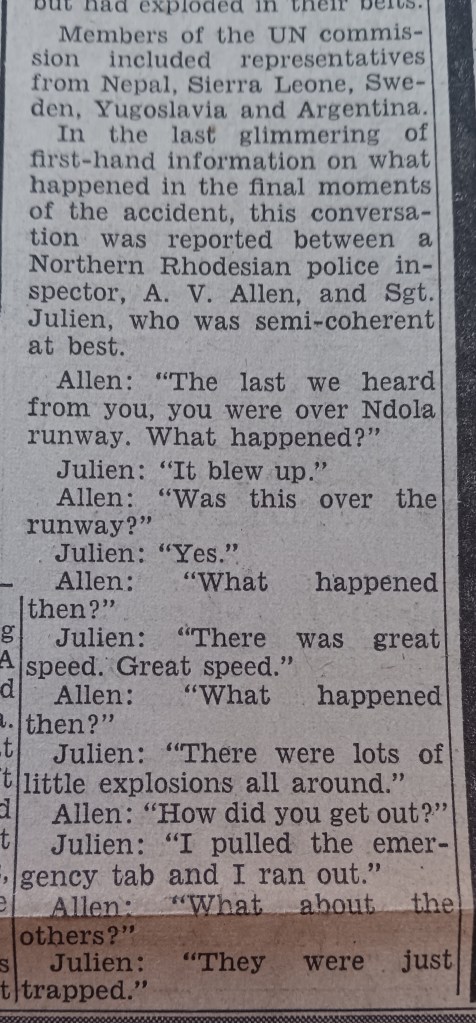
New York Herald Tribune, 3 May 1961

In September 2021, I posted Joe Majerle’s analysis of the Albertina crash here for everyone to read. He has revised his analysis, dated 7 June 2023, “based on information found in the personal files of the late Bo Virving, Chief Engineer of Transair Sweden, A.B., made available by his son, Bjorn Virving.” I am sharing this in connection to the testimony of Sgt. Harold Julien – and, also, to stress the importance of Bo Virving’s documents and observations. From Majerle’s analysis, pages 25-26:

THE PRECIPITATING EVENT

“To my observation, in the study of aircraft accidents throughout the course of my life, there is almost always a precipitating event that sets off a chain of actions, reactions, counteractions, etc. that result in the crashed aircraft somewhere on the surface of earth. In this case, it is known from Annex II that the captain communicated to Ndola tower that all was well and within minutes the aircraft was being incinerated with its own wing fuel and that fifteen of the sixteen occupants’ lives has ended, and that the last would succumb in less than a week. That person, Sgt. [Harold] Julien, was the only eyewitness to the crash.

“To my experience, eyewitness testimony is considered evidence in a court of law, at least in this country. I am unfamiliar with Rhodesian law in the 1960’s, but in the USA in the 1960’s Sgt. Julien’s statements would have been considered evidence in a crash investigation. Since there is no other actual evidence to the contrary, and testimony of ground observers about the airport over-flight and entry to the instrument approach procedure are insufficiently conclusive to determine externally what the precipitating event was, it seems logical to me that Sgt. Julien’s statements, as brief as they are, are the only thing that can be considered as evidence in a search for the cause of the chain of events leading to the crash.

“In the UN Commission report, par. 129., Senior Inspector Allen testified to the UN Commission that he spoke with Sgt. Julien and asked him three questions; 1.”What happened? He said: ‘It blew up’.” 2.”Was this over the runway? And he said ‘yes’. 3.”What happened then? And he replied: ‘There was great speed – great speed’.”

“It blew up–“

“–over the runway”

“I have read all three of these reports several times and still don’t understand the reluctance of the investigators, including the UN and the Swedish observers, to not make those six words the central point, the number one item on the list of where to begin to find the truth about what happened. Especially from the standpoint of determining whether or not there is fault to be assigned to the flight crew.

“Assuming Sgt. Julien was belted into any seat in the forward cabin, looking out the side window on whichever side he was sitting on, he may or may not have had a view of the lighted runway and the town of Ndola but it is likely that the captain would have informed the passengers that they had arrived overhead Ndola and would be setting up to land there. It would have been the last thing he could identify location-wise and anywhere in that vicinity for him would be “over the runway”. I don’t know if Inspector Allen was deliberately trying to trip him up or why he asked him if it was over the runway when he knew that the aircraft had overflown the runway and not blown up there, but, it seems to me, it was an unusual question to ask a person in Sgt. Julien’s condition. What I am getting at here is that Sgt. Julien knew where the runway was and that the aircraft had blown up. They sound like lucid answers to me, and not as though he was thinking about horses or submarines, for example.

“In my view, in light of all the data and evidence of all of the pages of all the reports and the information displayed in all of the images of all the photographs in the UN file, the only thing I can see that qualifies as a precipitating event is Sgt. Julien’s: “It blew up”.

“And he was the only one left that was there when it happened.”

As I pointed out in part two of this series, Hugo Blandori was a “retired” FBI agent, turned private investigator, who was hired by the UN as a consultant to this investigation. It is extremely upsetting to me that an FBI agent was involved, not only because of the racist history of that organization, but because of the role the FBI played during the McCarthy witch-hunt on United Nations staff members in 1953. Trygve Lie, the first UN Secretary-General, gave the FBI carte blanche of headquarters “for the convenience”, and it was his successor Dag Hammarskjold who protected his staff and kicked out the FBI by November 1953. Within every organization, including the UN, there have always been members who are actively working against the good that that organization is trying to achieve, and that is how I believe Hugo Blandori got the job of consultant. This is also how Dr. Max Frei-Sulzer – a Swiss police official that believed Hitler’s diaries were real – was appointed by the UN commission to examine the wreckage of the Secretary-General’s plane, and “who reported that there were no bullet holes in the plane and no evidence of explosives that would have been needed for a time bomb or other means of sabotaging the plane”. In my view, the contributions of Blandori and Frei-Sulzer are not just highly suspect, they discredit the investigation – I believe intentionally so!

This is why I am grateful for Bo Virving (and his son, Bjorn!), who was the smartest man on the scene in Ndola – an honest man – who saved important documents from the investigation, convinced that the crash was not an accident and that African witnesses testimony were deliberately ignored.

From Virving’s documents, “Memoranda submitted by Mr. Hugo Blandori, Consultant”, 21 February 1962, pages 8-9:

“Mr. Virving, in his appearance before the Commission, presented a theory wherein he claimed that aircraft SE-BDY had been shot down or forced down by a plane above it. He based his theory primarily on the statements of African witnesses that had been interviewed in Ndola. I talked with Mr. Virving at length after his appearance before the Commission, but he could not elaborate nor could he suggest any ways and means of confirming his beliefs. He made it known that the Rhodesian authorities had sought to suppress those witnesses whose testimonies were embarrassing to the Rhodesians and to emphasize those who vindicated their stand.

“Virving stated that he was limited in his movements and was unable to undertake an independent investigation to further his theory.”

From pages 9-10, Blandori writes this about the African witnesses:

“Concerning African witnesses, I wish to point out that it is most difficult to distinguish from their testimony what is truth and what is fiction or imagination. There were so many inconsistencies and discrepancies in their stories that to have believed them would refute the testimony of other witnesses who are generally reliable.

[…]

“As a consequence, I am of the opinion that the testimony of the African witnesses to the effect that they saw one or more small crafts flying along with SE-BDY just prior to its crash, has to be accepted with a grain of salt.”

From “Report of the UN Commission of Investigation, 1962” p.46, par.143:

“Mr. Virving, a Transair official, put before the Commission a theory that SE-BDY might have been attacked and shot down by a plane armed with rockets. This theory was based in part on an analysis of the statements of various witnesses concerning their observations of planes and of flashes in the sky. No substantial evidence was submitted in support of this theory and the Commission is of the opinion that most of the phenomena referred to by Mr. Virving are susceptible of other and more logical explanations. The Commission also consulted rocket experts with ONUC who expressed considerable doubt concerning the possibility of such an attack. Finally, as already noted, no signs of a pre-crash explosion or traces of a rocket were found in the wreckage.”

From Susan Williams’ “Who Killed Hammarskjold?”, 2016 edition, chapter 7, p. 99:

“All these [African] witnesses were challenged by the Federal examiner. Afterwards, Bo Virving followed [Dickson] Buleni and [Davidson] Simango from the court and interviewed them privately about what they had seen. They repeated their claim that they had seen two aircraft and not just one but were reluctant to talk too much to Virving, as they were being observed by a white police officer. According to Virving, their answers were reliable and tallied exactly with his own technical calculations.”
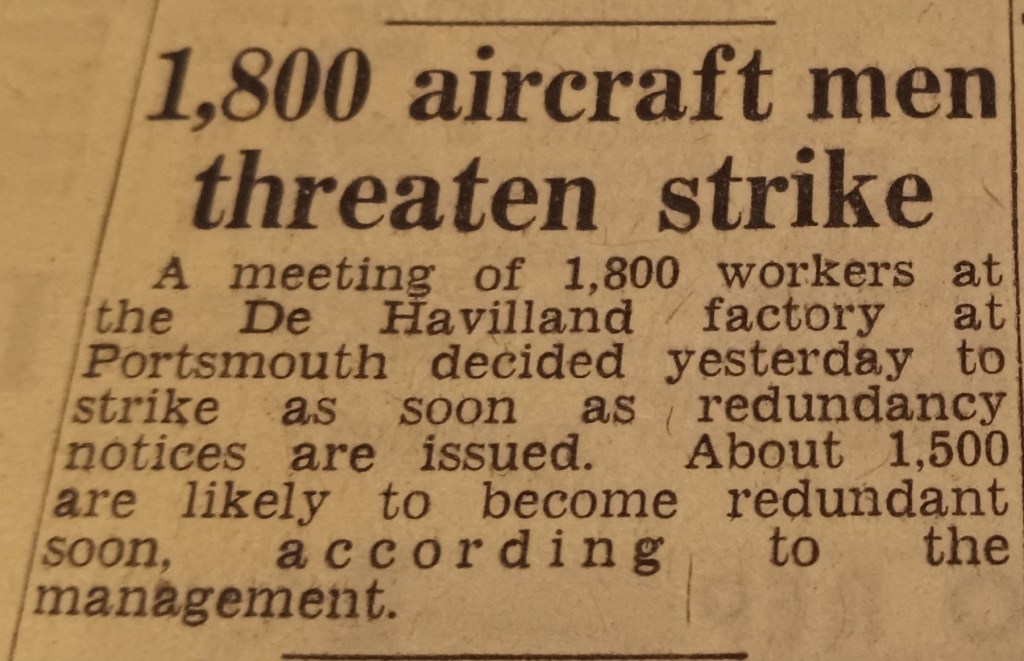
Daily Express, UK, 19 September 1961, page 2

Back in January 2014, I wrote here that I was convinced that the Albertina was shot down by Fouga Magisters. I am still convinced it was shot down, but I was wrong to believe it was a Fouga. I was misdirected by all the reports in the newspapers I was looking at, and I think that was the point – that these reports on Fougas were a red herring in the press. Bo Virving’s observations led him to believe that the Albertina was shot down by a Dove, and his theory rings true for me. From “Who Killed Hammarskjold?”, chapter 15, pages 185-187:

“Bo Virving had gathered ‘overwhelming evidence’, believed [George Ivan] Smith, that Hammarskjold’s plane was ‘forced down and crashed as a result of actions from an unidentified aircraft’. This evidence was carefully explored in a series of programmes about Hammarskjold which were produced by Gunnar Mollerstedt and shown on Swedish television. Mollerstedt had spent a year gathering material–including the interviews with Timothy Jiranda Kankasa and Dickson Buleni.

“Virving stated that there were five Doves in service in the Katangese air force in September 1961 at Kolwezi and Jadotville airports. They could stay airborne for three or four hours and their speed could match that of Hammarskjold’s DC6 in level flight; and in a dive from above they could increase their speed. It would be possible for the crew of the Dove to drop a small explosive device on to an aircraft below, then pull out of the dive. Virving had developed this theory about a Dove because on the day that Hammarskjold’s body was flown out to Sweden, he had seen a Dove at Ndola airport and discovered that it had a hole in its floor, which was apparently used for aerial photography. A man could lie there, he realized, telling the pilot ‘right, left, up, down’ and at a given moment let fall a small projectile.

“The theory that a Dove could be used in this way was later confirmed by Mercenary Commander, the memoir of the mercenary Jerry Puren–which was published six years after Mollerstedt’s programme. With evident pride, Puren describes in this book his technique of dropping bombs through a hole in the floor of a Dove aeroplane, by means of a rack system rigged along the fuselage. The racks were fitted to take bombs of 12.5 kg, which were despatched one at a time through the hatch in the floor when a lever was pulled. A bombing crew consisted of a pilot, a bomb aimer and a bombardier; usually Puren flew on these bombing missions with his friend Max Glasspole, the gum-chewing Canadian pilot, or the Hungarian pilot Sandor Gurkitz–both of whom were at Ndola airport on 17-18 September 1961, when he arrived that afternoon from South Africa. According to Puren, 12.5 kg bombs were turned out by Union Miniere workshops by the thousand; each had a contact fuse in the tail section which unwound and armed the bomb when lobbed from the aircraft.

“The Rhodesian Commission of Inquiry Report acknowledged that a Dove with a bombing capacity was found in September 1961 at Ndola–but after the crash. ‘One De Havilland Dove belonging to the Katanga Government,’ it stated, ‘was after the 18th September armed by removing a door and placing a machine gun on the floor to fire through the opening.’ The Dove had not, it stated, been at Ndola on the day of the crash, but elsewhere: ‘On 17th September this and possibly another were in the hands of the United Nations at Elisabethville. Three Doves were then in the Republic of South Africa undergoing examination.'”

[…]

“Virving’s suspicions about the use of a Dove against the Albertina were heightened when he went to Elisabethville in 1962 and found that the Katangese Doves had disappeared during the August 1961 UN action to expel mercenaries [Operation Rum Punch]. Significantly, their logbooks had been left behind. Then Virving found the Pretoria workshop where the Doves would normally have been serviced and sought information ‘for historical purposes’; but after two years’ wait he was told that no information could be given.”

Jerry Puren was one of the 79 mercenaries working for Katanga that uncle Vlado had arrested during Operation Rum Punch–he was also in the bar at Ndola airport the night of 17-18 September 1961, waiting for Hammarskjold’s plane to arrive. I believe that he was one of the men flying the Dove that shot down the Albertina. It wasn’t just glory he was after, it was personal revenge against Vlado and the UN for arresting him. From page 225-226 of “Who Killed Hammarskjold?”:

“[…]Puren’s behaviour at Ndola airport that evening seems totally out of character: for even though ‘excitement ran high, history was unfolding, and we were right on the spot,’ as he himself writes, he and fellow mercenary pilot Glasspole (who was also at Ndola airport) decided to have an early night:

Shortly after 22h00 there was a rustle of excitement among the chilled gathering. Several people claimed they had heard the sound of an aircraft’s engine, others said they saw lights disappearing low in the west. We saw nothing. Eventually Glasspole and I looked at each other, shrugged our shoulders and returned to our welcoming beds at the Savoy Hotel.

“This is a very different Jerry Puren from the man of action described in the rest of his memoir: who fearlessly, for example, escaped the UN after his capture during Rumpunch, disguised as a priest.”

[…]

“Puren’s and Glasspole’s unlikely early night at Ndola does make me wonder about the Dove found by Bo Virving at Ndola airport the following day–with a hole in the bottom, through which Puren and Glasspole had become adept at dropping bombs on to Baluba villages. Furthermore, Puren was rewarded by Tshombe just a few days after this episode, by being made Chief of Operations of the Katangese Air Force, at an impromptu parade.

“One intriguing aspect of Puren’s mercenary career is that he later became involved in the failed Seychelles invasion in 1981, with which SAIMR was apparently associated.”

Lastly, in connection to mercenaries and Doves, this brief interview with author and journalist Maurin Picard:

Valuing the Evidence of Harold Julien: Part Two

Here are more newspapers from New York, from September 19, 1961 to May 3, 1962, which support the evidence of the only survivor of the Albertina, Sgt. Harry Julien. For context of these events, please read Susan Williams’ most recent essay, published in The Yale Review, “Revisiting Dag Hammarskjold’s Mysterious Death”. Part one of this series can be found here.

The NYT, 19 September 1961. From article “Hostile Jet Cited in Crash”: “Jacques Poujoulat, personal assistant to Dr. Sture C. Linner, chief of the United Nations mission in the Congo, described the circumstances off the ill-fated flight. He said he “could not answer” when he was asked whether the possibilty that the plane might have been shot down could be ruled out. He declared, however, that the United Nations had been “unable to make daylight flights” because of constant attacks by enemy jet aircraft. He said that the timing of the Secretary General’s night flight to Northern Rhodesia was “at least partly” because of the attacks by enemy aircraft.”
The NYT, 19 September 1961. “[Poujoulat] said that seven hours after the plane took off from Leopoldville yesterday an “unidentified aircraft” flew over Ndola airport and that at about the same time the police reported a “flash in the sky.”
The NYT, 19 September 1961. “The jet fighter has been the greatest single threat to the United Nations troops in Katanga, the pilot, who flies two planes alternately, has been strafing and bombing United Nations forces in Elisabethville, Kamina and Jadotville every day. United Nations officials believe that one of the two planes is being reloaded and refueled while the other is in action. The United Nations announced yesterday that three Ethiopian jet fighters were “on their way” to Katanga to oppose enemy fighter planes. Today it was learned from qualified sources that the planes had not arrived because British authorities in Uganda had refused to let them make a refueling stop.”
New York Herald Tribune, 19 September 1961. From article “Survivor Says Blasts Shook Plane”: “The wreck was reported first spotted by a Negro charcoal burner, then by a Royal Rhodesian Air Force crew. It was still smouldering when a ground search party arrived in mid-afternoon.”
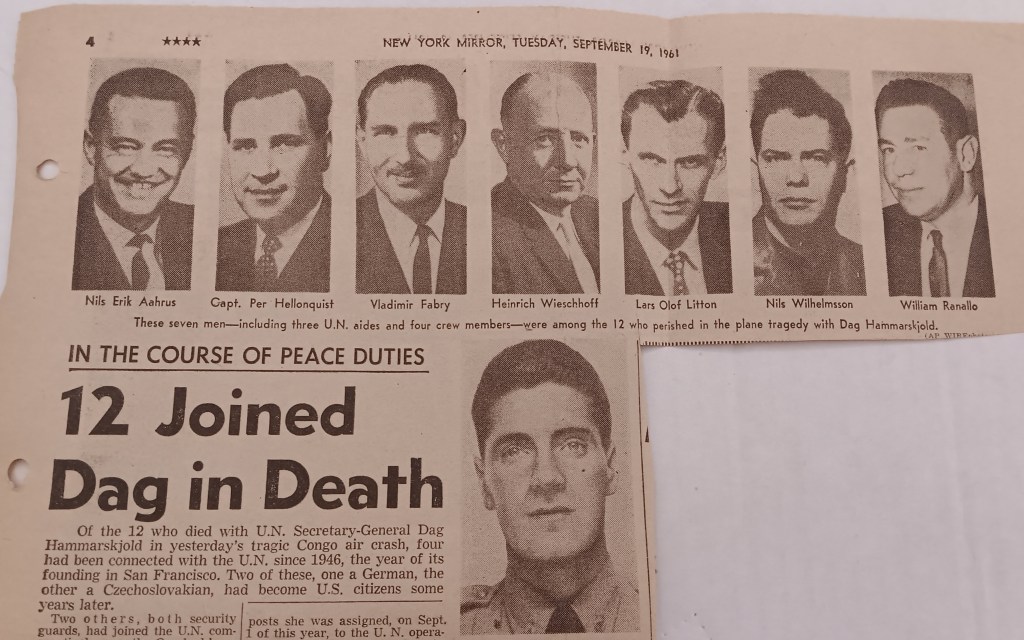
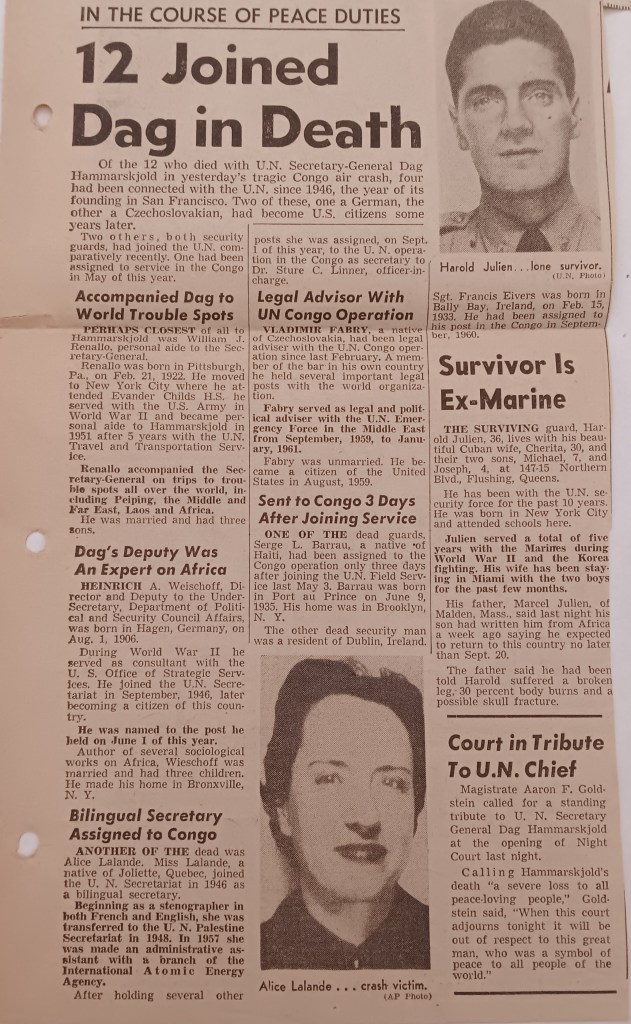
New York Mirror, 19 September 1961
New York Mirror, 19 September 1961. Col. Don Taylor is a typo for Col. Don Gaylor, who was sent to Ndola by the Pentagon on September 15. “Col. Don Taylor[sic], U.S. air attache in Pretoria, South Africa, who circled the wreck area until ground parties arrived, said it seemed obvious the plane was making an approach to Ndola Airport when it crashed about six miles away. Taylor said it looked to him as though the pilot misjudged the height and that the plane’s undercarriage caught in tree tops.”

From Susan Williams’ essay: “One other aspect of Gaylor’s involvement is worth noting. After the Albertina failed to land, a team of Norwegian U.N. soldiers flew to Ndola to assist in the search. Their aircraft was parked near Gaylor’s DC-3. Because of white Rhodesians’ hostility to U.N. personnel, they were not allowed to enter the airport terminal. So Gaylor’s crew invited them on board to get some food. To the surprise of U.N. soldiers, they discovered that the American plane was packed with highly sophisticated radio equipment.

“We know from other testimony that the U.S. Embassy in Leopoldville was communicating with Ndola via a U.S. aircraft, which presumably was Gaylor’s DC-3. And that may explain an intriguing aspect of the story, namely that Edmund A. Gullion, the U.S. ambassador in the Congo, sent a cable to Washington on the morning of September 18 that explicity referred to the possibility that the plane was shot down. “Hammarskjold’s plane believed lost in vicinity Rhodesian border near Ndola,” the cable read. “There is possibility he was shot down by single pilot who has harassed U.N. operations and who has been identified by one usually reliable source as van Riesseghel, Belgian, who accepted training lessons with so-called Katangan Air Force.” (The ambassador’s communique included an error — the name of the pilot in question was Jan van Risseghem.)”

New York Mirror, 19 September 1961
The NYT, 20 January 1962. “NDOLA, Northern Rhodesia, Jan. 19 (Reuters) — Two planes passed over Ndola shortly before Mr. Hammarskjold and fifteen other persons died in the air crash near here, a witness told an inquiry here today. T. J. Kankasa, an African municipal official, told the Rhodesian federal inquiry that one of the planes had its lights on and appeared to be a transport while the other was a “smaller aircraft without lights.” “It seemed as if the smaller plane was beaming lights on the large aircraft,” he said.”

From Susan Williams’ book, “Who Killed Hammarskjold?”, pages 107 and 109: “The UN Commission supplemented its findings by employing a consultant named Hugo Blandori to carry out some background research in Ndola.” […] “Blandori included in his memorandum some observations on the appearance of Bo Virving at the Commission hearings. Virving, he reported, had put forward the theory that the Albertina had been shot down or forced down by a plane above it. He based his theory primarily on the statements of African witnesses and told Blandori that he believed the Rhodesian authorities had suppressed their evidence.

“It was Blandori’s view that the Africans giving testimony had no experience of aircraft, so didn’t know what they were talking about. But this was not the case. For one thing, the witnesses lived very near the airport and had daily experience of the comings and goings of planes; and for another, some of them, such as Timothy Kankasa, had worked with planes during the Second World War[as a signalman].”

Who was Hugo Blandori? According to this article by Jerry Dumas, “Hugo Blandori [was an] F.B.I. agent and also a YMCA regular, who died beside me on the Y handball court”. And according to this article about Anne Cioffi, who was his former secretary, Blandori was an F.B.I. agent who later became a private investigator, but I don’t know when exactly that change happened. From the article:

“I used to babysit his kids,” she said.

One day Blandori told her he needed a secretary and she took the job.

“He taught me every angle of his business,” she said, adding that was unusual in those days because women weren’t often afforded such opportunities.

Cioffi said Blandori was affiliated with former FBI agents who did private investigating all over the world and, with her as his secretary, specialized in pre-employment screenings.

“Years ago you could do that,” she said.

The company also conducted insurance and fraud investigations, and occasionally cheating-spouse cases.

“I didn’t like those very much,” said Cioffi.

She said the two worked together until the day Blandori went to play handball in Greenwich and died of a heart attack.

“He was only 50,” she said.

Cioffi said Blandori’s widow knew nothing about the business so Cioffi ran the business herself until another former FBI agent bought it.

[…]

She said her husband, Carmine, and all her connections from her time with Blandori encouraged her to get her own private investigator’s license, so that’s what she did.

“I had my own office in Norwalk,” she said saying she did a lot of work for former FBI agents and even worked on a case or two for Interpol.

“It worked out very well.”

The NYT, 3 May 1962, “Cause of Hammarskjold Crash Still a Mystery as Inquiry Ends”: “[…] Dr. M. Frei-Sulzer, a Swiss police official, who was appointed by the commission to examine the wreckage of the Secretary General’s plane, which crashed near Ndola, Northern Rhodesia, attributed the disaster to the plane’s low altitude as it approached the airfield at Ndola after it had been cleared by the tower for landing.” [note: The Albertina was equipped with radar!] […] “Dr. Frei-Sulzer reported that “the only abnormal fact was the dangerously low altitude of the aircraft in relation to the airport elevation, probably due to human failure.” Dr. Frei-Sulzer is chief of the scientific department of the Zurich police and professor of science at the University of Zurich.” […] “The commission, which was appointed by the General Assembly last October, completed its report in Geneva March 8, three weeks before Dr. Frei-Sulzer submitted his findings to it.” […] “The [UN] commission criticized Rhodesian authorities for the fact that the wreckage was not found until fifteen hours after the crash. It said that Harold Julien, a United Nations guard who died several days after the crash, would have had a better chance for survival if the Rhodesians had shown more diligence. A report by the Royal Medical Board of Sweden said that a post-mortem indicated that, contrary to reports at the time, the Secretary General “lived for a certain period of time after the crash.” It said that he was the only person aboard the plane who had completely escaped burns.” […] “The Rhodesian and Swedish doctors agreed that bullets found in bodies of Mr. Hammarskjold’s guards had been exploded by the fire that consumed the wreckage and had not been fired from a weapon. Their finding were supplemented by Dr. Frei-Sulzer, who reported that there were no bullet holes in the plane and no evidence of explosives that would have been needed for a time bomb or other means of sabotaging the plane. However, the United Nations Commission examined at length the question whether a Fouga Magister fighter plane of the Katanga forces, “which had been operating against the United Nations in Katanga,” or some other plane [note: De Havilland Dove], had shot down the United Nations craft. It noted the reports of the Rhodesian inquiry board that the plane did not have sufficient range to fly from its base at Kolwezi and that the pilot had stated that it was on the ground on the night of the tragedy.”

Who was Dr. Max Frei-Sulzer? It is hard to take him seriously, considering that he investigated the authenticity of the Shroud of Turin, and he believed that Hitler’s diaries were real; and another case, which resulted in the imprisonment of an innocent man, who was released after 12 years!

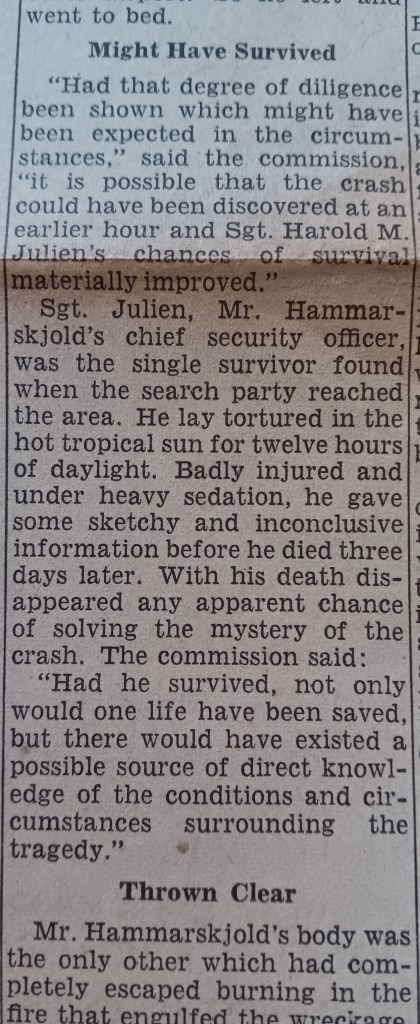
New York Herald Tribune, 3 May 1962, This article continues the narrative of down-playing and discounting the testimony of Sgt. Harry Julien, “Dag’s Death Probe: Still a Whodunit”: “Sgt. Harold Julien, Mr. Hammarskjold’s chief security officer, was the single survivor found when the search party reached the area. He lay tortured in the hot tropical sun for twelve hours of daylight. Badly injured and under heavy sedation, he gave some sketchy and inconclusive information before he died three days later. With his death disappeared any apparent chance of solving the mystery of the crash.”
New York Herald Tribune, 3 May 1961. From the same article, “Dag’s Death Probe”: […]In the last glimmering of first-hand information on what happened in the final moments of the accident, this conversation was reported between a Northern Rhodesian police inspector, A. V. Allen, and Sgt. Harold Julien who was semi-coherent at best. Allen: “The last we heard from you, you were over Ndola runway. What happened?” Julien: “It blew up.” Allen: “Was this over the runway?” Julien: “Yes.” Allen: “What happened then?” Julien: “There was great speed. Great speed.” Allen: “What happened then?” Julien: “There were lots of little explosions all around.” Allen: “How did you get out?” Julien: “I pulled the emergency tab and I ran out.” Allen: “What about the others?” Julien: “They were just trapped.”

Valuing the Evidence of Harold Julien

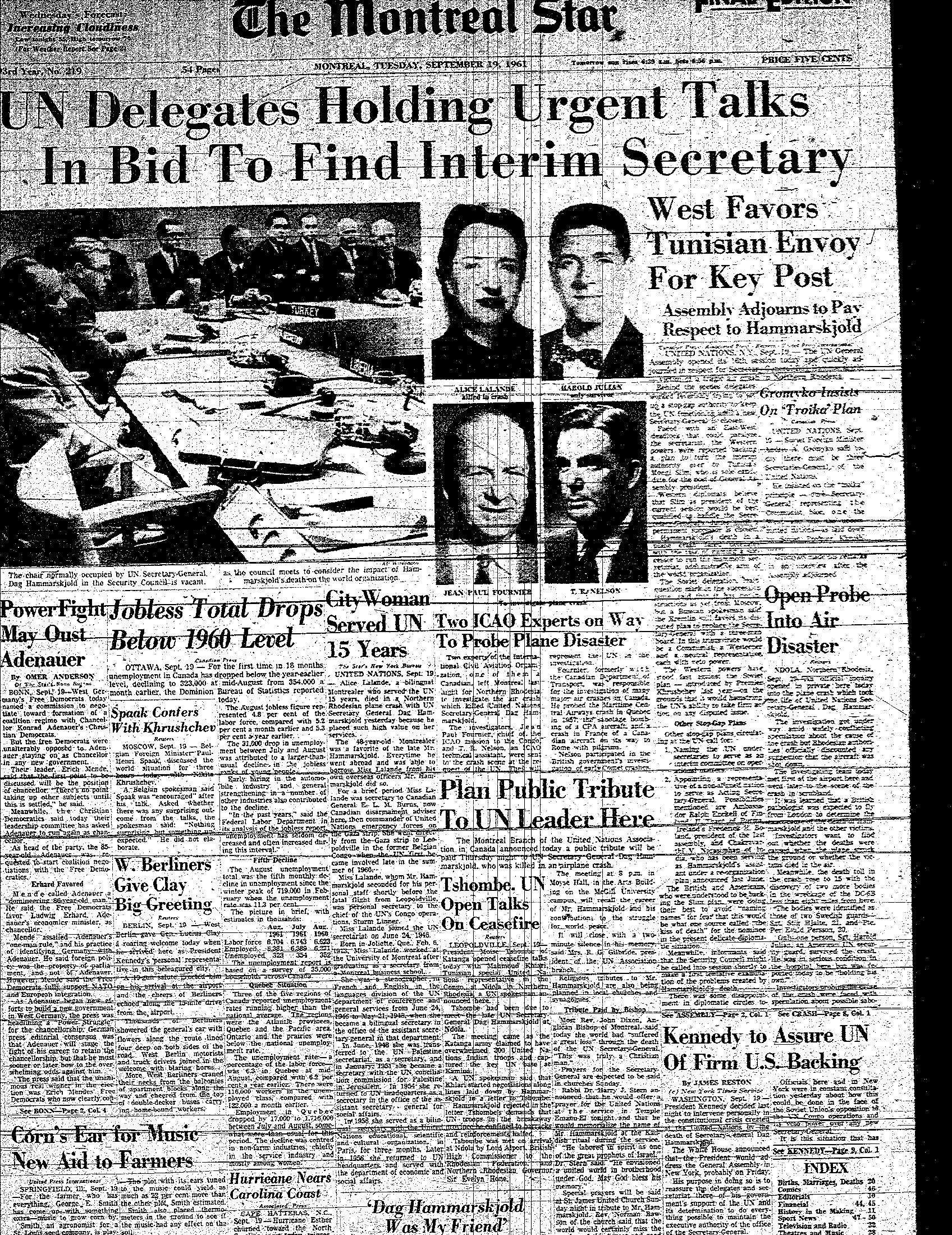
With gratitude to Susan Williams for her most recent essay, published in The Yale Review, “Revisiting Dag Hammarskjold’s Mysterious Death”, here is a larger selection of international papers from my archive, 19-27 September 1961. Harold Julien was the only survivor of the Albertina crash, and for too long his testimony has been undervalued and deliberately suppressed, it is time to take his evidence seriously.

From her essay: “In 2019, new information emerged relating to Julien’s stay in the Ndola hospital, provided by the government of Zimbabwe to the current U.N. inquiry. This fresh information reveals that Rhodesian authorities actively sought to prevent Julien’s statements from being made public. A senior Rhodesian intelligence official instructed Julien’s medical superintendent that “no one of his hospital staff must talk about this,” in relation to Julien’s statements that he had seen sparks in the sky. The superintendent and another doctor were warned about “the security angle” and asked “to make sure that none of their staff talked.

Justice Othman views this new evidence as significant. In his view, “a general undervaluing of the evidence of Harold Julien…may have affected the exhaustiveness of the earlier inquiries’ consideration of the possible hypotheses.”

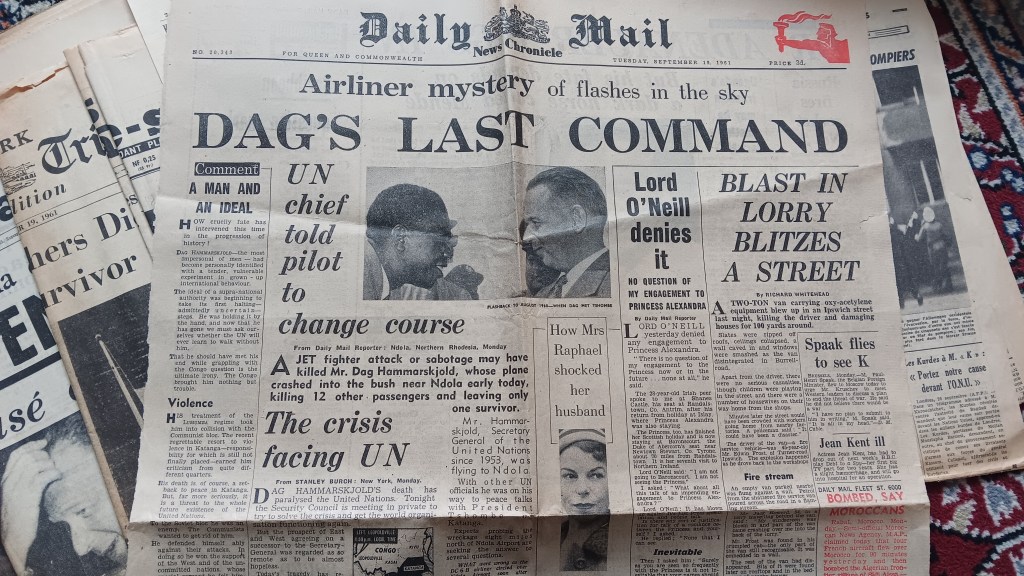
Daily Mail, 19 December 1961 “Airline mystery of flashes in the sky – Dag’s last command – UN chief told pilot to change course”
Daily Mail, September 19 “Sergeant Harold Julian, of the United States, a security guard on the plane, who was the lone survivor, said there was a series of explosions in the plane. Sergeant Julian, lying seriously injured and burned in Ndola Hospital, also said Mr. Hammarskjold changed his mind about landing at Ndola and told the pilot to alter course for another destination.” […] “Police in Ndola saw a huge flash in the sky just before the crash. […] “Officials of Transair, the Swedish charter company which owned the plane, said in Leopoldville that they believed the aircraft was shot down by a Katanga jet fighter. A UN spokeman said he could not definitely rule out sabotage or shooting down as the cause of the crash. He said Mr. Hammarskjold was flying at night to avoid the two jet planes in Katanga’s Air Force which for days have been straffing UN troops and bombing their airfields.”
Daily Mail, September 19 ” “Overdue procedure” was started. Checks were made at Congolese and Rhodesian towns. At dawn an all-out search began. But an African charcoal burner was the first man to find the smouldering wreckage. Then the pilot of a Rhodesian Air Force Provost plane saw the DC-6 and guided rescuers to the scene.”

From Williams’ essay: “[…]the 1961-62 official inquiries concluded that the first sighting of the crash site was at 3:10 p.m. on September 18 by a RRAF pilot flying overhead; at around the same time, there was a report of a sighting by the two aforementioned charcoal burners. Following these reports, police vehicles and ambulances were immediately sent to the site.

But a mass of evidence has emerged that shows that many people knew that the plane had crashed – and where – long before it was officially located. Indeed, the crash site was reported to the Northern Rhodesian authorities between 9:00 and 9:30 a.m. by Timothy Kankasa. Some charcoal burners had come across the burning plane in the morning and, in great concern, rushed to tell him. The men reported the crash to him, rather than to the police, because they mistrusted and feared the white authorities.”

Daily Mail, September 19 “Colonel Don Gaylor, U.S. Air Attache in Pretoria, who flew over the area helping to guide search parties, said he believed the crash took place between 12:30 a.m. and 1 a.m. It seemed clear that the pilot was making a direct approach to the airfield when he crashed, said Colonel Gaylor.”

From Williams’ essay: “[…] Colonel Don G. Gaylor […] was sent to Ndola on September 15 by the Pentagon.[…] Gaylor was one of three U.S. air attaches who are known to have flown to Ndola airport during the period of September 15-18. […] According to a letter Gaylor wrote to an official Swedish investigator in 1994 (a letter I was recently sent by Hans Kristian Simensen, a Norwegian researcher who, like me, is assisting Justice Othman on a voluntary basis), Gaylor was in the control tower at Ndola airport on the night of September 17-18, waiting for Hammarskjold’s aircraft. The letter states that after the plane failed to arrive, he and his crew prepared for takeoff at first light to look for a crash site. Gaylor wrote that he spotted the wreckage shortly after dawn and immediately contacted the “Ndola rescue frequency and gave them the map coordinates of the site.” His letter adds: “Then I circled the site for a considerable period to give the ground party a point of reference.” This account is consistent with Gaylor’s memoir.”

“It should be noted that there is a discrepancy between this claim by Gaylor and a report by Matlick to the U.S. Secretary of State on September 22, which states that Gaylor had wanted to search in the morning but was not allowed to do so by the Rhodesian civil authorities. Matlick adds that Gaylor flew the second aircraft to spot the crash site in the afternoon, following a sighting by a RRAF aircraft; this was echoed by Squadron Leader John Mussell in his testimony to the Rhodesian Board of Investigation.

“Without further documentary evidence, we cannot resolve these conflicting pieces of evidence, or verify Gaylor’s claim that he found the crash site shortly after dawn. This makes it all the more important to obtain and study the report that Gaylor said he sent to the Pentagon: “My report to my superiors in the Pentagon was acknowledged with some accolades.”

Daily Express, September 19 “…The survivor is identified as an American sergeant with the UNO forces, Harold Julian[sic]. He is severly burned. His report of explosions in the plane supports the theory of sabotage. Another theory is that it was shot down by a jet fighter from Katanga. […] Practically all the bodies were burned. Only Mr. Hammarskjold was immediately recognisable. Incredibly Sergeant Julian was still alive. He had lain all those hours in agony. Tonight hospital doctors give him a a “fair” chance of life.”

From Williams’ essay: “On Tuesday, September 19, the day after Julien had been taken to the hospital, he was “slightly better.” Though “still dangerously ill,” he was expected to survive. A day later, he was reported as “holding his own.”

Daily Express, 19 September, page 2. “1,800 aircraft men threaten strike. A meeting of 1,800 workers at the De Havilland factory at Portsmouth decided yesterday to strike as soon as redundancy notices are issued. About 1,500 are likely to become redundant soon, according to the management.”

From Susan Williams’ book “Who Killed Hammarskjold?”, pages 186 and 187:

“[Bo] Virving stated that there were five [De Havilland] Doves in service of the Katangese air force in September 1961 at Kolwezi and Jadotville airports. They could stay airborne for three or four hours and their speed could match that of Hammarskjold’s DC6 in level flight; and in a dive from above they could increase their speed. It would be possible for the crew of the Dove to drop a small explosive device on to an aircraft below, then pull out of the dive. Virving had developed this theory about a Dove because on the day that Hammarskjold’s body was flown out to Sweden, he had seen a Dove at Ndola airport and discovered that it had a hole in its floor, which was apparently used for aerial photography. A man could lie there, he realized, telling the pilot ‘right, left, up, down’ and at a given moment let fall a small projectile.

“The theory that a Dove could be used in this way was later confirmed by Mercenary Commander, the memoir of the mercenary Jerry Puren[…]

“The Rhodesian Commission of Inquiry Report acknowledged that a Dove with bombing capacity was found in September 1961 at Ndola–but after the crash. ‘One De Havilland Dove belonging to the Katanga Government,’ it stated, ‘was after the 18th September armed by removing a door and placing a machine gun on the floor to fire through the opening.’ The Dove had not, it stated, been at Ndola on the day of the crash, but elsewhere: ‘On 17th September this and possibly another were in the hands of the United Nations at Elisabethville. Three Doves were then in the Republic of South Africa undergoing examination.’

“A Dove plane at Ndola also caused consternation at the British Embassy in Leopoldville in the week after the crash of the Albertina. Ambassador Riches sent a telegram to the Foreign Office on 24 September 1961, reporting that, according to Matlick, the U.S. Air Attache in Leopoldville who had just returned from Ndola, a Dove aircraft with Katangan air force markings had taken off from Ndola for Kolwezi the day before, carrying mercenaries. He had given this information to the UN, who had passed it on to Riches. ‘Report could do us serious damage here,’ warned Riches to London.

“Virving’s suspicions about the use of a Dove against the Albertina were heightened when he went to Elisabethville in 1962 and found that the Katangese Doves had disappeared during the August 1961 UN action to expel mercenaries. Significantly, their logbooks had been left behind. Then Virving found the Pretoria workshop where the Doves would normally have been serviced and sought information ‘for historical purposes’; but after two years’ wait he was told that no information could be given.”

Daily Express, September 19. Not everyone in the press was singing the praises of Hammarskjold, certainly not George Gale, who seems to be not only a white supremacist and supporter of the Federation of Rhodesia and Nyasaland, but also a homophobe. He writes of Hammarskjold: “He loved mountains and had good paintings on his austere walls. He read poetry, especially the writings of Rilke and of T.S. Eliot.”
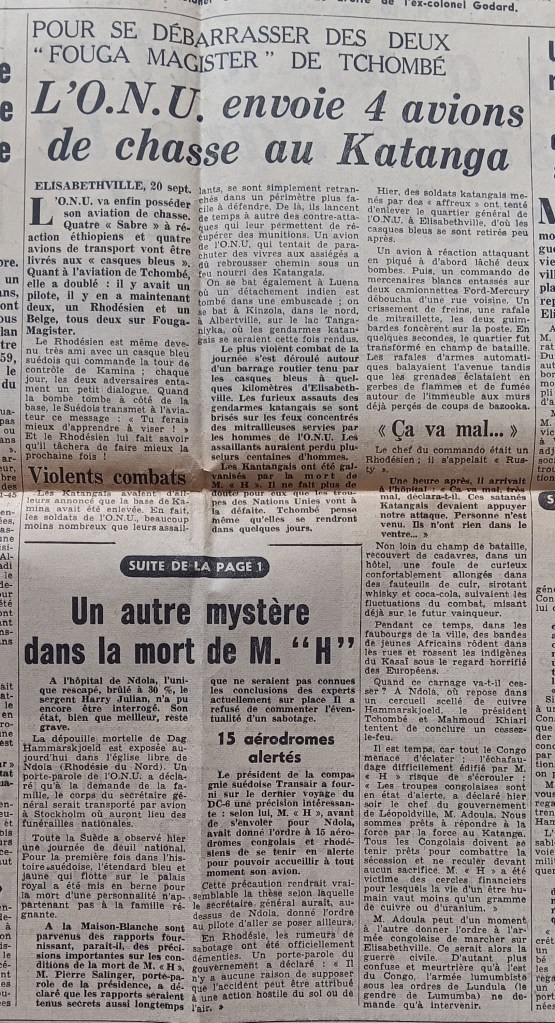
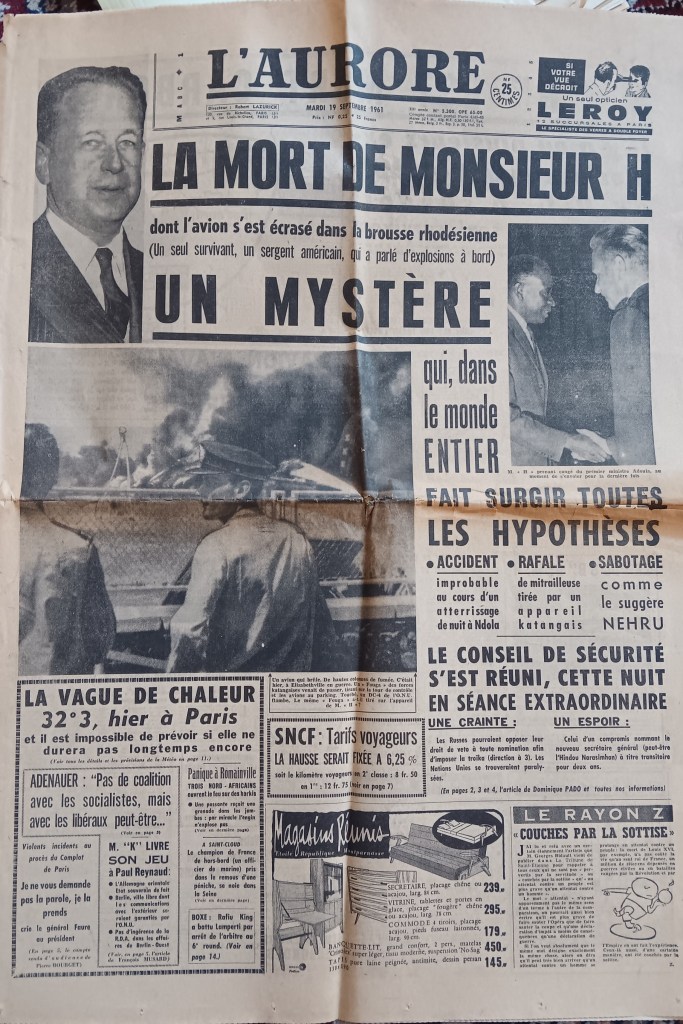
L’AURORE, September 19 “The Death of Mr. H, whose plane crashed in the Rhodesian bush(only one survivor, who spoke of explosions on board).”
L’AURORE September 19 “A burning plane. Tall columns of smoke. This was yesterday, in Elisabethville at war. A Fouga of the Katangese forces had just passed, shooting at the control tower, and at the planes in the parking lot. Hit, a United Nations DC-4 burns. Did the same Fouga shoot at Mr. H’s aircraft?”
L’AURORE September 19. The headline erroneously reports: “Mr. H is burned to death in his airplane tomb in Rhodesia” […] “There were several explosions before the crash of the Swedish DC-6, recounts the sole survivor”
International Edition of The NYT, September 19. This article refers to Colonel Don Taylor, which is a typo for Don Gaylor, saying that he “circled the wreck area until ground parties reach it shortly after 3 P.M.” On the front page of this edition of the NYT, it reports “Lone Survivor Reports Explosions on Flight to Tshombe Talks” and that “Officials quoted Mr. Julian[sic] as having said that Mr. Hammarskjold had changed his mind about landing at Ndola and that he had told the pilot to alter course for another destination. Moments later, according to the injured man, there was a series of explosions aboard the plane. Hospital authorities said Mr. Julian was in serious condition.”
International Edition of the NYT, September 19
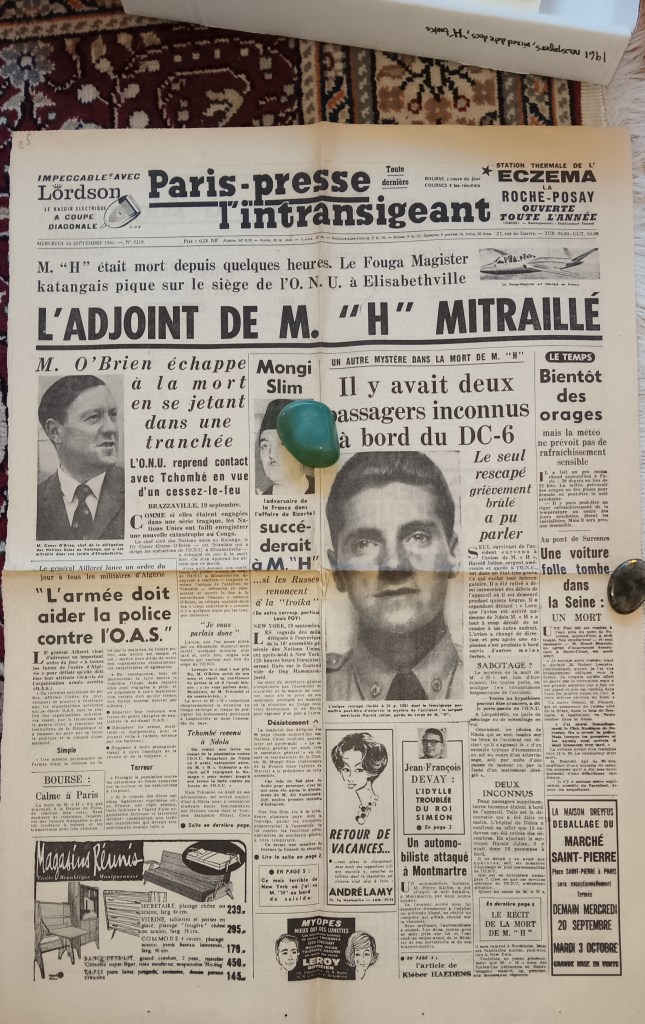
Paris-presse l’intransigeant, September 19. This publication does not mention Harold Julien by name or the testimony he gave to hospital staff in Ndola, reporting only that “Another person not yet identified was found seriously injured.”
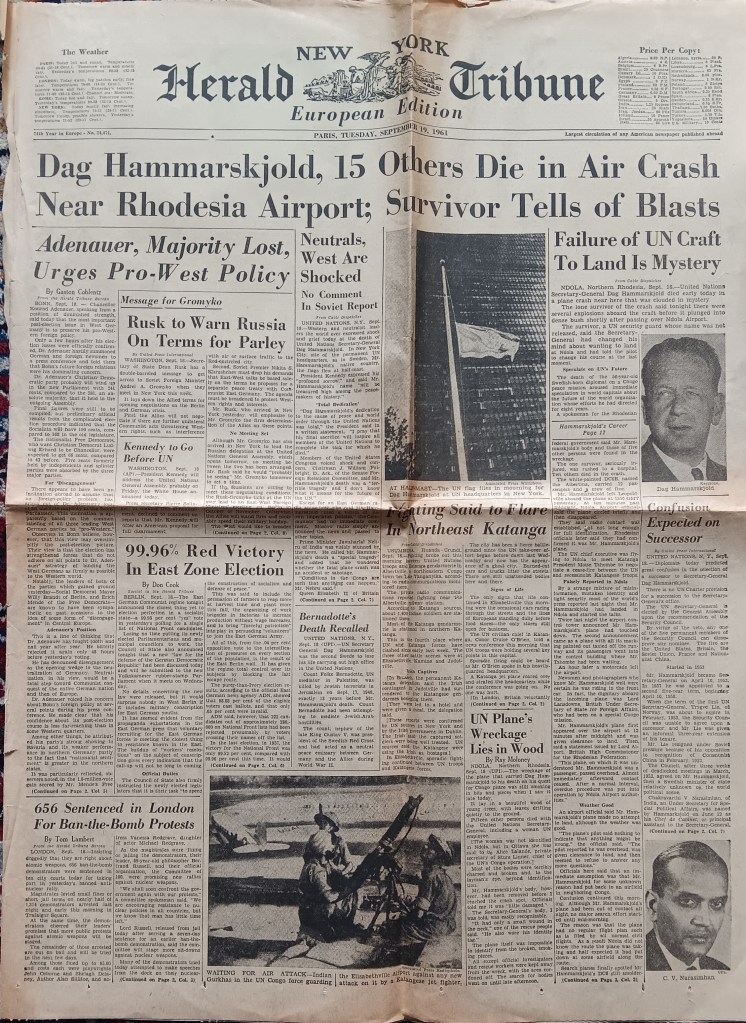
European Edition of the New York Herald Tribune, September 19
European Edition of the New York Herald Tribune, September 19. This article reports the testimony of Harold Julien, without mentioning his name, only that he was “a UN security guard whose name was not released.”
Paris-presse l’intransigeant, September 20. Headline: “Mr. H had been dead a few hours. The Katangese Fouga Magister attacks the headquarters of the O.N.U. in Elisabethville.” Text below photo: “The Fouga-Magister is made in France.”
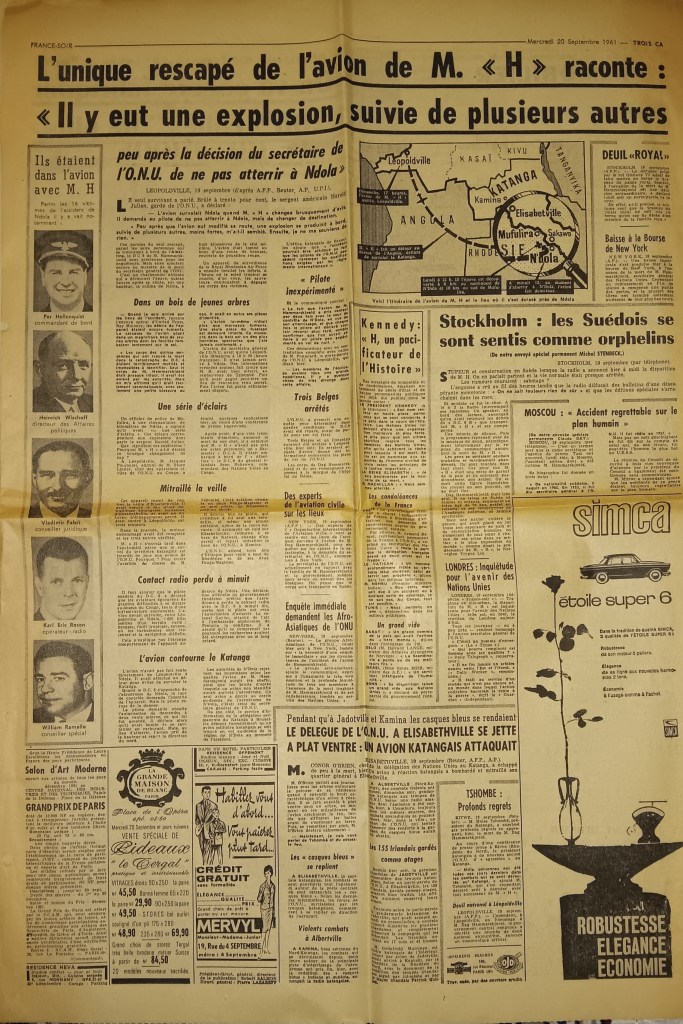
France-Soir, September 20
France-Soir, September 20. Rarely seen photos of Captain Per Hallonquist and Karl Erik Rosen.
France-Soir, September 20 “Three Belgians and a Congolese were reportedly arrested in Leopoldville yesterday evening. They would be accused of having given information concerning flight plans of the O.N.U.”
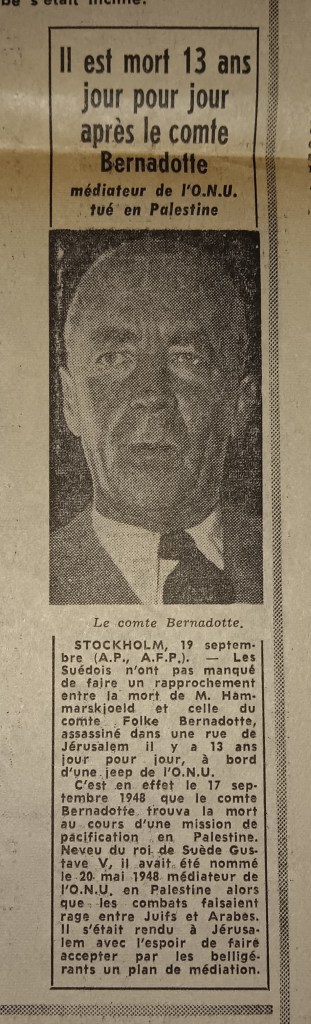
France-Soir, September 20. Many papers reported on the assassination of Swedish diplomat Count Folke Bernadotte, which happened exactly 13 years earlier in Gaza, 17 September 1948. And yet another eerie coincidence, Alice Lalande – the only woman on board the Albertina – was Bernadotte’s personal secretary.
International Edition of the NYT, September 20. Dag must have been bored to death of the overt and covert attacks on his sexuality and private life, on the job and in the press. But this was an era when being accused of homosexuality was akin to being accused of being a communist – Roy Cohn would understand! ”Mr. Hammarskjold did not like to talk about himself a great deal. He had an idea that he had been fixed forever in the public mind as a man with an alpenstock in one hand and a volume of T.S. Eliot’s works in the other. “That’s not a picture of me,” he said. “It is a caricature. Everywhere I go, mountains, mountains, T.S. Eliot. Believe me, I am sick of mountains and poetry talk.”
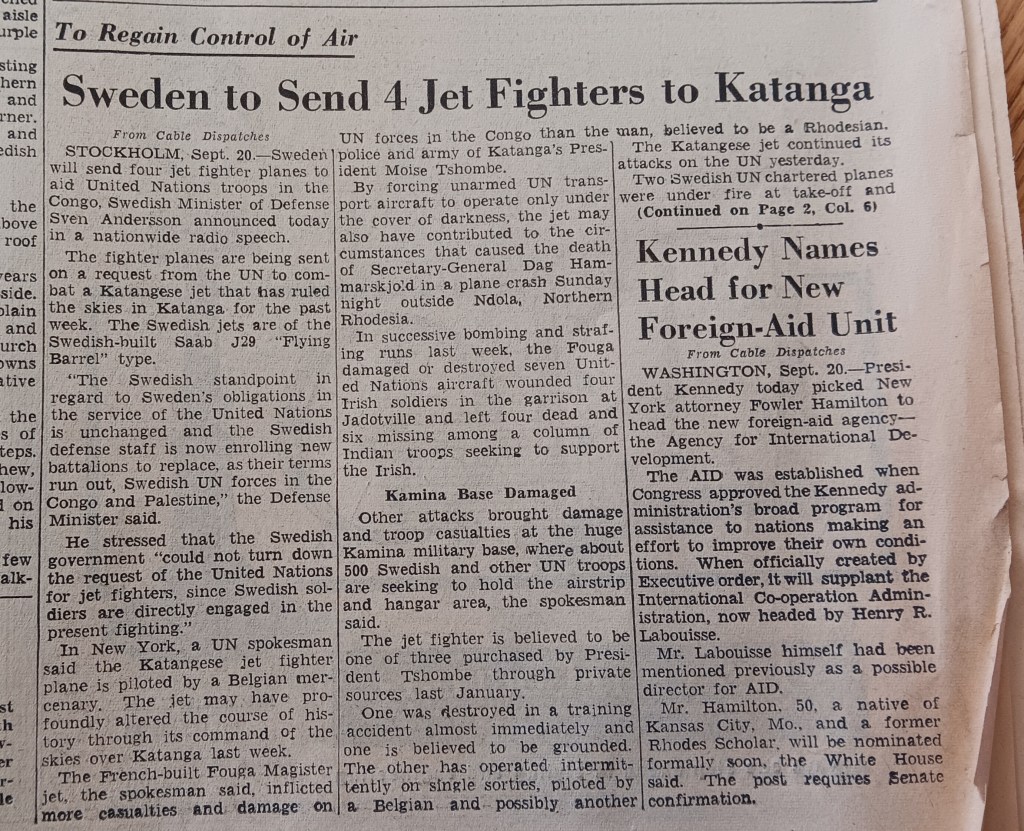
European Edition of the New York Herald Tribune, September 21. “The French-built Fouga Magister jet, the spokesman said, inflicted more casualties and damage on UN forces in the Congo than the police and army of Katanga’s President Moise Tshombe. By forcing unarmed UN transport aircraft to operate only under the cover of darkness, the jet may also have contributed to the circumstances that caused the death of Secretary-General Dag Hammarskjold in a plane crash Sunday night outside Ndola, Northern Rhodesia. In successive bombing and strafing runs last week, the Fouga damaged or destroyed seven United Nations aircraft, wounded four Irish soldiers in the garrison at Jadotville and left four dead and six missing among a column of Indian troops seeking to support the Irish.”
European Edition of the New York Herald Tribune, September 21
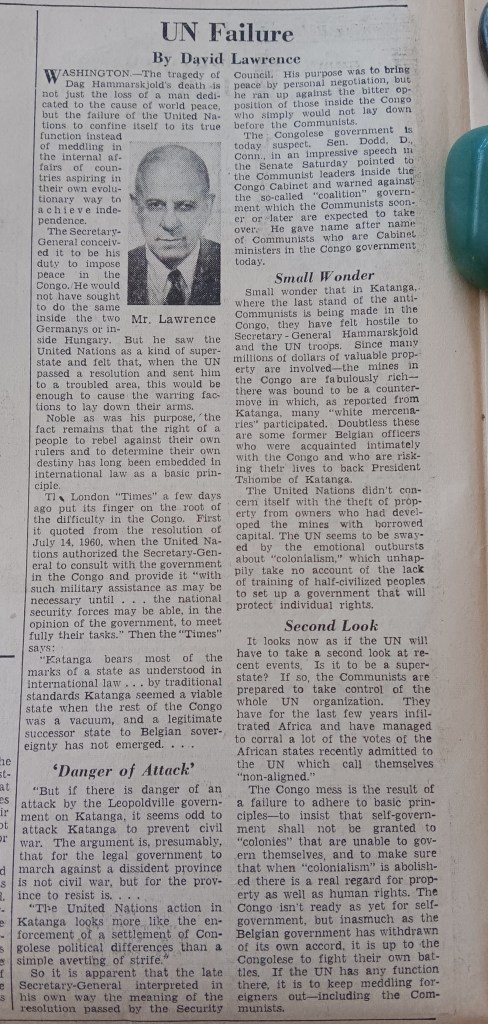
European Edition of the New York Herald Tribune, September 21. David Lawrence, yet another white supremacist who had nothing good to say about the United Nations or Dag Hammarskjold.
European Edition of the New York Herald Tribune, September 21. On the same page, next to David Lawrence, is this thoughtful and sad salute to Dag Hammarskjold from Walter Lippmann: “If the world is not ready for what Hammarskjold felt compelled to try in the Congo, it is also true, I hate to say, that this present world is not ready for the kind of man Hammarskjold was. He was a Western man in the highest traditions of political excellence in the West. Khrushchev says that Hammarskjold was not neutral in the Congo, and that there is no such thing as a neutral man. Hammarskjold was in fact the embodiment of the noblest Western political achievement — that laws can be administered by judges and civil servants who have their first allegiance to the laws, and not to the personal, their class, or even their national interests. No such political ideal is believed to be possible or is regarded as tolerable in the Marxist world. The ideal is not very well understood in most of the rest of the world, and there is no use pretending that such public servants are not very rare indeed. So there are times, as now in this hour of our grief and shock, when the ideal seems to belong to things that are passing away.”
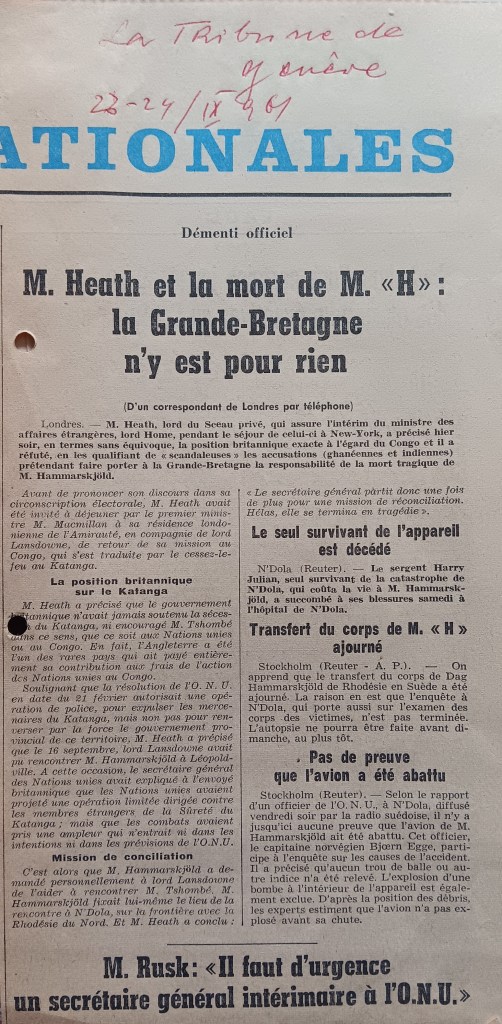
Paris-presse l’intransigeant, September 21 “At the Ndola hospital, the only survivor, 30% burned, Sgt. Harold Julian[sic], has not yet been able to be questioned. His condition, although improved, remains serious.”
France-Soir, September 21 Headline: “The survivor of Mr. H’s plane is incommunicado at the Ndola hospital (Rhodesia)” […] “Lying on his hospital bed in Ndola, the only survivor of the disaster, 30% burned, Sergeant Harry Julian[sic], one of the UNO bodyguards, is kept secret by doctors.” A rare photo of Mrs. Julien, caption says: “The wife of the sole survivor of Mr. H’s plane. Miami, 20 September (AP) — Mrs. Julian, 37 years, is the wife of the sole survivor of the DC-6 crash with Mr. H in Rhodesia. Mrs. Julian, who works for an advertising agency in Miami in the United States, only learned yesterday that her husband, Harry Julian, 37 years, one of Mr. H’s bodyguards, was on the plane.”

From Williams’ essay: “Maria Julien arrived in Ndola on Thursday, September 22, and was with Harry on the final day and night of his life. He was sedated and did not speak much. But she knew he was fully in his senses, because he asked about a chain that he had sent to her to be repaired — a chain to a medallion of St. Christopher, the patron saint of travelers. They were both devout Catholics, and Maria had called a priest to her husband’s bedside.

“But on the morning of the next day, her husband died — despite the expectation that he would survive. This was five days after the crash. The coroner’s summary report listed the cause as “Renal failure due to extensive burns following aircraft accident.”

[…]

“As Sgt. Julien was the only person left to describe what has happened on the flight, his recollections should have been crucial to the investigations of the Rhodesian Commission. But the commission discounted Julien’s statements to the nurses, writing: “No attention need be paid to remarks, later in the week, about sparks in the sky. They either relate to the fire after the crash, or a symptom of his then condition.” Even Julien’s comment about the plane having blown up, made to police inspector Allen, was not given serious attention.

“The senior medical staff at the hospital dismissed Julien’s recollections of the crash as the ramblings of a sick man; his reference to “sparks in the sky” was attributed to uraemia. But Dr. Lowenthal took a different view. He stated that Julien’s recollections were spoken during a plasma transfusion and before an injection of pethidine, which means that Julien had not been sedated at the time. Lowenthal felt so strongly about the need to establish this truth that he participated in the Rhodesian hearings as a volunteer witness; he insisted that when Julien spoke about the crash, he was “lucid and coherent.”

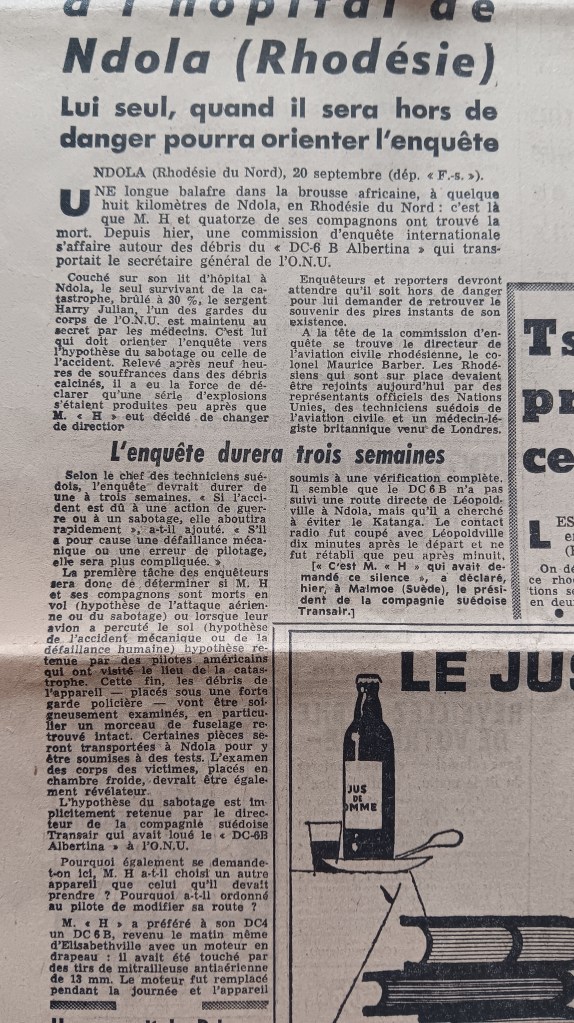
France-Soir, September 21 “Only he, when he is out of danger, will be able to guide the investigation.”
Tribune de Geneve, September 21. “Three months in hospital for the sole survivor of Hammarskjold’s plane. Sergeant Harry Julian[sic], seriously injured in the crash of the plane transporting Secretary-General Hammarskjold, and the only survivor of the disaster, will have to stay in hospital for at least three months. It will not be for ten or fifteen days before we will be able to know if he is really out of danger.”
France -Soir, September 21 “The only survivor of Mr. H’s plane is delirious and cannot be questioned.”
Tribune de Geneve, September 23-24 “The only survivor of the plane has died”
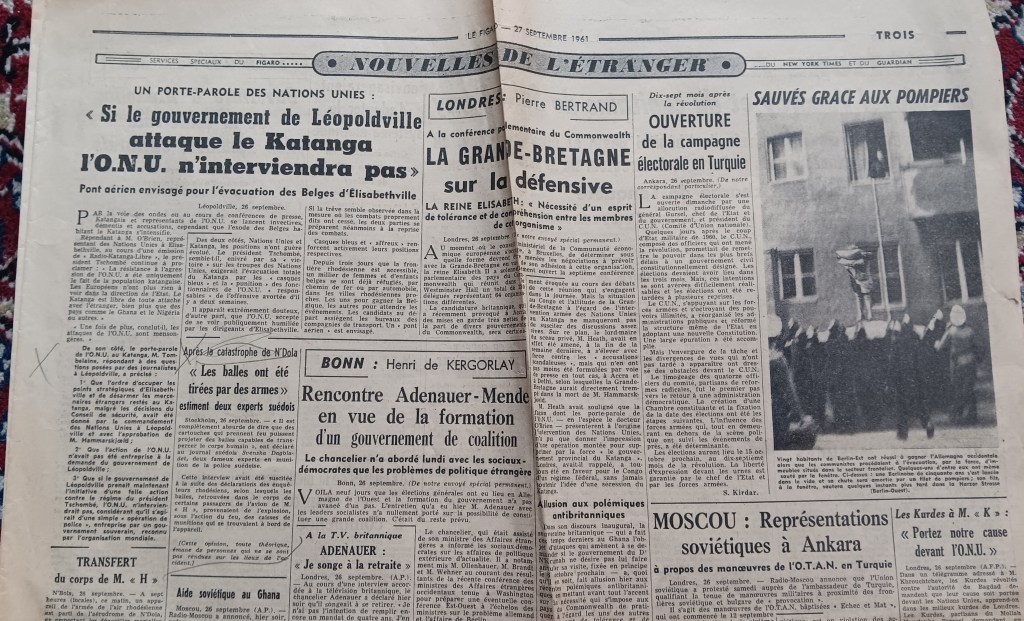
Le Figaro, September 27
Le Figaro, September 27 “After the Ndola disaster. The bullets were fired by weapons, say two Swedish experts.” […] “It is completely absurd to say that cartridges that catch fire can project bullets capable of piercing the human body” declared two famous ammunition experts from the Swedish police to Svenksa Dagbladet. This interview was prompted following statements by Rhodesian investigators, according to which, the bullets, found in the body of certain passengers of Mr. H’s plane, came from the explosion, under the action of fire, boxes of ammunition which were on board the aircraft. (This opinion, entirely theoretical, comes from people who did not go to the scene of the accident.)”

In honor of Dr. Martin Luther King’s birthday today, here is some encouragement from him: “I believe that unarmed truth and unconditional love will have the final word in reality. This is why right, temporarily defeated, is stronger than evil triumphant.”

Thank You, Judge Othman!

Judge Mohamed Chande Othman and Dag Hammarskjold Foundation Director Emeritus Henning Melber (photo source UNA Westminster)

Here is very good news I got this morning from a friend, with thanks to all of the friends of Hammarskjold!

“On 30 December 2022, the UN General Assembly passed Resolution A/77/L.31, which authorises the renewal of the UN’s ‘Investigation into the conditions and circumstances resulting in the tragic death of Dag Hammarskjöld and of the members of the party accompanying him.’ It further authorises the reappointment of the Eminent Person, Judge Mohamed Chande Othman, to lead the investigation.  

The Resolution was initiated by Sweden and co-sponsored by 141 Member States (out of 193). The US and the UK did not co-sponsor the resolution.  

The Resolution follows Judge Othman’s latest report (A/76/892), which is readily available on the UNA Westminster webpages on developments relating to the Hammarskjöld plane crash (along with various other significant documents and updates).  

In this latest report, Judge Othman writes:   

‘…I respectfully submit that the burden of proof to conduct a full review of records and archives resulting in full disclosure has not been discharged at the present time. Indeed, information received from other sources under the present mandate underscores that it is almost certain that these Member States [that is to say, the USA, the UK, and South Africa] created, held or were otherwise aware of specific and important information regarding the cause of the tragic event. That information is yet to be disclosed.’  

In case of interest, the passing of the Resolution by the GA can be watched on UNTV. It takes about three minutes from 1.04.40: https://media.un.org/en/asset/k14/k14tlsg06p

Interview with Madame Rime, Vlado’s secretary in Leopoldville, 1961

This is the full interview of Monique Cégel (now Madame Rime) sent to me in May 2020 by Maurin Picard, journalist and author of “Ils Ont Tue Monsieur H”; a portion of this interview was published here back in September 2020, “Vlado and the Mercenaries: Operation Rum Punch“, but I feel the whole interview deserves attention.

You can hear more interviews with Madame Rime about her experiences in the Congo working for the United Nations, with journalist David Glaser, reporter at GeneveMonde.ch.

Many thanks to Madame Rime, and to Maurin Picard for this interview and supporting the Hammarskjold investigation, and to David Glaser for promoting this blog and the life of Vlado Fabry – merci beaucoup to all who have contributed to this site!

Interview with Monique Rime Cégel

3 May 2020

Switzerland

Summary

– Monique Cégel, 83, was Vladimir Fabry’s secretary in Leopoldville in 1961

– She worked at the Hotel Le Royal between December 1960 and January 1962

– She knew Alice Lalande and Harold Julien very well

– She was working extra hours on 17 September 1961

– She typed Dag Hammarskjöld’s last message to Paul Henri Spaak, requesting Belgium to stop « van Riessenghem »

– She remembers there were serious doubts about UN communications being intercepted

– Vladimir Fabry did most of the research regarding Katanga mercenaries during the summer of 1961

– She remembers Dag Hammarskjöld’s collaborators tried to deter him from flying unescorted

– She does not think Sture Linnér was intended to fly along, as he had to stay in Leopoldville to liaise and work proper transmissions

– She flew to Ndola with Mahmoud Khiary on 19 September 1961 to type the ceasefire agreement with Moise Tshombe

– She saw the crash site right above her plane window prior to landing and was horrified 

– She recalls smoldering debris and the « long line » of burnt forest

– She found a very hostile atmosphere in Northern Rhodesia

– She met a very disdainful Lord Alport

– She was not allowed to join Mahmoud Khiary at the hospital to visit Harold Julien

* * *

I was Vladimir Fabry’s secretary, at the Hotel Le Royal, Leopoldville (Congo).

I worked there for the UN mission in Congo from December 1960 to January 1962, as secretary detached from the Atomic Agency (IAEA) in Vienna.

I kept working for the UN in Geneva until 1976, mostly through freelancing contracts. Then my husband and I moved to the city of Bulle.

I met my husband in 1961 in Congo! 

He was a representative for major Swiss companies of the time, including Schindler and Vega, and was selling chemical products to the university of Lovanium. 

I became a Swiss citizen, after getting married with him. 

I was French (and I still am), and was born in Paris.

* Sunday 17 September 1961

At the Hotel Le Royal, we had an office adjacent to the one occupied by Sture Linnér.

On the day Dag Hammarskjöld took off from Leopoldville, that Sunday, I was not supposed to work. 

But, as Fabry’s secretary, and since he only worked with me, they sent some military staff in a Jeep to pick me up and bring me back to Le Royal. 

They found me sitting at a cafe terrace, since I believe they always kept an eye on us for safety. 

I went back to my office and worked all afternoon, until the plane departed.

* Vladimir Fabry

That day, when I arrived at my office, Vladimir Fabry immediately requested to dictate some telegrams. I spent the whole afternoon doing that: typing messages, then bringing them to the « Chiffre » for them to be coded accordingly with the recipient’s identity. 

By the time I was finished, they were getting ready to leave for the airport.

Before leaving, Vladimir Fabry was so thrilled. 

Happy as a kid who was just offered a new toy. 

Albeit a very reserved character, he was practically jumping on his feet. 

He came into my office and said excitingly: 

« Monique, I am leaving with the Secretary-General! I am trusting you with my car keys! » 

He had to be very happy, for he would never have done such a thing otherwise. 

His car was an official UN vehicle. 

He told me I could use all the time during his absence. 

God knows Leopoldville is a very large town, with great distances between the various locations.

I used the car until, of course, I handed it back to the UN, since Fabry never returned.

I remember seeing their cars leaving Le Royal in convoy.

I went through these events with an innocent mind as I could only partially grasp what was going.

I would mostly type messages dictated by Fabry, messages that were generally meant for New York.

The last message I typed from them was dictated by M. Hammarskjöld himself. The recipient was Paul-Henri Spaak. 

(nota: the Belgian Foreign Minister) 

But I cannot remember its content (nota: requesting Belgian assistance to put an end to the criminal deeds of a mercenary pilot named « van Riessenghem »). 

I was so intimidated that I must have skipped two or three words he dictated. 

I had never met Hammarskjöld and I was so young then (nota : she was 24).

I saw Dag Hammarskjöld every day between 13 and 17 September 1961, since he occupied Sture Linnér’s office.

Can you recall Hammarskjöld’s state of mind?

I remember he was not very agreeable. He seemed really sad, not at all in a communicative mood. « You do this, this has to be done ». We were in the midst of a serious crisis with Katanga, obviously.

* Were there long sleepless nights at Le Royal?

I did not spend those ones with them, but I had a similar experience during the previous months. When you are assigned to someone high ranking, you did not count your days and your nights. With all the crises we went through, there were many sleepless nights at Le Royal.

* Harold Julien

I knew Harold Julien very well, as he was the Chief Security Officer in Leopoldville. Being M. Fabry’s secretary, I was granted the use of a car. 

This in turn created some serious trouble, because we were taken hostage with a Swiss colleague of mine by Mobutu’s troops for 24 hours. The time was around end January or early February 1961. 

They had spotted my car, I believe, due to the UN flags on it, and surrounded our house with two small armoured cars. There were rumors that the UN was bent on disarming the Congolese National Army. And we had been poorly inspired to move in a house across the street from Mobutu’s barracks along the river – a magnificent location, it was indeed. 

Then the witchhunt began against all UN staff. 

This is the only time in my life I was really scared.

I called the French embassy asking for their help, as I was a French citizen. Their answer was very … kind: « you work for the UN, hence you are no longer considered as a French citizen for us. There is nothing we can do for you ».

Since my colleague was Swiss, she called the Swiss embassy and they immediately answered. « Yes of course, we will come and rescue you ».

They arranged for a motorized convoy of Swiss people, with friends and colleagues of my future husband, led by the Red Cross delegate M. Olivet, who was killed another day.

(nota: Georges Olivet, 34, was killed in an ambulance on 12 December 1961, amidst heavy fighting in Elisabethville, Katanga)

They parlayed with Mobutu’s soldiers, who pretty quickly removed their blockade and let us go free. 

* Saturday 16 September, Lord Lansdowne meets Dag Hammarskjöld. Did you get word of a stormy exchange?

No, I do not remember that gentleman. 

I did not hear anything, although I was there that day and was working in the nearby room. If there had been loud voices, a shouting match, 

I would have heard something. 

But it does not mean it did not take place, as my memory could be failing me.

There were indeed many high ranking visitors in Sture Linnér’s office, and I did not always necessarily get a look at them.

* Did Dag Hammarskjöld’s collaborators try to deter him from flying unescorted?

That is true, since I remember I heard about it. 

They did try to deter him. 

There were rumors that they were « waiting » for him in Katanga. There were Tshombe’s two Fougas. 

(nota: in September 1961, the UN still believed two remaining Fouga were operational, as there was actually only one left, « 93 », the other one bing grounded awaiting spare parts)

When we heard about the crash, we immediately thought: « Tshombe’s Fougas did it ».

Personnally, I just could not imagine such a thing: who would want to shoot down the UN Secretary General? 

I really thought this was just an accident, at least until after I left Congo early 1962. 

If I had known … I was so scared in the air. I could never have boarded a plane. 

But since I had no clue of what happened, I departed very easily when told to, without any further stress.

* Was Sture Linnér supposed to join the mission and fly along with Dag Hammarskjöld, as he later commented?

I was not at Ndjili airport but I would be surprised if he was intending to fly with them. It was logical for him to stay in Leo and liaise. That would be surprising if true.

Alice Lalande, she had to be part of the travelling party, since she was in charge of sensitive equipments, these Enigma machines. Besides, the Secretary-General needed an assistant like her. In her daily job, Alice was handing over paperwork to all the secretaries. She was a perfectly bilingual Canadian.

* Did Dag Hammarskjöld know that UN communications were intercepted?

I do not know, but it was a serious question for everyone in Leopoldville. 

I had worked for weeks with Vladimir Fabry on the issue of the « frightfuls », these mercenaries.

I made dozens of photocopies from these documents that had been somehow collected and that had to do with these mercenaries. Vladimir Fabry worked a great deal on this issue. We did an extensive research on these documents. I am sorry that I did not have enough political awareness, to show an interest in the content of these documents.

* Monday 18 September 1961

Personnally, I did not get word of the crash when I arrived at the office on the next day. The other secretaries were doing a funny face, which was a bit intriguing. I made it late to the office due my long working hours on Sunday. I thought there was a dreadful atmosphere, but nobody told me anything. They did not dare tell me what had happened, probably because I was working so closely with M. Fabry. I only found out the same evening when I came home and my future husband told me: « did you hear what happened to Hammarskjöld ? »

The crash site

When Mahmoud Khiary took off for Ndola, I came along. 

(nota: on Tuesday 19 September 1961, in order to negotiate a ceasefire with Moïse Tshombé, as it was theoretically the case for Dag Hammarskjöld two days earlier)

I boarded the plane with him. If I had known the crash was foul play, I would never have come along with Khiary. This was so sudden, that I did not have the time to bring any equipment, not even a typing machine, as Alice Lalande had done.

We departed for Ndola. Prior to landing, while flying low over the forest, we managed to see the crash site from up close 

(nota: the whole area was forested back then)

This memory will stay with me forever. 

We spotted the wreckage, these scattered debris of an aircraft, what was left of it. This long line of burnt forest. It was terrible. I am still emotional about it, as I speak. I happened to realize the people I knew so well were only charred remains by now. 

Alice Lalande, to begin with, who was basically my boss. 

The security officers, such as Harold Julien.

I remember Alice’s dress with the flowery design. It sent cold shivers down my spine when I realized the plane had crashed and burnt that way. I though My God, she must have burnt so quickly. It was terrifying.

* Ndola, 19 September 1961

When we arrived in Ndola, there was this man, Lord Alport, welcoming us – so to say – at the airport. He was very cold. An extremely disagreeable character, very full of himself and every inch a British aristocrat. Still he invited our delegation for lunch in his home. I was just a secretary sitting at the end of the table with the security officers, but I found him disdainful towards us .

(nota : Khiary was not particularly welcome, since Tshombe had notified Linnér he agreed to negotiate a ceasefire with anyone but Khiary, whom he deemed responsible for launching Operation Morthor on 13 September 1961 – which is at least partially true) 

Our mission was not very welcome. 

Then we headed for the actual ceasefire negotiations with Moïse Tshombe, but I did not directly take part in the negotiations. The British mission there lent me a typing machine, whose keyboards had none of the French accents, which made my task very dfficult. I did however type all the ceasefire documents.

We stayed two or three days in Ndola.

Mahmoud Khiary and the delegation visited Harold Julien in the hospital. I was not allowed to join them.

1961 was a terrible year in my life. Annus horribilis, as the Queen Mother would say. 

There was my being taken hostage, then Hammarskjöld’s crash, then the murder of 13 Italian air crew.

(nota: massacred by the crowd who mistook them with Belgian paratroopers in Kindu on 11 or 12 November 1961) 

One of them was 25 and a very good friend of mine.

He had been at my wedding two weeks before, on 28 October 1961, along with Sture Linnér’s wife, whom I called Madame Linnér, of course, and also Jacques Poujoulat.

This day of September 1961, this Sunday the 17th. In my old age, I still cannot fathom what unfolded that day. It is still with me. It will stay with me until my last breath.

Thank you, Hynrich Wieschhoff!

With gratitude, “The Elusive Truth About the Death of Dag Hammarskjold”, written for PassBlue by the son of Heinrich A. Wieschhoff. I’m sharing it here in full so everyone will read this, and know how the relatives truly feel about the UN investigation.

“My clock radio clicked on. The morning news bulletin announced that United Nations Secretary-General Dag Hammarskjöld’s plane was missing.

It was Sept. 18, 1961. I was 16.

Over the next hours, my mother and sisters and I learned that Mr. Hammarskjöld, accompanied by Dad and 14 others, had flown from Leopoldville, in the Congo, to Northern Rhodesia (now Zambia); that the plane, a DC-6, had not landed at Ndola, its destination; that an unexplained 15 hours went by after the airliner passed over the Ndola airport and before its wreckage was found lying not far from the runway; that all on board save one were dead.

My father, Heinrich A. Wieschhoff, was one of Mr. Hammarskjöld’s political advisers. Their party was headed for talks with the head of the breakaway Congo province of Katanga in hopes of quieting the fighting that had broken out between UN peacekeeping troops and the largely mercenary-led forces backing Katanga’s secession. It was a dramatic moment in the history of this mineral-rich country — a year after it gained independence from Belgium and quickly became embroiled in a violent quagmire involving the interests of not only Belgium but also France, South Africa, the Soviet Union, Britain and the United States.

Days after the crash, we learned that the sole survivor had died. Now there was no one to shed light on what had occurred. My family’s experience was lived in one wrenching way or another by the families of the 15 other victims. The particulars were different; the pain was the same — and only worsened because no one could tell us why the plane had gone down.

From the outset, there were legitimate concerns about the possibility of foul play. Within months of the crash, three inquests were held in rapid succession. The report of a UN commission, relying to a large degree on groundwork done by the-then Rhodesian Federation, was inconclusive, as was a report by the federal civil aviation body. The report of a commission empaneled by the Federation arrived, by a curious turn of logic, at the convenient conclusion that the event was an accident.

At first we assumed the UN would be vigilant in looking for new clues and dogged in running them to ground, and for years that seemed to be the case. Dad’s UN associates fielded our questions about the results of the original investigations and new allegations of wrongdoing promptly and graciously.

Once those associates left the UN, however, I gradually began having doubts that anyone in a leadership position cared much, if at all. One exception was Jan Eliasson, the deputy secretary-general under Ban Ki-moon, who was seemingly alone in advocating a serious look at the death of his idol and fellow Swede, Mr. Hammarskjöld.

The UN’s public posture toward Mr. Hammarskjöld drips with veneration — naturally. Yet when it comes to actually unraveling the circumstances of his death, a certain callousness prevails, despite high-sounding pronouncements to the contrary. In my experience, concern about the other 15 victims is even lower.

One byproduct of this indifference has been a coming together of nearly all the families of the deceased. Partly as a result, I have sensed that the UN is paying more attention to their interests, at least in its public comments. Privately, I still encounter telltale signs that the organization views the search for answers as a housekeeping matter.

For instance, when a group of the relatives sent the UN Secretariat a copy of a letter thanking the UN members sponsoring a recent resolution bearing on the crash, the response was a form letter from the public inquiries team stating that “the matter you raise is one of domestic jurisdiction, and does not fall within the competence of the United Nations.”

In 2011, the inquiry hit a turning point. Susan Williams, who had no prior connection to the crash, published “Who Killed Hammarskjöld? The UN, the Cold War and White Supremacy in Africa.” A sobering probe of information that the three post-crash inquests did not have, or had but failed to consider properly, it presented the UN with a chance to dig deep.

Dr. Williams, a historian and senior research fellow at the University of London, did not identify a likely cause of the disaster, but she did present a number of startling claims, including that US intelligence services allegedly eavesdropped as an unidentified plane attacked Mr. Hammarskjöld’s during its landing approach.

The book sparked hope that the UN would finally give the crash its due. First, however, a group of private citizens established a pro bono commission of four jurists to evaluate her findings. In 2013, they determined that significant new evidence could justify reopening the UN’s original investigation.

The stage was set, at long last, to bring this unhappy affair to a definitive close. Unfortunately, instead of insisting that further exploration be unlinked from the agendas of individual member states, and Secretary-General Ban be given a free hand to deal with the crash as he saw fit, the office of the secretary-general solicited the views of certain members of the Security Council. Predictably, influential members signaled their lack of enthusiasm for a full-fledged re-opening of the investigation.

In other words, the UN ducked — in my view, avoiding discomfiting questions about the roles of Belgium, France, South Africa, the Soviet Union, Britain and the US in events related to the crash, and possibly about the UN’s own handling of its original investigation and subsequent new evidence as well.

What followed was five years (and counting) of a piecemeal, woefully ineffective process fashioned to give the impression of rigor. Through resolutions organized by Sweden, the General Assembly first relegated the crash to a “panel of experts” for yet another assessment of new information (2014), then to an “eminent person,” the former chief justice of Tanzania, Mohamed Chande Othman, for follow-up (2016).

The resolutions asked member states to search their archives for relevant material and to declassify sensitive records, namely intelligence and military files. But genuine cooperation from the key players has been slow and halting. Russia and the US, as of a recent date, failed to comply fully with the General Assembly’s resolutions, and South Africa and Britain appeared bent on frustrating the process altogether. To my knowledge, the UN has rarely generated information on its own, so that leaves Chief Justice Othman to rely heavily on private sources.

As far as I am aware, the Secretariat has not engaged at a high level with recalcitrant member states to get them to adhere to the General Assembly resolutions. It has done little to publicize the activities of the chief justice. It has been slow to fully declassify its own archives and still refuses to release some documents.

In their Dag Hammarskjöld Lectures, in Uppsala, Sweden (Mr. Hammarskjöld’s home base), Secretaries-General Ban and António Guterres each mentioned the search for the truth about the crash but at the tail end of their presentations, almost as an afterthought. Instead of taking a meaningful stand, they repeated the hollow refrain: the UN was doing all it could do to find answers and member states should comply with the call to declassify relevant records.

Equally revealingly is the fact that in 2017, Secretary-General Guterres’s office sought to end the Judge Othman probe. Thanks to Sweden’s insistence, the General Assembly renewed his appointment. Did the secretary-general tip his hand last year when, rather than appear in person before the General Assembly, he sent a subordinate to present Judge Othman’s interim report?

His findings were impressive, especially considering his meager support. For his current engagement of about 15 months, Judge Othman has only himself and an assistant, working part time and in different countries, on a budget so small that nearly a third will go toward translating his reports into the UN’s official languages.

The opportunity presented by Dr. Williams and the jurists’ commission still stands. And we may learn more from Judge Othman’s final report, due this summer. I worry, though, that unless that report or a new sense of purpose by the UN can pry the facts out of Britain, the US and other key states, what happened and why will once again fade unanswered into the past.”

Misleading Conduct? US and UK Intelligence Obstruct Justice of UN Investigation

Vlado's casket Geneva Lutheran Church

From Julian Borger’s Guardian article, 24 August 2016, “Dag Hammarskjold: Ban Ki-moon seeks to appoint investigator for fatal crash”:

“[…]Ban [Ki-moon] noted that the UK had stuck to its position last year that it had no further documentation to show the UN investigation. He appended a letter sent in June by the British permanent representative to the UN, Matthew Rycroft, saying “our position remains the same and we are not able to release the materials in question without any redactions”.

Rycroft added “the total amount of information withheld is very small and most of the redactions only consist of a few words”.

The wording of the letter echoed a similar letter, turning down the UN request for more information, the UK sent in June 2015, which said that “no pertinent material” had been found in a “search across all relevant UK departments”.

In reply the UN legal counsel, Miguel de Serpa Soares, reminded Rycroft of the shared responsibility of the UN and its member states “to pursue the full truth” about Hammarskjold’s death, and asked him to confirm that the search of “all relevant UK departments” included security and intelligence agencies.

In reply, Rycroft simply quoted the former UK foreign secretary Philip Hammond telling parliament that the foreign office had “coordinated a search across all relevant UK departments”.

“I think the British response is extraordinary. It’s very brisk and curt and evasive,” said Susan Williams, a British historian at the School of Advanced Study, University of London, whose book Who Killed Hammarskjold: The UN, The Cold War and White Supremacy in Africa, revealed new evidence that helped persuade the UN to open a new investigation into the crash near Ndola, in what was then the British colony of Northern Rhodesia, now Zambia.

Part of that evidence was a report from a British intelligence officer, Neil Ritchie, who was in the area at the time of the crash and who was trying to organise a meeting between Hammarskjold and a rebel leader from neighbouring Congo, where the UN secretary general was trying to broker a truce.

“This was British territory and they had a man on the ground. It doesn’t make them responsible for the crash but it does indicate they knew a lot of what was going on,” Williams said, adding it was “highly unlikely” that Ritchie’s report which she found in an archive at Essex University, was the only British intelligence report coming the area at the time.”

On 28 August 2016, Dr Mandy Banton (Senior Research Fellow, Institute of Commonwealth Studies), Henning Melber (Senior adviser/director emeritus, The Dag Hammarskjold Foundation), and David Wardrop (Chairman, United Nations Association Westminster Branch) published letters together in the Guardian, “UK’s lack of transparency over plane crash that killed Dag Hammarskjold”. From Melber:

“The US and British responses to the efforts by the United Nations to further explore the circumstances of the plane crash at Ndola should be an embarrassment to all citizens in these countries (and elsewhere), who have an interest in seeking clarification of what happened. The reports so far already present sufficient evidence that there is more to it than what the official government responses are willing to admit.

This form of denial through non-compliance with legitimate demands for access to information is tantamount to obstruction and sabotages the sincere efforts to bring closure to one of the unsolved cases involving western states and their security operations. Such an arrogant attitude further dents the image of those who claim to be among civilized nations then and now.”

From 2 September 2016, here is an excerpt from Justice Richard Goldstone’s letter to the Guardian, “Hammarskjold case is not yet closed”:

“[…]it is highly likely that some member states of the UN, especially but not only the US, hold records or transcripts of cockpit transmissions in the minutes before the plane came down. If so, these may well put the cause of the crash, whatever it was, beyond doubt. But neither the US National Security Agency, which has gradually resiled from its admission to our commission that it held two relevant records, nor, as Dr Banton’s letter (29 August) suggests, the UK government, has so far responded with any vigour to the secretary-general’s plea for cooperation.”

From the 6 September 2016 New York Times, “Release the Records on Dag Hammarskjold’s Death”, written by The Rt. Hon. Sir Stephen Sedley:

“There was also evidence that the N.S.A. was monitoring the airwaves in the Ndola region, almost certainly from one of two American aircraft parked on the tarmac. Our inquiry therefore asked the agency for any relevant records it held of local radio traffic before the crash. The agency replied that it had three records “responsive” to our request but that two of those were classified top secret and would not be disclosed.

At its close, my commission recommended that the United Nations follow up this lead. The General Assembly appointed a three-person panel, which repeated our request to the N.S.A. This time, the agency replied that the two documents were not transcripts of radio messages as Southall had described and offered to let one of the panel members, the Australian aviation expert Kerryn Macaulay, see them. This she did, reporting that the documents contained nothing relevant to the cause of the crash.

This makes it difficult to understand how those two documents were initially described as “responsive” to a request explicitly for records of radio intercepts, or why they were classified top secret. It raises doubts about whether the documents shown to Ms. Macaulay were, in fact, the documents originally identified by the N.S.A. The recent denial that there is any record of United States Air Force planes’ being present at Ndola increases the impression of evasiveness.”

****
From the Ohio State Bar Association (OSBA) website, “What You Should Know About Obstruction of Justice”:
“Q: Does obstruction of justice always involve bribery or physical force?
A: No. One particularly murky category of obstruction is the use of “misleading conduct” toward another person for the purpose of obstructing justice. “Misleading conduct” may consist of deliberate lies or “material omissions” (leaving out facts which are crucial to a case). It may also include knowingly submitting or inviting a judge or jury to rely on false or misleading physical evidence, such as documents, maps, photographs or other objects. Any other “trick, scheme, or device with intent to mislead” may constitute a “misleading conduct” form of obstruction.”

To Dag With Love

073
View from above Ralph Bunche Park.

It was a beautiful week in New York City for my visit to the UN Archives. Every morning, I took the 7 to Grand Central Station, walked down 42nd Street, crossing 2nd Avenue – also known as Yitzak Rabin Way, and then on towards 1st Avenue, where the Headquarters of the United Nations rise up along the edge of the East River. I slowed my pace through Ralph Bunche Park, which is mostly concrete, but the small fenced-in area of plants and flowers attracted a couple of American Robins, who were busy hunting for breakfast. I spent my time between 42nd and 47th Avenue – the location of Dag Hammarskjold Plaza – walking past security guards outside the US Department of State and Foreign Missions, and the House of Uganda, feeling very much at the center of the universe with all the languages being spoken around me. I’m sure I was noticed with amusement by a few, I was the only lady with UN blue hair!

066
Dashing diplomats, at the entrance of the UN.

059
Taking a rest in Dag Hammarskjold Plaza.

061
The Gazebo

060
There was a farmer’s market my first day at DH Plaza.

063
Fun public art – the giant Hello Kitty Time After Time Capsule, designed by Japanese artist Sebastian Masuda.

After my morning walk, I made my way to the UN archives, where the staff were waiting to help me get started. The archives are open to everyone, it’s a free service, and I had a really positive experience there – I even met someone who worked with Vlado’s sister, Olga – who was a librarian at the Dag Hammarskjold Library – that made me very happy. Here was my desk the first day:

053

Of course, since it was my first visit to an archive, I requested too much, and had to narrow down and prioritize quickly what I wanted to look at after the first day. To me, it was all very interesting, but I would have needed to spend a month in there, 8 hours a day, just to see everything I requested, and I had only three days!

The hard work was a pleasure, but it gave me an appetite. Fortunately, there were plenty of great choices for lunch in the neighborhood. One day, I had a Maine lobster roll from a food truck across the street from UN Headquarters, and if I hadn’t been so eager to get back to the work, I would have tried out the Nigerian food truck on the next block, too.

057
Also had a nice lunch here – a “Dag Burger with Cheese” at Dag’s Patio Cafe in DH Plaza.

By the end of my visit, I came to appreciate that it is the personal letters of these people that interest me the most, and how lucky I am to have so much of Vlado’s correspondence. I went to the archives out of curiosity, with no expectations, but with hope that I would find something special, something that other eyes had missed.

And I was rewarded for my efforts – with a love letter written to Dag.

When I found it, I immediately thought of Susan Williams’ discovery in the Royal Library of Sweden in Stockholm, the intriguing newspaper clipping she found inside Dag’s wallet that said ‘and when Nefertiti murmurs, “Oh Moses, Moses, you stubborn, splendid, adorable fool,” the Bible seems a long way off.’

The writer is very forward in her intentions, and though it embarrasses me to admit it, I couldn’t help but see a bit of myself in her admiration for his character, her wish to do something good because of him. I can’t deny the romantic tone of my writing, that I fell in love with both Vlado and Dag in the course of my research, and that love for them gave me the courage to write some of the things I did, so I feel this letter was meant to be found by me. The last page, with her signature, will be transcribed, to protect her identity. From the same file, I’m also including transcriptions of a letter of introduction from the Ambassador to Spain Jose Felix de Lequerica, and a small note from the Secretary-General’s private secretary, Miss Aase Alm, which came before he received her letter.

From the United Nations Archives in New York, S-0846-0004-08, Operational Records of Secretary-General Dag Hammarskjold, 1953-1961.

“Mision permanente de Espana
en las Nacions Unidas

New York, September 14, 1959

Miss Aase Alm
Private Secretary to the
Secretary General of the
United Nations.
New York, N.Y.

Dear Miss Alm:

I have received today a letter from His Eminence Cardinal Spellman, introducing Miss ——, from Houston, Texas, and asking me to receive her. During the course of the conversation Miss —— told me that she wishes to present her compliments to Mr. Hammarskjold and speak to him about a personal matter. I have called her attention about the difficulty of such an interview, as I personally cannot arrange for this meeting not knowing myself the nature of same.

But in the view of the interest shown by Cardinal Spellman, I am giving this letter of introduction to Miss —— in the event that during your conversation with her you may be able to find something of interest to the Secretary-General and, at the same time, comply with the wishes of Miss ——.

Thanking you in advance for your kind attention, I remain

Very truly yours,

Jose Felix de Lequerica
Ambassador
Permanent Representative of Spain
to the United Nations.”

On this note from Miss Alm, two big exclamation points in red pencil were added to hers–in red pencil at the top of the love letter is written “Oh!”:

“I asked Miss —— to write to you, as you were too busy at the moment to receive her; explained at the same time that an appointment would be difficult unless she could give you some information what it would be about. I think you would want to see this because of the introductions from Spellman and de Lequerica!”

030
Written on stationary from The Drake Hotel, Park Avenue at 56th Street, New York 22, N.Y.:

TELEPHONE: PLAZA 5-0600
[Ext. 421 written beneath]

Personal

Dear Mr. Hammarskjold;

I chose to meet you through the Spanish Ambassador because I thought that Spain’s more or less neutral position would eliminate any political implications. Even though I did not relate my specific reason for desiring to see you, His Eminence Cardinal Spellman very graciously assisted me by sending a letter of recommendation to H.E. Jose Felix de Lequerica.

Since meeting you through conventional channels is highly improbable, I shall proceed with all frankness and sincerity to reveal my reason for wanting to see you.

031

These reasons are unknown to my friends, relatives, or even to my mother who has accompanied me to this city. People travel all over the world to see the many wonders and the beauty of nature, but God’s greatest creation is mankind, and a man of your goodness and wisdom is the most beautiful sight of all.

You know Dag, that although Cassanova was supposed to have been the greatest rogue lover of all time, none of his numerous lady loves ever followed him. Of course his base type of love can be compared to your love for humanity only in that yours is so much more superior on both counts.

How well you use your intellect and readily become a tool to God’s manipulations by carrying out your mission, the burden of your high office with dedication and inspiration.

032

If you should perhaps have a few human imperfections, I’m sure they are heavily overshadowed by your better qualities. You undoubtedly derive much satisfaction by working and administrating for humanity and peace, yet high places are sometimes very lonely, demanding the impression of aloofness in order to appear impartial. To complete this impression, some of your close friends might do well to remain obscure. I would like to be a silent friend now and in your riper years after your work is done and you retire to ‘pasture’. And if I might someday in some small way be of any help to you, I would be very happy to make an effort to comply.

I plan to leave New York on Tuesday September 22nd and return to my home in Houston, Texas. I have been here since September 11th and trust that I will not have to wait much longer to meet you.

Please do not be embarrassed by my directness. My manner of writing is usually to the point as you can tell by a letter that I am enclosing here in reference to food surplus.

I realize that in polite society revelations such as I have made here are out of order and are kept more demurely, but time and circumstances do not permit this subtle cultivation of friendship. However, you may rest assured that at our meeting I shall conduct myself in the quiet, controlled dignity that becomes a respectable woman. Personally, I am much meeker and much more at loss for words.

With sincere esteem

The Montreal Star, 19 September 1961

Here is another brief article about Alice Lalande, who died with Dag Hammarskjold, which was sent on to me by Susan Williams. Because there is so little information about the 15 others who died with the Secretary General, I would like to use this blog as a place to share their stories, too. I encourage people to please contact me, if you have news clippings or anything else you are willing to share about these brave people. I would be glad to honor them here.

Alice pic from Montreal Star-1 (5)
City Woman Served UN 15 Years

UNITED NATIONS, Sept. 19–
Alice Lalande, a bilingual Montrealer who served the UN for 15 years, died in a Northern Rhodesia plane crash with UN Secretary General Dag Hammarskjold yesterday because he placed such high value on her services.

The 48-year-old Montrealer was a favorite of the late Mr. Hammarskjold. Every time he went abroad and was able to borrow Miss Lalande from his own overseas officers Mr. Hammarskjold did so.

For a brief period Miss Lalande was secretary to Canadian General E. L. M. Burns, now Canadian disarmament adviser here, then commander of United Nations emergency forces on the Gaza strip. She went directly from the Gaza strip to Leopoldville in the former Belgian Congo when the UN first became involved late in the summer of 1960.

Miss Lalande, whom Mr. Hammarskjold seconded for his personal staff shortly before the fatal flight from Leopoldville, was personal secretary to the chief of the UN’s Congo operations, Sture Linner.

Miss Lalande joined the UN secretariat on June 24, 1946.

Born in Joliette, Que., Feb. 6, 1913, Miss Lalande worked at the University of Montreal after graduating as a secretary from a Montreal business school. She was a stenographer in French and English in the languages division of the UN department of conference and general services from June 24, 1946 to May 21, 1948, when she became a bilingual secretary in the office of the assistant secretary general in that department.

In June 1948 she was transferred to the UN Palestine secretariat as a secretary, and in January 1951 she became a secretary with the UN conciliation commission for Palestine in Jerusalem. In 1954 she returned to UN Headquarters as a secretary in the office of the assistant secretary general for social affairs.

In 1956 she served as a bilingual secretary with the United Nations educational, scientific and cultural organization, in Paris, for three months. Later in 1956 she returned to UN Headquarters and served with the department of economic and social affairs.

Photos of Hammarskjold

Several months ago, I was sent something serious that has been troubling me, and I have been reticent to write about it, because I wanted to be more informed before giving my opinion.

The anonymous source that sent me the scans of letters from the archive of Roy Welensky (I have three, one of them is published here), also sent photos of the crash site and wreckage of the Albertina in Ndola. Some of the photos I recognized from Susan Williams book Who Killed Hammarskjold?, but many I had never seen before.

In one photo, labelled “Offloading wreckage of DC-6B SE-BDY prior to burial at Ndola airport”, you see white men standing around, talking to each other, while black men work to offload the wreckage from the back of a truck into a pit, which has been made by a nearby bulldozer that is preparing to flatten everything before burying it all. I don’t understand why the plane had to be buried, it makes no sense to me. Is it normal to bury planes like this? I’ve never heard of such a thing.

In another photo, labelled “Location of levelled site with “burial party” Messrs. J.D. Williams (Ndola Airport Manager) H.C. Bowell (Aircraft Engineer) M.C.H. Barber (Director of Civil Aviation) and M. Madders (Chief Aircraft Engineer)”, you see these four white men, standing side by side in the bulldozer tracks of the freshly covered grave of the Albertina, smiling, hands on hips, a pipe in the mouth of the Ndola Airport Manager. They look rather pleased with themselves.

But the most troubling thing I received were the autopsy photos of Dag Hammarskjold, six of them. I don’t know how many people have seen these photos, but they are shocking, and very sad. The post mortem of Hammarskjold makes no mention of the playing card that was placed in his shirt collar (an ace of spades, supposedly, which was from decks of playing cards found scattered at the scene) but there it was, very clearly seen in the three photos taken at the crash site. The card also appears to have been adjusted to its side in one photo. Even if it was placed there as a sick joke, it certainly lends a sinister note to the whole macabre scene. The three photos from the crash site show him on a stretcher, his clothes unburned and intact, his face streaked with blood, and the other three were taken in the mortuary, but there is no photo evidence of the actual place where Hammarskjold’s body was found. I wish I could publish these photos, so people could see for themselves, but I’ve been asked to keep them private.

Having seen them, I found myself very upset at Brian Urquhart after reading this passage he wrote in his biography of Hammarskjold:

“Hammarskjold was thrown clear of the wreckage and alone among the victims, was not burned at all. Although the post mortem showed that he had probably lived for a short time after the crash, his injuries–a severely fractured spine, several broken ribs, a broken breastbone, a broken thigh, and severe internal hemorrhaging–were certainly fatal. He was lying on his back near a small shrub which had escaped the fire, his face extraordinarily peaceful, a hand clutching a tuft of grass.”

Did Urquhart look at the same photos I did? Because the face of Hammarskjold does not look “extraordinarily peaceful” to me, it looks beaten and bloodied. And just like the post mortem report, Urquhart makes no mention of the obvious playing card. What was the point of this omission, if not to cover up the horror of the situation? These are just my observations.

Unfortunately, Urquhart was of the opinion that the testimonies of African witnesses who saw the Albertina followed closely by smaller planes just before the crash, and any other theory of murder, were just “fantasy”, as he writes in the epilogue of the biography:

“Although there is a large–and still growing–literature on Hammarskjold’s death, it is significant that none of those who cling to the idea that he was murdered in one way or another have seen fit to demand a new inquiry or to present serious evidence. The main conspiracy theories put forward are mutually exclusive–if one is true, all the others must be false–and so far none of them is backed by anything more than rumor, speculation, and fantasy.”

Urquhart wrote this back in 1972, but I wonder if he still holds the same opinion after reading Susan Williams book, and the September 2013 Report from the Hammarskjold Commission. After all these years have gone by, I have to ask, why is there still so much secrecy about what happened to Hammarskjold?

Vlado’s Final Rest in Geneva

Just recently, I purchased the book WHO KILLED HAMMARSKJOLD?: THE UN, THE COLD WAR AND WHITE SUPREMACY IN AFRICA, written by Susan Williams, a senior research fellow at the Institute of Commonwealth Studies, University of London, and reading it has left me disturbed. It was a shock to open the book to the back page and see, for the very first time, the drawing of the wreckage plan of the Albertina. There was Vlado’s body, indicated by a circled “B 7”, not far from Dag Hammarskjold (“B 8”) and Sgt. Harold Julien (“B 16” – the only survivor of the crash, who died six days later). This book is an incredible help for my research, and I want to thank Williams for writing it. I hope the U.N. does not ignore the evidence she has presented in her book – Dag Hammarskjold’s death was not an accident, and there should be a new inquiry. Like so many good men that dared to live out their philosophy on this planet, he had to pay for it with his life.
From the family photo archive, here is Vlado’s body being delivered to Geneva on the Pan Am DC8 that carried the body of Hammarskjold and the other 14 victims, the first stop of many around the world. The UN flag that drapes his coffin was later given to Madame Fabry-Palka and her daughter Olga, and is now in our home. (click images to enlarge)
Body of Vladimir Fabry Returned to Geneva1

In this photo, Madame Fabry-Palka is consoled by a UN staff member as Olga Fabry (Vlado’s only sibling) stands nearby. I wish I knew who the other people in the photograph were – especially the man with the reflective glasses and the baton at the foot of the stairs.
Body of Vladimir Fabry Returned to Geneva2

Vlado is buried in the Cimetière du Petit-Saconnex in Geneva, next to his father – they died within 9 months of each other. Madame Olga Fabry-Palka died in 1974, and is buried there with them, also. Whenever I am in Geneva, I pay my respects to this good family, and thank them for their example of courage.
Fabry Grave Petit-Saconnex