
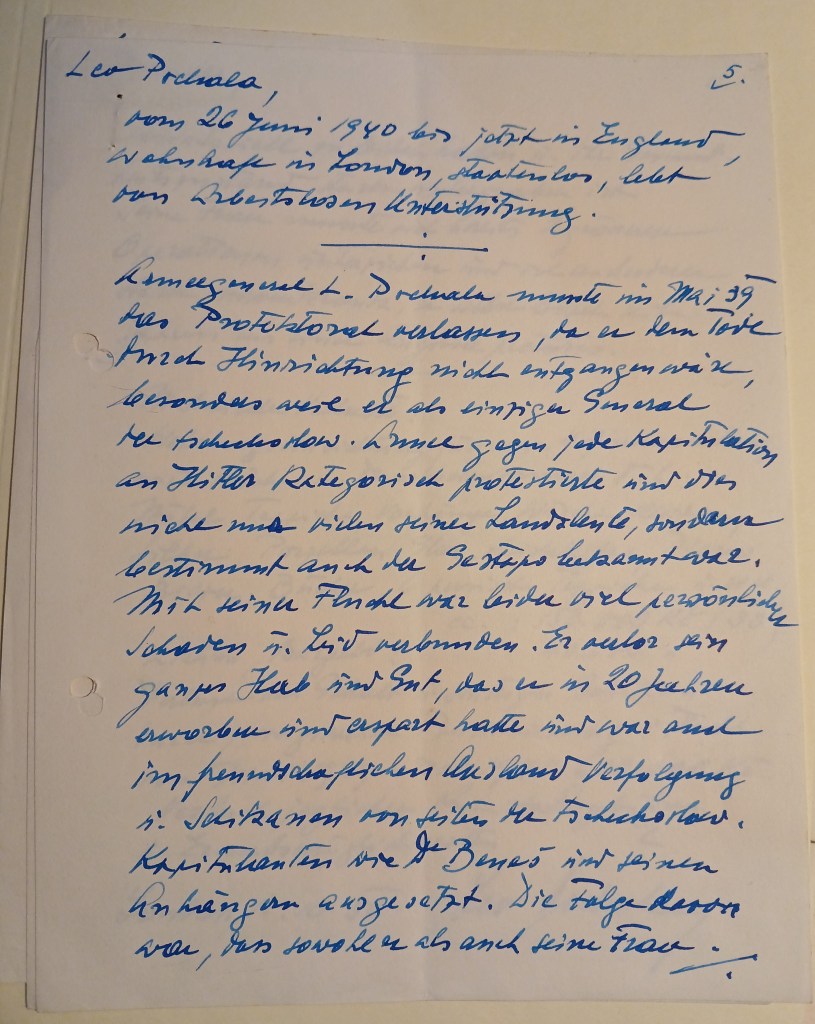
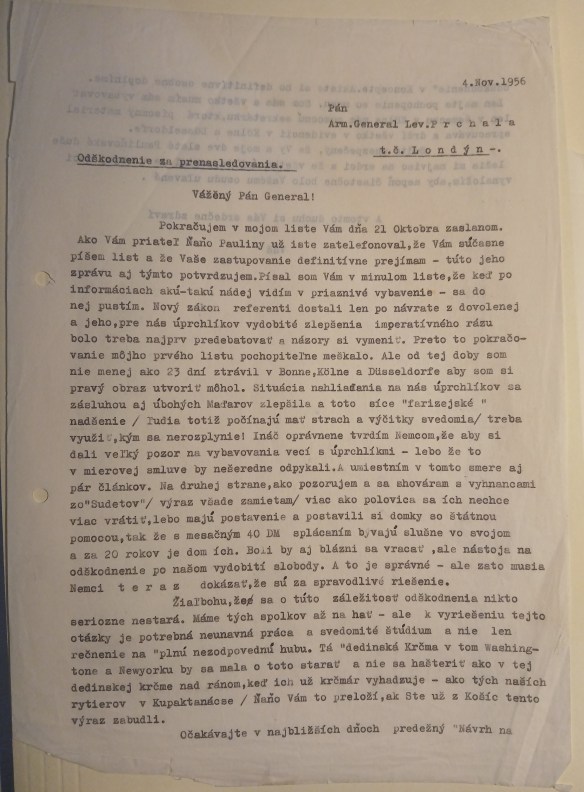
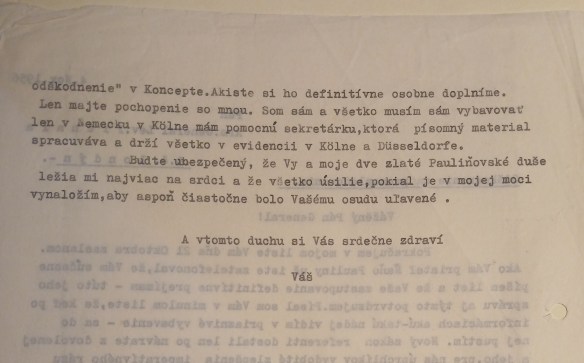
Happy birthday to Czechoslovak politician and Army General Lev Prchala, born on 23 March 1892! He sent this handwritten letter and his Curriculum Vitae to Pavel Fabry in 1956 from London, where he was living in exile. I have included the typewritten response from Pavel confirming that he will represent General Prchala for “Compensation for Persecution”.
*Update 14 May 2025: This post has been moved to the top of the page, the previous post was deleted. My sincere appreciation to Miroslav Kamenik, who kindly sent me his translation of Gen. Prchala’s letter and C.V., which I have transcribed here – thank you!
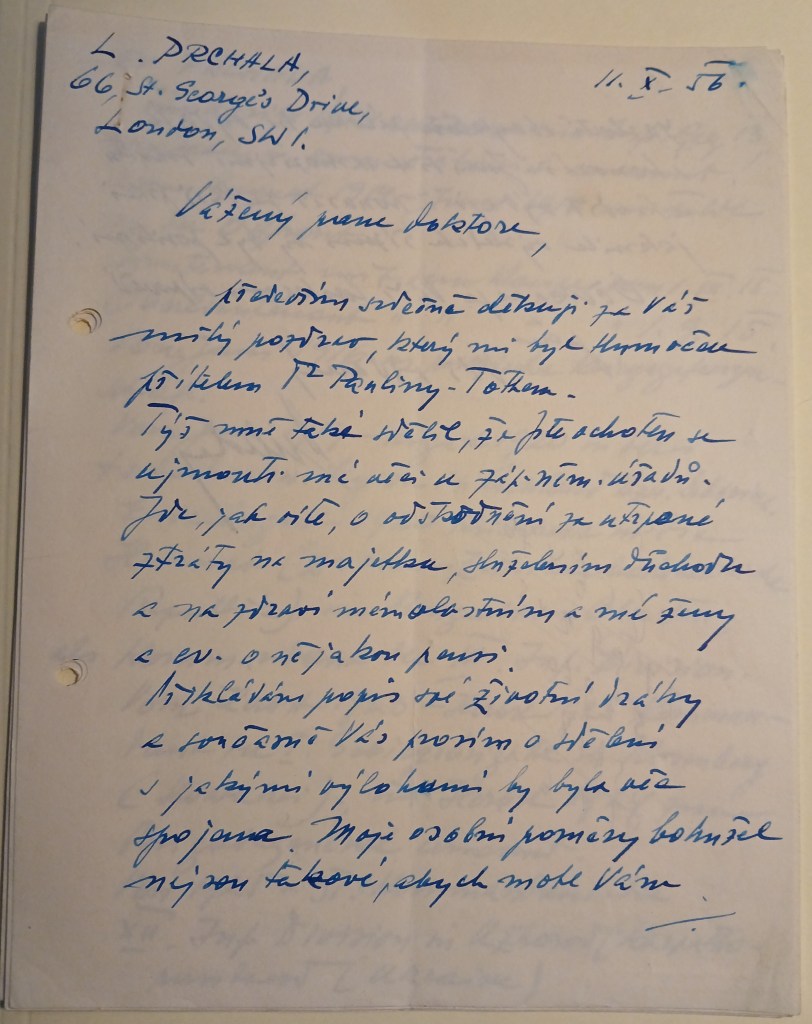
“11 Oct 1956
Dear Doctor,
First of all, let me kindly thank you for your warm greetings forwarded to me by our friend Dr. Pauliny-Toth. He also stated you were ready to take care about my case by West-German offices. As you know, it is about a compensation for losses suffered in my property, service pension [MK – soldier], health of myself and my wife and possible some kind of pension.
Attached is my CV as well, let me kindly ask you about the estimated costs related with my case. My personal circumstances are not such that I could send you the usual fee and advance payment for expenses. Of course, I am ready to cover your fee and all costs when the result of my case will be positive [MK – i.e. from future profit].
Awaiting your kind reply,
Yours faithfully,
Prchala”


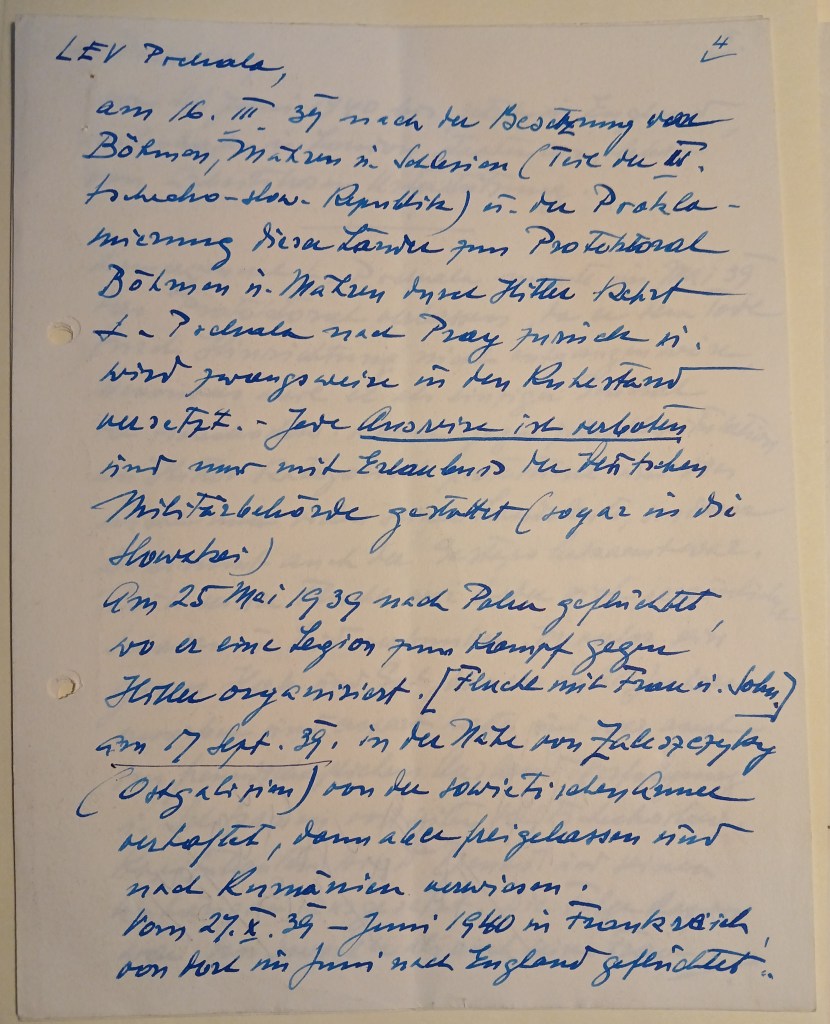

“C.V.
*23 March 1892 [born] in Polska Ostrava, Frydek area, Silesia [MK – Empire of Austria-Hungary]
Roman Catholic, married with Lucie Seebode *9 August 1901 Kuokkala Finland, resident in St. Petersburg (Russia), evangelical
Children – son Ladislav Vladimir *5 Feb 1920 in Batarejnaja, Siberia (Russia), now resident in Buenos Aires, Argentina; daughter Lucie Marie *29 July 1921, died 9 Oct 1936 in Kosice [MK – Slovakia today]
Education – Gymnazium [MK – classic high school] with exam; 4 semesters of Law in Vienna; Military school in Paris 1921-23
April 1914 – activated in Inf. Regiment 13 in Krakow [MK – Cracovia, Poland today], sergeant.
August 1914 till June 1916 in the field/ eastern front of WWI
Since June 1916 in Russian captivity, in rank of lieutenant
June 1917 till August 1920 in Czechoslovak legion in Russia (or Siberia), then returned to newly established Czechoslovakia in rank of Colonel, as the commander of the III. Czechoslovak division in Russia [MK – in charge of retreating battles, towards to Vladivostok]
Autumn 1923 till autumn 1925 commander of the 1st mountain brigade in Ruzomberok [MK – Slovakia today], since autumn 1924 in rank of Brigade General
1925 till 1931 Commander of the XII. Inf. Division in Uzhorad [MK – or Uzhhorod, in Ruthenia/Subcarpathian Ukraine/Russia in Czechoslovak times, now part of Ukraine], since 1927 in rank of Division General
Autumn 1931 till autumn 1933 Deputy Chief of Staff in Prague
Nov 1933 till 1938 Army Commander in Kosice [MK – Provincial/Land’s military commander in Slovakia +Ruthenia], since January 1935 in rank of Army General [MK – highest rank]
September 1938 Commander of IV. Army in Brno in time of Munich [MK – expected attack from 3rd Reich, Prchala in the area of most expected fights]
Since 5 October 1938 till till 19 January 1939 Commander of Army in Slovakia
19 Jan 1939 appointed minister of the II. Czechoslovak Republic for Subcarpathia [MK – 1 of 3 ministers of this part of CZ]
16 March 1939, after 15th when Czechoslovakia had been occupied by Germans, Lev Prchala turns back to Prague to newly established so-called Protektorat Bohmen und Mahren and has been forced into retirement. It is prohibited to leave the Protektorat, possible only with special approval by German Military office.
25 May 1939 fled secretly to Poland, with wife and son, where he organized the Czechoslovak Legion for the fight against Hitler.
17 September 1939 arrested by Soviets in eatern Galicia [MK – most probably Zalishchyky in todays Ukraine, history was not very kind in/to this area…], then released and passed to Romania.
27 October 1939 till June 1940 in France, in June fled to England – since 26 June 1940 in UK, living in London [MK – next words not fully legible, probably meaning “stateless, on state support”, this corresponds with the date of Prchala’s naturalization officially done by UK in 1961]
Army general had to escape from Protektorat in May 1939 in order to avoid capture/avoid death by execution, because he was the only General of Czechoslovak army strongly against the capitulation to Hitler, well known to the people of Czech lands, and Gestapo as well. Many personal damages and harm are connected to the escape. He left all his belongings which he had acquired and saved in 20 years, and was exposed to persecution and harassment by the Czechoslovak capitulators like Dr. Benes and his followers, even in friendly foreign countries. The result is not only material but also in the matter of the failing health, including his wife. She had to pass two operations and suffers nervous disease [MK-?], he suffers from angina pectoris.
Material losses: Four room flat + kitchen + office equipment: furniture, carpets, clothes, silver, porcelain, glass incl. Crystal glass, piano, paintings, books, 6 Persian carpets – 150,000Kc [MK – Czechoslovak Crowns in 1938 prices] and 40,000Kc in shares and cash.
Losses due to the forced retirement between May 1939 and May 1945 about 600,000Kc [MK – other potential losses unknown, not legible]
Lev Prchala, London, 11 Oct 1956″
Translation: Miroslav Kamenik/10.4.2025

With thanks to journalist and author Maurin Picard for passing on a recent interview with Madame Monique Rime, who was Vlado’s personal secretary in the Congo in 1961; published in La Liberte (Switzerland), written by Kessava Packiry. Maurin has just published a new book called “Katanga! The forgotten war of Francafrique against the UN”, I look forward to read it! Thanks to Hynrich Wieschhoff for passing on an English translation of Madame Rime’s interview, and for sharing the latest Hammarskjold investigation news that “Chief Justice Othman has delivered his report to Secretary-General Guterres. It will be made available to the public on October 18.” We continue to urge the US and UK to cooperate fully with the investigation.
From Packiry’s interview with Madame Rime:
Does it still hurt to talk about Africa again?
The year 1961 was intense with many dramas. When I left ONUC in December 1961, I didn’t want to hear about Africa anymore, it was like that for decades. I think I was too young, ill-prepared for all that and even now, these painful memories are deeply embedded in my memory.
The UN was intent on continuing with its Secretary-General’s mission. A few days after his death, Monique Rime found herself in a delegation flying to Ndola. “I had been assigned to this mission because I knew all the files. As we approached the airport, we flew over the wreck of the Albertina (the nickname of the Swedish DC-6 chartered by the UN, editor’s note), which had crashed in the forest. That image is still in my head.
*Update: 18 October 2024, Eminent Person’s report A/78/1006
Remember Patrice Lumumba and why he was murdered! Stand up for black lives, end the system of slavery and cruelty!
Patrice Lumumba
The First Prime Minister of the Congo (Zaire)
On June 30, 1960, Independence DayMen and women of the Congo,
Victorious fighters for independence, today victorious, I greet you in the name of the Congolese Government. All of you, my friends, who have fought tirelessly at our sides, I ask you to make this June 30, 1960, an illustrious date that you will keep indelibly engraved in your hearts, a date of significance of which you will teach to your children, so that they will make known to their sons and to their grandchildren the glorious history of our fight for liberty.
For this independence of the Congo, even as it is celebrated today with Belgium, a friendly country with whom we deal as equal to equal, no Congolese worthy of the name will ever be able to forget that is was by fighting that it has been won [applause], a day-to-day fight, an ardent and idealistic fight, a fight in which we were spared neither privation nor suffering, and for which we gave our strength and our blood.
We are proud of this struggle, of tears, of fire, and of blood, to the depths of our being, for it was a noble and just struggle, and indispensable to put an end to the humiliating slavery which was imposed upon us by force.
This was our fate for eighty years of a colonial regime; our wounds are too fresh and too painful still for us to drive them from our memory. We have known harassing work, exacted in exchange for salaries which did not permit us to eat enough to drive away hunger, or to clothe ourselves, or to house ourselves decently, or to raise our children as creatures dear to us.
We have known ironies, insults, blows that we endured morning, noon, and evening, because we are Negroes. Who will forget that to a black one said “tu”, certainly not as to a friend, but because the more honorable “vous” was reserved for whites alone?
We have seen our lands seized in the name of allegedly legal laws which in fact recognized only that might is right.
We have seen that the law was not the same for a white and for a black, accommodating for the first, cruel and inhuman for the other.
We have witnessed atrocious sufferings of those condemned for their political opinions or religious beliefs; exiled in their own country, their fate truly worse than death itself.
We have seen that in the towns there were magnificent houses for the whites and crumbling shanties for the blacks, that a black was not admitted in the motion-picture houses, in the restaurants, in the stores of the Europeans; that a black traveled in the holds, at the feet of the whites in their luxury cabins.
Who will ever forget the massacres where so many of our brothers perished, the cells into which those who refused to submit to a regime of oppression and exploitation were thrown [applause]?
All that, my brothers, we have endured.
But we, whom the vote of your elected representatives have given the right to direct our dear country, we who have suffered in our body and in our heart from colonial oppression, we tell you very loud, all that is henceforth ended.
The Republic of the Congo has been proclaimed, and our country is now in the hands of its own children.
Together, my brothers, my sisters, we are going to begin a new struggle, a sublime struggle, which will lead our country to peace, prosperity, and greatness.
Together, we are going to establish social justice and make sure everyone has just remuneration for his labor [applause].
We are going to show the world what the black man can do when he works in freedom, and we are going to make of the Congo the center of the sun’s radiance for all of Africa.
We are going to keep watch over the lands of our country so that they truly profit her children. We are going to restore ancient laws and make new ones which will be just and noble.
We are going to put an end to suppression of free thought and see to it that all our citizens enjoy to the full the fundamental liberties foreseen in the Declaration of the Rights of Man [applause].
We are going to do away with all discrimination of every variety and assure for each and all the position to which human dignity, work, and dedication entitles him.
We are going to rule not by the peace of guns and bayonets but by a peace of the heart and the will [applause].
And for all that, dear fellow countrymen, be sure that we will count not only on our enormous strength and immense riches but on the assistance of numerous foreign countries whose collaboration we will accept if it is offered freely and with no attempt to impose on us an alien culture of no matter what nature [applause].
In this domain, Belgium, at last accepting the flow of history, has not tried to oppose our independence and is ready to give us their aid and their friendship, and a treaty has just been signed between our two countries, equal and independent. On our side, while we stay vigilant, we shall respect our obligations, given freely.
Thus, in the interior and the exterior, the new Congo, our dear Republic that my government will create, will be a rich, free, and prosperous country. But so that we will reach this aim without delay, I ask all of you, legislators and citizens, to help me with all your strength.
I ask all of you to forget your tribal quarrels. They exhaust us. They risk making us despised abroad.
I ask the parliamentary minority to help my Government through a constructive opposition and to limit themselves strictly to legal and democratic channels.
I ask all of you not to shrink before any sacrifice in order to achieve the success of our huge undertaking.
In conclusion, I ask you unconditionally to respect the life and the property of your fellow citizens and of foreigners living in our country. If the conduct of these foreigners leaves something to be desired, our justice will be prompt in expelling them from the territory of the Republic; if, on the contrary, their conduct is good, they must be left in peace, for they also are working for our country’s prosperity.
The Congo’s independence marks a decisive step towards the liberation of the entire African continent [applause].
Sire, Excellencies, Mesdames, Messieurs, my dear fellow countrymen, my brothers of race, my brothers of struggle– this is what I wanted to tell you in the name of the Government on this magnificent day of our complete independence.
Our government, strong, national, popular, will be the health of our country.
I call on all Congolese citizens, men, women and children, to set themselves resolutely to the task of creating a prosperous national economy which will assure our economic independence.
Glory to the fighters for national liberation!
Long live independence and African unity!
Long live the independent and sovereign Congo!

From Julian Borger’s Guardian article, 24 August 2016, “Dag Hammarskjold: Ban Ki-moon seeks to appoint investigator for fatal crash”:
“[…]Ban [Ki-moon] noted that the UK had stuck to its position last year that it had no further documentation to show the UN investigation. He appended a letter sent in June by the British permanent representative to the UN, Matthew Rycroft, saying “our position remains the same and we are not able to release the materials in question without any redactions”.
Rycroft added “the total amount of information withheld is very small and most of the redactions only consist of a few words”.
The wording of the letter echoed a similar letter, turning down the UN request for more information, the UK sent in June 2015, which said that “no pertinent material” had been found in a “search across all relevant UK departments”.
In reply the UN legal counsel, Miguel de Serpa Soares, reminded Rycroft of the shared responsibility of the UN and its member states “to pursue the full truth” about Hammarskjold’s death, and asked him to confirm that the search of “all relevant UK departments” included security and intelligence agencies.
In reply, Rycroft simply quoted the former UK foreign secretary Philip Hammond telling parliament that the foreign office had “coordinated a search across all relevant UK departments”.
“I think the British response is extraordinary. It’s very brisk and curt and evasive,” said Susan Williams, a British historian at the School of Advanced Study, University of London, whose book Who Killed Hammarskjold: The UN, The Cold War and White Supremacy in Africa, revealed new evidence that helped persuade the UN to open a new investigation into the crash near Ndola, in what was then the British colony of Northern Rhodesia, now Zambia.
Part of that evidence was a report from a British intelligence officer, Neil Ritchie, who was in the area at the time of the crash and who was trying to organise a meeting between Hammarskjold and a rebel leader from neighbouring Congo, where the UN secretary general was trying to broker a truce.
“This was British territory and they had a man on the ground. It doesn’t make them responsible for the crash but it does indicate they knew a lot of what was going on,” Williams said, adding it was “highly unlikely” that Ritchie’s report which she found in an archive at Essex University, was the only British intelligence report coming the area at the time.”
On 28 August 2016, Dr Mandy Banton (Senior Research Fellow, Institute of Commonwealth Studies), Henning Melber (Senior adviser/director emeritus, The Dag Hammarskjold Foundation), and David Wardrop (Chairman, United Nations Association Westminster Branch) published letters together in the Guardian, “UK’s lack of transparency over plane crash that killed Dag Hammarskjold”. From Melber:
“The US and British responses to the efforts by the United Nations to further explore the circumstances of the plane crash at Ndola should be an embarrassment to all citizens in these countries (and elsewhere), who have an interest in seeking clarification of what happened. The reports so far already present sufficient evidence that there is more to it than what the official government responses are willing to admit.
This form of denial through non-compliance with legitimate demands for access to information is tantamount to obstruction and sabotages the sincere efforts to bring closure to one of the unsolved cases involving western states and their security operations. Such an arrogant attitude further dents the image of those who claim to be among civilized nations then and now.”
From 2 September 2016, here is an excerpt from Justice Richard Goldstone’s letter to the Guardian, “Hammarskjold case is not yet closed”:
“[…]it is highly likely that some member states of the UN, especially but not only the US, hold records or transcripts of cockpit transmissions in the minutes before the plane came down. If so, these may well put the cause of the crash, whatever it was, beyond doubt. But neither the US National Security Agency, which has gradually resiled from its admission to our commission that it held two relevant records, nor, as Dr Banton’s letter (29 August) suggests, the UK government, has so far responded with any vigour to the secretary-general’s plea for cooperation.”
From the 6 September 2016 New York Times, “Release the Records on Dag Hammarskjold’s Death”, written by The Rt. Hon. Sir Stephen Sedley:
“There was also evidence that the N.S.A. was monitoring the airwaves in the Ndola region, almost certainly from one of two American aircraft parked on the tarmac. Our inquiry therefore asked the agency for any relevant records it held of local radio traffic before the crash. The agency replied that it had three records “responsive” to our request but that two of those were classified top secret and would not be disclosed.
At its close, my commission recommended that the United Nations follow up this lead. The General Assembly appointed a three-person panel, which repeated our request to the N.S.A. This time, the agency replied that the two documents were not transcripts of radio messages as Southall had described and offered to let one of the panel members, the Australian aviation expert Kerryn Macaulay, see them. This she did, reporting that the documents contained nothing relevant to the cause of the crash.
This makes it difficult to understand how those two documents were initially described as “responsive” to a request explicitly for records of radio intercepts, or why they were classified top secret. It raises doubts about whether the documents shown to Ms. Macaulay were, in fact, the documents originally identified by the N.S.A. The recent denial that there is any record of United States Air Force planes’ being present at Ndola increases the impression of evasiveness.”
****
From the Ohio State Bar Association (OSBA) website, “What You Should Know About Obstruction of Justice”:
“Q: Does obstruction of justice always involve bribery or physical force?
A: No. One particularly murky category of obstruction is the use of “misleading conduct” toward another person for the purpose of obstructing justice. “Misleading conduct” may consist of deliberate lies or “material omissions” (leaving out facts which are crucial to a case). It may also include knowingly submitting or inviting a judge or jury to rely on false or misleading physical evidence, such as documents, maps, photographs or other objects. Any other “trick, scheme, or device with intent to mislead” may constitute a “misleading conduct” form of obstruction.”
 Vlado
Vlado 