Tag Archives: Great Britain

Max Frei-Sulzer vs. the United Nations Commission, 1962

It is a special feeling to contribute to the efforts of Vlado’s mother and sister, who saved every newspaper clipping on the investigation into the 1961 crash, and to see these efforts pay off decades later in the most recent 2026 UN report. The NYT article shown below is the only article to mention Dr. M. Frei-Sulzer, a Swiss police official who was “appointed by the commission to examine the wreckage of the Secretary-General’s plane”. Thank you to Chief Justice Othman, and all those assisting him, who took my criticism of Frei-Sulzer seriously and found “a series of telegrams exchanged between members of the United Nations Commission[…]” giving evidence of “[…] opposition from members of the Commission to Frei-Sulzer’s conclusions and differences in views among some of them. It was questioned whether Frei-Sulzer’s report should be published at all.” Not surprising, when Justice Othman requested information in 2025 from Switzerland on Frei-Sulzer, they found “no results from searches in the Zurich City Archives.”

From “Valuing the Evidence of Harold Julien: Part Two”, published here on January 20, 2024:

NYT, 3 May 1962, “Cause of Hammarskjold Crash Still a Mystery as Inquiry Ends”:

“[…] Dr. M. Frei-Sulzer, a Swiss police official, who was appointed by the commission to examine the wreckage of the Secretary-General’s plane, which crashed near Ndola, Northern Rhodesia, attributed the disaster to the plane’s low altitude as it approached the airfield at Ndola after it had been cleared by the tower for landing.” [Note: The Albertina was equipped with radar! -T.B.] […] “Dr. Frei-Sulzer reported that “the only abnormal fact was the dangerously low altitude of the aircraft in relation to the airport elevation, probably due to human failure.” Dr. Frei-Sulzer is chief of the scientific department of the Zurich police and professor of science at the University of Zurich.” […] “The commission, which was appointed by the General Assembly last October, completed its report in Geneva March 8, three weeks before Dr. Frei-Sulzer submitted his findings to it.” […] “The [UN] commission criticized Rhodesian authorities for the fact that the wreckage was not found until fifteen hours after the crash. It said that Harold Julien, a United Nations guard who died several days after the crash, would have had a better chance for survival if the Rhodesians had shown more diligence. A report by the Royal Medical Board of Sweden said that a post-mortem indicated that, contrary to reports at the time, the “Secretary General lived for a certain period of time after the crash.” It said that he was the only person aboard the plane who had completely escaped burns.” […] “The Rhodesian and Swedish doctors agreed that bullets found in bodies of Mr. Hammarskjold’s guards had been exploded by the fire that consumed the wreckage and had not been fired from a weapon. Their findings were supplemented by Dr. Frei-Sulzer, who reported that there were no bullet holes in the plane and no evidence of explosives that would have been needed for a time bomb or other means of sabotaging the plane. However, the United Nations Commission examined at length the question whether a Fouga Magister fighter plane of the Katanga forces, “which had been operating against the United Nations in Katanga,” or some other plane [Note: De Havilland Dove. T.B.], had shot down the United Nations craft. It noted the reports of the Rhodesian inquiry board that the plane did not have sufficient range to fly from its base at Kolwezi and that the pilot had stated that it was on the ground on the night of the tragedy.”

Who was Dr. Max Frei-Sulzer? It is hard to take him seriously, considering that he investigated the authenticity of the Shroud of Turin, and he believed that Hitler’s diaries were real; and another case, which resulted in the imprisonment of an innocent man, who was released after 12 years!

From “Valuing the Evidence of Harold Julien: Part Three”, published here on June 11, 2024:

As I pointed out in part two of this series, Hugo Blandori was a “retired” FBI agent, turned private investigator, who was hired by the UN as a consultant to this investigation. It is extremely upsetting to me that an FBI agent was involved, not only because of the racist history of that organization, but because of the role the FBI played during the McCarthy witch-hunt on United Nations staff members in 1953. Trygve Lie, the first UN Secretary-General, gave the FBI carte blanche of headquarters “for the convenience”, and it was his successor Dag Hammarskjold who protected his staff and kicked out the FBI by November 1953. Within every organization, including the UN, there have always been members who are actively working against the good that that organization is trying to achieve, and that is how I believe Hugo Blandori got the job of consultant. This is also how Dr. Max Frei-Sulzer – a Swiss police official that believed Hitler’s diaries were real – was appointed by the UN commission to examine the wreckage of the Secretary-General’s plane, and “who reported that there were no bullet holes in the plane and no evidence of explosives that would have been needed for a time bomb or other means of sabotaging the plane”. In my view, the contributions of Blandori and Frei-Sulzer are not just highly suspect, they discredit the investigation – I believe intentionally so!

From the 2026 report of Chief Justice Othman (A/80/815):

Page 4: “Switzerland promptly made inquiries in response to my request concerning the possible location of metallurgical test materials.”

Page 36-37; para. 158-160:

“The Mattei case and the crash of SE-BDY share several notable features. Both aircraft crashed during the landing approach with landing gear deployed. Both crashes initially received official verdicts of accident. The analysis of Mattei’s plane crash occurred despite the passage of time and despite the fact that much of the original wreckage had been destroyed by remelting, following the original court ruling of accidental death.

Additionally, both Mattei and Hammarskjöld received OAS death threats in mid-1961, and both died in aircraft crashes within approximately a year of those threats. The Mayor of Evian had also been killed by an OAS-attributed plastic explosive attack in March 1961.

The United Nations Commission’s metallurgical expert, Max Frei-Sulzer, conducted tests on recovered fragments and did not find evidence of foreign substances indicating sabotage. The forensic methodology used in the Mattei case was not available at that time. Further, limitations on Frei-Sulzer’s analysis included that it was limited to the small percentage (around 20 per cent) of the wreckage that remained after the aircraft caught fire. Additionally, as analysed in section III.D
below, it appears that the members of the United Nations Commission had different opinions regarding whether Frei-Sulzer’s report should be relied upon or agreed with at all.”

Page 37; para. 163-165:

“In contrast to the Mattei case, the SE-BDY wreckage was severely damaged by post-crash fire, which destroyed 75 to 80 per cent of the fuselage. During the initial inquiries, fused metal parts of the remaining wreckage were remelted and tested by an expert at a local foundry; evidence of suspect foreign materials was not located. A limited number of additional fragments were taken to Switzerland for analysis by Frei-Sulzer, the expert using the forensic resources of the Zurich police, with similar results. After the conclusion of the work of the United Nations Commission, it appears
that, on 22 and 23 August 1962, the remnants of the wreckage were “removed from [the] hanger and buried at Ndola airport”, where they remain. Whether any surviving fragments of SE-BDY exist in a condition suitable for analysis of the type conducted by Firrao in the Mattei case is as yet uncertain.

There have been, over time, calls for a retesting of any wreckage that remains using modern technology, such as X-ray photoelectron spectroscopy (XPS). The purpose of a re-examination of any remaining wreckage would include ascertaining whether adjoining key metal parts of the landing mechanism (including the hydraulics junction box) was affected by foreign substances that may be indicators of sabotage. For such an analysis, it would be necessary to first identify any remaining material. Given that much of the fuselage was burned in the crash and some of the remaining
wreckage melted in subsequent tests, together with the degrading effects of the passing of time since, there may be insufficient material remaining that is capable of conclusive testing and determination.

In 2025, I requested assistance from Switzerland to locate records, physical remnants or archives relating to Frei-Sulzer’s work. The request was answered helpfully, but with no results from searches in the Zurich City Archives.”

Pages 56-57; para. 282-289:

“Contemporaneous documents show that the Rhodesian authorities discussed, at the highest levels, the desirability of avoiding the convening of a separate United Nations Commission and, when it was clear that one would be convened, sought to “cultivate” the Commissioners and steer the outcome towards pilot error. Other information showed that British officials sought and obtained revisions to the draft report of the United Nations Commission in advance of its publication, with a similar
aim of ruling out sabotage or external attack as a cause of the crash. On this basis, it was established that the United Kingdom and Northern Rhodesia were concerned about ensuring that a conclusion of pilot error being the cause of the crash was reached in 1961/62, rather than merely permitting an impartial analysis to occur.

In 2026, United Nations archives staff identified additional documents of potential relevance to this inquiry. The documents do not address external influence on the early inquiries, but rather the consensus nature of the conclusions reached by the United Nations Commission. For consistency, they are considered in this section.

Documentation recently identified in United Nations archives includes a series of telegrams exchanged between members of the United Nations Commission following the publication of the Commission’s report and the subsequent receipt of the metallurgical analysis conducted by Frei-Sulzer.

The documentation records that the report of the United Nations Commission had been criticized because it declined to exclude attack and sabotage as possible causes of the crash. It outlines 10 specific grounds on which the Commission’s refusal to exclude sabotage and attack is supported by expert opinion and evidence. These include the following: (a) that the initial draft report prepared by the Rhodesian Board of Investigation had itself concluded that attack and sabotage should not be ruled out and that other possible causes should not be given a higher order of priority; (b) that
the final report of the Board also stated that the willful act of some person or persons unknown could not be ruled out, though it attributed the probable cause to other possibilities (this was a departure from the initial draft that had not been accepted by the United Nations observers); (c) that J. P. Fournier of the International Civil Aviation Organization stated categorically when interviewed by the Commission that he “did not in any way exclude the possibility of sabotage”; (d) that the Rhodesian engineering expert agreed that sabotage could not be ruled out; (e) that anonymous
threats had been made against the Secretary-General, the latest of which was reported to have been in Leopoldville in the days before the crash; (f) that an opportunity for sabotage existed when the plane was left unguarded before its departure from Leopoldville; (g) that Julien (the sole temporary survivor) spoke of an explosion; (h) that several reliable witnesses reported seeing flashes in the sky, at times varying by several minutes, with some experts raising the question of whether this could
indicate an explosion in the air before the crash; (i) that at least five persons reported seeing a second plane flying near the Secretary-General’s plane just before the crash, with some claiming the second plane was attacking it; and (j) that an attempt was later made to sabotage another United Nations plane at Kitona by filing the control lines that operate on take-off and landing.

The information thus defends the United Nations Commission’s findings, given that if the Commission had wished to take a political approach, it could have “played up” testimony that supported an external attack or sabotage. In this regard, the information indicates that an external attack and sabotage were each considered to be credible hypotheses at the time.

Frei-Sulzer’s report was received after the United Nations Commission had drafted its report. The documentation records that the Commission’s report was drafted on the assumption that Frei-Sulzer’s tests would be negative; the new factor from Frei-Sulzer’s report was “not the scientific results of his tests, but the sweeping conclusions which he drew”. The documentation records opposition from members of the Commission to Frei-Sulzer’s conclusions and differences in views among some of them. It was questioned whether Frei-Sulzer’s report should be published at all.

I am grateful for the identification of this documentation, which adds a significant primary source to the record of the United Nations Commission’s deliberations. Three matters are of particular note. The first is that the Commission faced attempted influence from Member States when preparing, and after the publication of, its report. This relates to the findings discussed in previous reports that more than one Government had sought to influence the early inquiries towards a predetermined finding of pilot error.

The second matter of note is that the findings of Frei-Sulzer were not universally accepted by the United Nations Commission members; the consensus position appears to have been to publish his report as an annexure without further commentary, rather than criticize it or otherwise reconvene the Commission to provide individual opinions about it. The telegram record confirms that at least two members were against modifying the Commission’s conclusions in light of Frei-Sulzer’s findings,
with one going so far as to prefer that the findings not be published at all.”

Valuing the Evidence of Harold Julien: Part Two

Here are more newspapers from New York, from September 19, 1961 to May 3, 1962, which support the evidence of the only survivor of the Albertina, Sgt. Harry Julien. For context of these events, please read Susan Williams’ most recent essay, published in The Yale Review, “Revisiting Dag Hammarskjold’s Mysterious Death”. Part one of this series can be found here.

The NYT, 19 September 1961. From article “Hostile Jet Cited in Crash”: “Jacques Poujoulat, personal assistant to Dr. Sture C. Linner, chief of the United Nations mission in the Congo, described the circumstances off the ill-fated flight. He said he “could not answer” when he was asked whether the possibilty that the plane might have been shot down could be ruled out. He declared, however, that the United Nations had been “unable to make daylight flights” because of constant attacks by enemy jet aircraft. He said that the timing of the Secretary General’s night flight to Northern Rhodesia was “at least partly” because of the attacks by enemy aircraft.”
The NYT, 19 September 1961. “[Poujoulat] said that seven hours after the plane took off from Leopoldville yesterday an “unidentified aircraft” flew over Ndola airport and that at about the same time the police reported a “flash in the sky.”
The NYT, 19 September 1961. “The jet fighter has been the greatest single threat to the United Nations troops in Katanga, the pilot, who flies two planes alternately, has been strafing and bombing United Nations forces in Elisabethville, Kamina and Jadotville every day. United Nations officials believe that one of the two planes is being reloaded and refueled while the other is in action. The United Nations announced yesterday that three Ethiopian jet fighters were “on their way” to Katanga to oppose enemy fighter planes. Today it was learned from qualified sources that the planes had not arrived because British authorities in Uganda had refused to let them make a refueling stop.”
New York Herald Tribune, 19 September 1961. From article “Survivor Says Blasts Shook Plane”: “The wreck was reported first spotted by a Negro charcoal burner, then by a Royal Rhodesian Air Force crew. It was still smouldering when a ground search party arrived in mid-afternoon.”
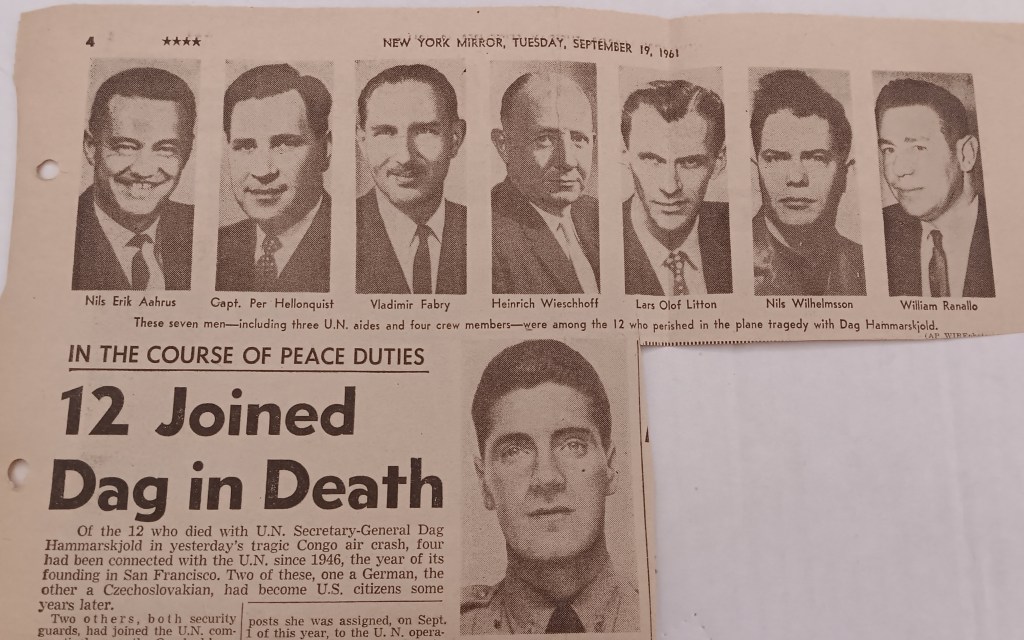
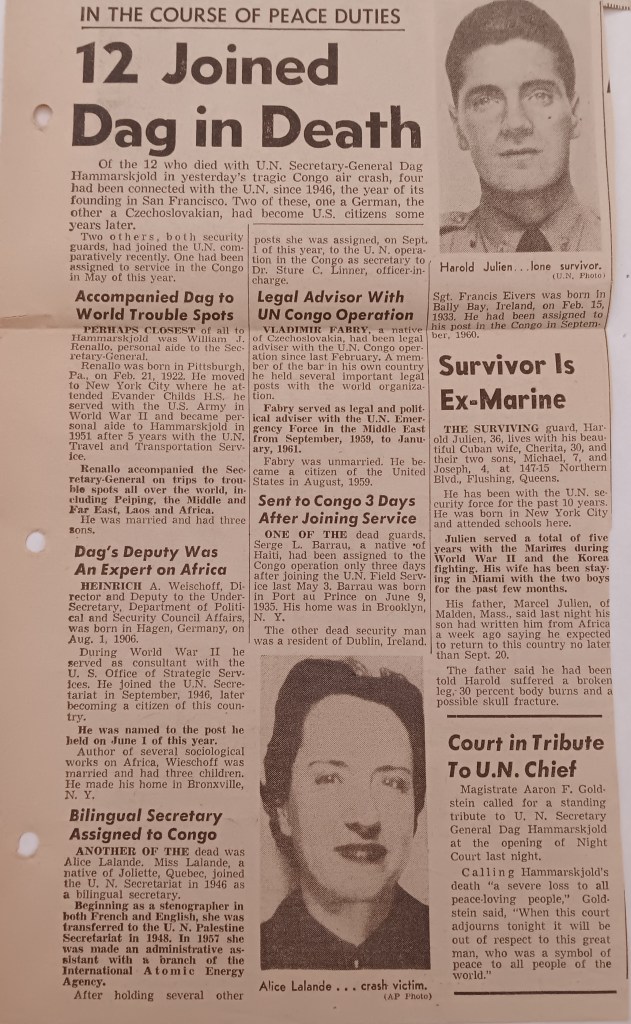
New York Mirror, 19 September 1961
New York Mirror, 19 September 1961. Col. Don Taylor is a typo for Col. Don Gaylor, who was sent to Ndola by the Pentagon on September 15. “Col. Don Taylor[sic], U.S. air attache in Pretoria, South Africa, who circled the wreck area until ground parties arrived, said it seemed obvious the plane was making an approach to Ndola Airport when it crashed about six miles away. Taylor said it looked to him as though the pilot misjudged the height and that the plane’s undercarriage caught in tree tops.”

From Susan Williams’ essay: “One other aspect of Gaylor’s involvement is worth noting. After the Albertina failed to land, a team of Norwegian U.N. soldiers flew to Ndola to assist in the search. Their aircraft was parked near Gaylor’s DC-3. Because of white Rhodesians’ hostility to U.N. personnel, they were not allowed to enter the airport terminal. So Gaylor’s crew invited them on board to get some food. To the surprise of U.N. soldiers, they discovered that the American plane was packed with highly sophisticated radio equipment.

“We know from other testimony that the U.S. Embassy in Leopoldville was communicating with Ndola via a U.S. aircraft, which presumably was Gaylor’s DC-3. And that may explain an intriguing aspect of the story, namely that Edmund A. Gullion, the U.S. ambassador in the Congo, sent a cable to Washington on the morning of September 18 that explicity referred to the possibility that the plane was shot down. “Hammarskjold’s plane believed lost in vicinity Rhodesian border near Ndola,” the cable read. “There is possibility he was shot down by single pilot who has harassed U.N. operations and who has been identified by one usually reliable source as van Riesseghel, Belgian, who accepted training lessons with so-called Katangan Air Force.” (The ambassador’s communique included an error — the name of the pilot in question was Jan van Risseghem.)”

New York Mirror, 19 September 1961
The NYT, 20 January 1962. “NDOLA, Northern Rhodesia, Jan. 19 (Reuters) — Two planes passed over Ndola shortly before Mr. Hammarskjold and fifteen other persons died in the air crash near here, a witness told an inquiry here today. T. J. Kankasa, an African municipal official, told the Rhodesian federal inquiry that one of the planes had its lights on and appeared to be a transport while the other was a “smaller aircraft without lights.” “It seemed as if the smaller plane was beaming lights on the large aircraft,” he said.”

From Susan Williams’ book, “Who Killed Hammarskjold?”, pages 107 and 109: “The UN Commission supplemented its findings by employing a consultant named Hugo Blandori to carry out some background research in Ndola.” […] “Blandori included in his memorandum some observations on the appearance of Bo Virving at the Commission hearings. Virving, he reported, had put forward the theory that the Albertina had been shot down or forced down by a plane above it. He based his theory primarily on the statements of African witnesses and told Blandori that he believed the Rhodesian authorities had suppressed their evidence.

“It was Blandori’s view that the Africans giving testimony had no experience of aircraft, so didn’t know what they were talking about. But this was not the case. For one thing, the witnesses lived very near the airport and had daily experience of the comings and goings of planes; and for another, some of them, such as Timothy Kankasa, had worked with planes during the Second World War[as a signalman].”

Who was Hugo Blandori? According to this article by Jerry Dumas, “Hugo Blandori [was an] F.B.I. agent and also a YMCA regular, who died beside me on the Y handball court”. And according to this article about Anne Cioffi, who was his former secretary, Blandori was an F.B.I. agent who later became a private investigator, but I don’t know when exactly that change happened. From the article:

“I used to babysit his kids,” she said.

One day Blandori told her he needed a secretary and she took the job.

“He taught me every angle of his business,” she said, adding that was unusual in those days because women weren’t often afforded such opportunities.

Cioffi said Blandori was affiliated with former FBI agents who did private investigating all over the world and, with her as his secretary, specialized in pre-employment screenings.

“Years ago you could do that,” she said.

The company also conducted insurance and fraud investigations, and occasionally cheating-spouse cases.

“I didn’t like those very much,” said Cioffi.

She said the two worked together until the day Blandori went to play handball in Greenwich and died of a heart attack.

“He was only 50,” she said.

Cioffi said Blandori’s widow knew nothing about the business so Cioffi ran the business herself until another former FBI agent bought it.

[…]

She said her husband, Carmine, and all her connections from her time with Blandori encouraged her to get her own private investigator’s license, so that’s what she did.

“I had my own office in Norwalk,” she said saying she did a lot of work for former FBI agents and even worked on a case or two for Interpol.

“It worked out very well.”

The NYT, 3 May 1962, “Cause of Hammarskjold Crash Still a Mystery as Inquiry Ends”: “[…] Dr. M. Frei-Sulzer, a Swiss police official, who was appointed by the commission to examine the wreckage of the Secretary General’s plane, which crashed near Ndola, Northern Rhodesia, attributed the disaster to the plane’s low altitude as it approached the airfield at Ndola after it had been cleared by the tower for landing.” [note: The Albertina was equipped with radar!] […] “Dr. Frei-Sulzer reported that “the only abnormal fact was the dangerously low altitude of the aircraft in relation to the airport elevation, probably due to human failure.” Dr. Frei-Sulzer is chief of the scientific department of the Zurich police and professor of science at the University of Zurich.” […] “The commission, which was appointed by the General Assembly last October, completed its report in Geneva March 8, three weeks before Dr. Frei-Sulzer submitted his findings to it.” […] “The [UN] commission criticized Rhodesian authorities for the fact that the wreckage was not found until fifteen hours after the crash. It said that Harold Julien, a United Nations guard who died several days after the crash, would have had a better chance for survival if the Rhodesians had shown more diligence. A report by the Royal Medical Board of Sweden said that a post-mortem indicated that, contrary to reports at the time, the Secretary General “lived for a certain period of time after the crash.” It said that he was the only person aboard the plane who had completely escaped burns.” […] “The Rhodesian and Swedish doctors agreed that bullets found in bodies of Mr. Hammarskjold’s guards had been exploded by the fire that consumed the wreckage and had not been fired from a weapon. Their finding were supplemented by Dr. Frei-Sulzer, who reported that there were no bullet holes in the plane and no evidence of explosives that would have been needed for a time bomb or other means of sabotaging the plane. However, the United Nations Commission examined at length the question whether a Fouga Magister fighter plane of the Katanga forces, “which had been operating against the United Nations in Katanga,” or some other plane [note: De Havilland Dove], had shot down the United Nations craft. It noted the reports of the Rhodesian inquiry board that the plane did not have sufficient range to fly from its base at Kolwezi and that the pilot had stated that it was on the ground on the night of the tragedy.”

Who was Dr. Max Frei-Sulzer? It is hard to take him seriously, considering that he investigated the authenticity of the Shroud of Turin, and he believed that Hitler’s diaries were real; and another case, which resulted in the imprisonment of an innocent man, who was released after 12 years!

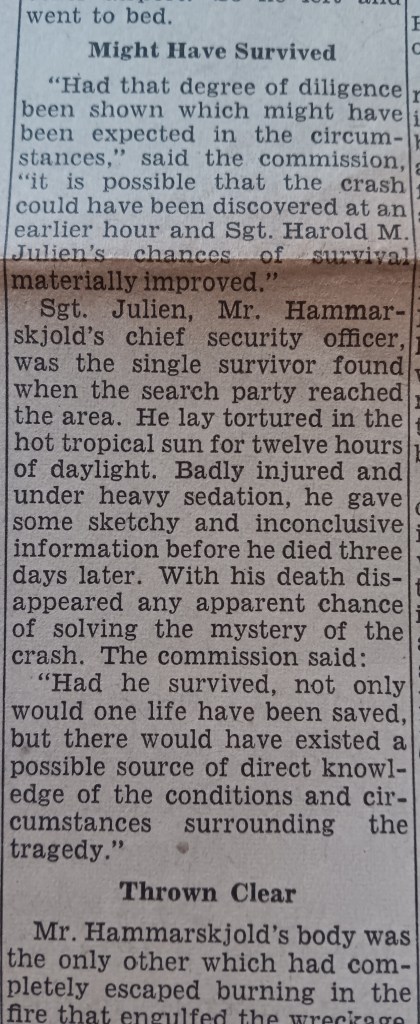
New York Herald Tribune, 3 May 1962, This article continues the narrative of down-playing and discounting the testimony of Sgt. Harry Julien, “Dag’s Death Probe: Still a Whodunit”: “Sgt. Harold Julien, Mr. Hammarskjold’s chief security officer, was the single survivor found when the search party reached the area. He lay tortured in the hot tropical sun for twelve hours of daylight. Badly injured and under heavy sedation, he gave some sketchy and inconclusive information before he died three days later. With his death disappeared any apparent chance of solving the mystery of the crash.”
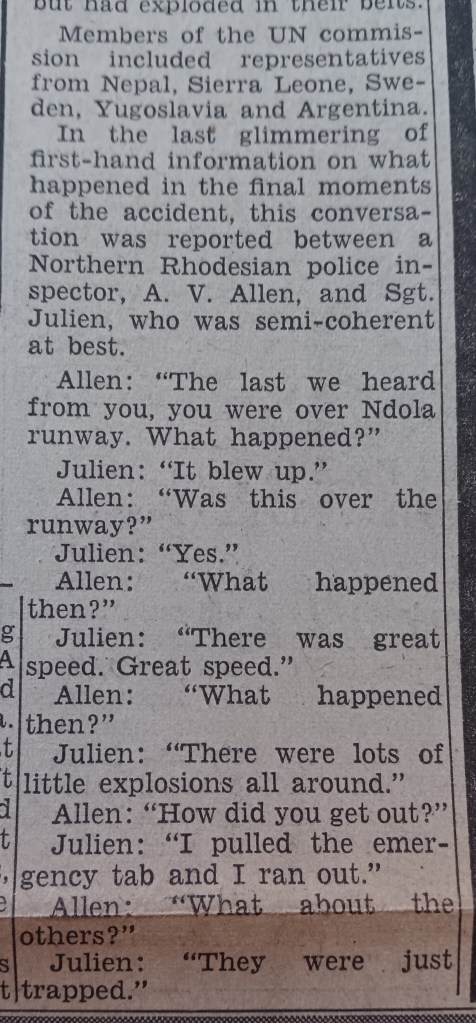
New York Herald Tribune, 3 May 1961. From the same article, “Dag’s Death Probe”: […]In the last glimmering of first-hand information on what happened in the final moments of the accident, this conversation was reported between a Northern Rhodesian police inspector, A. V. Allen, and Sgt. Harold Julien who was semi-coherent at best. Allen: “The last we heard from you, you were over Ndola runway. What happened?” Julien: “It blew up.” Allen: “Was this over the runway?” Julien: “Yes.” Allen: “What happened then?” Julien: “There was great speed. Great speed.” Allen: “What happened then?” Julien: “There were lots of little explosions all around.” Allen: “How did you get out?” Julien: “I pulled the emergency tab and I ran out.” Allen: “What about the others?” Julien: “They were just trapped.”

Interview with Madame Rime, Vlado’s secretary in Leopoldville, 1961

This is the full interview of Monique Cégel (now Madame Rime) sent to me in May 2020 by Maurin Picard, journalist and author of “Ils Ont Tue Monsieur H”; a portion of this interview was published here back in September 2020, “Vlado and the Mercenaries: Operation Rum Punch“, but I feel the whole interview deserves attention.

You can hear more interviews with Madame Rime about her experiences in the Congo working for the United Nations, with journalist David Glaser, reporter at GeneveMonde.ch.

Many thanks to Madame Rime, and to Maurin Picard for this interview and supporting the Hammarskjold investigation, and to David Glaser for promoting this blog and the life of Vlado Fabry – merci beaucoup to all who have contributed to this site!

Interview with Monique Rime Cégel

3 May 2020

Switzerland

Summary

– Monique Cégel, 83, was Vladimir Fabry’s secretary in Leopoldville in 1961

– She worked at the Hotel Le Royal between December 1960 and January 1962

– She knew Alice Lalande and Harold Julien very well

– She was working extra hours on 17 September 1961

– She typed Dag Hammarskjöld’s last message to Paul Henri Spaak, requesting Belgium to stop « van Riessenghem »

– She remembers there were serious doubts about UN communications being intercepted

– Vladimir Fabry did most of the research regarding Katanga mercenaries during the summer of 1961

– She remembers Dag Hammarskjöld’s collaborators tried to deter him from flying unescorted

– She does not think Sture Linnér was intended to fly along, as he had to stay in Leopoldville to liaise and work proper transmissions

– She flew to Ndola with Mahmoud Khiary on 19 September 1961 to type the ceasefire agreement with Moise Tshombe

– She saw the crash site right above her plane window prior to landing and was horrified 

– She recalls smoldering debris and the « long line » of burnt forest

– She found a very hostile atmosphere in Northern Rhodesia

– She met a very disdainful Lord Alport

– She was not allowed to join Mahmoud Khiary at the hospital to visit Harold Julien

* * *

I was Vladimir Fabry’s secretary, at the Hotel Le Royal, Leopoldville (Congo).

I worked there for the UN mission in Congo from December 1960 to January 1962, as secretary detached from the Atomic Agency (IAEA) in Vienna.

I kept working for the UN in Geneva until 1976, mostly through freelancing contracts. Then my husband and I moved to the city of Bulle.

I met my husband in 1961 in Congo! 

He was a representative for major Swiss companies of the time, including Schindler and Vega, and was selling chemical products to the university of Lovanium. 

I became a Swiss citizen, after getting married with him. 

I was French (and I still am), and was born in Paris.

* Sunday 17 September 1961

At the Hotel Le Royal, we had an office adjacent to the one occupied by Sture Linnér.

On the day Dag Hammarskjöld took off from Leopoldville, that Sunday, I was not supposed to work. 

But, as Fabry’s secretary, and since he only worked with me, they sent some military staff in a Jeep to pick me up and bring me back to Le Royal. 

They found me sitting at a cafe terrace, since I believe they always kept an eye on us for safety. 

I went back to my office and worked all afternoon, until the plane departed.

* Vladimir Fabry

That day, when I arrived at my office, Vladimir Fabry immediately requested to dictate some telegrams. I spent the whole afternoon doing that: typing messages, then bringing them to the « Chiffre » for them to be coded accordingly with the recipient’s identity. 

By the time I was finished, they were getting ready to leave for the airport.

Before leaving, Vladimir Fabry was so thrilled. 

Happy as a kid who was just offered a new toy. 

Albeit a very reserved character, he was practically jumping on his feet. 

He came into my office and said excitingly: 

« Monique, I am leaving with the Secretary-General! I am trusting you with my car keys! » 

He had to be very happy, for he would never have done such a thing otherwise. 

His car was an official UN vehicle. 

He told me I could use all the time during his absence. 

God knows Leopoldville is a very large town, with great distances between the various locations.

I used the car until, of course, I handed it back to the UN, since Fabry never returned.

I remember seeing their cars leaving Le Royal in convoy.

I went through these events with an innocent mind as I could only partially grasp what was going.

I would mostly type messages dictated by Fabry, messages that were generally meant for New York.

The last message I typed from them was dictated by M. Hammarskjöld himself. The recipient was Paul-Henri Spaak. 

(nota: the Belgian Foreign Minister) 

But I cannot remember its content (nota: requesting Belgian assistance to put an end to the criminal deeds of a mercenary pilot named « van Riessenghem »). 

I was so intimidated that I must have skipped two or three words he dictated. 

I had never met Hammarskjöld and I was so young then (nota : she was 24).

I saw Dag Hammarskjöld every day between 13 and 17 September 1961, since he occupied Sture Linnér’s office.

* Can you recall Hammarskjöld’s state of mind?

I remember he was not very agreeable. He seemed really sad, not at all in a communicative mood. « You do this, this has to be done ». We were in the midst of a serious crisis with Katanga, obviously.

* Were there long sleepless nights at Le Royal?

I did not spend those ones with them, but I had a similar experience during the previous months. When you are assigned to someone high ranking, you did not count your days and your nights. With all the crises we went through, there were many sleepless nights at Le Royal.

* Harold Julien

I knew Harold Julien very well, as he was the Chief Security Officer in Leopoldville. Being M. Fabry’s secretary, I was granted the use of a car. 

This in turn created some serious trouble, because we were taken hostage with a Swiss colleague of mine by Mobutu’s troops for 24 hours. The time was around end January or early February 1961. 

They had spotted my car, I believe, due to the UN flags on it, and surrounded our house with two small armoured cars. There were rumors that the UN was bent on disarming the Congolese National Army. And we had been poorly inspired to move in a house across the street from Mobutu’s barracks along the river – a magnificent location, it was indeed. 

Then the witchhunt began against all UN staff. 

This is the only time in my life I was really scared.

I called the French embassy asking for their help, as I was a French citizen. Their answer was very … kind: « you work for the UN, hence you are no longer considered as a French citizen for us. There is nothing we can do for you ».

Since my colleague was Swiss, she called the Swiss embassy and they immediately answered. « Yes of course, we will come and rescue you ».

They arranged for a motorized convoy of Swiss people, with friends and colleagues of my future husband, led by the Red Cross delegate M. Olivet, who was killed another day.

(nota: Georges Olivet, 34, was killed in an ambulance on 12 December 1961, amidst heavy fighting in Elisabethville, Katanga)

They parlayed with Mobutu’s soldiers, who pretty quickly removed their blockade and let us go free. 

* Saturday 16 September, Lord Lansdowne meets Dag Hammarskjöld. Did you get word of a stormy exchange?

No, I do not remember that gentleman. 

I did not hear anything, although I was there that day and was working in the nearby room. If there had been loud voices, a shouting match, 

I would have heard something. 

But it does not mean it did not take place, as my memory could be failing me.

There were indeed many high ranking visitors in Sture Linnér’s office, and I did not always necessarily get a look at them.

* Did Dag Hammarskjöld’s collaborators try to deter him from flying unescorted?

That is true, since I remember I heard about it. 

They did try to deter him. 

There were rumors that they were « waiting » for him in Katanga. There were Tshombe’s two Fougas. 

(nota: in September 1961, the UN still believed two remaining Fouga were operational, as there was actually only one left, « 93 », the other one bing grounded awaiting spare parts)

When we heard about the crash, we immediately thought: « Tshombe’s Fougas did it ».

Personnally, I just could not imagine such a thing: who would want to shoot down the UN Secretary General? 

I really thought this was just an accident, at least until after I left Congo early 1962. 

If I had known … I was so scared in the air. I could never have boarded a plane. 

But since I had no clue of what happened, I departed very easily when told to, without any further stress.

* Was Sture Linnér supposed to join the mission and fly along with Dag Hammarskjöld, as he later commented?

I was not at Ndjili airport but I would be surprised if he was intending to fly with them. It was logical for him to stay in Leo and liaise. That would be surprising if true.

Alice Lalande, she had to be part of the travelling party, since she was in charge of sensitive equipments, these Enigma machines. Besides, the Secretary-General needed an assistant like her. In her daily job, Alice was handing over paperwork to all the secretaries. She was a perfectly bilingual Canadian.

* Did Dag Hammarskjöld know that UN communications were intercepted?

I do not know, but it was a serious question for everyone in Leopoldville. 

I had worked for weeks with Vladimir Fabry on the issue of the « frightfuls », these mercenaries.

I made dozens of photocopies from these documents that had been somehow collected and that had to do with these mercenaries. Vladimir Fabry worked a great deal on this issue. We did an extensive research on these documents. I am sorry that I did not have enough political awareness, to show an interest in the content of these documents.

* Monday 18 September 1961

Personnally, I did not get word of the crash when I arrived at the office on the next day. The other secretaries were doing a funny face, which was a bit intriguing. I made it late to the office due my long working hours on Sunday. I thought there was a dreadful atmosphere, but nobody told me anything. They did not dare tell me what had happened, probably because I was working so closely with M. Fabry. I only found out the same evening when I came home and my future husband told me: « did you hear what happened to Hammarskjöld ? »

* The crash site

When Mahmoud Khiary took off for Ndola, I came along. 

(nota: on Tuesday 19 September 1961, in order to negotiate a ceasefire with Moïse Tshombé, as it was theoretically the case for Dag Hammarskjöld two days earlier)

I boarded the plane with him. If I had known the crash was foul play, I would never have come along with Khiary. This was so sudden, that I did not have the time to bring any equipment, not even a typing machine, as Alice Lalande had done.

We departed for Ndola. Prior to landing, while flying low over the forest, we managed to see the crash site from up close 

(nota: the whole area was forested back then)

This memory will stay with me forever. 

We spotted the wreckage, these scattered debris of an aircraft, what was left of it. This long line of burnt forest. It was terrible. I am still emotional about it, as I speak. I happened to realize the people I knew so well were only charred remains by now. 

Alice Lalande, to begin with, who was basically my boss. 

The security officers, such as Harold Julien.

I remember Alice’s dress with the flowery design. It sent cold shivers down my spine when I realized the plane had crashed and burnt that way. I though My God, she must have burnt so quickly. It was terrifying.

* Ndola, 19 September 1961

When we arrived in Ndola, there was this man, Lord Alport, welcoming us – so to say – at the airport. He was very cold. An extremely disagreeable character, very full of himself and every inch a British aristocrat. Still he invited our delegation for lunch in his home. I was just a secretary sitting at the end of the table with the security officers, but I found him disdainful towards us .

(nota : Khiary was not particularly welcome, since Tshombe had notified Linnér he agreed to negotiate a ceasefire with anyone but Khiary, whom he deemed responsible for launching Operation Morthor on 13 September 1961 – which is at least partially true) 

Our mission was not very welcome. 

Then we headed for the actual ceasefire negotiations with Moïse Tshombe, but I did not directly take part in the negotiations. The British mission there lent me a typing machine, whose keyboards had none of the French accents, which made my task very dfficult. I did however type all the ceasefire documents.

We stayed two or three days in Ndola.

Mahmoud Khiary and the delegation visited Harold Julien in the hospital. I was not allowed to join them.

1961 was a terrible year in my life. Annus horribilis, as the Queen Mother would say. 

There was my being taken hostage, then Hammarskjöld’s crash, then the murder of 13 Italian air crew.

(nota: massacred by the crowd who mistook them with Belgian paratroopers in Kindu on 11 or 12 November 1961) 

One of them was 25 and a very good friend of mine.

He had been at my wedding two weeks before, on 28 October 1961, along with Sture Linnér’s wife, whom I called Madame Linnér, of course, and also Jacques Poujoulat.

This day of September 1961, this Sunday the 17th. In my old age, I still cannot fathom what unfolded that day. It is still with me. It will stay with me until my last breath.