Nicolae Ceaușescu, leader of the Romanian Communist Party since 19 March 1965, gave his final speech in Bucharest on 21 December 1989. He and his wife Elena were sentenced to death and killed by firing squad on Christmas Day 1989. Romania was the last hard-line dictatorship to fall in the Warsaw Pact, after the resignation of Czechoslovakia’s President Gustáv Husák.
Florian Rat, Ceaușescu’s bodyguard, is the nervous looking man on the right in this screenshot. This video is part one of the speech with English subtitles, below is part two.
The above video shows the full speech on the 21st (no English subtitles), and the protests on the 22nd[starting 23:07], ending with the Ceaușescus fleeing Bucharest by helicopter[35:40].
This video is age-restricted because it shows the trial and bloody execution of Nicolae and Elena Ceaușescu, but when it happened it was seen on Romanian television and around the world. It is important that this history is preserved so we never forget!
Finally, this incredible ABC news report from Ted Koppel, “Death of a Dictator”, aired on 2 April 1990, shows rare film footage of the Romanian revolution.
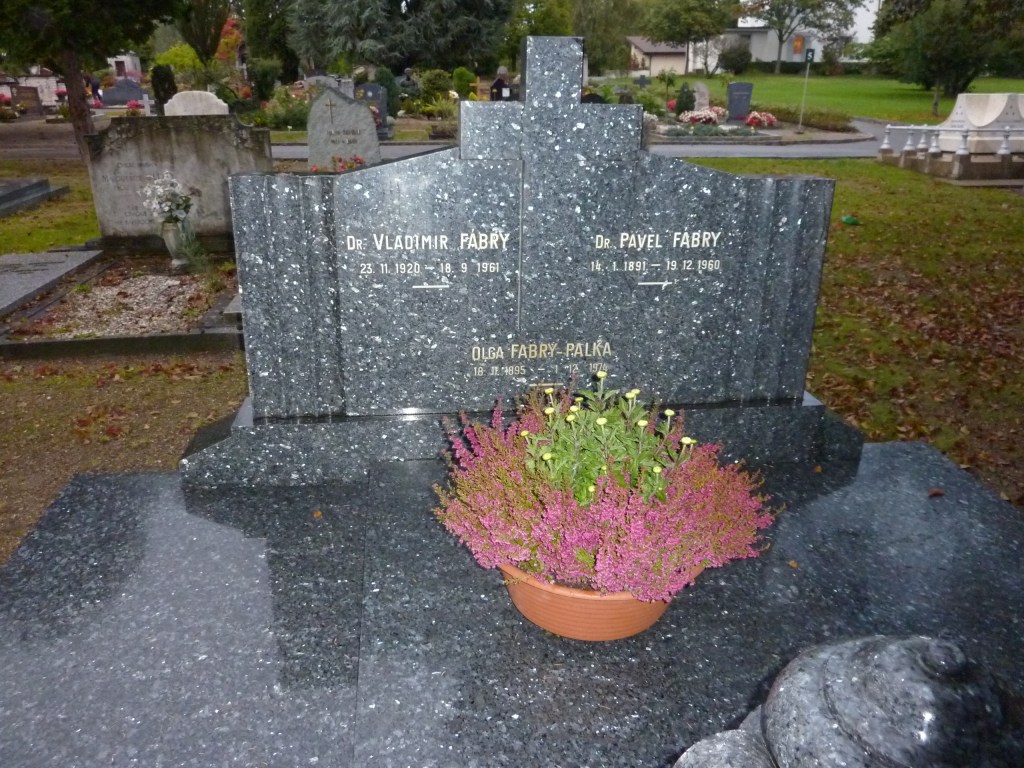
I have received some mysterious emails over the years, but none as mysterious as this one, sent November 26th. I have not included the photos that were attached in the message from Mrs. Anna Hrabovska, a Slovak diplomat working at the Slovak Permanent Mission to the UN in Geneva, but, if they are legitimate, it shows that the Fabry family grave has been removed and replaced with two very plain crosses made of wood – I don’t know who those crosses are for, but where are our relatives? Victor and I visited the grave in 2009, and 2013 was the last time I visited (I posted the above photo here in 2013). The grave was in Cimetiere du Petit-Saconnex.
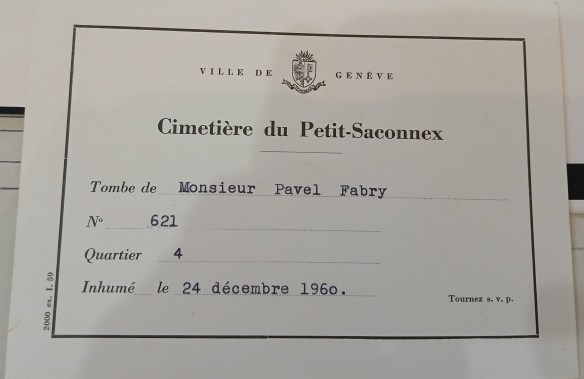
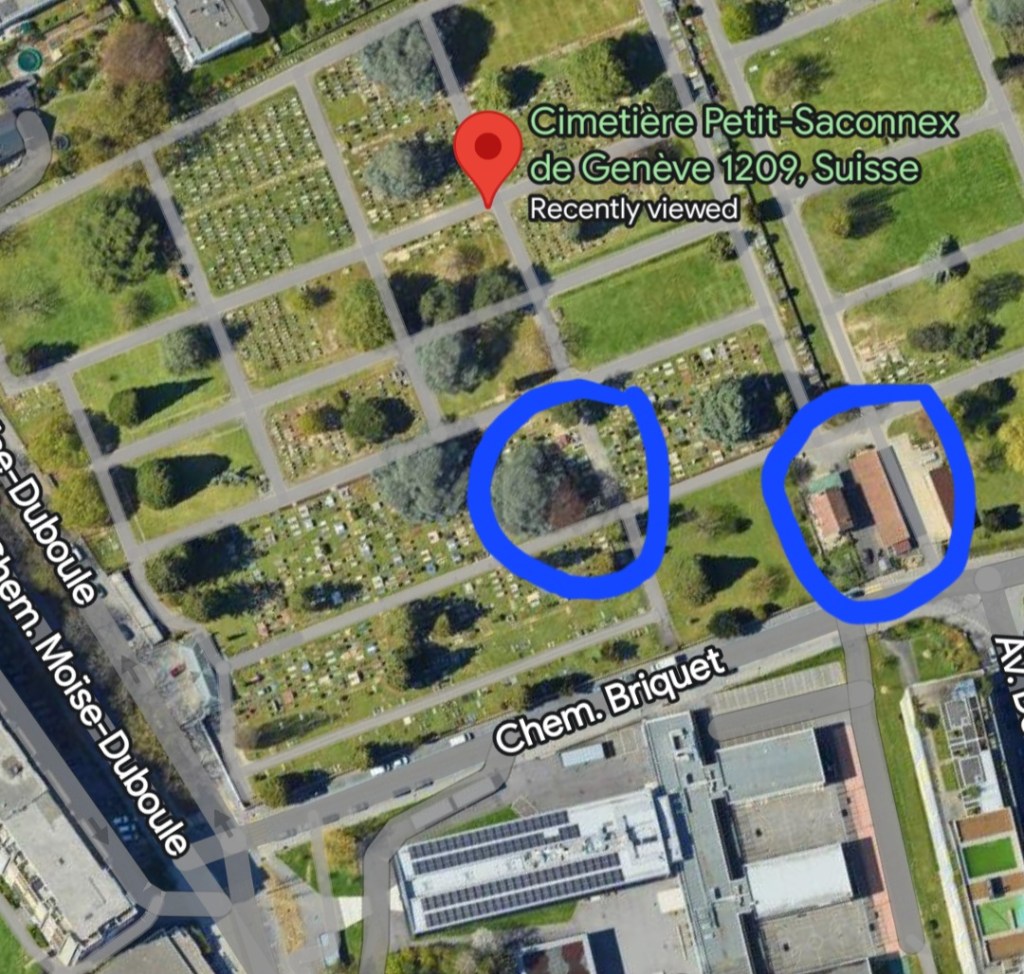
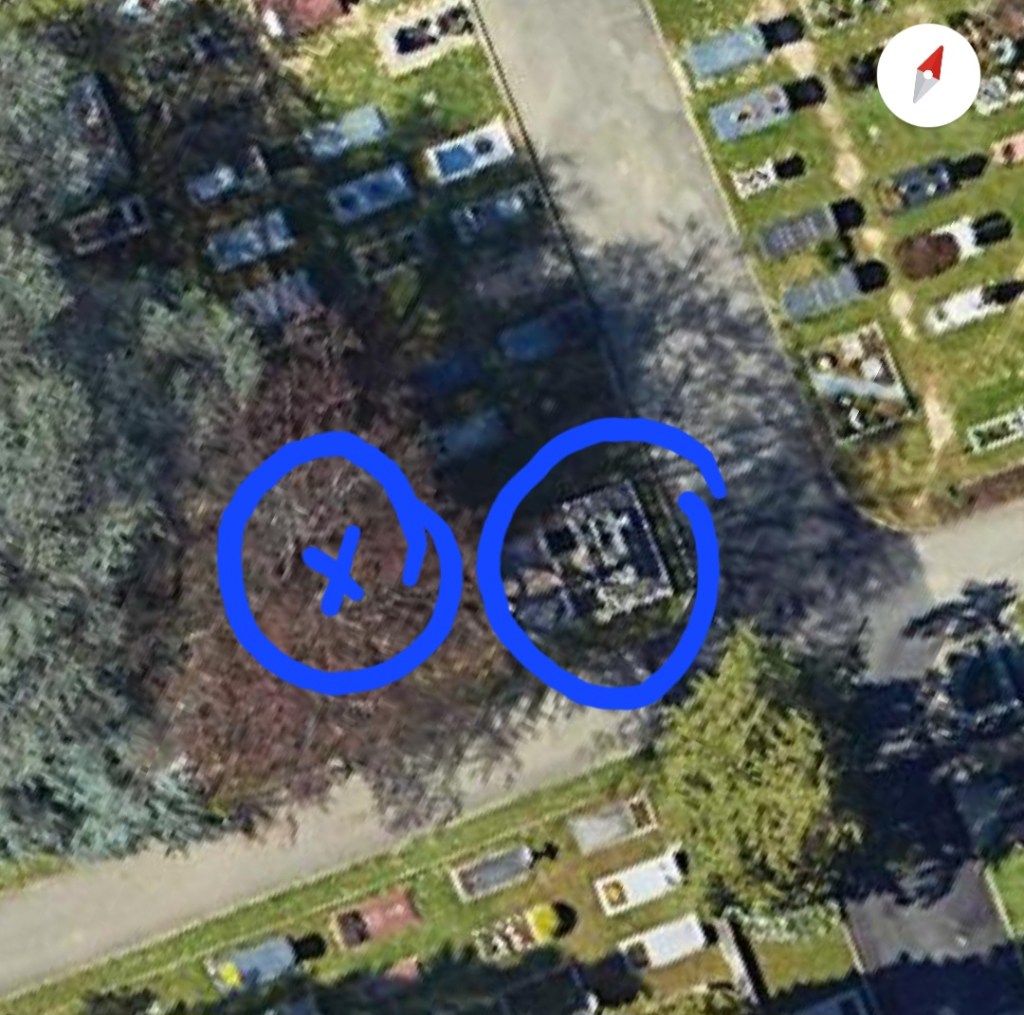
This document for Pavel Fabry, and the document below, confirms that the Fabry grave is in Cimetiere du Petit-Saconnex. There are also 3 documents from the designer of the gravestone, Jacques Colliard.Screenshot of the cemetery. When you zoom on the 2013 photo I took of the grave, you can see a large and distinct grave behind on the right. To the right of the grave and across the one-lane road, there is a sign post with a number “5”, and you can see a building further to right. I have circled the building and the location of the Fabry family grave.Zoomed in further, the large and distinctive grave seen in my 2013 photo is circled, and the location of the Fabry grave is circled and marked with an “X”.
I am presenting Anna’s message publicly, to ask for help from friends living in Geneva and in the United Nations – would someone please confirm if the Fabry family grave is missing? How can this even happen?
With good wishes and thanks for detective help! – Tara
………………………………………………………………………………..
Dear Tara,
My name is Anna, and I am a Slovak diplomat currently serving at the Slovak Permanent Mission to the United Nations in Geneva. I want to express my heartfelt gratitude for the remarkable work you’ve done with the blog about Vladimir Fabry. It’s a beautifully crafted tribute that truly honors his memory and legacy.
As you may know, November 23rd would have marked his 104th birthday. To pay my respects to this brave and inspiring man from Slovakia, I decided to visit his grave and light a candle in his honor. I printed a photo from your blog and went to the cemetery in Petit-Saconnex, only to discover, to my surprise, that the Fabry family grave was no longer there.
The following day, I contacted the Cemetery Administration for guidance. The representative informed me that Vladimir Fabry, listed as being from New York, is buried at the Saint George Cemetery, section 5. However, despite my efforts to locate the grave today, I was unable to find it. Please see in the attachment current photos from both cemeteries.
Since you are close to the family, may I kindly ask if his remains have been relocated or if there is additional information about the exact location of his grave? I couldn’t find any articles or updates regarding this matter.
Thank you so much for your time and assistance. I deeply appreciate any help you can provide.
Almost three weeks after the Slovak Foreign Ministry expelled a Russian diplomat and summoned Russian ambassador Igor Bratchikov, the ministry summoned Bratchikov again.
In its statement from October 2, the ministry writes that the reason is the statements made by Director of the Foreign Intelligence Service of Russia Sergey Naryshkin during the 48-hour election moratorium in Slovakia.
On September 28, Russia’s intelligence service published a press release on its website. Naryshkin accused the USA of interfering in the Slovak parliamentary election. The vote took place two days after the press release, on September 30.
“The upcoming elections in Slovakia can hardly be perceived as a democratic expression of the will of the people free from external influence,” the press release reads, claiming that the liberal party Progresívne Slovensko is expected to win and form a government loyal to Washington.
The Slovak election was won by the populist party Smer, led by former three-time PM Robert Fico.
[…]
The Slovak Foreign Ministry slammed the Russian intelligence service for questioning the integrity of free and democratic elections in Slovakia.
“We consider such deliberately disseminated disinformation to be inadmissible interference by the Russian Federation in the electoral process in Slovakia.”
The manipulation of election results is practically impossible in Slovakia. If, for example, a member of the electoral commission wanted to change the results, there are still nominees of other parties sitting in who can prevent them from doing so.
The Russian embassy in Bratislava, a notorious disseminator of disinformation and propaganda in Slovakia, denied the Slovak ministry’s allegation.
Slovakia said on September 14 it was expelling an employee of the Russian Embassy in Bratislava for activities in “direct violation” of the Vienna Convention on Diplomatic Relations. The Foreign Ministry said it summoned Russian Ambassador to Slovakia Igor Bratchikov and informed him that the employee, whose identity was not disclosed, must leave the country within 48 hours. No details were provided.
At least three people have been detained on suspicion of having spied for Russia in Slovakia.
The Denník N daily reported that since Friday, the police have been on an operation unprecedented in Slovakia’s history. The National Criminal Agency (NAKA) detained a lieutenant from the Defence Ministry, a member of the Slovak Information Service (SIS) and a person with ties to the Hlavné Správy disinformation website, which was taken down after the Russian invasion of Ukraine.
At least one of the detained confessed to the crime, the daily wrote. An employee of the Russian Embassy reportedly bribed the detained persons. As a result, the Foreign Ministry has decided to expel three Russian Embassy staffers from Slovakia.
As many as 35 Russian diplomats will have to leave Slovakia, following a decision of the Foreign Affairs Ministry on the reduction of the embassy’s staff.
The Russian Ambassador to Slovakia Igor Bratchikov has already received a diplomatic note about this decision, the TASR newswire reported.
He was summoned to the ministry following the information of Slovakia’s security forces on the actions of another Russian diplomat at odds with the Vienna Convention on Diplomatic Relations.
[…]
“In this regard, we must say regretfully that after the previous expulsions of Russian diplomats in the past two years, the Russian diplomatic mission has not shown interest in proper work on our territory,” the Slovak Foreign Affairs Ministry said, as quoted by TASR.
[…]
Even though the official documents from last year show that officially there were 29 Russian diplomats plus nine partners, the Sme daily reported that there might be nearly 70 of them at the Russian Embassy in Bratislava.
BERLIN (AP) — A Russian accused of killing a Georgian man in broad daylight in downtown Berlin on Moscow’s orders went on trial for murder Wednesday, in a case that has contributed to growing frictions between Germany and Russia.
The defendant Vadim Krasikov, using the alias Vadim Solokov, traveled to the German capital last August on the orders of the Russian government to kill a Georgian citizen of Chechen ethnicity who fought Russian troops in Chechnya, prosecutor Ronald Georg said.
“State agencies of the central government of the Russian Federation gave the defendant the contract to liquidate the Georgian citizen with Chechen roots,” Georg told the court, reading the indictment.
“The defendant took the contract, either for an unknown sum of money or because he shared the motive of those who gave the contract to liquidate the (victim) as a political enemy in revenge for his role in the second Chechen war and participation in other armed conflict against the Russian Federation.”
[…]
After the Aug. 23, 2019 killing, Germany expelled two Russian diplomats last December over the case, prompting Russia to oust two German diplomats in retaliation.
If the allegations against the suspect are proved in court, the case has the potential to exacerbate tensions between Moscow and Berlin, which have also been fueled by allegations of Russian involvement in the 2015 hacking of the German parliament and the theft of documents from Chancellor Angela Merkel’s own office, as well as the poisoning of Russian opposition leader Alexei Navalny.
Navalny fell ill on a flight in Russia on Aug. 20, landing in a Siberian hospital. Two days later, he was transferred on Merkel’s personal invitation to Berlin’s Charite hospital, where doctors concluded he had been poisoned by a Soviet-era nerve agent.
Moscow has dismissed accusations of involvement in the Navalny case and denied ties in the parliamentary hacking, even though Merkel herself said there was “hard evidence” of the latter.
Russian President Vladimir Putin’s spokesman, Dmitry Peskov, has also called the allegations of Russian involvement in the Berlin killing “absolutely groundless.”
After Merkel confronted Putin about the killing at a meeting in Paris in December, the Russian leader called the victim, Zelimkhan “Tornike” Khangoshvili, a “bandit” and a “murderer,” accusing him of killing scores of people during fighting in the Caucasus.
The growing acrimony between the two countries comes at a delicate time, as Germany and Russia work towards the completion of a joint pipeline project to bring Russian gas directly to Germany under the Baltic, and work to try and salvage a nuclear deal with Iran that has been unraveling since President Donald Trump unilaterally pulled the U.S. out of it in 2018.
Khangoshvili, 40, was a Georgian citizen of Chechen ethnicity who fought Russian troops in Chechnya. He had also volunteered to fight for a Georgian unit against the Russians in South Ossetia in 2008, but peace was negotiated before he took part. He had previously survived multiple assassination attempts and continued to receive threats after fleeing in 2016 to Germany, where he had been granted asylum.
1948 was a very difficult year for the Fabry family, which was the time of the Communist coup d’état in Czechoslovakia. Vlado was far away from Bratislava, working in former Dutch Batavia, now Jakarta, for the United Nations Committee of Good Offices on the Indonesian Question, but his concern for his family stayed close. Vlado was devoted to the ideals of the United Nations, and making the world more peaceful, but he was torn by a greater devotion to his family. His position with the UN made many things possible for himself and his family, who were all political refugees, stateless, and fearful of being deported at any time, so it was not so easy for Vlado to ask for a post nearer his family, without sounding like he cared more about his family than his work. From a letter dated October 21, 1948, frustrated in Indonesia, Vlado writes to a member of the UN asking to be assigned to Palestine:
“Well, that would be all very nice as a position in a showdown if I would be alone and could make it without having to worry what would happen to my family if something goes wrong. As things are, I have rather to be concerned about everything, and address myself to you for help. With the indication not to appear in Paris for some time I have to rely on you and Boka, and hope that this year you will have more luck than last. I really can not work too much longer in this atmosphere of uncertainty in which I am now, without letting down either my work or my nerves, and I have to have my family sheltered somewhere, preferably in Europe, and be reasonably near to it for some time – 3 or 4 months – to give them the initial support they need. An assignment to Palestine as your assistant – which in my opinion should be for [Ivan] Kerno extremely simple, as all he has to do is to recall Kingstone and assign me instead – would be for me wonderful – it would keep me near my folks, would give me the opportunity to get a working acquaintance with the people who would decide on my transfer to trusteeship – I just learned that there were two resignations in Wishoff’s section lately – and would give me the immense advantage to work with somebody I like and esteem, and to be near to a friend again. So I pin my hopes on it.”
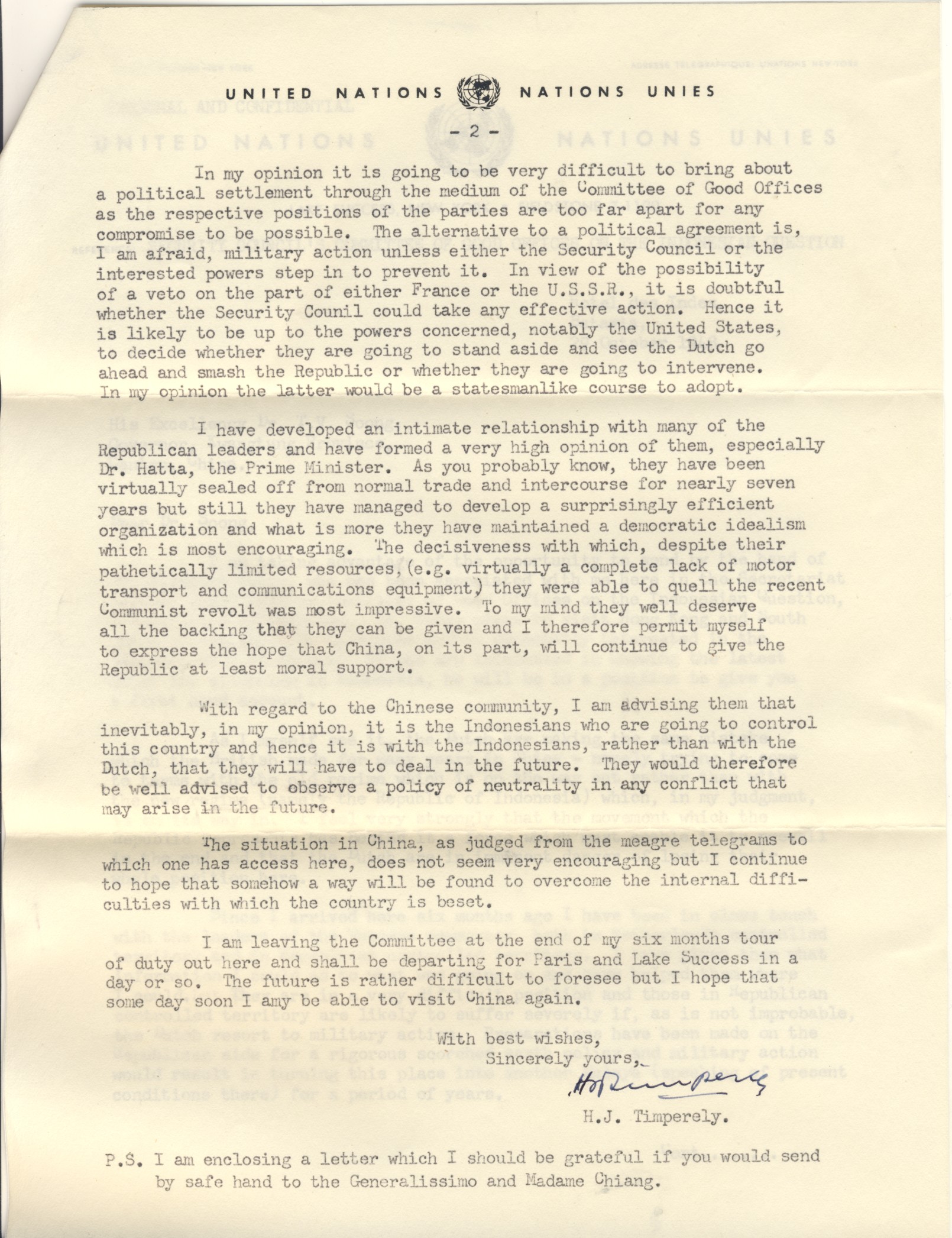
Vlado would remain in Jakarta until May 1951, as Assistant Secretary and adviser to Principal Secretary of United Nations Commission for Indonesia, but he wasn’t entirely “stuck” there – he managed to get away to Europe (most likely, to see his family) around the end of October/beginning of November 1948, with plans to visit Hong Kong and South China on his way there. Here is a letter from H.J. Timperely, sent from the Hotel des Indes and dated October 29, 1948, to His Excellency Dr. T.V. Soong in China, introducing Dr. Vladimir Fabry, and giving Timperely’s insights on the situation in Indonesia:
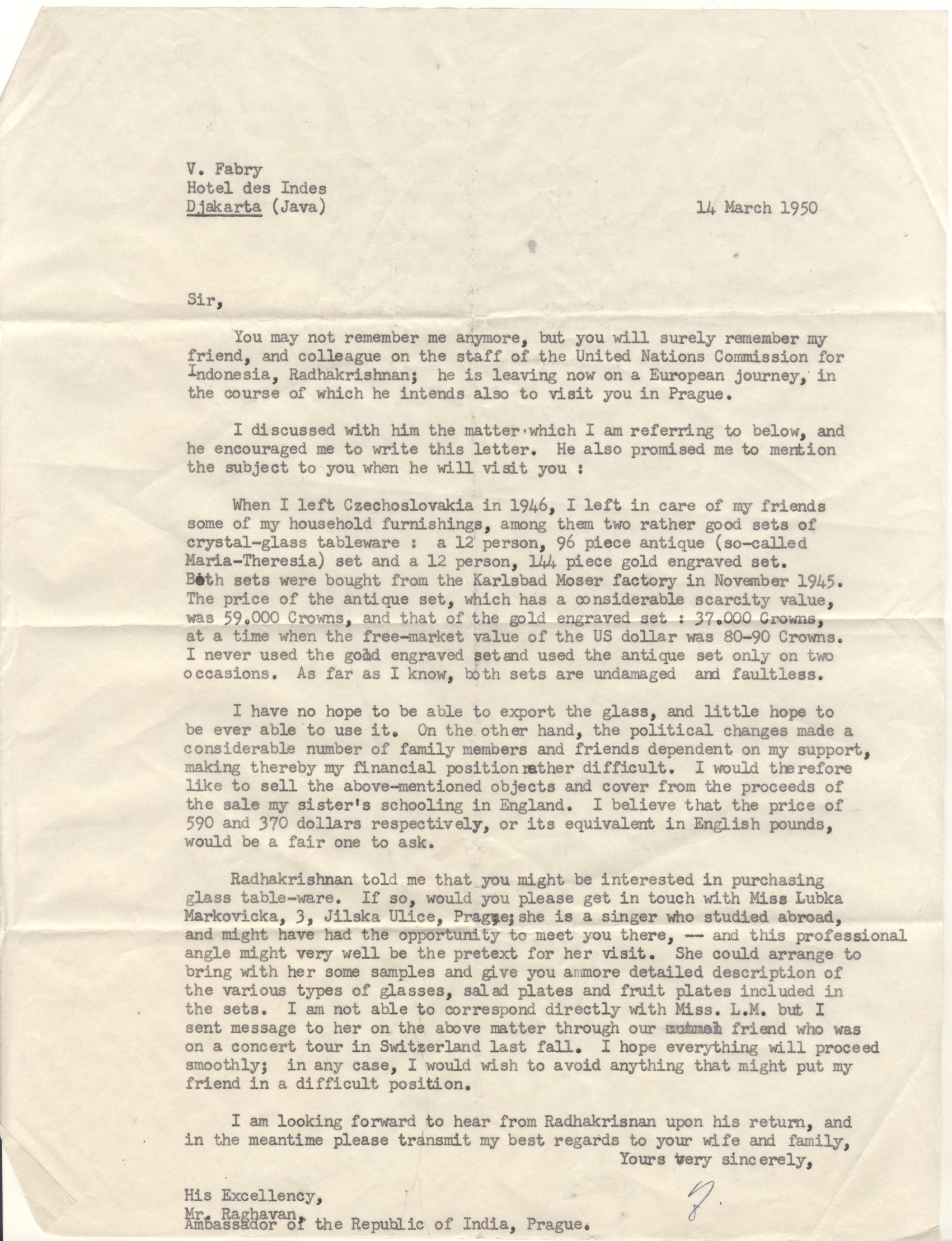
On March 14, 1950, referencing mutual friend and colleague Sarvepalli Radhakrishnan, Vlado wrote to His Excellency Mr. Raghavan, Ambassador to the Republic of India in Prague, asking if he would be interested in buying a set of crystal tableware to cover his sister’s school tuition:





 Vlado
Vlado 