
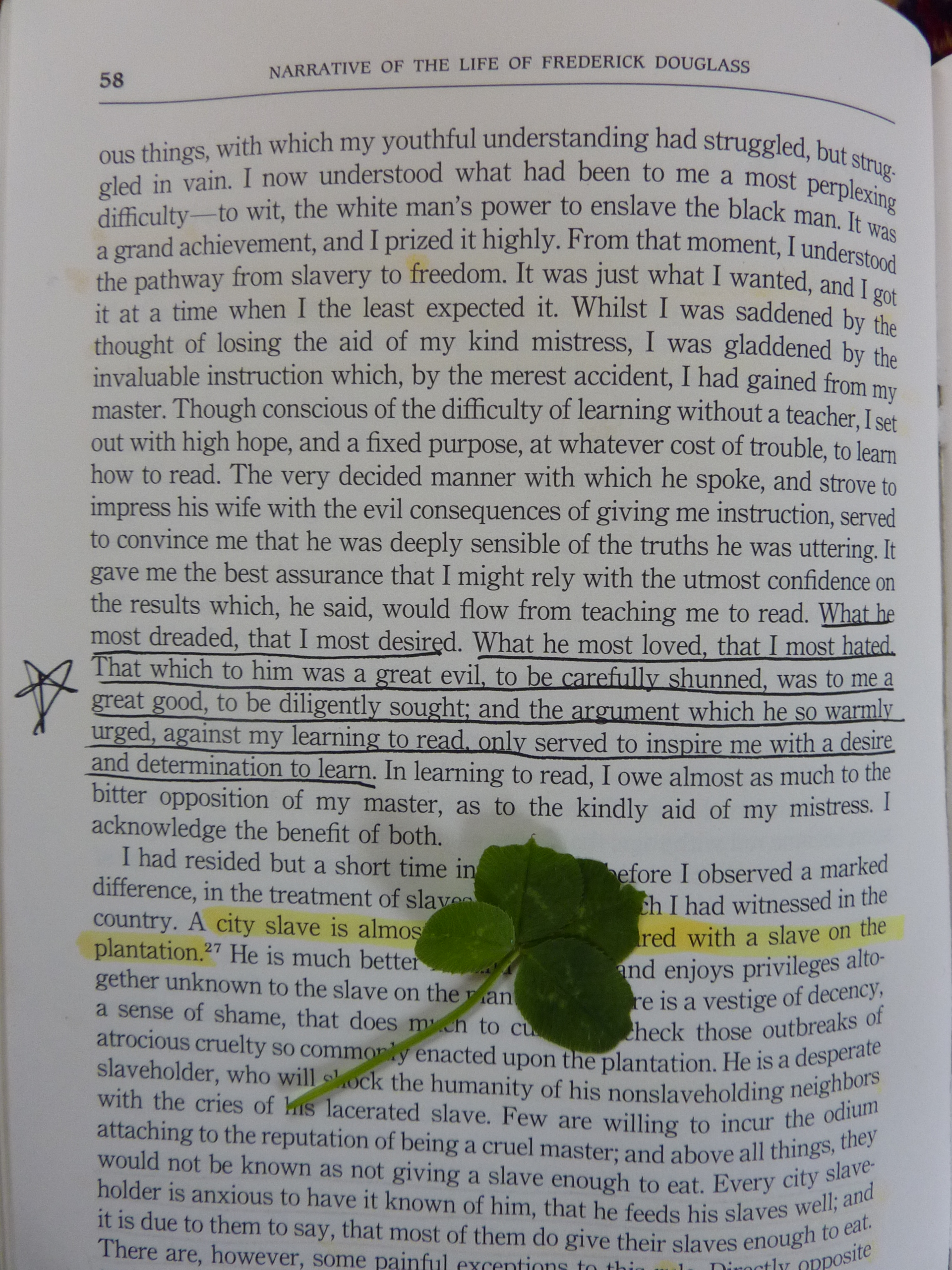
“I have observed this in my experience of slavery,–that whenever my condition was improved, instead of increasing my contentment, it only increased my desire to be free, and set me to thinking of plans to gain my freedom. I have found that, to make a contented slave, it is necessary to make a thoughtless one. It is necessary to darken his moral and mental vision, and, as far as possible, to annihilate the power of reason. He must be able to detect no inconsistencies in slavery; he must be made to feel that slavery is right; and he can be brought to that only when he ceases to be a man.”

[…]
“He told me I could go nowhere but that he could get me; and that, in the event of my running away, he should spare no pains in his efforts to catch me. He exhorted me to content myself, and be obedient. He told me, if I would be happy, I must lay out no plans for the future. He said, if I behaved myself properly, he would take care of me. Indeed, he advised me to complete thoughtlessness of the future, and taught me to depend solely upon him for happiness. He seemed to see fully the pressing necessity of setting aside my intellectual nature, in order to contentment in slavery. But in spite of him, and even in spite of myself, I continued to think, and to think about the injustice of my enslavement, and the means of escape.”
[…]
“I had a number of warm-hearted friends in Baltimore,–friends that I loved almost as I did my life,–and the thought of being separated from them forever was painful beyond expression. It is my opinion that thousands would escape from slavery, who now remain, but for the strong cords of affection that bind them to their friends. The thought of leaving my friends was decidedly the most painful thought with which I had to contend.”

[…]
“It was a most painful situation; and, to understand it, one must needs experience it, or imagine himself in similar circumstances. Let him be a fugitive slave in a strange land–a land given up to be the hunting-ground for slaveholders–whose inhabitants are legalized kidnappers–where he is every moment subjected to the terrible liability of being seized upon by his fellowmen, as the hideous crocodile seizes upon his prey!–I say, let him place himself in my situation–without home or friends–without money or credit–wanting shelter, and no one to give it–wanting bread, and no money to buy it,–and at the same time let him feel that he is pursued by merciless men-hunters, and in total darkness as to what to do, where to go, or where to stay,–perfectly helpless both as to the means of defence and means of escape,–in the midst of plenty, yet suffering the terrible gnawings of hunger,–in the midst of house, yet having no home,–among fellow-men, yet feeling as if in the midst of wild beasts, whose greediness to swallow up the trembling and half-famished fugitive is only equalled by that with which the monsters of the deep swallow up the helpless fish upon which they subsist,–I say, let him be placed in this most trying situation,–the situation in which I was placed,–then, and not till then, will he fully appreciate the hardships of, and know how to sympathize with, the toil-worn and whip-scarred fugitive slave.”
–From chapters 10 and 11 of “Narrative of the Life of Frederick Douglass, An American Slave, Written by Himself”
 Vlado
Vlado 