Here are two wonderful letters from Vlado to his “Mamka”. The first one was sent just after a new government was formed in former Leopoldville headed by Prime Minister Cyrille Adoula. Vlado was trying to quit smoking at the most intense time in the Congo Crisis, too! I admire his resolve at self-mastery, but he deserved that cigarette.
3.8.61
Dear Mom,
Finally, after a lot of procrastination and negotiations I formed a government and I can say with a clear conscience that it would not have happened without me. Not only did I have to flatter them and draw up the entire government program for them, but I also had to draw up the protocol on the conspiracy and the establishment of the government in the end.
After the meeting of the parliament, when everything was safely approved, I lit a cigarette for the first time in 11 days! At first, it was very difficult for me to deny myself, but now I’ve given up enough and I don’t really want to smoke, I just suck on menthol cigarettes all the time.
[Sture] Linner, the American and English ambassador, was waiting for me in the office with champagne when I came down from the parliament with the news that we have a government. Thank God I’ve managed to avoid all the journalists so far, I’m keeping my fingers crossed that it continues.
Now I have to start working on plans to get the United Nations and especially the army out of there as soon as possible without making a mess. As soon as its on the way (and if nothing happens by then) I’ll start thinking about leaving.
I will try to write to Frau Tag and [Kornel] Filo before the end of the week, but until now I have had neither the time nor the mind to do so.
Kisses
Vlado
Thanks to Miroslav Kamenik for his help translating this letter!
21.8.61
Drahá Mamka,
dúfám že si dobre dostala list čo som Ti dal poslať cez Rím a že si teraz uspokojená. Hja (MK – povzdech ve smyslu zlehčení až rezignace), musím doháňať čo sa mi pokazilo kým som bol v Europe, keď mi ?pripustili ?Laov(MK – Laos je možný, toho roku Čína a Laos navázali diplomatické styky), Číňanov a iných zloduchov do Stanleyville – teraz mám šarapatu (MK – mrzutost) s ich zlym vlivom. No dúfám že po minulom týždni veci pojdu lepšie – len Katanga eště zostáva tvrdý oriešok.
Poslední list od Teba je datovaný 13 augusta, poslaný 14 augusta – išel tyždeň. Držím sa eště ?úzdy ako nefajčiar.
Bozky
Vlado
→ Dear Mom,
I hope you received the letter I sent you via Rome and that you are now satisfied (at ease?). Hya (MK – „hja“, sigh in the sense of belittling and resignation), I have to catch up with what went wrong while I was in Europe, when they ?allowed ?Laos(MK – Laos is possible, that year China and Laos established diplomatic relations), Chinese and other bad guys to Stanleyville – now I have a quarrel (MK – annoyance) with their bad influence. But I hope that after last week things will go better – only Katanga remains a tough nut to crack.
The last letter from you is dated August 13, sent August 14 – a week has passed. I am still holding on to the ?bridle like a non-smoker.
With thanks to journalist and author Maurin Picard for passing on a recent interview with Madame Monique Rime, who was Vlado’s personal secretary in the Congo in 1961; published in La Liberte (Switzerland), written by Kessava Packiry. Maurin has just published a new book called “Katanga! The forgotten war of Francafrique against the UN”, I look forward to read it! Thanks to Hynrich Wieschhoff for passing on an English translation of Madame Rime’s interview, and for sharing the latest Hammarskjold investigation news that “Chief Justice Othman has delivered his report to Secretary-General Guterres. It will be made available to the public on October 18.” We continue to urge the US and UK to cooperate fully with the investigation.
Does it still hurt to talk about Africa again? The year 1961 was intense with many dramas. When I left ONUC in December 1961, I didn’t want to hear about Africa anymore, it was like that for decades. I think I was too young, ill-prepared for all that and even now, these painful memories are deeply embedded in my memory. The UN was intent on continuing with its Secretary-General’s mission. A few days after his death, Monique Rime found herself in a delegation flying to Ndola. “I had been assigned to this mission because I knew all the files. As we approached the airport, we flew over the wreck of the Albertina (the nickname of the Swedish DC-6 chartered by the UN, editor’s note), which had crashed in the forest. That image is still in my head.
*Update: 18 October 2024, Eminent Person’s report A/78/1006
“To my observation, in the study of aircraft accidents throughout the course of my life, there is almost always a precipitating event that sets off a chain of actions, reactions, counteractions, etc. that result in the crashed aircraft somewhere on the surface of earth. In this case, it is known from Annex II that the captain communicated to Ndola tower that all was well and within minutes the aircraft was being incinerated with its own wing fuel and that fifteen of the sixteen occupants’ lives has ended, and that the last would succumb in less than a week. That person, Sgt. [Harold] Julien, was the only eyewitness to the crash.
“To my experience, eyewitness testimony is considered evidence in a court of law, at least in this country. I am unfamiliar with Rhodesian law in the 1960’s, but in the USA in the 1960’s Sgt. Julien’s statements would have been considered evidence in a crash investigation. Since there is no other actual evidence to the contrary, and testimony of ground observers about the airport over-flight and entry to the instrument approach procedure are insufficiently conclusive to determine externally what the precipitating event was, it seems logical to me that Sgt. Julien’s statements, as brief as they are, are the only thing that can be considered as evidence in a search for the cause of the chain of events leading to the crash.
“In the UN Commission report, par. 129., Senior Inspector Allen testified to the UN Commission that he spoke with Sgt. Julien and asked him three questions; 1.”What happened? He said: ‘It blew up’.” 2.”Was this over the runway? And he said ‘yes’. 3.”What happened then? And he replied: ‘There was great speed – great speed’.”
“It blew up–“
“–over the runway”
“I have read all three of these reports several times and still don’t understand the reluctance of the investigators, including the UN and the Swedish observers, to not make those six words the central point, the number one item on the list of where to begin to find the truth about what happened. Especially from the standpoint of determining whether or not there is fault to be assigned to the flight crew.
“Assuming Sgt. Julien was belted into any seat in the forward cabin, looking out the side window on whichever side he was sitting on, he may or may not have had a view of the lighted runway and the town of Ndola but it is likely that the captain would have informed the passengers that they had arrived overhead Ndola and would be setting up to land there. It would have been the last thing he could identify location-wise and anywhere in that vicinity for him would be “over the runway”. I don’t know if Inspector Allen was deliberately trying to trip him up or why he asked him if it was over the runway when he knew that the aircraft had overflown the runway and not blown up there, but, it seems to me, it was an unusual question to ask a person in Sgt. Julien’s condition. What I am getting at here is that Sgt. Julien knew where the runway was and that the aircraft had blown up. They sound like lucid answers to me, and not as though he was thinking about horses or submarines, for example.
“In my view, in light of all the data and evidence of all of the pages of all the reports and the information displayed in all of the images of all the photographs in the UN file, the only thing I can see that qualifies as a precipitating event is Sgt. Julien’s: “It blew up”.
“And he was the only one left that was there when it happened.”
As I pointed out in part two of this series, Hugo Blandori was a “retired” FBI agent, turned private investigator, who was hired by the UN as a consultant to this investigation. It is extremely upsetting to me that an FBI agent was involved, not only because of the racist history of that organization, but because of the role the FBI played during the McCarthy witch-hunt on United Nations staff members in 1953. Trygve Lie, the first UN Secretary-General, gave the FBI carte blanche of headquarters “for the convenience”, and it was his successor Dag Hammarskjold who protected his staff and kicked out the FBI by November 1953. Within every organization, including the UN, there have always been members who are actively working against the good that that organization is trying to achieve, and that is how I believe Hugo Blandori got the job of consultant. This is also how Dr. Max Frei-Sulzer – a Swiss police official that believed Hitler’s diaries were real – was appointed by the UN commission to examine the wreckage of the Secretary-General’s plane, and “who reported that there were no bullet holes in the plane and no evidence of explosives that would have been needed for a time bomb or other means of sabotaging the plane”. In my view, the contributions of Blandori and Frei-Sulzer are not just highly suspect, they discredit the investigation – I believe intentionally so!
This is why I am grateful for Bo Virving (and his son, Bjorn!), who was the smartest man on the scene in Ndola – an honest man – who saved important documents from the investigation, convinced that the crash was not an accident and that African witnesses testimony were deliberately ignored.
“Mr. Virving, in his appearance before the Commission, presented a theory wherein he claimed that aircraft SE-BDY had been shot down or forced down by a plane above it. He based his theory primarily on the statements of African witnesses that had been interviewed in Ndola. I talked with Mr. Virving at length after his appearance before the Commission, but he could not elaborate nor could he suggest any ways and means of confirming his beliefs. He made it known that the Rhodesian authorities had sought to suppress those witnesses whose testimonies were embarrassing to the Rhodesians and to emphasize those who vindicated their stand.
“Virving stated that he was limited in his movements and was unable to undertake an independent investigation to further his theory.”
From pages 9-10, Blandori writes this about the African witnesses:
“Concerning African witnesses, I wish to point out that it is most difficult to distinguish from their testimony what is truth and what is fiction or imagination. There were so many inconsistencies and discrepancies in their stories that to have believed them would refute the testimony of other witnesses who are generally reliable.
[…]
“As a consequence, I am of the opinion that the testimony of the African witnesses to the effect that they saw one or more small crafts flying along with SE-BDY just prior to its crash, has to be accepted with a grain of salt.”
“Mr. Virving, a Transair official, put before the Commission a theory that SE-BDY might have been attacked and shot down by a plane armed with rockets. This theory was based in part on an analysis of the statements of various witnesses concerning their observations of planes and of flashes in the sky. No substantial evidence was submitted in support of this theory and the Commission is of the opinion that most of the phenomena referred to by Mr. Virving are susceptible of other and more logical explanations. The Commission also consulted rocket experts with ONUC who expressed considerable doubt concerning the possibility of such an attack. Finally, as already noted, no signs of a pre-crash explosion or traces of a rocket were found in the wreckage.”
From Susan Williams’ “Who Killed Hammarskjold?”, 2016 edition, chapter 7, p. 99:
“All these [African] witnesses were challenged by the Federal examiner. Afterwards, Bo Virving followed [Dickson] Buleni and [Davidson] Simango from the court and interviewed them privately about what they had seen. They repeated their claim that they had seen two aircraft and not just one but were reluctant to talk too much to Virving, as they were being observed by a white police officer. According to Virving, their answers were reliable and tallied exactly with his own technical calculations.”
Daily Express, UK, 19 September 1961, page 2
Back in January 2014, I wrote here that I was convinced that the Albertina was shot down by Fouga Magisters. I am still convinced it was shot down, but I was wrong to believe it was a Fouga. I was misdirected by all the reports in the newspapers I was looking at, and I think that was the point – that these reports on Fougas were a red herring in the press. Bo Virving’s observations led him to believe that the Albertina was shot down by a Dove, and his theory rings true for me. From “Who Killed Hammarskjold?”, chapter 15, pages 185-187:
“Bo Virving had gathered ‘overwhelming evidence’, believed [George Ivan] Smith, that Hammarskjold’s plane was ‘forced down and crashed as a result of actions from an unidentified aircraft’. This evidence was carefully explored in a series of programmes about Hammarskjold which were produced by Gunnar Mollerstedt and shown on Swedish television. Mollerstedt had spent a year gathering material–including the interviews with Timothy Jiranda Kankasa and Dickson Buleni.
“Virving stated that there were five Doves in service in the Katangese air force in September 1961 at Kolwezi and Jadotville airports. They could stay airborne for three or four hours and their speed could match that of Hammarskjold’s DC6 in level flight; and in a dive from above they could increase their speed. It would be possible for the crew of the Dove to drop a small explosive device on to an aircraft below, then pull out of the dive. Virving had developed this theory about a Dove because on the day that Hammarskjold’s body was flown out to Sweden, he had seen a Dove at Ndola airport and discovered that it had a hole in its floor, which was apparently used for aerial photography. A man could lie there, he realized, telling the pilot ‘right, left, up, down’ and at a given moment let fall a small projectile.
“The theory that a Dove could be used in this way was later confirmed by Mercenary Commander, the memoir of the mercenary Jerry Puren–which was published six years after Mollerstedt’s programme. With evident pride, Puren describes in this book his technique of dropping bombs through a hole in the floor of a Dove aeroplane, by means of a rack system rigged along the fuselage. The racks were fitted to take bombs of 12.5 kg, which were despatched one at a time through the hatch in the floor when a lever was pulled. A bombing crew consisted of a pilot, a bomb aimer and a bombardier; usually Puren flew on these bombing missions with his friend Max Glasspole, the gum-chewing Canadian pilot, or the Hungarian pilot Sandor Gurkitz–both of whom were at Ndola airport on 17-18 September 1961, when he arrived that afternoon from South Africa. According to Puren, 12.5 kg bombs were turned out by Union Miniere workshops by the thousand; each had a contact fuse in the tail section which unwound and armed the bomb when lobbed from the aircraft.
“The Rhodesian Commission of Inquiry Report acknowledged that a Dove with a bombing capacity was found in September 1961 at Ndola–but after the crash. ‘One De Havilland Dove belonging to the Katanga Government,’ it stated, ‘was after the 18th September armed by removing a door and placing a machine gun on the floor to fire through the opening.’ The Dove had not, it stated, been at Ndola on the day of the crash, but elsewhere: ‘On 17th September this and possibly another were in the hands of the United Nations at Elisabethville. Three Doves were then in the Republic of South Africa undergoing examination.'”
[…]
“Virving’s suspicions about the use of a Dove against the Albertina were heightened when he went to Elisabethville in 1962 and found that the Katangese Doves had disappeared during the August 1961 UN action to expel mercenaries [Operation Rum Punch]. Significantly, their logbooks had been left behind. Then Virving found the Pretoria workshop where the Doves would normally have been serviced and sought information ‘for historical purposes’; but after two years’ wait he was told that no information could be given.”
Jerry Puren was one of the 79 mercenaries working for Katanga that uncle Vlado had arrested during Operation Rum Punch–he was also in the bar at Ndola airport the night of 17-18 September 1961, waiting for Hammarskjold’s plane to arrive. I believe that he was one of the men flying the Dove that shot down the Albertina. It wasn’t just glory he was after, it was personal revenge against Vlado and the UN for arresting him. From page 225-226 of “Who Killed Hammarskjold?”:
“[…]Puren’s behaviour at Ndola airport that evening seems totally out of character: for even though ‘excitement ran high, history was unfolding, and we were right on the spot,’ as he himself writes, he and fellow mercenary pilot Glasspole (who was also at Ndola airport) decided to have an early night:
Shortly after 22h00 there was a rustle of excitement among the chilled gathering. Several people claimed they had heard the sound of an aircraft’s engine, others said they saw lights disappearing low in the west. We saw nothing. Eventually Glasspole and I looked at each other, shrugged our shoulders and returned to our welcoming beds at the Savoy Hotel.
“This is a very different Jerry Puren from the man of action described in the rest of his memoir: who fearlessly, for example, escaped the UN after his capture during Rumpunch, disguised as a priest.”
[…]
“Puren’s and Glasspole’s unlikely early night at Ndola does make me wonder about the Dove found by Bo Virving at Ndola airport the following day–with a hole in the bottom, through which Puren and Glasspole had become adept at dropping bombs on to Baluba villages. Furthermore, Puren was rewarded by Tshombe just a few days after this episode, by being made Chief of Operations of the Katangese Air Force, at an impromptu parade.
“One intriguing aspect of Puren’s mercenary career is that he later became involved in the failed Seychelles invasion in 1981, with which SAIMR was apparently associated.”
Lastly, in connection to mercenaries and Doves, this brief interview with author and journalist Maurin Picard:
Here are more newspapers from New York, from September 19, 1961 to May 3, 1962, which support the evidence of the only survivor of the Albertina, Sgt. Harry Julien. For context of these events, please read Susan Williams’ most recent essay, published in The Yale Review, “Revisiting Dag Hammarskjold’s Mysterious Death”. Part one of this series can be found here.
The NYT, 19 September 1961. From article “Hostile Jet Cited in Crash”: “Jacques Poujoulat, personal assistant to Dr. Sture C. Linner, chief of the United Nations mission in the Congo, described the circumstances off the ill-fated flight. He said he “could not answer” when he was asked whether the possibilty that the plane might have been shot down could be ruled out. He declared, however, that the United Nations had been “unable to make daylight flights” because of constant attacks by enemy jet aircraft. He said that the timing of the Secretary General’s night flight to Northern Rhodesia was “at least partly” because of the attacks by enemy aircraft.”The NYT, 19 September 1961. “[Poujoulat] said that seven hours after the plane took off from Leopoldville yesterday an “unidentified aircraft” flew over Ndola airport and that at about the same time the police reported a “flash in the sky.”The NYT, 19 September 1961. “The jet fighter has been the greatest single threat to the United Nations troops in Katanga, the pilot, who flies two planes alternately, has been strafing and bombing United Nations forces in Elisabethville, Kamina and Jadotville every day. United Nations officials believe that one of the two planes is being reloaded and refueled while the other is in action. The United Nations announced yesterday that three Ethiopian jet fighters were “on their way” to Katanga to oppose enemy fighter planes. Today it was learned from qualified sources that the planes had not arrived because British authorities in Uganda had refused to let them make a refueling stop.”New York Herald Tribune, 19 September 1961. From article “Survivor Says Blasts Shook Plane”: “The wreck was reported first spotted by a Negro charcoal burner, then by a Royal Rhodesian Air Force crew. It was still smouldering when a ground search party arrived in mid-afternoon.”New York Mirror, 19 September 1961New York Mirror, 19 September 1961. Col. Don Taylor is a typo for Col. Don Gaylor, who was sent to Ndola by the Pentagon on September 15. “Col. Don Taylor[sic], U.S. air attache in Pretoria, South Africa, who circled the wreck area until ground parties arrived, said it seemed obvious the plane was making an approach to Ndola Airport when it crashed about six miles away. Taylor said it looked to him as though the pilot misjudged the height and that the plane’s undercarriage caught in tree tops.”
From Susan Williams’ essay: “One other aspect of Gaylor’s involvement is worth noting. After the Albertina failed to land, a team of Norwegian U.N. soldiers flew to Ndola to assist in the search. Their aircraft was parked near Gaylor’s DC-3. Because of white Rhodesians’ hostility to U.N. personnel, they were not allowed to enter the airport terminal. So Gaylor’s crew invited them on board to get some food. To the surprise of U.N. soldiers, they discovered that the American plane was packed with highly sophisticated radio equipment.
“We know from other testimony that the U.S. Embassy in Leopoldville was communicating with Ndola via a U.S. aircraft, which presumably was Gaylor’s DC-3. And that may explain an intriguing aspect of the story, namely that Edmund A. Gullion, the U.S. ambassador in the Congo, sent a cable to Washington on the morning of September 18 that explicity referred to the possibility that the plane was shot down. “Hammarskjold’s plane believed lost in vicinity Rhodesian border near Ndola,” the cable read. “There is possibility he was shot down by single pilot who has harassed U.N. operations and who has been identified by one usually reliable source as van Riesseghel, Belgian, who accepted training lessons with so-called Katangan Air Force.” (The ambassador’s communique included an error — the name of the pilot in question was Jan van Risseghem.)”
New York Mirror, 19 September 1961New York Mirror, 19 September 1961The NYT, 20 January 1962. “NDOLA, Northern Rhodesia, Jan. 19 (Reuters) — Two planes passed over Ndola shortly before Mr. Hammarskjold and fifteen other persons died in the air crash near here, a witness told an inquiry here today. T. J. Kankasa, an African municipal official, told the Rhodesian federal inquiry that one of the planes had its lights on and appeared to be a transport while the other was a “smaller aircraft without lights.” “It seemed as if the smaller plane was beaming lights on the large aircraft,” he said.”
From Susan Williams’ book, “Who Killed Hammarskjold?”, pages 107 and 109: “The UN Commission supplemented its findings by employing a consultant named Hugo Blandori to carry out some background research in Ndola.” […] “Blandori included in his memorandum some observations on the appearance of Bo Virving at the Commission hearings. Virving, he reported, had put forward the theory that the Albertina had been shot down or forced down by a plane above it. He based his theory primarily on the statements of African witnesses and told Blandori that he believed the Rhodesian authorities had suppressed their evidence.
“It was Blandori’s view that the Africans giving testimony had no experience of aircraft, so didn’t know what they were talking about. But this was not the case. For one thing, the witnesses lived very near the airport and had daily experience of the comings and goings of planes; and for another, some of them, such as Timothy Kankasa, had worked with planes during the Second World War[as a signalman].”
Who was Hugo Blandori? According to this article by Jerry Dumas, “Hugo Blandori [was an] F.B.I. agent and also a YMCA regular, who died beside me on the Y handball court”. And according to this article about Anne Cioffi, who was his former secretary, Blandori was an F.B.I. agent who later became a private investigator, but I don’t know when exactly that change happened. From the article:
“I used to babysit his kids,” she said.
One day Blandori told her he needed a secretary and she took the job.
“He taught me every angle of his business,” she said, adding that was unusual in those days because women weren’t often afforded such opportunities.
Cioffi said Blandori was affiliated with former FBI agents who did private investigating all over the world and, with her as his secretary, specialized in pre-employment screenings.
“Years ago you could do that,” she said.
The company also conducted insurance and fraud investigations, and occasionally cheating-spouse cases.
“I didn’t like those very much,” said Cioffi.
She said the two worked together until the day Blandori went to play handball in Greenwich and died of a heart attack.
“He was only 50,” she said.
Cioffi said Blandori’s widow knew nothing about the business so Cioffi ran the business herself until another former FBI agent bought it.
[…]
She said her husband, Carmine, and all her connections from her time with Blandori encouraged her to get her own private investigator’s license, so that’s what she did.
“I had my own office in Norwalk,” she said saying she did a lot of work for former FBI agents and even worked on a case or two for Interpol.
“It worked out very well.”
The NYT, 3 May 1962, “Cause of Hammarskjold Crash Still a Mystery as Inquiry Ends”: “[…] Dr. M. Frei-Sulzer, a Swiss police official, who was appointed by the commission to examine the wreckage of the Secretary General’s plane, which crashed near Ndola, Northern Rhodesia, attributed the disaster to the plane’s low altitude as it approached the airfield at Ndola after it had been cleared by the tower for landing.” [note: The Albertina was equipped with radar!] […] “Dr. Frei-Sulzer reported that “the only abnormal fact was the dangerously low altitude of the aircraft in relation to the airport elevation, probably due to human failure.” Dr. Frei-Sulzer is chief of the scientific department of the Zurich police and professor of science at the University of Zurich.” […] “The commission, which was appointed by the General Assembly last October, completed its report in Geneva March 8, three weeks before Dr. Frei-Sulzer submitted his findings to it.” […] “The [UN] commission criticized Rhodesian authorities for the fact that the wreckage was not found until fifteen hours after the crash. It said that Harold Julien, a United Nations guard who died several days after the crash, would have had a better chance for survival if the Rhodesians had shown more diligence. A report by the Royal Medical Board of Sweden said that a post-mortem indicated that, contrary to reports at the time, the Secretary General “lived for a certain period of time after the crash.” It said that he was the only person aboard the plane who had completely escaped burns.” […] “The Rhodesian and Swedish doctors agreed that bullets found in bodies of Mr. Hammarskjold’s guards had been exploded by the fire that consumed the wreckage and had not been fired from a weapon. Their finding were supplemented by Dr. Frei-Sulzer, who reported that there were no bullet holes in the plane and no evidence of explosives that would have been needed for a time bomb or other means of sabotaging the plane. However, the United Nations Commission examined at length the question whether a Fouga Magister fighter plane of the Katanga forces, “which had been operating against the United Nations in Katanga,” or some other plane [note: De Havilland Dove], had shot down the United Nations craft. It noted the reports of the Rhodesian inquiry board that the plane did not have sufficient range to fly from its base at Kolwezi and that the pilot had stated that it was on the ground on the night of the tragedy.”
New York Herald Tribune, 3 May 1962, This article continues the narrative of down-playing and discounting the testimony of Sgt. Harry Julien, “Dag’s Death Probe: Still a Whodunit”: “Sgt. Harold Julien, Mr. Hammarskjold’s chief security officer, was the single survivor found when the search party reached the area. He lay tortured in the hot tropical sun for twelve hours of daylight. Badly injured and under heavy sedation, he gave some sketchy and inconclusive information before he died three days later. With his death disappeared any apparent chance of solving the mystery of the crash.” New York Herald Tribune, 3 May 1961. From the same article, “Dag’s Death Probe”: […]In the last glimmering of first-hand information on what happened in the final moments of the accident, this conversation was reported between a Northern Rhodesian police inspector, A. V. Allen, and Sgt. Harold Julien who was semi-coherent at best. Allen: “The last we heard from you, you were over Ndola runway. What happened?” Julien: “It blew up.” Allen: “Was this over the runway?” Julien: “Yes.” Allen: “What happened then?” Julien: “There was great speed. Great speed.” Allen: “What happened then?” Julien: “There were lots of little explosions all around.” Allen: “How did you get out?” Julien: “I pulled the emergency tab and I ran out.” Allen: “What about the others?” Julien: “They were just trapped.”
With gratitude to Susan Williams for her most recent essay, published in The Yale Review, “Revisiting Dag Hammarskjold’s Mysterious Death”, here is a larger selection of international papers from my archive, 19-27 September 1961. Harold Julien was the only survivor of the Albertina crash, and for too long his testimony has been undervalued and deliberately suppressed, it is time to take his evidence seriously.
From her essay: “In 2019, new information emerged relating to Julien’s stay in the Ndola hospital, provided by the government of Zimbabwe to the current U.N. inquiry. This fresh information reveals that Rhodesian authorities actively sought to prevent Julien’s statements from being made public. A senior Rhodesian intelligence official instructed Julien’s medical superintendent that “no one of his hospital staff must talk about this,” in relation to Julien’s statements that he had seen sparks in the sky. The superintendent and another doctor were warned about “the security angle” and asked “to make sure that none of their staff talked.
“Justice Othman views this new evidence as significant. In his view, “a general undervaluing of the evidence of Harold Julien…may have affected the exhaustiveness of the earlier inquiries’ consideration of the possible hypotheses.”
Daily Mail, 19 December 1961 “Airline mystery of flashes in the sky – Dag’s last command – UN chief told pilot to change course”Daily Mail, September 19 “Sergeant Harold Julian, of the United States, a security guard on the plane, who was the lone survivor, said there was a series of explosions in the plane. Sergeant Julian, lying seriously injured and burned in Ndola Hospital, also said Mr. Hammarskjold changed his mind about landing at Ndola and told the pilot to alter course for another destination.” […] “Police in Ndola saw a huge flash in the sky just before the crash. […] “Officials of Transair, the Swedish charter company which owned the plane, said in Leopoldville that they believed the aircraft was shot down by a Katanga jet fighter. A UN spokeman said he could not definitely rule out sabotage or shooting down as the cause of the crash. He said Mr. Hammarskjold was flying at night to avoid the two jet planes in Katanga’s Air Force which for days have been straffing UN troops and bombing their airfields.”Daily Mail, September 19 ” “Overdue procedure” was started. Checks were made at Congolese and Rhodesian towns. At dawn an all-out search began. But an African charcoal burner was the first man to find the smouldering wreckage. Then the pilot of a Rhodesian Air Force Provost plane saw the DC-6 and guided rescuers to the scene.”
From Williams’ essay: “[…]the 1961-62 official inquiries concluded that the first sighting of the crash site was at 3:10 p.m. on September 18 by a RRAF pilot flying overhead; at around the same time, there was a report of a sighting by the two aforementioned charcoal burners. Following these reports, police vehicles and ambulances were immediately sent to the site.
“But a mass of evidence has emerged that shows that many people knew that the plane had crashed – and where – long before it was officially located. Indeed, the crash site was reported to the Northern Rhodesian authorities between 9:00 and 9:30 a.m. by Timothy Kankasa. Some charcoal burners had come across the burning plane in the morning and, in great concern, rushed to tell him. The men reported the crash to him, rather than to the police, because they mistrusted and feared the white authorities.”
Daily Mail, September 19 “Colonel Don Gaylor, U.S. Air Attache in Pretoria, who flew over the area helping to guide search parties, said he believed the crash took place between 12:30 a.m. and 1 a.m. It seemed clear that the pilot was making a direct approach to the airfield when he crashed, said Colonel Gaylor.”
From Williams’ essay: “[…] Colonel Don G. Gaylor […] was sent to Ndola on September 15 by the Pentagon.[…] Gaylor was one of three U.S. air attaches who are known to have flown to Ndola airport during the period of September 15-18. […] According to a letter Gaylor wrote to an official Swedish investigator in 1994 (a letter I was recently sent by Hans Kristian Simensen, a Norwegian researcher who, like me, is assisting Justice Othman on a voluntary basis), Gaylor was in the control tower at Ndola airport on the night of September 17-18, waiting for Hammarskjold’s aircraft. The letter states that after the plane failed to arrive, he and his crew prepared for takeoff at first light to look for a crash site. Gaylor wrote that he spotted the wreckage shortly after dawn and immediately contacted the “Ndola rescue frequency and gave them the map coordinates of the site.” His letter adds: “Then I circled the site for a considerable period to give the ground party a point of reference.” This account is consistent with Gaylor’s memoir.”
“It should be noted that there is a discrepancy between this claim by Gaylor and a report by Matlick to the U.S. Secretary of State on September 22, which states that Gaylor had wanted to search in the morning but was not allowed to do so by the Rhodesian civil authorities. Matlick adds that Gaylor flew the second aircraft to spot the crash site in the afternoon, following a sighting by a RRAF aircraft; this was echoed by Squadron Leader John Mussell in his testimony to the Rhodesian Board of Investigation.
“Without further documentary evidence, we cannot resolve these conflicting pieces of evidence, or verify Gaylor’s claim that he found the crash site shortly after dawn. This makes it all the more important to obtain and study the report that Gaylor said he sent to the Pentagon: “My report to my superiors in the Pentagon was acknowledged with some accolades.”
Daily Express, September 19 “…The survivor is identified as an American sergeant with the UNO forces, Harold Julian[sic]. He is severly burned. His report of explosions in the plane supports the theory of sabotage. Another theory is that it was shot down by a jet fighter from Katanga. […] Practically all the bodies were burned. Only Mr. Hammarskjold was immediately recognisable. Incredibly Sergeant Julian was still alive. He had lain all those hours in agony. Tonight hospital doctors give him a a “fair” chance of life.”
From Williams’ essay: “On Tuesday, September 19, the day after Julien had been taken to the hospital, he was “slightly better.” Though “still dangerously ill,” he was expected to survive. A day later, he was reported as “holding his own.”
Daily Express, 19 September, page 2. “1,800 aircraft men threaten strike. A meeting of 1,800 workers at the De Havilland factory at Portsmouth decided yesterday to strike as soon as redundancy notices are issued. About 1,500 are likely to become redundant soon, according to the management.”
From Susan Williams’ book “Who Killed Hammarskjold?”, pages 186 and 187:
“[Bo] Virving stated that there were five [De Havilland] Doves in service of the Katangese air force in September 1961 at Kolwezi and Jadotville airports. They could stay airborne for three or four hours and their speed could match that of Hammarskjold’s DC6 in level flight; and in a dive from above they could increase their speed. It would be possible for the crew of the Dove to drop a small explosive device on to an aircraft below, then pull out of the dive. Virving had developed this theory about a Dove because on the day that Hammarskjold’s body was flown out to Sweden, he had seen a Dove at Ndola airport and discovered that it had a hole in its floor, which was apparently used for aerial photography. A man could lie there, he realized, telling the pilot ‘right, left, up, down’ and at a given moment let fall a small projectile.
“The theory that a Dove could be used in this way was later confirmed by Mercenary Commander, the memoir of the mercenary Jerry Puren[…]
“The Rhodesian Commission of Inquiry Report acknowledged that a Dove with bombing capacity was found in September 1961 at Ndola–but after the crash. ‘One De Havilland Dove belonging to the Katanga Government,’ it stated, ‘was after the 18th September armed by removing a door and placing a machine gun on the floor to fire through the opening.’ The Dove had not, it stated, been at Ndola on the day of the crash, but elsewhere: ‘On 17th September this and possibly another were in the hands of the United Nations at Elisabethville. Three Doves were then in the Republic of South Africa undergoing examination.’
“A Dove plane at Ndola also caused consternation at the British Embassy in Leopoldville in the week after the crash of the Albertina. Ambassador Riches sent a telegram to the Foreign Office on 24 September 1961, reporting that, according to Matlick, the U.S. Air Attache in Leopoldville who had just returned from Ndola, a Dove aircraft with Katangan air force markings had taken off from Ndola for Kolwezi the day before, carrying mercenaries. He had given this information to the UN, who had passed it on to Riches. ‘Report could do us serious damage here,’ warned Riches to London.
“Virving’s suspicions about the use of a Dove against the Albertina were heightened when he went to Elisabethville in 1962 and found that the Katangese Doves had disappeared during the August 1961 UN action to expel mercenaries. Significantly, their logbooks had been left behind. Then Virving found the Pretoria workshop where the Doves would normally have been serviced and sought information ‘for historical purposes’; but after two years’ wait he was told that no information could be given.”
Daily Express, September 19. Not everyone in the press was singing the praises of Hammarskjold, certainly not George Gale, who seems to be not only a white supremacist and supporter of the Federation of Rhodesia and Nyasaland, but also a homophobe. He writes of Hammarskjold: “He loved mountains and had good paintings on his austere walls. He read poetry, especially the writings of Rilke and of T.S. Eliot.”L’AURORE, September 19 “The Death of Mr. H, whose plane crashed in the Rhodesian bush(only one survivor, who spoke of explosions on board).”L’AURORE September 19 “A burning plane. Tall columns of smoke. This was yesterday, in Elisabethville at war. A Fouga of the Katangese forces had just passed, shooting at the control tower, and at the planes in the parking lot. Hit, a United Nations DC-4 burns. Did the same Fouga shoot at Mr. H’s aircraft?”L’AURORE September 19. The headline erroneously reports: “Mr. H is burned to death in his airplane tomb in Rhodesia” […] “There were several explosions before the crash of the Swedish DC-6, recounts the sole survivor”International Edition of The NYT, September 19. This article refers to Colonel Don Taylor, which is a typo for Don Gaylor, saying that he “circled the wreck area until ground parties reach it shortly after 3 P.M.” On the front page of this edition of the NYT, it reports “Lone Survivor Reports Explosions on Flight to Tshombe Talks” and that “Officials quoted Mr. Julian[sic] as having said that Mr. Hammarskjold had changed his mind about landing at Ndola and that he had told the pilot to alter course for another destination. Moments later, according to the injured man, there was a series of explosions aboard the plane. Hospital authorities said Mr. Julian was in serious condition.”International Edition of the NYT, September 19International Edition of the NYT, September 19Paris-presse l’intransigeant, September 19. This publication does not mention Harold Julien by name or the testimony he gave to hospital staff in Ndola, reporting only that “Another person not yet identified was found seriously injured.”European Edition of the New York Herald Tribune, September 19European Edition of the New York Herald Tribune, September 19. This article reports the testimony of Harold Julien, without mentioning his name, only that he was “a UN security guard whose name was not released.”Paris-presse l’intransigeant, September 20. Headline: “Mr. H had been dead a few hours. The Katangese Fouga Magister attacks the headquarters of the O.N.U. in Elisabethville.” Text below photo: “The Fouga-Magister is made in France.”France-Soir, September 20France-Soir, September 20France-Soir, September 20. Rarely seen photos of Captain Per Hallonquist and Karl Erik Rosen.France-Soir, September 20 “Three Belgians and a Congolese were reportedly arrested in Leopoldville yesterday evening. They would be accused of having given information concerning flight plans of the O.N.U.” France-Soir, September 20. Many papers reported on the assassination of Swedish diplomat Count Folke Bernadotte, which happened exactly 13 years earlier in Gaza, 17 September 1948. And yet another eerie coincidence, Alice Lalande – the only woman on board the Albertina – was Bernadotte’s personal secretary.International Edition of the NYT, September 20. Dag must have been bored to death of the overt and covert attacks on his sexuality and private life, on the job and in the press. But this was an era when being accused of homosexuality was akin to being accused of being a communist – Roy Cohn would understand! ”Mr. Hammarskjold did not like to talk about himself a great deal. He had an idea that he had been fixed forever in the public mind as a man with an alpenstock in one hand and a volume of T.S. Eliot’s works in the other. “That’s not a picture of me,” he said. “It is a caricature. Everywhere I go, mountains, mountains, T.S. Eliot. Believe me, I am sick of mountains and poetry talk.”European Edition of the New York Herald Tribune, September 21. “The French-built Fouga Magister jet, the spokesman said, inflicted more casualties and damage on UN forces in the Congo than the police and army of Katanga’s President Moise Tshombe. By forcing unarmed UN transport aircraft to operate only under the cover of darkness, the jet may also have contributed to the circumstances that caused the death of Secretary-General Dag Hammarskjold in a plane crash Sunday night outside Ndola, Northern Rhodesia. In successive bombing and strafing runs last week, the Fouga damaged or destroyed seven United Nations aircraft, wounded four Irish soldiers in the garrison at Jadotville and left four dead and six missing among a column of Indian troops seeking to support the Irish.”European Edition of the New York Herald Tribune, September 21European Edition of the New York Herald Tribune, September 21. David Lawrence, yet another white supremacist who had nothing good to say about the United Nations or Dag Hammarskjold.European Edition of the New York Herald Tribune, September 21. On the same page, next to David Lawrence, is this thoughtful and sad salute to Dag Hammarskjold from Walter Lippmann: “If the world is not ready for what Hammarskjold felt compelled to try in the Congo, it is also true, I hate to say, that this present world is not ready for the kind of man Hammarskjold was. He was a Western man in the highest traditions of political excellence in the West. Khrushchev says that Hammarskjold was not neutral in the Congo, and that there is no such thing as a neutral man. Hammarskjold was in fact the embodiment of the noblest Western political achievement — that laws can be administered by judges and civil servants who have their first allegiance to the laws, and not to the personal, their class, or even their national interests. No such political ideal is believed to be possible or is regarded as tolerable in the Marxist world. The ideal is not very well understood in most of the rest of the world, and there is no use pretending that such public servants are not very rare indeed. So there are times, as now in this hour of our grief and shock, when the ideal seems to belong to things that are passing away.”Paris-presse l’intransigeant, September 21 “At the Ndola hospital, the only survivor, 30% burned, Sgt. Harold Julian[sic], has not yet been able to be questioned. His condition, although improved, remains serious.”France-Soir, September 21 Headline: “The survivor of Mr. H’s plane is incommunicado at the Ndola hospital (Rhodesia)” […] “Lying on his hospital bed in Ndola, the only survivor of the disaster, 30% burned, Sergeant Harry Julian[sic], one of the UNO bodyguards, is kept secret by doctors.” A rare photo of Mrs. Julien, caption says: “The wife of the sole survivor of Mr. H’s plane. Miami, 20 September (AP) — Mrs. Julian, 37 years, is the wife of the sole survivor of the DC-6 crash with Mr. H in Rhodesia. Mrs. Julian, who works for an advertising agency in Miami in the United States, only learned yesterday that her husband, Harry Julian, 37 years, one of Mr. H’s bodyguards, was on the plane.”
From Williams’ essay: “Maria Julien arrived in Ndola on Thursday, September 22, and was with Harry on the final day and night of his life. He was sedated and did not speak much. But she knew he was fully in his senses, because he asked about a chain that he had sent to her to be repaired — a chain to a medallion of St. Christopher, the patron saint of travelers. They were both devout Catholics, and Maria had called a priest to her husband’s bedside.
“But on the morning of the next day, her husband died — despite the expectation that he would survive. This was five days after the crash. The coroner’s summary report listed the cause as “Renal failure due to extensive burns following aircraft accident.”
[…]
“As Sgt. Julien was the only person left to describe what has happened on the flight, his recollections should have been crucial to the investigations of the Rhodesian Commission. But the commission discounted Julien’s statements to the nurses, writing: “No attention need be paid to remarks, later in the week, about sparks in the sky. They either relate to the fire after the crash, or a symptom of his then condition.” Even Julien’s comment about the plane having blown up, made to police inspector Allen, was not given serious attention.
“The senior medical staff at the hospital dismissed Julien’s recollections of the crash as the ramblings of a sick man; his reference to “sparks in the sky” was attributed to uraemia. But Dr. Lowenthal took a different view. He stated that Julien’s recollections were spoken during a plasma transfusion and before an injection of pethidine, which means that Julien had not been sedated at the time. Lowenthal felt so strongly about the need to establish this truth that he participated in the Rhodesian hearings as a volunteer witness; he insisted that when Julien spoke about the crash, he was “lucid and coherent.”
France-Soir, September 21 “Only he, when he is out of danger, will be able to guide the investigation.” Tribune de Geneve, September 21. “Three months in hospital for the sole survivor of Hammarskjold’s plane. Sergeant Harry Julian[sic], seriously injured in the crash of the plane transporting Secretary-General Hammarskjold, and the only survivor of the disaster, will have to stay in hospital for at least three months. It will not be for ten or fifteen days before we will be able to know if he is really out of danger.”France -Soir, September 21 “The only survivor of Mr. H’s plane is delirious and cannot be questioned.” Tribune de Geneve, September 23-24 “The only survivor of the plane has died”Le Figaro, September 27Le Figaro, September 27 “After the Ndola disaster. The bullets were fired by weapons, say two Swedish experts.” […] “It is completely absurd to say that cartridges that catch fire can project bullets capable of piercing the human body” declared two famous ammunition experts from the Swedish police to Svenksa Dagbladet. This interview was prompted following statements by Rhodesian investigators, according to which, the bullets, found in the body of certain passengers of Mr. H’s plane, came from the explosion, under the action of fire, boxes of ammunition which were on board the aircraft. (This opinion, entirely theoretical, comes from people who did not go to the scene of the accident.)”
In honor of Dr. Martin Luther King’s birthday today, here is some encouragement from him: “I believe that unarmed truth and unconditional love will have the final word in reality. This is why right, temporarily defeated, is stronger than evil triumphant.”
Newspaper clippings from 1961: NYT, DIE WELT, Tribune De Lausanne.
From New York Times, 24 September 1961, “U.N. BRACES FOR ITS CONGO TASK”:
[…]”On the fateful Wednesday morning, Sept. 13, the United Nations did little more than try to recoup the terrain it had given up voluntarily two weeks earlier. Then the explosion came.
The moment and place of the explosion, it now seems, was chosen by the handful of French, Belgian and other officers who were still in Katanga in defiance of their government’s orders. These mercenaries had made plans for effective military resistance.
One must assume they had drawn a defense line and had, in advance, made a decision, that they would strike if the United Nations troops crossed this line.
One must further assume that the United Nations troops, when they moved against the Post Office and radio station, crossed this line without realizing it and thus tripped the mechanism that touched off the explosion.
Then came Mr. Hammarskjold’s death.
Dr. Sture C. Linner, the head of the United Nations mission, lost a close friend, a man he had worshipped almost as a father. He lost his private secretary and, in Dr. Vladimir Fabri[sic] he lost what he had once called his “one-man brain trust.” Dr. [Fabry], officially the legal councilor[sic], had in fact been the mission’s thinker who analyzed events and suggested decision.”
From Tribune De Lausanne, 17 October 1961, “Mr. Hammarskjold’s Plane Was Allegedly Fired Upon”:
“Information from the Congo from a private source to the United Nations indicates that the investigators on the spot have proof that Hammarskjold’s plane was fired upon, writes L’hebdomadaire “News Week”. Several African countries, they added, intend to ask for full light to be shed on this matter.”
I am a bit slow in posting the latest Hammarskjold investigation news, but here is the link to the 2022 UN report from Judge Othman, which was released at the beginning of November. Many thanks to Judge Othman, and to all “individual researchers and non-State entities” who have been responsible for providing “almost all new information generated between 2020 and 2022”. From page 9 of the report: “Despite the decrease in the amount of information identified by Member States, the amount and quality of new information provided by individuals and non-State entities highlights that additional information is highly likely to exist in Key Member States’ records and archives.” As a reminder, those “Key Member States” are South Africa, United Kingdom, and the United States. From page 34 of the report: “…a small number of Member States, which have been identified as being almost certain to hold relevant information, appear to have been the least willing to provide further disclosure.”
From the Fabry archive, I have recently discovered a new stack of international newspapers from the 19th-27th of September 1961. Here are two papers from London, both from the 19th of September:
This paper has a different photo of Alice Lalande I have not seen before.It is interesting to note that “1,800 aircraft men threaten strike” was at the De Havilland factory in Portsmouth, makers of the De Havilland Dove that were supplied to the air force of Katanga, Avikat, in 1961.From George Gale: “And above all [Hammarskjold] had the Congo itself, this vast land filled with ignorant and bewildered tribes untutored in the art of governing themselves, on which to experiment, with which he and his servants could learn the craft of rule.” I find it funny that the Daily Express “OPINION” column is not written by anyone in particular.This article mentions that “…an African[Black] charcoal burner was the first man to find the smouldering wreckage.”
Many thanks to Madame Rime, and to Maurin Picard for this interview and supporting the Hammarskjold investigation, and to David Glaser for promoting this blog and the life of Vlado Fabry – merci beaucoup to all who have contributed to this site!
Interview with Monique Rime Cégel
3 May 2020
Switzerland
Summary
– Monique Cégel, 83, was Vladimir Fabry’s secretary in Leopoldville in 1961
– She worked at the Hotel Le Royal between December 1960 and January 1962
– She knew Alice Lalande and Harold Julien very well
– She was working extra hours on 17 September 1961
– She typed Dag Hammarskjöld’s last message to Paul Henri Spaak, requesting Belgium to stop « van Riessenghem »
– She remembers there were serious doubts about UN communications being intercepted
– Vladimir Fabry did most of the research regarding Katanga mercenaries during the summer of 1961
– She remembers Dag Hammarskjöld’s collaborators tried to deter him from flying unescorted
– She does not think Sture Linnér was intended to fly along, as he had to stay in Leopoldville to liaise and work proper transmissions
– She flew to Ndola with Mahmoud Khiary on 19 September 1961 to type the ceasefire agreement with Moise Tshombe
– She saw the crash site right above her plane window prior to landing and was horrified
– She recalls smoldering debris and the « long line » of burnt forest
– She found a very hostile atmosphere in Northern Rhodesia
– She met a very disdainful Lord Alport
– She was not allowed to join Mahmoud Khiary at the hospital to visit Harold Julien
* * *
I was Vladimir Fabry’s secretary, at the Hotel Le Royal, Leopoldville (Congo).
I worked there for the UN mission in Congo from December 1960 to January 1962, as secretary detached from the Atomic Agency (IAEA) in Vienna.
I kept working for the UN in Geneva until 1976, mostly through freelancing contracts. Then my husband and I moved to the city of Bulle.
I met my husband in 1961 in Congo!
He was a representative for major Swiss companies of the time, including Schindler and Vega, and was selling chemical products to the university of Lovanium.
I became a Swiss citizen, after getting married with him.
I was French (and I still am), and was born in Paris.
* Sunday 17 September 1961
At the Hotel Le Royal, we had an office adjacent to the one occupied by Sture Linnér.
On the day Dag Hammarskjöld took off from Leopoldville, that Sunday, I was not supposed to work.
But, as Fabry’s secretary, and since he only worked with me, they sent some military staff in a Jeep to pick me up and bring me back to Le Royal.
They found me sitting at a cafe terrace, since I believe they always kept an eye on us for safety.
I went back to my office and worked all afternoon, until the plane departed.
* Vladimir Fabry
That day, when I arrived at my office, Vladimir Fabry immediately requested to dictate some telegrams. I spent the whole afternoon doing that: typing messages, then bringing them to the « Chiffre » for them to be coded accordingly with the recipient’s identity.
By the time I was finished, they were getting ready to leave for the airport.
Before leaving, Vladimir Fabry was so thrilled.
Happy as a kid who was just offered a new toy.
Albeit a very reserved character, he was practically jumping on his feet.
He came into my office and said excitingly:
« Monique, I am leaving with the Secretary-General! I am trusting you with my car keys! »
He had to be very happy, for he would never have done such a thing otherwise.
His car was an official UN vehicle.
He told me I could use all the time during his absence.
God knows Leopoldville is a very large town, with great distances between the various locations.
I used the car until, of course, I handed it back to the UN, since Fabry never returned.
I remember seeing their cars leaving Le Royal in convoy.
I went through these events with an innocent mind as I could only partially grasp what was going.
I would mostly type messages dictated by Fabry, messages that were generally meant for New York.
The last message I typed from them was dictated by M. Hammarskjöld himself. The recipient was Paul-Henri Spaak.
(nota: the Belgian Foreign Minister)
But I cannot remember its content (nota: requesting Belgian assistance to put an end to the criminal deeds of a mercenary pilot named « van Riessenghem »).
I was so intimidated that I must have skipped two or three words he dictated.
I had never met Hammarskjöld and I was so young then (nota : she was 24).
I saw Dag Hammarskjöld every day between 13 and 17 September 1961, since he occupied Sture Linnér’s office.
* Can you recall Hammarskjöld’s state of mind?
I remember he was not very agreeable. He seemed really sad, not at all in a communicative mood. « You do this, this has to be done ». We were in the midst of a serious crisis with Katanga, obviously.
* Were there long sleepless nights at Le Royal?
I did not spend those ones with them, but I had a similar experience during the previous months. When you are assigned to someone high ranking, you did not count your days and your nights. With all the crises we went through, there were many sleepless nights at Le Royal.
* Harold Julien
I knew Harold Julien very well, as he was the Chief Security Officer in Leopoldville. Being M. Fabry’s secretary, I was granted the use of a car.
This in turn created some serious trouble, because we were taken hostage with a Swiss colleague of mine by Mobutu’s troops for 24 hours. The time was around end January or early February 1961.
They had spotted my car, I believe, due to the UN flags on it, and surrounded our house with two small armoured cars. There were rumors that the UN was bent on disarming the Congolese National Army. And we had been poorly inspired to move in a house across the street from Mobutu’s barracks along the river – a magnificent location, it was indeed.
Then the witchhunt began against all UN staff.
This is the only time in my life I was really scared.
I called the French embassy asking for their help, as I was a French citizen. Their answer was very … kind: « you work for the UN, hence you are no longer considered as a French citizen for us. There is nothing we can do for you ».
Since my colleague was Swiss, she called the Swiss embassy and they immediately answered. « Yes of course, we will come and rescue you ».
They arranged for a motorized convoy of Swiss people, with friends and colleagues of my future husband, led by the Red Cross delegate M. Olivet, who was killed another day.
(nota: Georges Olivet, 34, was killed in an ambulance on 12 December 1961, amidst heavy fighting in Elisabethville, Katanga)
They parlayed with Mobutu’s soldiers, who pretty quickly removed their blockade and let us go free.
* Saturday 16 September, Lord Lansdowne meets Dag Hammarskjöld. Did you get word of a stormy exchange?
No, I do not remember that gentleman.
I did not hear anything, although I was there that day and was working in the nearby room. If there had been loud voices, a shouting match,
I would have heard something.
But it does not mean it did not take place, as my memory could be failing me.
There were indeed many high ranking visitors in Sture Linnér’s office, and I did not always necessarily get a look at them.
* Did Dag Hammarskjöld’s collaborators try to deter him from flying unescorted?
That is true, since I remember I heard about it.
They did try to deter him.
There were rumors that they were « waiting » for him in Katanga. There were Tshombe’s two Fougas.
(nota: in September 1961, the UN still believed two remaining Fouga were operational, as there was actually only one left, « 93 », the other one bing grounded awaiting spare parts)
When we heard about the crash, we immediately thought: « Tshombe’s Fougas did it ».
Personnally, I just could not imagine such a thing: who would want to shoot down the UN Secretary General?
I really thought this was just an accident, at least until after I left Congo early 1962.
If I had known … I was so scared in the air. I could never have boarded a plane.
But since I had no clue of what happened, I departed very easily when told to, without any further stress.
* Was Sture Linnér supposed to join the mission and fly along with Dag Hammarskjöld, as he later commented?
I was not at Ndjili airport but I would be surprised if he was intending to fly with them. It was logical for him to stay in Leo and liaise. That would be surprising if true.
Alice Lalande, she had to be part of the travelling party, since she was in charge of sensitive equipments, these Enigma machines. Besides, the Secretary-General needed an assistant like her. In her daily job, Alice was handing over paperwork to all the secretaries. She was a perfectly bilingual Canadian.
* Did Dag Hammarskjöld know that UN communications were intercepted?
I do not know, but it was a serious question for everyone in Leopoldville.
I had worked for weeks with Vladimir Fabry on the issue of the « frightfuls », these mercenaries.
I made dozens of photocopies from these documents that had been somehow collected and that had to do with these mercenaries. Vladimir Fabry worked a great deal on this issue. We did an extensive research on these documents. I am sorry that I did not have enough political awareness, to show an interest in the content of these documents.
* Monday 18 September 1961
Personnally, I did not get word of the crash when I arrived at the office on the next day. The other secretaries were doing a funny face, which was a bit intriguing. I made it late to the office due my long working hours on Sunday. I thought there was a dreadful atmosphere, but nobody told me anything. They did not dare tell me what had happened, probably because I was working so closely with M. Fabry. I only found out the same evening when I came home and my future husband told me: « did you hear what happened to Hammarskjöld ? »
* The crash site
When Mahmoud Khiary took off for Ndola, I came along.
(nota: on Tuesday 19 September 1961, in order to negotiate a ceasefire with Moïse Tshombé, as it was theoretically the case for Dag Hammarskjöld two days earlier)
I boarded the plane with him. If I had known the crash was foul play, I would never have come along with Khiary. This was so sudden, that I did not have the time to bring any equipment, not even a typing machine, as Alice Lalande had done.
We departed for Ndola. Prior to landing, while flying low over the forest, we managed to see the crash site from up close
(nota: the whole area was forested back then)
This memory will stay with me forever.
We spotted the wreckage, these scattered debris of an aircraft, what was left of it. This long line of burnt forest. It was terrible. I am still emotional about it, as I speak. I happened to realize the people I knew so well were only charred remains by now.
Alice Lalande, to begin with, who was basically my boss.
The security officers, such as Harold Julien.
I remember Alice’s dress with the flowery design. It sent cold shivers down my spine when I realized the plane had crashed and burnt that way. I though My God, she must have burnt so quickly. It was terrifying.
* Ndola, 19 September 1961
When we arrived in Ndola, there was this man, Lord Alport, welcoming us – so to say – at the airport. He was very cold. An extremely disagreeable character, very full of himself and every inch a British aristocrat. Still he invited our delegation for lunch in his home. I was just a secretary sitting at the end of the table with the security officers, but I found him disdainful towards us .
(nota : Khiary was not particularly welcome, since Tshombe had notified Linnér he agreed to negotiate a ceasefire with anyone but Khiary, whom he deemed responsible for launching Operation Morthor on 13 September 1961 – which is at least partially true)
Our mission was not very welcome.
Then we headed for the actual ceasefire negotiations with Moïse Tshombe, but I did not directly take part in the negotiations. The British mission there lent me a typing machine, whose keyboards had none of the French accents, which made my task very dfficult. I did however type all the ceasefire documents.
We stayed two or three days in Ndola.
Mahmoud Khiary and the delegation visited Harold Julien in the hospital. I was not allowed to join them.
1961 was a terrible year in my life. Annus horribilis, as the Queen Mother would say.
There was my being taken hostage, then Hammarskjöld’s crash, then the murder of 13 Italian air crew.
(nota: massacred by the crowd who mistook them with Belgian paratroopers in Kindu on 11 or 12 November 1961)
One of them was 25 and a very good friend of mine.
He had been at my wedding two weeks before, on 28 October 1961, along with Sture Linnér’s wife, whom I called Madame Linnér, of course, and also Jacques Poujoulat.
This day of September 1961, this Sunday the 17th. In my old age, I still cannot fathom what unfolded that day. It is still with me. It will stay with me until my last breath.
I was hesitant to share this here, because of the editorial choice of the word “suicide” to describe the death of Secretary-General Dag Hammarskjold, but it is important because this was saved in a collection of other international papers by Olinka and Olga Fabry. The political cartoon, showing Moïse Tshombe collecting his money from the Union Minière du Haut-Katanga mines with the murders of Patrice Lumumba and Hammarskjold, is gruesome but on point. From our personal coin collection, not from the Fabry archive, I have also included scans of two coins from Katanga from 1961.
September 17, 2021, will be the 60th anniversary of the plane crash that killed our uncle Vlado, Dag Hammarskjold, and 14 of their brave colleagues while flying on a peace mission to Ndola, and we continue to wait for justice. For this reason, I am especially grateful to those who have no direct connection to the crash, who have made it their mission to help us uncover the truth with independent research and inquiry.
In July of this year, Joseph (Joe) Majerle III shared his own analysis of the crash with all the relatives, and it is an incredibly thoughtful and moving effort to support us. The points he makes deserve serious examination, and I want everyone to read it, so I am publishing it here in full – it offers a new perspective that was eye-opening for me, and lifted my spirits. Thank you, Joe!
AN ANALYSIS OF THE EVIDENCE CONTAINED IN RHODESIAN REPORT’S ANNEXES II AND III AN D THE U.N. GENERAL ASSEMBLY REPORT A/5069 PERTAINING TO THE CRASH OF DOUGLAS DC-6B SE-BDY S/N 43559 ON SEPTEMBER 17-18, 1961
By Joseph Majerle III
PREFACE I AM NOT a professional aircraft accident investigator. I am writing this account because after reading the reports of the crash, the professional aircraft accident investigators that were tasked with determining the facts of this tragedy, or for that matter, anyone else that has viewed the evidence contained in the above–mentioned files, have not come forward and pointed out the glaring misperceptions, dismissiveness of obvious real evidence, and inappropriate focus on irrelevancies that shaped the conclusions of the reports. In addition, there is at least one aspect that I can only describe as a deliberate inaccuracy that I consider to be of decisive importance. The Annex III and U.N. A/5069 reports, following the original Board report, did not effectively question the basic premises of the Investigating Board report as presumably would have been their purpose; which is why nearly 60 years after the crash this subject is still very unresolved for a surprising number of people.
I AM PRIMARILY, an aircraft mechanic. But, I earned a private pilot’s license and had begun commercial and instrument flight training before earning any of my mechanics ratings. Before I had any ratings at all, I had already built and flown my first airplane out of salvaged, crashed, repaired and new parts. At this point, I was already self-employed in the aircraft maintenance, salvage and rebuild business. I started salvaging airplanes from crash sites in 1974, studying whatever evidence was left at the scene in an effort to understand what and how the accident happened. With the advent of the Internet and the posting of Civil Aeronautics Board (CAB) and National Transportation Safety Board (NTSB) accident reports online, I have been able to read many reports going back to at least to the mid 1930’s because I was interested in learning what was known about particular incidents that I had heard about as a youngster, and for well into adulthood.
I decided to abandon thoughts of becoming a professional pilot because at the time there were probably ten newly qualified commercial and airline transport pilots competing for every available job opening, and operators had their pick of the best. In the maintenance field, however, it was the opposite story; at the flight school there was only one mechanic, recently licensed, and not very confident at all in his abilities. As an experienced, but not yet licensed mechanic, I assisted him in getting the flight school’s grounded aircraft operational again. For all intent and purpose, I have never been without work since.
I do not think it is inappropriate that I should be the person to write this report. What is required here is a broad-based, general knowledge of aviation, aircraft, their operations. I do not think an investigator has to have a DC-6 type rating to know how they are operated; provided one consults pilots with the rating to confirm what published documents like airplane flight manuals and Approved Type Certificate (A.T.C.) specifications say. Here in Alaska, it is very possible that we currently have the largest base of DC-6 experience operating, on a daily basis, in the world. I have known a great many DC-6 type rated pilots in my lifetime, to say nothing of having been related to one by marriage.
Any reader who wants to challenge what I state in this document is urged to consult with their own “expert(s)”. I do not claim to be an expert on any aspect of this; however every DC-6 expert that I consulted throughout this process confirmed readily what I thought to be the case when I presented them with the evidence. So that is why I think that it is time to reexamine what actually happened during the crash, as opposed to what most of the world thinks happened. Because, the two are very different.
It is not within my area of expertise to speculate on the “why” of what caused the precipitating action of this accident. I have read a number of reports and books over recent years that attempt to tackle that subject, but I have nothing to contribute to what other researchers, with apparent objective credibility, have amassed.
I am, however, bothered enough by the acceptance of the original Rhodesian premises by the world at large and former U.N. officials, and the effect these misconceptions have had on the descendants, relatives, and friends of the victims, crew and passengers, that I am submitting this document to whom it may concern.
PREMISES The Annex II report sets a number of premises that have gone unquestioned. They are, and I will attempt to order them in terms of occurring chronology, as follows:
That the aircraft crashed during the course of making a “normal instrument approach”.
That the aircraft was not on fire prior to its collision with the anthill on the ground.
That the crew could be faulted for not having transmitted a declaration of emergency during the approach.
That the crew could be faulted for the wreckage being found with the landing lights in the off position.
That the captain could be faulted for not having broadcast all of his intentions to the destination airport, especially in an area known to be hostile to U.N. personnel. These points, in addition to others, are where I will begin.
THE INSTRUMENT APPROACH Annex II, part 3, par. 12.6 “. . .hit trees and the ground at a shallow angle of 5 degrees or less, at what appears to have been normal approach speed, at an altitude of 4357 feet MER (?) with its undercarriage locked down, flaps partially extended, and with all four engines developing power and all the propellers in the normal pitch range, heading towards the Ndola radio beacon on a landing approach.”
There are four main parts of this statement to be addressed. They are to be considered in light of the aircrafts position in relation to the Ndola airport, which according to Annex II Part 1 par. 1 item 1.1 was “From Ndola aerodrome control tower 8.05 nautical miles on a true bearing 279 degrees.” 8.05 nautical miles is over 9.25 statute miles, from the airport at which it was intending to land.
01. “Normal approach speed” in my experience is based upon the aircraft’s stall speed, landing speed, and minimum control speed in multi-engine aircraft. It varies with combinations of all of the above and is normally calculated in percentages above the stall speed, which itself varies with differing weights, centers of gravity, bank angle, flap/high-lift device deployment, etc. In standard airport traffic area there is also a speed limit of 156 knots (180 mph.) Since the beginning of the age of the jumbo jets and the airports from which they operate, the speed restrictions have been raised because many of that class of aircraft have higher stall speeds than 156 knots (180 mph.), so for them, there is only the 250 knots (288 mph.) below 10,000 feet rule, which I believe applies to all airspace complying with ICAO rules.
Normal approach speed, at that stage of the approach, should have been 160 knots (184 mph.) or even more in this case, with this captain concerned about the possibility of armed, hostile aircraft in the general area. In consultation with a DC-6 captain, he said except in very unusual circumstances the standard instrument approach speed up to the final approach fix, which in this case was the Ndola NDB, 2.5 nautical miles, 2.875 statute miles from the runway end, would be 160 knots (184 mph.) Maximum flap extension speed is 139 knots (160 mph.)
The point that needs to be made here, and clearly with no ambiguity, is that there would have been no reason whatsoever in a normal instrument approach, especially in good weather conditions, to have had the aircraft slowed down to landing configuration while over 9 miles away from the airport. Standard procedure would be to begin deploying landing flaps and landing gear upon reaching the final approach fix, which in this case was the Ndola NDB (non directional beacon), approx. 3 miles from the runway, which is a fairly average distance for an NDB or a VOR (very high frequency omni-directional range) to be situated to a runway. That the aircraft was found configured for landing at the farthest point it was going to reach away from the airport during its instrument approach, means that the pilot would have had to slow-fly it throughout all of the rest of the approach procedure to a landing at the airport. There is absolutely nothing normal about that. This was the very first thing that struck me when I initially read the report. It is indicative, however, OF A LANDING ATTEMPT AT THE LOCATION WHERE IT CAME TO REST.
02. “. . .with its undercarriage locked down, flaps partially extended, . . .” The DC-6 series aircraft have a stall speed of approximately 80 knots (92 mph.), and consequently a lower approach speed than the jet airliners that replaced them beginning in the 1960’s. The closest replacement is the Boeing 737 series, which like the DC-6 have an approximately 30,000 lb. payload and were generally intended to operate from the same runways that the DC-series used. While the Boeing will neither take off or land and stop in as short a distance as a DC-6 due to its higher stall and approach speeds, the differences are not gigantic. For this project I consulted a Boeing 737 captain whose career spanned the 737-200 series thru the 900 series, and was told, again, that landing gear and landing flap settings were deployed upon reaching the final approach fix, which is generally approximately 3 miles from the end of the runway. This, in an aircraft with higher approach and landing speeds.
Wing flaps increase both lift and drag, and were originally developed to enable an aircraft to make steeper approaches to land without increasing speed that would need to be bled off during rollout after touchdown, in other words to shorten the landing to a stop distance. That they would also reduce the takeoff distance and improve the climb performance was a secondary consideration. Annex II part 10 par. 10.3.4.2 states that all indications were that the flaps were in the 30 degree position. I would estimate that this is approximately optimal for lift and slow flight which would be desirable for the lowest approach and landing speed based upon experience with numerous different types of aircraft; I have flown a number of different airplanes with flap deployment angles beyond 35 degrees and noticed that at angles much beyond 35 resulted in much higher drag components than lift components and engineering books generally support that observation based on wind tunnel testing. The higher angles of extension were generally useful only for bleeding off excess altitude quickly in situations where a pilot wanted to get a lot closer to the ground in a hurry. To my experience, 30 degrees was optimal landing flap in many, but not all, types. Again, it is indicative OF A LANDING ATTEMPT AT THE LOCATION WHERE IT CAME TO REST.
03. “. . .with all 4 engines developing power . . .” 10.1.4 states “. . . the four engines were broken from their mountings and severely damaged by impact and subsequent fire . . . .” Examination of photographs in the appendix reveals that engines #1, 2, and 3 had fallen to the ground after the aluminum nacelle structures melted away in the fire subsequent to coming to rest, and the straight steel tube struts of the actual engine mounts are still straight and attached to the engines. Furthermore, the above mentioned engines are all still in the approximate positions they would have occupied on the wing with only the #4 engine having detached in the crash sequence, and it is laying in probably very close proximity to where it was wrenched from the wing during the cartwheel arc.
The second thing that struck me upon first viewing the wreckage plan is that almost the entire aircraft is still in one place.10.2.1 “The main wreckage was contained in an area approximately 60 feet by 90 feet . . . .”
The DC-6 is almost exactly 100 feet long with a 117’6” wingspan, which means after it came to rest and cooled down the whole of the main wreckage would fit within the same rectangle as its original size. The wreckage plan, as surveyed, indicates that the vast majority of its original parts ended up oriented in the approximate positions that they occupied prior to the crash. In other words, throughout the crash sequence, very little of the aircraft was displaced from itself until very close to the end of its movement. This indicates a low energy crash with a very slow speed impact, at least relative to even minimum flying speed, to say nothing of a 160 knot instrument approach speed. 160 knots (184 statute mph.) is a velocity of almost exactly 270 feet per second. The wreckage plan length of 760 ft. from first point of treetop contact to ground strike of the fuselage nose (10.1.1) is approximately one half of what I have observed to occur in unintentional controlled flight into terrain (CFIT) crashes during my time in this business. It is, however, in addition to viewing the appendix photographs of the site that were taken from the ground and from the air, completely consistent with the path of an aircraft with an 80 knot stall speed being intentionally landed.
Aircraft that are only capable of even 120 knots in unintentional CFIT crashes generally never resemble an airplane by the time all of the parts come to a stop, their propellers are almost never still attached to the engines, their landing gear are almost never anywhere near where they were originally attached, and their tail groups when broken off have usually broken the control cables in overload displaying a “broomstraw” effect. In this case, when the tailcone broke off in the cartwheel there wasn’t enough energy left to pull the cables apart. If I had to estimate the minimum speed required to disintegrate the nose section of the fuselage such as is displayed in the wreckage plan and what can be seen of the remains in the photographs, I would say that it would require at most only about 50 to 60 knots to do that kind of damage. It was explained to me in 1986 by a good friend that was a DC-6 captain at that time, that the 4-engine DC-series had a somewhat fragile nose landing gear structure but not unusually so compared to other makes in it’s class; but when they tore out of the fuselage it often did a lot of other damage and could possibly make the incident beyond economic repair. I saw an example of that just last fall (2020) where a DC-4 had its nose landing gear torn out in a ditch at barely more than walking speed; the damage extended through both sides of the factory break joint where the nose (flight deck, cockpit) section attaches to the forward fuselage section and the operator decided that it was beyond economical repair, according to a conversation with his director of maintenance. This should reflect no discredit on the part of the designers; from personal experience repairing nose landing gear damage on many different types of nosewheel type airplanes it is generally a fragile part of all of them.
04. “. . .and all the propellers in the normal pitch range, . . .” This statement stretches ambiguity beyond limits. The Hamilton Standard 43E60/6895A-8 propellers such as were installed on SE-BDY (of which I have owned several sets and still possess a crate full of hub and dome parts) has a normal pitch range of approximately 90 degrees from neutral for feathering and forward thrust and maybe 20 degrees aft of neutral for reverse thrust. 10.3.4.4 states: “Inspection of the propeller stop ring assemblies confirmed that the angular setting of all propellers was in the constant speed range.”
First, the stop rings do not determine the constant speed range; they are only the outer limits of the blade travel, at full feather and full reverse. The constant speed range is a function of the engine driven governor and the distributor valve assembly housed within the hub and dome and is sensed with electrical switches attached to the blades and actuated with an electric motor driven oil pump mounted on the engine reduction gear nose case immediately behind the propeller hub, with a rubber/spring lip seal interfacing the parting surfaces. The only way to determine the angular setting of the blades in this installation is to measure with a propeller protractor against the rotational axis.
Second, the constant speed range is also a function of the engine turning at a high enough RPM for the governor to supply enough boosted oil pressure to operate the distributor valve to keep the blades off of the low pitch stop, which in reversing propellers such as these is again a function of the distributor valve. But for the purposes of this analysis, that is not important.
Third, the photographic evidence, is what is important. The U.N. report appendix contains photographs with 16-digit letter/number codes, of which I saved fifteen to a file, beginning with S-0727-0004-01-00002, and following will be referencing the last two digits. I will reference the individual blades in clock face numbers, as viewed from the rear of the engine looking forward as is standard practice.
It is difficult to differentiate between engine#1 and engine#4 because there were fewer views of #4, but both could be identified by orientation with the wreckage plan. It is readily apparent that both of these had almost identical damage to their blades, except that the third blade on #4 is not visible. Photo 07 shows #4 with the 10 o’clock blade in standard reverse thrust position. The 2 o’clock blade has had its spring pack drives sheared in overload during the ground strike and has rotated on its pivot axis into an approximate reverse feather position, with its trailing edge forward instead of its leading edge when in standard feather mode. This indicates that its leading edge struck the ground hard enough to shear the spring packs while the leading edge of the blade was rotated aft of its plane of rotation, in other words while at a reverse thrust angle. With 2 of the 3 blades coming to rest in a reverse thrust angle, I think it’s safe to assume that the propeller was fully operating in the reverse thrust mode at time of impact.
The #1 engine is well represented in the photographs, with all blades visible. Photo 16 shows the 10 o’clock blade in standard reverse thrust position, spring packs intact. The 2 o’clock blade is in reverse feather position, spring packs sheared as per the same blade on the #4 engine, and the 6 o’clock blade is also in standard reverse thrust position, spring packs intact, but has bent aft throughout its length progressively to the tip which is common when rotation is coming to a stop while the engine and airframe behind it are still moving forward. That the propellers on engines #1 and #4 are far less damaged than the ones on #2 and #3 is partially due to the fact that they were mounted higher on the wings due to wing dihedral, and didn’t penetrate the ground as deeply when they struck.
Photo 07 shows #2 engine with its 2 o’clock blade rotated into a reverse feather position also, spring packs sheared. The broken off shank of what would be the 10 o’clock blade is in standard feather position, spring packs intact. What would be the 6 o’clock blade is not visible in this view, and I haven’t found any other photos showing it, but based on its proximity to the ground I think it’s reasonable to assume that it also was sheared off during its ground strike.
Photo 33 shows #3 engine, which reveals its 2 o’clock blade broken off at what I would estimate at most to be its 25” station, which is measured from the propeller shaft centerline. It is clearly in a standard reverse thrust position, spring packs intact. The 10 o’clock blade is broken off 1.5” to 2” outboard of the hub clamp halves, so close to its round shank section that its angular position is inconclusive. The 6 o’clock blade has broken off inside of the hub clamp halves through the blade bushing bore; it obviously fragmented into a number of pieces. As with all three of the other engine’s propellers, I think it is reasonable to assume that the #3 propeller was fully in the reverse thrust mode when the blades struck the ground. I would deduce from the condition of the #3 propeller that it was positioned to penetrate the ground the deepest and most solidly of the four. The #3 engine also received by far the most fire damage after coming to rest most likely due to its proximity to the most remaining fuel in the right hand wing. I will discuss this in more detail later.
I have thought long and hard about how to estimate how much power the engines were developing at the moment the propellers struck the ground, and it is a difficult question. The propeller blades were group 4, an early post-war development and were the strongest of all the Hamiltons ever built for piston engines, generally used only on the latest and most powerful post-war radial engines. I am not aware of any empirical strike strength tests, which is not to say that Hamilton Standard didn’t conduct any, I just haven’t heard about them. If I had to guess I would estimate that it would require a high-cruise manifold pressure setting to shear them off and break them through the blade bore bushing hole as is evident in the photos. The captain clearly had gotten the throttles well forward and was making a lot of reverse thrust before the nose landing gear collapsed and the nose and propellers hit the ground.
THE WRECKAGE PLAN The Annex II wreckage plan and the photographs of the descent path appear to show a deliberate, controlled descent with directional control maintained all the way to the anthill, as though it was intentional, and I am suggesting that it was.
I had difficulty scaling the exact measurements of where the small parts that were torn from the aircraft came to rest relative to the initial tree contact, and varying figures are given for the height of the anthill from 9 to 12 feet, which I would have thought would be consistent with the whole site having been charted by professional surveyors, but in reality this is not important.
What is important is to realize that only 760 feet from initial treetop contact the aircraft was rolling with all three landing gear on the ground, right side up, travelling in a straight line, directionally under control.
At some point not far from the anthill the left wing bottom skins were breached, presumably by a tree trunk, the top of which would have been broken off by the wing leading edge and spar(s), opening up one or more fuel bays and dumping their contacts to the ground in a concentrated area, which fueled the incinerated area shown at that location in the wreckage plan. As stated earlier, this would contribute to the reason that the #1 and #2 engines on the left side of the aircraft were less heavily fire damaged post-crash than the engines on the right side. However, the overall strength of the main wing box structure remained sufficiently adequate to retain its basic shape to provide the arm about which the entire aircraft would pivot upon striking close to the base of the anthill, leading edge down, and not be sheared off at that point. Obviously, the wing leading edge outboard of the engines is what actually contacted the anthill, and initiated the cartwheel, as both of the left hand engines stayed with the wing and came to rest close to their original positions on the wing.
At some point close to the anthill, (and somebody could probably do a better job of quantifying the actual measurement from the wreckage plan), but it is not marked as such, the nose landing gear structure was overloaded in the undisturbed forest terrain and collapsed. Which is to say that the oleo strut and its retraction/extension linkage was torn from its mounting structure and its broken pieces were spread along the ground from forward movement of the rest of the aircraft behind it. I looked long and hard in the wreckage plan to find the exact point where the nose gear departed, but could only find reference to a “steel shaft” alongside the base of the anthill, and couldn’t find it in the photos. Presumably, the “steel shaft” was the nose strut piston tube, which is a steel tube approximately 5” in diameter, and it was about where I would have expected it to be in this case. Other associated parts of the nose gear system were a little farther along the path, again where I would have expected them to be. I could find no reference to where the nosewheel and tire came to rest, which is important from the standpoint of knowing how long it was on the ground before failing, which was in some measure the fate sealer for the crew and passengers. I did find reference to an unidentified portion of wheel rim on the right hand side of the path and well before the anthill, but whether it was from the nosewheel or one of the dual main wheels may never be known. Photo 19 shows one of the main landing gear assemblies with the remains of both tires and wheels in place and another photo shows the same for the other MLG, so it is certain that all of the main wheel tires stayed in place throughout. While on the subject of the main landing gear, the DC-6 MLG units retract forward into their nacelle bays, and their retraction/extension links for normal operation on the ground loads the links in tension, which for metallic structures allows them to be at their strongest, especially in terms of retaining their shape when loaded. The photos show that the links had failed in compression and had bent, which would be expected to happen upon the main wheels striking the ground while traveling backwards during the cartwheel, and partially retracting back into their nacelle bays. But, effectively, they stayed in place throughout the crash, again indicative of a relatively low speed occurrence.
As stated above, shortly after landing with all three landing gear on the ground, close to the anthill, at probably the worst possible location and time, with all four engines evenly at fairly high power settings in reverse thrust in what would have been a desperate attempt to slow the momentum of the aircraft and get it stopped, (but what is in reality standard operating procedure), the nose landing gear collapsed, instantly dropping the nose section of the belly and fuselage to the ground, pivoting on the main wheel axles. When this happened, the propeller blades began contacting the ground, bending and breaking them off, and the wing leading edge from end to end rotated downwards, drastically lowering in height. As the fuselage nose belly skins, stringers, formers etc. began crushing and tearing away it allowed the wing leading edge to get even closer to the ground, until the left side contacted the anthill nearer the base than the top, which initiated the cartwheel. Had the nose gear remain in place, there is at least a chance that a relatively level wing might have been able to ride up and over it and the aircraft’s momentum to remain linear, and with even a few more seconds of reverse thrust as braking action, the survival odds would have increased dramatically.. The noted fragment of wheel rim found along the glide path, if from the single nosewheel, and if large enough to have allowed the tire to depart from the wheel, I think in this terrain would have guaranteed the failure of the nose gear assembly.
I think a further word here about center of gravity is appropriate. SE-BDY as it departed Leopoldville was handicapped with a forward C.G. (center of gravity), with little or no aft cabin load. The DC-6, as with all large airliners, was designed to carry its nominal 15-ton payload distributed throughout the cabin from end to end and as with most aircraft have the load approximately centered on the wing, since that is what is supporting everything. In this case, with the passengers and their gear in the forward part of the cabin, the C.G. would have been well toward its forward limit, known as nose heavy. This means that the pilot, under any circumstance, would have a harder time holding the nose off the ground with the elevators than if there was weight in the fuselage behind the main wheels assisting him with the balance.
I have flown airplanes with only the pilots in the front seats and nothing in the aft cabin where the nosewheel could not be held off the runway whatsoever upon landing. With power at idle, when the main wheels touched the nosewheel slammed to the runway instantly because the C.G. was well forward of the mains. At least three different DC-6 pilots I have known over the years have told me that they much preferred flying them with a somewhat aft C.G. because of the better balance. In this case however, I think it could be listed as a contributing factor to the deadliness because after getting the main wheels to the ground, with the propellers in reverse and no accelerated air flow over the elevators, the captain was unlikely to have been able to keep the nosewheel from slamming to the ground immediately and beginning the sequence of breakup of the forward fuselage structure.
ABOUT THOSE ALTIMETERS . . . There are numerous references throughout the reports about the barometric altimeters, three each, forming one of the major premises upon which the reports conclusions are based. So many, in fact, that I am not going to bother referencing them here. The Board (Annex II) and the Commission (Annex III) both spared no expense to prove beyond any shadow of doubt that the their Air Traffic Control (ATC) had properly informed the crew of the altimeter setting and that Transair had properly maintained their instruments and aircraft, as well, and that there should be no discredit reflected upon the servants of and the country hosting the visitors. If those visiting aircrews could not pay attention to their altimeters and keep from flying into the ground while executing an otherwise exemplary instrument approach it was not the host’s fault.. There is one very major problem with this.
There were four altimeters installed in this aircraft. The fourth altimeter was an “AVQ-10 Receiver Transmitter (Radar) “, per Annex II Par. 6.2 Page 15, line 3. That, and a reference on the “Enlarged Portion of Wreckage Plan” to a “Radio Altimeter” on the extreme left hand side of the page are the only times throughout all of the original reports that its existence was ever mentioned. And it was decisively important.
Mankind had long awaited a means to know exactly how far the ground was below you and how far away an obstacle was in front of you while making instrument approaches. Barometric pressure gauge instruments were reliable but didn’t give you all the information you really wanted and needed for making truly blind instrument approaches. With the WWII British development of the cavity magnetron, which made radar small enough to be carried aboard aircraft, it was a short step away to build an accurate radar altimeter. The DC-6 was among the very first of the postwar civil aircraft to be fitted with them. By then, airlines couldn’t afford not to have them. And all of the pilots that I have ever known use them when they have them during instrument approaches especially when near the ground. They tell me that they are a very reassuring and confidence-building device.
It is inconceivable that captain Hallonquist was not using the radar altimeter, if he needed an altimeter at all, throughout the portion of the instrument approach that the aircraft completed. Barometric altimeters are fine for flight where there are large safe heights above ground level and sufficiently accurate for keeping airplanes at known levels relative to each other but when you start getting close to the ground in conditions of poor or no visibility the radar altimeter is what is going to tell you where the ground or a solid object is in front of you.
I mentioned above about needing an altimeter at all. In the USA, in order to qualify for a private pilot certificate, a student must accomplish a certain number of landings and fly a certain number of hours at night during official after-sunset periods, (night time). This must be accomplished visually, under official VFR (visual flight rules) conditions. I am fairly certain that the rules to qualify for airman certificates in Sweden or the UK would be pretty similar, and in fact for all ICAO (International Civil Aviation Organization) countries. Without access to his logbooks, it’s a foregone conclusion to assume that with over 7800 flight hours captain Hallonquist was competent and comfortable with night VFR landings. On the night in question, the weather 38 minutes before the crash, per Annex II chap. 5 par.5.3 page 14, the visibility was 5 to 10 miles with slight smoke haze, with ceiling not given, but presumably nil cloud cover from the last prior routine weather observation, 3-1/2 hours before. So there is no reason to assume that the crew couldn’t see where the ground was.
Prior to the advent of aircraft with auto-land capability, which was probably not until at least the mid-1970’s and to my knowledge didn’t come into service until the early 1980’s, all, at least all civilian airplane landings were made visually by the human pilot. Even instrument landings were made visually, even when the approaches were made coupled to an autopilot. If at some minimum height above the ground at some certain distance from the end of the runway, and these numbers varied with different airports and with differently equipped aircraft, the pilot could not see the end of the runway to land the approach was called missed, power was applied and the aircraft climbed away to either try the approach again or proceed to an alternate airport where the weather was hopefully better. But all landings required the pilot, at some point, to see the runway visually. And the pilot was only using the altimeter to know where to not descend below. To this day, the vast majority of airplane landings worldwide are still done this way.
Upon reaching Ndola, the aircraft established communications with the tower informing them that they had the airport in sight. At that point the captain could have made a VFR landing within the airport traffic area (ATA) without following the instrument approach procedure. Transair company policy was that if the crew was unfamiliar with an airport, and captain Hallonquist had never been to Ndola before, an instrument approach was to be made. The captain could have ignored this but he was obviously the type of person that would rather follow the rules and go by the book than ever have to explain in the future why he did not. I fully understand this philosophy, it is how I’ve tried to live my own life. It can be well imagined that for an instant it crossed his mind that he could just set up and land while he was right there, but he knew that an instrument approach was just a few minutes more, no big deal, we can see the ground, no appreciable weather. In other words, he didn’t really need an altimeter to tell him where the ground was. He could see the ground. And the radar altimeter told him exactly how high above the ground he was.
THE PRECIPITATING EVENT To my observation, in the study of aircraft accidents throughout the course of my life, there is almost always a precipitating event that sets off a chain of actions, reactions, counteractions, etc. that results in the crashed aircraft somewhere on the surface of earth. In this case, it is known from Annex II that the captain communicated to Ndola tower that all was well and within minutes the aircraft was being incinerated with its own wing fuel and that fifteen of the sixteen occupants lives had ended, and that the last would succumb in less than a week. That person, Sgt. Harold Julien, was the only eyewitness to the crash.
To my experience, eyewitness testimony is considered evidence in a court of law, at least in this country. I am unfamiliar with Rhodesian law in the 1960’s, but in the USA in the 1960’s Sgt. Julien’s statements would have been considered evidence in a crash investigation. Since there is no other actual evidence to the contrary, and testimony of ground observers about the airport over-flight and entry to the instrument approach procedure are insufficiently conclusive to determine externally what the precipitating event was, it seems logical to me that Sgt. Julien’s statements, as brief as they are, are the only thing that can be considered as evidence in a search for the cause of the chain of events leading to the crash.
In the UN Commission report, par. 129., Senior Inspector Allen testified to the U.N. Commission that he spoke with Sgt. Julien and asked him three questions; 1. “What happened? He said: ‘It blew up’.” 2. “Was this over the runway? And he said ‘Yes’. “ 3. “What happened then? And he replied: ‘There was great speed—great speed’.” “It blew up—” “—over the runway.”
I have read all three of these reports several times and still don’t understand the reluctance of the investigators, including the U.N. and the Swedish observers, to not make those six words the central point, the number one item on the list of where to begin to find the truth about what happened. Especially from the standpoint of determining whether or not there is fault to be assigned to the flight crew.
Assuming Sgt. Julien was belted into any seat in the forward cabin, looking out the side window on whichever side he was sitting on, he may or may not have had a view of the lighted runway and the town of Ndola but it is likely that the captain would have informed the passengers that they had arrived overhead Ndola and would be setting up to land there. It would have been the last thing he could identify location-wise and anywhere in that vicinity for him would be “over the runway”. I don’t know if Inspector Allen was deliberately trying to trip him up or why he asked him if it was over the runway when he knew that the aircraft had overflown the runway and not blown up there, but, it seems to me, it was an unusual question to ask a person in Sgt. Julien’s condition. What I am getting at here is that Sgt. Julien knew where the runway was and that the aircraft had blown up. They sound like lucid answers to me, and not as though he was thinking about horses or submarines, for example.
In my view, in light of all of the data and evidence of all of the pages of all of the reports and the information displayed in all of the images of all of the photographs in the U.N. file, the only thing I can see that qualifies as a precipitating event is Sgt. Julien’s: “It blew up”. And he was the only one left that was there when it happened.
Airplanes have been blowing up for a long time, in fact for almost as long as they’ve been in existence. There is a lot of video of it happening; I can think of footage that I’ve seen going back to the 1920’s. And I’ve been on-scene to ones within seconds to minutes after the explosion. I’ve salvaged wrecks after the fact, and studied the effects of explosions on structures and materials.
To my experience and observation, on metallic structures, if some event ignites the fuel vapors, it is the vapors that explode and the still-liquid fuel then burns, but the explosive event is by then over. During the explosion some weak area in or near a seam will give way and tear open, leaving, in effect, a chimney from which the burning fuel would exhaust. In aluminum stressed-skin wet wing or bladder tank explosions, there is usually a torn section of skin along a rib or a stringer or even a spar, (weakened because of the drilled holes for rivets) that has opened up and from which the the fire burned upward out. I have never seen an example where the fire burned downward; only upward. Presumably, because heat rises.
In viewing video of air combat, of which many hours exist of footage of most of the combatant countries back to at least WWII, when an airplane being shot at catches fire and smoke begins trailing behind, it is subtle but noticeable that the flames are still burning upward and the smoke is trailing slightly upward.
Another thing that struck me when I was standing near a burning airplane at night, while the fire department was trying to extinguish it with water, which was rather ineffective, was how brightly a gasoline fire lit up the sky in the dark.
As stated earlier, aircraft fuel tanks have been blowing up resulting in the destruction of the aircraft for a long time, for a number of reasons. The incendiary (tracer) bullet was developed during WWI to ignite the hydrogen gas in enemy airships and observation balloons, and was very effective, not only for that purpose but also to ignite the fuel in airplane fuel tanks. As TWA 800 proved in 1996, chafing electrical wiring after arcing long enough could blow a hole through an aluminum alloy sheet and ignite fuel vapors that would explode the tank so violently that it initiated an inflight breakup. About two weeks after that, right here in Alaska an engine failure on a DC-6 led to a chain of events that resulted in ignition of one of the wing fuel tanks which was left to burn long enough to result in the wing folding up and an inflight breakup. Electrostatic discharge (ESD)(static electricity) igniting empty or only partially full fuel tanks was known to have damaged or destroyed (I am going by memory here) about 25 civilian turbojet airliners and comparable heavy military aircraft (bombers, tankers, transports) combined since the introduction of the jet age. For that reason, after an airliner lands at an airport and taxis to its gate and shuts down, along with chocking the wheels a ground cable is attached to a fitting in the structure to remove the static charge it has built up while flying through the air. An airline line mechanic colleague tells me that he has measured as much as 50 volts upon making that connection.
But ESD is unlikely to have been the cause of the explosion that SE-BDY experienced. However, the explosion that Sgt. Julien described is most likely to have been the precipitating event that caused captain Hallonquist to make the decision to get the airplane on the ground, now, immediately if not sooner.
FORCED LANDINGS Forced landings have happened throughout history for nearly countless reasons, but several of the reasons account for the vast majority of the occurrences. Topping the list would be engine failure; if your engine fails you have no choice but to put it down wherever you happen to be. That would be in the involuntary forced landing category. In the voluntary forced landing category, and some statistical database could prove me wrong, but to my experience inflight fire would be at the top. I have before me a list of seven airplanes that I had some thread of connection to in some form or other that were force landed by their pilots into whatever terrain was below them at that moment because it was the only chance they had to stay alive. One of the seven, the aforementioned DC-6, technically doesn’t qualify as an attempted forced landing, because of the captain’s indecision, but all of them resulted in aircraft that never flew again, and in five of the seven all survived, but with some minor injuries. In the other two, there were no survivors. The incidents I am referring to here all occurred in Alaska since 1977, and it is likely that there have been others that never came to my attention. All seven of them were due to inflight fires. One of the seven was a new customer of mine, but the aircraft was one I had never and was destined to never work on.
After almost five months of examining these three reports, the conclusion I would draw is that the case of SE-BDY fits into the category of a voluntary attempted forced landing due to an inflight explosion and fire that was successful until its final seconds, and then an unseen and un-seeable solid object ended its chance for a successful termination.
THE LAST ACTIONS I will attempt to re-create the final minutes of the flight of SE-BDY based on the information in the reports, as I would visualize it to have to have occurred. I want to remind the reader that the largest airplane that I have ever steered through the sky was a DC-3, which is for all practical purposes not all that different from a DC-6. The ancillary control systems in the DC-6 were substantially different in being mostly electrical relay controlled, it had two more engines, and there were more systems in general such as anti-detonant injection (water/methanol) for the engines, reversing propellers, BMEP gauges for fine-tuning engine power and fuel mixture, etc.; it is a considerably more complex machine. But for the purposes of understanding what actions were taken and their results, it would have been basically as follows:
01. The aircraft has descended from the east toward Ndola from its reported maximum cruise altitude of 16,000 ft. and establishes communications with the control tower. It has just flown a long trip, far out of its way to avoid aircraft hostile to U.N. personnel and has avoided radio transmissions as much as possible to avoid detection. The captain states his intentions to enter the NDB instrument approach and is told to report reaching 6000 ft. There are no further communications with the tower.
02. It is likely that at last communication with the tower that the aircraft was already at 6000 ft., based on airport personnel statements and the extreme likelihood that the captain already had the Ndola approach plate in front of him, and had based his descent rate into Ndola to arrive near the minimum descent altitude (MDA) for the area.
03. The aircraft turns onto the outbound course leg and airspeed adjusted to at least 160 knots indicated airspeed. The Ndola approach plate in the U.N. report appendix gave times for approaches at 180 and 200 knots in addition; there is no way to ever know what speed was actually used. My best guess is that it would have been 160 knots.
04. At some point approximately but probably more than half way on the outbound leg course the precipitating event occurs. There is a bang, a flash of light, and then a constant partial illumination of the night sky on the left side of the aircraft.
05. The captain looks out the left cabin window and sees a section of the upper wing skin torn open upwards, with bright yellow flames billowing rearward behind that area. It is possible that he can feel some diminished lift component from the spoiler-effect of the damaged wing skin on that side, and may have moved the aileron trim to compensate.
06. Seeing this, the captain realizes quickly that they cannot expect the wing to last long enough for them to make it the three or more minutes it would take to get back to the Ndola runway; that they probably have only some number of seconds to live. He determines that he is going to land the airplane onto the ground in front of him, whatever that looks like, before the airplane breaks up. He is not going to waste the time it takes to inform Ndola tower of the situation; flight crews generally never do. Investigators wish they would.
07. With his right hand he reaches up and pulls the throttles back; with his left he holds some back pressure on the elevators and with his right hand then starts trimming the elevators nose up. Airspeed begins to decrease, heading toward flap extension speed.
08. The captain has already told the first officer and flight engineer his intentions; they are assisting him in the other physical actions necessary to configure the aircraft for slow flight and landing. It’s possible that the first officer is also assisting him in holding pressure on the ailerons to keep the wings level.
09. The aircraft is slowing down into flap extension range, beginning to descend, the captain is trimming the nose up on and off, waiting to get down to landing gear extension speed, for a large drag component to bleed off the excess altitude. The captain is nominally staying on the turn-back arc of the instrument approach.
10. The aircraft has slowed enough for landing flap angle, then landing gear speed is reached and the captain calls for gear down.
11. With the aircraft slowed well down, in an effort to speed the descent and get rid of the excess altitude, the captain pushes the nose down with the elevators. The wind noise increases, and with the nose down attitude the occupants get a sense of “great speed”, but in reality the DC-6’s landing profile is comparatively steeply nose down in normal conditions, opposite that of jet airliners, that land steeply nose up. The large double-slotted wing flaps, and modest wing loading allow for impressively steep descents at comparatively low airspeeds.
12. Seeing and sensing the proximity to the treetops, the captain begins putting back pressure on the control column, judging the round-out with the experience of 1445 hours in DC-6’s, and rolls out of the procedure turn onto the return course to the NDB. He is possibly helped in his depth perception sight picture by some of the small campfires that the local charcoal makers have burning sprinkled around the general area. He probably doesn’t need landing lights; they are useful for illuminating reflective objects and lighter colored areas/objects, but can be only distracting if there is nothing light to reflect.
13. Having leveled off just above the treetops, the captain retards the throttles to idle and holds back pressure on the elevators and adds more nose up trim to relieve the pressure, bleeding off more speed toward the stall. It is possible that the thought occurs to him for a few thousandths of a second that if he makes it through this, in the future he will insist on having some ballast in the tail on these otherwise fairly empty charter trips. Now would be a good time to be a bit tail-heavy.
14. The aircraft is gently settling, the treetops are beginning to brush the belly, the propellers are chopping off twigs, there are probably some unfamiliar sounds resulting from this.
15. The ever-increasingly sized tree branches are clattering off the sides of the fuselage from the propellers now, the sounds of tree trunks snapping off beneath the belly and wings can be heard clearly. A somewhat larger tree trunk contacts the left wing leading edge a little inboard of the tip rib and shears through the light skin, stringers, etc. and the wing tip falls away to the ground. That left wing just can’t be held up quite level, but the aircraft is still traveling straight, into a little darker darkness.
16. The captain throws the propeller switches into the reverse thrust position as a group with his right hand and when the propellers start translating he reaches for the throttles and begins advancing them forward.
17. The aircraft is halfway or more to the ground and the trees are breaking off lower and lower. The manifold pressures are coming well up and the engines are roaring, the propellers are chopping off ever-increasing sizes of limbs and trunks. The reverse thrust in addition to the arresting effect of the bending and breaking trees are having an effect; the aircraft is well below stall speed now. Landing gear doors are being battered and tearing off, as well as pieces of wing skin, wing flap skin, and possibly horizontal stabilizer leading edge skin.
18. The aircraft has made it to the ground; all three landing gear are on the forest floor. The burning left wing has not had enough time to shed molten sections of skin yet, due to the occurrence at pattern height and the captain’s immediate decision to get the airplane on the ground.
19. The left wing pushes over a larger tree, probably just outboard of the main wheels that doesn’t surrender easily and tears a sizeable hole through the bottom wing skins, instantly dumping a significant quantity of already burning fuel onto the ground.
20. Some or all of the flight deck crew could possibly, for some very small fraction of a second, think that this might turn out OK. They are on the ground, upright, still largely in one piece, all still strapped into their seats, uninjured.
21. The aircraft at this time is effectively a 38-ton bulldozer, mowing down trees on a forest floor that has probably been undisturbed for centuries, if not millennia; I don’t know the history of that area. Except that it’s not built like a bulldozer, and I doubt that one has ever been built that would move at whatever speed it was going at this moment on its own. The nose landing gear at this time cannot withstand the combination of ground roughness, imposed weight, speed, possibly flat or even missing tire, and/or other unknown factors, and collapses, tearing out and further weakening the surrounding structure. The forward fuselage and nose section have pushed the nose gear down to its collapse, and relieved of its resistance continue to plunge downward, crushing and tearing the light aluminum structure to pieces as the forward shifting center of gravity exacerbates the situation even further, as it is effectively standing what originally was a 100 ft. long fuselage on its end.
22. Immediately after this, with the nose section disintegrating, the wing leading edges rotated downward, and well powered-up engines and propellers slicing the ground, the left wing leading edge contacts near the base of the anthill, and the 38 ton mass with still considerable momentum rotates around it, side-loading the second fuselage section that attaches presumably to the front spar section of the wing, ultimately severing it.
I don’t think I need to go any farther with this; I assume the reader knows the rest of the story.
For the aircraft to have been found as described and photographed in the reports, it would have had to happen generally as I have described. A type-rated DC-6 captain could certainly provide more and better detail of the specifics of operations and actions, and a mechanic with a lot of DC-6 experience could provide more and better detail of how things worked in this case, and here in Alaska there is and has been a lot of DC-6 experience, but to my knowledge none have researched this case and come forward with their observations. I suspect that most who are currently alive are unaware of it. I don’t think I had heard of it until maybe ten years ago at the most. But, those who were aware of it at the time, even as children, have kept the account of the crash alive, and rightfully so, as it is an injustice to the memory of those whose lives were cut short.
In my view, the flight crew did everything right. I can’t see a single place where I wouldn’t have done the same thing in that situation. I can’t imagine that approach through the trees and the touchdown on the forest floor to have been accomplished more skillfully by anyone I’ve ever heard of, Eric Brown or Bob Hoover, anybody. I can only hope that I would instantly swallow my fear and act decisively in a similar situation, as this captain and crew did. They are as shining an example to all that it can be done, as others I have known and have heard of have done, as there is.
To me, it is really, and I mean really, obvious what happened there.
I have written this for the offspring, the relatives, and friends of the victims, in hopes that the dark cloud of implication that has surrounded this crew, completely unreasonably I believe, for some six decades now, can finally be lifted.
Joseph (Joe) Majerle III Anchorage, Alaska July 2021
The United Nations will be 75 years old this October 24th, and when I see how certain member nations react to having their human rights abuses pointed out to them, how they bully and attempt to silence others, interfere with elections, poison their tea, kidnap, arrest, dismember them, or shoot down their planes, it only reaffirms how important the UN truly is; how important it is that all nations be able to come together and communicate honestly with each other for peace. The UN makes a difference in so many lives every day around the world, and it made a huge difference in the lives of the Fabry family, pretty much saving Vlado’s life by giving him a legal position in 1946 and getting him out of Prague – Vlado was lucky to live to age 40.
In May of this year, I was sent an interview of Vlado’s personal secretary at Hotel Le Royal in Leopoldville(now Kinshasa), from Maurin Picard, author of “Ils Ont Tue Monsieur H”, and she says she “had worked for weeks with Vladimir Fabry and the issue of the “frightfuls”, these mercenaries.
“I made dozens of photocopies from these documents that had been somehow collected and that had to do with these mercenaries. Vladimir Fabry worked a great deal on this issue. We did an extensive research on these documents.”
She gives her recollection of 17 September 1961: “That day, when I arrived at my office, Vladimir Fabry immediately requested to dictate some telegrams. I spent the whole afternoon doing that: typing messages, then bringing them to the “chiffre” for them to be coded accordingly with the recipient’s identity.
By the time I was finished, they were getting ready to leave for the airport.
Before leaving, Vladimir Fabry was so thrilled.
Happy as a kid who was just offered a new toy.
Albeit a very reserved character, he was practically jumping on his feet.
He came into my office and said excitedly: “M******, I am leaving with the Secretary-General! I am trusting you with my car keys!”
He had to be very happy, for he would never have done such a thing otherwise. His car was an official UN vehicle. He told me I could use it all the time during his absence.”
In connection to mercenaries, here is one more document of interest I found during my visit to the UN archives in May 2015, concerning Vlado and Operation Rum Punch; when 79 mercenaries working for Katanga were arrested on 28 August 1961. From Series 0793-0012-81, with folder description “UNOC: Mercenaries, Fabry”, a letter from Conor Cruise O’Brien to Michel Tombelaine in English, with the legal advice of Vladimir Fabry in French:
From the family of UN officer Peter J. Hazou, I am proud to share their contribution of photos and memories from 1961, and a letter from the former Leopoldville, now Kinshasa, that was written on this day, 55 years ago.
Dag Hammarskjold, center, in white suit, his bodyguard William Ranallo at far left, and Peter J. Hazou at right in dark suit with lapel pin.
From reverse of UN photo: “SECRETARY-GENERAL LEAVES FOR CONFERENCE WITH CONGO PREMIER. UN 72653 -United Nations, Leopoldville, September, 1961. Secretary-General Dag Hammarskjold leaves UN Headquarters in Leopoldville on his way to meet Congolese Premier, Cyrille Adoula. The Secretary-General was consulting with Premier Adoula on the Katanga dispute.”
Friday, September 15, 1961
Dear Abboud and family,
We are still here in Congo and still enjoying ourselves. Peter has decided to stay a while longer as it is to our advantage financially, and so we will remain here in Congo until the end of November, 1961. At that time we are planning to take a three week cruise from Point Noir in French Congo and go up West Africa, stopping at a different port each day and ending up in Casablanca and then going to Marseille, where we will take a plane home. It will be a very interesting trip. It will get us home in cold Winter weather, though. We would stay longer but we have our house empty at home and that is a responsibility. We have registered Linda at Sacre Coeure school where they speak only French. She doesn’t know any yet but will learn quickly. In two months she won’t speak it perfectly but it will be better than nothing.
Sunday we all went on another boat ride up the Congo River. We stopped at a few islands and on one was a small African village. The children were interested in seeing how the people live. It was on the French Congo side. It is fun to go on these sandy islands. People swim from there but we don’t because the Congo River is brown and has strong currents which would pull one downstream quickly. Someone saw a crocodile once but we never did.
I take the children to the pool often because they love it. Linda swims a bit now, and Petey uses the tube. Tennis is available but I haven’t been able to get Peter to play much. He is still gaining weight but this week he intends to go on a diet. Linda has gotten very tall, and Petey is maturing nicely. I am happy that you are all well. We received your letter and it was good to get all your news. It is good Marcos is still globe-trotting, and I am glad it has been a good tourist season. I hope the weather remains pleasant for you. Over here it is still pleasantly cool, and we have rainy days now and then. The heavy rains will be coming soon and also the warm weather. Yesterday I taught our house boy to cook stuffed cabbage and Peter loved it. Also, I cook spaghetti occasionally because the family loves it. Sunday nights we sit at the outdoor gelateria and have Italian ice cream. Sometimes we go to the football matches (the Nigerians are good players) and sometimes we go to the movies, and so the time goes. There are still many cocktail parties, and the enclosed picture was taken at an Indian Officers’ one under a huge tent.
Wednesday [13 September 1961], Dag [Hammarskjold] came in and Peter was the protocol officer for the government at the airport. He greeted Adoula, Gizenga, Mobutu and Momboko[?-TB] when they arrived and then he made all the arrangements. When the S-G’s plane arrived he went up to meet him with Linner and Gen.[McKeown]. The Congolese and Nigerian bands played and it was a very nice welcome.
Tonight we will attend a big reception given by the Sec. General. This is a very crucial week here in the Congo. There is heavy fighting in Katanga, and at the huge UN army base. Last night the planes of UN personnel arrived from there as they were evacuated for safety. Don’t worry about us, though, as we are quite safe in Leopoldville as the fighting is far away. Peter is taking care of settling the refugees comfortably. If there is any big job Peter is asked to do it because they know it will get done properly. Because of this, Peter is working hard and practically running the big UN operation here but feels he doesn’t get the appreciation he deserves from headquarters, who do not realize he is working so hard because some of the other men are not capable of handling their jobs and so it falls on Peter. But it is a satisfaction to handle jobs well. He set up the whole Lovanium operation, which was tremendous and cost a million dollars. He used to have a private radio connection with it when it was locked in session, although he was one of the few people who had complete access to it. Too bad he didn’t take pictures there. We all hope the Katanga situation resolves itself quickly without civil war breaking out.
Well, Linda will start school Monday and we are glad about it. Tomorrow we will take a trip across the river to Brazzaville and look the town over. It is much smaller than Leopoldville. The past few days were warm and the hot season is starting to come in. It isn’t uncomfortable yet, though. I guess it is getting cooler in Bethlehem and the tourists are fewer. It is amazing to think that we will be having another great trip next Summer and will be with you again. I guess we can never complain about the United Nations! The children send kisses to each one of you and they are constantly drawing pictures which they say are for you. They are too bulky to send, though. Take good care of yourselves and keep in good spirits and health.
Love, Winnie
[At end of letter, Peter Hazou writes in pen:]
Dear Abboud,
I am sorry I have not been able to write more often since I have not been able to find the time. Thank you for your letters which arrive here via New York much quicker than in the past. As soon as we return to New York (about 17 December 1961) I shall resume a more regular correspondence. I am tired but healthy and I am sure the boat trip from the Congo to Marseille will do me a lot of good. My love to Mother, Victoria, Jamil and Mary and of course to yourself. I shall take a few days off and will write you a more detailed letter. The S-G will return to New York after tomorrow. The news from Katanga this evening is quite bad. I hope things improve. Love, Peter
Boat rides on the Congo River, Peter Hazou and family, 1961
Peter Hazou, Congo, 1961
First page of Lovanium Operation report from Hazou, who did tremendous work to organize all the details for the Lovanium conference to happen, dated 23 August 1961, with photo and ONUC Lovanium pass. Hazou worked for the United Nations for over three decades, from 1947 until 1978.
Peter and Winnie Hazou at left, with Sergeant Harold Julien second from right. This is likely the photo of the Indian Officer’s cocktail party mentioned in the letter, it is undated. The son of Winnie Hazou recalls: “She told me that she told Harry [Julien] at the reception how very lucky he was to be going on the mission to Katanga with the S-G”.
Hazou with unidentified person, possibly at same Indian Officer’s Party.
Invitation to the reception for Dag Hammarskjold, at La Deviniere, 15 September 1961
At reception for Hammarskjold, on the terrace at La Deviniere, Peter and Winnie with unidentified person.
La Deviniere terrace, Peter and Winnie Hazou, Joseph Kasa-Vubu, and S. Habib Ahmed
Here is the reverse of the last photo, which is dated in arabic 16 September 1961. Though she writes in the letter to Abboud that the reception for Hammarskjold was on the 15th, Winnie Hazou told her family later on that the reception was the night before the flight, the 16th, which also contradicts the date on the invitation, but the days leading up to the flight were intense with fighting, so it’s very possible that the date was moved at the last minute.
Prime Minister Cyrille Adoula, far left, with Peter Hazou on right, at Ndjili airport, Leopoldville, to transfer the 16 fallen to the Pan-Am plane.
Leopoldville, Pan-Am transport of fallen
The son of Peter and Winnie was only four years old at the time of the crash, but he remembers how he heard the news about Hammarskjold. He was at a luncheon for wives of diplomats with his mother, when the news came that Hammarskjold’s plane was announced missing, and the luncheon ended abruptly. He knew that something was wrong when his father came home in the middle of the day, which was very unusual for him. And then he saw his parents crying together. When the bodies of the fallen arrived in Leopoldville, he was on the observation deck at Ndjili airport with his family, and still recalls the intense sadness and solemnity of the people around him.
It took many people to run the United Nations Operation in the Congo, and I am glad to pay tribute to the memory of a colleague of Vlado, who no doubt grieved his death as well.
“Target shooting at the Congo” (DIE WELT clipping from Fabry archive)
Back in January, I posted one of three letters that were sent to me from the Archive of Sir Roy Welensky, the last Prime Minister of the Federation of Rhodesia and Nyasaland; written by High Commissioner of South Africa, H.L.T. Taswell, and marked “TOP SECRET”. Since they don’t appear to be available anywhere else, I decided to publish the other two letters here today, in full (emphasis mine).
12th October, 1961
TOP SECRET
SECRETARY FOR EXTERNAL AFFAIRS.
PRETORIA
The Federation and the Katanga
At Sir Roy’s request, I had an interview with him this morning.
He told me that there were certain things he would like to have brought to the notice of our Prime Minister. One of them was that he had had a talk about ten days ago with Tshombe. The interview took place at Sir Roy’s request and Tshombe was flown to the airport at Salisbury with two Katanga Ministers. They spoke for about five hours in secrecy.
While he did not always think too much of the black man as a statesman, Sir Roy said, he was greatly impressed with Tshombe’s ability and sincerity. Sir Roy told Tshombe he had arranged the meeting because he felt there were certain points he wished to stress and hoped he would take his advice.
Sir Roy told him that it was impossible for him to try to fight the whole Afro-Asian bloc on his own and that it was essential to avoid a further clash with the U.N. which could be disastrous particularly with Nehru, his greatest enemy, doing everything he could to crush the Katanga completely.
The Katanga was the first setback the Afro-Asian bloc had suffered in Africa and it was therefore essential that he, Tshombe, should do all he could to capitalize on it. He must play his cards extremely well. As a start, it was most desirable that he should have talks with Adoula and reach a Congo settlement. He suggested that he should insist that all outsiders, including the United Nations, be excluded from the talks. Furthermore, any agreement reached with Adoula should be on a phased basis. No irrevocable step should be taken and each successive phase of a settlement should only be put into operation when each previous step had been carried out in an entirely satisfactory manner. Sir Roy hoped too that Tshombe would move in the direction of a federation in which a certain degree of autonomy would be retained by the Katanga.
Tshombe accepted this advice with much gratitude and since his return it appears that he has been working in this direction.
In so far as the United Kingdom and the Katanga were concerned, Sir Roy said his tactics all along had been to keep the United Kingdom fully informed on how he viewed developments. He had given them advance warning all along of trouble and had forecast developments with accuracy.
The United Kingdom, however, had preferred to close their eyes to all this and to let the United Nations go ahead unchecked.
When the Indians moved into the Elisabethville Post Office last month and the fighting started, Sir Roy delivered an ultimatum to the United Kingdom. He said that regardless of what the Federation’s legal position might be he was going to aid Tshombe. The Federal Air Force was at the alert and unless the United Kingdom took steps at once to the check the United Nations he was ordering the RRAF into action.
“While Tshombe and I could not have taken on the world we could have cleared up that U.N. bunch in no time. And that, ‘he smiled’ would really have started something.”
This ultimatum infuriated the United Kingdom and Sir Roy’s public statement that the British were going back on assurances they had given regarding the Katanga so incensed Mr. Sandys that he said he would have no further dealings with Sir Roy.
Driven into a corner, however, and fearful of the consequences for themselves of any federal armed intervention, the United Kingdom brought pressure to bear on the United Nations and the United States for a cease fire.
Since then Sir Roy has been pressing a reluctant U.K. to take further action by supplying them with information on the U.N. violations of the ceasefire and their military build up. He has been asking the United Kingdom what justification there is for example for the bringing in of Canberra bombers and jet fighters when the Katanga has only one Fouga jet trainer. The United Kingdom are now finally reacting favourably to all this and their influence on the Americans and U.N. is discernible.
In this connection, he mentioned that a further U.N. attack on Tshombe was expected this past week-end but it had not materialized. The danger of such an attack, incidentally, was the motive behind the issue of Sir Roy’s statement last Saturday. The text was telegraphed to you.
We believe that O’Brien’s recall for consultation is imminent and that he is unlikely to return to the Congo.
While Tshombe and his regime are by no means out of the woods, Sir Roy believes that they now have a reasonable chance of survival.
Touching on the Indians, Sir Roy said that one of the main reasons for their use was that other troops, particularly the Tunisians, had shown themselves to be extremely faint hearted. When the action started in the Katanga, the Tunisians had refused to leave Leopoldville.
Sir Roy, however, does not underestimate Indian motives. Referring to the report of an agreement between Lumumba and [Rajeshwar] Dayal for the settlement of two million Indians in the Congo, he stated that he had heard that documentary proof of this was available but he had not yet been able to lay his hands on it.
Referring to the Indian military build-up, he said he hoped we fully appreciated the grave danger it presented to us as far as S.W.A. was concerned.
His security people had information that a further contingent of Indian troops had arrived at Dar-es Salaam on October 8th on an American transport ship. The name of the vessel was something like “Blatchford”.
Touching on the question of foreign mercenaries, Sir Roy mentioned that the Federation had taken a man by the name of Browne off one of the two Dove aircraft that came up from South Africa recently on their way to the Katanga.
Sir Roy said they have proof that Browne was working for both sides – the U.N. and the Katanga. This is the man Col. Zinn spoke to the Commandant-General about when he visited South Africa recently.
After the interview I asked Federal security what they knew against him specifically. They replied that the white Katanga security people had long suspected Browne of double dealings. Also, when he was taken prisoner of the U.N., along with other mercenaries, earlier this year he was released “almost in a matter of minutes” while the others were detained. As a personality too federal security have no time for him and do not trust him in the least. His British passport was impounded by the United Kingdom High Commissioner here and he has been declared a prohibited immigrant by the Federal Government. He may since have made his way into the Katanga.
On the subject of Dag Hammarskjoeld’s [sic] death, Sir Roy said that he was preparing to have an enquiry take place under the chairmanship of the Chief Justice of the Federation, Sweden and I.C.A.O. would be invited to attend and he hoped to obtain another judge from a neutral country such as Switzerland. He would insist that the enquiry be a public one as there were certain things he felt should come out in the open and not be hushed up.
Hammarskjoeld’s plane left Leopoldville in such secrecy that even the United Nations Commander there did not have details of the flight. The plane had sufficient petrol on board when it started out for 13 hours flight. When it was over Ndola it still had sufficient fuel for another 8 hours. The plane had taken a round about route to avoid Katanga. There were 7 guards on board and a large quantity of ammunition. The general impression gained was that all were greatly afraid of an attack by the Katanga jet. The plane circled Ndola but did not ask for permission to land. There is reason to believe that the pilot may even had made a mistake in the altitude of Ndola and confused it with that of a place with a similar name in Angola.
Hammarskjoeld’s bag of documents was intact and could not be opened as it had a special locking device. Various parties tried their best to gain control of the bag. It was finally handed to the U.N. Representative. The Swedish Minister in South Africa was one of those who made strong endeavours to secure it. The Minister, Sir Roy said, gave the impression here of being an unpleasant character who required watching.
Turning to the Federation’s own present position, Sir Roy seemed very heartened by the removal of McLeod as Colonial Secretary and by the increasing feeling among Conservatives that the British Government should go more slowly in its African policy and that the interests of the white man should be protected.
The situation in Northern Rhodesia was also improving. Kaunda was being more and more discredited and his campaign of violence had backfired on him considerably. The Northern Rhodesia Government was distributing posters showing the damage done to schools and this was having a telling effect on the the Chiefs. The United Federal Party was now actively backing Katilungu of the A.N.C. with funds and helping him in his campaign. He was following closely behind Kaunda on his tour through parts of Northern Rhodesia and meeting with considerable success.
Although Heinriche and the Campbell, Booker Carter group were also backing Katilungu Anglo-American’s position was not very clear. Rhodesia’s Selection Trust, it seemed, did not approve of the idea at all. They had backed Kaunda very strongly, Sir Roy added, and Kaunda was also McLeod’s choice as leader of Northern Rhodesia.
He remarked incidentally that neither Anglo-American nor RST contributed financially to the United Federal Party any longer. (In a recent report I commented that I had heard these companies had recently restored their support. The information was given to me by an opposition M.P.)
Sir Roy did not touch on Dr. Banda directly. He just nodded his head and smiled when I commented that Banda would find himself very isolated if Katilungu were to come to terms with the United Federal Party. Sir Roy just did not seem to worry what happened to Banda.
During my interview I referred to our desire to overfly Federal territory in order to map our border. Sir Roy’s reaction was “Of course you can. Go ahead”. At the request of the Secretary for External Affairs here I have, however, put the request in writing and hope to have a formal reply shortly.
On defence generally Sir Roy did not say anything special but he gave me to understand that he would like to see Mr. Caldicott visit South Africa shortly.
Sir Roy said that he thought our Minister’s statement at the U.N. was a very sound one indeed and that Afro Asian reaction showed that body up in its true light. I gave Sir Roy a full copy of the Minister’s statement.
While one has gained the impression all along here that the Federal Prime Minister has been Tshombe’s main champion, the additional information Sir Roy gave me today shows just what lengths he was prepared to go to help the Katanga. But for the great pressure he brought to bear on the United Kingdom I think Katanga would have collapsed by now – and the U.N. and the Indians would no doubt have had more time to devote to S.W.A.
We can be extremely thankful that our Federal buffer to the north has as capable and resolute a Prime Minister as Sir Roy. We can be glad too that he has as skilled and well informed a Secretary for External Affairs as Mr. F.N.N. Parry. Both, moreover, show an exceptional amount of goodwill towards our country.
H.L.T. Taswell
High Commissioner
——————————————————————————————————-
2nd December, 1961
TOP SECRET
SECRETARY FOR FOREIGN AFFAIRS
PRETORIA
The Federation and the Dangers Ahead.
“The wind of change speech which Macmillan made in Cape Town was originally to have been made by Butler but it was postponed because of Strijdom’s death.”
That is what Sir Roy told me in the strictest confidence when I had an interview with him this morning. He asked too that the information be passed only to the Prime Minister, our Minister of Foreign Affairs and yourself.
He revealed this piece of information while talking about the great dangers facing Southern Africa.
Sir Roy, as you know, has just recently returned from London and Lisbon. Salazar, he said, is a worried, disillusioned and perturbed man who finds it extremely difficult to understand why his friends have turned against him.
“I am not disillusioned by Britain’s attitude” Sir Roy went on “I have known the British too long. If they tell you one thing now you can be almost certain that they mean exactly the opposite.
“A few weeks before McLeod was switched to another cabinet post I was assured” Sir Roy continued “that no such change was contemplated. Now I am assured that Macmillan will fight the next election. That just about convinces me that he will shortly resign in favour of Butler.”
Macmillan, Sir Roy added, has aged about five years mentally since he last saw him and will accordingly not be able to hold the reins of government much longer.
The present British trend to get out of Africa as quickly as possible is nothing new, he continued, it has been part of a plan for several years. Men like Lennox-Boyd and Home who developed such close and sound personal relations with people in British territories in Africa have been deliberately pushed aside. The British Government do not want people in top positions who have given firm assurances abroad which it would now be embarrassing for them to withdraw. The British want their hands free.
It was at this stage of the conversation that Sir Roy mentioned the wind of change speech in Cape Town.
Shortly before this he had said that “we in this country are on our own. I fully realize that.” He added that there was a tremendous danger of Southern Africa being cut off altogether of arms. The United Kingdom, he said, were selling fighter aircraft to the Federation at top prices. America on the other hand was supplying Yugo Slavia [sic] with aircraft at a nominal price of $10,000 each. Russia was now giving Migs to African states free of charge in order to help them in their struggle for freedom.
In the face of all this he went on, he was disgusted to see that Denmark had just refused to supply any further arms to Portugal. He deplored Israel’s action in voting for sanctions against us and added “I hope your Prime Minister is bending every possible effort to produce an atomic bomb in South Africa.”
Sir Roy stated that during he recent visit to London he had accused the British Government of deliberately going against the white man in Africa and of letting the Federation down at every turn. He told them too that he knew from information he had received in London that they were trying to put obstacles in the way of supplying arms to South Africa and, in turn, to stop the Federation from obtaining anything from the South.
The British Government hotly denied all this.
At present, Sir Roy went on, he could draw all he wanted from Kenya and Aden. Those bases would, however, one day close down and the only British base left in Africa would be the Federation.
It is interesting to speculate at this point whether Sir Roy’s strong remarks in London could not have had some bearing on the favourable negotiations which our Commandant-General and our Secretary for Defence were able to conduct in London recently.
Turning to the Indians in the Katanga, Sir Roy said that he had someone sitting in Dar-es-Salaam and watching troop movements. It was quite clear that more Indians were going into the Katanga than were coming out. Apart from the question of build up of U.N. strength it seemed probable that many Indians were being moved into the Congo as settlers. He confirmed that Indians were making an economic survey and taking an intense interest in mines.
“There is a great deal on the military side which I would like our Minister of Defence to discuss with your people urgently” Sir Roy went on “and I hope he can get down to see you very shortly. I don’t think this matter should be delayed too long.”
Turning to the Federation’s internal affairs Sir Roy remarked that economically the situation was much better than it had been expected to be at this time. Politically too the position looked hopeful.
A month or two ago Sir Roy declared that provided agreement could be reached internally with the constituent territories there would be little need for a review of the Federal Constitution. The British Government would be presented with a fait accompli and have to accept it as such.
I asked Sir Roy what progress he was making in this direction. He replied that Banda had already indicated his willingness to meet him after Maudlin’s present visit was over.
In so far as Northern Rhodesia was concerned Kaunda had already had a talk with Roberts, the leader of the United Federal Party there. Sir Roy has little time for Kaunda personally, however, he has reason to believe that Kaunda was at one time in an asylum and is mentally unstable. He doubts if he has full control of UNIP.
Barotseland, Sir Roy feels, is very much on his side and adamantly opposed to falling under a black nationalist government in Northern Rhodesia. The Federal authorities have provided the territory with a legal adviser to keep it fully informed and advise it on tactics when talking to the British Government.
Expressing confidence that it would eventually be possible to reach an agreement Sir Roy concluded “we will have no Congo here and if Britain tries to force one on us we will defend ourselves at gunpoint.”
This interview was one I had asked for prior to going on leave. As I entered his room, however, Sir Roy remarked that he presumed I had come in response to his request. When I explained that I had not, he said “but I told my people I wanted to see you. How is it these things go wrong?”
Looking back on my talk with him, I would say that Sir Roy is much more worried about the current dangers to the Federation than he cared to admit.
If the Katanga collapses, the Federation will be on its own. If attacked from outside it is very doubtful how long the Federation will be able to hold out on its own. Every effort will no doubt be made to hold the line of rail Northern Rhodesia and the Copperbelt and Southern Rhodesia.
With internal unrest fomented by the UNIP in Northern Rhodesia and by the NDP in Southern Rhodesia, to say nothing of trouble from Banda and from the dissident white elements, the position could be extremely difficult. Our buffer in the North could easily disappear leaving the path open for an attack on South West Africa and ourselves.
I should accordingly not be surprised to find that Mr. Caldicott’s proposed visit to South Africa, is to learn what our attitude is likely to be in the event of an attack on the Federation.
The following is the latest information available on the make up of the Federation’s population—
Whites: S.R. 220,610/ N.R. 74,600/ Nys. 8,730/ Total 303,940
Asians: S.R. 6,990/ N.R. 7,740/ Nys. 10,580/ Total 25,310
Others: S.R. 10,540/ N.R. 1,910/ Nys. 1,500/ Total 13,950
Blacks: S.R. 2,920,000/ N.R. 2,410,000/ Nys. 2,880,000/ Total 8,210,000
———————————————————————–
Total: S.R. 3,158,140/ N.R. 2,494,250/ Nys. 2,900,810/ Total 8,553,200
In assessing the problems which face the Federation one must not underestimate the drive, determination and dynamic personality of Sir Roy who stand head and shoulders about all other politicians in this country.
Having spent so much time thinking about the life of Vlado Fabry, it has been impossible not to care about the way he died, and to want to know the truth about what happened. I’ve been reading every book and article I can find on the subject, but, for me, just reading the 1962 reports of the UN and Rhodesian Commissions investigation of the crash has been very revealing, especially in regards to Fouga Magisters which, I am convinced, shot down the Secretary General’s plane and caused it to crash on the night of 17/18 September, 1961. There were many Africans who saw one or two smaller planes following the DC-6 SE-BDY, but when they were interviewed by the Rhodesian and UN Commissions, they were treated like ignorant children and their testimonies were dismissed as fantasy. I learned a lot more about their treatment in Goran Bjorkdahl and Jacob Phiri’s excellent 2013 article for INTERNATIONAL PEACEKEEPING, Eyewitnesses: The Hammarskjold Plane Crash. From the article, here is one particularly awful comment from UN consultant Hugo Blandiori:
‘Thus, when it is taken into consideration that some of the African witnesses had lack of knowledge in air-plane identification, were of limited learning and might have been motivated by personal or political reasons, it becomes difficult in assessing the truth of their statements…As a consequence, I am of the opinion that the testimony of the African witnesses to the effect that they saw one or two small crafts flying along with SE-BDY just prior to its crash, has to be accepted with a grain of salt’.
I have provided here a few excerpts from both the Rhodesian and United Nations Commission, in order for you to appreciate the context of the following letter, which was written by former High Commissioner of South Africa, H.L.T.Taswell, on 29 September 1961, and was found in the archive of former Prime Minister of the British territory of the Central African Federation Sir Roy Welensky. A scan of the letter was sent to me by an anonymous source. I’m not positive if this particular letter is still considered “TOP SECRET”, but it won’t be anymore. It belongs in the public domain.
“At the outset we would say no reason was suggested, and we cannot think of one, why anyone who might have been able to attack this aircraft from the air should ever have wanted to attack it as it carried Mr. Hammarskjold on the mission he was then undertaking.”
(Federation of Rhodesia and Nyasaland, Report of the Commission on the Accident Involving Aircraft SE-BDY, chaired by Sir John Clayden, Chief Justice of the Federation, presented to the Federal Assembly, Salisbury, Federation of Rhodesia and Nyasaland; February 1962; Annex III, p.20, par.10)
“On landing at Leopoldville [the morning of 17 September 1961], [Flight Engineer] Wilhelmson had reported that SE-BDY had been fired on at the takeoff from Elisabethville. A thorough inspection of the aircraft was accordingly carried out under the supervision of Chief Mechanic Tryggvason of Transair. In the course of the inspection it was found that number 2 engine (inboard port) had been struck by a bullet, which had penetrated the engine cowling and hit the exhaust pipe. The exhaust pipe was replaced and the plane refueled to a total of ten tons.”
(…)
“The Commission further notes that no flight plan for the SE-BDY was transmitted to Salisbury. The Commission has taken into consideration the conditions existing in the Congo at the time and in particular the danger of an attack from the “Fouga Magister” which explains this departure from the rules governing commercial aviation. Indeed, the system of aeronautical communications cannot ensure the secrecy of messages”
(…)
“It is also relevant to observe that, because of the danger of an attack from the “Fouga Magister”, most of the flights in the Congo at the time were undertaken at night”
(…)
“The possibility of other aircraft being in the area of Ndola at the time of the crash was examined. Since the “Fouga Magister” of the Katangese Armed Forces had been operating against the United Nations in Katanga, the possibility of its reaching Ndola was examined by the Rhodesian Board of Investigation and the Rhodesian Commission of Inquiry. It was established that it could not have made the flight from its normal base in Kolwezi to Ndola and returned to Kolwezi since the distance is greater than its operational range. It was also stated by its captain and others that the “Fouga” was on the ground at Kolwezi the night of 17/18 September and could not have operated that night. This evidence is not entirely conclusive since the captain admitted before the Rhodesian Commission of Inquiry that on at least one occasion the “Fouga” had taken off from an unpaved track. While this track was said to be at an even greater distance from Ndola, nothing would appear to preclude the use of a track within range of Ndola. Nevertheless, there is no evidence that the “Fouga” was in the vicinity of Ndola on the night of the crash.”
(…)
“The Commission has, however, been informed that no radar watch was maintained in the Ndola area during the evening and night of 17 September 1961 and, therefore, the possibility of an “unknown aircraft” cannot be entirely excluded.”
(…)
“Certain witnesses testified that they saw or heard a second, or even third, plane. In particular, some of these testified that they saw a second smaller aircraft flying close to SE-BDY after it had passed over the airport or immediately before the crash and that the smaller aircraft was beaming lights on the larger. The Commission visited with some of these witnesses the spots from which their observations had been made and endeavored to obtain an understanding of their testimony. The Commission considers that several of these witnesses were sincere in their accounts of what they believed they saw.
The Commission is also of the opinion, however, that those witnesses may have misinterpreted their observations and reported some incidents which may not in fact have occurred in the way or at the time that they believed when they testified before the Commission.”
(United Nations General Assembly, Report of the Commission of the Investigation into the Conditions and Circumstances Resulting in the Tragic Death of Mr. Hammarskjold and the Members of the Party Accompanying Him, chaired by Rishikesh Shaha (UN A/5069); 24 April 1962; par. 69, 82, 89, 135, 136)
“TOP SECRET”
Salisbury S.R.
29th September, 1961
Dear Mr. Jooste,
As you will know, I had correspondence, during your absence, with our Minister regarding a suggestion made by Mr. Harper, Leader of the Opposition in Southern Rhodesia, that we assist in the establishment of an English language paper in this territory. The Minister’s reply is dated 5th September, 1961.
I have since had a further talk with Mr. Harper and explained the position to him. He will be visiting South Africa one of these days to have a discussion with Minister de Klerk on our Immigration laws. I will write to you again in due course on this matter.
Another approach for the establishment of an English language paper in Southern Rhodesia has since been made to me. It comes from quite a different quarter – namely from Mr. John Gaunt, Independent Member for Lusaka West, Northern Rhodesia, in the Federal Assembly. Particulars of Mr. Gaunt, taken from page 940-92 of the Who’s Who of Southern Africa 1961 are attached.
Mr. Gaunt is a colourful, outspoken and irrepressible politician who has a considerable following in this country. I would be inclined to describe him as the Arthur Marlow of the Federation. He is a fighter, a strong protagonist of the maintenance of white civilisation, yet not a supporter of our Government’s policy in its entirety. At the same time he is not an open or malicious critic of ours but a good friend.
A summary of what Mr. Gaunt had to say during the interview is attached.
Very briefly, his suggestion is that we make about £300,000 available through commercial interests in South Africa for the establishment of an English language paper here. This would be in opposition to the Argus press which is dedicated to the appeasement of “black nationalism” and aims at inducing whites to hand over control to a black majority as quickly as possible.
If £300,000 seems a great deal of money it should, he says, be borne in mind that it is barely the cost of a medium size commercial aircraft.
Mr. Gaunt does not feel that the proposed paper could dedicate itself to applying our racial policy in this country. The position here has already changed too much for that. But what it could do is ensure that the present constitution is rigorously adhered to. The Governments in Southern Rhodesia and the Federation should not be allowed to use the present constitution just as a temporary measure and as a means of sliding towards a still more liberal constitution.
Mr. Gaunt also feels that this paper would be able to further South Africa’s interests greatly by concentrating on favourable positive information. Such a paper if air mailed to South Africa each day could also serve a valuable purpose in our country and would assist the Government.
Mr. Gaunt would like to be made editor-in-chief so that he could give the correct slant to reports. He does not want to be responsible in any way for the financial side.
To me this idea of an independent paper has great appeal. Any opposition here is completely frustrated through having no paper. The Argus group is so powerful, moreover, that it could go far to breaking even the most established politician who does not follow its particular line – and I do not exclude Sir Roy Welensky.
Nearly two years ago Anglo-American and NST[? abbreviation unclear] withdrew their financial support of the United Federal Party. It looked then as if they were going to support Todd who was given a tremendous boost by the press because of his liberal line. Now the U.F.P. are following the liberal line themselves, Todd is in the background, Anglo-American and NST[?]have, I hear, restored their financial support of the U.F.P. and the Argus press are supporting the party. That the United Federal Party have been forced to toe the line by Argus press is no secret to us in South Africa.
The future say of the white man in the Government of this country does not look rosy. Banda has control in Nyasaland, Kaunda may, through British action, still attain a similar position in Northern Rhodesia. Southern Rhodesia’s new constitution could be merely the first step towards giving greater say to the black man here. The Federal constitution when revised must follow the pattern of the constitutions of the three constituent territories. That means infinitely greater say for the black man in the Federal Assembly. Such say will have to be very considerable indeed if Banda is to be induced to stay in the Federation.
Sir Roy and the United Kingdom are already at loggerheads over the talks on the Federal constitution. Sir Roy wanted them now. The United Kingdom wants postponement, no doubt with the object of further appeasement in Northern Rhodesia and conditioning of white feeling to a black majority government.
There is strong and bitter feeling in this country against the United Kingdom. Given an independent press it could be fanned to a point where the United Kingdom could be seriously embarrassed, and where Southern Rhodesia could still be saved, where it could break from the Federation and become independent. There are many influential men here would gladly grasp a weapon like an independent paper.
There are many seeds of discontent. This week we heard rumours of a serious division in the Federal Cabinet. The Deputy Governor of the Bank of Rhodesia and Nyasaland, told me only a few days ago too that the financial picture here is far from rosy. The “expected” recovery after the Southern Rhodesia referendum has not materialized. The number of people who voted “yes” at that referendum and now feel they were duped and should have voted “no” is increasing. Properly exploited this discontent could have a marked influence when Southern Rhodesia goes to the polls in about a year’s time.
If the United Federal Party and the Argus press continue unchecked, it is merely a matter of time before our buffer zone north melts away. With an independent paper we could stave that day off and could even preserve the Southern Rhodesia[border? word obscured]with its 215,000 whites(2,630,000 blacks).
As Mr. Gaunt points out it is surely to our interest to have the main struggle for survival take place in Southern Rhodesia rather in South Africa.
A Canadian group is now negotiating for the purchase of African Newspapers here. One can imagine the kind of vitriol the Canadians would be capable of using against us.
The “Citizen”, Mr. Gaunt says, could be bought by us for a song. An immediate start could be made with a paper. Improvements could follow.
The Argus will try to kill any independent paper and financial losses must be expected. But would they not be worthwhile? We are fighting for our lives. They are fighting for a black majority government, for cheap labour and greater profits.
H.L.T. Taswell
High Commissioner
This letter perfectly illustrates how propaganda works, and it’s a history lesson on racism, and the lengths men will go to defend their right to it. Even though the Fouga Magister is a small fighter jet, the sentence about an independent paper being less expensive to purchase to defend their racial policy than “a medium size commercial aircraft” gave me a chill, because this written only 11 days after the crash. No wonder they hated Hammarskjold so much – what was the fragrance of life to the African was the stench of death to white rule.


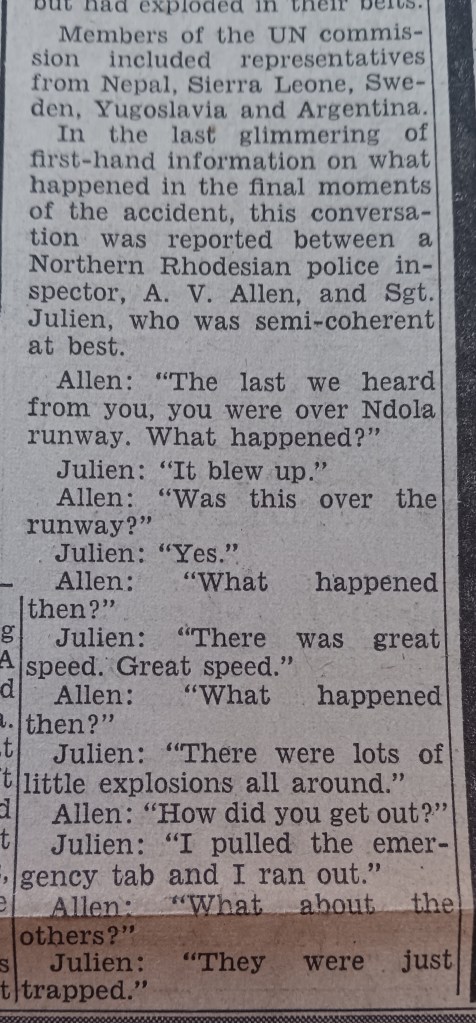
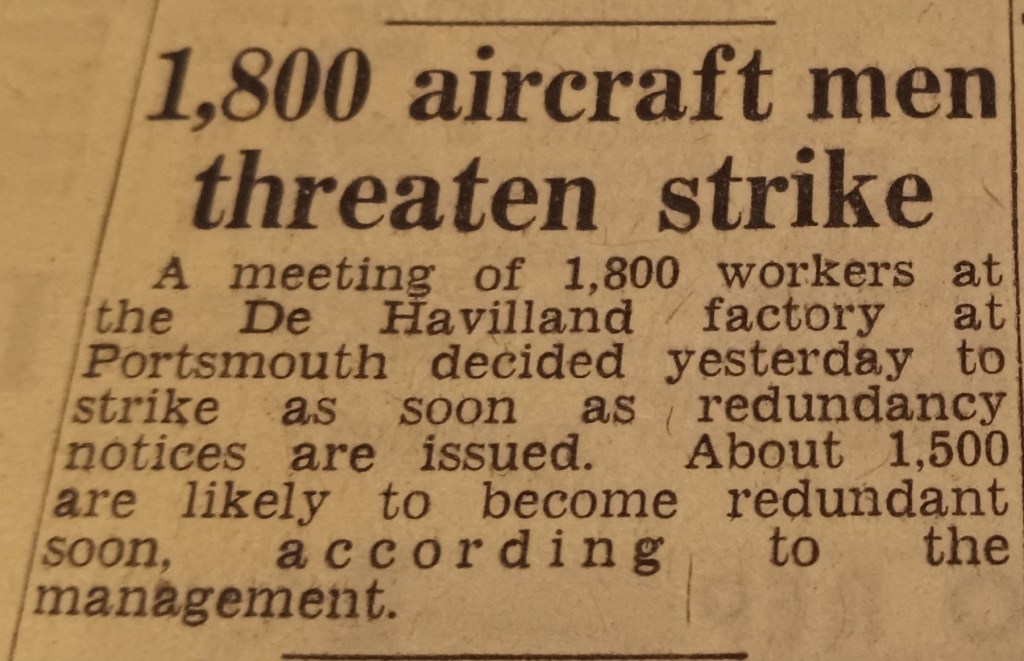


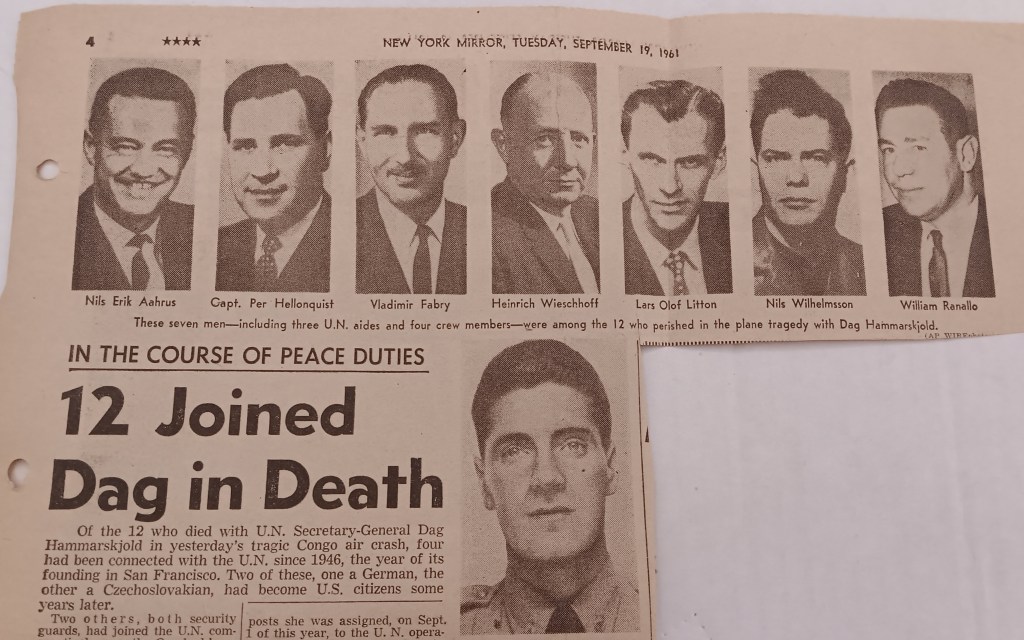
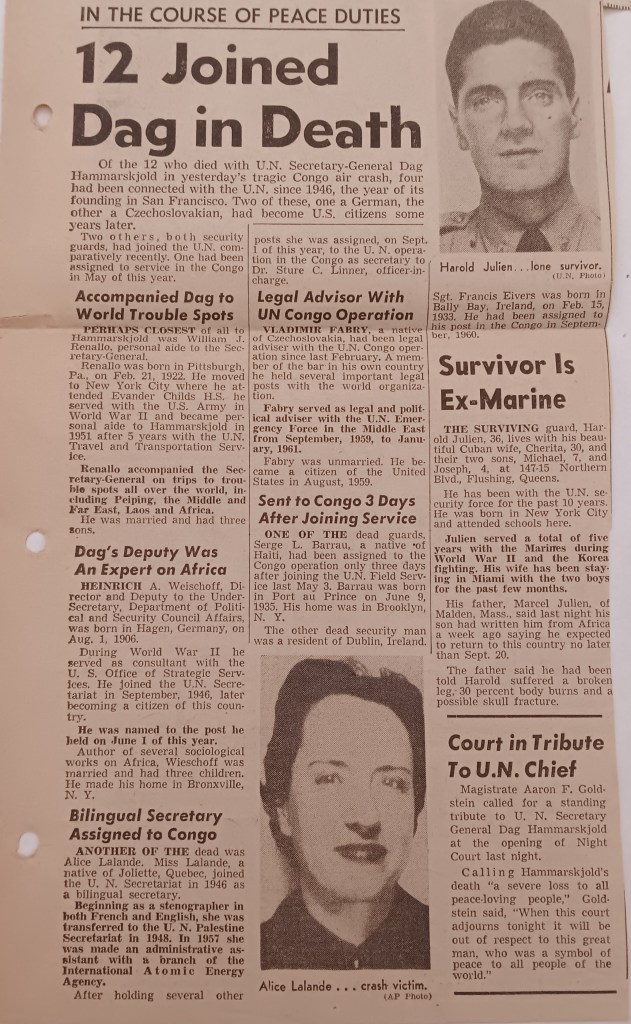


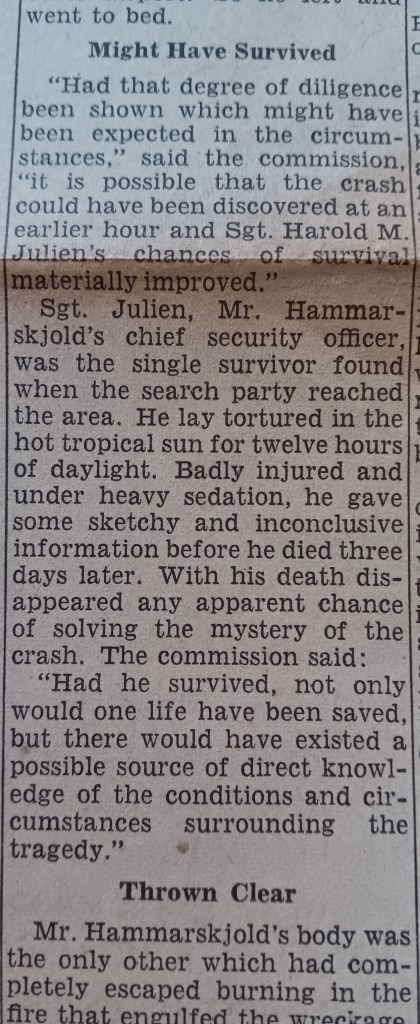
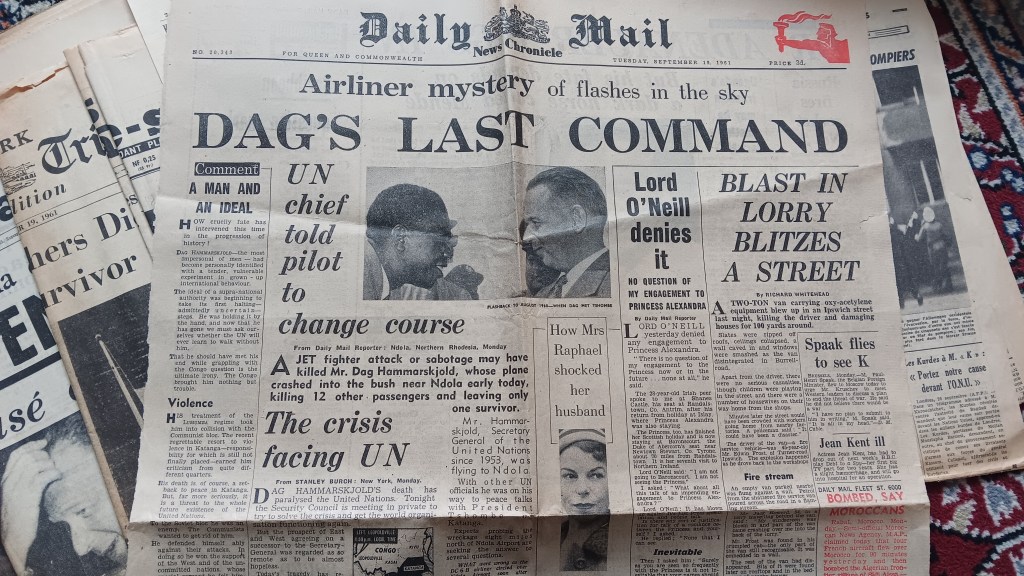


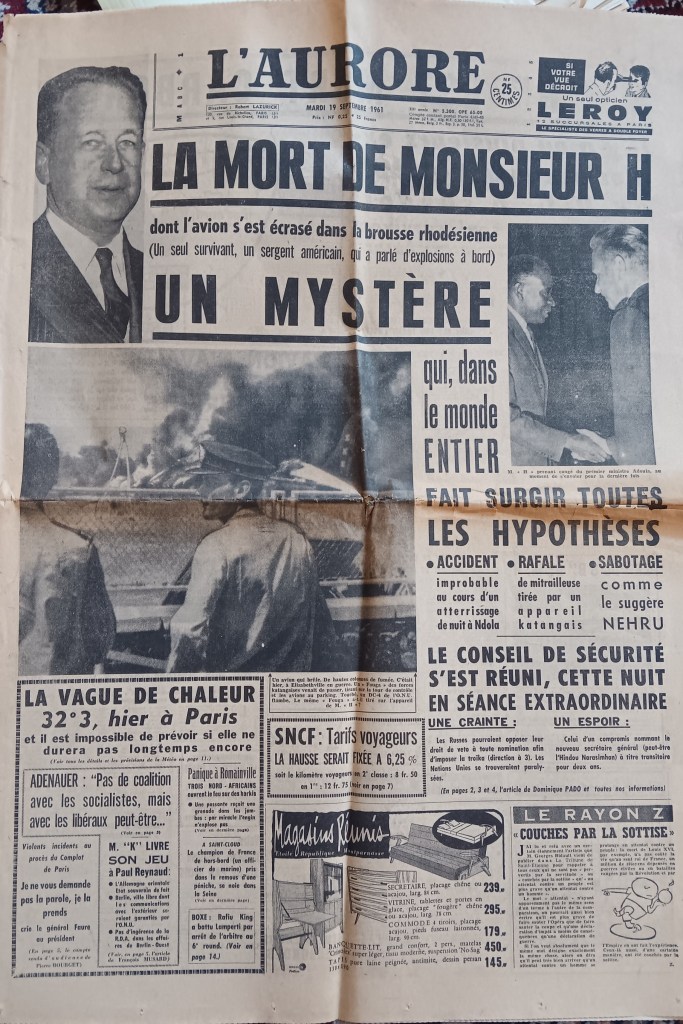


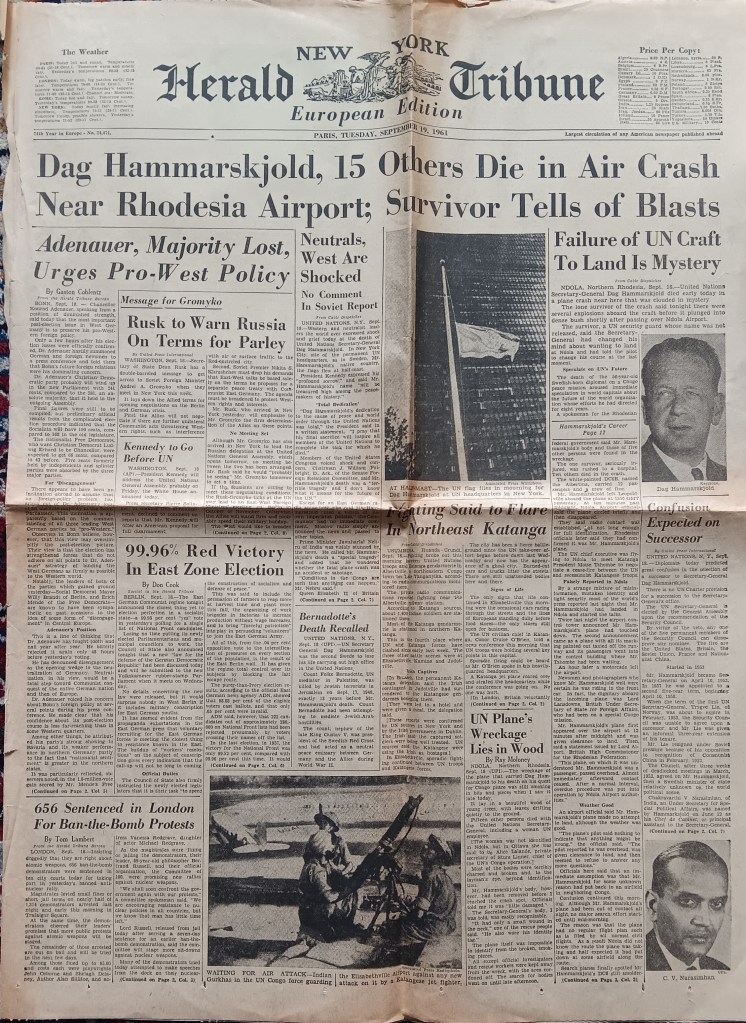

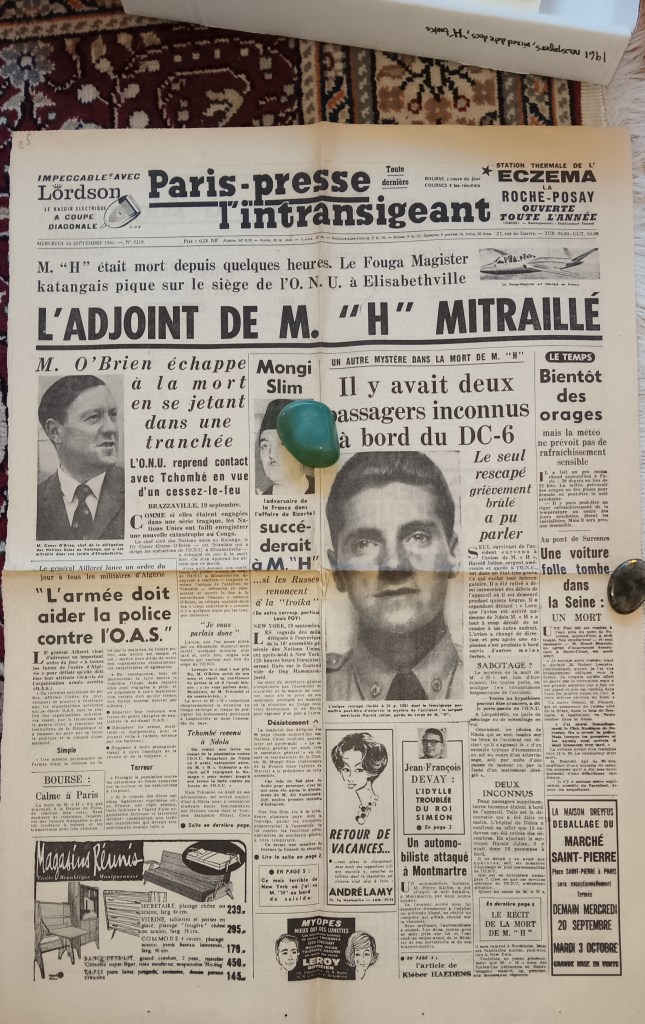

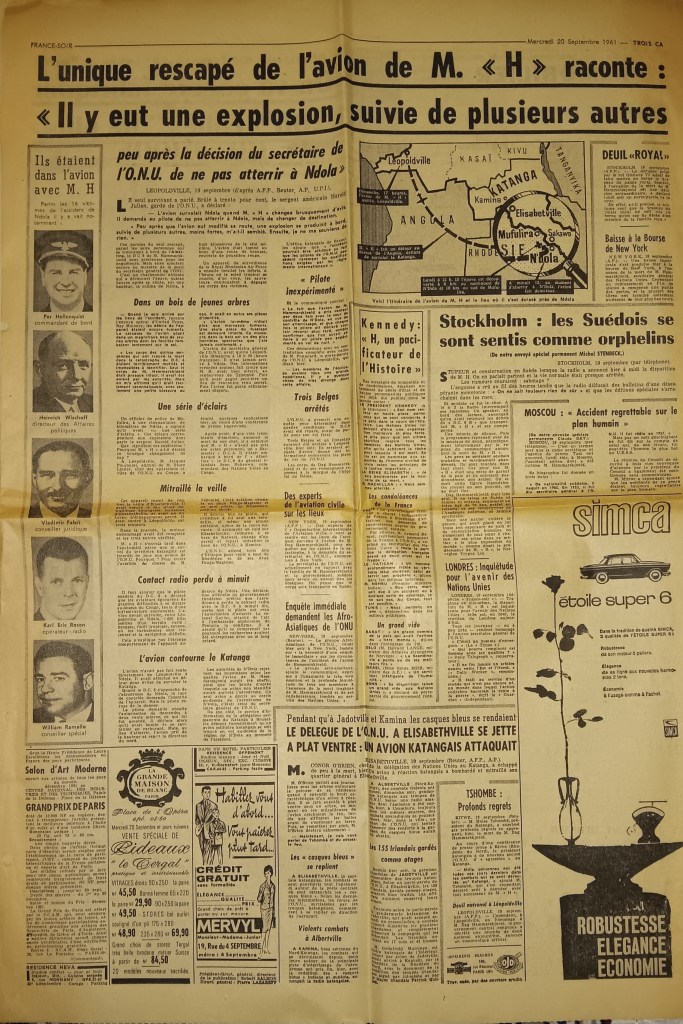


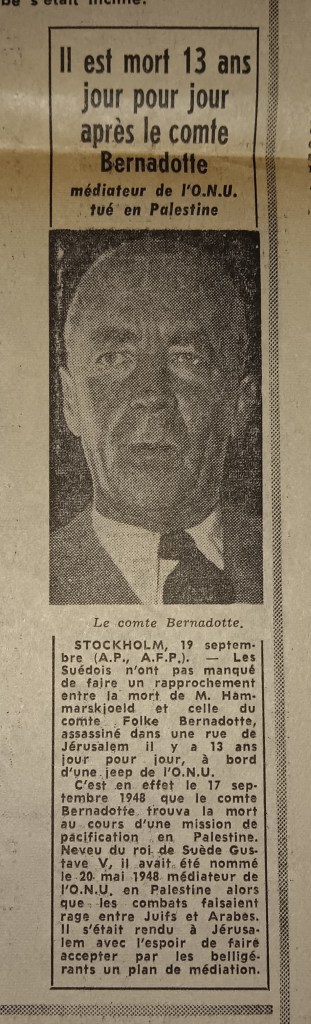

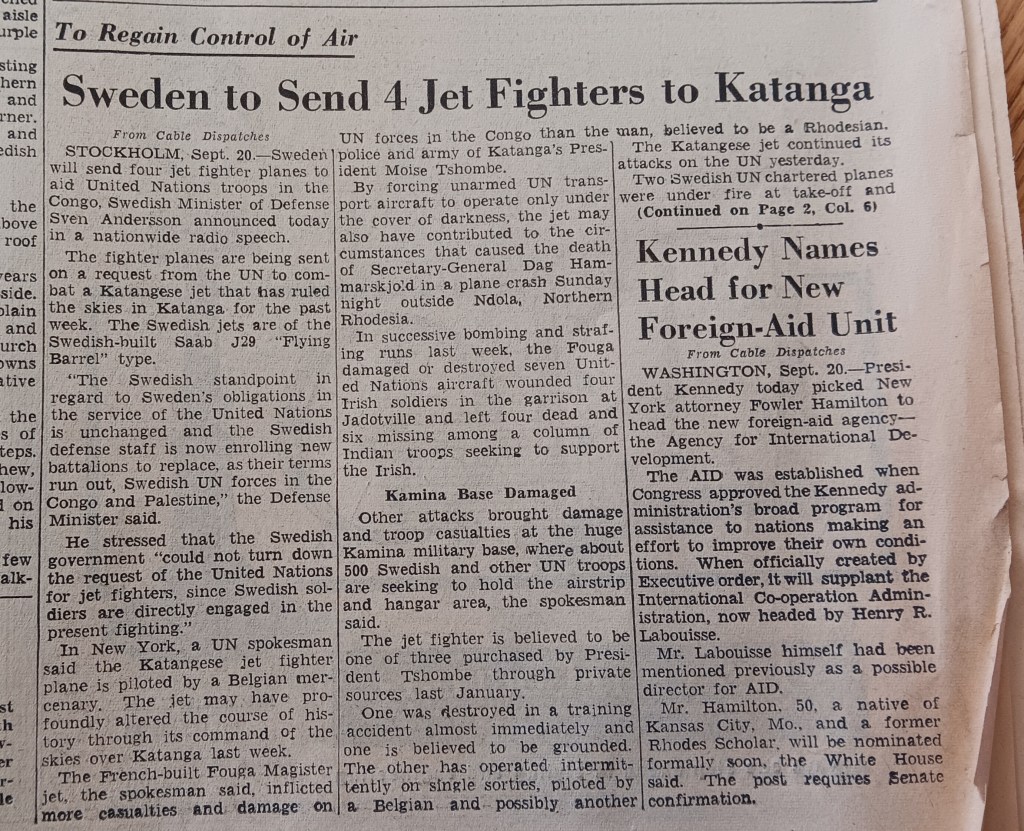

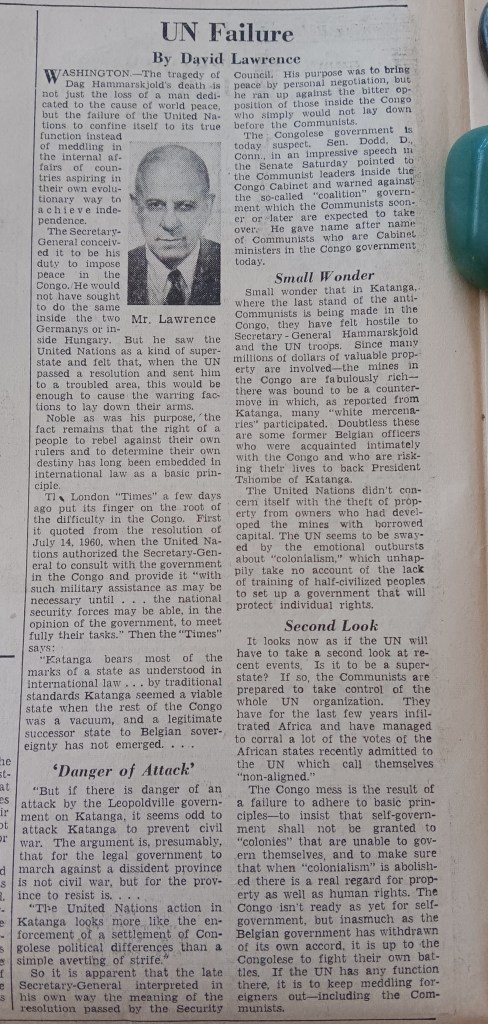

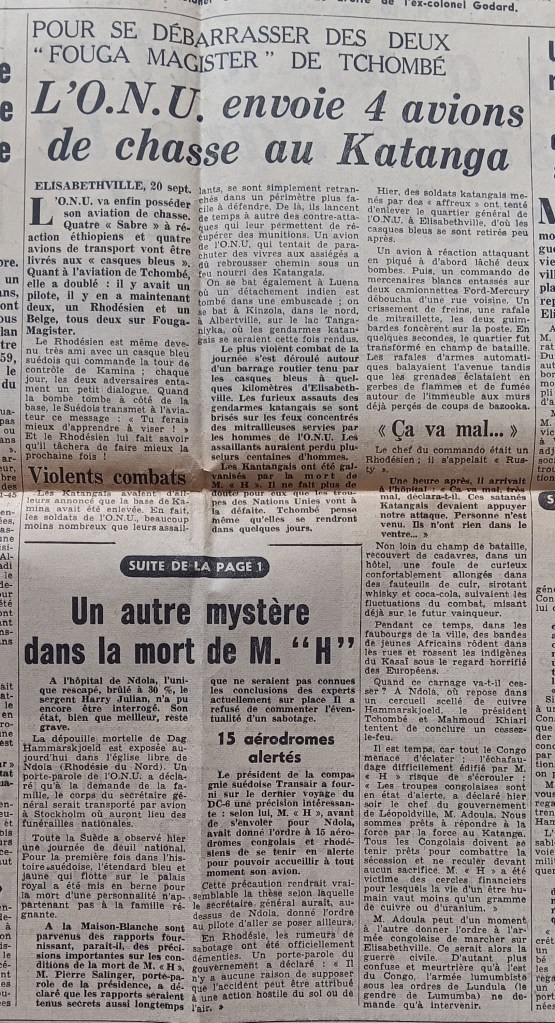

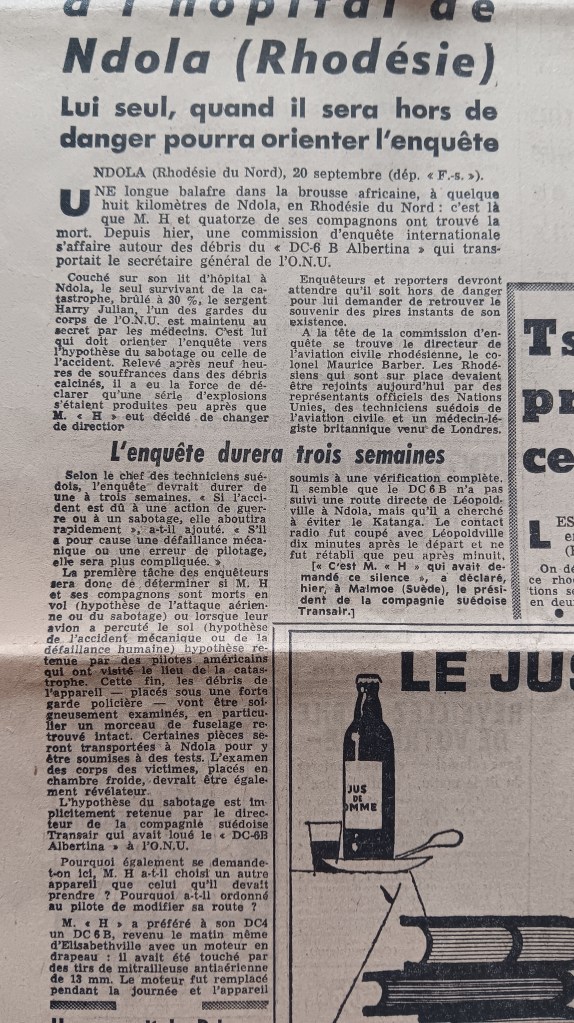


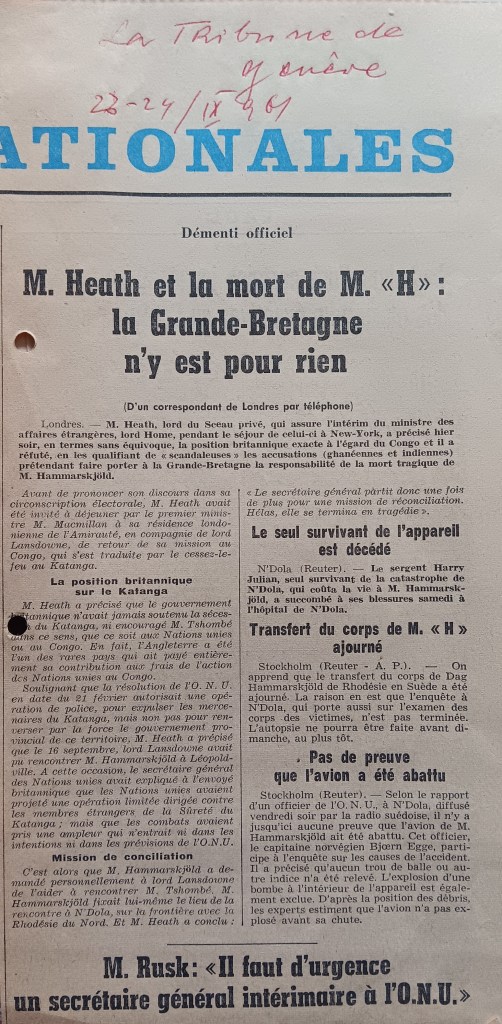
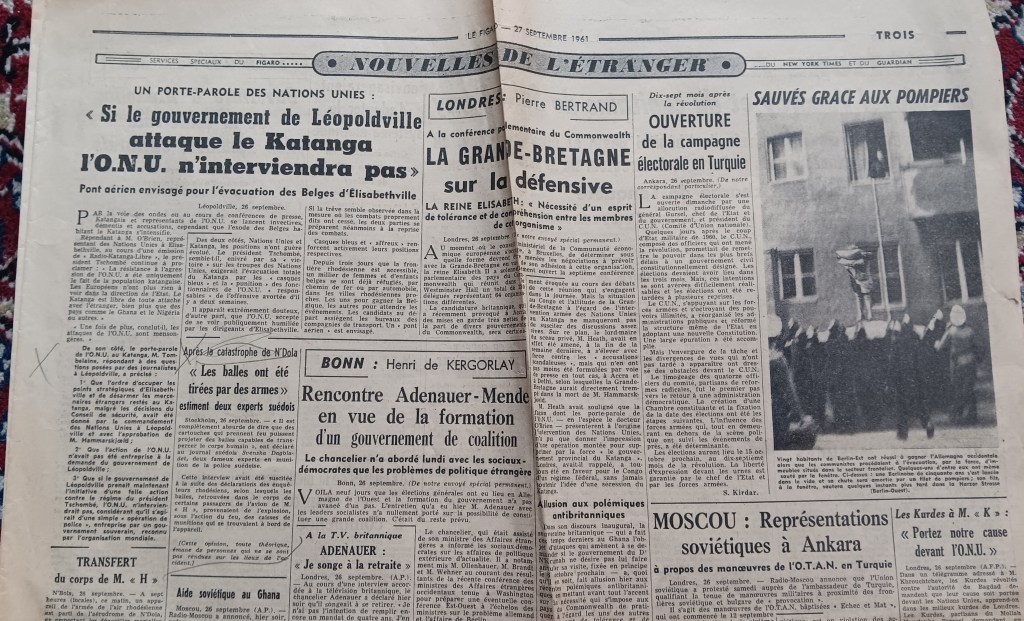


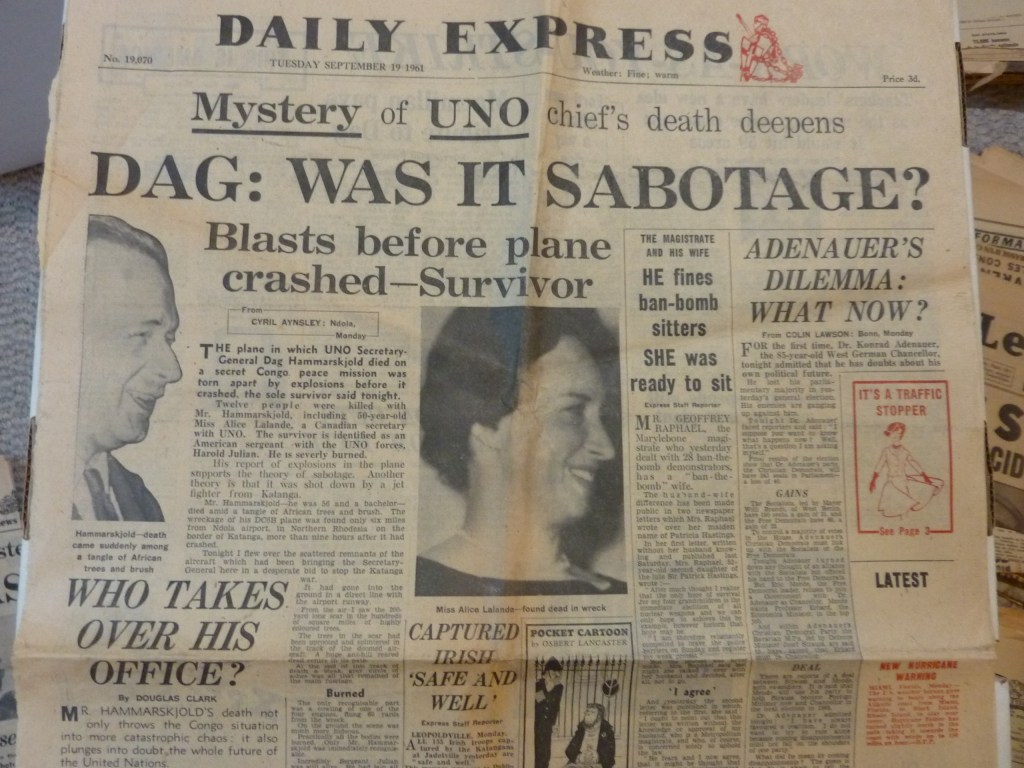
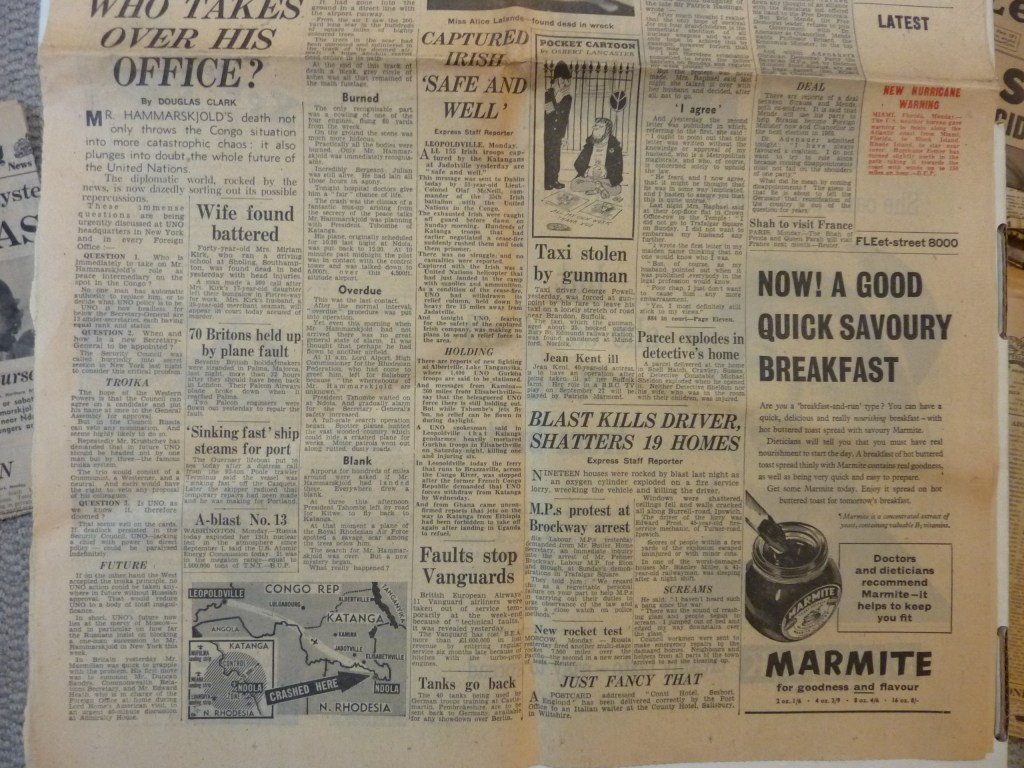
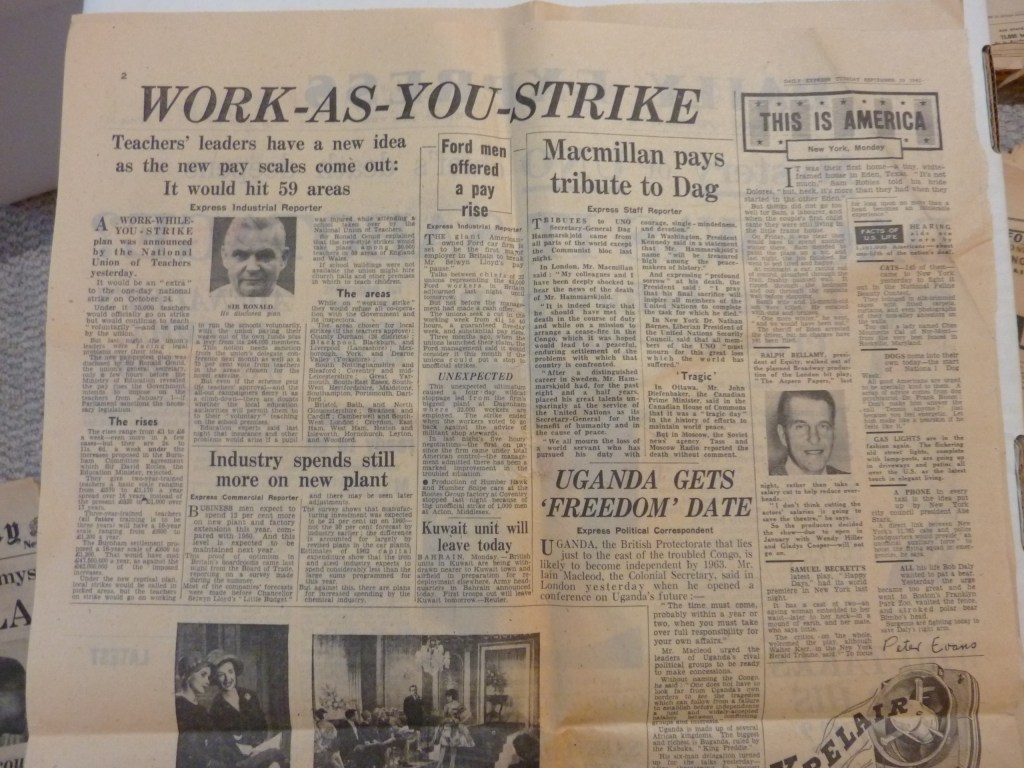


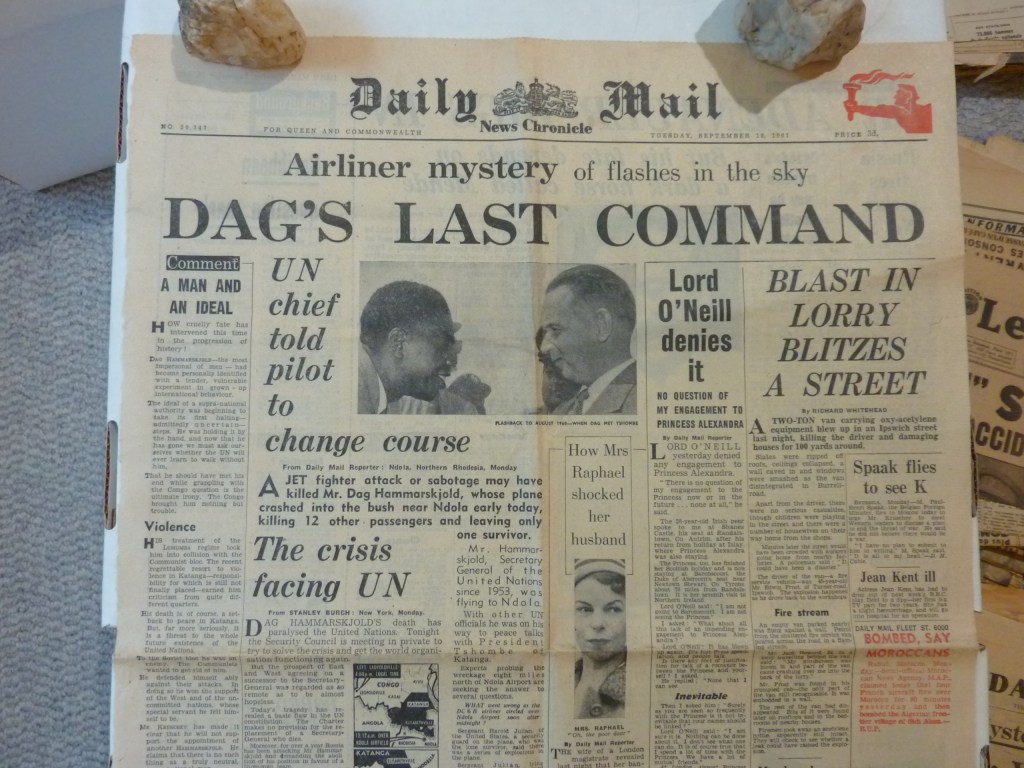
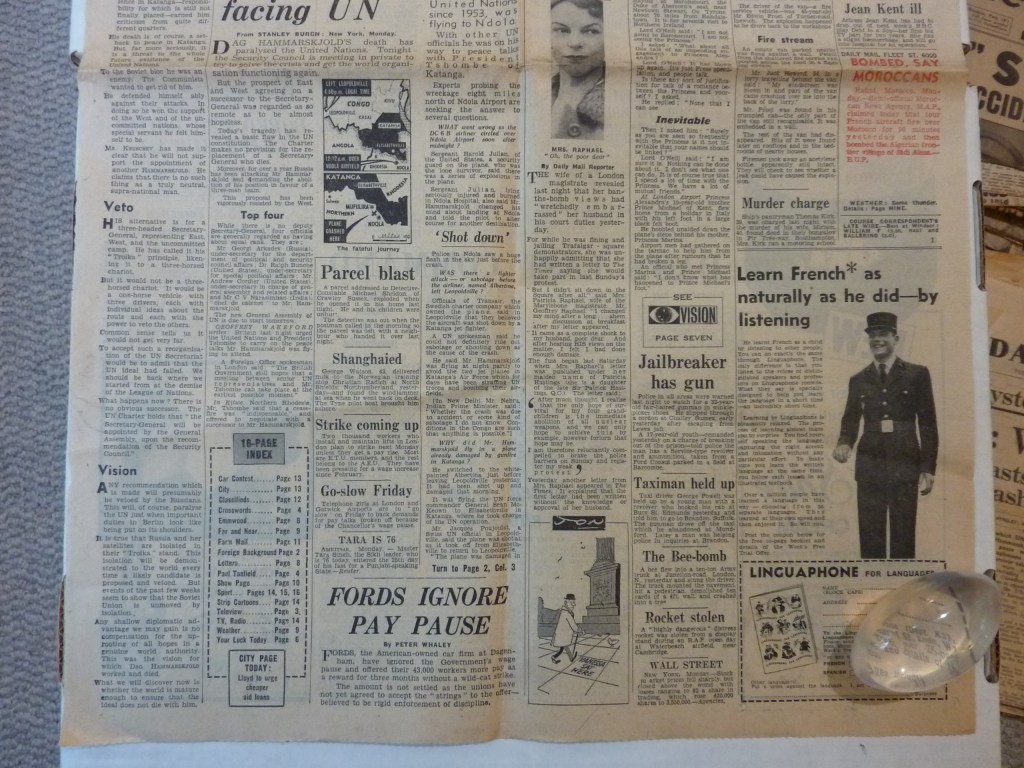

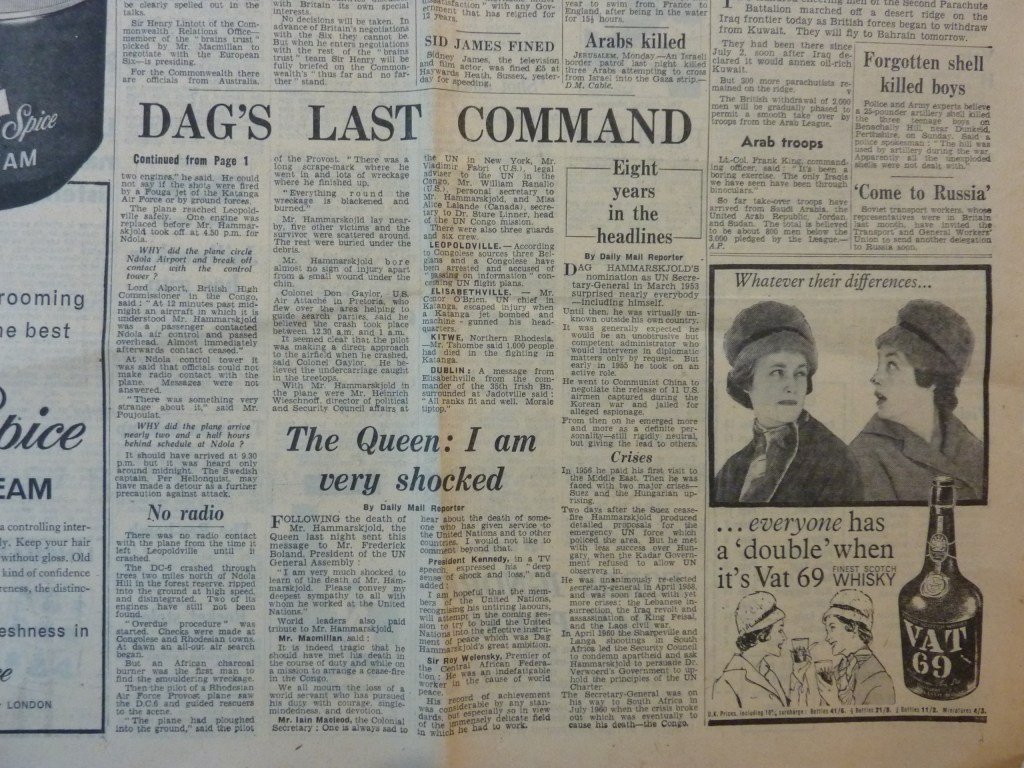

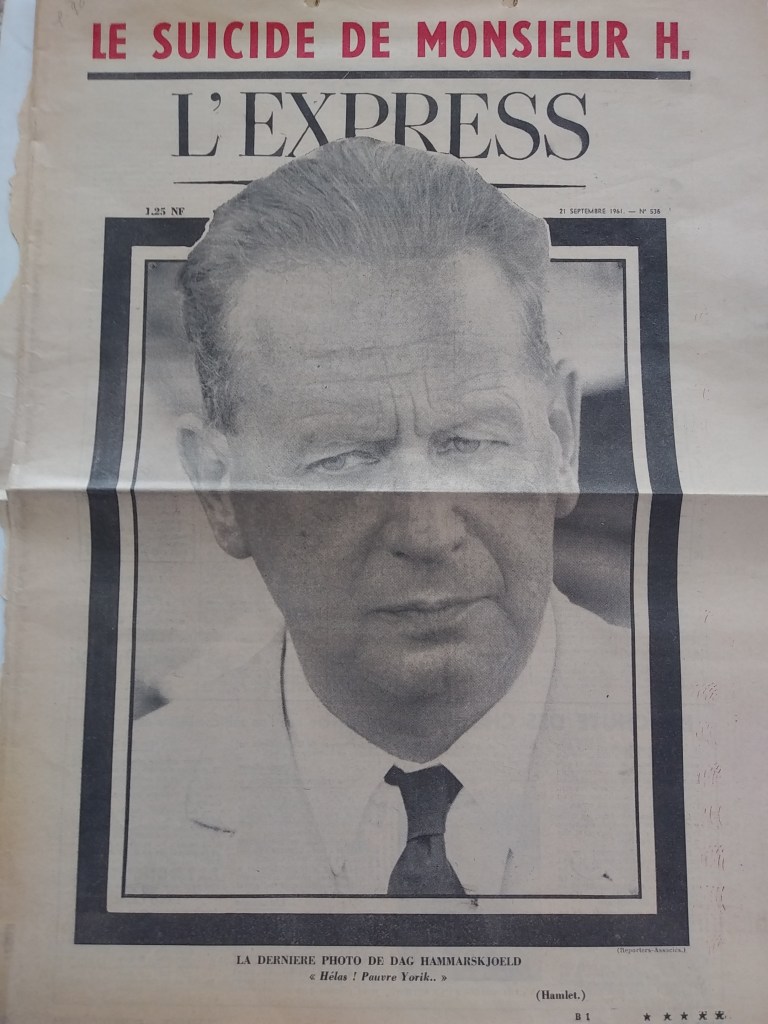
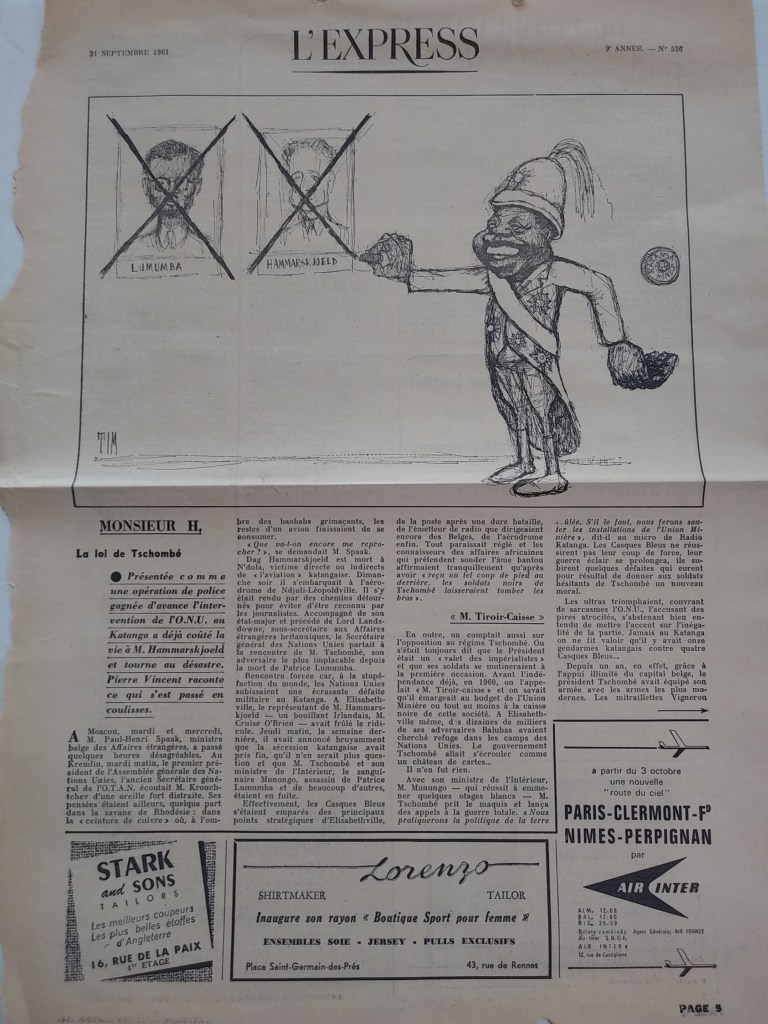
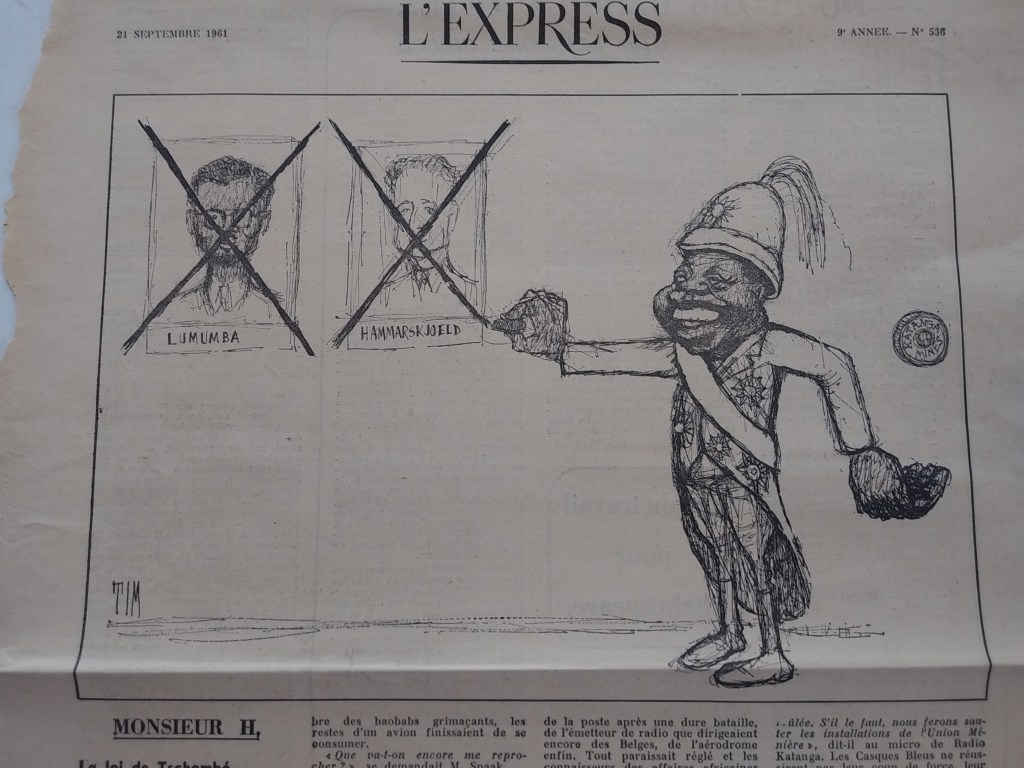
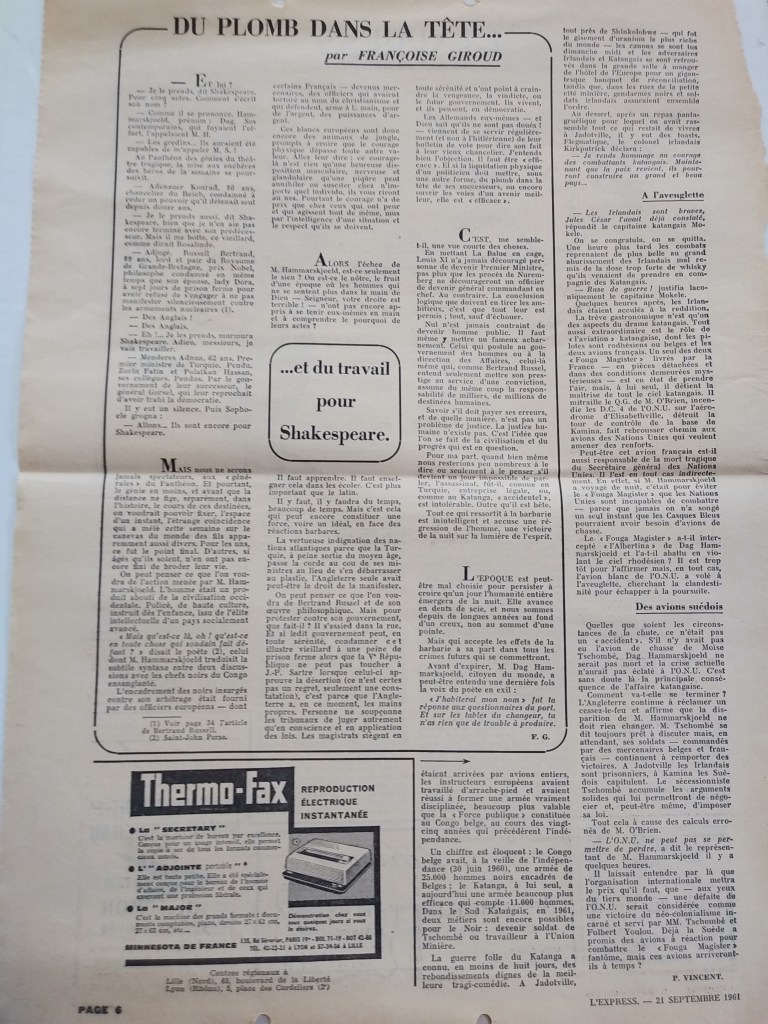

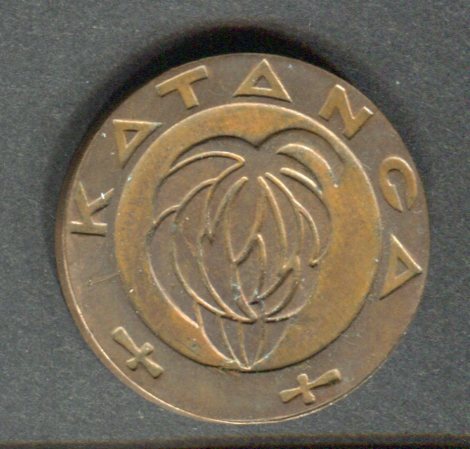
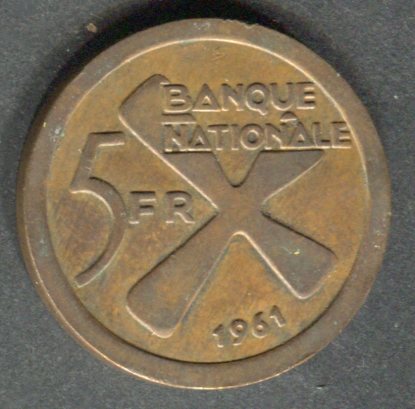


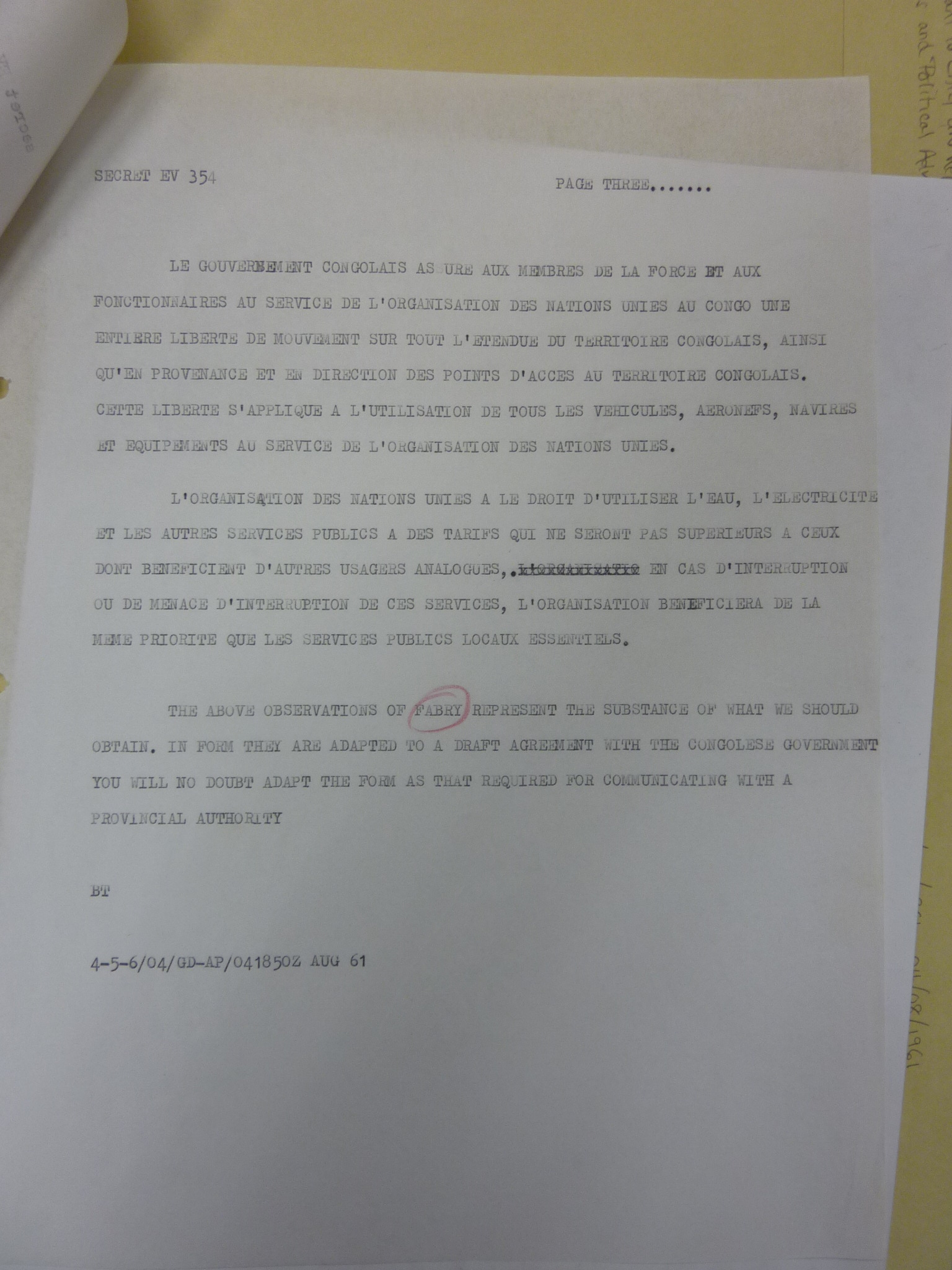




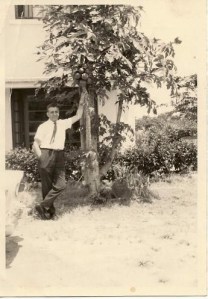


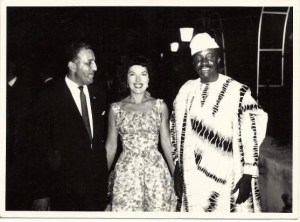
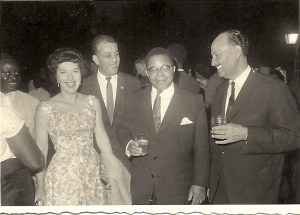
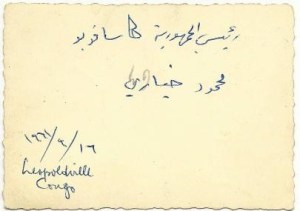
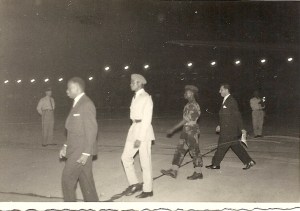
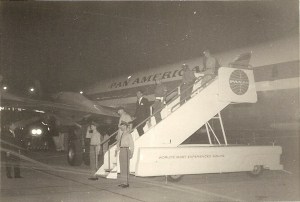

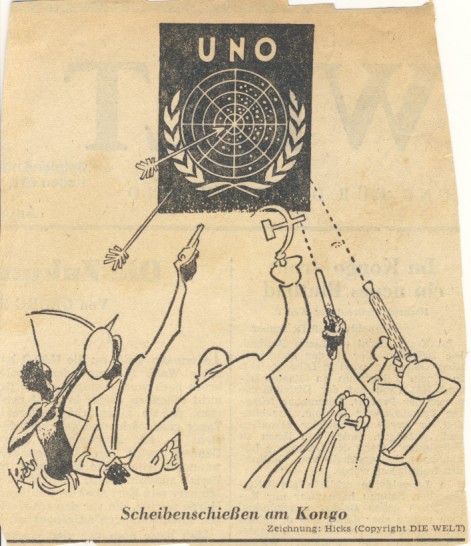
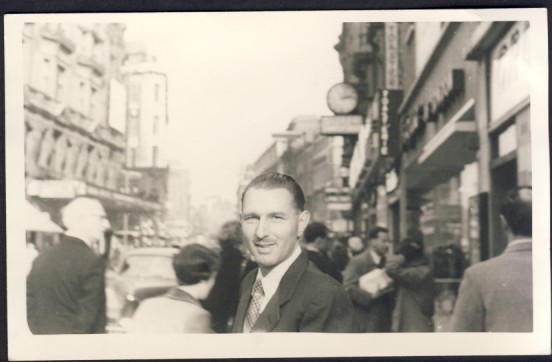
 Vlado
Vlado 