Tag Archives: Olinka Fabry

Letters of General Lev Prchala, 1960-61

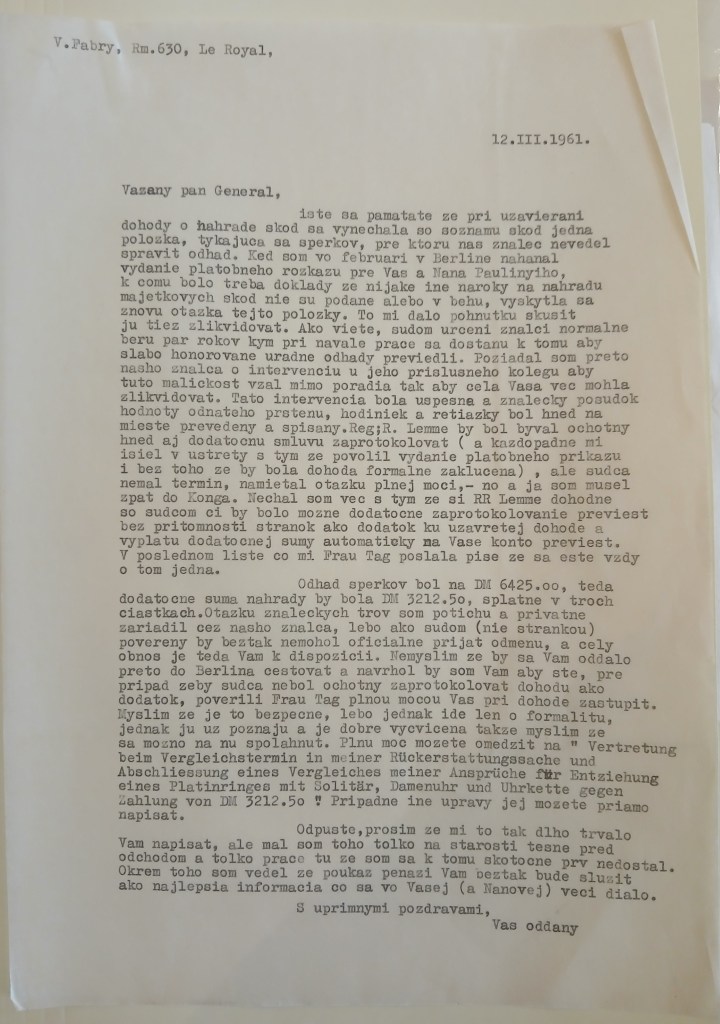
With great respect to Army General Lev Prchala and to our grandfather Dr. Pavel Fabry – Czechoslovakian heroes, defenders of democratic freedom, symbols of resistance against nazis and fascists! These are the last letters between them, from 1960, with related documents included. Translations will be added later. Pavel died of a heart attack in Berlin on 19 December 1960, he was 69. Vlado took over the remaining legal work from his father, somehow finding time for it while also working for the UN in the Congo. Vlado’s letter to the General is sent from Hotel Le Royal, Leopoldville (now Kinshasa), 12 March 1961. It brings tears to my eyes how much love they had for their friends, the personal sacrifices they were willing to make for each other – my cup runs over in their memory.

Thanks to Miroslav Kamenik for transcribing and translating all the handwritten letters here!

17.5.60

Vážený pane doktore, drahý příteli,

byl bych Vám nesmírně vděčen, kdybyste mi alespoň několika slovy naznačil jak stojí záležitosti Vašich Londýnských klientů, resp. klientek, které mě svými dotazy stále bombardují.Také bych rád věděl, zda máte v úmyslu se se mnou v Německu viděti, poněvadž čas utíká a můj odlet do Mnichova se blíží. Počítám, že přiletím pravděpodobně 2 nebo 3 června a že se v Mnichově zdržím až týden. Pak bych Vám byl k dispozici a vše závisí z Vašich plánů, kdy a kde byste mě potřeboval.

Těším se na Vaši laskavou odpověď a jsem s ruky políbením milostivé paní a se srdečnými pozdravy

Váš oddaný

Prchala

Dear Doctor, my friend,

I would be extremely grateful if you could give me at least a few words about the state of cases of your London clients, who are constantly bombarding me with their inquiries. I would also like to know whether you intend to see me in Germany, as time is running out and my departure for Munich is approaching. I expect to arrive probably on the 2nd or 3rd of June and to stay in Munich for up to a week. Then I would be at your disposal, and it all depends on your plans, when and where you would need me.

I look forward to your kind reply and I am with a kiss on the hand of your wife and with warm regards

Faithfully your

Prchala

20.5.60

Velevážený pane doktore, drahý příteli,

dnes jsem obdržel letecký lístek London – Mnichov – London od Česko – Sud. Něm federálního výboru pro let dne 2. června 1960.

Poletím tedy ve čtvrtek dne 2. června do Mnichova a zdržím se tam asi týden. Zároveň jsem byl uvědoměn, že čestné pozvánky budou rozposlány v příštích dnech. Doufám, že pozvánku pro sebe a Vaši milostivou obdržíte co nejdříve.

A nyní mám k Vám, vzázcný příteli, jednu velikou prosbu. Abych zde měl pevný důkaz pro nutnost své jízdy do Německa, zašlete mně, prosím, telegram, v němž mě vyzýváte k schůzce v Německu. Dejž Bůh, aby taková schůzka se stala doopravdy možnou.

S ruky políbením velevážené milostivé paní a se srdečnými pozdravy jsem Váš oddaný,

Prchala

Dear Doctor, my friend,

today I received a London – Munich – London ticket from the Czech – SudetenGerman Federal Committee for the flight on June 2, 1960.

I will fly to Munich on Thursday, June 2, and will stay there for about a week. At the same time, I was informed that the honorary invitations will be sent out in the coming days. I hope that you will receive the invitation for yourself and your ladyship as soon as possible.

And now I have one great request for you, dear friend. So that I may have solid proof of the necessity of my journey to Germany, please send me a telegram in which you invite me to a meeting in Germany. God grant that such a meeting may actually become possible.

I am with a kiss on the hand of your wife and with warm regards

Faithfully your

Prchala

28.5.60

Velevážený pane doktore, drahý příteli,

dovolte, abych Vám srdečně poděkoval za telegram, který jsem právě obdržel. Telegrafoval jsem ihned do Mnichova, aby Vám zaslali čestnou pozvánku, o kterou jsem žádal již před několika týdny. Vysvětluji si tuto chybu jedině tím, že Ing. Simon je zavalen prací a pevně doufám, že tento faux pas okamžitě napraví.

Těším se velice na setkání s Vámi a Vaší milostivou paní, které uctivě líbám ruku.

Srdečně Vás zdraví

Váš oddaný

Prchala

P.S. Tatsachenbericht jsem odevzdal pí. S a pí. M. V Mnichově bydlím v hotelu „Esplanade“ naproti hl. nádraží.

Dear Doctor, my friend,

let me to thank you most cordially for the telegram I have just received. I immediately telegraphed to Munich to have the honorary invitation sent to you, which I had requested several weeks ago. I can only explain this mistake by saying that Ing. Simon is overwhelmed with work and I firmly hope that he will rectify this faux pas immediately.

I am very much looking forward to meeting you and your honorable wife, whose hand I respectfully kiss.

Yours sincerely

Prchala

P.S. I handed over the Tatsachenbericht to Mrs. S and Mrs. M. In Munich I live in the hotel “Esplanade” opposite the main station.
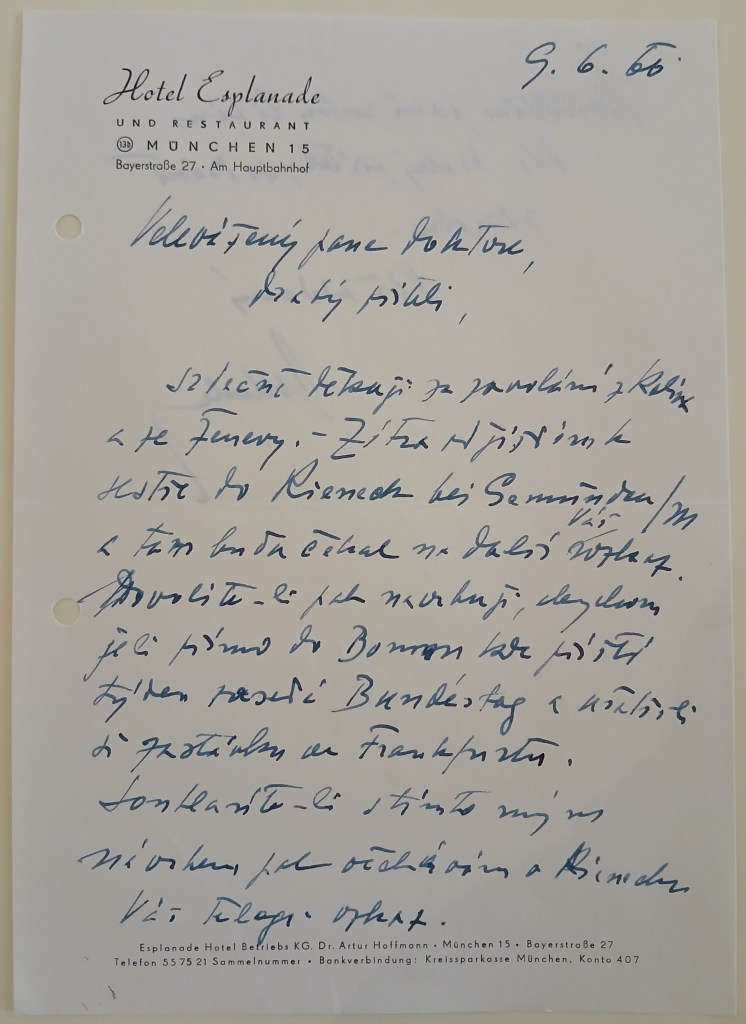
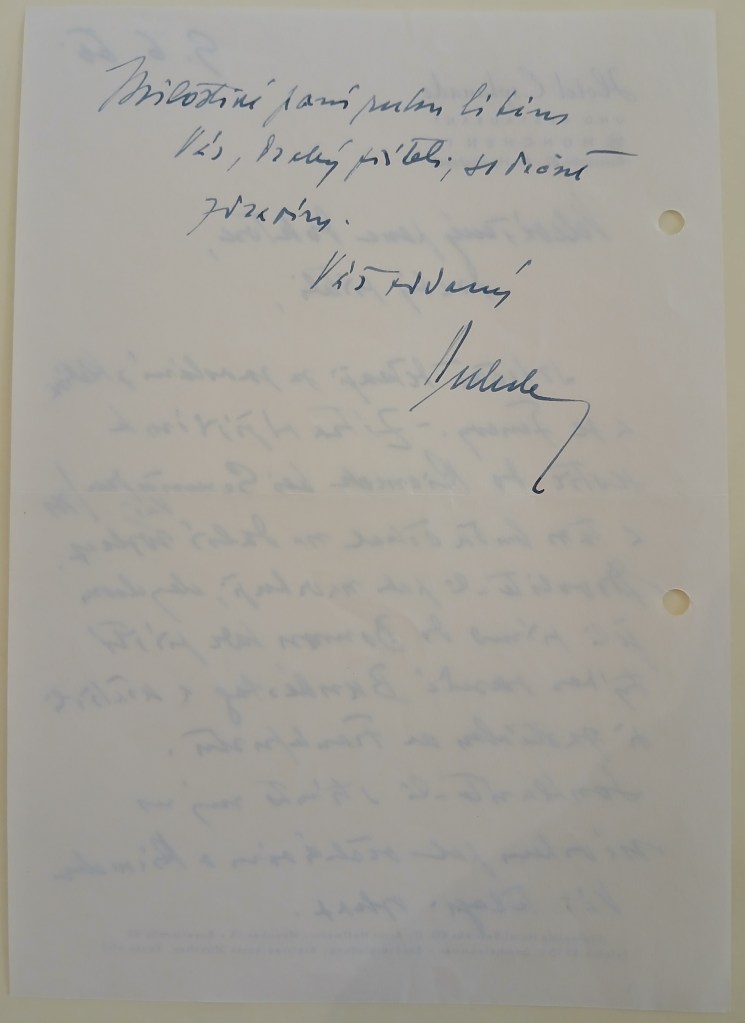
9.6.60, München, Hotel Esplanade

Velevážený pane doktore, drahý příteli,

srdečně děkuji za zavolání z Kolína a ze Ženevy. Zítra odjíždím k sestře do Rieneck bei Gemünden / M a tam budu čekat na další Váš rozkaz. Dovolíte-li, pak navrhuji, abychom jeli přímo do Bonnu kde příští týden zasedá Bundestag a ušetřili si zastávku ve Frankfurtu. Souhlasíte-li s tímto mým návrhem, pak očekávám v Rienecku Váš telegr. vzkaz.

Milostivé paní ruku líbám,

Vás, drahý příteli, srdečně zdravím.

Váš oddaný

Prchala

Dear Doctor, my friend,

thank you very much for your call from Cologne and Geneva. Tomorrow I am leaving for my sister in Rieneck bei Gemünden / M and there I will await your further orders. If you allow me, I suggest that we go directly to Bonn where the Bundestag is in session next week and save ourselves a stopover in Frankfurt. If you agree with this proposal of mine, I am expecting your telegram in Rieneck.

Kind kisses to your honorable wife’s hand,

I greet you warmly, my dear friend.

Yours faithfully

Prchala

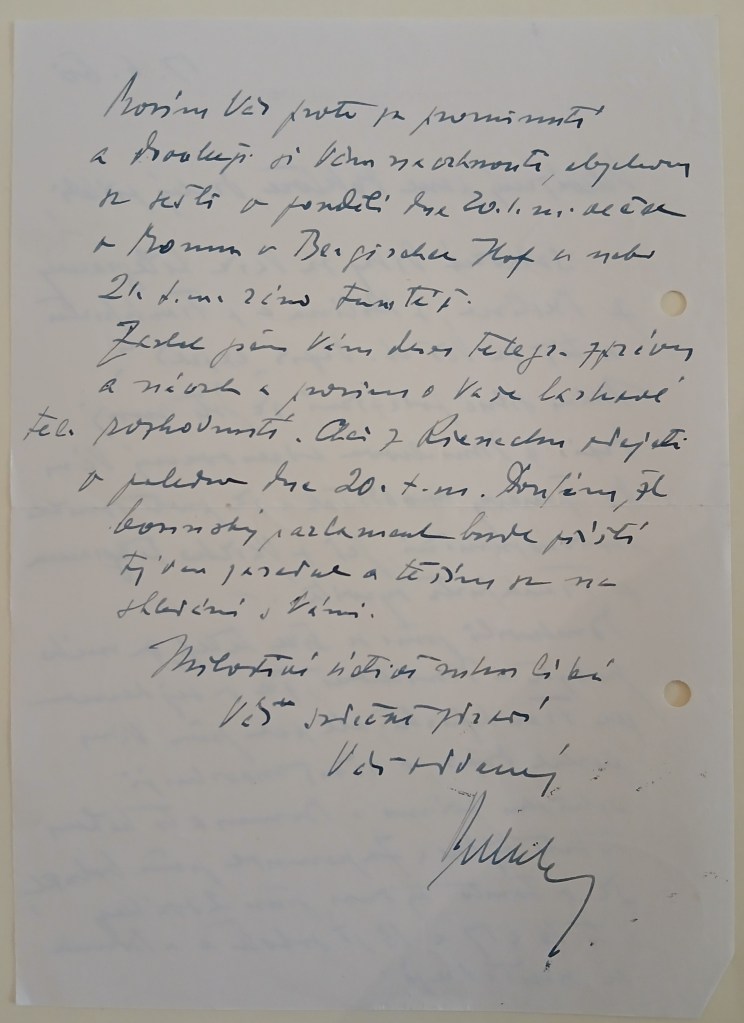
17.6.60

Velevážený pane doktore, drahý příteli,

srdečné díky za Vaše telegramy z Berlna, z Kolína a z Frankfurtu a též za Váš ctěný dopis „expres“. Mám silné podezření, že jste můj dopis z Mnichova adresovaný Vám do Ženevy neobdržel a že zde vzniklo nedorozumění, jež z Vašeho telegramu z Frankfurtu vysvitá.

Domluvili jsme se sice telefonicky za mého pobytu v Mnichově, že se sejdeme ve Frankfurtu, ale pak jsem Vám poslal dopis, v němž navrhuji schůzku přímo v Bonnu, a to během tohoto týdne. Zapomněl jsem bohužel, že v tomto týdnu jsou 2 svátky, a to 16 a 17 a 18 je sobota a v Bonnu se neúřaduje.

Prosím Vás proto za prominutí a dovoluji si Vám navrhnouti, abychom se sešli v pondělí dne 20. t.m. večer v Bonnu v Bergischer Hof a nebo 21. t.m. ráno tamtéž.

Zaslal jsem Vám dnes telegr. zprávu a návrh a prosím o Vaše laskavé tel. rozhodnutí. Chci z Rienecku odjeti v poledne dne 20. t.m. Doufám, že bonnský parlament bude příští týden zasedat a těším se na shledání s Vámi.

Milostivé uctivě ruku líbá

Vás srdečně zdraví

Váš oddaný

Prchala

Dear Doctor, my friend,

Heartfelt thanks for your telegrams from Berlin, Cologne and Frankfurt and also for your esteemed “express” letter. I strongly suspect that you did not receive my letter from Munich addressed to you in Geneva and that there was a misunderstanding here, which will become clear from your telegram from Frankfurt.

We agreed by telephone during my stay in Munich that we would meet in Frankfurt, but then I sent you a letter in which I propose a meeting directly in Bonn, during this week. Unfortunately, I forgot that there are 2 holidays this week, namely the 16th and 17th and the 18th are Saturdays and there are no offices in Bonn.

Therefore, I beg your pardon and allow me to suggest that we meet on Monday, the 20th, in the evening in Bonn at the Bergischer Hof or on the 21st, in the morning there.

I sent you a telegram today. report and proposal and I ask for your kind decision. I want to leave Rieneck at noon on the 20th. I hope that the Bonn parliament will be in session next week and I look forward to seeing you.

Kind kisses to your honorable wife’s hand,

I greet you warmly, my dear friend.

Yours faithfully

Prchala
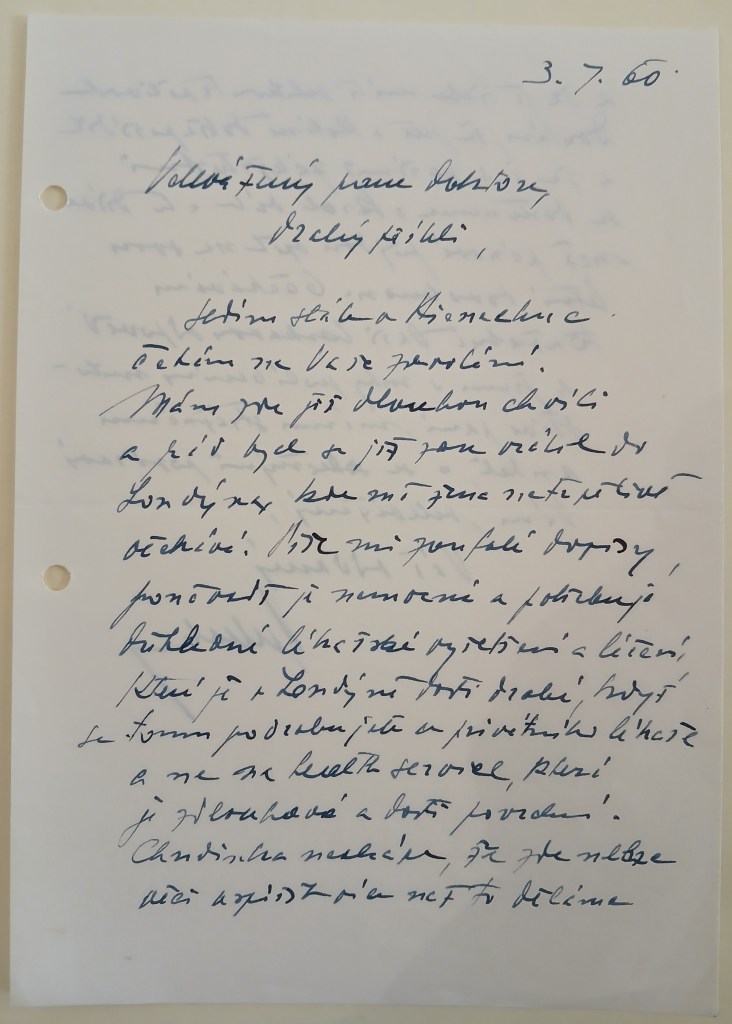
3.7.60 (Rieneck)

Velevážený pane doktore, drahý příteli,

sedím stále v Rienecku a čekám na Vaše zavolání. Mám zde již dlouhou chvíli a rád bych se již zas vrátil do Londýna, kde mě žena netrpělivě očekává. Píše mi zoufalé dopisy, poněvadž je nemocná a potřebuje důkladné lékařské vyšetření a léčení, které je v Londýně dosti drahé, když se tomu podrobujete u privátního lékaře a ne na health service, které je zdlouhavé a dosti povrchní. Chudinka nechápe, že zde nelze věci uspíšit více než to děláme a že je třeba míti velikou trpělivost. Doufám, že jste v Kolíně dobře pořídil a že i s našimi záležitostmi se dostaneme o krok dále a to dříve než pánové půjdou opět na svou dovolenou. Očekávám toužebně Vaši laskavou odpověď a jsem s ruky políbením milostivé paní, mému strážnému anděli, a se srdečnými pozdravy Vám, velevážený,

Váš oddaný

Prchala

Dear Doctor, my friend,

I am still sitting in Rieneck and waiting for your call. I have been here for a long time and I would like to return to London, where my wife is impatiently waiting for me. She writes me desperate letters because she is ill and needs a thorough medical examination and treatment, which is quite expensive in London if you undergo it with a private doctor and not with the health service, which is lengthy and rather superficial. My poor wife does not understand that things cannot be rushed here any more than we do and that great patience is needed. I hope that you have made good arrangements in Cologne and that we will also get a step further with our affairs before the gentlemen go on their vacation again. I eagerly await your kind answer, kind kisses to your honorable wife’s hand, my guardian angel,

I greet you warmly, my dear friend.

Yours faithfully

Prchala

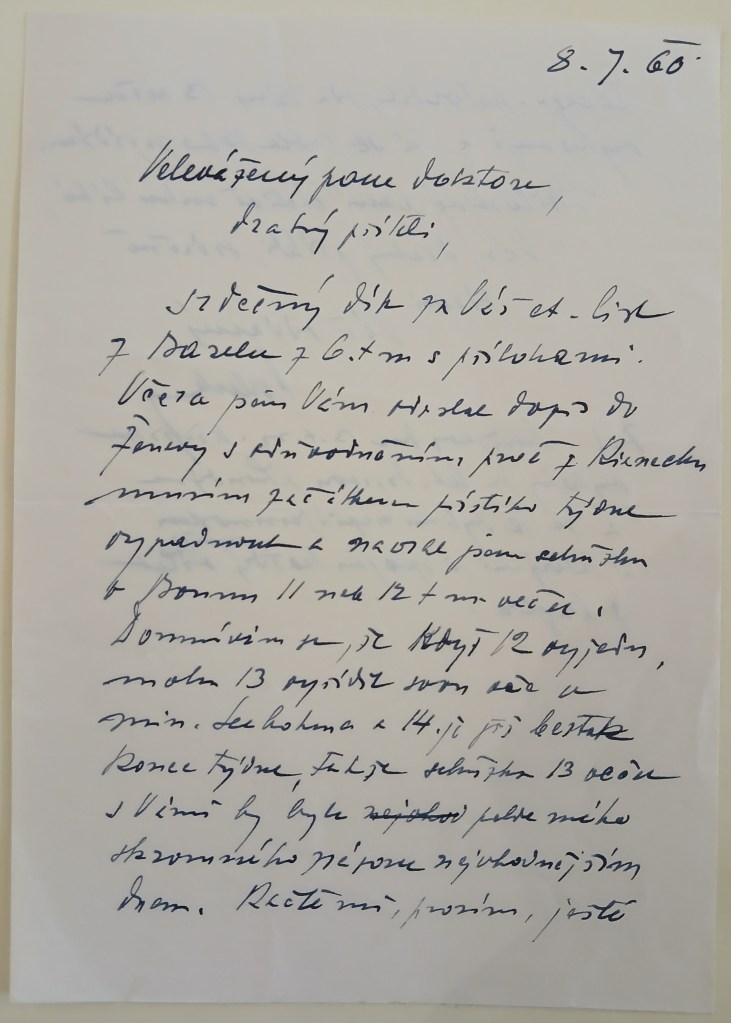
8.7.60

Velevážený pane doktore, drahý příteli,

srdečný dík za Váš ctěný list z Baselu z 6. t.m. s přílohami. Včera jsem Vám odeslal dopis do Ženevy s odůvodněním, proč z Rienecku musím začátkem příštího týdne vypadnout (?) a navrhl jsem schůzku v Bonnu 11 nebo 12 t.m. večer. Domnívám se, že když 12 vyjedu, mohu 13 vyřídit svou věc u min. Seebohma a 14 je již beztak konec týdne, takže schůzka 13 večer s Vámi by byla podle mého skromného názoru nejvhodnějším dnem. Račte mi, prosím, ještě telegr. potvrdit, zda Vám 13 večer vyhovuje a já se podle toho zařídím. Milostivé paní uctivě ruku líbá,

Vás, drahý příteli, srdečně zdraví

Váš oddaný

Prchala

Dear Doctor, my friend,

heartfelt thanks for your esteemed letter from Basel of the 6th with attachments. Yesterday I sent you a letter to Geneva with the justification why I have to leave Rieneck at the beginning of next week (?) and I proposed a meeting in Bonn on the 11th or 12th in the evening. I believe that if I leave on the 12th, I can take care of my business with Minister Seebohm on the 13th and the 14th is already the end of the week anyway, so a meeting with you on the 13th evening would be, in my humble opinion, the most suitable day. Please confirm by telegram whether the 13th evening suits you and I will make arrangements accordingly.

Kind kisses to your honorable wife’s hand,

I greet you warmly, my dear friend.

Yours faithfully

Prchala
2.8.60

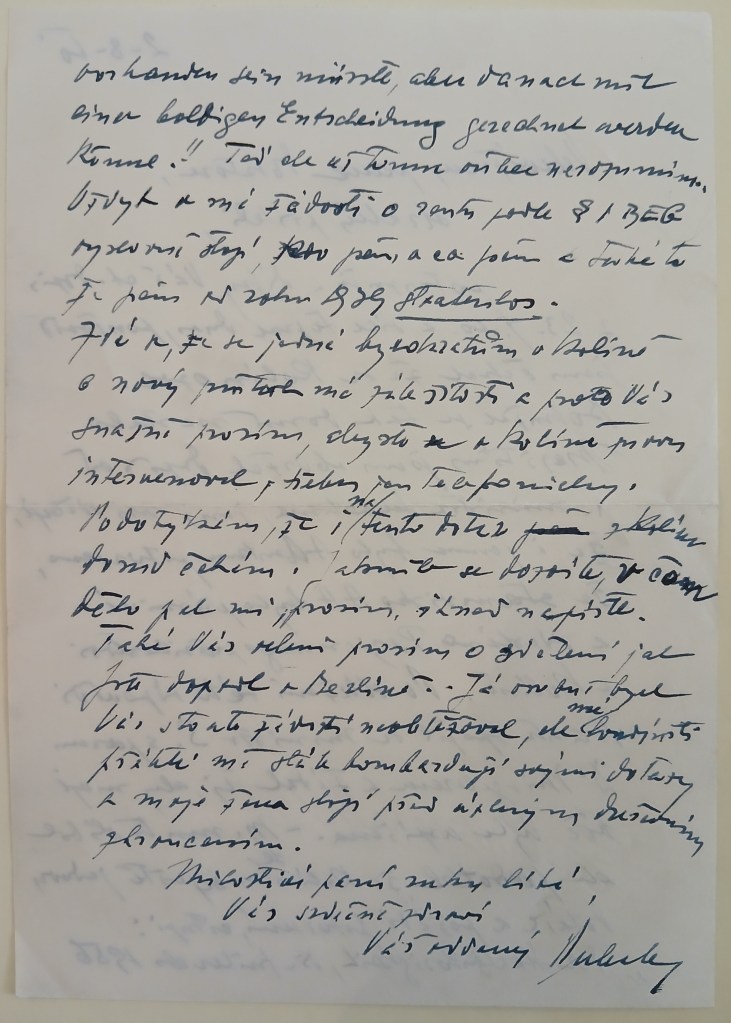
Velevážený pane doktore, drahý příteli,

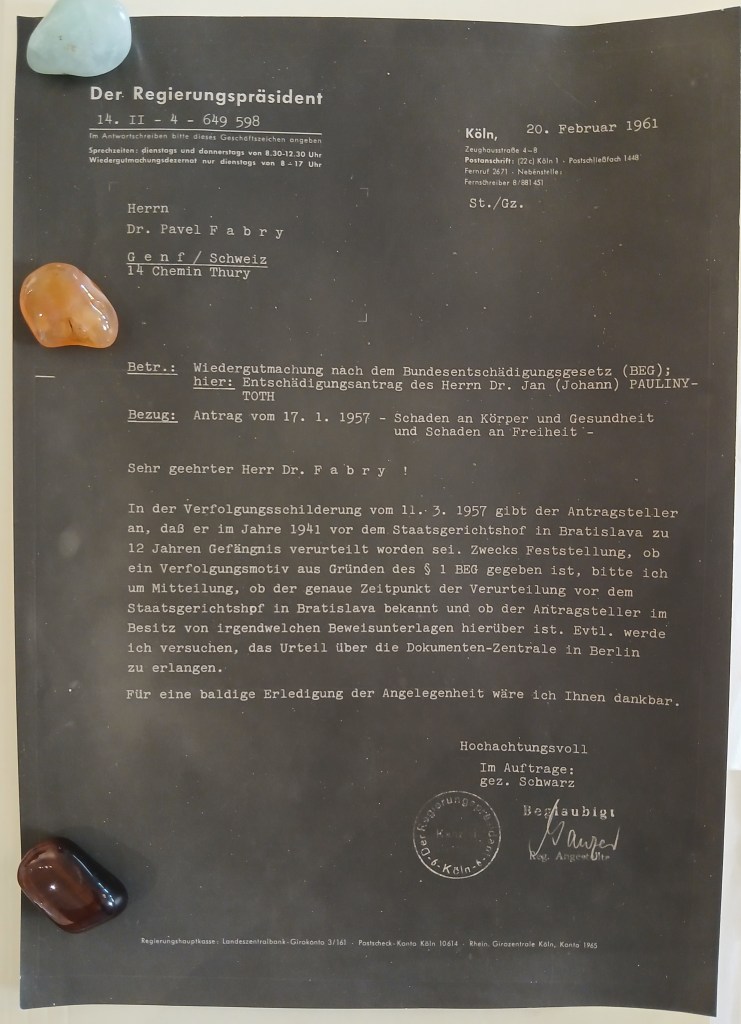
potvrzuji s díky Váš ctěný dopis z 23.7.60 a sice teprve dnes, poněvadž jsem čekal, že se Kolín ozve. Bohužel se tak dosud nestalo. Mezitím jsem obdržel dopis od p. ministra Seebohma, jenž mi sděluje, že i jemu bylo A Amtem potvrzeno, že stanovisko AA bylo příznivé a odesláno Regierungspräsidentovi v Kolíně. Po obdržení této odpovědi A-amt spojil se ministr S. S panem Dr. Mirgelerem a žádal jej, aby moje věc byla uspíšena. M. mu to slíbil, ale podotkl, že Kolín se mne ještě jednou dotáže a požádá potvrzení, cituji: „der Staatenhorigkeit, die früher als 1956 vorhanden sein müsste, aber danach mit einer boldigen Entscheidung gerechnet werden könne“. Teď ale už tomu vůbec nerozumím. Vždyť v mé žádosti o rentu podle § 1 BEG výslovně stojí, kdo jsem a co jsem a také to že jsem od roku 1939 staatenlos.

Zlé je, že se jedná byrokratům v Kolíně o nový (???) mé záležitosti a proto Vás snažně prosím, abyste v Kolíně znovu intervenoval, třeba jen telefonicky. Podotýkám, že i na tento dotaz z Kolína dosud čekám. Jakmile se dozvíte, v čem dělo?, pak mi, prosím, ihned napište. Také Vás velmi prosím o sdělení, jak jste dopadl v Berlíně. Já osobně bych Vás s touto žádostí neobtěžoval, ale mí londýnští přátelé mě stále bombardují svými dotazy a moje žena stojí před úplným duševním zhroucením.

Milostivé paní ruku líbá, Vás srdečně zdraví

Váš oddaný

Prchala

Dear Doctor, my friend,

I confirm with thanks your esteemed letter of 23.7.60, replying today, because I was expecting Cologne to respond. Unfortunately, this has not happened yet. In the meantime, I have received a letter from Mr. Minister Seebohm, who informs me that he too was confirmed by the A-Amt that the AA’s opinion was favorable and sent to the Regierungspräsident in Cologne. After receiving this reply from the A-Amt, Minister S. contacted Dr. Mirgeler and asked him to expedite my case. M. promised him this, but pointed out that Cologne would ask me again and ask for confirmation, I quote: “der Staatenhorigkeit, die früher als 1956 vorhanden sein müsste, aber danach mit einer boldigen Entscheidung gerechnet werden könne”. But now I don’t understand it at all. After all, my application for a pension according to § 1 BEG explicitly states who I am and what I am and also that I have been stateless since 1939.

The bad thing is that this is a new (???) of my affairs for the bureaucrats in Cologne and therefore I strongly ask you to intervene again in Cologne, even if only by phone. I would like to point out that I am still waiting for this inquiry from Cologne. As soon as you find out what happened, please write to me immediately. I also ask you to tell me how you ended up in Berlin. I personally would not bother you with this request, but my London friends are constantly bombarding me with their questions and my wife is on the verge of a complete mental breakdown.

Kind kisses to your honorable wife’s hand,

I greet you warmly, my dear friend.

Yours faithfully

Prchala

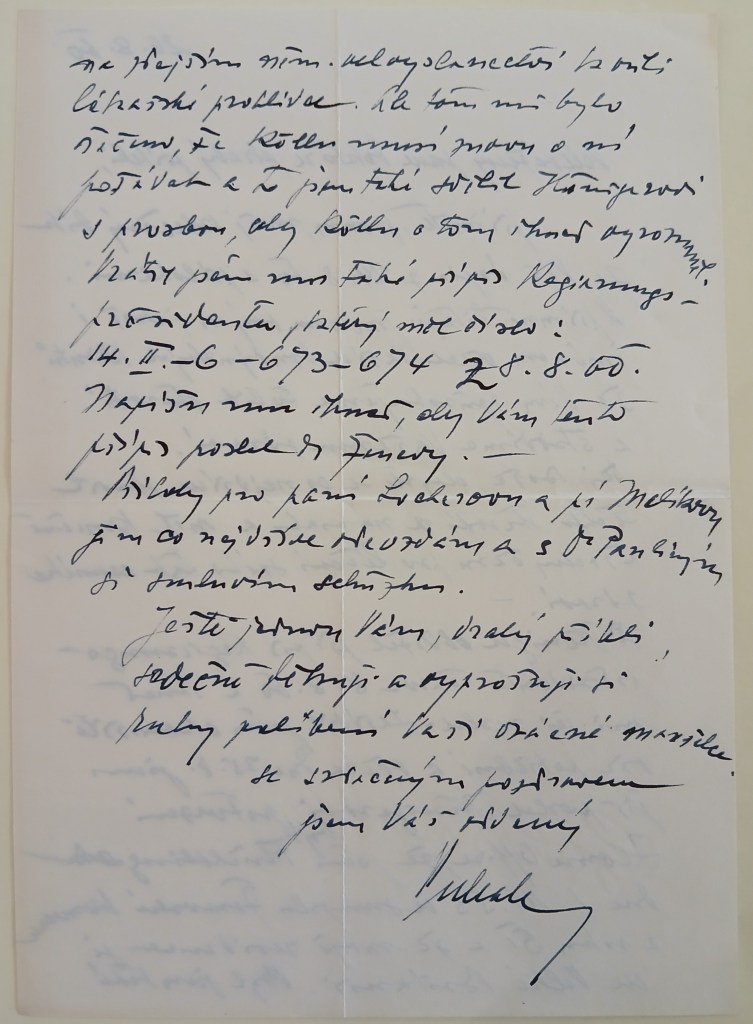
26.8.60

Velevážený pane doktore, drahý příteli,

přijměte, prosím, můj srdečný dík za Váš dopis z 24.8.60 s přílohami. Upřímně lituji jménem svým jakož i jménem všech Vašich londýnských klientů, že Vám způsobujeme tolik starostí a škodíme Vašemu zdraví.

Dej Bože, abyste se co nejdříve zbavil těchto starostí o návrat a měl konečně trochu času pro léčení svého tak cenného zdraví.

Dr.Höniger obdržel přípis Regierungspräsidenta teprve 8.8.60 a ihned mi jej zaslal. Zařídil jsem okamžitě vše potřebné a včera dne 25.8. jsem již poslal Hönigerovi potvrzení Home Office, že jsem byl Flüchtling (ode) dne 1.10.53 ve smyslu Ženevské konvence z roku 51 a že moje residence je ve Velké Británii. Byl jsem také na zdejším německém velvyslanectví kvůli lékařské prohlídce. Ale tam mi bylo řečeno, že Köln musí znovu o ní požádat a to jsem také sdělil Hönigerovi s prosbou, aby Köln o tom ihned vyrozuměl. Vrátil jsem mu také přípis Regierungspräsidenta, který měl číslo: 14.II.-6-673-674 28.8.60. Napíšu mu ihned, aby Vám tento přípis poslal do Ženevy.

Přílohy pro paní Locherovou a paní Malíkovou jim co nejdříve odevzdám a s Dr. Paulínym si smluvím schůzku.

Ještě jednou Vám, drahý příteli, srdečně děkuji a vyprošuji si ruky políbení Vaší vzácné manželce.

Se srdečným pozdavem

jsem Váš oddaný

Prchala

Dear Doctor, my friend

please accept my heartfelt thanks for your letter of 24.8.60 with the enclosures. I sincerely regret, on my own behalf and on behalf of all your London clients, that we are causing you so much trouble and harming your health.

May God grant that you may be rid of these worries about returning as soon as possible and finally have some time to treat your precious health.

Dr. Höniger received the Regierungspräsident’s letter only on 8.8.60 and sent it to me immediately. I immediately arranged everything necessary and yesterday, 25.8. I already sent Höniger a confirmation from the Home Office that I was a Flüchtling (from) on 1.10.53 within the meaning of the Geneva Convention of 51 and that my residence is in Great Britain. I also went to the German embassy here for a medical examination. But I was told there that Cologne had to apply for it again and I also told Höniger about this, asking that Cologne understand this immediately. I also returned to him the letter from the Regierungspräsident, which had the number: 14.II.-6-673-674 28.8.60. I will write to him immediately to send this letter to you in Geneva.

I will hand over the enclosures for Mrs. Locherová and Mrs. Malíková to them as soon as possible and I will arrange a meeting with Dr. Paulíny.

Once again, my dear friend, I thank you heartily and with a hand kiss to your honorable wife

Yours faithfully

Prchala

16.9.60

Velevážený pane doktore, drahý příteli,

mám za to, že jste již opět v Ženevě a doufám, že Vás svým dopisem neobtěžuji. Doufám také, že jste si po tak namáhavé práci alespoň trochu odpočinul a že zdravotně se cítíte nyní lépe.

O obsahu Vašeho telegramu a dopisu nás již podrobně informoval přítel Dr. A a nezbývá než Vás obdivovat a Vám za Vaši obětavou práci mnohokráte děkovat. Zdá se, že to teď již dlouho trvat nebude a že vbrzku dojednáte věci definitivně.

Mě osobně velmi znepokojuje mlčení Kolína. Nedostal jsem dosud ani „Erklärung“, který jsem měl podepsat, ani povolání k lékařské prohlídce. Höniger sice slíbil, že po své dovolené, která končila 6.9., zajede do Kolína a o mé věci osobně pohovoří s Reg. Presidentem, ale dosud jsem bez zprávy jak z Kolína tak od Hönigera. A proto Vás prosím, abyste Vy se na to ještě jednou podíval, a to proto, poněvad6 Vám věří a vím, že bez Vaší intervence se nic nevyřídí.

Milostivé paní uctivě ruku líbám, Vás, drahý příteli, srdečně zdravím

a jsem Váš oddaný

Prchala

Dear Doctor, my friend,

I believe you are back in Geneva and I hope I am not bothering you with my letter. I also hope that you have at least rested a little after such strenuous work and that you are now feeling better in health.

We have already been informed in detail about the content of your telegram and letter by our friend Dr. A and there is nothing left but to admire you and thank you many times for your dedicated work. It seems that it will not be long now and that you will soon arrange things definitively.

I am personally very concerned about the silence of Cologne. I have not yet received either the “Erklalung” that I was supposed to sign or the summons for a medical examination. Honiger promised that after his vacation, which ended on September 6, he would go to Cologne and personally discuss my case with the Prime Minister, but I have still not heard from either Cologne or Honiger. And that’s why I’m asking you to take another look at it, because I trust you and I know that nothing will be resolved without your intervention.

Kind kisses to your honorable wife’s hand,

I greet you warmly, my dear friend.

Yours faithfully

Prchala
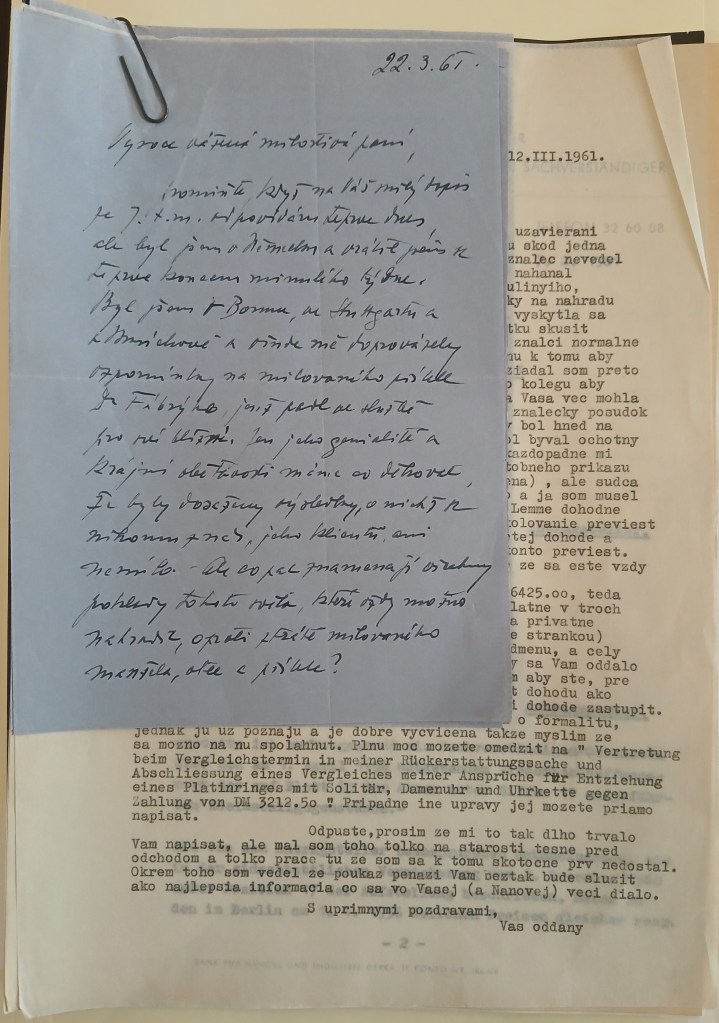
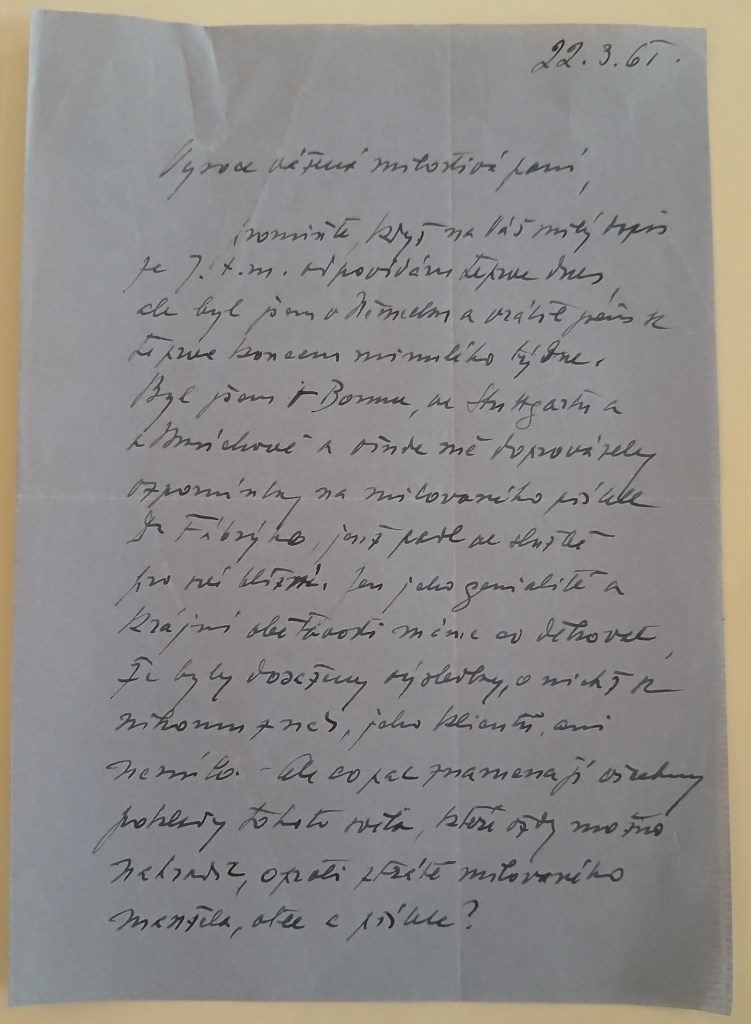
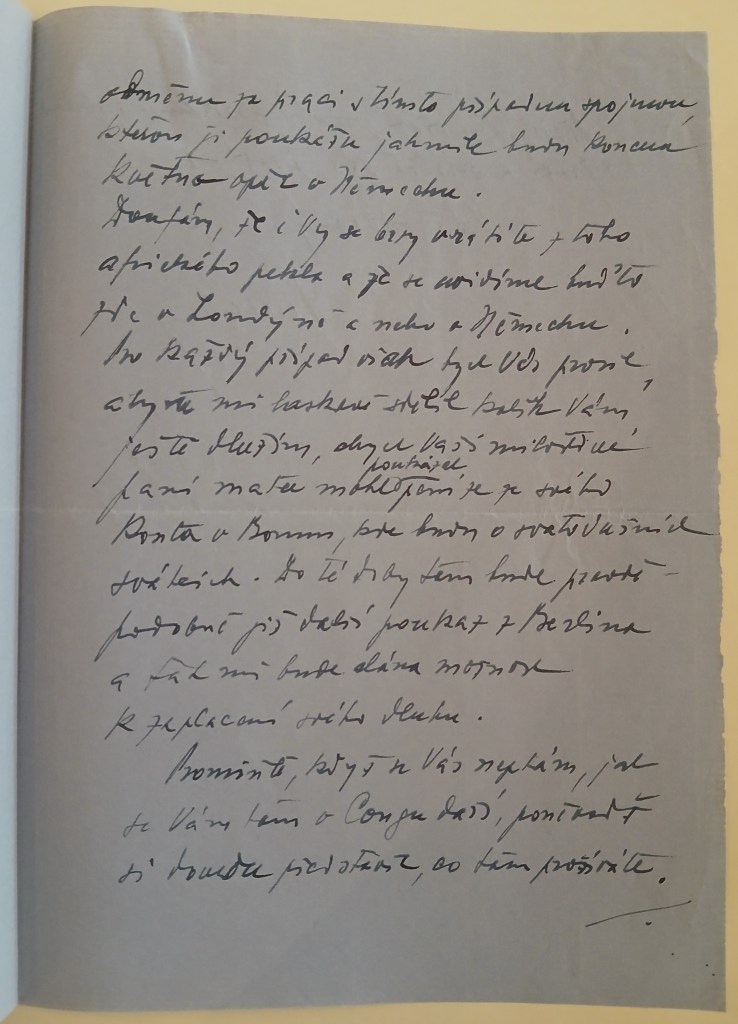
22.3.61

Vysoce vážená milostivá paní,

promiňte, když na Váš milý dopis ze 7. t.m. odpovídám teprve dnes, ale byl jsem v Německu a vrátil jsem se teprve koncem minulého týdne. Byl jsem v Bonnu, ve Stuttgartu a Mnichově a všude mě doprovázely vzpomínky na milovaného přítele Dr. Fábryho, jenž padl ve službě pro své blízké. Jen jeho genialitě a krajní obětavosti máme co děkovat, že byly dosažena výsledky, o nichž se nikomu z nás, jeho klientů, ani nesnilo. Ale co pak znamenají všechny poklady tohoto světa, které vždy možno nahradit, oproti ztrátě milovaného manžela, otce a přítele?

Stále ještě se nemohu smířit s jeho odchodem a mrzí mne, že jsem mu nemohl osobně poděkovat za jeho vzácnoua opravdu přátelskou službu, kterou prokázal mi a mé rodině.

V sobotu dne 20. t.m. obdržel jsem dopis od pana Dr. Vladimíra z Conga. Upřímně ho lituji a doufám, že se vrátí zdráv a co nejdříve z tohoto afrického pekla. Potvrzuje mi to, co mi před týdnem vyřídila telefonicky Vaše milostivá slečna dcera a paní Tágová, od níž jsem dostal dopis po svém příjezdu z Německa. Doufám, že koncem května budu opět v Bonnu a pak si dovolím zaslat Vám, milostivá, zbytek svého dluhu z druhé částky náhrady, která, jak předpokládám, bude do té doby už určitě v mé bance v Bonnu.

V červnu pak chci opět na léčení do Bad Kissingen. Žena tam chce také, ale teprve v srpnu, poněvadž někdo z nás zde musí zůstat. Takový je předpisCzech Trust Fundu, v jehož domě chceme bydlet i nadále. Do Ženevy se podívám až budu míti britský pas, což bude někdy na podzim.

Srdečně Vás, milostivá paní, oba zdravíme, já uctivě ruku líbám a jsem

Váš oddaný

Prchala

Dear Madam,

I apologize for only replying to your kind letter of the 7th, but I was in Germany and only returned at the end of last week. I was in Bonn, Stuttgart and Munich and everywhere I was accompanied by memories of my beloved friend Dr. Fábry, who fell in the service of his loved ones. It is only to his genius and extreme dedication that we have something to thank for that results were achieved that none of us, his clients, could even dream of. But what are all the treasures of this world, which can always be replaced, compared to the loss of a beloved husband, father and friend?

I still cannot come to terms with his passing and I regret that I was not able to thank him personally for his precious and truly friendly service that he rendered to me and my family.

On Saturday, the 20th, I received a letter from Dr. Vladimír from Congo. I sincerely feel sorry for him and hope that he will return safely and as soon as possible from this African hell. I am confirmed by what your gracious daughter and Mrs. Tágová told me by telephone a week ago, from whom I received a letter after my arrival from Germany. I hope that I will be in Bonn again at the end of May and then I will take the liberty of sending you, my lady, the rest of my debt from the second amount of compensation, which, as I assume, will certainly be in my bank in Bonn by then.

In June I want to go to Bad Kissingen again for treatment. My wife also wants to go there, but not until August, because one of us has to stay here. This is the regulation of the Czech Trust Fund, in whose house we want to continue living. I will travel to Geneva when I have a British passport, which will be sometime in the autumn.

We both warmly greet you, dear Madam, I respectfully kiss your hand and I am

Yours faithfully

Prchala

From Gen. Lev Prchala to Vladimir Fabry, 22 March 1961:

22.3.61

Dear Doctor,

Thank you very much for your esteemed letter of 12.3.61, which I received only on the 20th of this month, just after sending my letter to Mrs. Tagova. She sent me the letter on 7.3.61, while I was in Germany, and asked me only for a short statement that I agreed with the expert’s estimate of 6,425DM. I sent this to her immediately after my return, i.e. on the 20th of this month, with my notarized signature. She did not ask for a power of attorney from me, because she hopes that it will be possible to do without a “Vergleich”. I also promised her a special reward for the work connected with this case, which I will pay her as soon as I am back in Germany at the end of May.

I hope that you will also return soon from this African hell and that we will see each other either here in London or in Germany. Just in case, I would ask you to kindly tell me how much I still owe you, so that I can transfer the money to your gracious mother from my account in Bonn, where I will be during the Whitsun holidays. By then, another order from Berlin will probably be there and I will be given the opportunity to pay my debt.

Excuse me if I do not ask you how you are doing in Congo, because I can imagine what you are going through there.

I wish you much success and good health and send you my warmest regards

Yours faithfully

Prchala
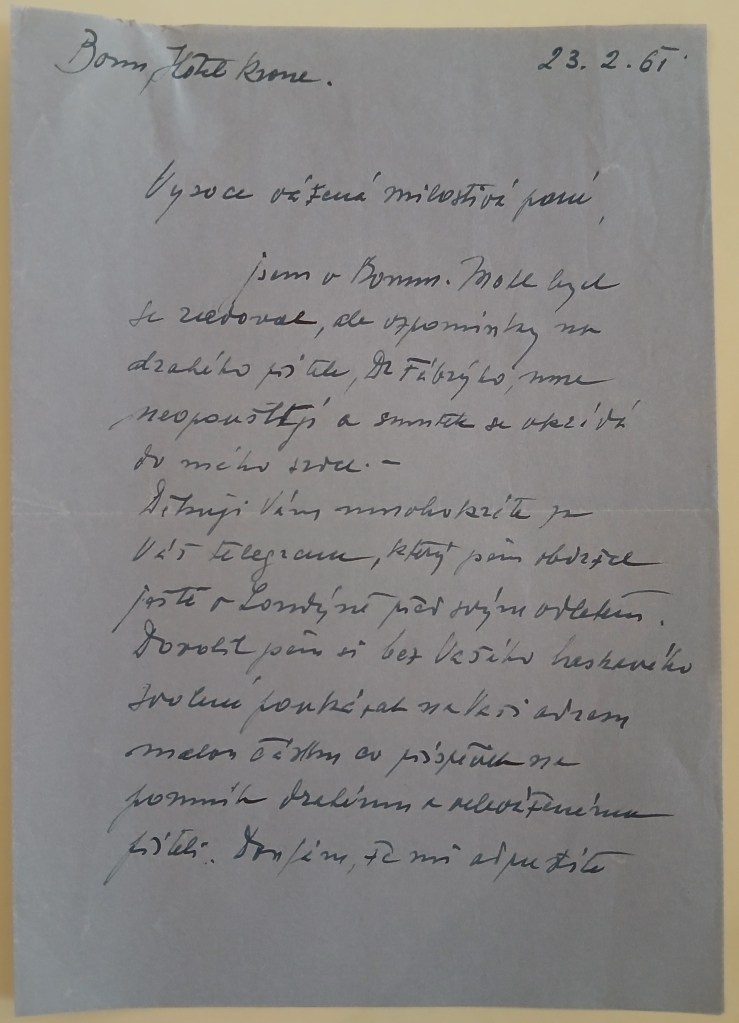
From Prchala to Madam Olga Fabry-Palka, 23 February 1961:

Bonn, Hotel Krone. 23.2.61

Dear Madam,

I am in Bonn. I could be happy, but the memories of my dear friend, Dr. Fabry, do not leave me and sadness returns to my heart.

Thank you very much for your telegram, which I received in London before my departure. Without your kind permission, I took the liberty of sending to your address a small sum as a contribution to the monument to a dear and esteemed friend. I hope you will forgive me and with a hand kiss I am

Yours faithfully

Prchala

From the Czechoslovak Desk of Radio Free Europe, Munich, 13 December 1960

Here is a unique letter from Dr. Samuel Bellus to Vlado’s sister Olga (Olinka) – he calls her ‘Olichka’ – sent 13 December 1960. At this time, Radio Free Europe became a European-based organization, it had been headquartered in New York.

13. December 1960

Dear Olichka,

Thank you very much for your letter. Don’t be angry that I didn’t get back to you sooner, but I really had a lot of work to do. A very turbulent time has passed us by. Ralph will surely tell you later.

Rudko and Fedor [Hodza] were here and we remembered you. Do you already know exactly when you will come here? Write me an appointment soon so I can relax. I would like to point out that I won’t be able to take even the shortest vacation, because I really can’t move away from Munich.

I will remember you at Christmas and I hope you remember me. Have a good time, Olichka.

Yours

Samuel

Envelopes found from Free Europe Committee, Two Park Avenue, New York 16, NY, sent to Dr. Pavel Fabry, in Geneva, Switzerland. Radio Free Europe was created through the efforts of the National Committee for a Free Europe, later known as Free Europe Committee, formed in New York by Allen Dulles who was head of the CIA. Until 1971, RFE was secretly funded by the CIA.

More details on Free Europe Committee history from Martin Nekola, Charles University in Prague:

“Looking back at the FEC as a shelter for prominent émigrés who used its resources and facilities to fight communism from abroad, the Committee can be considered a very unique organization with a specific role in the Cold War history. The number of people involved, the expenses incurred, and the efforts to get the FEC into the U.S. public awareness all serve as evidence of this. The émigrés relied on their “American friends” in the early Cold War years, believing in the possibility of defeating communism in Europe. However, after the failed Hungarian uprising in the fall 1956 that was violently suppressed by Soviet tanks, the mood among East-European exile communities dramatically changed. The émigrés realized that the West would not intervene directly in favor of an opposition group in a country within the Soviet sphere of influence. As a result, their expectations, along with the Free Europe Committee’s importance, gradually diminished.

Nevertheless, the legacy of the organization, sometimes called the “unofficial Department of U.S. propaganda” is not entirely forgotten. More than two decades after the fall of the Iron Curtain, Radio Free Europe still broadcasts in twenty-one countries, and Captive Nations Week—marked every year in July—serves as a reminder of the suffering of many nations still living in undemocratic conditions.”

The next document was first shared here on 30 April 2013, exactly 12 years ago today. From Dr. Samuel Bellus, a sworn statement on behalf of Mrs. OIga Viera Fabry-Palka (Vlado’s mother), 30 September 1956:

I, Samuel Bellus, of 339 East 58th Street, New York 22, New York, hereby state and depose as follows:

That this statement is being prepared by me at the request of Mrs. Olga Viera Fabry, nee Palka, who formerly resided in Bratislava, Czechoslovakia, but since 1948 has become a political refugee and at present resides at 14, Chemin Thury, Geneva, Switzerland;

That I have known personally the said Mrs. Olga Viera Fabry and other members of her family and have maintained a close association with them since the year 1938, and that I had opportunity to observe directly, or obtain first hand information on, the events hereinafter referred to, relating to the persecution which Mrs. Olga Viera Fabry and the members of her family had to suffer at the hands of exponents of the Nazi regime;

That in connection with repeated arrests of her husband, the said Mrs. Fabry has been during the years 1939 – 1944 on several occasions subject to interrogations, examinations and searches, which were carried out in a brutal and inhumane manner by members of the police and of the “Sicherheitsdienst” [SD -TB] with the object of terrorizing and humiliating her;

That on a certain night on or about November 1940 Mrs. Fabry, together with other members of her family, was forcibly expelled and deported under police escort from her residence at 4 Haffner Street, Bratislava, where she was forced to leave behind all her personal belongings except one small suitcase with clothing;

That on or about January 1941 Mrs. Fabry was ordered to proceed to Bratislava and to wait in front of the entrance to her residence for further instructions, which latter order was repeated for several days in succession with the object of exposing Mrs. Fabry to the discomforts of standing long hours without protection from the intense cold weather and subjecting her to the shame of making a public show of her distress; and that during that time humiliating and derisive comments were made about her situation in public broadcasts;

That the constant fear, nervous tension and worry and the recurring shocks caused by the arrests and deportations to unknown destinations of her husband by exponents of the Nazi regime had seriously affected the health and well-being of Mrs. Fabry during the years 1939 – 1944, so that on several such occasions of increased strain she had to be placed under medical care to prevent a complete nervous breakdown; and

That the facts stated herein are true to the best of my knowledge and belief.

Samuel Bellus

Reintroducing “Vlado”

Vlado in Egypt

My name is Tara Burgett, I am an independent researcher and archivist, and the author of this blog dedicated to Vladimir “Vlado” Fabry. My husband, Victor, is the nephew of Vlado, the only child of Vlado’s sister, Olinka. When Olinka passed away in 2009, we discovered a trove of papers and photos stuffed in old suitcases in the house in New York; recognizing their importance, we packed them up and brought them to Washington state, and since then I have made it my mission to share the family story with the world.

Vlado and sister Olinka with his Buick and Bambi hood ornament
Vlado and Olinka in Switzerland

When I first began my blog in 2013, the only information I could find on the internet about Vlado, other than the details of the plane crash in Ndola with Dag Hammarskjold, was a memoriam to one of Vlado’s girlfriends, Mary Sheila Dean Marshall; written by her son Chris Marshall. Here is the paragraph mentioning Vlado that made me laugh out loud:

“Sheila considered her time in New York to be some of the happiest days of her life. She roomed with her dearest friend, a gorgeous Czechoslovakian socialite named Desa Pavlu. The two of them must have left a trail of broken hearts throughout Manhattan. Sheila had a proposal of marriage from a young man named Arthur Gilkey. She declined, and shortly thereafter, he perished while ascending K2. Sheila was also courted by a chap named Vladimir “Vlado” Fabry. Vlado died with Dag Hammerskjold[sic] in The Congo[sic]. It seems that Vlado may have been connected with the CIA. Sheila said she could never see herself marrying Vlado because of his “very round bottom”.”

I was only a little annoyed that someone was using the words of one dead person to slag off another dead person, because it was just too funny to read about Vlado’s “very round bottom” on the internet. What did bother me though, was the statement from Mr. Marshall, that “Vlado may have been connected with the CIA”; which was just his opinion, when in fact, his father, Sheila’s husband Mike Marshall, was a CIA operative from 1952-1967.

The more time I spent reading and translating the letters and documents, the more I realized how important it was that I speak up for Vlado and his family. The Fabry family were the targets of intentional and malicious slander, in revenge for their fierce resistance to both Nazi and communist invasions of Czechoslovakia, and sharing their archive has been my way of setting the record straight.

Vlado and his mother Olga Fabry – Maminka – Geneva, 17 April 1948

Vlado studied Law and Political Science at Comenius University in Bratislava, following in the footsteps of his father, Pavel Fabry, who was also a lawyer. Before joining the United Nations Legal Department in 1946, Vlado served as Personal Secretary to the Minister of Commerce in Prague. Vlado and his father were both very romantic and unconventional characters, who loved music, poetry, travel, and all kinds of adventure; they were not afraid to stand up for their beliefs, even in the face of danger and threats of death.

Vlado hugging his father good-bye at Prague airport, June 1946
Vlado and Pavel in Switzerland

After the communist coup d’etat in 1948, the whole family were forced to flee Czechoslovakia, and lived as political refugees in Switzerland. Vlado was often on the move, working for the UN in many countries, including New Zealand, Indonesia, Ghana, Egypt, and Congo, but he would stay with his parents in Geneva whenever he was on leave, at 14 Chemin Thury. 

Vlado and Maminka in Switzerland
Vlado with his parents, Geneva, Switzerland, 14 Chemin Thury
Breakfast in Geneva, 14 Chemin Thury
Vlado at work, Geneva, Switzerland, 14 Chemin Thury

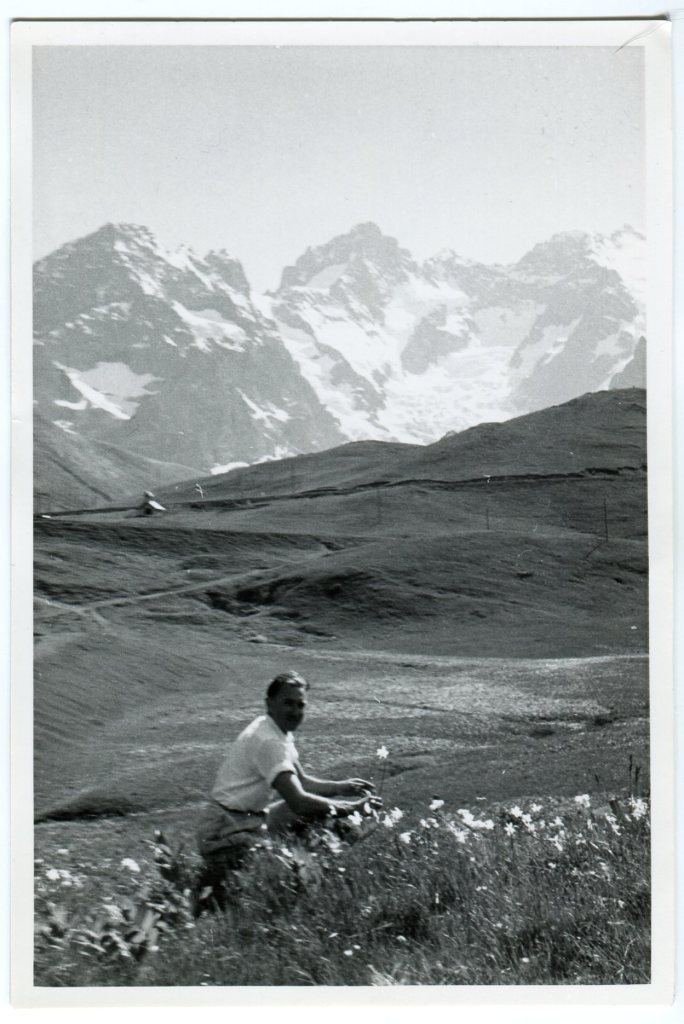
Vlado was loved by many of his colleagues at the UN, for his kindness and hospitality, and for his enthusiasm for skiing, mountain climbing, as well as his intellect and charm.

Vlado in Geneva

I could say more about his personality, but I feel the letters Vlado left behind, and the letters of his friends and family who knew him, say it best. He was an example of courage that anyone who knew him tried to follow, and is an inspiration to me, personally.

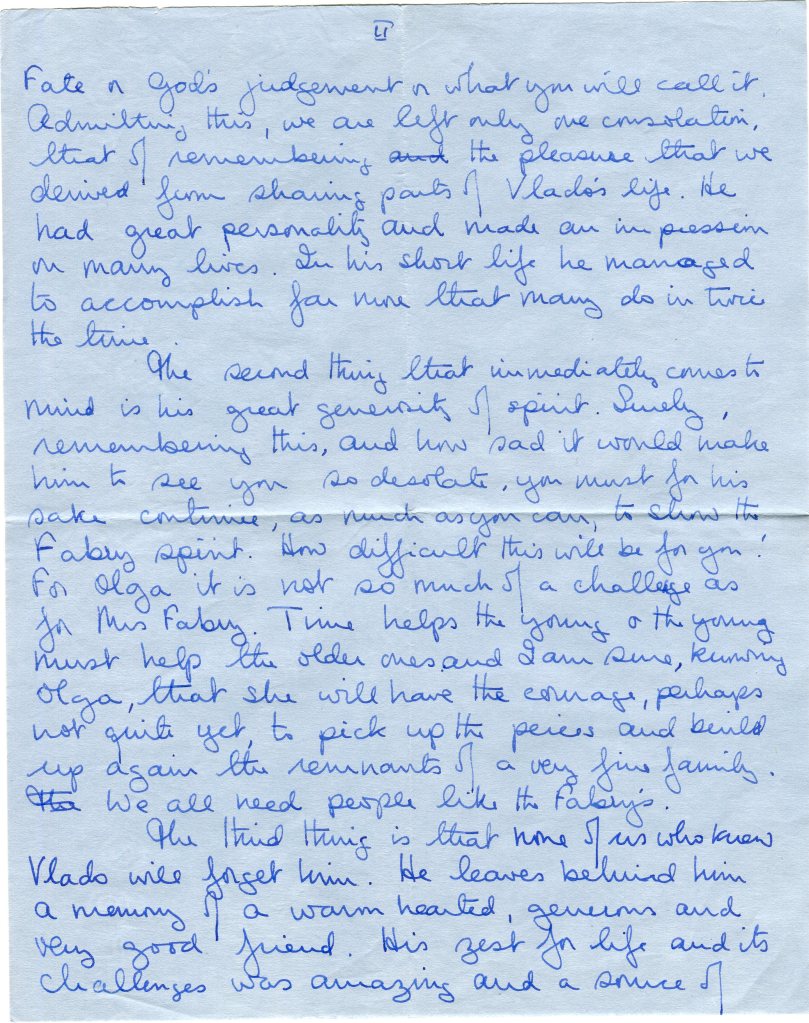
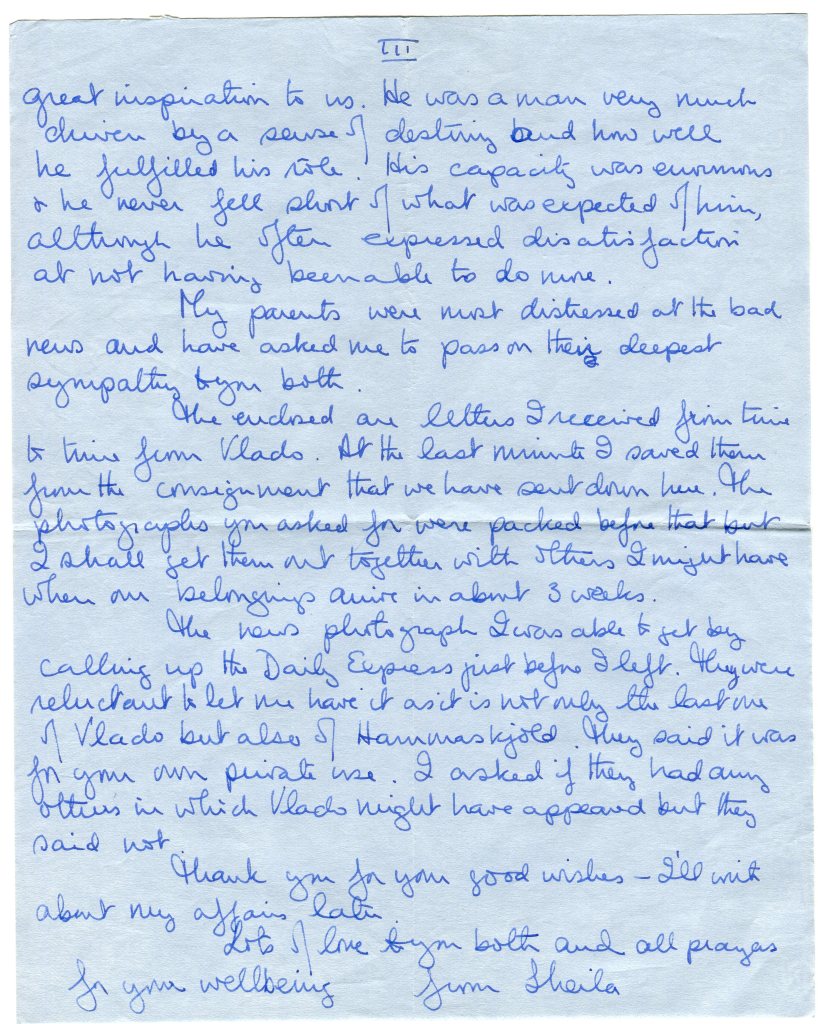
Condolence letter from Mary Sheila Dean Marshall
Last photo of Vlado and Dag Hammarskjold, from Daily Express, included in letter from Mary Sheila Dean Marshall
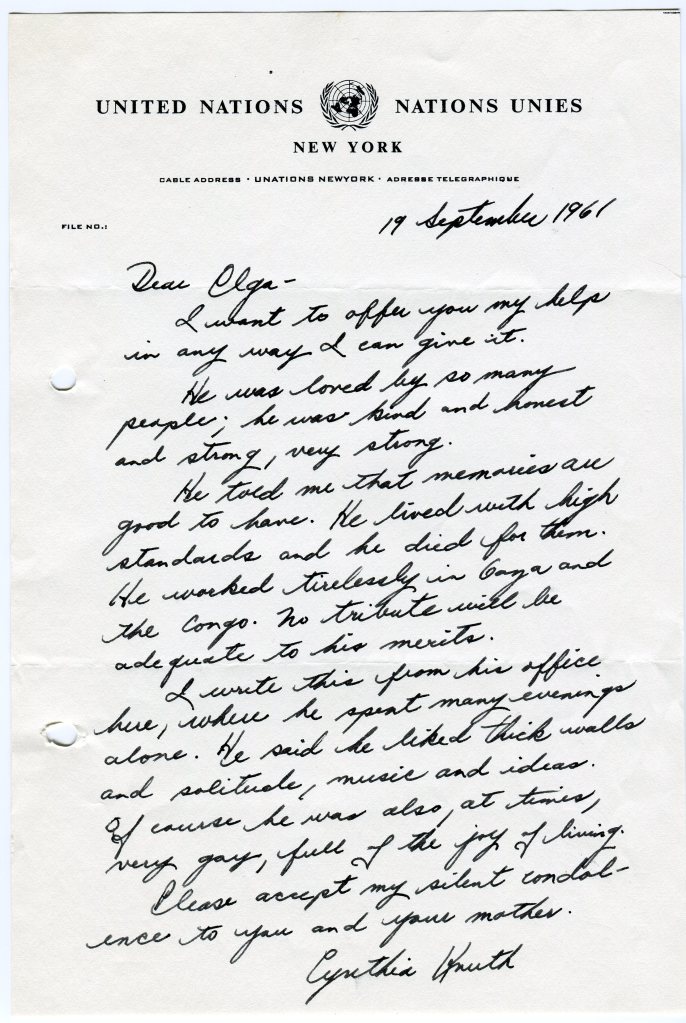
Condolence letter from Cynthia Knuth
Condolence letter from Zeno F. Marcella
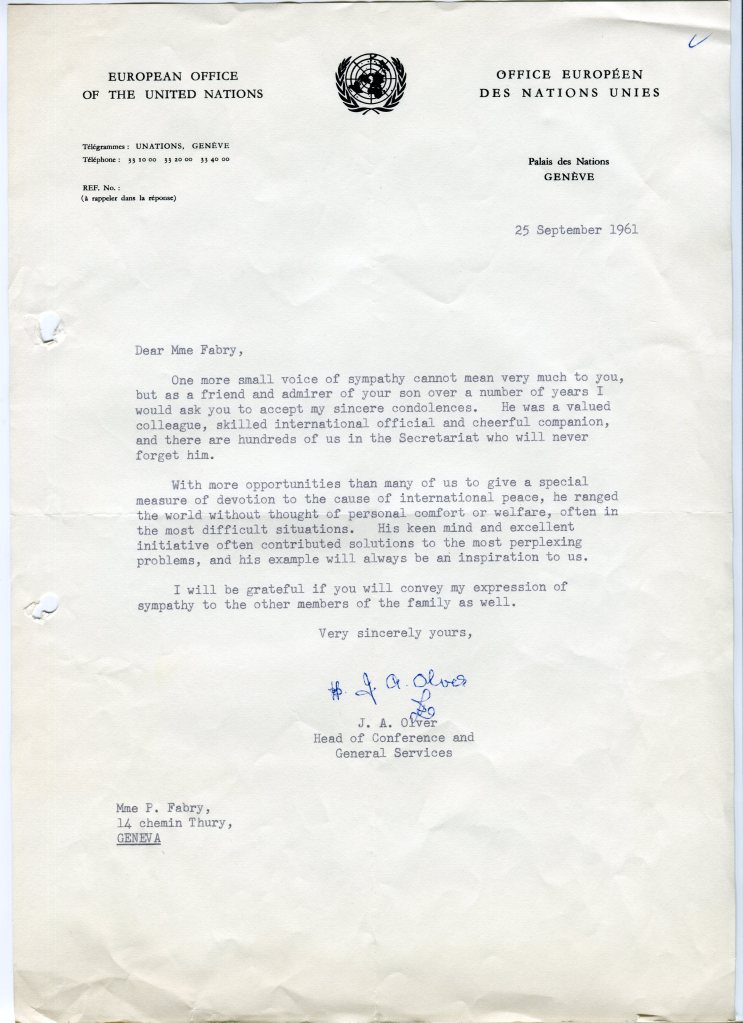
Condolence letter from John A. Olver
Condolence letter from Bernard T. Twight
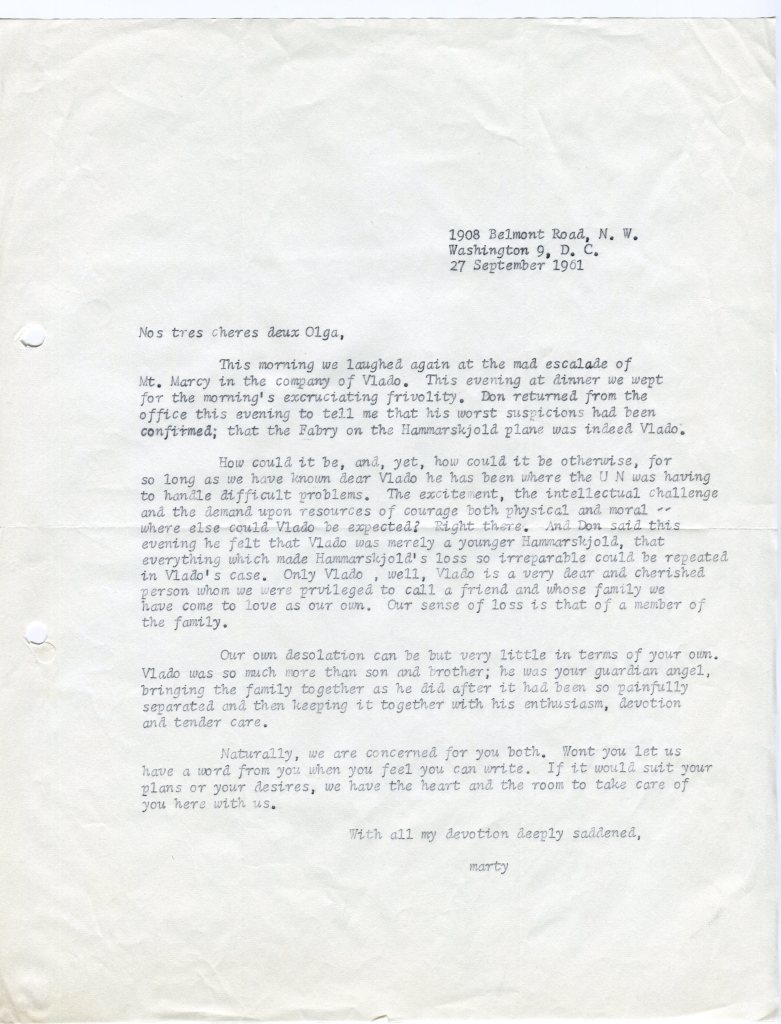
Condolence letter from Marty and Don Davies
Friends of Vlado, in Geneva, Marty and Don Davies
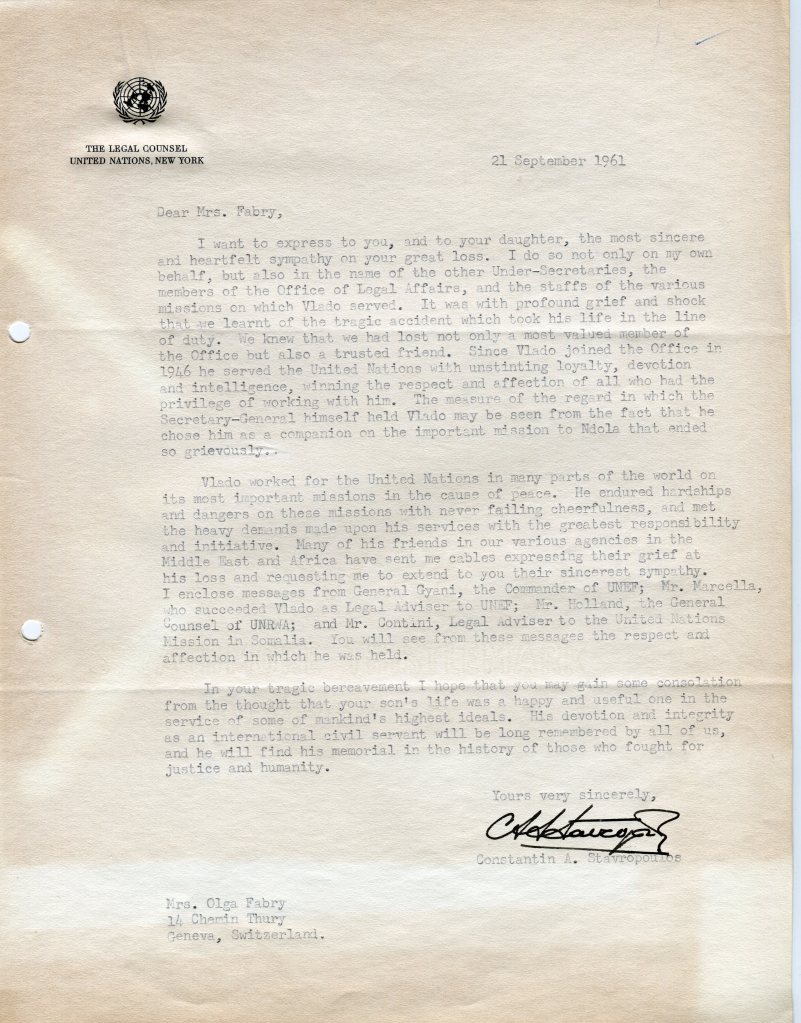
Condolence letter from Constantin A. Stavropoulos
Condolence letter from “Dody”
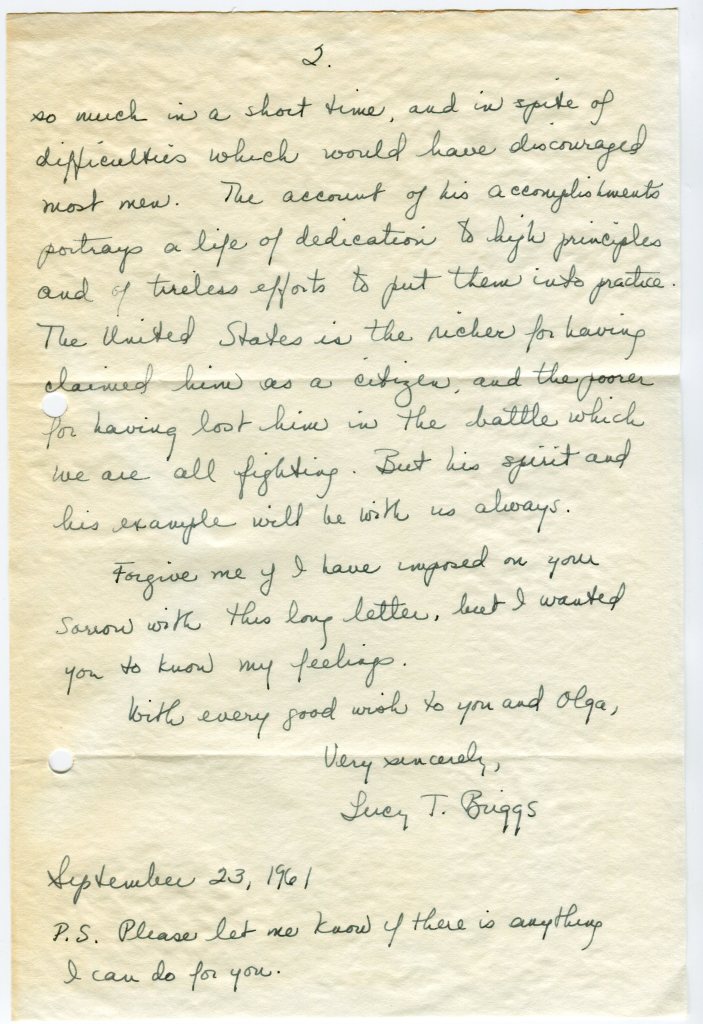
Condolence letter from Lucy T. Briggs, daughter of Ambassador Ellis O. Briggs, who served in the Foreign Service – she is the friend that gave Vlado “Bambi” – which you can see Vlado attaching to the hood ornament of his Buick, in the header photo of this blog.
Condolence letter from Monique Cegel (now Madame Rime), Vlado’s personal secretary in former Leopoldville, now Kinshasa, room 632 Le Royal
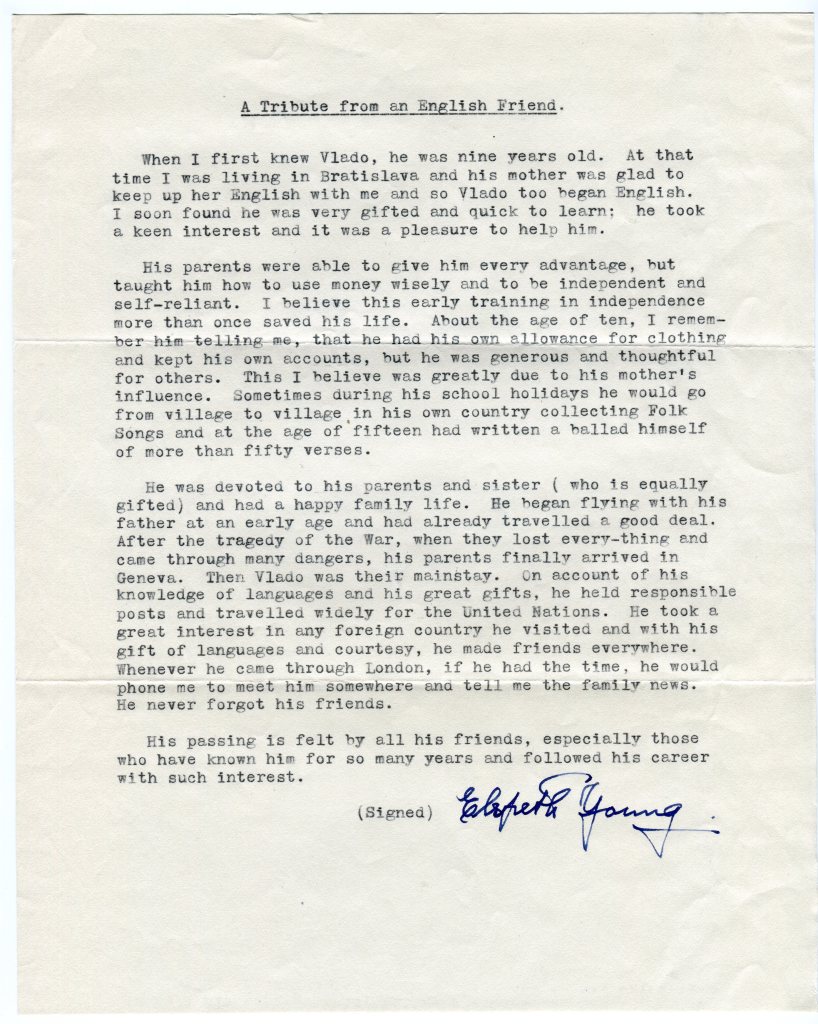
Tribute to Vlado from Elspeth Young

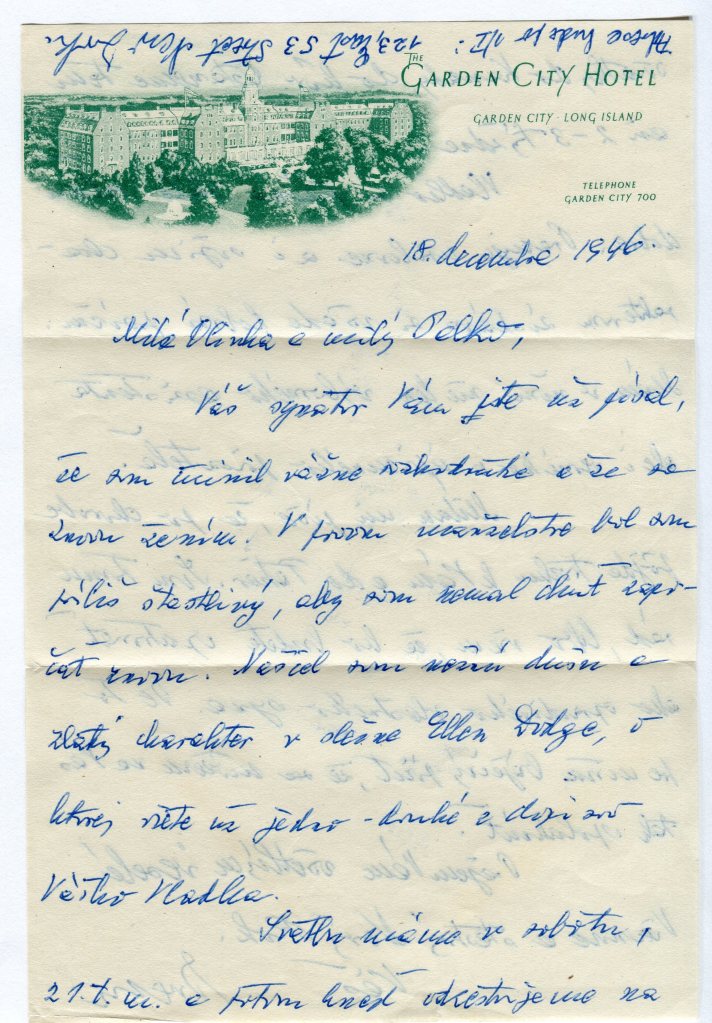
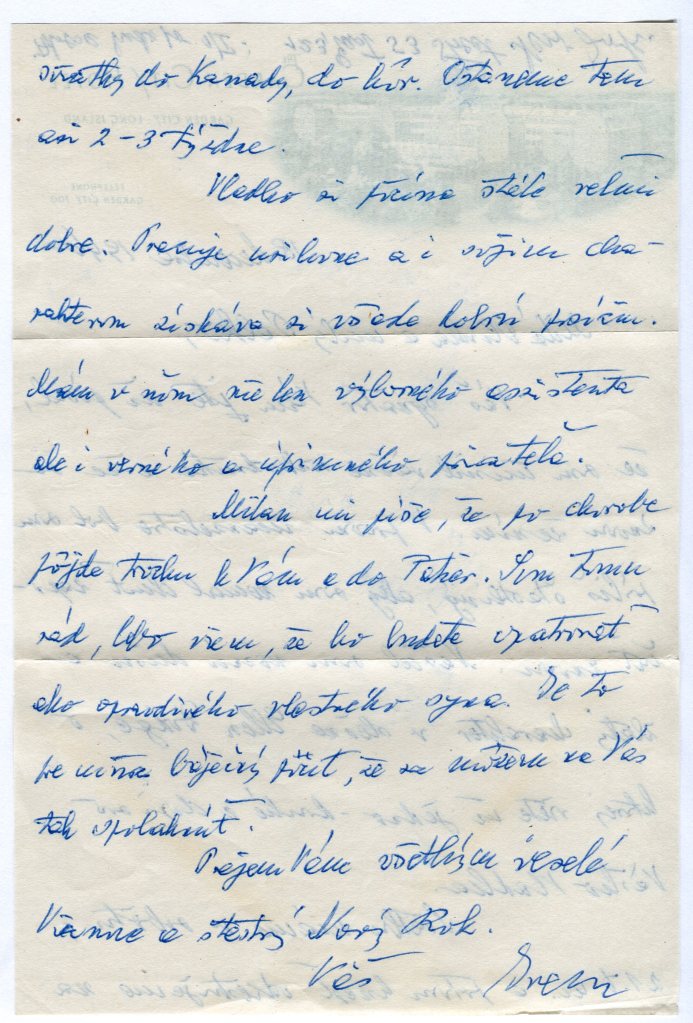
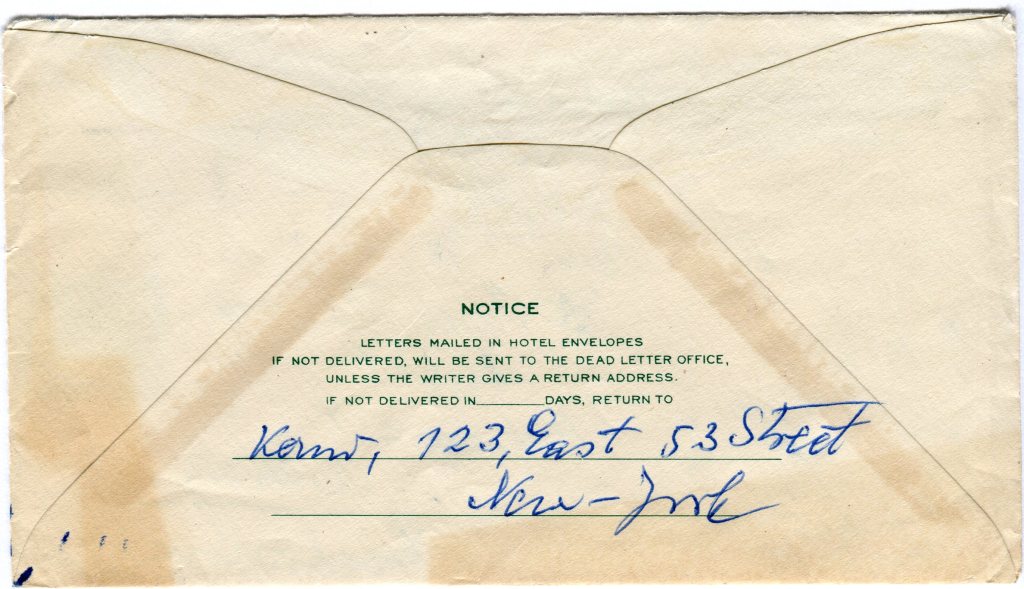
Letter from Ivan S. Kerno, 18 December 1946

My husband Victor is the nephew of Vlado Fabry, the only child of Vlado’s sister Olinka. When Olinka passed away in 2009, we discovered a trove of papers and photos stuffed in old suitcases in the house in New York; we packed them up and brought them to Washington state, and since then I have made it my mission to share the family story with the world. The photo above shows one of these suitcases, which was originally owned by Ivan S. Kerno – Slovak lawyer and family friend, who was Assistant to Secretary-General Trygve Lie and was head of the United Nations Legal Department. We have many letters from Ivan Kerno, but here is one from Garden City, Long Island, New York, from 1946, the year Vlado joined the Legal Department of the United Nations; addressed to Vlado’s father, Pavel Fabry, in Bratislava, Czechoslovakia, to our family home that is still illegally occupied by the Russian Federation, since the coup d’etat of 1948.

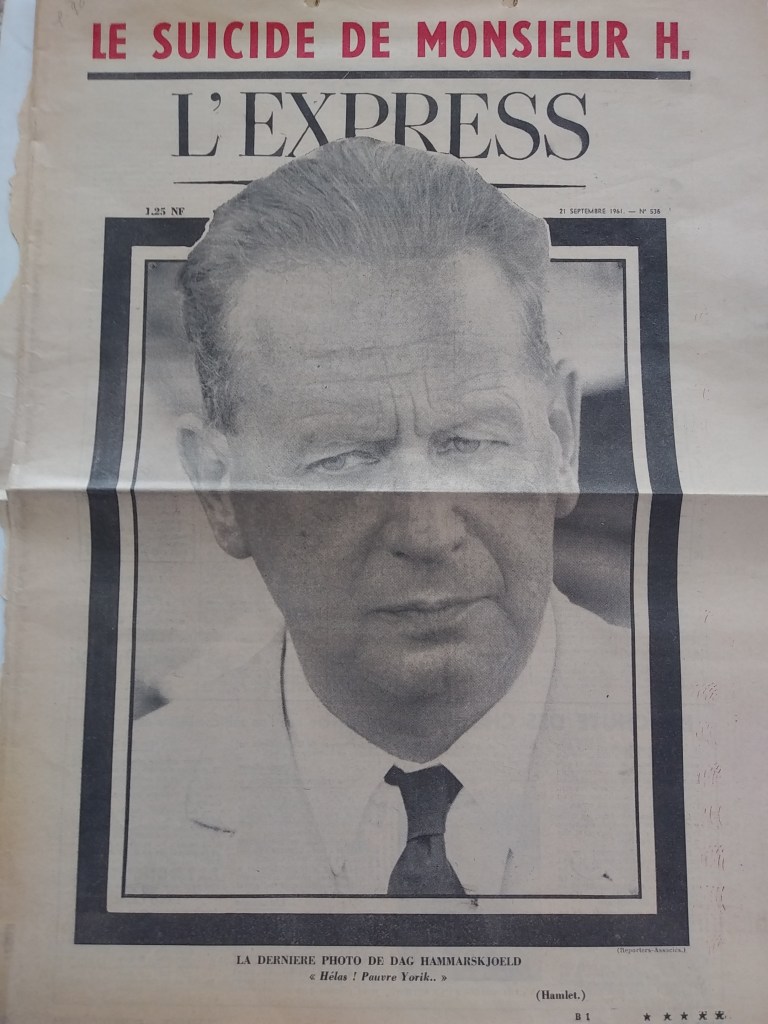
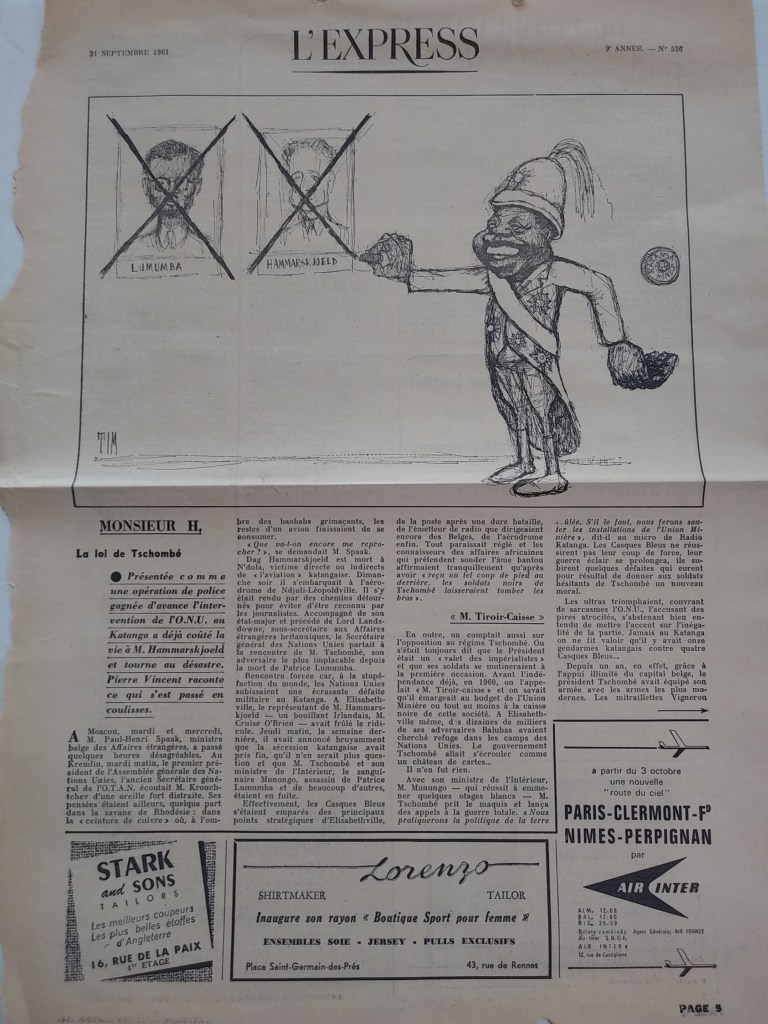
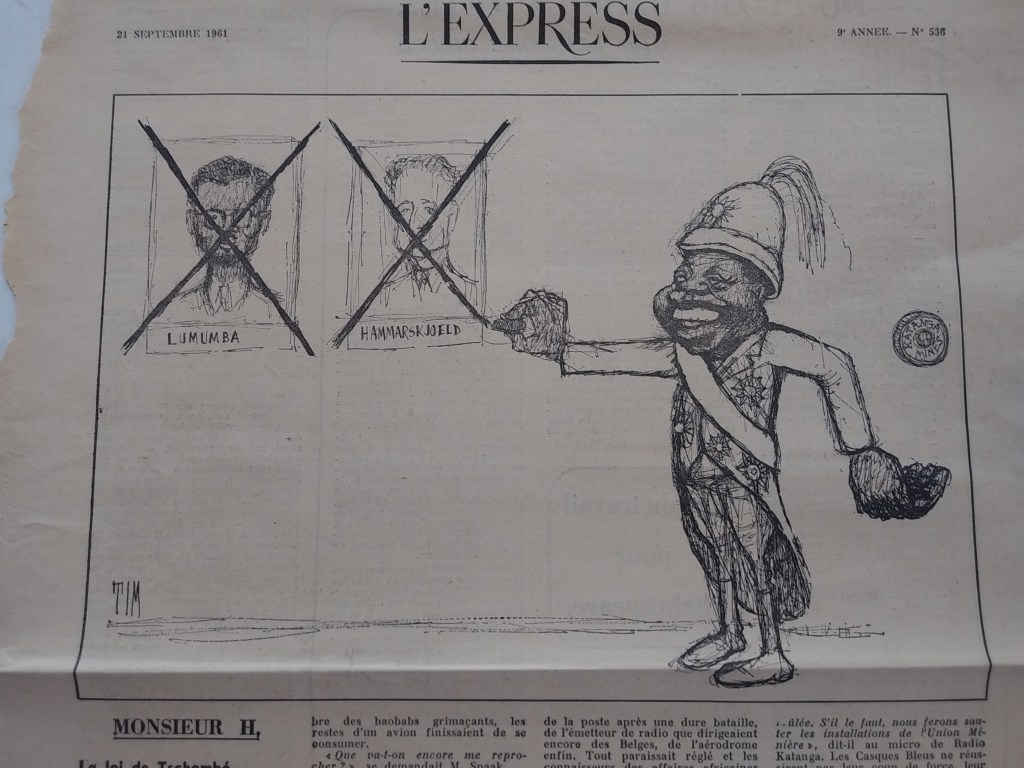
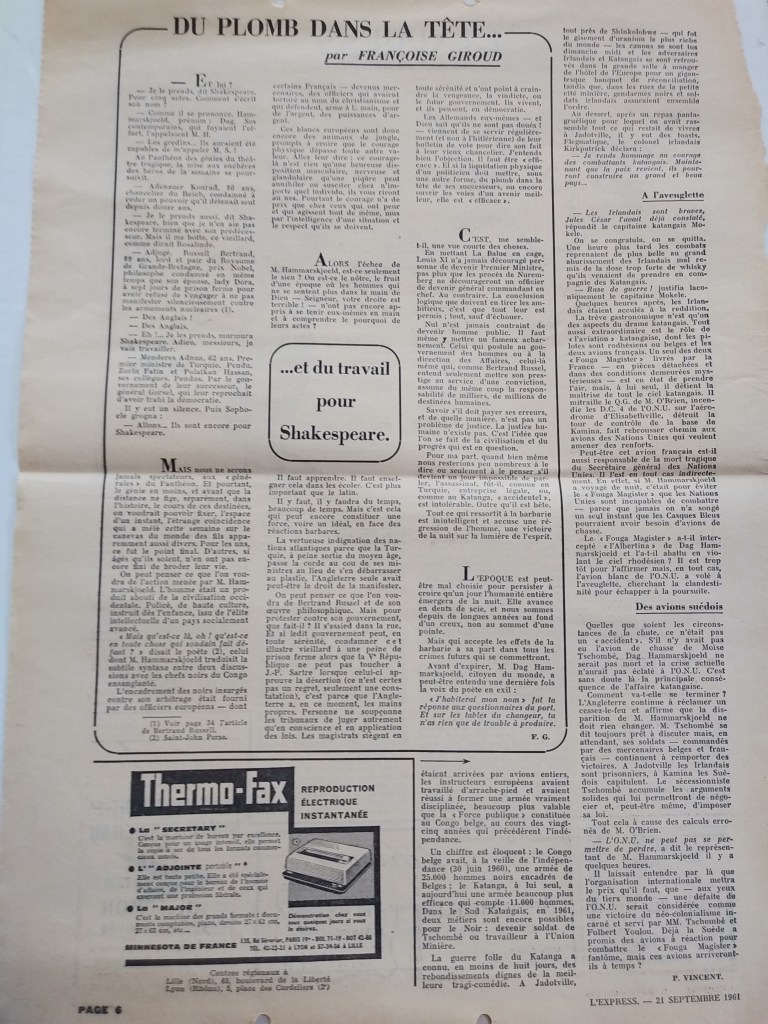
L’Express, 21 September 1961

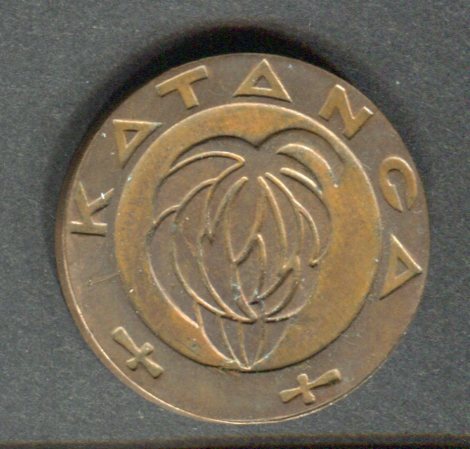
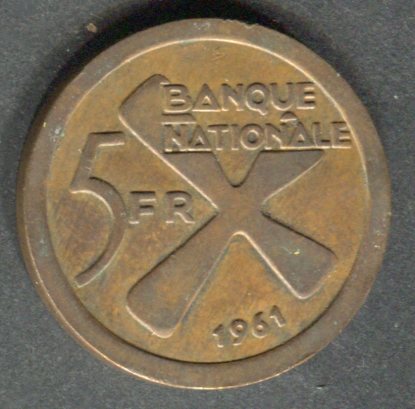
I was hesitant to share this here, because of the editorial choice of the word “suicide” to describe the death of Secretary-General Dag Hammarskjold, but it is important because this was saved in a collection of other international papers by Olinka and Olga Fabry. The political cartoon, showing Moïse Tshombe collecting his money from the Union Minière du Haut-Katanga mines with the murders of Patrice Lumumba and Hammarskjold, is gruesome but on point. From our personal coin collection, not from the Fabry archive, I have also included scans of two coins from Katanga from 1961.

A National Gift to the People of Slovakia

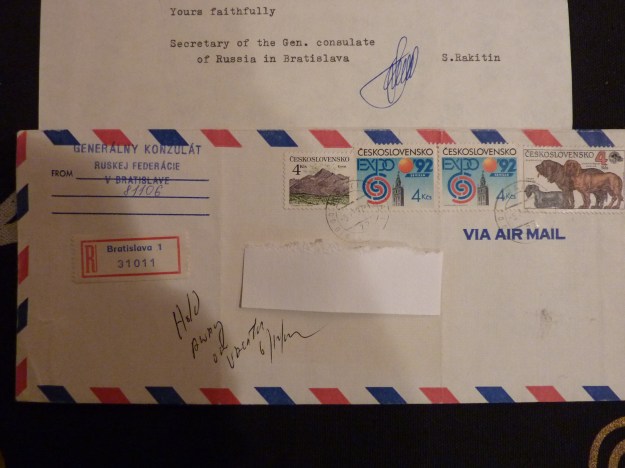
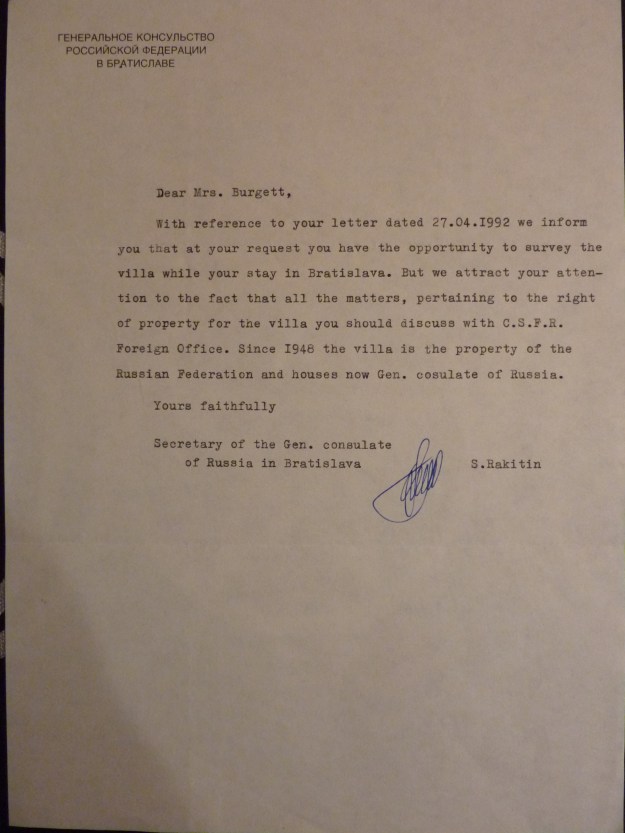
Letter from Russian Consulate, Bratislava, to my mother-in-law Olga Fabry-Burgett; June 1992.
Letter from the Secretary of the Gen. consulate S. Rakitin, admitting that our home was taken in 1948; which corroborates the personal testimony of Pavel Fabry.

Excerpt from C.V. of Pavel Fabry, 1955:

“After the Communist coup [February 1948] performed by Russian Deputy Foreign Minister [Valerian] Zorin for the Communists, the time is broken up with invoices to settle for my work against Communism as High Commissioner in 1919. And on the instructions of the insulted Mátyás Rákosi I was first of all relieved of all my functions and representatives, and subjected to all possible harassment, interrogations, etc. When I went to the delegation, as elected President of the Financial and Economic Committee of the General Assembly of the World Council of Churches, in Amsterdam, and was asked for my passport, I was arrested on the pretext of excessive imaginary charges. My whole fortune was taken, all accounts were confiscated and my Villa locked with furnishings, clothes, supplies, and everything, since it was the Consul-General of Russia; and on the same evening I was arrested as a “National Gift”, the nation was taken over, and in the night the Russians transferred the land register.”

My mother-in-law Olinka spent her whole life fighting to get the family home back from the Russians, but I will not be following in her footsteps – I want peace and to be happy! It is the sincere wish of myself and my family, that the Fabry home be donated to the city of Bratislava, as a gift to the people of Slovakia; to be of good use and service for the community, and that the garden be enjoyed by all people, as a memorial to our beloved ancestors.

The time has come for Russia to find a new home in Bratislava for their Consulate, obtained by legal means and not by brute force.

FREE ALEXEI NAVALNY!

Happy 100th Birthday, Vlado!

Born 23 November 1920, a toast to Vlado from the S-G – and me! Thank you to everyone who has contacted me with your fond memories of Vlado, I appreciate them all.

From New York to Gaza, 22 November 1960, birthday wishes from Vlado’s sister Olinka.

Not a birthday telegram, just a “confidential” message from Vlado’s mother to write home more often!

A birthday message and pep talk from big brother Vlado to his sister, sent late September 1960:

“However it may be, there’s no use fighting it or grumbling about what could be – just try to enjoy life as it comes and make every year of it – or every day, or every minute, – a memorable experience and adventure. Carpe diem! -“

Governor Fabry of Czechoslovakia

Grandpa Pavel Fabry made a lot of powerful enemies when he was a Governor in Czechoslovakia, he was not afraid to stand up to stark raving mad lunatics in power, and to make himself the target of Nazis and Communists. He also made many friends because he was a man of integrity, he loved and fought for his country, and he cared about the health and well-being of all Czechoslovakians. In his memory, I send my heartfelt appreciation to Washington state Governor Jay Inslee, for his strong and compassionate leadership – thank you!

There is a story connected to Pavel’s escape from the prison hospital in January 1949 I have not written about here, but it comes from his daughter Olinka Fabry; which was recorded by Olinka’s son, Victor(my husband), December 2008, several months before she passed away.

Many years before 1949, she does not recall what year exactly, her father Pavel was out driving in his car, when he saw a young girl lying hurt on the side of the road. He did not know who she was or what was wrong with her, but he picked her up and drove her to his own doctor. He told the doctor to give her anything she needed and he would pay for it. By some twist of fate, the father of this girl was the jailer in charge of the keys of the prison hospital, and he did not forget Pavel and his kindness – he helped him escape, in the words of Olinka, in a “uniform of a nun with an enormous hat”.

To refresh the memory, short excerpts from Pavel Fabry’s Curriculum Vitae, 11 September 1952:
 

[…]
During World-War-I, Mr. Fabry served as officer in an artillery division as well as in the service of the Army’s Judge Advocate-General. He became the first Secretary of the Provisional National Council established to prepare the liberation of Slovakia and the orderly transfer of its administration to the Czechoslovak Government. After the foundation of the Czechoslovak Republic, he was appointed Prefect (chief Government official) for the Eastern part of Slovakia.
When the Communist armies of the Hungarian Government of Bela Kun attacked Slovakia in 1919, Mr. Fabry was named High Commissioner Plenipotentiary for the defense of Eastern Slovakia. In this function he was entrusted with the co-ordination of the civil administration with the military actions of the Czechoslovak Army and of the Allied Military Command of General Mittelhauser. His determined and successful effort to prevent Eastern Slovakia to fall under the domination of Communist Armies – the victorious results of which contributed to the fall of the Communist regime in Hungary – drew on Mr. Fabry the wrath of the Communist leaders; they declared him the “mortal enemy of the people”, led violent press campaigns against him and attacked him overtly and covertly continually and at every opportunity.
[…]
Among civic functions, Mr. Fabry devoted his services particularly to Church, acting as Inspector (lay-head) of his local parish and as member of the Executive Committee of the Lutheran Church of Czechoslovakia. His appointment as delegate to the World Council of Churches’ meeting in Amsterdam in 1948 prompted his arrest by the Communist Government.
Although Mr. Fabry never stood for political office nor for any political party function, he was well known for his democratic and liberal convictions, and for the defense of these principles whenever his activities gave him the opportunity to do so. He earned himself a reputation in this respect which brought him the enmity of the adversaries of democracy from both the right and the left. He became one of the first Slovaks to be sent to a concentration camp following the establishment of a Pro-German fascist regime in 1939. His release could later be arranged and he was able to take active part in the underground resistance movement against the occupant; for this activity the German secret police (Gestapo) ordered his pursuit and execution in 1945, but he was able to escape the death sentence. In spite of his resistance record (or perhaps because of it), Mr. Fabry was among those arrested by the Russian Army, on the instigation of the Communist Party which could not forget his anti-Communist activities dating back all the way to 1919. Due to pressure of public opinion Mr. Fabry’s imprisonment at that time was very short; but when Communist seized power in Czechoslovakia in 1948, they did not miss the opportunity to settle accounts with him. He was removed from all his offices, his property was confiscated, he was imprisoned and subjected to a third degree cross-examination taking six months. No confessions of an admission which could have served as a basis for the formulation of an accusation could, however, be elicited from Mr. Fabry, and he managed to escape from the prison hospital where he was recovering from injuries inflicted during the examination. He succeeded to reach Switzerland in January 1949, where he has continued in his economic activities as member of the Board of Directors, and later President, of an enterprise for the development of new technologies in the field of bottling and food conservation. He was also active in assisting refugees and was appointed as member of the Czechoslovak National Council-in-exile.

From Pavel Fabry’s CV from 1955, translated from German:

“My parlous state of health has not allowed me to carry my work further. The law firm I have has only a limited representation of associates, and these are only my best performing workers.
After the Communist coup performed by Russian Deputy Foreign Minister [Valerian] Zorin for the Communists, the time is broken up with invoices to settle for my work against Communism as High Commissioner in 1919. And on the instructions of the insulted Mátyás Rákosi I was first of all relieved of all my functions and representatives, and subjected to all possible harassment, interrogations, etc. When I went to the delegation, as elected President of the Financial and Economic Committee of the General Assembly of the World Council of Churches, in Amsterdam, and was asked for my passport, I was arrested on the pretext of excessive imaginary charges. My whole fortune was taken, all accounts were confiscated and my Villa locked with furnishings, clothes, supplies, and everything, since it was the Consul-General of Russia; and on the same evening I was arrested as a “National Gift”, the nation was taken over, and in the night the Russians transferred the land register.
And so, my health still shattered by the persecution these Nazi monsters caused, they transferred me to the locked section of the hospital to make interrogations there. After seven months detention the workers and employees of some companies succeeded to liberate me in the night on January 21-22, 1949, and led me to a kamion near the border. I had foreseen that the police would know about my escape during the night, and that’s why I escaped (uberschreitete ?) to the Hungarian border with Austria, and again by the Austrian border, since I was immediately searched with many dogs.
I managed with the help of my friends to leave the Soviet zone disguised, and made it to Switzerland where I anticipated my wife and daughter.
The Swiss authorities immediately received me as a political refugee and assured me of asylum, and issued all the necessary travel documents.”

Vlado and Mary Liz, 1957: Part 3

What a year 1957 was for Vlado – from late January until the end of May, he worked night and day on the Suez Canal Clearance Operation, and then he was stricken with Hepatitis; which he had contracted in Egypt, and it took months to recover from that. In all this, there was the consolation of letters from Mary Liz, who remained optimistic in spite of the challenges that kept them apart. Her letters end in September, sometime before Vlado returned to New York, at the end of his convalescence in Switzerland.

It was also a challenging year health-wise for Vlado’s sister, who had suffered a brain concussion – and for their father, who had serious heart troubles. Fortunately, for the ailing Fabry members there was Maminka, who nursed and cared for them all. It was a rare thing for all four of them to be together for an extended period of time, and I imagine she must been happy to give them all her attention.

7 July 1957

Congratulations!!!

and thank you for letting me know how you are. It’s such a relief to picture you sitting up and starting to enjoy life again. Yet every time I remember what you’ve been through I literally shudder. But you sure are made of stern stuff Vlado, that steak & 4 eggs for breakfast routine of yours must have helped too.

I hope you’re convalescing well. It seems as though with this illness the convalescent period can be trying since you feel like you’re “raring to go” whereas you’re actually not completely healed. And especially with Vlado who is so enthusiastic.

Karol read me parts of your letter to him – his came before mine & he knew how anxious I was – and you’re already thinking of the U.N. I know you have to but “take it slow”.

Now about my Trans-Atlantic phone call. I realized that you would be upset when you heard about it. But as I mentioned in my subsequent letter to your sister, I was sure they would not tell you until there wasn’t any chance of it aggravating your condition. As it happened, I had just heard from Karol that you were sick with some liver ailment but he didn’t know how serious it was. And when I tried to find out from Miss Cerna whether you were in the hospital and what your condition was, (it’s either good, fair or critical over here) all she said was that you were sick for a couple of weeks, that you would be for a while yet, and didn’t say whether you were in the hospital. So I hope you understand why I couldn’t tolerate it & had to call. It is fortunate that your sister speaks English – otherwise I’d have been completely frustrated (incidentally I’ve been promoted to French IV, but I was in no mood to try speaking that). It must have been difficult for her since she didn’t know who in the world I was. Actually, I knew I probably wouldn’t speak with you, if only due to the lateness of the hour. I just wanted to know how sick you were.

It’s wonderful though, to be able to speak with someone on the the other side of an ocean. Sometimes I think we can do anything if we try hard enough. I mean the scientists can.

But since you seem to be getting along alright I can wait until September to speak with you. I’m dying to see you again (have I said that before?) but realize that, after the attack you had, you need two months at least to rest up. Anyway, you’re in good hands so there’s no need to worry.

Love,

Mary Liz

P.S. My father keeps asking me how you’re coming along.

P.P.S. My letters end abruptly but that’s me. I’m trying to improve on it.

Geneve, 9.VII.1957.

Dear General,

Please forgive me for the delay in answering your letters, but it was only this morning that I got the permission to get up a bit,- and besides, even if I had been allowed to write earlier, I would have hardly been able to. For three weeks my fever never dropped under 104 – it was apparently all my fault, my body fighting against the illness instead of letting itself go – and even now I am still quite shaky. But I was really glad that I managed to finish the report before the virus started its dirty work – the first symptoms showed up on my last day in Holland – and I must have had a presentiment of the things to come that made me so eager to do the job before embarking on a vacation. Luckily the incubation period for the infection is 6-12 weeks, and that gave me ample time to clear the decks.

I am very grateful for your letters which cheered me up a lot, and I want to thank you sincerely for your kind words as well as for the thoughtfulness and effort of writing to me so often. I admit frankly that up to now I am still in a stage where I cannot bring myself to think with too much interest of any future work projects, but I am sure that I shall return to them with eagerness as soon as I recover. I will have a hard time to live up to the flattering words that you used about me in your letter to Mr. Stavropoulos.

Central Europe has the most marvelous summer-weather it had since decades – up to now I was in no position to appreciate it one way or another, but as I am recuperating interest in my surroundings I begin to realize what perfect mountain-climbing conditions I would have had if I had not let myself so stupidly be involved into an illness. For this season I will of course have to forget about mountain climbing and restrict myself – at best – to tame little walks along comfortable paths in some health resort.

My sister has unfortunately still not quite recovered from her accident, she still suffers occasional loss of balance and of memory, and so her wedding plans were again postponed until later. I am a bit sorry for mother with her two patients – she wouldn’t hear about my going to a hospital and insisted on nursing me all along – but she seems to take it well and claims that at least she was able to have a real long visit of mine this way. She remembers you and talks of you very often, you seem to have made quite a lightning contest and left a deep impression during the few minutes she was able to enjoy your company. My father also asks to convey his regards.

Thank you again for everything, and “au revoir”. Please give my best to Mr. Connors.

Respectfully yours

Vlado

Geneve, 10. VII. 1957.

Dear Oscar,

The doctor allowed me since yesterday to get up for a couple of hours each afternoon, and I am taking the opportunity to write to you and to thank you for your interest and for the very kind words you wrote to me and to Olga. I am feeling much better now, my temperatures are near normal (although for three weeks they never dropped under 104) and I am starting to feel interested in my surroundings again. But I still feel very shaky and tired, and spend most of the time asleep – after all, the kind and quantities of food that I am allowed to take in could hardly provide enough energy for a sparrow to keep alive. I don’t think I have even been so limp and listless before – I have literally to force myself to get out of bed, although normally I can’t stand it to be bedridden. But I hope that this sorry state of affairs will improve now that I am over the hump.

The weather during the past three weeks was about the best that Europe had in many a decade – hot but dry, with unblemished blue skies and radiant sunshine. Not that it made any difference to me at the time, but now that I am beginning to take more interest in life I feel a little pang of regret thinking of the perfect climbing conditions that I could have enjoyed if I did not let myself get stupidly involved into my illness. Well, it doesn’t look that I would be fit during the rest of this year to do any more than a few tame walks along the promenade of some health resort, so it seem to matter how the rest of the summer will shape up. I am glad though that I managed to finish my work on the UNSCO report before I got knocked out of circulation – I must have had some sort of a presentiment about it which made me rush the job. At this point I should also apologize for any trouble that I may have caused to you and Costi by my letter to Gen. Wheeler complaining about Sullivan’s position. I was already feeling unwell at the time and rather sorry for myself, and Sullivan had been a very sore chapter in the life of UNSCO, so I just blew up. Thanks for the reassuring words.

My doctor still refuses to commit himself in any way as to the time it will take until I am fit to travel back to New York and to resume my duties. I shall let you know about it as soon as I am told myself.

I hope you manage to enjoy some nice holiday with Molly and your daughters this year, and that you will have a pleasant summer. Please give my best regards to them.

With my best wishes,

sincerely yours,

Vlado

Geneve, 20. VII. 1957.

My Dear One,

thanks for your two letters (30.VI and 7.VII) and for all your love and thoughtfulness that showed and shone through them – it made me feel like packing up and flying to you right away. But on second thought I rejected the idea again – I don’t think I could bear it to have you around in the grumpy, messy and lazy state of mind in which I am now, it wouldn’t be fair in any case. I do look a bit less Oriental now (except for my eyes) but otherways[sic] I still seem to be in a sort of physical and mental doldrums. No wonder, with the amount and kind of food that I am allowed to eat even a kolibri-bird would have troubles keeping alive[Vlado means the family Colibri of Hummingbirds.-TB] (seems providential that I had gotten so fat in Egypt and could burn away the stored-up mass like a camel its hump), but even the few crumbs that I swallow seem to have troubles getting through my stomach and knock me out for a couple of hours after each meal. I would have never believed it if anybody had told me that there will be a time when I shall voluntarily (sic!) betake myself to bed and actually enjoy staying there. I don’t remember ever having been so limp and listless before, just as shaky and ready to drop as an aspen leaf in October. Somehow it doesn’t even bother me just to float along – at first I fought the doctor trying to get him to let me get up and out, but by the time he allowed me to do so I lost interest and the energy to make use of my new freedom, and now I have literally to force myself out of bed. It took me four days before I gathered enough determination to write this letter. Not much to be congratulated upon!

Apart from giving you my latest medical bulletin, there is hardly anything else that I could write. My mental activities are limited to reading news magazines and extra-lightweight literature a la Forester, Chesterton, and Hemingway, with occasional Huxley or Anouilh thrown in, not to speak of Francoise Sagan and a ghastly Nevil Shute. I certainly don’t let the international situation worry me, far from it; although they[sic] are a few things to worry me nearer-by – my sister is still in a very bad shape from her accident and my father had three attacks during last month – and all this has of course further ramifications that will have to be thought out and decided upon soon, for my sis regarding her planned marriage and for father whether to let him continue working, but all this is still too complicated for me to bother right now. My apartment situation in NY is in a mess too, I may have to call on your help for storing awhile the things I have there if I decide to give it up – it would be a three-cornered project with Karol supplying the key and packing, Harry my car for driving and you the expert and dependable management and, if you can, a bit of an attic or closet space. I shall send you an emergency signal with instructions if it comes so far – although, on second thought, I remember now that you are off to Cape Cod, so it shall have to be somebody else. Anyhow, I don’t think it will really be necessary. By the way, how long are you going to be on the Cape – better let me know your address so I can drop you a line there in case I come back before you.

You can see my muddled and wobbly mental state from the way this letter reads – but between the lines I hope you can see the real message which is lots of love.

Vlado

P.S. Father sends his best, and decided to brighten up the envelope a bit to make up for the poor letter. Thanks to your Dad for his interest.

Here is just one example of Pavel’s cheery envelopes:
Pavel Fabry envelope drawing

29 July 1957

Well I finally got off to the Cape – arrived here at Chatham 8:00 Saturday morning after an all-night train trip. This has convinced me I should learn to drive – but definitely. It really wasn’t so bad – had a fascinating conversation on electroencephalography with a doctor we met. While I was at the hospital I saw it practiced on a Puerto Rican woman – but she was so scared of everything that the result wasn’t too enlightening -. Still it does prove a lot.

Chatham is a quiet little town and we’ve seen all there is to see so far. Yesterday we bicycled around and today we had some fun with a motor boat. However the water was sort of rough and we had quite a time leaving a certain island that we had stopped at. Especially since there were lots of rocks that you could be dashed against.

On Wednesday we plan to go to Provincetown.

It was was so good to get your letter. It came just before I left and quite unexpectedly since I know you’re feeling so lousy. Still I had wished I’d hear from you.

What I meant by “Congratulations” was that I was so glad your fever had gone down and that the worst was over. Even tho maybe it’s not so apt an expression, I couldn’t think of anything better at the moment. But it’s quite natural that you should feel so weak and it’s just as well that you float along sometimes.

I’m so sorry to hear about your sister & your father – Karol had told me about Olga’s accident when he told me about you; but at that time he thought she was getting along all right. And she sounds so sweet in her letters. -It never rains but it pours I guess.

Your father’s envelope was just the cutest thing. Hope he’s feeling better and tell him thanks for his greeting.

However, no letter of yours needs brightening. And if you knew what it means to me just to read that you do care, you wouldn’t think so either.

As far as your apartment – even tho I won’t be back till sometime August 17th, you could get in touch with H.S. (my father, that is) since the space is there for any of your things. He’d be only too happy to do something.

Really don’t know where I’ll be for a couple of weeks – probably be moving around. But from 10 August to 17th I’ll be in the Berkshires – address is: Chanterwood, Lee, Massachusetts. It’s supposed to be mid-way between Tanglewood and Jacob’s Pillow Dance Festival. Only don’t tell me your coming back till you’re actually getting on the plane (a post card would do). And please don’t feel you have to write otherwise, because I understand.

All my love,

Mary Liz

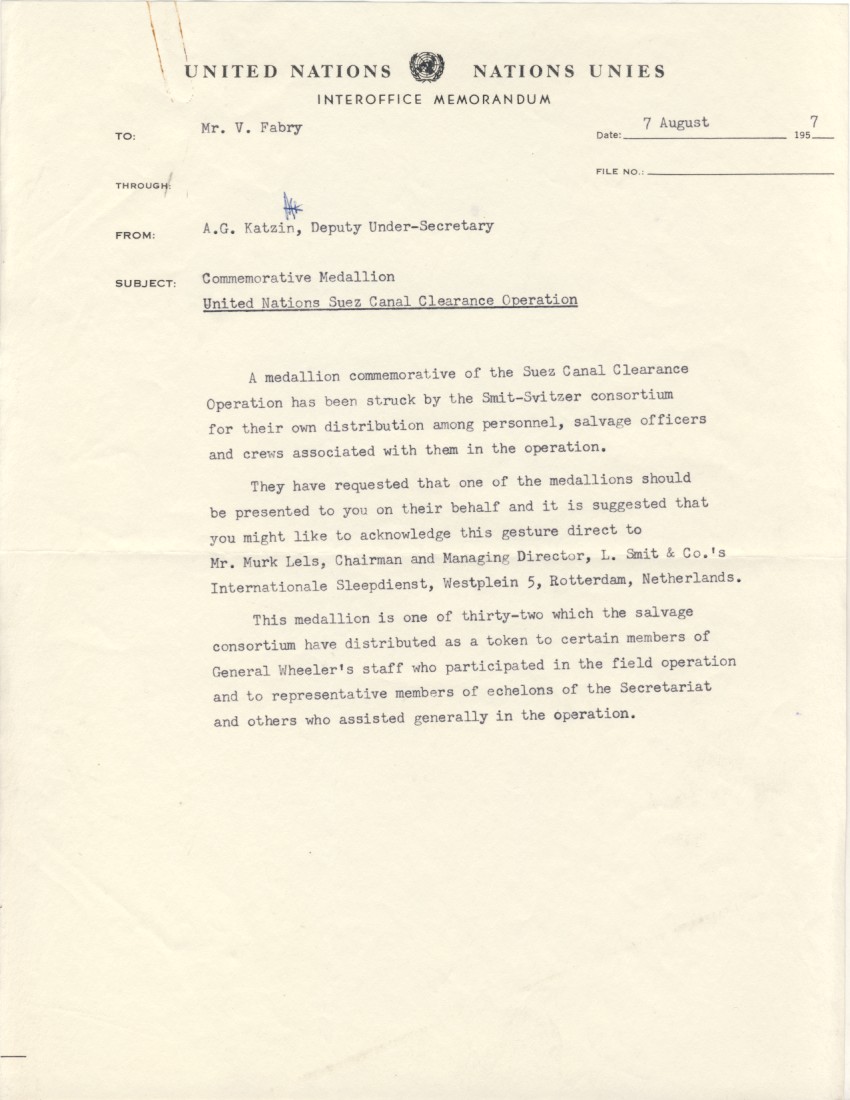
Commerorative Medal letter

7 August 1957

TO: Mr. V. Fabry

FROM: A.G. Katzin, Deputy Under-Secretary

SUBJECT: Commemorative Medallion
United Nations Suez Canal Clearance Operation

A medallion commemorative of the Suez Canal Clearance Operation has been struck by the Smit-Svitzer consortium for their own distribution among personnel, salvage officers and crews associated with them in the operation.

They have requested that one of the medallions should be presented to you on their behalf and it is suggested that you might like to acknowledge this gesture direct to Mr. Murk Lels, Chairman and Managing Director, L. Smit & Co.’s International Sleepdienst, Westplein 5, Rotterdam, Netherlands.

This medallion is one of thirty-two which the salvage consortium have distributed as a token to certain members of General Wheeler’s staff who participated in the field operation and to representative members of echelons of the Secretariat and others who assisted generally in the operation.

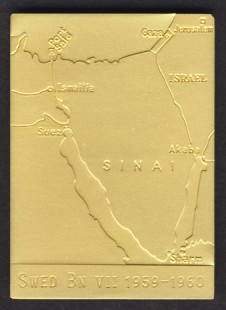
Suez Canal Commemorative Medal obverse

Suez Canal Commemorative Medal reverse

Geneve, 23.VIII.1957.

My Dear One,

I hoped to be with you by now – but it still isn’t quite that far yet. I am going to be released from sick-leave status by the end of the month, though, unless some new trouble shows by then. Seems I really managed to make a mess of myself. Then they want me to take a convalescing cure for two or three weeks – which I wouldn’t mind too much as I shall be allowed to go on walks and to spend the time in the mountains (or rather, unfortunately, under them). I’m still weak, listless and irritable, but I’m sure that will pass when I’m able to live more normally. I can eat a bit more now – an absolute starvation diet by my usual standards but quite an improvement – although I still get cramps whenever I exceed the slightest bit the norm in amount or kind, and nothing will do but the most carefully supervised home cooking. And that is supposed to last for another three months – how cheerful!

My future dietary problems caused me also to change my mind about my apartment. I don’t know whether you heard, but my landlord had some troubles with the house owners (who want to make a cooperative and force old tenants out) about subletting the place, and as a result my sub-sub-tenant, David Sisson, had to move out in May a few weeks earlier than his agreed date (which was to coincide with my planned return). The situation was apparently smoothed out, but the threat that the sub-tenant may have to leave the apartment at short notice persisted, and so I wrote to my landlord that I did not consider further bound by my lease as of May. There was some correspondence in which he asked me to remove my belongings and I claimed difficulties. But after learning that I shall have to rely on home cooking because my diet will still be too restricted to allow me relying on restaurants I decided that I may be best off keeping the place (where I can go home for lunch) even if it will be only for a short time. Two days ago I wrote to Mr. Crandall that if he did not yet find another tenant, I am willing to keep the apartment. At the same time I wrote to him that if he has rented the apartment and still insists on moving my stuff out, he should get in touch with you. I hope it won’t be necessary but if it comes to the worst, would you be kind enough to see to it that my things are properly packed and put away – maybe Harry LeBien could help you taking the stuff away, and of course if you can keep it for a while in some attic it would save the need to crate the loose items that do not fit into the two empty suitcases I have there. There are two packed suitcases, a rucksack and a lot of loose stuff in the two closets (bedroom and hall) that I used; if I remember well, I left there also some small bags, some packed and some empty. You will, I hope, recognize my radio, embroideries and dishes and glassware – if not, a commission consisting of you, Karol, David Sisson and Mr. Crandall should be able to decide on the ownership of each item found in the bedroom, living room and kitchen. My books were on the lower shelf on the right of the bed. The biggest problem will be the kitchenware which I left out so that David can use it, but where some items belong also to Mr. C.. I hope you don’t mind this nuisance but it is a great comfort to me to know that somebody will take good care of my interests if it comes to it, and I know I can rely on you!!!

Au revoir soon – and all my love –

Vlado

8 September 1957

I sure was disappointed when I read that it would be later still. But it’s much wiser and, of course, only fair since you didn’t have any vacation. You must be having a wonderful time; wish I was there.

Thanks for the pictures. You certainly have made good progress. Being able to sit up for your meals really means a lot, doesn’t it. What really hit me in the other picture (besides your horizontal position) though was the look on your face and the way your hand lay so limply. Don’t ever do that again! – get sick, I mean.

And the beard is interesting. I guess it was hard to shave in bed. But wasn’t it uncomfortable during those hot days?

I look kinda different too – got my hair cut. But since I haven’t a decent picture you’ll have to use your imagination. Hope you like it too, because I do – lots.

So far I’ve heard nothing from Mr. Crandall. I’m glad you recognize my dependability. My mother told me it would come in handy. I just like doing things for people like you, though. So don’t worry about it being a possible nuisance.

Hope to see you real soon, darling. I love you –

Mary Liz