Category Archives: UNOC

No Sun Without Shadow

“There is no sun without shadow, and it is essential to know the night.” – Albert Camus, The Myth of Sisyphus

Archival assistance and emotional support from Farfel. Swissair ticket stubs from 29 December 1960 to 10 February 1961; Vlado’s father, Pavel, died of a heart attack in Berlin 19 December 1960. Sabena ticket stub appears to be from 1956, date is unclear. St. Bernard medal retrieved from the Albertina crash site, Ndola, 17-18 September 1961.
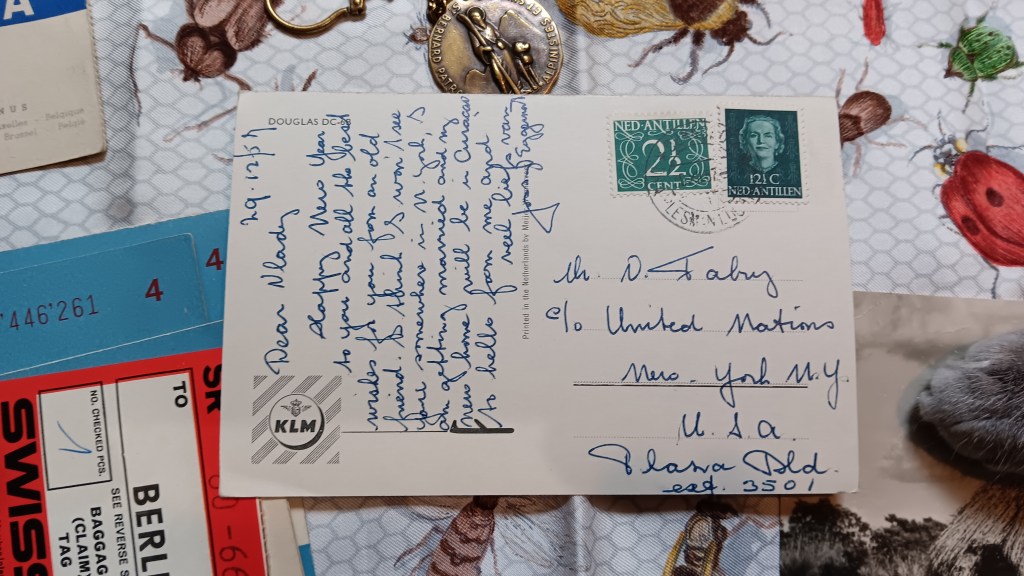
KLM postcard addressed to Vlado, care of the United Nations, New York, N.Y., “The Flying Dutchman”, Douglas DC-6B.
KLM postcard reverse, 29 December 1957: “Dear Vlady, Happy New Year to you and all the best wishes for you from an old friend. I think I won’t see you somewhere in N. York, I am getting married and my new home will be in Curacao…”
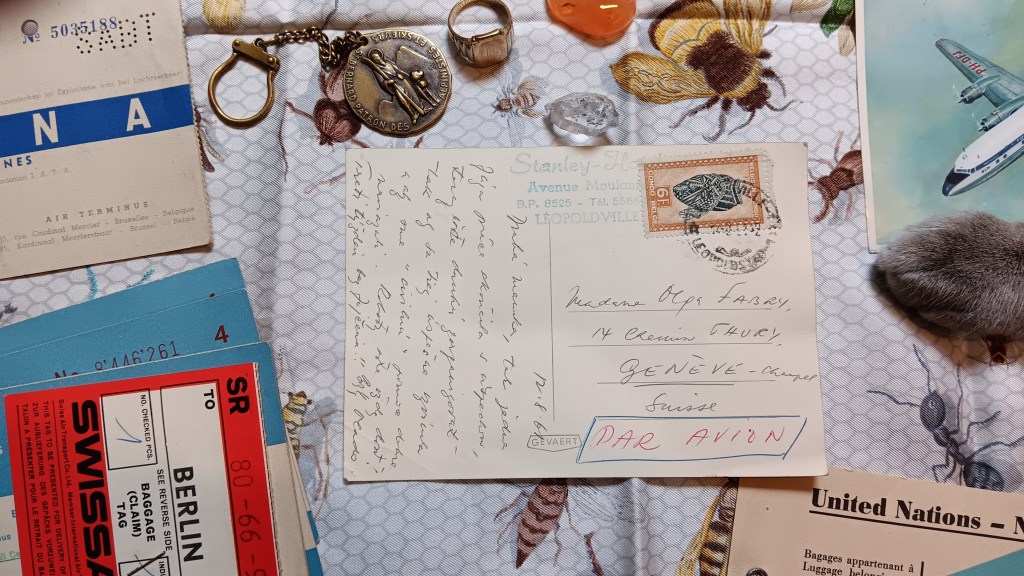
Farfel picks his favorite postcard from Vlado, sent from former Leopoldville, Democratic Republic of the Congo, now Kinshasa.
Reverse of postcard from Vlado, 12 August 1961, to his mother, “Maminka”, Madame Olga Fabry.
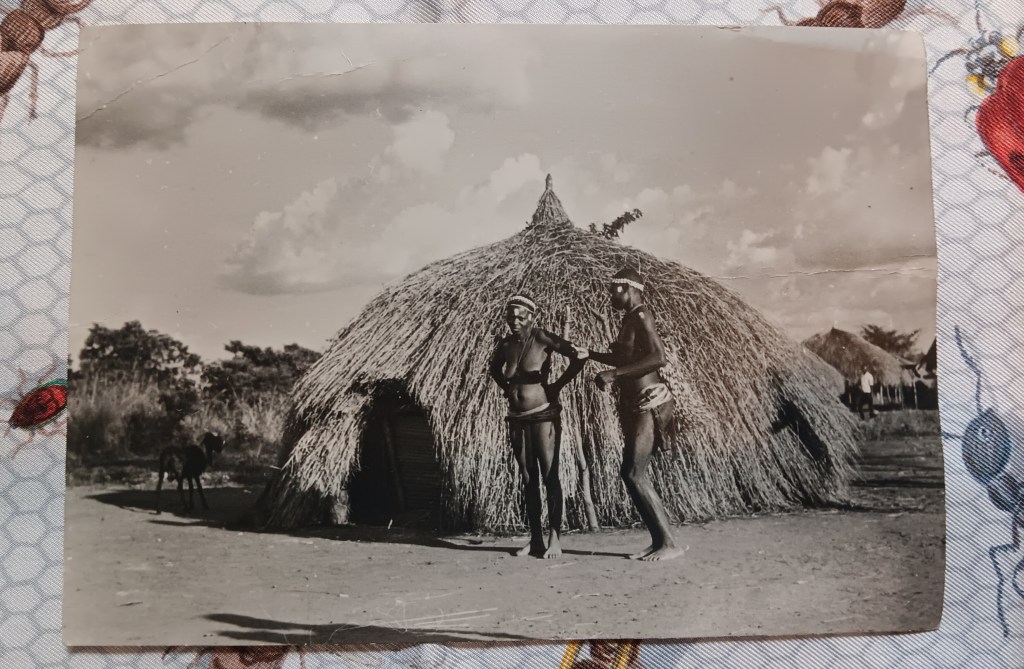
A better look at the real photo postcard from Vlado, purchased from the “Stanley-Hotel, Avenue Moulaert”.
Vlado’s signet ring, retrieved from the Albertina crash site, Ndola, 17-18 September 1961.

“The struggle itself towards the heights is enough to fill a man’s heart. One must imagine Sisyphus happy.” – Albert Camus, The Myth of Sisyphus

“…the dreamt kingdom of peace…”

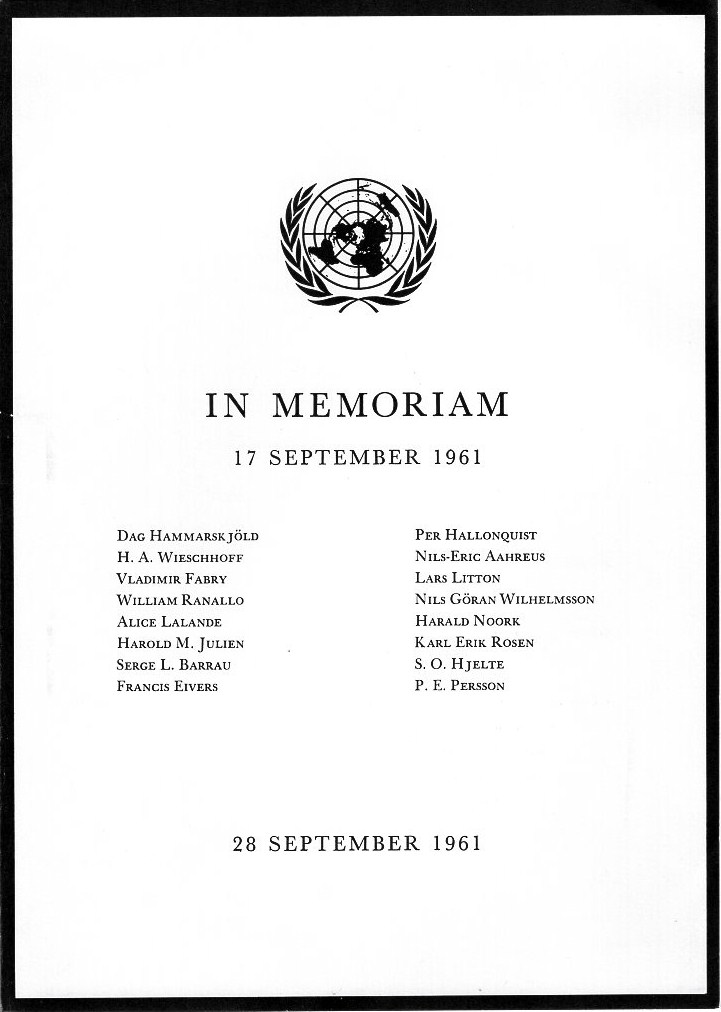
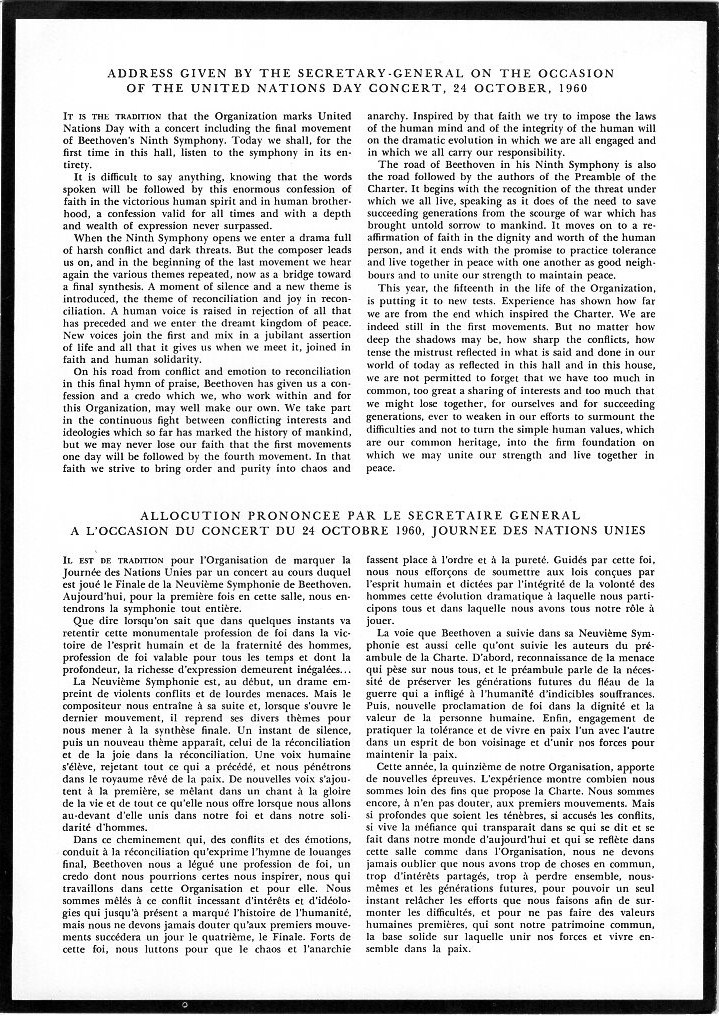
From the family archive, here is the program from the United Nations memorial service for Secretary-General Dag Hammarskjold, and the 15 others who died with him, on 17 September 1961, while on a peace mission to Ndola. As the anniversary nears, I send kind thoughts to all who have been touched by this event. Included in the memorial program, held on 28 September 1961, is an address by the late Secretary-General Dag Hammarskjold “on the occasion of the United Nations Day Concert, 24 October 1960” – it is one of Hammarskjold’s shorter speeches, but full of his warmth and optimism for humanity, so I have transcribed it here.

To further appreciate Hammarskjold’s sentiment towards music, to feel a little of what he felt when he listened to Beethoven, I have included the Christmas Day 1989 Berlin performance of Beethoven’s Ninth Symphony, conducted by Leonard Bernstein, in celebration of the fall of the Berlin Wall – it is perfection, one of the most beautiful and moving concerts of all time.

(click images to enlarge)
UN Memorial program, 28 September 1961

IN MEMORIAM, 17 SEPTEMBER 1961

Dag Hammarskjold
Per Hallonquist
H.A. Wieschhoff
Nils-Eric Aahreus
Vladimir Fabry
Lars Litton
William Ranallo
Nils Goran Wilhelmsson
Alice Lalande
Harald Noork
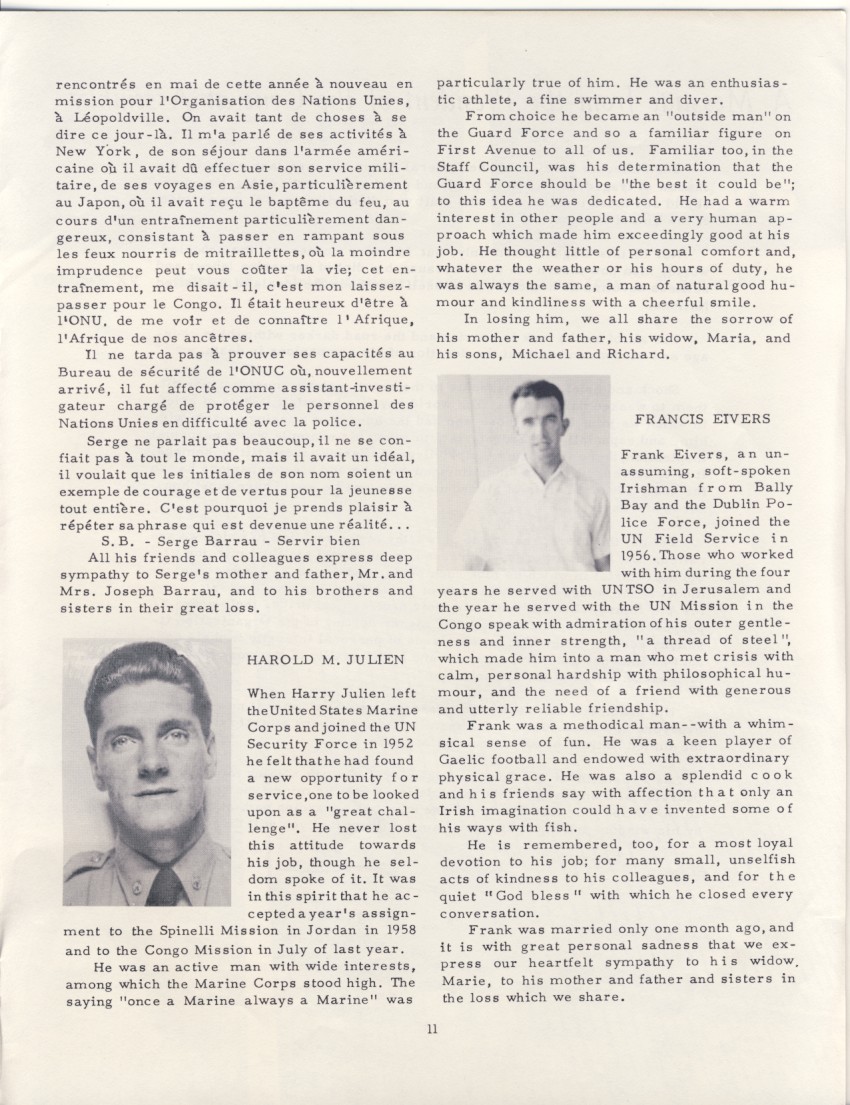
Harold M. Julien
Karl Erik Rosen
Serge L. Barrau
S.O. Hjelte
Francis Eivers
P.E. Persson

28 SEPTEMBER 1961

UN Memorial program, 28 September 1961, p.2

UN Memorial program, 28 September 1961, back page

“ADDRESS GIVEN BY THE SECRETARY-GENERAL ON THE OCCASION OF THE UNITED NATIONS DAY CONCERT, 24 OCTOBER, 1960”

It is the tradition that the Organization marks United Nations Day with a concert including the final movement of Beethoven’s Ninth Symphony. Today we shall, for the first time in this hall, listen to the symphony in its entirety.

It is difficult to say anything, knowing that the words spoken will be followed by this enormous confession of faith in the victorious human spirit and in human brotherhood, a confession valid for all times and with a depth and wealth of expression never surpassed.

When the Ninth Symphony opens we enter a drama full of harsh conflict and dark threats. But the composer leads us on, and in the beginning of the last movement we hear again the various themes repeated, now as a bridge toward a final synthesis. A moment of silence and a new theme is introduced, the theme of reconciliation and joy in reconciliation. A human voice is raised in rejection of all that has preceded and we enter the dreamt kingdom of peace. New voices join the first and mix in a jubilant assertion of life and all that it gives us when we meet it, joined in faith and human solidarity.

On his road from conflict and emotion to reconciliation in this final hymn of praise, Beethoven has given us a confession and a credo which we, who work within and for this Organization, may well make our own. We take part in the continuous fight between conflicting interests and ideologies which so far has marked the history of mankind, but we may never lose our faith that the first movements one day will be followed by the fourth movement. In that faith we strive to bring order and purity into chaos and anarchy. Inspired by that faith we try to impose the laws of the human mind and of the integrity of the human will on the dramatic evolution in which we are all engaged and in which we all carry our responsibility.

The road of Beethoven in his Ninth Symphony is also the road followed by the authors of the Preamble and of the Charter. It begins with the recognition of the threat under which we all live, speaking as it does of the need to save succeeding generations from the scourge of war which has brought untold sorrow to mankind. It moves on to a reaffirmation of faith in the dignity and worth of the human person, and it ends with the promise to practice tolerance and live together in peace with one another as good neighbours and to unite our strength to maintain peace.

This year, the fifteenth in the life of the Organization, is putting it to new tests. Experience has shown how far we are from the end which inspired the Charter. We are indeed still in the first movements. But no matter how deep the shadows may be, how sharp the conflicts, how tense the mistrust reflected in this hall and in this house, we are not permitted to forget that we have too much in common, too great a sharing of interests and too much that we might lose together, for ourselves and for succeeding generations, ever to weaken in our efforts to surmount the difficulties and not to turn the simple human values, which are our common heritage, into the firm foundation on which we may unite our strength and live together in peace.

A Christmas Card and Good News

It wouldn’t be Christmas without a Christmas card, so here is one for you. I don’t know who the people pictured are, but they do look merry! This was sent to Vlado – United Nations Box 20 Grand Central Station – with no return address.
Christmas card to Vlado

And inside – a mysterious and amusing poem! From who??
Christmas poem to Vlado

Strange
silent
mono-one
with
leaping
liver
.
.
rule
yourself
epistolary
at-home
too
.
.
.
(Wednesday
nights)
.
.
.
.
or
send
me
a card
with
a spotted
Swiss
cow
.
.
.
.
.

And now for the good news: The Resolution put forward by Sweden passed in the United Nations General Assembly today – and now there are 56 co-sponsors from around the world! Is someone trying to restore my faith in humanity? To all who have contributed in some part to this worthy effort, my thanks and gratitude!

From the Archive of Sir Roy Welensky, 1961

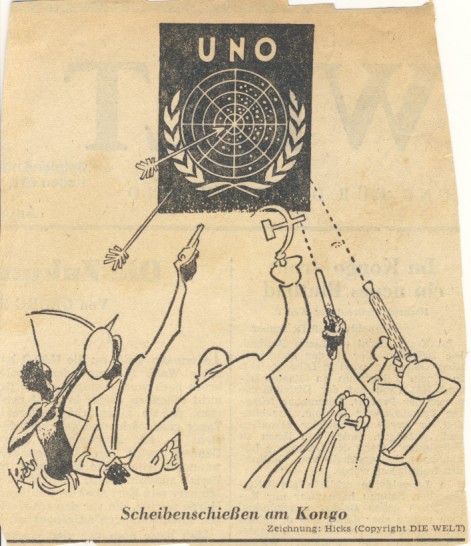
Congo political cartoon
“Target shooting at the Congo” (DIE WELT clipping from Fabry archive)

Back in January, I posted one of three letters that were sent to me from the Archive of Sir Roy Welensky, the last Prime Minister of the Federation of Rhodesia and Nyasaland; written by High Commissioner of South Africa, H.L.T. Taswell, and marked “TOP SECRET”. Since they don’t appear to be available anywhere else, I decided to publish the other two letters here today, in full (emphasis mine).

12th October, 1961

TOP SECRET

SECRETARY FOR EXTERNAL AFFAIRS.
PRETORIA

The Federation and the Katanga

At Sir Roy’s request, I had an interview with him this morning.

He told me that there were certain things he would like to have brought to the notice of our Prime Minister. One of them was that he had had a talk about ten days ago with Tshombe. The interview took place at Sir Roy’s request and Tshombe was flown to the airport at Salisbury with two Katanga Ministers. They spoke for about five hours in secrecy.

While he did not always think too much of the black man as a statesman, Sir Roy said, he was greatly impressed with Tshombe’s ability and sincerity. Sir Roy told Tshombe he had arranged the meeting because he felt there were certain points he wished to stress and hoped he would take his advice.

Sir Roy told him that it was impossible for him to try to fight the whole Afro-Asian bloc on his own and that it was essential to avoid a further clash with the U.N. which could be disastrous particularly with Nehru, his greatest enemy, doing everything he could to crush the Katanga completely.

The Katanga was the first setback the Afro-Asian bloc had suffered in Africa and it was therefore essential that he, Tshombe, should do all he could to capitalize on it. He must play his cards extremely well. As a start, it was most desirable that he should have talks with Adoula and reach a Congo settlement. He suggested that he should insist that all outsiders, including the United Nations, be excluded from the talks. Furthermore, any agreement reached with Adoula should be on a phased basis. No irrevocable step should be taken and each successive phase of a settlement should only be put into operation when each previous step had been carried out in an entirely satisfactory manner. Sir Roy hoped too that Tshombe would move in the direction of a federation in which a certain degree of autonomy would be retained by the Katanga.

Tshombe accepted this advice with much gratitude and since his return it appears that he has been working in this direction.

In so far as the United Kingdom and the Katanga were concerned, Sir Roy said his tactics all along had been to keep the United Kingdom fully informed on how he viewed developments. He had given them advance warning all along of trouble and had forecast developments with accuracy.

The United Kingdom, however, had preferred to close their eyes to all this and to let the United Nations go ahead unchecked.

When the Indians moved into the Elisabethville Post Office last month and the fighting started, Sir Roy delivered an ultimatum to the United Kingdom. He said that regardless of what the Federation’s legal position might be he was going to aid Tshombe. The Federal Air Force was at the alert and unless the United Kingdom took steps at once to the check the United Nations he was ordering the RRAF into action.

“While Tshombe and I could not have taken on the world we could have cleared up that U.N. bunch in no time. And that, ‘he smiled’ would really have started something.”

This ultimatum infuriated the United Kingdom and Sir Roy’s public statement that the British were going back on assurances they had given regarding the Katanga so incensed Mr. Sandys that he said he would have no further dealings with Sir Roy.

Driven into a corner, however, and fearful of the consequences for themselves of any federal armed intervention, the United Kingdom brought pressure to bear on the United Nations and the United States for a cease fire.

Since then Sir Roy has been pressing a reluctant U.K. to take further action by supplying them with information on the U.N. violations of the ceasefire and their military build up. He has been asking the United Kingdom what justification there is for example for the bringing in of Canberra bombers and jet fighters when the Katanga has only one Fouga jet trainer. The United Kingdom are now finally reacting favourably to all this and their influence on the Americans and U.N. is discernible.

In this connection, he mentioned that a further U.N. attack on Tshombe was expected this past week-end but it had not materialized. The danger of such an attack, incidentally, was the motive behind the issue of Sir Roy’s statement last Saturday. The text was telegraphed to you.

We believe that O’Brien’s recall for consultation is imminent and that he is unlikely to return to the Congo.

While Tshombe and his regime are by no means out of the woods, Sir Roy believes that they now have a reasonable chance of survival.

Touching on the Indians, Sir Roy said that one of the main reasons for their use was that other troops, particularly the Tunisians, had shown themselves to be extremely faint hearted. When the action started in the Katanga, the Tunisians had refused to leave Leopoldville.

Sir Roy, however, does not underestimate Indian motives. Referring to the report of an agreement between Lumumba and [Rajeshwar] Dayal for the settlement of two million Indians in the Congo, he stated that he had heard that documentary proof of this was available but he had not yet been able to lay his hands on it.

Referring to the Indian military build-up, he said he hoped we fully appreciated the grave danger it presented to us as far as S.W.A. was concerned.

His security people had information that a further contingent of Indian troops had arrived at Dar-es Salaam on October 8th on an American transport ship. The name of the vessel was something like “Blatchford”.

Touching on the question of foreign mercenaries, Sir Roy mentioned that the Federation had taken a man by the name of Browne off one of the two Dove aircraft that came up from South Africa recently on their way to the Katanga.

Sir Roy said they have proof that Browne was working for both sides – the U.N. and the Katanga. This is the man Col. Zinn spoke to the Commandant-General about when he visited South Africa recently.

After the interview I asked Federal security what they knew against him specifically. They replied that the white Katanga security people had long suspected Browne of double dealings. Also, when he was taken prisoner of the U.N., along with other mercenaries, earlier this year he was released “almost in a matter of minutes” while the others were detained. As a personality too federal security have no time for him and do not trust him in the least. His British passport was impounded by the United Kingdom High Commissioner here and he has been declared a prohibited immigrant by the Federal Government. He may since have made his way into the Katanga.

On the subject of Dag Hammarskjoeld’s [sic] death, Sir Roy said that he was preparing to have an enquiry take place under the chairmanship of the Chief Justice of the Federation, Sweden and I.C.A.O. would be invited to attend and he hoped to obtain another judge from a neutral country such as Switzerland. He would insist that the enquiry be a public one as there were certain things he felt should come out in the open and not be hushed up.

Hammarskjoeld’s plane left Leopoldville in such secrecy that even the United Nations Commander there did not have details of the flight. The plane had sufficient petrol on board when it started out for 13 hours flight. When it was over Ndola it still had sufficient fuel for another 8 hours. The plane had taken a round about route to avoid Katanga. There were 7 guards on board and a large quantity of ammunition. The general impression gained was that all were greatly afraid of an attack by the Katanga jet. The plane circled Ndola but did not ask for permission to land. There is reason to believe that the pilot may even had made a mistake in the altitude of Ndola and confused it with that of a place with a similar name in Angola.

Hammarskjoeld’s bag of documents was intact and could not be opened as it had a special locking device. Various parties tried their best to gain control of the bag. It was finally handed to the U.N. Representative. The Swedish Minister in South Africa was one of those who made strong endeavours to secure it. The Minister, Sir Roy said, gave the impression here of being an unpleasant character who required watching.

Turning to the Federation’s own present position, Sir Roy seemed very heartened by the removal of McLeod as Colonial Secretary and by the increasing feeling among Conservatives that the British Government should go more slowly in its African policy and that the interests of the white man should be protected.

The situation in Northern Rhodesia was also improving. Kaunda was being more and more discredited and his campaign of violence had backfired on him considerably. The Northern Rhodesia Government was distributing posters showing the damage done to schools and this was having a telling effect on the the Chiefs. The United Federal Party was now actively backing Katilungu of the A.N.C. with funds and helping him in his campaign. He was following closely behind Kaunda on his tour through parts of Northern Rhodesia and meeting with considerable success.

Although Heinriche and the Campbell, Booker Carter group were also backing Katilungu Anglo-American’s position was not very clear. Rhodesia’s Selection Trust, it seemed, did not approve of the idea at all. They had backed Kaunda very strongly, Sir Roy added, and Kaunda was also McLeod’s choice as leader of Northern Rhodesia.

He remarked incidentally that neither Anglo-American nor RST contributed financially to the United Federal Party any longer. (In a recent report I commented that I had heard these companies had recently restored their support. The information was given to me by an opposition M.P.)

Sir Roy did not touch on Dr. Banda directly. He just nodded his head and smiled when I commented that Banda would find himself very isolated if Katilungu were to come to terms with the United Federal Party. Sir Roy just did not seem to worry what happened to Banda.

During my interview I referred to our desire to overfly Federal territory in order to map our border. Sir Roy’s reaction was “Of course you can. Go ahead”. At the request of the Secretary for External Affairs here I have, however, put the request in writing and hope to have a formal reply shortly.

On defence generally Sir Roy did not say anything special but he gave me to understand that he would like to see Mr. Caldicott visit South Africa shortly.

Sir Roy said that he thought our Minister’s statement at the U.N. was a very sound one indeed and that Afro Asian reaction showed that body up in its true light. I gave Sir Roy a full copy of the Minister’s statement.

While one has gained the impression all along here that the Federal Prime Minister has been Tshombe’s main champion, the additional information Sir Roy gave me today shows just what lengths he was prepared to go to help the Katanga. But for the great pressure he brought to bear on the United Kingdom I think Katanga would have collapsed by now – and the U.N. and the Indians would no doubt have had more time to devote to S.W.A.

We can be extremely thankful that our Federal buffer to the north has as capable and resolute a Prime Minister as Sir Roy. We can be glad too that he has as skilled and well informed a Secretary for External Affairs as Mr. F.N.N. Parry. Both, moreover, show an exceptional amount of goodwill towards our country.

H.L.T. Taswell
High Commissioner

——————————————————————————————————-

2nd December, 1961

TOP SECRET

SECRETARY FOR FOREIGN AFFAIRS
PRETORIA

The Federation and the Dangers Ahead.

“The wind of change speech which Macmillan made in Cape Town was originally to have been made by Butler but it was postponed because of Strijdom’s death.”

That is what Sir Roy told me in the strictest confidence when I had an interview with him this morning. He asked too that the information be passed only to the Prime Minister, our Minister of Foreign Affairs and yourself.

He revealed this piece of information while talking about the great dangers facing Southern Africa.

Sir Roy, as you know, has just recently returned from London and Lisbon. Salazar, he said, is a worried, disillusioned and perturbed man who finds it extremely difficult to understand why his friends have turned against him.

“I am not disillusioned by Britain’s attitude” Sir Roy went on “I have known the British too long. If they tell you one thing now you can be almost certain that they mean exactly the opposite.

“A few weeks before McLeod was switched to another cabinet post I was assured” Sir Roy continued “that no such change was contemplated. Now I am assured that Macmillan will fight the next election. That just about convinces me that he will shortly resign in favour of Butler.”

Macmillan, Sir Roy added, has aged about five years mentally since he last saw him and will accordingly not be able to hold the reins of government much longer.

The present British trend to get out of Africa as quickly as possible is nothing new, he continued, it has been part of a plan for several years. Men like Lennox-Boyd and Home who developed such close and sound personal relations with people in British territories in Africa have been deliberately pushed aside. The British Government do not want people in top positions who have given firm assurances abroad which it would now be embarrassing for them to withdraw. The British want their hands free.

It was at this stage of the conversation that Sir Roy mentioned the wind of change speech in Cape Town.

Shortly before this he had said that “we in this country are on our own. I fully realize that.” He added that there was a tremendous danger of Southern Africa being cut off altogether of arms. The United Kingdom, he said, were selling fighter aircraft to the Federation at top prices. America on the other hand was supplying Yugo Slavia [sic] with aircraft at a nominal price of $10,000 each. Russia was now giving Migs to African states free of charge in order to help them in their struggle for freedom.

In the face of all this he went on, he was disgusted to see that Denmark had just refused to supply any further arms to Portugal. He deplored Israel’s action in voting for sanctions against us and added “I hope your Prime Minister is bending every possible effort to produce an atomic bomb in South Africa.”

Sir Roy stated that during he recent visit to London he had accused the British Government of deliberately going against the white man in Africa and of letting the Federation down at every turn. He told them too that he knew from information he had received in London that they were trying to put obstacles in the way of supplying arms to South Africa and, in turn, to stop the Federation from obtaining anything from the South.

The British Government hotly denied all this.

At present, Sir Roy went on, he could draw all he wanted from Kenya and Aden. Those bases would, however, one day close down and the only British base left in Africa would be the Federation.

It is interesting to speculate at this point whether Sir Roy’s strong remarks in London could not have had some bearing on the favourable negotiations which our Commandant-General and our Secretary for Defence were able to conduct in London recently.

Turning to the Indians in the Katanga, Sir Roy said that he had someone sitting in Dar-es-Salaam and watching troop movements. It was quite clear that more Indians were going into the Katanga than were coming out. Apart from the question of build up of U.N. strength it seemed probable that many Indians were being moved into the Congo as settlers. He confirmed that Indians were making an economic survey and taking an intense interest in mines.

“There is a great deal on the military side which I would like our Minister of Defence to discuss with your people urgently” Sir Roy went on “and I hope he can get down to see you very shortly. I don’t think this matter should be delayed too long.”

Turning to the Federation’s internal affairs Sir Roy remarked that economically the situation was much better than it had been expected to be at this time. Politically too the position looked hopeful.

A month or two ago Sir Roy declared that provided agreement could be reached internally with the constituent territories there would be little need for a review of the Federal Constitution. The British Government would be presented with a fait accompli and have to accept it as such.

I asked Sir Roy what progress he was making in this direction. He replied that Banda had already indicated his willingness to meet him after Maudlin’s present visit was over.

In so far as Northern Rhodesia was concerned Kaunda had already had a talk with Roberts, the leader of the United Federal Party there. Sir Roy has little time for Kaunda personally, however, he has reason to believe that Kaunda was at one time in an asylum and is mentally unstable. He doubts if he has full control of UNIP.

Barotseland, Sir Roy feels, is very much on his side and adamantly opposed to falling under a black nationalist government in Northern Rhodesia. The Federal authorities have provided the territory with a legal adviser to keep it fully informed and advise it on tactics when talking to the British Government.

Expressing confidence that it would eventually be possible to reach an agreement Sir Roy concluded “we will have no Congo here and if Britain tries to force one on us we will defend ourselves at gunpoint.”

This interview was one I had asked for prior to going on leave. As I entered his room, however, Sir Roy remarked that he presumed I had come in response to his request. When I explained that I had not, he said “but I told my people I wanted to see you. How is it these things go wrong?”

Looking back on my talk with him, I would say that Sir Roy is much more worried about the current dangers to the Federation than he cared to admit.

If the Katanga collapses, the Federation will be on its own. If attacked from outside it is very doubtful how long the Federation will be able to hold out on its own. Every effort will no doubt be made to hold the line of rail Northern Rhodesia and the Copperbelt and Southern Rhodesia.

With internal unrest fomented by the UNIP in Northern Rhodesia and by the NDP in Southern Rhodesia, to say nothing of trouble from Banda and from the dissident white elements, the position could be extremely difficult. Our buffer in the North could easily disappear leaving the path open for an attack on South West Africa and ourselves.

I should accordingly not be surprised to find that Mr. Caldicott’s proposed visit to South Africa, is to learn what our attitude is likely to be in the event of an attack on the Federation.

The following is the latest information available on the make up of the Federation’s population—

Whites: S.R. 220,610/ N.R. 74,600/ Nys. 8,730/ Total 303,940
Asians: S.R. 6,990/ N.R. 7,740/ Nys. 10,580/ Total 25,310
Others: S.R. 10,540/ N.R. 1,910/ Nys. 1,500/ Total 13,950
Blacks: S.R. 2,920,000/ N.R. 2,410,000/ Nys. 2,880,000/ Total 8,210,000
———————————————————————–
Total: S.R. 3,158,140/ N.R. 2,494,250/ Nys. 2,900,810/ Total 8,553,200

In assessing the problems which face the Federation one must not underestimate the drive, determination and dynamic personality of Sir Roy who stand head and shoulders about all other politicians in this country.

H.L.T. Taswell
High Commissioner

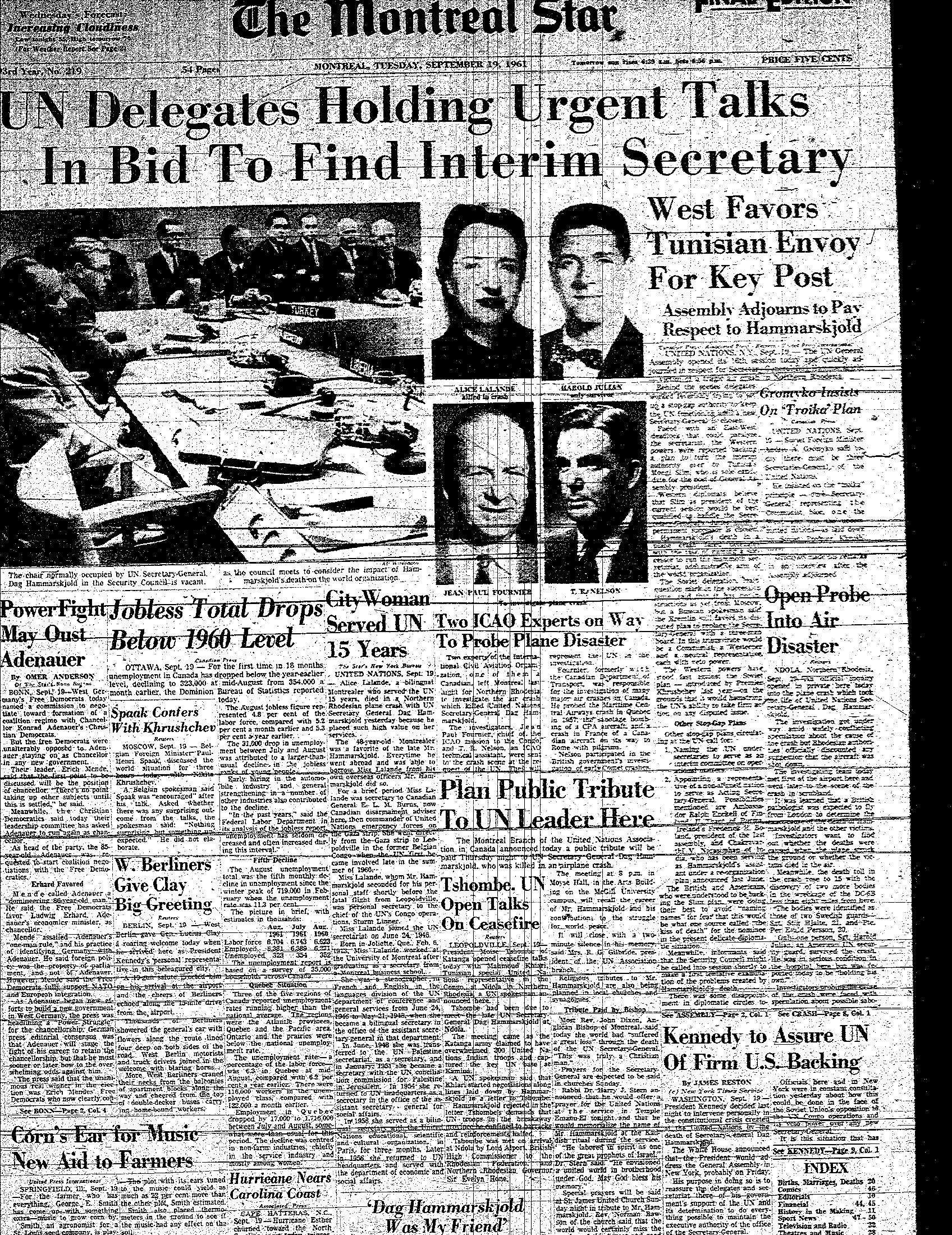
The Montreal Star, 19 September 1961

Here is another brief article about Alice Lalande, who died with Dag Hammarskjold, which was sent on to me by Susan Williams. Because there is so little information about the 15 others who died with the Secretary General, I would like to use this blog as a place to share their stories, too. I encourage people to please contact me, if you have news clippings or anything else you are willing to share about these brave people. I would be glad to honor them here.

Alice pic from Montreal Star-1 (5)
City Woman Served UN 15 Years

UNITED NATIONS, Sept. 19–
Alice Lalande, a bilingual Montrealer who served the UN for 15 years, died in a Northern Rhodesia plane crash with UN Secretary General Dag Hammarskjold yesterday because he placed such high value on her services.

The 48-year-old Montrealer was a favorite of the late Mr. Hammarskjold. Every time he went abroad and was able to borrow Miss Lalande from his own overseas officers Mr. Hammarskjold did so.

For a brief period Miss Lalande was secretary to Canadian General E. L. M. Burns, now Canadian disarmament adviser here, then commander of United Nations emergency forces on the Gaza strip. She went directly from the Gaza strip to Leopoldville in the former Belgian Congo when the UN first became involved late in the summer of 1960.

Miss Lalande, whom Mr. Hammarskjold seconded for his personal staff shortly before the fatal flight from Leopoldville, was personal secretary to the chief of the UN’s Congo operations, Sture Linner.

Miss Lalande joined the UN secretariat on June 24, 1946.

Born in Joliette, Que., Feb. 6, 1913, Miss Lalande worked at the University of Montreal after graduating as a secretary from a Montreal business school. She was a stenographer in French and English in the languages division of the UN department of conference and general services from June 24, 1946 to May 21, 1948, when she became a bilingual secretary in the office of the assistant secretary general in that department.

In June 1948 she was transferred to the UN Palestine secretariat as a secretary, and in January 1951 she became a secretary with the UN conciliation commission for Palestine in Jerusalem. In 1954 she returned to UN Headquarters as a secretary in the office of the assistant secretary general for social affairs.

In 1956 she served as a bilingual secretary with the United Nations educational, scientific and cultural organization, in Paris, for three months. Later in 1956 she returned to UN Headquarters and served with the department of economic and social affairs.

Letters of Olinka: October 1961

Desperate times call for desperate measures, and here is a letter of great desperation written by Vlado’s sister, Olga Fabry – who was still a stateless political refugee at the time of his death – asking Constantin Stavropoulos to help her obtain a professional position at the U. N. Library in Geneva. With both her father and her brother gone, she suddenly had to financially support her mother and herself, and that meant being bold and asking every important person she knew for help. This letter was translated from French:

Oct. 10, 1961

Cher Costi,

Allow me to thank you again for your presence at Vlado’s funeral and for your lovely speech to the church. Your presence was a great comfort to my mother so painfully struck by the cruel loss of her beloved son.

Maman has been admirable until now, but the much dreaded reaction unfortunately has already started to manifest itself. It’s a bit too much for her and for me, especially since Christmas, when Papa died, we had only Vladko for our support. Vladko was our support, notre soutient, our everything, in this world in which we are already deprived of homeland and family. Now we have also lost Vladko, so tragically, so brutally and it seems the ravine of misery and despair appears to engulf us slowly…. Mother is even more saddened and upset since she was always so opposed to his mission in Congo, especially so soon after the death of my father.

Even in New York in the Spring, you were out, I think, she asked M. Schachter could Vladko return as soon as possible. She has been very worried and unhappy ever since Vladko has been in Congo, as if she had a presentiment… She showed me now the copies of letters she wrote to you and Mr. Schachter when Vladko was sent to Congo; he knew nothing of these letter, but she had felt something, and she wanted to do everything for him to return… alas, he left his life there.

Now we have, in our present so heavy, such desperation to take care of our future.

After talks with the Head of Naturalization in Geneva, I obtained a promise of Swiss naturalization on the condition of having employment at the United Nations in Geneva.

I went to see the director of the Library of the United Nations in Geneva, Dr. Breycha Vauthier, who told me of a professional vacancy in the library. He told me he would like very much that I take this position, because I have already worked in the Library of the United Nations in Geneva, I know the languages and that New York always sends someone who is not proficient, who does not know the languages and of which one wants to get rid of.

As I have already worked temporarily on several occasion in the Library, I have already a good experience and thorough knowledge of the functioning of the U.N. Library in Geneva. I’ve even done my diploma work. In addition, my experience in the United States where I am “Head Librarian”, my development from below can only speak in favor of my professional competence. In New York I hold a professional position and my salary is equivalent to that of P II in the United Nations.

Mr. Breycha told me he would write to Mr. Palthey in New York to recommend me from the professional point of view; the professional positions, as you know perhaps, are decided in New York. Mr. Marx told me that he would write to New York to recommend me, so to speak from a point of view of moral obligation of the United Nations to my mother and to Vlado.

If difficulties arise, if there are problems to vanquish, it must be overcome. It must make an exception this time, even if the United Nations have never done it before. Vlado, as you said yourself in your speeches, has rendered outstanding service to the United Nations, and everyone knows how and how much he worked, all that he has so generously given: his brilliant intellect, his intelligence of the heart, his multiple talents, his devotion, and ultimately the sacrifice of his life so young, all to the United Nations.

My mother may have only a few years left to live and I would like to make her life easier as much as possible and make it impossible for her not to suffer any more injustice or human wickedness. She would like to see me continue in some way not so nobly traced by her son and I would like to work in the institution and for its ideals for which Vladko sacrificed his young life.

Decisions for professional positions are taken in New York. Dear Costi, I pray you especially to do EVERYTHING for me to get this professional position in the Library of the U. N. in Geneva, I ask you on behalf of my poor mother so painfully affected and on behalf of our beloved Vladko of which you were a friend. I beg you to continue your friendship with Vladko and also for my mother and me and not abandon us in our hours so difficult to endure.

My thanks go out to you with all my heart for all your help and I ask you to receive, from my mother and me, our best wishes and memories.

Olga Fabry

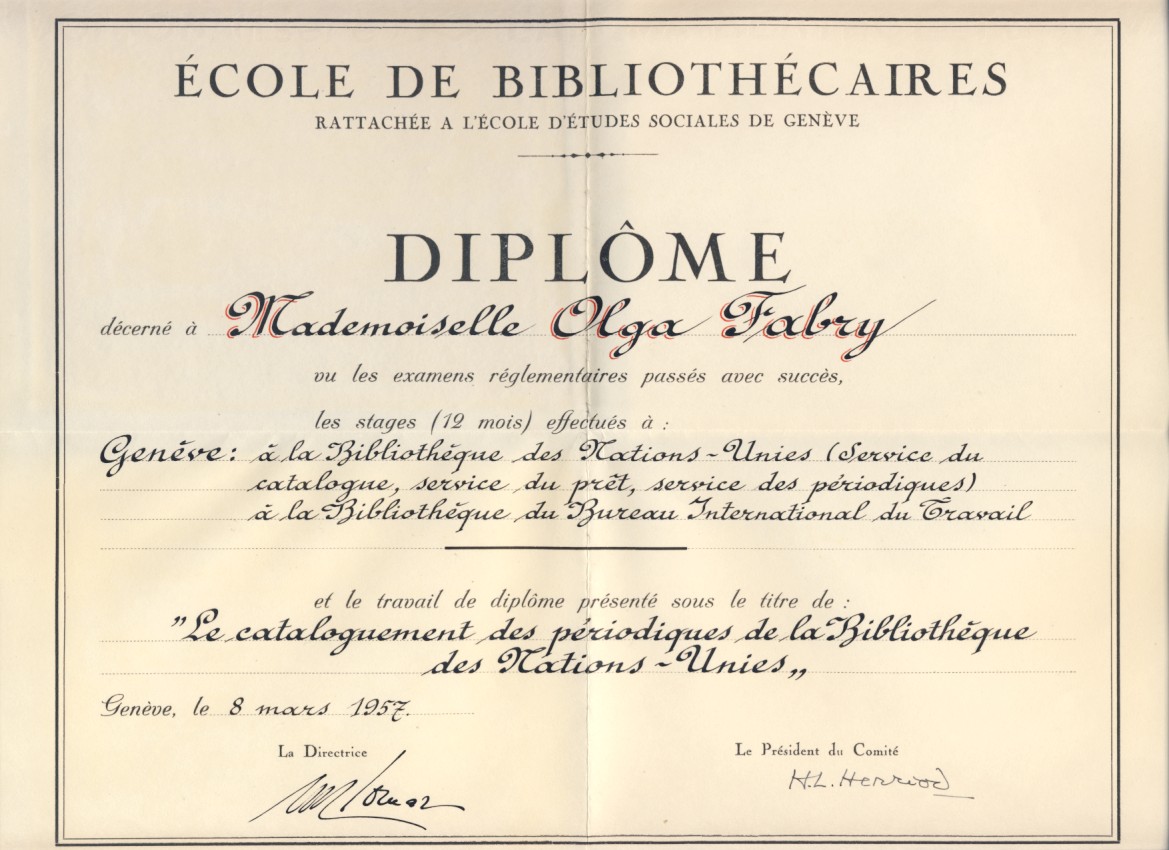
Here is Olga’s diploma from the Ecole de Bibliothécaires, signed 8 March 1957.
Olga Fabry Diploma 1
Olga Fabry Diploma 2

I have not found the letter that Olga sent to Sture Linner, Head of UN Civilian Operations in the Congo, but he found the time to respond her request – even asking Ralph Bunch for his assistance!
Sture Linner letter to Olga 19 Oct 1961

UNITED NATIONS ORGANIZATION IN THE CONGO

19 October 1961

Dear Miss Fabry,

You and your Mother have been in my thoughts very much indeed all this dreadful time. I was so sorry not to be able to find you again on the eve of my departure, but I trust there will sooner or later be an opportunity for me to pass through Geneva and I shall then certainly be very happy to look you up.

I do wish with all my heart that you and your Mother may find strength to endure all the strain from which you must be suffering. Already from our brief encounter, I am convinced that you have the fortitude of character that will carry through even this ordeal.

As to your request for me to help you to obtain an assignment as a Librarian with the UN in Geneva, I took it up with Ambassador Spinelli during our trip from Geneva to Stockholm after you had first mentioned to me your wishes in this respect. Mr. Spinelli promised to do everything he could to obtain some such post for you, and I got the impression that the prospects were quite bright. On receipt of your letter, I have cabled Dr. Bunche in New York, quoting what you say and also reporting on my conversation with Mr. Spinelli. I am sure you realize that a decision on this matter is beyond my competence, but I trust that with a double approach thus having been made, to Mr. Spinelli and to Headquarters in New York, the matter will be settled to your satisfaction.

Please give your Mother my warmest regards.

Sincerely,

Sture Linner

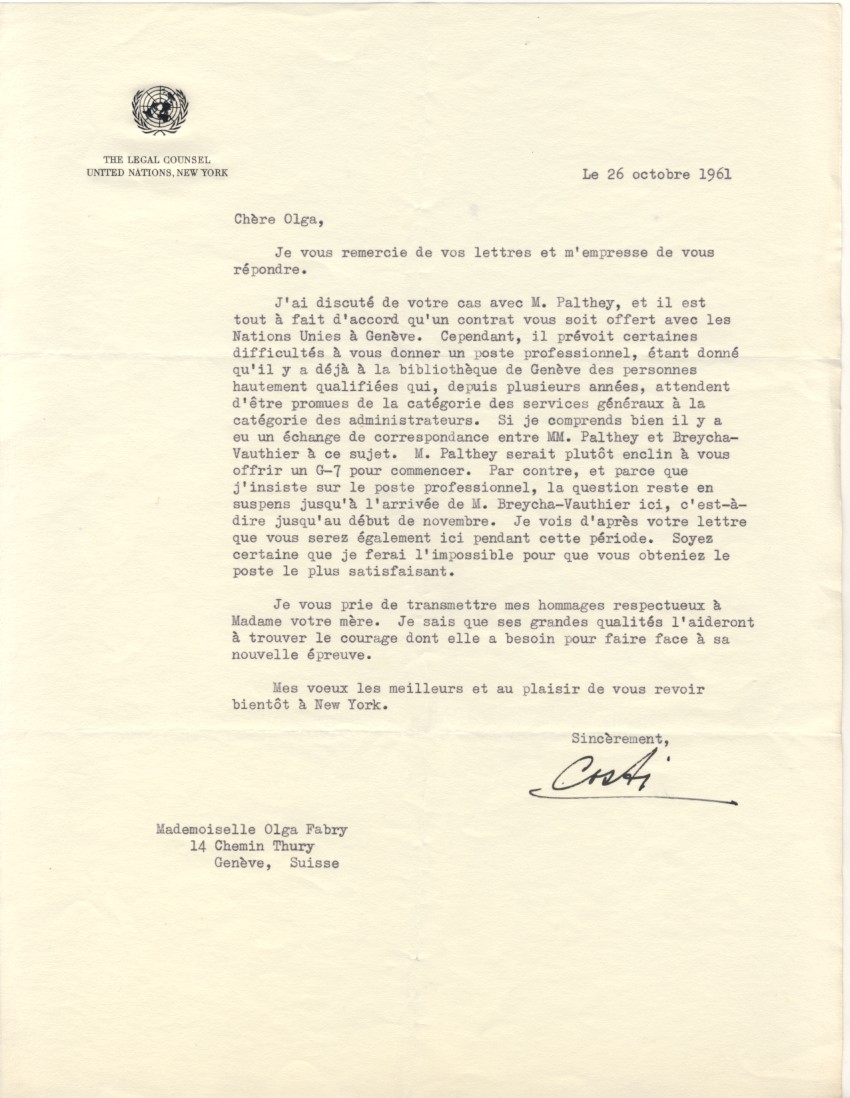
Here also is the response from Stavropoulos, which I did not translate, but he offers some of the same encouragement as Linner:
Costi letter to Olga 26 October 1961

Because of Olga’s intelligence and determination to survive, she was able to find work and take care of herself and her mother, and would eventually spend many years as Librarian at the U.N. Foundation Library in New York, as a citizen of the United States.

Response to Maminka’s Request

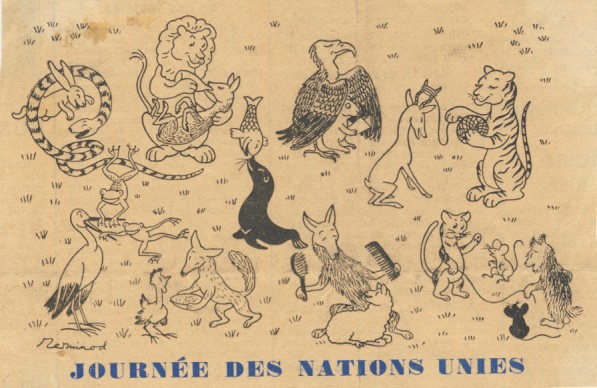
Journee des Nations Unies

In a previous post, “A Desperate Personal Demand For Help”, I posted correspondence written by Vlado’s mother to UN legal counselors Oscar Schachter and Constantin Stavropoulos, where she asks them to reconsider Vlado’s assignment to the Congo. Her need for Vlado was understandable – the stress of losing her husband suddenly, inheriting the legal cases he was unable to finish, and her own poor health, seemed too much to bear alone. What is also understandable, was Vlado’s need for adventure, and to be useful to the United Nations, and to the world. Even the death of his beloved father could not slow down his work, he was devoted to the peaceful goals of the Organization.

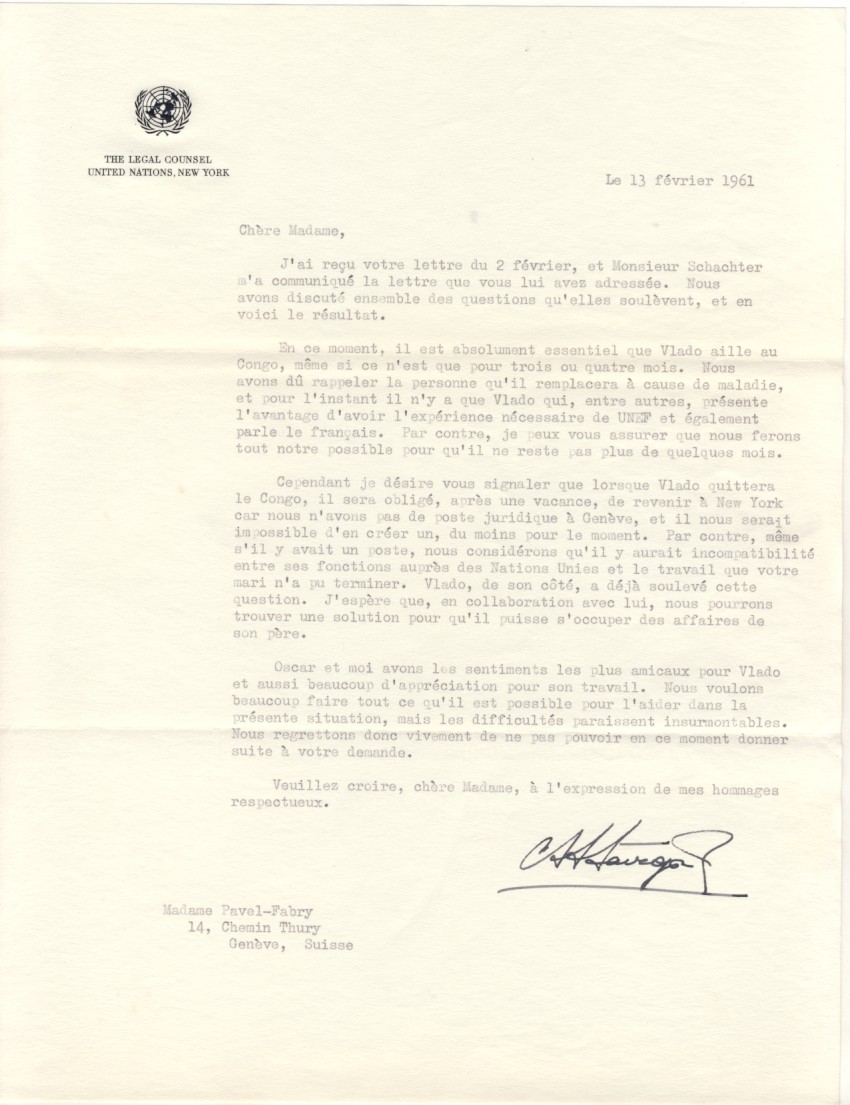
Here is the response to Madame Fabry’s letter from Constantin “Costi” Stavropoulos:

Stavropoulos letter to Madam Fabry 13 Feb 1961

THE LEGAL COUNSEL
UNITED NATIONS, NEW YORK

13 February 1961

Dear Madame,

I have received your letter of 2 February, and Mr. Schachter has communicated to me the letter you sent to him. We discussed all the questions that have been raised, and here are the results.

At the moment, it is absolutely essential that Vlado go to the Congo, even if it is only for three or four months. We had to recall the replacement person due to illness, and at the moment there is only Vlado who, among others, has the advantage of having the necessary experience of UNEF and also speaks French. Conversely, I can assure you that we will do everything possible so that he does not stay more than a few months.

However, I wish to point out that when Vlado leaves the Congo, he will be obliged, after a vacation, back in New York because we have no legal position in Geneva, and it would be impossible to create one, at least for the time being. Besides, even if there was a position, we consider that there would be incompatibility between his duties with the United Nations and the work that your husband could not finish. Vlado, for his part, has already raised this issue. I hope that, in collaboration with him, we can find a solution for him to deal with his father’s business.

Oscar and I have the friendliest of feelings for Vlado and also a lot of appreciation for his work. We want very much to do whatever we can to help in this situation, but the difficulties appear insurmountable. We deeply regret not being able to respond to your request at this time.

Please accept, dear Madame, the expression of our respectful regards.

Constantin Stavropoulos

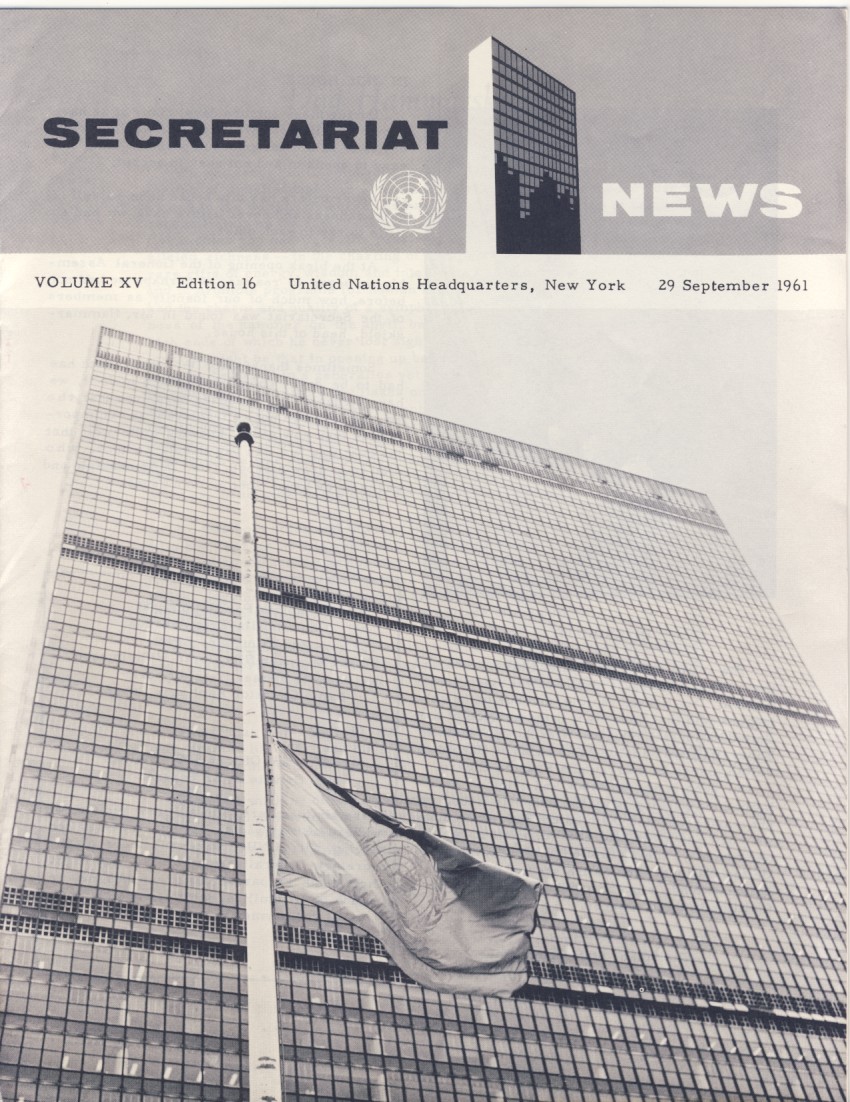
Secretariat News, 29 September 1961

Secretariat News September 1961 cover

Secretariat News September 1961 p2
IN TRIBUTE
The entire staff of the United Nations mourns the sudden and tragic death of the Secretary-General, Dag Hammarskjold, and our other colleagues who lost their lives in the service of the United Nations: Heinrich A. Wieschhoff, Vladimir Fabry, William Ranallo, Alice Lalande, Harold M. Julien, Serge L. Barrau and Francis Eivers.

Our deep sense of shock and grief on hearing of their passing is all the deeper because we knew and respected them as colleagues; because we knew, admired and shared, each in his or her own way, their devotion to the ideals of the United Nations. The entire staff of the Organization extends sincere condolences to their families in their sadness.

R.V. Klein, Chairman, Staff Committee

IN THIS HOUSE
During these somber days, many of us have known a feeling of unreality. The world’s tragedy is to us a most grievous personal loss, not easy to speak of and not easy to accept.

Never before has this house been so full of quiet sadness and never before have we had so little to say to each other.

At the bleak opening of the General Assembly we began to realize, as perhaps we had not before, how much of our identity as members of the Secretariat was found in Mr. Hammarskjold, head of this house.

Sometimes thankful for the work which has had to be done, sometimes unable to do it, we have struggled to persuade ourselves that the routine jobs are not so irrelevant and unimportant as they now seem, knowing quite well that the best way we can pay tribute to those who died is to draw strength from their example and carry on as usual–better than usual.

——————————————————————————————–

Captain Per Hallonquist
Captain Nils-Eric Aarhreus
2nd Pilot Lars Litton
Flight Engineer Nils Goran Wilhelmsson
Air Purser Harald Noork
Radio Operator Karl Erik Rosen
and
Warrant Officer S.O. Hjelte
Private P.E. Persson

These six members of the air crew and the two soldiers of the Swedish 11th Infantry Battalion serving with the ONUC were members of the Secretary-General’s team on his last flight. Their death is part of our great loss and we include their families, their friends and their countrymen in our thoughts.
Secretariat News September 1961 p3
Secretariat News September 1961 p4
Dag Hammarskjold

We who labor “in this house” share with the whole of humanity the deep feeling of unbelief that our great and esteemed chief has been lost to us and to the world. He served humanity in the noble mission of peace and reconciliation as Secretary-General of the United Nations for eight years, five months and one week. His passing marks the close of an era of unparalleled richness — in the charting of new paths in diplomacy, in combining rare gifts of energy, wisdom and intelligence to bring crises under control and to promote programs for human betterment. Sometimes his methods had the charm and quality of a symphony; sometimes the decisive abruptness of the hammer on the anvil, but they were always calculated to gain high ends of which he never lost sight. If he had accomplished less, his epitaph might be that in opening up bold new vistas of international cooperation he belonged to a generation yet unborn. But his accomplishments are myriad–they are like snowflakes on a dotted landscape and the glistening white on the mountain peaks–countless small almost unnoticed achievements joined with decisively constructive results on great issues which only he could achieve by virtue of his office and of the rare natural gifts with which he was endowed. He belongs to our generation; he has carved his name in granite upon it; but he belongs equally to those who will come after us, benefiting by the lights he lit that can illumine their way.

He was both actor and interpreter; both history-maker and historian; with the Charter as his guide and resolutions as his directives, he mobilized and conducted the action with the scope and initiative that each situation required; his executive actions were an interpretation of the Charter which, together with his speeches and reports, gave the document a living quality of rich potentiality for the welfare of mankind.

His unflinching courage rested upon faith and his faith upon principles and ideals derived from a sturdy and valued heritage and an intellect alive with almost limitless appraisal of values with meaning for himself and humanity.

From that day–April 10, 1953–when he took his oath of office, his dedication to the task and his single-minded devotion to duty has inspired the staff and the wider world.

Although working often from dawn to midnight or in crises around the clock, he had time for wide cultural interests — in literature, drama, art and music — which were a source of constant pleasure to his associates in the United Nations family and an inspiration to the masters in these fields.

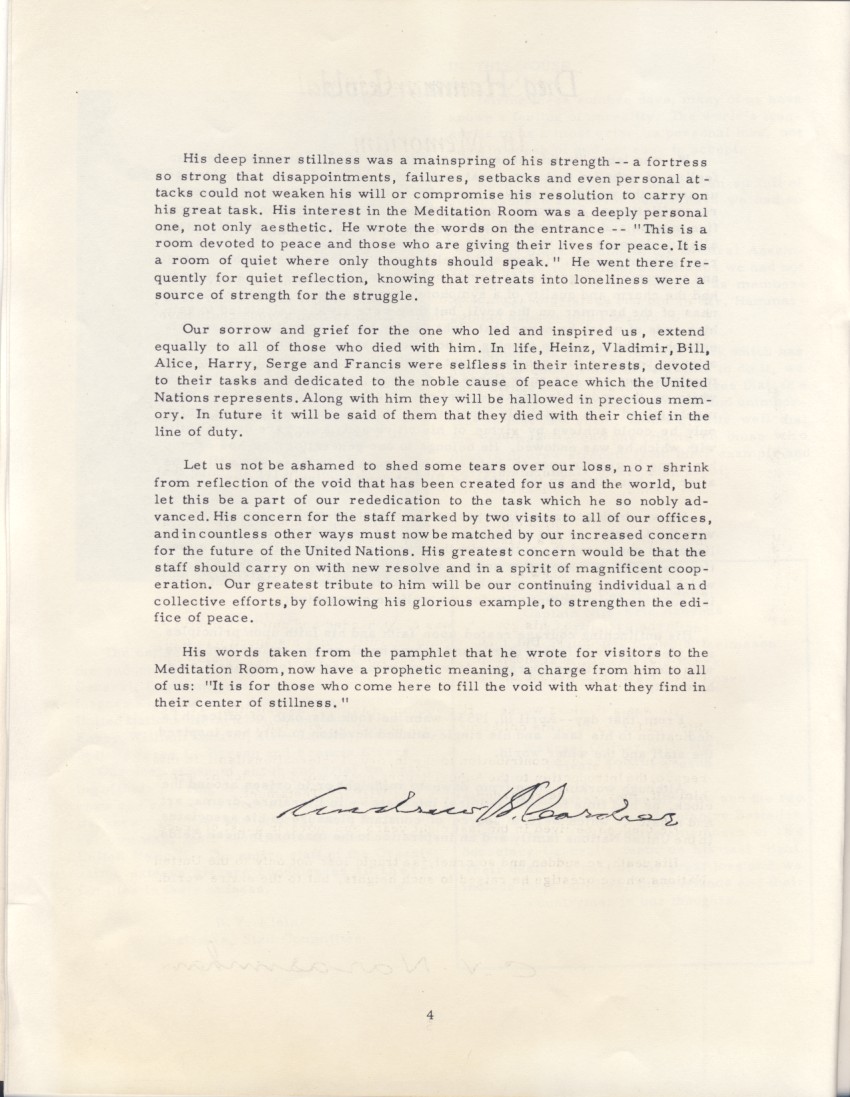
His deep inner stillness was a mainspring of his strength — a fortress so strong that disappointments, failures, setbacks and even personal attacks could not weaken his will or compromise his resolution to carry on his great task. His interest in the Meditation Room was a deeply personal one, not only aesthetic. He wrote the words on the entrance — “This is a room devoted to peace and those who are giving their lives for peace. It is a room of quiet where only thoughts should speak.” He went there frequently for quiet reflection, knowing that retreats into loneliness were a source of strength for the struggle.

Our sorrow and grief for the one who led and inspired us, extend equally to all those who died with him. In life, Heinz, Vladimir, Bill, Alive, Harry, Serge and Francis were selfless in their interests, devoted to their tasks and dedicated to the noble cause of peace which the United Nations represents. Along with him they will be hallowed in precious memory. In future it will be said of them that they died with their chief in the line of duty.

Let us not be ashamed to shed some tears over our loss, nor shrink from reflection of the void that has been created for us and the world, but let this be a part of our rededication to the task which he so nobly advanced. His concern for the staff marked by two visits to all of our offices, and in countless other ways must now be matched by our increased concern for the future of the United Nations. His greatest concern would be that the staff should carry on with new resolve and in a spirit of magnificent cooperation. Our greatest tribute to him will be our continuing individual and collective efforts, by following his glorious example, to strengthen the edifice of peace.

His words taken from the pamphlet that he wrote for visitors to the Meditation Room, now have a prophetic meaning, a charge from him to all of us: “It is for those who come here to fill the void with what they find in their center of stillness.”

— Andrew Cordier

Secretariat News September 1961 p5
The Secretary-General
In Memoriam

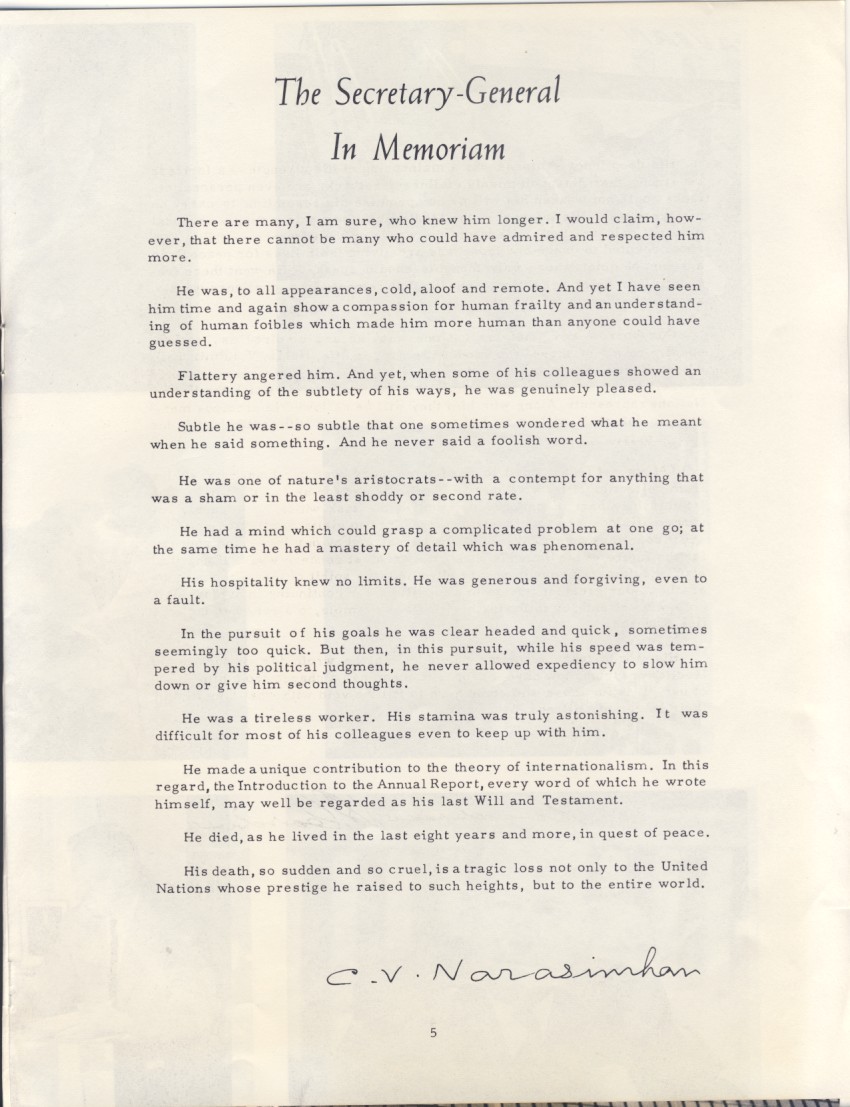
There are many, I am sure, who knew him longer. I would claim, however, that there cannot be many who could have admired and respected him more.

He was, to all appearance, cold, aloof and remote. And yet I have seen him time and again show a compassion for human frailty and an understanding of human foibles which made him more human than anyone could have guessed.

Flattery angered him. And yet, when some of his colleagues showed an understanding of the subtlety of his ways, he was genuinely pleased.

Subtle he was–so subtle that one sometimes wondered what he meant when he said something. And he never said a foolish word.

He was one of nature’s aristocrats–with a contempt for anything that was a sham or in the least shoddy or second rate.

He had a mind which could grasp a complicated problem at one go; at the same time he had a mastery of detail which was phenomenal.

His hospitality knew no limits. He was generous and forgiving, even to a fault.

In the pursuit of his goals he was clear headed and quick, sometimes seemingly too quick. But then, in this pursuit, while his speed was tempered by his political judgement, he never allowed expediency to slow him down or give him second thoughts.

He was a tireless worker. His stamina was truly astonishing. It was difficult for most of his colleagues even to keep up with him.

He made a unique contribution to the theory of internationalism. In this regard, the Introduction to the Annual Report, every word of which he wrote himself, may well be regarded as his last Will and Testament.

He died, as he lived in the last eight years and more, in quest of peace.

His death, so sudden and so cruel, is a tragic loss not only to the United Nations whose prestige he raised to such heights, but to the entire world.

—C. V. Narasimhan
Secretariat News September 1961 p8
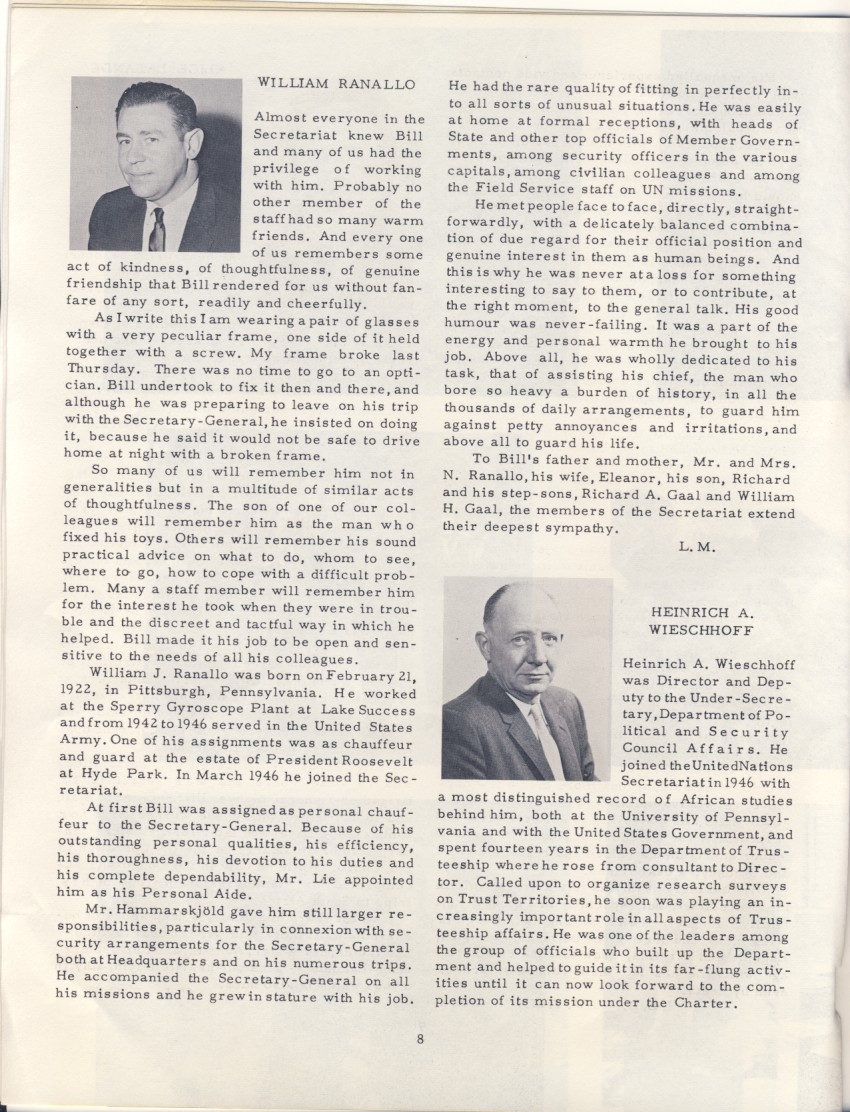
WILLIAM RANALLO

Almost everyone in the Secretariat knew Bill and many of us had the privilege of working with him. Probably no other member of the staff had so many warm friends. And every one of us remembers some act of kindness, of thoughtfulness, of genuine friendship that Bill rendered for us without fanfare of any sort, readily and cheerfully.

As I write this I am wearing a pair of glasses with a very peculiar frame, one side of it held together with a screw. My frame broke last Thursday. There was no time to go to an optician. Bill undertook to fix it then and there, and although he was preparing to leave on his trip with the Secretary-General, he insisted on doing it, because he said it would not be safe to drive home at night with a broken frame.

So many of us will remember him not in generalities but in a multitude of similar acts of thoughtfulness. The son of one of our colleagues will remember him as the man who fixed his toys. Others will remember his sound practical advice on what to do, whom to see, where to go, how to cope with a difficult problem. Many a staff member will remember him for the interest he took when they were in trouble and the discreet and tactful way in which he helped. Bill made it his job to be open and sensitive to the needs of all his colleagues.

William J. Ranallo was born on February 21, 1922, in Pittsburgh, Pennsylvania. He worked at the Sperry Gyroscope Plant at Lake Success and from 1942 to 1946 served in the United States Army. One of his assignments was as chauffeur and guard at the estate of President Roosevelt at Hyde Park. In March 1946 he joined the Secretariat.

At first Bill was assigned as personal chauffeur to the Secretary-General. Because of his outstanding personal qualities, his efficiency, his thoroughness, his devotion to his duties and his complete dependability, Mr. Lie appointed him as his Personal Aide.

Mr. Hammarskjold gave him still larger responsibilities, particularly in connexion with security arrangements for the Secretary-General both at Headquarters and on his numerous trips. He accompanied the Secretary-General on all his missions and he grew in stature with his job. He had a rare quality of fitting in perfectly into all sorts of unusual situations. He was easily at home at formal receptions, with heads of State and other top officials of Member Governments, among security officers in the various capitals, among civilian colleagues and among the Field Service staff on UN missions.

He met people face to face, directly, straight-forwardly, with a delicately balanced combination of due regard for their official position and genuine interest in them as human beings. And this is why he was never at a loss for something interesting to say to them, or to contribute, at the right moment, to the general talk. His good humour was never-failing. It was a part of the energy and personal warmth he brought to his job. Above all, he was wholly dedicated to his task, that of assisting his chief, the man who bore so heavy a burden of history, in all the thousands of daily arrangements, to guard him against petty annoyances and irritations, and above all to guard his life.

To Bill’s father and mother, Mr. and Mrs. N. Ranallo, his wife, Eleanor, his son, Richard and his step-sons, Richard A. Gaal and William H. Gaal, the members of the Secretariat extend their deepest sympathy.

HEINRICH A. WIESCHHOFF

Heinrich A. Wieschhoff was Director and Deputy to the Under-Secretary, Department of Political and Security Council Affairs. He joined the United Nations Secretariat in 1946 with a most distinguished record of African studies behind him, both at the University of Pennsylvania and with the United States Government, and spent fourteen years in the Department of Trusteeship where he rose from consultant to Director. Called upon to organize research surveys on Trust Territories, he soon was playing an increasingly important role in all aspects of Trusteeship affairs. He was one of the leaders among the group of officials who built up the Department and helped to guide it in its far-flung activities until it can now look forward to the completion of its mission under the Charter.

His unequaled experience and wide contacts with African political leaders led him to be called upon increasingly with regard to the political problems that would arise for the United Nations in connexion with the accession of many African colonies to independent Statehood. It was therefore natural that the Secretary-General should turn to him in connexion with African affairs as that continent, with its many problems, burst into the forefront of world politics. He accompanied Mr. Hammarskjold on most of his trip through Africa in the winter of 1960. Subsequently, he was appointed Director of the Department of Political and Security Council Affairs.

Mr. Wieschhoff became one of the Secretary-General’s most intimate political advisers on Africa, assisting in the formulation of Congo policies and other African questions in regard to which political responsibilities devolved upon the the Secretary-General.

Mr. Wieschhoff was wholly devoted to the United Nations and to the cause of peace. He had a brilliantly sharp and penetrating mind which he applied not only to the analysis of political processes, but also to creative political action in conformity with the purposes and principles of the Charter.

He was a scholar, a man subject to the discipline involved in the pursuit of truth in the way of the scholar. The scholar’s discipline is sometimes stern and this was typical of Wieschhoff. He was an exacting taskmaster, particularly towards himself. He was always on guard against any kind of falsity or pretense. This at times caused him to be falsely judged as cynical. Those who knew him well saw beneath the gruff exterior, the man of high principle and lofty ideals. Many of us who were fortunate enough to enjoy his personal friendship will never forget his charm and kindness.

He worked a regular seven-day and seven-evening week, seldom took more than a few days’ leave, yet always maintained his dynamism, his good spirits, and his ability to act creatively and purposefully for the cause of peace. He was a leader among men, a valued and respected chief, and to many, a dear friend.

His untimely death has left a tragic void in the Secretariat, but especially in a closely knit family. In their hour of anguish, Virginia Wieschhoff and their three children, Heinrich, Eugenia and Virginia, know that the rich heritage which he has left them cannot be erased even by death.

Secretariat News September 1961 p9
ALICE LALANDE

Throughout her many years with the United Nations, most of them spent in the field, Alice never allowed hard work, physical hardship, or personal danger disturb her serene conviction that the job at hand must be done: now and well.

To those who worked with her, she will remain a source of inspiration as the devoted, self-possessed and unobtrusively efficient colleague that she was. For her many friends, the memory of a delicate, understanding and warm human being lives on. Who could forget her quiet smile, her ready response to a witty remark, the gay sparkle in her eyes?

Alice traveled the world in service of the United Nations. As secretary to Count Folke Bernadotte, UN Mediator in Palestine, she was on the Island of Rhodes and the borders of Syria and Lebanon when the armistice agreements were signed in 1948. She worked in Palestine for General Riley, UNTSO Chief of Staff, and for his successor, General Vagn Bennike. At the first and second UN International Conferences on the Peaceful Uses of Atomic Energy in Geneva, Alice was secretary to Professor Whitman, the first Secretary-General, and to Dr. Eklund, the second. She also served with the Department of Economic and Social Affairs at Headquarters, at UNESCO in Paris, and as an Administrative Assistant with the Preparatory Commission and first General Conference of the International Atomic Energy Agency in Vienna.

Alice is also remembered with warm affection in Gaza where she was secretary to Brigadier-General Rikhye, UNEF Chief of Staff, and in the Congo where she worked first for Ambassador Dayal and later for Dr. Sture Linner, Officer-in-Charge of the UN Operation in the Congo. While on duty in the Congo she accompanied Mr. Hammarskjold on one of his trips to South Africa.

We all share her family’s deep sense of bereavement. To those who were so dear to Alice–her father, her sister, Annette, and her brother, Abbé Lalande — goes our heartfelt sympathy in a loss which is also ours.

Secretariat News September 1961 p10
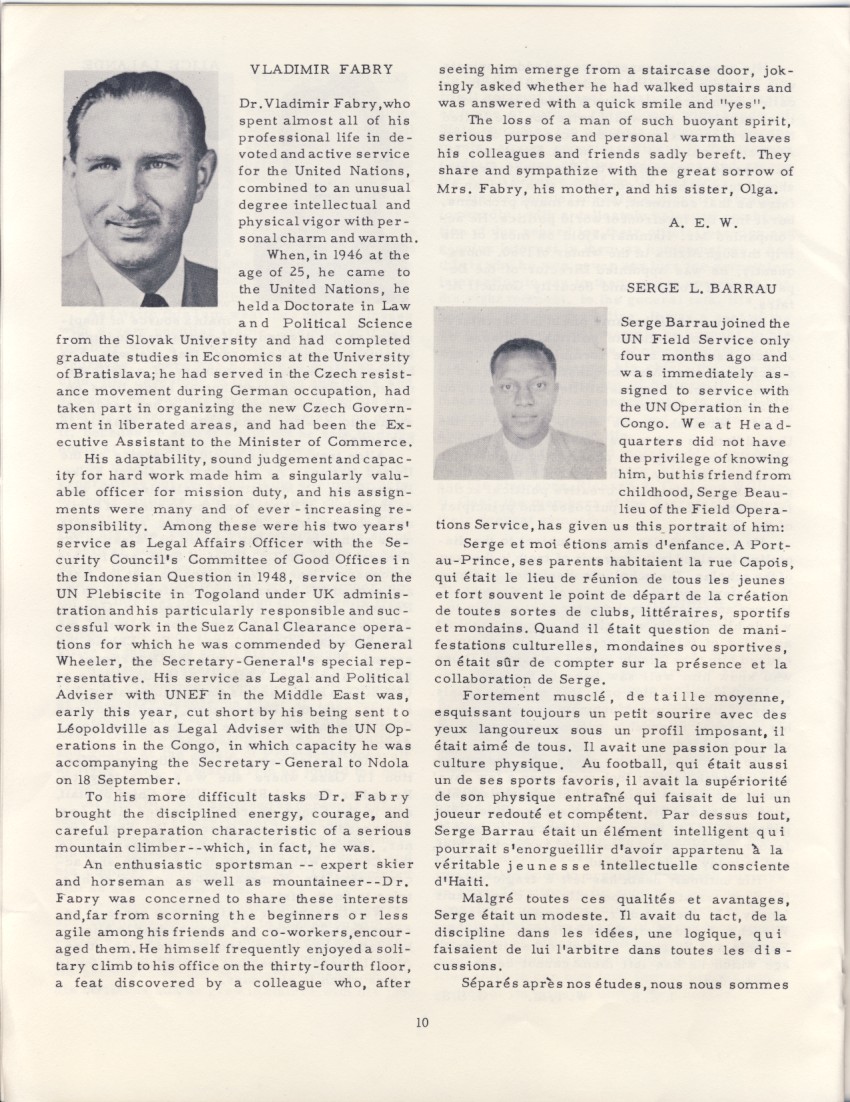
VLADIMIR FABRY

Dr. Vladimir Fabry, who spent almost all of his professional life in devoted and active service for the United Nations, combined to an unusual degree intellectual and physical vigor with personal charm and warmth.

When, in 1946 at the age of 25, he came to the United Nations, he held a Doctorate in Law and Political Science from the Slovak University and had completed graduate studies in Economics at the University of Bratislava; he had served in the Czech resistance movement during German occupation, had taken part in organizing the new Czech Government in liberated areas, and had been the Executive Assistant to the Minister of Commerce.

His adaptability, sound judgement and capacity for hard work made him a singularly valuable officer for mission duty, and his assignment were many and of ever-increasing responsibility. Among these were his two years’ service as Legal Affairs Officer with the Security Council’s Committee of Good Offices in the Indonesian Question in 1948, service on the UN Plebiscite in Togoland under UK administration and his particularly responsible and successful work in the Suez Canal Clearance operations for which he was commended by General Wheeler, the Secretary-General’s special representative. His service as Legal and Political Adviser with UNEF in the Middle East was, early this year, cut short by his being sent to Léopoldville as Legal Adviser with the UN Operations in the Congo, in which capacity he was accompanying the Secretary-General to Ndola on 18 September.

To his more difficult tasks Dr. Fabry brought the disciplined energy, courage, and careful preparation characteristic of a serious mountain climber–which, in fact, he was.

An enthusiastic sportsman — expert skier and horseman as well as mountaineer — Dr. Fabry was concerned to share these interests and, far from scorning the beginners or less agile among his friends and co-workers, encouraged them. He himself frequently enjoyed a solitary climb to his office on the thirty-fourth floor, a feat discovered by a colleague who, after seeing him emerge from a staircase door, jokingly asked whether he had walked upstairs and was answered with a quick smile and “yes”.

The loss of a man of such buoyant spirit, serious purpose and personal warmth leaves his colleagues and and friends sadly bereft. They share and sympathize with the great sorrow of Mrs. Fabry, his mother, and his sister, Olga.

SERGE L. BARRAU

Serge Barrau joined the UN Field Service only four months ago and was immediately assigned to service with the UN Operation in the Congo. We at Headquarters did not have the privilege of knowing him, but his friend from childhood, Serge Beaulieu of the Field Operations Service, has given us this portrait of him:
[Translated from French-T.B.]
Serge and I were childhood friends. In Port-au-Prince, his parents lived on the Rue Capois, which was the meeting place for all young people and very often the point of departure for the creation of all kinds of clubs, literary, sports and worldly. When it came to cultural events, sports or worldly, it was safe to rely of the presence and collaboration of Serge.

Strong-muscled, medium-sized, always a little smile drawn with languorous eyes under an imposing profile, he was loved by all. He had a passion for physical fitness. In football, which was also one of his favorite sports, he had the physical superiority which resulted in making him a feared and competent player. Above all, Serge Barrau was an intelligent element that could boast to have belonged to the true conscious intellectual youth of Haiti.

In spite of all these qualities and advantages, Serge was modest. He had tact, discipline in ideas, logic, which made him the arbiter in all discussions.

Separated after our studies, we met again in May this year on mission for the United Nations Organization, in Léopoldville. We had so much to say on that day. He told me about his activities in New York, his stay in the US Army where he performed his military service, his travels in Asia, particularly in Japan, where he received the baptism of fire, during a particularly dangerous drive, of moving crawling under machine gun fire, wherein the slightest imprudence can cost you your life; this training, he told me, this is my pass to the Congo. He was happy to be at the UN, to see me and to know Africa, the Africa of our ancestors.

It did not take long to prove his abilities in the UN Security Office where, newly arrived, he was assigned as assistant-investigator responsible for protecting the United Nations staff in trouble with the police.

Serge did not talk much, he did not trust himself to everyone, but he had an ideal, he wanted the initials of his name to be an example of courage and virtue to youth entire. That’s why I take pleasure in repeating his phrase which has become a reality.

S.B. – Serge Barrau – Servir bien

All his friends and colleagues express deep sympathy to Serge’s mother and father, Mr. and Mrs. Joseph Barrau, and to his brothers and sisters in their great loss.

Secretariat News September 1961 p11
HAROLD M. JULIAN

When Harry Julien left the United States Marine Corps and joined the UN Security Force in 1952 he felt that he had found a new opportunity for service, one to be looked upon as a “great challenge”. He never lost this attitude towards his job, though he seldom spoke of it. It was in this spirit that he accepted a years’ assignment to the Spinelli Mission in Jordan in 1958 and to the Congo Mission in July of last year.

He was an active man with wide interests, among which the Marine Corps stood high. The saying “once a Marine always a Marine” was particularly true of him. He was an enthusiastic athlete, a fine swimmer and diver.

From choice he became an “outside man” on the Guard Force and so a familiar figure on First Avenue to all of us. Familiar too, in the Staff Council, was his determination that the Guard Force should be “the best it could be”; to this idea he was dedicated. He had a warm interest in other people and a very human approach which made him exceedingly good at his job. He thought little of personal comfort and, whatever the weather or his hours of duty, he was always the same, a man of natural good humour and kindliness with a cheerful smile.

In losing him, we all share the sorrow of his mother and father, his widow, Maria, and his sons, Michael and Richard.

FRANCIS EIVERS

Frank Eivers, an unassuming, soft-spoken Irishman from Bally Bay and the Dublin Police Force, joined the UN Field Service in 1956. Those who worked with him during the four years he served with UNTSO in Jerusalem and the year he served in the UN Mission in the Congo speak with admiration of his outer gentleness and inner strength, “a thread of steel”, which made him into a man who met crisis with calm, personal hardship with philosophical humour, and the need of a friend with generous and utterly reliable friendship.

Frank was a methodical man–with a whimsical sense of fun. He was a keen player of Gaelic football and endowed with extraordinary physical grace. He was also a splendid cook and his friends say with affection that only an Irish imagination could have invented some of his ways with fish.

He is remembered, too, for a most loyal devotion to his job; for many small, unselfish acts of kindness to his colleagues, and for the quiet “God bless” with which he closed every conversation.

Frank was married only one month ago, and it is with great personal sadness that we express our heartfelt sympathy to his widow, Marie, to his mother and father and sisters in the loss which we share.
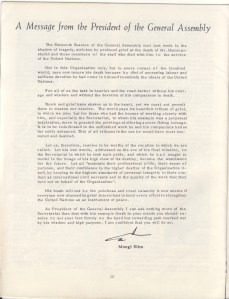
Secretariat News September 1961 p12
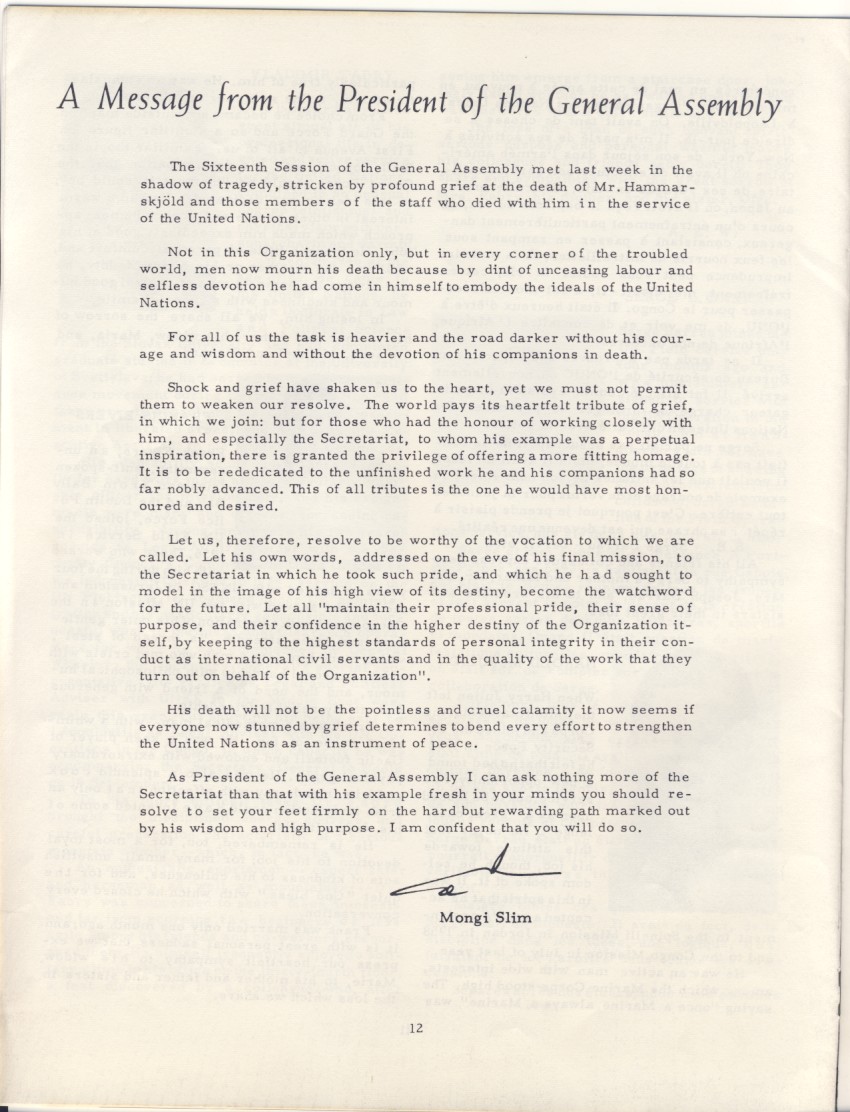
A MESSAGE FROM THE PRESIDENT OF THE GENERAL ASSEMBLY

The Sixteenth Session of the General Assembly met last week in the shadow of tragedy, stricken by profound grief at the death of Mr. Hammarskjold and those members of the staff who died with him in the service of the United Nations.

Not in this Organization only, but in every corner of the troubled world, men now mourn his death because by dint of unceasing labour and selfless devotion he had come in himself to embody the ideals of the United Nations.

For all of us the task is heavier and the road darker without his courage and wisdom and without the devotion of his companions in death.

Shock and grief have shaken us to the heart, yet we must not permit them to weaken our resolve. The world pays its heartfelt tribute of grief, in which we join: but for those who had the honour of working closely with him, and especially the Secretariat, to whom his example was a perpetual inspiration, there is granted the privilege of offering a more fitting homage. It is to be rededicated to the unfinished work he and his companions had so far nobly advanced. This of all tributes is the one he would have most honouored and desired.

Let us, therefore, resolve to be worthy of the vocation to which we are called. Let his own words, addressed on the eve of his final mission, to the Secretariat in which he took such pride, and which he had sought to model in the image of his high view of its destiny, become the watchword for the future. Let all “maintain their professional pride, their sense of purpose, and their confidence in the higher destiny of the Organization itself, by keeping to the highest standards of personal integrity in their conduct as international civil servants and in the quality of the work that they turn out on behalf of the Organization”.

His death will not be the pointless and cruel calamity it now seems if everyone now stunned by grief determines to bend every effort to strengthen the United Nations as an instrument of peace.

As President of the General Assembly I can ask nothing more of the Secretariat than that with his example fresh in your minds you should resolve to set your feet firmly on the hard but rewarding path marked out by his wisdom and high purpose. I am confident that you will do so.
—Mongi Slim

Medal of Saint Bernard

From the estate of Vladimir Fabry, here are a few items of interest. First, the “Notice of Death” from Ndola, Northern Rhodesia:
(click images to enlarge)
Vlado Notice of Death Northern Rhodesia

The same notice would have been sent to the families of the other crash victims, who should be remembered here for their sacrifice:
H. A. Wieschoff
William Ranallo
Alice Lalande
Harold M. Julien
Serge L. Barrau
Francis Eivers
Per Hallonquist
Nils-Eric Aahreus
Lars Litton
Nils Goran Wilhelmsson
Harald Noork
Karl Erik Rosen
S.O. Hjelte
P.E. Persson

The post mortem of Vlado says his body was badly burned, and that he was identified by a monogrammed signet ring, so it was surprising to find this letter, and to learn I was in possession of at least one artifact from the crash:
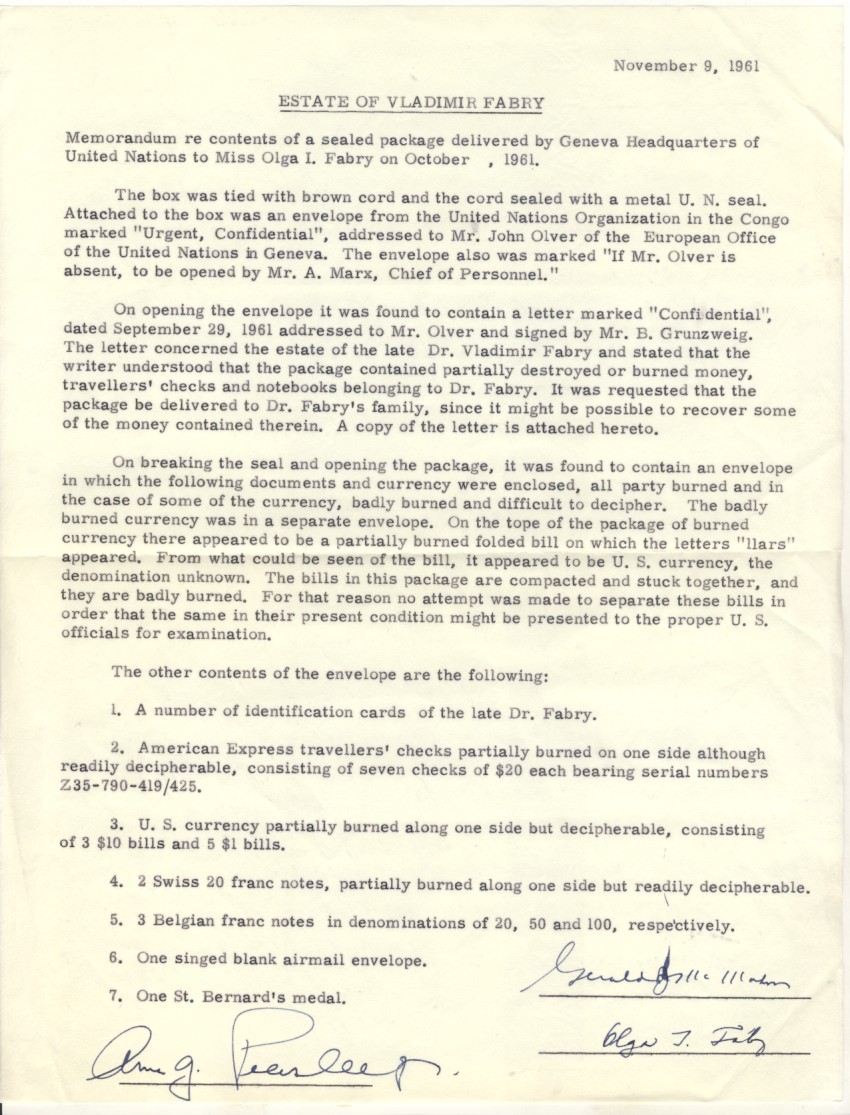
Estate of Vladimir Fabry

November 9, 1961
ESTATE OF VLADIMIR FABRY

Memorandum re contents of a sealed package delivered by Geneva Headquarters of United Nations to Miss Olga I. Fabry on October , 1961.

The box was tied with brown cord and the cord sealed with a metal U.N. seal. Attached to the box was an envelope from the United Nations Organization in the Congo marked “Urgent, Confidential”, addressed to Mr. John Olver of the the European office of the United Nations in Geneva. The envelope was marked “If Mr. Olver is absent, to be opened by Mr. A. Marx, Chief of Personnel.”

On opening the envelope it was found to contain a letter marked “Confidential”, dated September 29, 1961 addressed to Mr. Olver and signed by Mr. B. Grunzweig. The letter concerned the estate of the late Dr. Vladimir Fabry and stated that the writer understood that the package contained partially destroyed or burned money, travellers’ checks and notebooks belonging to Dr. Fabry. It was requested that the package be delivered to Dr. Fabry’s family, since it might be possible to recover some of the money contained therein. A copy of the letter is attached hereto.

On breaking the seal and opening the package, it was found to contain an envelope in which the following documents and currency were enclosed, all party burned and in the case of some of the currency, badly burned and difficult to decipher. The badly burned currency was in a separate envelope. On the top of the package of burned currency there appeared to be a partially burned folded bill on which the letters “llars” appeared. From what could be seen of the bill, it appeared to be U.S. currency, the denomination unknown. The bills in this package are compacted and stuck together, and they are badly burned. For that reason no attempt was made to separate these bills in order that the same in their present condition might be presented to the proper U.S. officials for examination.

The other contents of the envelope are the following:

1. A number of identification cards of the late Dr. Fabry.
2. American Express travellers’ checks partially burned on one side although readily decipherable, consisting of seven checks of $20 each bearing serial numbers Z35-790-419/425.
3. U.S. currency partially burned along one side but decipherable, consisting of 3 $10 bills and 5 $1 bills.
4. 2 Swiss 20 franc notes, partially burned along one side but readily decipherable.
5. 3 Belgian franc notes in denominations of 20, 50 and 100, respectively.
6. One singed blank airmail envelope.
7. One St. Bernard’s medal.

Though I have looked, I have found no sign of the burned notebooks. Here is all that remains from the crash, from the last moments of Vlado’s life, one St. Bernard’s medal, which I now carry as my own good luck charm:

Vlado St Bernard Medal 1
Vlado St Bernard Medal 2

Letter from High Commissioner of South Africa, H.L.T. Taswell, 29 September 1961

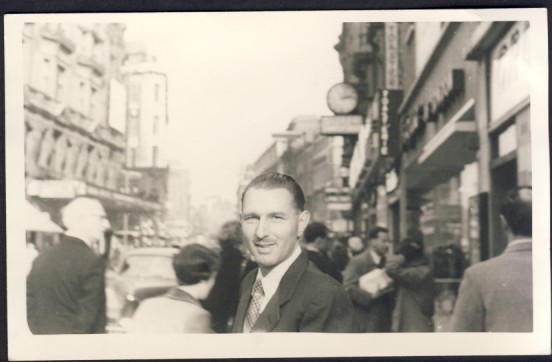
Vlado cityscene
Having spent so much time thinking about the life of Vlado Fabry, it has been impossible not to care about the way he died, and to want to know the truth about what happened. I’ve been reading every book and article I can find on the subject, but, for me, just reading the 1962 reports of the UN and Rhodesian Commissions investigation of the crash has been very revealing, especially in regards to Fouga Magisters which, I am convinced, shot down the Secretary General’s plane and caused it to crash on the night of 17/18 September, 1961. There were many Africans who saw one or two smaller planes following the DC-6 SE-BDY, but when they were interviewed by the Rhodesian and UN Commissions, they were treated like ignorant children and their testimonies were dismissed as fantasy. I learned a lot more about their treatment in Goran Bjorkdahl and Jacob Phiri’s excellent 2013 article for INTERNATIONAL PEACEKEEPING, Eyewitnesses: The Hammarskjold Plane Crash. From the article, here is one particularly awful comment from UN consultant Hugo Blandiori:

‘Thus, when it is taken into consideration that some of the African witnesses had lack of knowledge in air-plane identification, were of limited learning and might have been motivated by personal or political reasons, it becomes difficult in assessing the truth of their statements…As a consequence, I am of the opinion that the testimony of the African witnesses to the effect that they saw one or two small crafts flying along with SE-BDY just prior to its crash, has to be accepted with a grain of salt’.

I have provided here a few excerpts from both the Rhodesian and United Nations Commission, in order for you to appreciate the context of the following letter, which was written by former High Commissioner of South Africa, H.L.T.Taswell, on 29 September 1961, and was found in the archive of former Prime Minister of the British territory of the Central African Federation Sir Roy Welensky. A scan of the letter was sent to me by an anonymous source. I’m not positive if this particular letter is still considered “TOP SECRET”, but it won’t be anymore. It belongs in the public domain.

“At the outset we would say no reason was suggested, and we cannot think of one, why anyone who might have been able to attack this aircraft from the air should ever have wanted to attack it as it carried Mr. Hammarskjold on the mission he was then undertaking.”
(Federation of Rhodesia and Nyasaland, Report of the Commission on the Accident Involving Aircraft SE-BDY, chaired by Sir John Clayden, Chief Justice of the Federation, presented to the Federal Assembly, Salisbury, Federation of Rhodesia and Nyasaland; February 1962; Annex III, p.20, par.10)

“On landing at Leopoldville [the morning of 17 September 1961], [Flight Engineer] Wilhelmson had reported that SE-BDY had been fired on at the takeoff from Elisabethville. A thorough inspection of the aircraft was accordingly carried out under the supervision of Chief Mechanic Tryggvason of Transair. In the course of the inspection it was found that number 2 engine (inboard port) had been struck by a bullet, which had penetrated the engine cowling and hit the exhaust pipe. The exhaust pipe was replaced and the plane refueled to a total of ten tons.”
(…)
“The Commission further notes that no flight plan for the SE-BDY was transmitted to Salisbury. The Commission has taken into consideration the conditions existing in the Congo at the time and in particular the danger of an attack from the “Fouga Magister” which explains this departure from the rules governing commercial aviation. Indeed, the system of aeronautical communications cannot ensure the secrecy of messages”
(…)
“It is also relevant to observe that, because of the danger of an attack from the “Fouga Magister”, most of the flights in the Congo at the time were undertaken at night”
(…)
“The possibility of other aircraft being in the area of Ndola at the time of the crash was examined. Since the “Fouga Magister” of the Katangese Armed Forces had been operating against the United Nations in Katanga, the possibility of its reaching Ndola was examined by the Rhodesian Board of Investigation and the Rhodesian Commission of Inquiry. It was established that it could not have made the flight from its normal base in Kolwezi to Ndola and returned to Kolwezi since the distance is greater than its operational range. It was also stated by its captain and others that the “Fouga” was on the ground at Kolwezi the night of 17/18 September and could not have operated that night. This evidence is not entirely conclusive since the captain admitted before the Rhodesian Commission of Inquiry that on at least one occasion the “Fouga” had taken off from an unpaved track. While this track was said to be at an even greater distance from Ndola, nothing would appear to preclude the use of a track within range of Ndola. Nevertheless, there is no evidence that the “Fouga” was in the vicinity of Ndola on the night of the crash.”
(…)
“The Commission has, however, been informed that no radar watch was maintained in the Ndola area during the evening and night of 17 September 1961 and, therefore, the possibility of an “unknown aircraft” cannot be entirely excluded.”
(…)
“Certain witnesses testified that they saw or heard a second, or even third, plane. In particular, some of these testified that they saw a second smaller aircraft flying close to SE-BDY after it had passed over the airport or immediately before the crash and that the smaller aircraft was beaming lights on the larger. The Commission visited with some of these witnesses the spots from which their observations had been made and endeavored to obtain an understanding of their testimony. The Commission considers that several of these witnesses were sincere in their accounts of what they believed they saw.
The Commission is also of the opinion, however, that those witnesses may have misinterpreted their observations and reported some incidents which may not in fact have occurred in the way or at the time that they believed when they testified before the Commission.”
(United Nations General Assembly, Report of the Commission of the Investigation into the Conditions and Circumstances Resulting in the Tragic Death of Mr. Hammarskjold and the Members of the Party Accompanying Him, chaired by Rishikesh Shaha (UN A/5069); 24 April 1962; par. 69, 82, 89, 135, 136)

“TOP SECRET”

Salisbury S.R.
29th September, 1961

Dear Mr. Jooste,

As you will know, I had correspondence, during your absence, with our Minister regarding a suggestion made by Mr. Harper, Leader of the Opposition in Southern Rhodesia, that we assist in the establishment of an English language paper in this territory. The Minister’s reply is dated 5th September, 1961.

I have since had a further talk with Mr. Harper and explained the position to him. He will be visiting South Africa one of these days to have a discussion with Minister de Klerk on our Immigration laws. I will write to you again in due course on this matter.

Another approach for the establishment of an English language paper in Southern Rhodesia has since been made to me. It comes from quite a different quarter – namely from Mr. John Gaunt, Independent Member for Lusaka West, Northern Rhodesia, in the Federal Assembly. Particulars of Mr. Gaunt, taken from page 940-92 of the Who’s Who of Southern Africa 1961 are attached.

Mr. Gaunt is a colourful, outspoken and irrepressible politician who has a considerable following in this country. I would be inclined to describe him as the Arthur Marlow of the Federation. He is a fighter, a strong protagonist of the maintenance of white civilisation, yet not a supporter of our Government’s policy in its entirety. At the same time he is not an open or malicious critic of ours but a good friend.
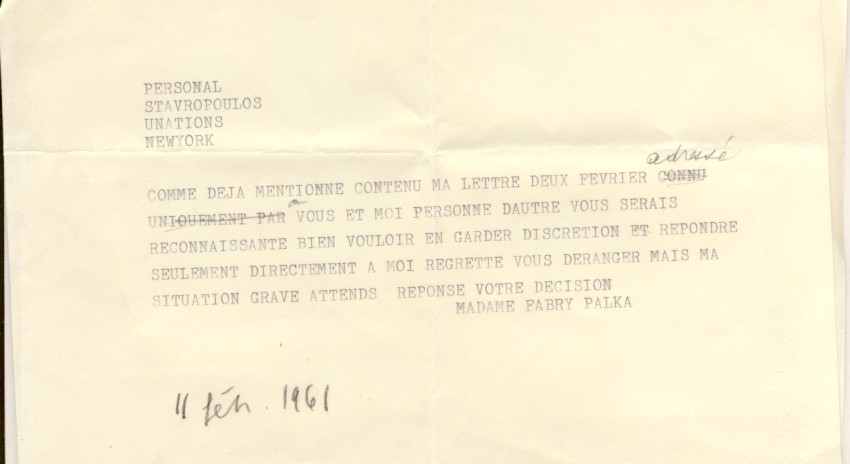
A summary of what Mr. Gaunt had to say during the interview is attached.

Very briefly, his suggestion is that we make about £300,000 available through commercial interests in South Africa for the establishment of an English language paper here. This would be in opposition to the Argus press which is dedicated to the appeasement of “black nationalism” and aims at inducing whites to hand over control to a black majority as quickly as possible.

If £300,000 seems a great deal of money it should, he says, be borne in mind that it is barely the cost of a medium size commercial aircraft.
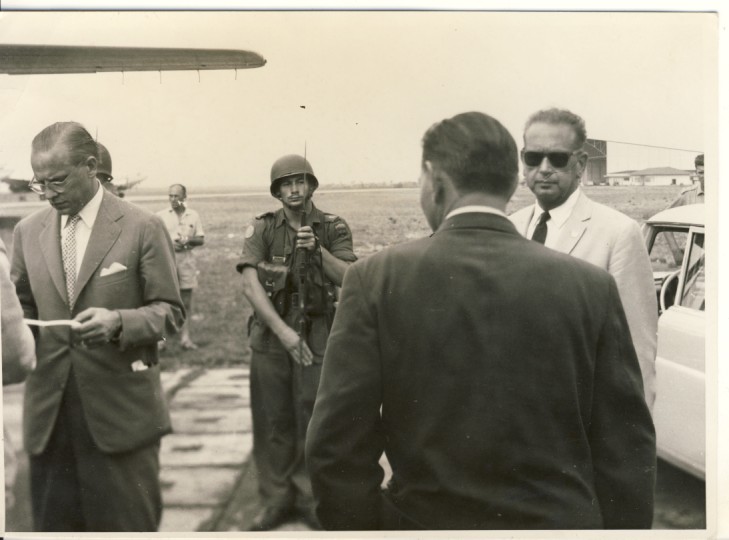
Mr. Gaunt does not feel that the proposed paper could dedicate itself to applying our racial policy in this country. The position here has already changed too much for that. But what it could do is ensure that the present constitution is rigorously adhered to. The Governments in Southern Rhodesia and the Federation should not be allowed to use the present constitution just as a temporary measure and as a means of sliding towards a still more liberal constitution.

Mr. Gaunt also feels that this paper would be able to further South Africa’s interests greatly by concentrating on favourable positive information. Such a paper if air mailed to South Africa each day could also serve a valuable purpose in our country and would assist the Government.

Mr. Gaunt would like to be made editor-in-chief so that he could give the correct slant to reports. He does not want to be responsible in any way for the financial side.

To me this idea of an independent paper has great appeal. Any opposition here is completely frustrated through having no paper. The Argus group is so powerful, moreover, that it could go far to breaking even the most established politician who does not follow its particular line – and I do not exclude Sir Roy Welensky.

Nearly two years ago Anglo-American and NST[? abbreviation unclear] withdrew their financial support of the United Federal Party. It looked then as if they were going to support Todd who was given a tremendous boost by the press because of his liberal line. Now the U.F.P. are following the liberal line themselves, Todd is in the background, Anglo-American and NST[?]have, I hear, restored their financial support of the U.F.P. and the Argus press are supporting the party. That the United Federal Party have been forced to toe the line by Argus press is no secret to us in South Africa.

The future say of the white man in the Government of this country does not look rosy. Banda has control in Nyasaland, Kaunda may, through British action, still attain a similar position in Northern Rhodesia. Southern Rhodesia’s new constitution could be merely the first step towards giving greater say to the black man here. The Federal constitution when revised must follow the pattern of the constitutions of the three constituent territories. That means infinitely greater say for the black man in the Federal Assembly. Such say will have to be very considerable indeed if Banda is to be induced to stay in the Federation.

Sir Roy and the United Kingdom are already at loggerheads over the talks on the Federal constitution. Sir Roy wanted them now. The United Kingdom wants postponement, no doubt with the object of further appeasement in Northern Rhodesia and conditioning of white feeling to a black majority government.

There is strong and bitter feeling in this country against the United Kingdom. Given an independent press it could be fanned to a point where the United Kingdom could be seriously embarrassed, and where Southern Rhodesia could still be saved, where it could break from the Federation and become independent. There are many influential men here would gladly grasp a weapon like an independent paper.

There are many seeds of discontent. This week we heard rumours of a serious division in the Federal Cabinet. The Deputy Governor of the Bank of Rhodesia and Nyasaland, told me only a few days ago too that the financial picture here is far from rosy. The “expected” recovery after the Southern Rhodesia referendum has not materialized. The number of people who voted “yes” at that referendum and now feel they were duped and should have voted “no” is increasing. Properly exploited this discontent could have a marked influence when Southern Rhodesia goes to the polls in about a year’s time.

If the United Federal Party and the Argus press continue unchecked, it is merely a matter of time before our buffer zone north melts away. With an independent paper we could stave that day off and could even preserve the Southern Rhodesia[border? word obscured]with its 215,000 whites(2,630,000 blacks).

As Mr. Gaunt points out it is surely to our interest to have the main struggle for survival take place in Southern Rhodesia rather in South Africa.

A Canadian group is now negotiating for the purchase of African Newspapers here. One can imagine the kind of vitriol the Canadians would be capable of using against us.

The “Citizen”, Mr. Gaunt says, could be bought by us for a song. An immediate start could be made with a paper. Improvements could follow.

The Argus will try to kill any independent paper and financial losses must be expected. But would they not be worthwhile? We are fighting for our lives. They are fighting for a black majority government, for cheap labour and greater profits.

H.L.T. Taswell
High Commissioner

This letter perfectly illustrates how propaganda works, and it’s a history lesson on racism, and the lengths men will go to defend their right to it. Even though the Fouga Magister is a small fighter jet, the sentence about an independent paper being less expensive to purchase to defend their racial policy than “a medium size commercial aircraft” gave me a chill, because this written only 11 days after the crash. No wonder they hated Hammarskjold so much – what was the fragrance of life to the African was the stench of death to white rule.

“A Desperate Personal Demand For Help”

Tara 2013 003
In 1961, even in the midst of the Congo Crisis, Vlado was doing all he could to help his family. Conor Cruise O’Brien’s observations of Vlado, in his book To Katanga and Back – that he did nothing but work and hardly slept – were fairly accurate for the time he knew him, because it seems that he was spending every spare moment attending to the unfinished legal cases of his father, Pavel Fabry, who died December 19, 1960.

From February 2, 1961, here is a letter to United Nations legal counselor Oscar Schachter from Vlado’s Maminka:

Dear Mr. Schachter,

I am sorry to take your valuable time and to disturb you with this letter. It is only the serious situation and the emergency in which I find myself after the death of my beloved husband that urge me to write this letter.

As you may know my husband was working for some years as an international lawyer with the German Government on war reparation. My husband devoted not only his effort, time, money, but finally his life to this cause. Unfortunately it was not permitted to him to finish his affairs as he died so very suddenly in the middle of his unfinished task. Vladko who was always a remarkable son is now sacrifying[sic] all his free time besides his work and his vacations to work until late at night on his father’s affairs. There are many difficulties, many hard problems to be solved, which will need patience, time, travelling and possibilities of good communications.

All these are problems which I cannot face alone, and the only person to solve them and to continue the unfinished work of my husband is my son. If we had to take a lawyer, we would have to do it in many countries of Europe and my husband has indebted himself already too much to afford so many lawyers. It is therefore only my son who is the only person to help me out in this.

My health has been weakened by the sudden loss of my husband. When I learned about the transfer of my son to Congo, it was another shock for my heart illness. I am unfortunately unable to cope alone with the situation I have mentioned as much as I don’t like to ask something, I am driven to it by this emergency. It is furthermore a situation which presents itself during our life, such as accident, illness, death and its consequences, etc. I would like to ask you to help me, Mr. Schachter. You have always been very nice to us all, a real good and understable[sic] friend and I would like to ask you not to let me down now, when I most need it.

I wonder whether it would be possible to arrange a transfer for my son to Europe – Geneva or elsewhere – so that he could easier communicate and work to finish my husband’s most urgent cases. I have never asked you anything before and I would never have, but as you can see it is a very serious situation and I am in an emergency.

It is very difficult for me to write this letter and I am doing so on my own, without my son’s knowledge. Would you please consider it as such, a desperate personal demand for help.

Many thanks for everything you will do for me to help me out. Kindest regards to Molly and to you.

As ever yours,
Olga Fabry Palka

Vlado’s mother also wrote Constantin Stavropoulos for help. Here is a personal telegram she sent to him, dated February 11, 1961:

Maminka Stavropoulos telegram
(click scan to enlarge)

Respect For The Word

Vlado and Hammarskjold full image

Respect for the word is the first commandment in the discipline by which a man can be educated to maturity — intellectual, emotional, and moral.
Respect for the word — to employ it with scrupulous care and in incorruptible heartfelt love of truth — is essential if there is to be any growth in a society or in the human race.
To misuse the word is to show contempt for man. It undermines the bridges and poisons the wells. It causes Man to regress down the long path of his evolution.
“But I say unto you, that every idle word that men speak…”

~ Dag Hammarskjold “Markings”

This Christmas, I bought myself a copy of Conor Cruise O’Brien’s TO KATANGA AND BACK, and the first thing I did was look for Vladimir Fabry in the index. This is what I found on pages 70-71:

Another important figure on the 6th floor at this time was Vladimir Fabry, an American citizen of Croat origin and ONUC’s legal adviser (‘Special Councelor’). Fabry was a thin-faced young man with a frequent but unamused smile and a stoop brought on by unremitting work. Even in an organization where all the key people worked excessively hard (surrounded, for no apparent reason, by large numbers of non-key officials who seemed to do no work at all) Fabry’s industry stood out. He slept little, he read nothing for pleasure, he had no vices or other hobbies, he simply worked – fourteen to eighteen hours a day. Dealing with paper he was accurate, penetrating and happy; with people he seemed on edge, as if he found them distressingly large and imprecise; and this was especially true of his relations with M Poujoulat. At this time, on first meeting Fabry, I was taken aback, mistaking his uneasy, abstracted air for personal hostility. Later, I came to respect his clarity of mind and to appreciate, and even admire, his lonely integrity. ‘I am an anti-social person’, he told me once, with melancholy pride. It was not true, but what was social in him – his fierce drive to bring some tidiness and predictability into the activities of man – took the impersonal form of a shy, jealous, exclusive loyalty to the abstract and developing idea of the United Nations. It is not unfitting that he should have met his death as he did, on the flight towards Ndola, working for Hammarskjold.

While I agree with a few things he said about Vlado, so much of this is just O’Brien’s opinion, and he doesn’t bother to fact check. Vlado is not “of Croat origin”, he was born in Liptovský Svätý Mikuláš, in the former Czechoslovakia. There is no doubt Vlado was working hard and sleeping little when O’Brien met him – considering the pressure of the situation in the Congo, Vlado was compelled to sacrifice his social life for a greater cause – but O’Brien really didn’t know Vlado as well as he thought he did.
Here are two photos of Vlado at work:
Vlado at work
Here he is in Egypt, taking in the sights:
Vlado in Egypt

Here are two letters of condolence from September 1961, from friends who knew and loved Vlado:

52 Champs Elysees
Paris

My Dear Friends,
Although it may seem selfish, I think the best way I can express my condolence and my sympathy to you is to tell you what Vlado meant to me.
I won’t tell you how much admiration or respect or affection I felt for him. I will tell you only that I think I can honestly say I considered him my best friend – and I was proud of knowing him: and I can say that all the more validly because I knew his faults as well as his virtues. I am very well acquainted with loneliness – but the thought of losing Vlado makes me feel even lonelier.
Please believe that just as I share your grief and sorrow at losing him, so also, since you can be very proud of him, I feel privileged to be able to share, even a little bit, your pride.
With very deep sorrow,
Peter Kenton

United Nations
New York, NY

Dear Olga,
I want to offer you my help in any way I can give it.
He was loved by so many people; he was kind and honest and strong, very strong.
He told me that memories are good to have. He lived with high standards and he died for them. He worked tirelessly in Gaza and the Congo. No tribute will be adequate to his merits.
I write this from his office here, where he spent many evenings alone. He said he liked thick walls and solitude, music and ideas. Of course he was also, at times, very gay, full of the joy of living.
Please accept my silent condolence to you and your mother.
Cynthia Knuth

And from the UNEF weekly, THE SAND DUNE, September 22, 1961, here is a tribute to Vlado from friends who understood his devotion to the UN:

With the sudden death in Congo of Vladimir Fabry UN has lost a distinguished and devoted son. Until his recently acquired US citizenship he had no country but UN to which he gave that same fierce loyalty with which he had served his own land. He was a sagacious lawyer, a skillful negotiator and a indefatigable worker for whom time did not exist. There were many Fabrys. The scholar and man of affairs who in his twenties had managed a huge industrial combine. The fighter whose activities sent him to exile. The mountaineer, skier, gourmet and music lover who was fluent in nine or ten languages and had knowledge of as many countries. He was an epitome of European culture.
We in the UNEF will remember Vlad not only for the work he did here but for his personal quirks. His hatred of the sea which did not prevent daily voyages on an air mattress. His pull ups on door lintels to tone the Mountaineer’s arm muscles and controlled skidding on sand to remind him of skiing. His undisguised joy in good food, good wine and good conversation, all of which he delighted to provide. No matter how busy, he could always find time to advise and aid anybody, no matter how humble, who had any problem. He was unassuming, courteous, exquisitely polite and we will never forget him.

Sand Dune Sept 1961 2
Sand Dune Sept 1961

UNOC Leopoldville, Republic of Congo, 1961

Fabry Archive - Selected Photographs (86)
(Vlado the mountain climber – click photo to enlarge)
After the death of Vlado Fabry on September 18, 1961, there were many letters of condolence sent to Mrs. Fabry, Vlado’s mother, from around the world. One such letter I found recently, written on UNOC stationary, is from the Italian United Nations legal expert Giorgio Pagnanelli, posted from the UNOC in Leopoldville, Republic of Congo, October 10, 1961. Only a month later, on November 11 or 12, 1961, 13 Italian airmen, members of the UNOC working to maintain peace, were brutally murdered by Congolese troops; Giorgio Pagnanelli was asked to make a report on the 13 murdered men for U.N. Security Council.

Dear Mrs. Fabry,
Please do accept my apologies for the delay in answering your letter.
Vlado’s death has left such a vacuum which will be very difficult to fill. I still cannot adapt myself to the tragic reality and sometimes I refuse to accept it. Dr. [Sture] Linner told me of your brief encounter in Geneva. I trust that Vlado’s belongings and papers have already reached you.
I am enclosing herewith a few things which were very dear to Vlado – a poster, showing his beloved mountains [Tatras] – which I gave to him and he had in his office – I enclose also an edelweiss – Vlado brought it back from his short visit in Switzerland: he kept it in a little vase in front of your picture (a color photograph taken in the mountains). [The edelweiss was still in the envelope!-T]
I am also sending newspapers and other publications.
Dear Mrs. Fabry, it is very true , indeed, that nothing could console the soul of a loving mother in a lost (sic) of her son; words or expressions of sympathy are within [indecipherable word] limits but sorrow goes hither and beyond these terms – I wish to say, however, that whenever I am tired, disappointed or frustrated in a job where we are expected to accomplish [indecipherable word], I remember Vlado, his courage, his strength, his belief in right things, his devotion to the U.N., then I feel that I should try to be like him – this feeling is shared by many here in the ONUC. As the New York Times pointed out, he was “a one man brain trust”. Since his arrival he organized, analyzed, solved every political, legal, administrative problem. People here used to say: “All right, we do not know the answer, let us ask Dr. Fabry”. He found it.
Vlado spoke very often of his “Mamuska” and his sister Olga. Once I told him that his mother would not have liked to see him working 19 hours a day; he simply answered: “Yes, I know, but she would understand”. On Sundays he used to take some exercise – He ran for one or two hours around the golf [?] court then arrived at the office saying that he had taken a little walk….
Dear Mrs. Fabry, Unfortunately I do not have a picture of Vlado. Once he showed me one with his beloved parents (a color photo where he is seated on the armchair with his father) – if you have an extra picture of Vlado, I’d like very much to have it.
Please do not hesitate to write me for anything you might desire.
Affectionately,
Giorgio Pagnanelli

Leg. Officer UNOC
Le Royal
Room 650
Leopoldville, Congo

The following is an excert from the NYT article “U.N. BRACES FOR ITS CONGO TASK”, by Henry Tanner, dated September 24, 1961:

Dr. Sture C. Linner, the head of the United Nations mission … lost his private secretary and, in Dr. Vladimir Fabri[sic] he lost what he had once called his “one-man brain trust”. Dr. Fabri officially the legal councilor, had in fact been the mission’s thinker who analyzed events and suggested decision.

Dr. Sture Linner was also on the plane headed to Leopoldville, but Hammarskjold told him that he was needed in Kinshasa; so he stayed behind, and escaped the tragic fate of the others.

I would like to add one more excerpt from the September 29, 1961 edition of SECRETARIAT NEWS, from the U.N. Headquarters in New York; which includes the obituaries of William Ranallo, Heinrich A. Wieschhoff, Alice Lalande, Serge L. Barrau, Harold M. Julien, Francis Eivers, as well as Vlado, who is remembered here:

To his more difficult tasks Dr. Fabry brought the disciplined energy, courage, and careful preparation characteristic of a serious mountain climber–which, in fact, he was.
An enthusiastic sportsman–expert skier and horseman as well as mountaineer–Dr. Fabry was concerned to share these interests and, far from scorning the beginners or less agile among his friends and co-workers, encouraged them. He himself frequently enjoyed a solitary climb to his office on the thirty-fourth floor, a feat discovered by a colleague who, after seeing him emerge from a staircase door, jokingly asked whether he had walked upstairs, and was answered with a quick smile and “yes”.