Tag Archives: exile

Letters from General Lev Prchala, 1958

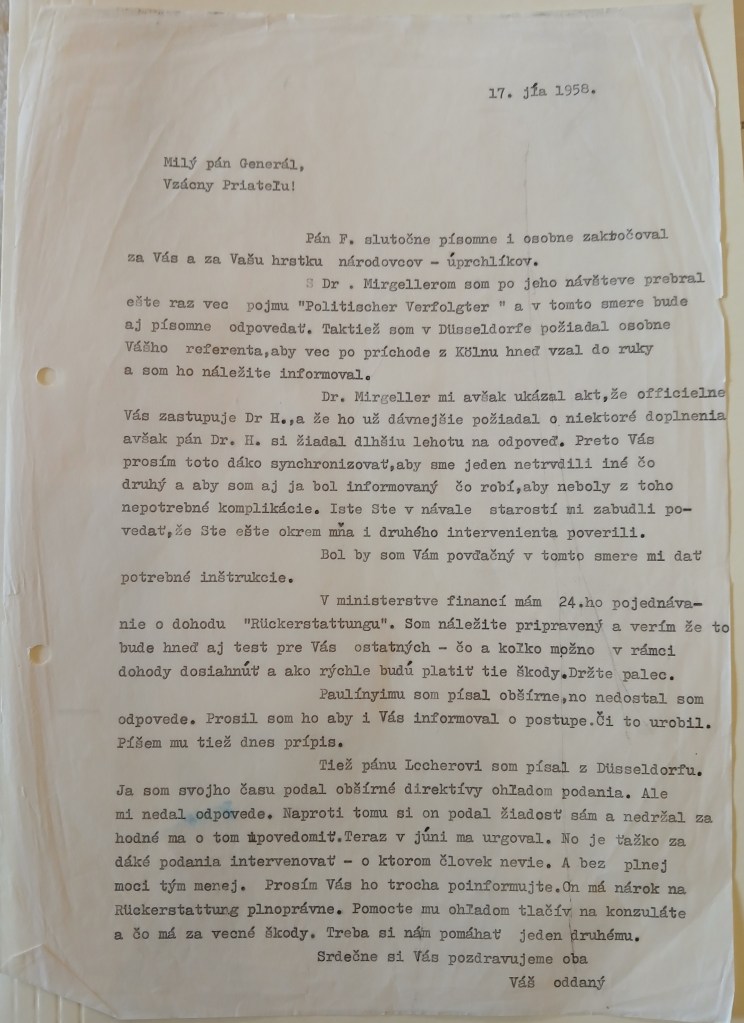
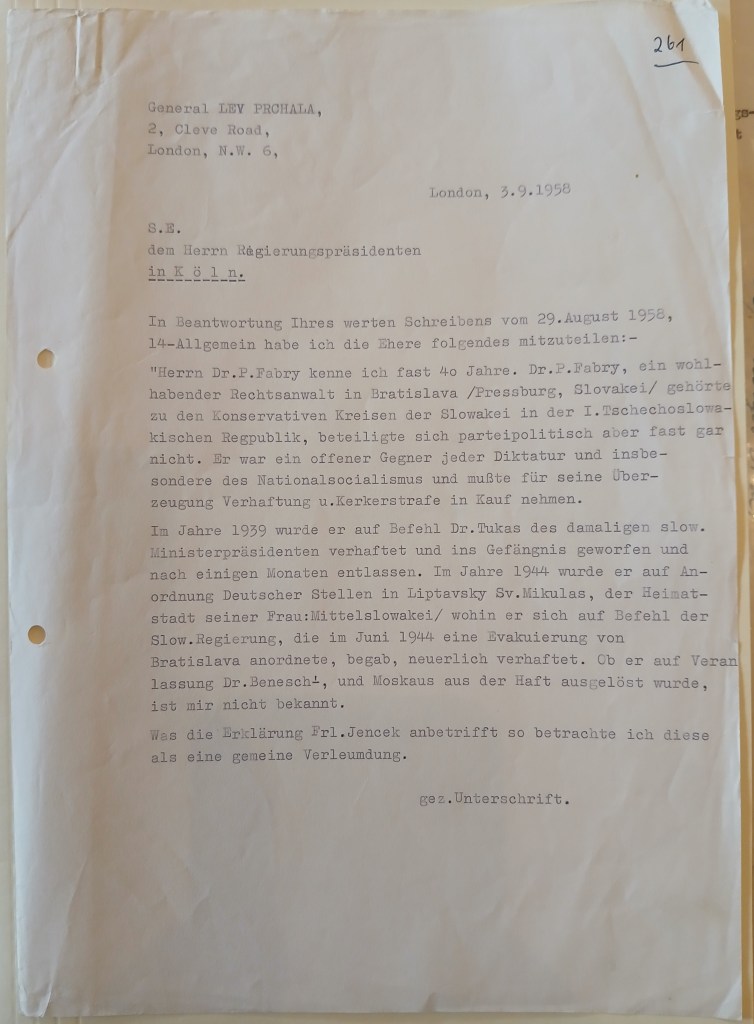
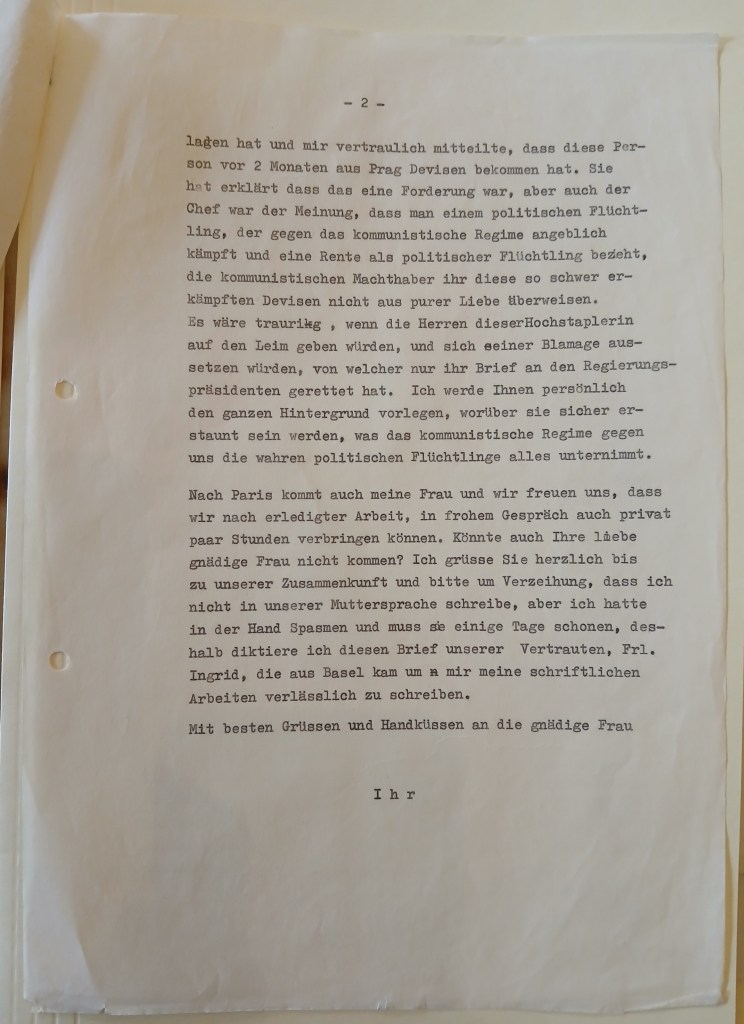
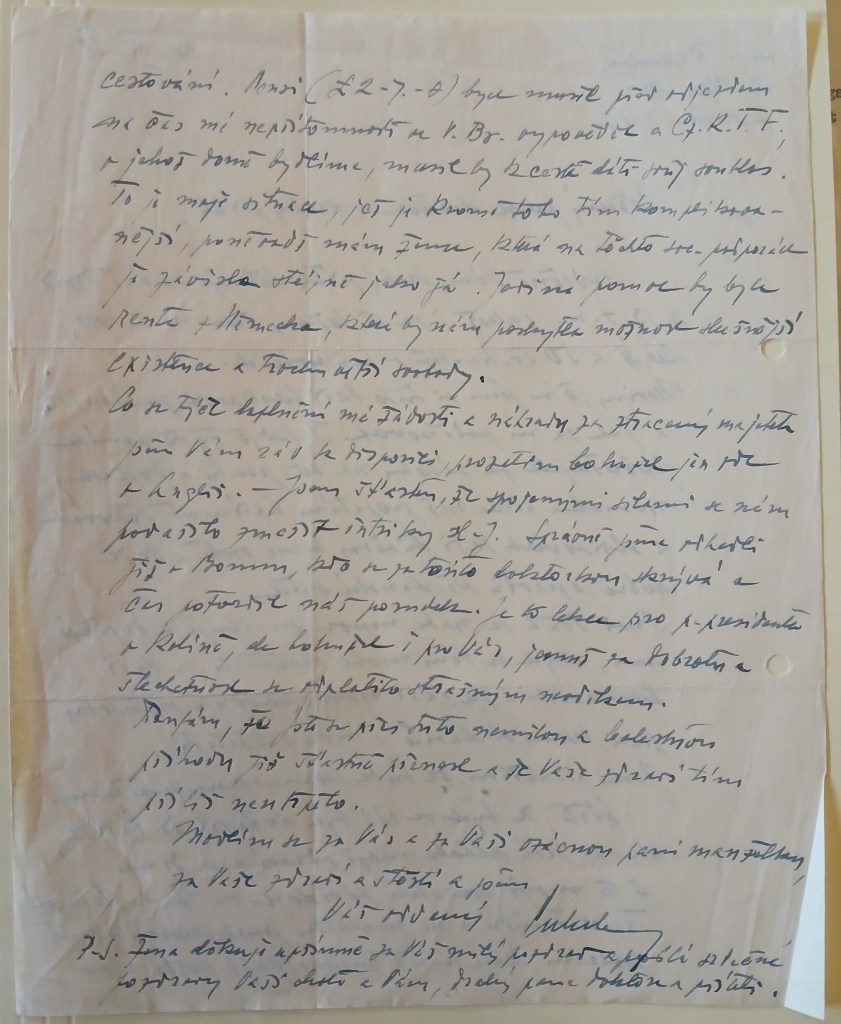
Here are more letters from General Lev Prchala to Dr. Pavel Fabry (Vlado’s father) from 1958. I have also included duplicates of letters from Pavel. Thank you to Miroslav Kamenik for translating many of the letters here!

From Lev Prchala, 29.3.58

Vážený pane doktore, drahý příteli,

již dlouho jsem Vám nepsal. Byl jsem dosti vážně churav a ještě dnes nejsem ve své kůži. Trpím rheumatickými bolestmi svalstva a rychlým úbytkem váhy. Není vyloučeno, že je to ve spojení se zdejším podnebím, je však také možné, že jde současně o neuralgii způsobenou celkovým stavem mých nervů. Nebylo by divu, povážím-li co jsem za svého života musel unésti. Právě nejnověji mému zdravotnímu stavu a nervovému systému neprospěl dopis Regierungspräsidenta z Köllnu, jehož opis přikládám.

Byl bych Vám velmi povděčen, kdybyste mi laskavě co nejdříve oznámil svůj názor a poradil, co dále dělat. Doufám, vážený pane doktore, že jste alespoň Vy zdráv v lepším švýcarském klimatu a jsem se srdečným pozdravem

Váš oddaný

Prchala

Dear Doctor, dear friend,

I have not written to you for a long time. I have been quite seriously ill and am still not myself today (in my senses?). I suffer from rheumatic muscle pains and rapid weight loss. It is not impossible that this is connected with the local climate, but it is also possible that it is at the same time neuralgia caused by the general condition of my nerves. It would not be surprising, considering what I have had to endure in my lifetime. Most recently, my health and nervous system have not benefited from the letter from the Regierungspräsident of Köln (Cologne, Germany), a copy of which I enclose.

I should be very grateful if you would kindly let me know your opinion as soon as possible and advise me what to do next. I hope, dear Doctor, that you at least are well in the better climate of Switzerland, and I am with cordial regards

Your devoted

Prchala

[Translation: Miroslav Kamenik / 17.4.2025]
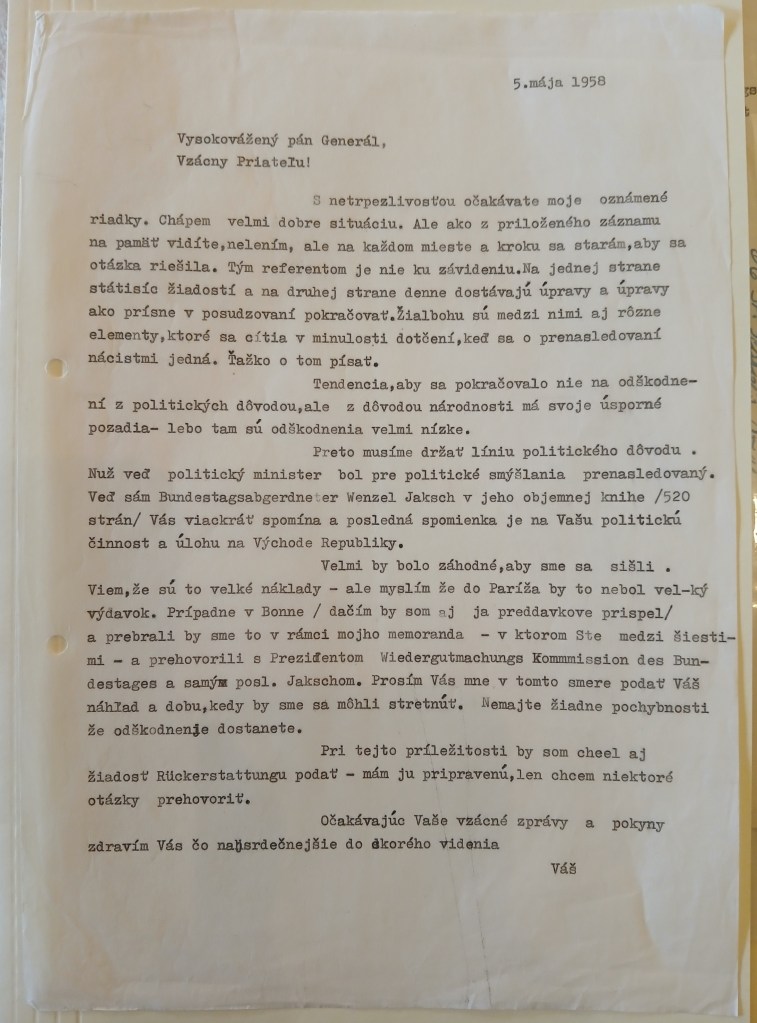
From Pavel Fábry, 5.mája 1958 (5 May)

Typewritten in Slovak language

Vysokovážený pán Generál,

Vzácný Priateľu!

S netrpezlivosťou očakávate moje oznámené riadky. Chápem velmi dobře situáciu. Ale ako z priloženého záznamu napamäť vidíte, nelením, ale na každom mieste a kroku sa starám, aby sa otázka riešila. Tým referentom je nie kuzávidieniu. Na jednej strane státisíc žiadostí a na druhej strane denne dostávajú úpravy a úpravy, ako prísne vposudzovaní pokračovať. Žialbohu sú medzi nimi aj rôzne elementy, ktoré sa cítia v minulosti dotčení, keď sa oprenasledovaní nácistmi jedná. Ťažko o tom písať.

Tendencia, aby sa pokračovalo nie na odškodnění z politických dôvodov, ale z dovodu národnosti má svoje úspornépozadie, lebo tam sú odškodnenia veľmi nízke.

Preto musíme držať líniu politického dovodu. Nuž veď politický minister bol pre politické smýšlania prenásledovaný. Veď Bundestagsabgerdneter Wenzel Jaksch v jeho objemnej knihe /520 strán/ Vás viackráť spomína a posledná spomienka je na Vašu politickú činnost a úlohu na Východe Republiky.

Velmi by bylo záhodné, aby sme sa sišli. Viem, že sú to veľké náklady – ale myslím že do Paríža by to nebol veľký výdavok. Prípadne v Bonne / dačím by som aj ja preddávkove prispel/ a prebrali by sme to v rámci mojho memoranda – v ktorom Ste medzi šiestimi – a prehovorili s Prezidentom Wiedergutmachungs Kommission des Bundestages a samým poslancom Jakschom. Prosím Vás mne v tomto smere podať Váš náhľad a dobu, kedy by sme sa mohli stretnúť. Nemajtežiadne pochybnosti že odškodnenie dostanete.

Pri tejto príležitosti by som chcel aj žiadost Rückerstattungu podať – mám ju pripravenú, len chcem niektoré otázky prehovoriť.

Očekávajúc Vaše vzácné zprávy a pokyny zdravím Vás čo najsrdečnejšie do skorého videnia

Váš (not signed Fábry)

Highly Exalted General,

Dear Friend!

You eagerly await my announced lines. I understand the situation very well. But as you can see from the enclosed memoir, I am not lying, but at every place and step I am making sure that the issue is addressed. Those clerks are not to be envied. On the one hand, hundreds of thousands of applications and on the other hand, they receive daily adjustments and modifications as to how strictly to proceed in the assessment. Unfortunately, there are various elements among them who feel aggrieved by the Nazi persecution in the past. Hard to write about it.

The tendency to continue not on reparations on political grounds but on grounds of nationality has its economical background, for there the reparations are very low.

Therefore, we must hold the line on political grounds. Well, after all, a political Minister has been persecuted for his political views. After all, Bundestagsabgeordneter (MK – member of Parliament) Wenzel Jaksch mentions you several times in his voluminous book /520 pages/ and the last memory is of your political activity and role in the East of the Republic.

It would be very convenient for us to get together. I know it’s a big expense – but I don’t think it would be a big expense to go to Paris. Possibly in Bonn / I would also make a contribution in advance / and we would discuss it within the framework of my memorandum – in which you are one of the six – and talk to the President of the Wiedergutmachungs Kommission of the Bundestags and to the Member Jaksch himself. I would ask you to give me your insight in this regard and a time when we could meet. Have no doubt that you will receive compensation.

I would also like to take this opportunity to make a request to the Rückerstattung – I have it ready, but I just want to ask a few questions.

In anticipation of your kind messages and instructions I greet you most cordially until I see you soon

Yours (not signed Fábry)

[Translation: Miroslav Kamenik / 17.4.2025]
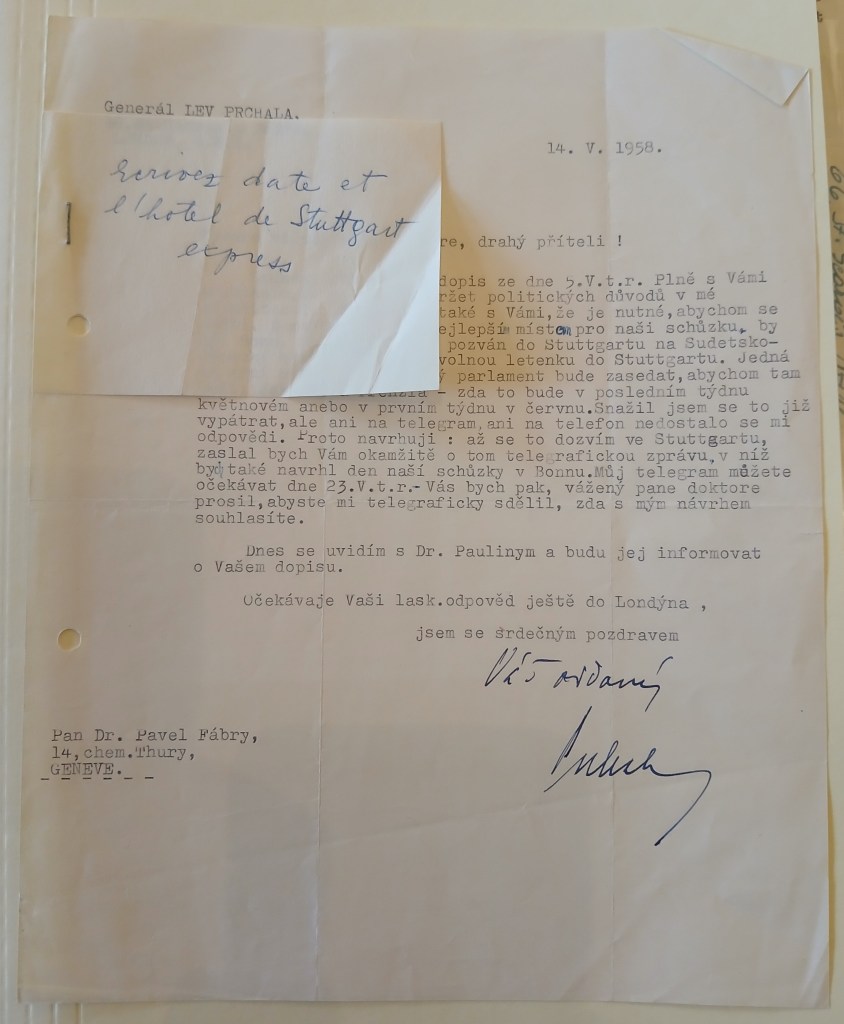
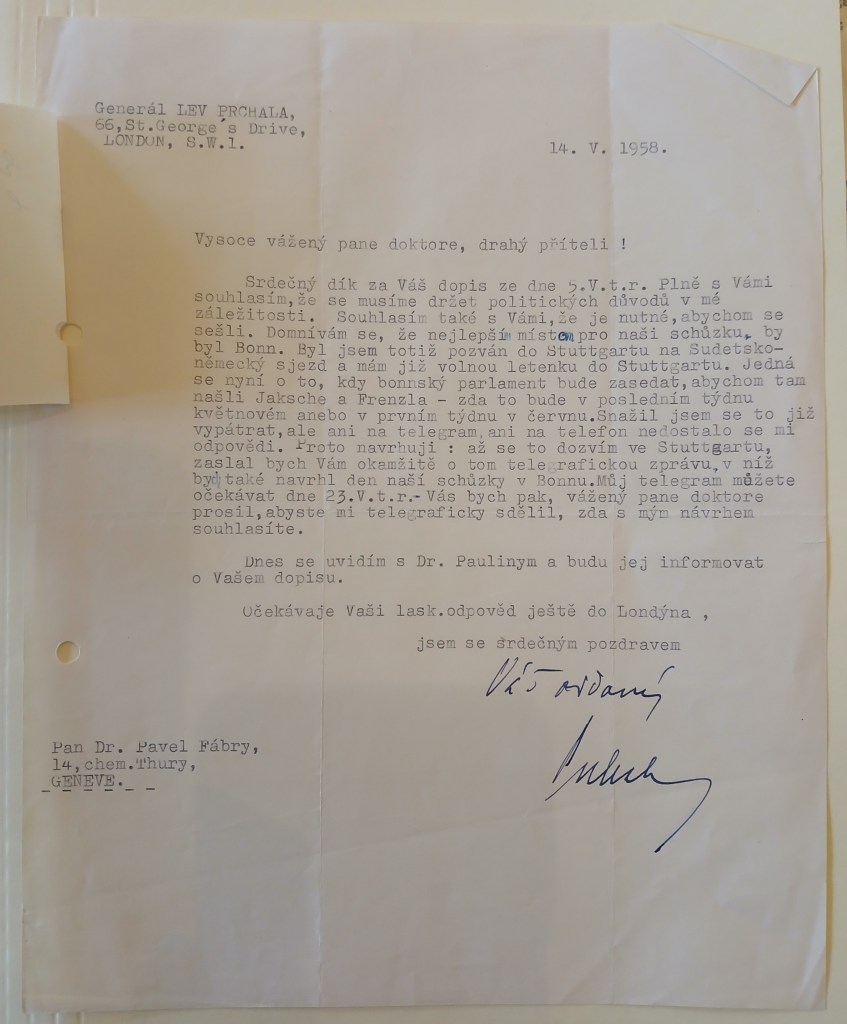
From Lev Prchala, 14.V.1958

66, St. George’s Drive, London SW1

Vysoce vážený pane doktore, drahý příteli!

Srdečný dík za Váš dopis ze dne 5.V. t.r. (MK – 5. května tohoto roku). Plně s Vámi souhlasím, že se musíme držet politických důvodů v mé záležitosti. Souhlasím také s Vámi, že je nutné, abychom se sešli. Domnívám se, že nejlepší místo pro nai schůzku by byl Bonn. Byl jsem totiž pozván do Stuttgartu na Sudetskoněmecký sjezd a mám již volnou letenku do Stuttgartu. Jedná se nyní o to, kdy bonnský parlament bude zasedat, abychom tam našli Jaksche a Frenzla – zda to bude v posledním týdnu květnovém anebo v prvním týdnu v červnu. Snažil jsem se to již vypátrat, ale ani na telegram, ani na telefon nedostalo se mi odpovědi. Proto navrhuji: až se to dozvím ve Stuttgartu, zaslal bych Vám okamžitě o tom telegrafickou zprávu, v níž bych také navrhl den naší schůzky v Bonnu. Můj telegram můžete očekávat dne 23.V. t.r. – Vás bych pak, Vážený pane doktore prosil, abyste mi telegraficky sdělil, zda s mým návrhem souhlasíte.

Dnes se uvidím s Dr. Paulinym a budu jej informovat o Vašem dopisu.

Očekávaje Vaši laskavou odpověď ještě do Londýna,

jsem se srdečným pozdravem

Váš oddaný

Prchala

Highly respected doctor, dear friend!

Sincere thanks for your letter of 5.V. this year (MK – 5 May this year). I fully agree with you that we must stick to political considerations in my matter. I also agree with you that it is imperative that we meet. I believe that the best place to meet would be Bonn. I have been invited to Stuttgart for the Sudeten German Congress and I already have a free ticket to Stuttgart. The question now is when the Bonn parliament will meet so that we can find Jaksch and Frenzel there – whether it will be in the last week of May or the first week of June. I have already tried to find out, but neither the telegram nor the telephone has been answered. I therefore suggest that when I hear about this in Stuttgart, I should send you a telegraphic message immediately, in which I would also suggest a date for our meeting in Bonn. You can expect my telegram on the 23rd of May – I would then ask you, Dear Doctor, to tell me by telegraph whether you agree with my proposal.

I shall see Dr. Pauliny today and inform him of your letter.

Expecting your kind reply still to London,

I am your devoted

Prchala

[Translation: Miroslav Kamenik / 17.4.2025]
From Lev Prchala, 19.6.1958

t.č. Rieneck 235 bei Gemünden am Main

Vysoce vážený pane doktore, drahý příteli,

přijměte, prosím, ještě jednou můj srdečný dík za Vaši obětavou a přátelskou pomoc. Můj krátký pobyt v Bonnuve společnosti Vaší milostivé paní choti a Vaší mně zůstane ještě dlouho milou vzpomínkou na vzácné lidi a krásné Slovensko. V příloze dovoluji si zaslati 6 mnou podepsaných formulářů a jsem s ruky políbením a se srdečným pozdravem

Váš

Prchala

PS: 27. t.m. budu již zpět v Londýně, 2 Cleve Rd., NW6

(at that time) Rieneck 235 bei Gemünden am Main (Germany)

Dear Doctor, dear friend,

please accept once again my heartfelt thanks for your dedicated and friendly help. My short stay in Bonn in the company of your gracious wife and your [daughter – TB] will remain for a long time a pleasant memory of the precious people and beautiful Slovakia. Enclosed I take the liberty of sending you 6 forms signed by me and with my hand kisses and warm regards

Yours

Prchala

PS: I shall be back in London, 2 Cleve Rd., NW6 on the 27th of this month.

[Translation: Miroslav Kamenik / 17.4.2025]

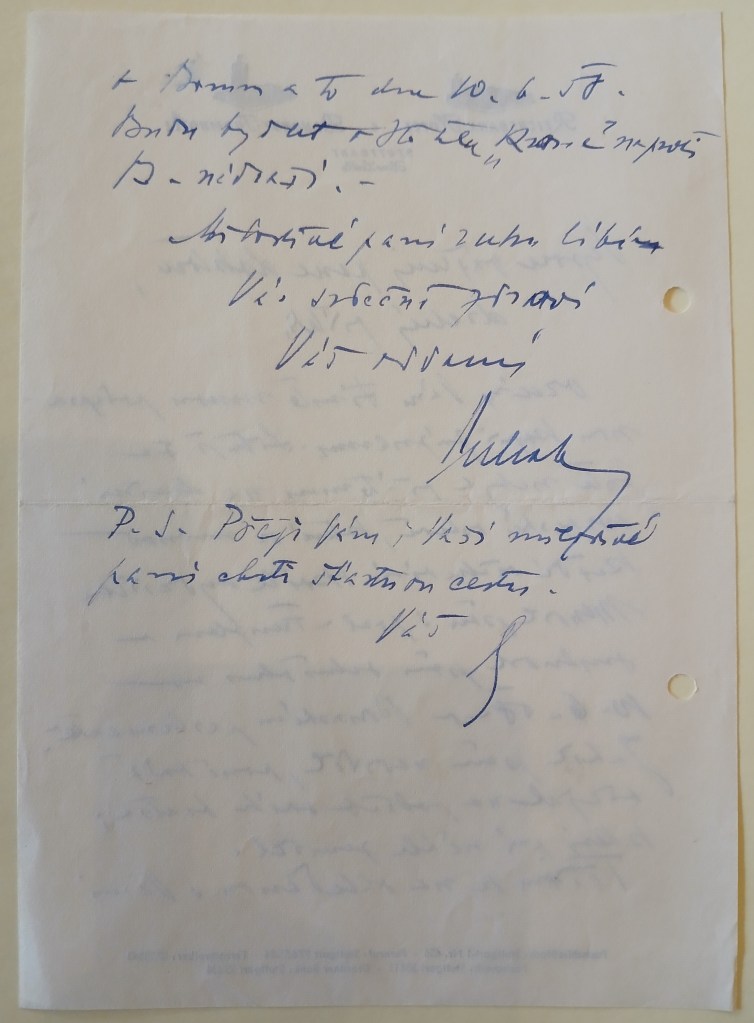
no date – Karlspreis / Sudetendeutscher Tag Stuttgart, 25.5.1958???

(Reichsbahn-Hotel & Bahnhof-Turmhotel Stuttgart, Hans Loeble)

Vysoce vážený pane doktore, drahý příteli,

vracím Vám tímto mnou podepsanou kopii (zázrkami?). Lituji, že jste nebyl přítomen na dnešní evropské oslavě, která se mimo každé očekávání skvěle vydařila. Mluvil jsem s poslancem Frenzelem a smluvil s ním schůzku na 10.6.1958 v Bonnském parlamentě. Jakše jsem nestihl, poněvadž odjel na pohřeb svého bratra, který prý náhle zemřel. Těším se na shledanou s Vámi v Bonnu a to dne 10.6.1958. Budu bydlet v hotelu Krone (?) naproti hlavnímu nádraží.

Milostivé paní ruku líbám, Vás srdečně zdraví Váš oddaný

Prchala

PS: Přeji Vám i Vaší milostivé paní chotišťastnou cestu.

Highly respected doctor, dear friend,

I hereby return to you a copy signed by me (by miracles?). I regret that you were not present at today’s European celebration, which, beyond all expectations, was a great success. I have spoken to MEP Frenzel and arranged a meeting with him on 10 June 1958 in the Bonn Parliament. I was unable to meet Jakš because he had gone to attend the funeral of his brother, who is said to have died suddenly. I look forward to seeing you in Bonn on 10.6.1958. I will be staying at the Hotel Krone (?) opposite the main station.

I kiss your gracious lady’s hand and send you my heartfelt greetings from your devoted

Prchala

PS: I wish you and your gracious lady a happy journey

[Translation: Miroslav Kamenik / 17.4.2025]

From Lev Prchala, 2.7.1958

Vážený pane doktore, drahý příteli,

srdečný dík za Váš ctěný dopis z 28.6.1958, jakož i za přílohu, kterou Vám přiloženě vracím. Děkuji také za lístek z Gemünden, který mi zaslala Vaše milostivá paní choť do Rienecku. Nyní jsem opět v tom zaplakaném Londýně a marně vzpomínám na krásné chvíle, které jsem v Bonnu prožil va Vaší a Vaší milostivé paní společnosti. Dejž Bože, aby páni v Kölnu moji žádost příznivě posoudili. Pak bych měl po starostech a letěl bych rovnou do Ženevy, abych Vám, vážený pane doktore, osobně poděkoval a milostivé paní složil svou poklonu. V Německu jsem obdržel také dopis od svého přítele Dr. Hönigera, bývalého majora justiční služby v Košicích, v němž mi sděluje, že chce s Vámi navázat spojení a dát své služby k Vaší disposici. Je to velmi čestný chlap, sportovec, který po Mnichově vydržel v armádě až do posledního okamžiku a nechal se pak pensionovat. Rozhodně nepatřil k těm Němcům, kteří v neštěstí ??? opouštěli potápějící se loď.

Milostivé paní ruku líbá, Vás srdečně zdraví, Váš oddaný

Prchala

Dear Doctor, dear friend,

my heartfelt thanks for your esteemed letter of 28.6.1958, as well as for the enclosure which I am returning to you. Thank you also for the note from Gemünden, which your kind wife sent me in Rieneck. I am now back in that weepy London and I am vainly recalling the beautiful moments I spent in Bonn in your and your gracious wife’s company. God grant that the gentlemen in Cologne may consider my application favourably. Then my worries would be over, and I would fly straight to Geneva to thank you personally and to pay my respects to your ladyship. In Germany I also received a letter from my friend Dr. Höniger, a former major in the judicial service in Košice, in which he tells me that he wishes to make contact with you and place his services at your disposal. He is a very honest man, a sportsman, who after Munich lasted in the army until the last moment and then retired. He certainly wasn’t one of those Germans who abandoned a sinking ship in a disaster.

I kiss the hand of the gracious lady, I greet you warmly, your devoted

Prchala

[Translation: Miroslav Kamenik / 17.4.2025]

From Lev Prchala, 22.VIII.1958

2, Cleve Rd. London NW6

Vážený pane doktore, drahý příteli!

Srdečný dík za lístek z Bonnu a za Váš ctěný dopis ze dne 17. t.m. ze Ženevy. Je mi opravdu líto, že došlo k nedorozumění ohledně mého zastoupení. Došlo k tomu tak, že po Vašem odjezdu ze Stuttgartu mne navštívil Dr. Höniger, jejž jsem požádal o svědectví ve věci mého pronásledování z politických důvodů. Dr. Höniger byl totiž majorem justiční služby v Košcích a může býti důležitým svědkem v mé věci.

Bohužel Dr. Höniger, který je nyní sám advokátem v Západním Německu (bydlí v blízkosti Stuttgartu), učinil více – ve saze mně prospět. Než jsem od něho žádal. Ukázal jsem mu při osobním setkání odpověď kolínského presidenta a tu Dr. Höniger – ač jsem jej výslovně upozornil, že Vy jste mým právním zástupcem a požádal, aby se s Vámi přími dorozuměl – napsal přímo Regierungspresidentovi dopis z 12.6.1958 o prodloužení lhůty. Při tom – patrně, aby svou intervenci blíže odůvodnil, užil – jak z opisu vidno – rčení, že jsem jej „pověřil péčí o mé zájmy“.

Není pochyby, že tak učinil v nejlepším úmyslu v obavě, aby nebyla promeškána lhůta. Bylo by mně velmi líto, kdybyste se z toho důvodu rozhněval na mne nebo na Dr. Hönigera. Sám Vás prosím, abyste mi laskavě prominul, jestliže jsem snad věc „zbabral“, ale současně, abyste se na Dr. Hönigera nezlobil, že Vám hned nenapsal, jak bylo jeho povinností a oč jsem jej také požádal. Na druhé straně by však bylo opravdu škoda, nepoužít jeho služeb a rozsáhlých styků, které mi nabídl ochotně ze staré známosti. Ostatně si vzpomínám, že po návratu do Londýna jsem se Vám zmínil o Dr. Hönigerovi v dopise, který jsem Vám hned napsal. Nyní napíši Dr. Hönigerovi do Winnenden znovu, aby neopomenul přímo s Vámi se dorozumět o meritu věci. Byl bych opravdu šťasten, kdybyste se dohodli o spolupráci a společném postupu.

Dr. Locherovi jsem vyřídil Vaše vzkazy. Byl však v posledních týdnech opět churav srdeční chorobou, vzniklou z loňského úrazu. Slíbil však, že Vám napíše přímo, jakmile zdravotní stav mu dovolí.

Ještě jednou Vám děkuji za Vaši neúnavnou péči a obětavou činnost za nás všechny a jsem s rukypolíbením milostivé paní

Váš oddaný

Prchala

Dear Doctor, dear friend!

My sincere thanks for the note from Bonn and for your esteemed letter of the 17th of this month from Geneva. I am really sorry that there has been a misunderstanding about my representation. It happened that after your departure from Stuttgart I was visited by Dr. Höniger, whom I asked to give evidence on the matter of my persecution for political reasons. Dr. Höniger was a major in the judicial service in Košice and can be an important witness in my case.

Unfortunately, Dr. Höniger, who is now himself a lawyer in West Germany (he lives near Stuttgart), has done more – in an effort to benefit me. than I had asked of him. I showed him in a personal meeting the reply of the President of Cologne, and here Dr. Höniger – although I had expressly informed him that you were my attorney and asked him to communicate with you directly – wrote a letter dated 12.6.1958 directly to the Regierungspresident for an extension of time. In doing so, apparently in order to further justify his intervention, he used – as can be seen from the description – the phrase that I had ‘entrusted him to look after my interests’.

There is no doubt that he did so with the best of intentions, fearing that the deadline would be missed. I should be very sorry if you were angry with me or Dr. Höniger for that reason. I would ask you to forgive me if I have perhaps “botched” the matter, but at the same time not to be angry with Dr. Höniger for not writing to you immediately, as was his duty and as I had asked him to do. On the other hand, however, it would be a real pity not to use his services and the extensive contacts which he has offered me willingly out of old acquaintance. Incidentally, I remember that on my return to London I mentioned Dr. Höniger to you in a letter which I wrote to you at once. I shall now write to Dr. Höniger in Winnenden again, so that he may not fail to communicate directly with you on the merits of the matter. I would be very happy if you could agree on cooperation and joint action.

I have conveyed your messages to Dr. Locher. However, he has been sick again in recent weeks with a heart condition arising from an accident last year. But he has promised to write to you directly as soon as his health permits.

I thank you again for your untiring care and dedication on behalf of us all, and I am hand in hand with the gracious lady

Your devoted

Prchala

[Translation: Miroslav Kamenik / 17.4.2025]
From Lev Prchala, 21.X.1958

Velevážený pane doktore, drahý příteli,

srdečně děkuji za Váš ctěný dopis z 20.X.1958, jakož i letecký lístek, který přiloženě vracím. Velmi lituji, že nemohu vyhovět Vašemu přání a přiletět do Paříže. Jsem opravdu churav a kromě toho zabraňují tomu i jiné překážky. Promiňte!

Milostivé paní uctivě ruku líbá, Vás srdečně zdraví Váš oddaný

Prchala

Dear Doctor, dear friend,

I thank you very much for your esteemed letter of 20.X.1958, as well as the air ticket (MK – air ticket), which I enclose. I regret very much that I am unable to comply with your wish and come to Paris. I am really sick and there are other obstacles preventing it. Excuse me!

Gracious ladies respectful hand kisses, I greet you cordially

Your devoted

Prchala

[Translation: Miroslav Kamenik / 17.4.2025]
From Lev Prchala, 16.XI.1958 (viditelná změna v rukopisu, těžko čitelný / hard to read handwriting)

L.Prchala

2, Cleve Rd.

London NW6

Vážený pane doktore a drahý příteli,

srdečně Vám, drahý příteli, děkuji za Váš dopis z 13. t.m., jakož i za přiložený šek na Ł100 (GBP), 20 dollarů a 50 swiss francs v bankovkách.

Nevím, čím jsem si tuto Vaši laskavost zasloužil a jak za ni poděkovat. I když tyto peníze považujete za zálohu na eventuální rentu (?) a doplatky, nemohu přece než prozatím upřímně děkovat a obdivovat Vaši důvěru k mé osobě a Vaše dobré opravdu křesťanské srdce.

Snad Bůh se nade mnou smiluje a dopřeje mi, abych se Vám mohl odvděčiti za Vaši laskavost a za Vaši namáhavou a obětavou práci, kterou si dáváte s mou záležitostí. Jsem přesvědčen, že bude korunována úspěchem.

Věřte, že bych se rád byl dostavil do Paříže, ale zaprvé selhalo moje zdraví a zadruhé že to moje sociální závislost na Czech Refugee Trust Fund a na maličké penzi, kterou týdně pobírám, které téměř neumožňují každé moje cestování. Penzi (Ł 2-7-0) bych musel před odjezdem na čas mé nepřítomnosti z V.Br. Vypovědět a Cz.R.T.F., v jehož domě bydlíme, musel by k cestě dáti svůj souhlas. To je moje situace, jež je kromě toho tím komplikovanější, poněvadž mám ženu, která na těchto soc. podporách je závislá stejně jako já. (?) pomoc by byla renta z Německa, která by nám poskytla možnost slušnější existence a trochu větší svobody.

Co se týče doplnění mé žádosti o náhradu za ztracený majetek jsem Vám rád k dispozici, prozatím bohužel jen zde v Anglii. Jsem šťasten, že spojenými silami se nám podařilo zmařit intriky sl. J. (Jenček?). Správně jsme odhadli již v Bonnu, kdo se za (?) touto ….ou skrývá a čas potvrdil náš posudek. Je to lekce pro p. presidenta v Kolíně, ale bohužel i pro Vás, jemuž za dobrotu a šlechetnost se odplatilo strašným nevděkem.

Doufám, že jste se přes tuto nemilou a bolestivou příhodu již šťastně přenesl a že Vaše zdraví tím příliš neutrpělo.

Modlím se za Vás a za Vaši vzácnou pani manželku, za Vaše zdraví a štěstí a jsem

Váš oddaný

Prchala

PS: Žena děkuje a upřímně za Váš milý pozdrav a posílá srdečné pozdravy Vaší choti a Vám, drahý pane doktore a příteli.

Dear Doctor and dear friend,

I thank you most heartily for your letter of the 13th instant, and for the enclosed cheque for £100 (GBP), 20 dollars and 50 swiss francs in notes.

I do not know what I have done to deserve this kindness and how to thank you for it. Even if you consider this money as a deposit for the eventual annuity (?) and supplementary payments, I cannot but for the present sincerely thank and admire your confidence in my person and your good truly Christian heart.

May God have mercy on me and grant that I may repay you for your kindness and for the laborious and devoted work you are putting into my cause. I am confident that it will be crowned with success.

Believe me, I would have liked to have come to Paris, but firstly my health has failed and secondly it is my social dependence on the Czech Refugee Trust Fund and the tiny pension I receive weekly that make any travel almost impossible. The pension (£2-7-0) would have to be paid to me before I could leave for the time of my absence from Great Britain. I would have to give notice and Cz.R.T.F., in whose house we live, would have to give his consent to the journey. This is my situation, which is all the more complicated because I have a wife who is as dependent on these social benefits as I am. (?) Help would be an annuity from Germany, which would give us the possibility of a moredecent existence and a little more freedom.

I am happy to be of service to you regarding the completion of my application for compensation for lost property, unfortunately for the time being only here in England. I am happy that by joining forces we have been able to thwart Ms. J. (?) intrigues. We correctly guessed back in Bonn who was behind … (not legible) and time has confirmed our assessment. It is a lesson for Mr. President in Cologne, but unfortunately also for you, whose kindness and generosity have been repaid with terrible ingratitude.

I hope that you have got over this unpleasant and painful episode happily, and that your health has not suffered much.

I pray for you and for your precious wife, for your health and happiness and am

your devoted

Prchala

PS: My wife thanks and sincerely for your kind greetings and sends her heartfelt regards to your wife and to you, dear doctor and friend.

[Translation: Miroslav Kamenik / 17.4.2025]

Postcard and Letter from Dr. Ivan Krno, 1935 and 1958

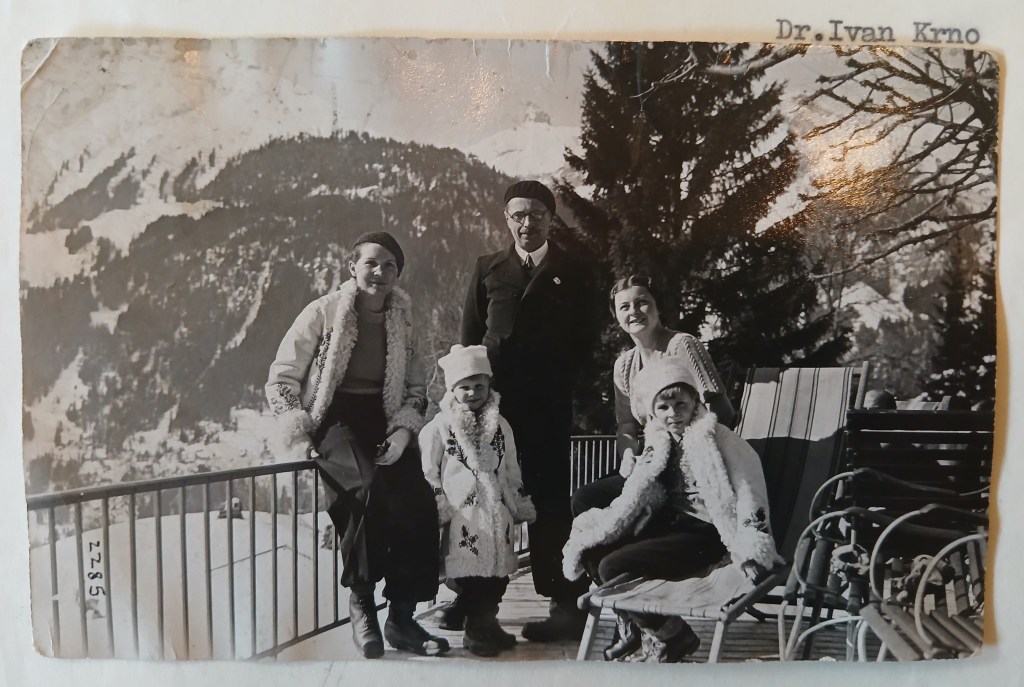
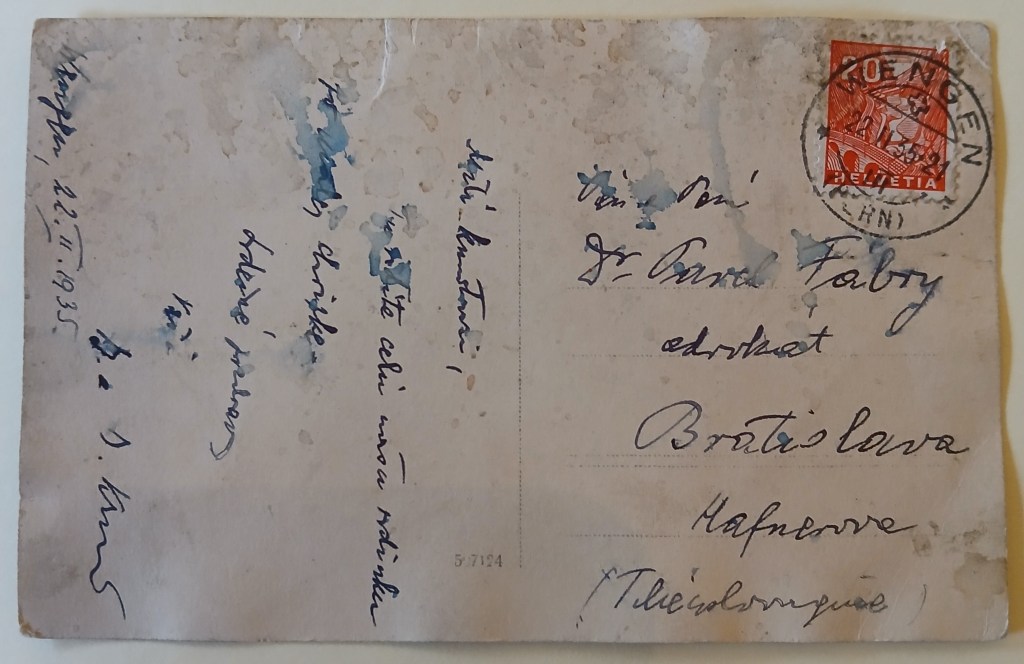
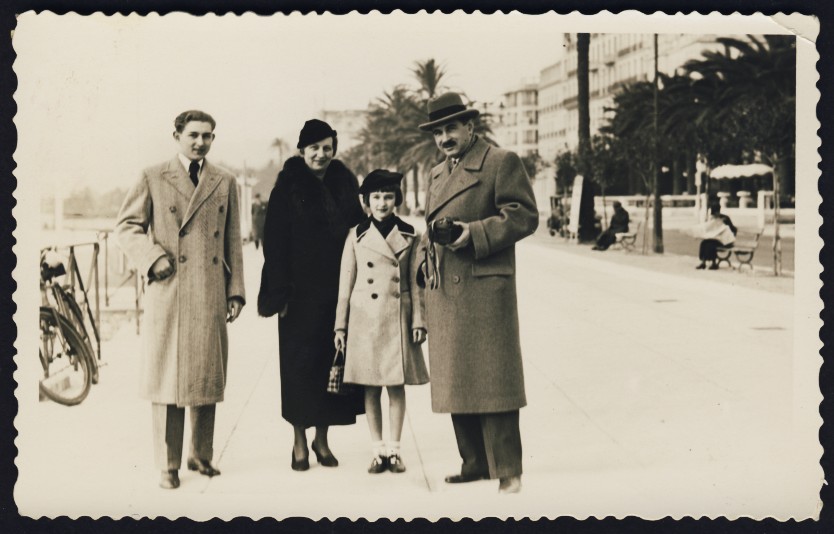
Real photo postcard from Dr. Ivan Krno, 22 Feb. 1935, sent from Wengen, Switzerland, to “Mr. and Mrs. Dr. Pavel Fabry, advokat, Bratislava, Hafnerova, Czechoslovakia”. Ivan Krno stands at center, with his wife and three sons.
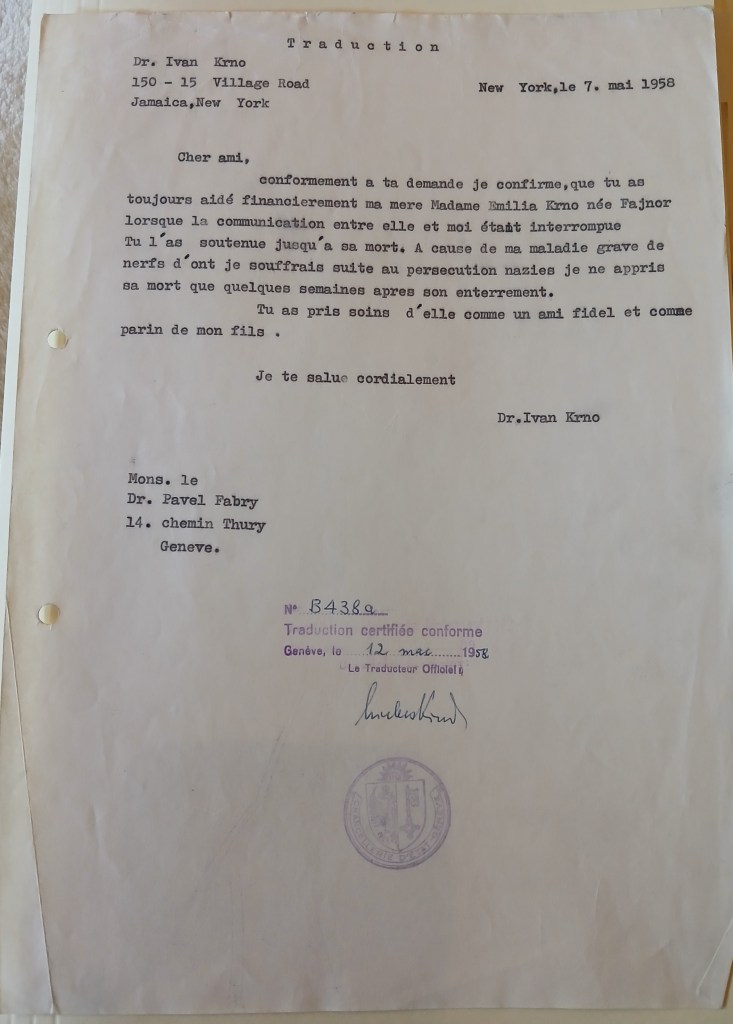
Translation of letter from Dr. Ivan Krno in New York to Dr. Pavel Fabry in Geneva, certified in Geneva on 12 May 1958. Ivan lived in exile from 1948 until his death in 1961.

“New York, 7 May 1958

Dear Friend,

In accordance with your request, I confirm that you have always financially helped my mother, Mrs. Emilia Krno nee Fajnor, when communications between her and me was interrupted. You supported her until her death. Due to my severe nervous illness from which I suffered as a result of Nazi persecution, I only learned of her death a few weeks after her funeral.

You took care of her as a loyal friend and as godfather to my sons.

I greet you warmly,

Dr. Ivan Krno”

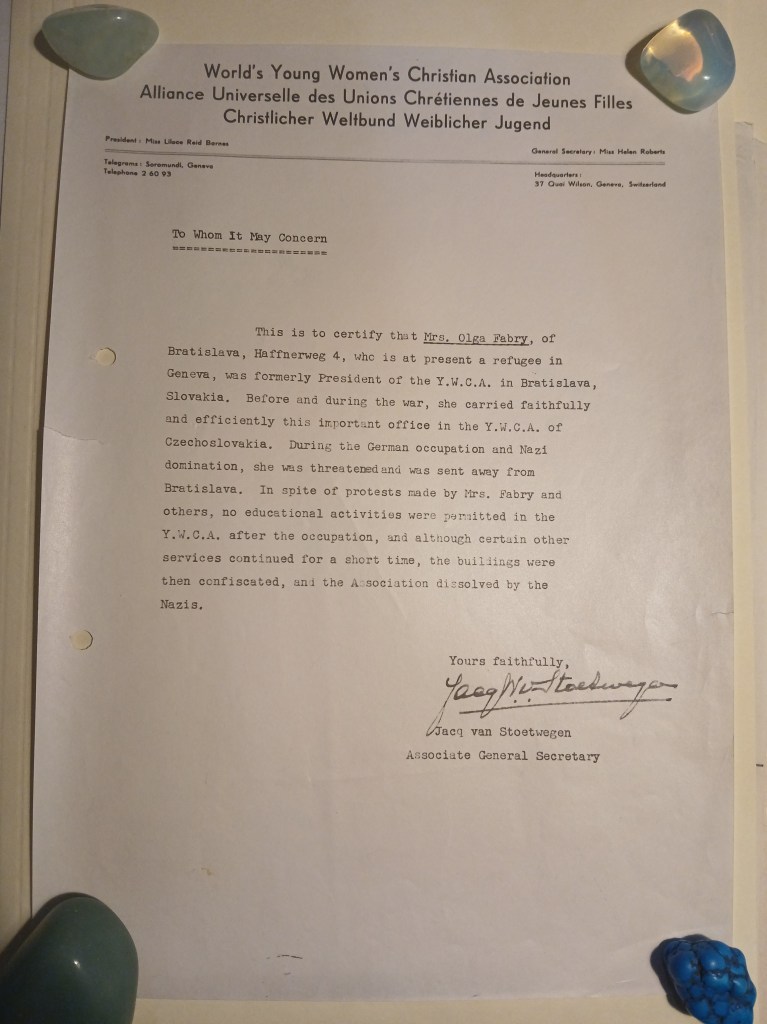
Grandma Fought The Nazis For You

Vlado with his “Maminka” Olga Fabry, Geneva, circa 1948, after she had fled Czechoslovakia.
Letter from World’s YWCA Associate General Secretary Jacq van Stoetwegen, confirming the testimony of Olga Fabry.

“To Whom It May Concern

This is to certify that Mrs. Olga Fabry, of Bratislava, Haffnerweg 4, who is at present a refugee in Geneva, was formerly President of the Y.W.C.A. in Bratislava, Slovakia. Before and during the war, she carried faithfully and efficiently this important office in the Y.W.C.A. in Czechoslovakia. During the German occupation and Nazi domination, she was threatened and was sent away from Bratislava. In spite of protests made by Mrs. Fabry and others, no educational activities were permitted in the Y.W.C.A after the occupation, and although certain other services continued for a short time, the buildings were then confiscated, and the Association dissolved by the Nazis.”

Letters from Fraňo Tiso

Who was Fraňo Tiso? When I first posted the image of his postcard to Vlado here, back in March of 2013, I was frankly too horrified to consider that he could be any relation to Jozef Tiso, that there were probably lots of people with the last name of Tiso. But considering the political connections that Vlado and Pavel had, that Fraňo was the former Slovak Ambassador to the Soviet Union, and that I also have letters from Fraňo to Pavel concerning his communication with Franz Karmasin (letters from Karmasin posted here), this Fraňo was very likely the cousin of Jozef Tiso; he is mentioned briefly in James Mace Ward’s “Priest, Politician, Collaborator: Jozef Tiso and the Making of Fascist Slovakia” (published 2013, Cornell University Press); from chapter 7, “Sacred Convictions, 1939-44”, page 206:

“Although still pro-German, [Jozef] Tiso also wanted greater independence, a desire that led to a sharp foreign policy turn: détente with the Soviet Union. In addition to general issues of sovereignty, the economics of German domination increasingly troubled him. His idea of the state was for “national” property to come into Slovak hands. Instead, German-held shares in Slovakia’s industry exploded to over half in 1942. The Reich meanwhile consumed around three-quarters of Slovak exports, paying in devalued credits instead of hard cash. Seeking relief from such economic dependence and exploitation, Ďurčanský as foreign minister looked east. Diplomatic ties with the Communist state offered markets, an ally for revising the Vienna Award, and the prestige of Great Power recognition. Despite a lifetime of anti-bolshevism, Tiso supported the strategy. He later claimed to have welcomed the 1939 Hitler-Stalin Pact, expecting it to facilitate the solution of “European questions” on the basis of the ethnic principle. In his first presidential address, he proposed Slovakia as “a mediator…between…the Slavic and German worlds.” Soon, he was courting “extensive economic relations” with the Soviets not only by exchanging ambassadors (sending to Moscow his cousin Fraňo) but even by congratulating Stalin on the anniversary of the October Revolution.”

More about Fraňo and Jozef Tiso is mentioned in David S. Wyman’s book “The World Reacts to the Holocaust” (published 1996, Johns Hopkins University Press):

“The fate of the Jewish population had been given more attention in Slovakia than in the Czech lands, mainly because of the involvement and complicity of the clero-fascist Slovak regime, headed by the Catholic priest-president Dr. Jozef Tiso. The role played by the Catholic clergy in Slovakia during World War II conformed with the antireligious propaganda of the Communist Party.

The initial attempt to review the birth of the Slovak state was made by the pre-war minister of justice Ivan Dérer, in his Slovenský vývoj a ľudácká zrada, fakta, vzpomínky a úvahy (The Slovak state and the treachery of the L’udaks: Facts, memories, and thoughts). The first writer to set a novel against the backdrop of the years of Slovak independence was Dominik Tatarka in his Farská republika (The Parish republic). Tatarka depicted the misguided policy and the corrupt leadership that ultimately led to the wholesale deportation and destruction of the Jewish population. Other authors, such as Hela Volanská and Katerína Lazarová, portrayed the heroic stance of Jewish participants in the Slovak National Uprising. The History of Modern Slovakia, the first in-depth study to disclose the policy of the Nazi puppet regime and to describe at great length the persecution of Slovak Jewry, was published in New York in 1955 by Dr. Jozef Lettrich, a chairman of the Slovak National Council who had fled after the Communist coup. The role of the Hlinka Guard and the Jewish plight were analyzed by Imrich Staňek, himself a survivor, in the 1958 Zrada a pád: hlinkovští separatisté a tak zvaný Slovenský stát (Treachery and downfall: The Hlinka separatists and the so-called Slovak state), written from a strictly Marxist-Leninist viewpoint.

The capture of Adolf Eichmann in May 1960 by the Mossad and his subsequent trial in Jerusalem were widely covered in the national press and media. Eichmann, notorious for engineering the deportation of both Czech and Slovak Jewry, was of major interest to the local population. (He had commuted between Berlin and Prague, where he resided in the elegant, confiscated Rosenthal villa, in the Střešovice district.) The Czech and Slovak press sent special reporters to cover the proceedings of the trial. One of these reporters, the writer Ladislav Mňačko, later published a book portraying Eichmann’s satanic role in the Holocaust. The testimonies given at the trial by survivors appeared frequently in the press and in Věstník ŽNO, the weekly bulletin of the Jewish Religious Communities in Prague. Many of these related to the wholesale deportation of Slovak Jewry orchestrated by the [Jozef] Tiso regime. During one of the sessions of the trial Eichmann’s claim that “the Slovaks gave away their Jews as one spills sour beer,” from Life magazine’s interview with him, was quoted. Widely repeated in the international press, this assertion provoked reactions among leading Slovak figures in exile. The Munich-based Fraňo Tiso, in an effort to whitewash the Slovak wartime leadership, published an article in which he stressed the endeavors of the “moderate parish regime” to save Jews from deportation. In response, Edo Friš took up the topic in the article “In the Background was Heydrich,” published in the Bratislava weekly Kultúrny život. The controversy focused on the visit of SS Obergruppenführer Reinhard Heydrich to Bratislava on April 10, 1942. Friš challenged [Frano] Tiso’s claim that the reason for Heydrich’s visit was to pressure the Slovak government to continue implementing the Final Solution. Citing documents referred to in The Destruction of Slovak Jewry, published some months earlier, Friš stressed the initiative and involvement of the Slovak leaders in the mass deportation of Jews; the aim of Heydrich’s visit, Friš added, was to assist the Slovak government in formulating a fallacious reply to the Vatican’s March 14, 1942, protest against the deportation of Jews. This was the first discussion of this sensitive issue in more than a decade.”

Here is another perspective of Fraňo Tiso, from the article “Slovak Historians In Exile In North America, 1945-1992” (published 1996), written by M. Mark Stolarik, Chair of Slovak History and Culture, University of Ottawa, Canada:

“Finally, another émigré journalist briefly settled in the Dominion and produced a significant work of scholarship. He was Dr. Fraňo Tiso (1894-1974), the former Slovak Ambassador to the Soviet Union between 1939 and 1941. Tiso fled Slovakia in 1945 and settled in Canada in 1950. In spite of his advanced age, he studied at the University of Montreal and in 1956 earned a Ph.D. in history. He published a portion of his dissertation on “The Empire of Samo, 623-658” in 1960. In 1957 he moved to West Germany where he edited the newspaper Slobodné Slovensko until his death.”

Obviously, I am very unsettled that I have these letters, I don’t know what to make of them yet, but I am publishing them here because I want to know the truth about the Fabrys, even if it shatters my whole lovely narrative about them – this is about history and not fiction.

Frano Tiso-P.Fabry doc. 2-19-59 1
Frano Tiso-P.Fabry doc. 2-19-59 2

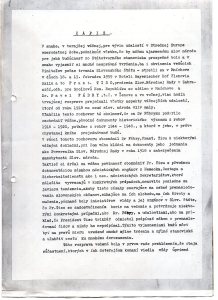
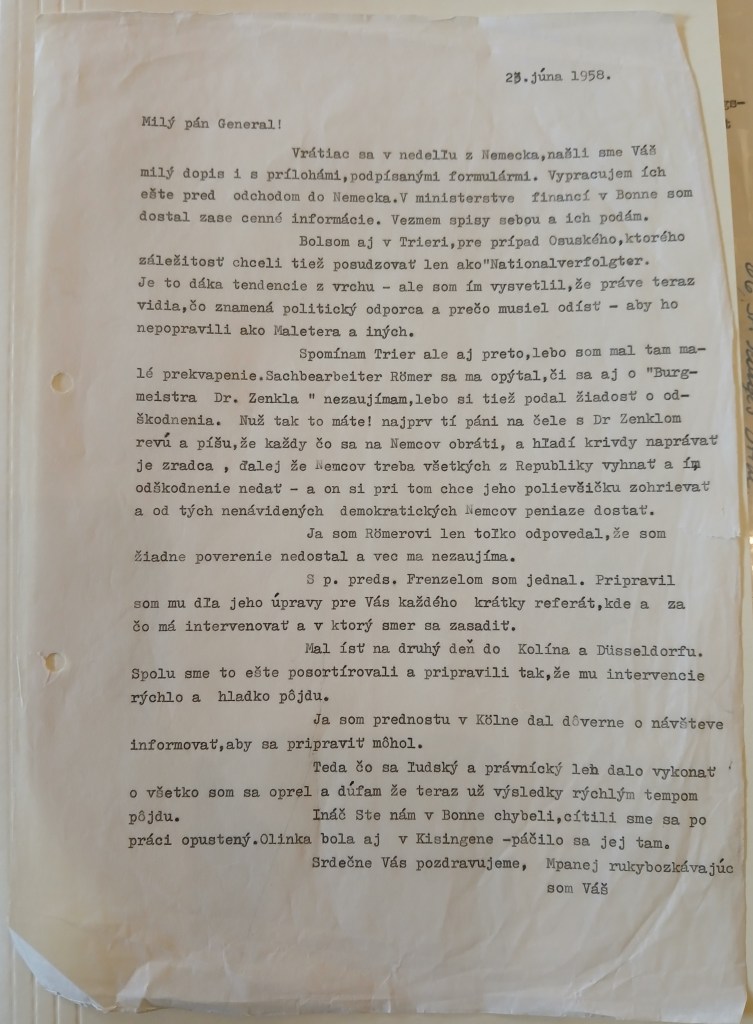
ZÁPIS

V snahe, v terajšej vážnej, pre vývin udalostí v Strednej Europe smerodatnej dobe, podniknúť všetko, čo by nášmu ujarmenému slov národu pre jeho budúcnosť zo štátotvorného stanoviska prospešné bolo a v snahe vyjasniť si mnohé nesprávné tvrdenia, ba i obvinenia vedúcich činiteľov počas trvania Slovenského štátu – stretli sa v Mníchove v dňoch 18. a 19. februára 1959 v Hoteli Bayerischer Hof členovia Exilu a to Frant. TISO, predseda Slov. Národnej Rady v Zahraničí, odb. pre Spolkovú Nem. Republiku so sídlom v Mníchove a Dr. Pavel FABRY, t.č. v Ženeve a vo voľnej, viac hodín trvajúcej rozprave prejednali všetky aspekty vážnejších udalostí, ktoré od roku 1918 na osud slov. národa vliv maly.
Uľahčila tento rozhovor tá okolnosť, že sa Dr Fabrymu podarilo zachrániť vážne, pôvodné dokumenty historického významu z rokov 1918 – 1920, poťažne z rokov 1944 – 1948., a ktoré v jeho, v práve chystanej knihe prejednávané budú.
V rámci tohoto rozhovoru oboznámil Dr Fábry, Frant. Tisu s niektorými vážnými dokladmi, pri čom váhu kládol na dokumenty jeho jednania ako Povereníka Slov. Národnej Rady v roku 1918 o zabezpečenia samobytosti Slov. národa.
Taktiež si držal za vážnu povinnosť oboznámiť Fr. Tisu s pôvodnou dokumentáciou zásahou nácistických orgánov z Nemecka, Gestapa a Sicherheitsdienstu ako i nem. nácistických Sekretariátov, ktoré náležite vyvracajú v konkretných prípadoch, menovite posledne sa javiacu tendenciu, akoby tieto zásahy smerujúce na osbné prenasledovania slovenských občanov, sihajúce na ích slobodu, na ích životy a mučenia, páchané boly iniciatívov vládz a jej orgánov v Slov. štáte, čo Fr. Tiso so zadosťučinením berie na vedomie a potvrdzuje niektorými konkretnými prípadmi, ako Dr. Fábry, a udalostiami, ako na príklad, že Prezident Tiso trikráť odmietol podpísať zákon o prenasledovaní židov a nikdy ho nepodpísal. Týmito vyjasneniami budú môcť byť na pravú mieru uvedené mnohé mýlne trdenia a mýlné stanoviská a uľahčiť cestu ku mnohému dorozumeniu.
Táto rozprava vedená bola v prvom rade prehlásením, že obaja súčastnení, ktorých v ích doterajšom konaní viedla vždy úprimná snaha, za v dobe daných okolností pomôcť svojmu rodu a berú za toto pred Bohom, národom a vlastným svedomím vždy a všade zodpovednosť.
Preto sa rozhodli, na základe v rozprave zistených okolností všetko potrebné podniknúť, aby vytýčený cieľ mohol byť uskutočnený, ktorého podrobností a postup pripravia do stretnutia najbližšej príležitosti.
Do tej doby overia tento záp-is svojím parafom a prosia Všemohúceho aby žehnal ďalšie kroky ích úsilia.

Dané v Mníchove, dňa 19. februára 1959.

Dr. Pavel Fabry parafuje:
Frant. Tiso parafuje:

Napísané v dvoch exemplároch parafom potvrdených.
————————————————————————————————–
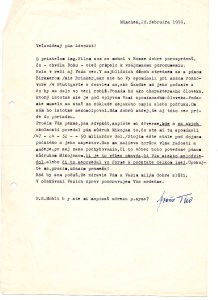
Frano Tiso letter 2-28-59

München, 28.februára 1959

Veľavážený pán Advokát!

S priateľom ing.Filom som sa mohol v Bonne dobre porozprávať, čo – chvála Bohu – tiež prispelo k vzájomnému porozumeniu.
Bola v reči aj Vaša vec. V najbližších dňoch stretnem sa s pánom Birknerom / nie Brinker, ako ste ho Vy spomínali pri našom rozhovore / v Stuttgarte a dozviem sa, aké úzadie má jeho podanie a čo by sa dalo vo veci robiť. Poznám ho ako charakterného človeka, ktorý istotne nie je pod vplyvom Vami spomínaného človeka. Podanie muselo sa stať na zaklade nejakéko omylu alebo podfuku. On sám ho istotne nekoncipoval. Mám dobrú nádej, že aj táto vec príde do poriadku.
Prosím Vás pekne, pán Advokát, napíšte mi dôverne, kde a za akých okolností povedal pán súdruh Mikojan to, čo ste mi tu spomínali /47 – 24 – 32 – – 50 miliardov dol. / Stojím ešte stále pod dojmom počutého a jeho aspektov. Raz ma zalieva horúca vlna radosti a nádeje, po nej zasa pochybovania, či to vôbec bolo povedané pánom súdruhom Mikojanom, či je to vôbec pravda, či Vás niekto nepodviedol, alebo či to nepovedal vo forme a podstate celkom inej. Upokojte ma, prosím, udaním prameňa!
Rád by som počuť, že zdravie Vám a Vašim milým dobre slúzi.
V očakávaní Vašich zpráv pozdravujem Vás srdečne.

P.S. Mohli by ste mi napísať adresu p. syna?

Frano Tiso

—————————————————————————————————-
Frano Tiso telegram 4-7-59
—————————————————————————————————-

Frano Tiso letter 6-29-59 1
München, 29. júna 1959

Frano Tiso letter 6-29-59 2

Veľavážený pán Doktor Fábry!

Keďže prem mojim odchodom do Pariza nemohol som sa stretnúť s p. št. sekretárom Karmasinom, aby som s ním pohovoril v zmysle toho, na čom sa dohodli pán Filo a Birkner, napísal som mu list a vysvetlil, že nemôže byť ani v jeho záujme, aby povstal proces a aby sa rozprestierali pred nepritaeľskou verejnosťou veci, ktoré najradšej zabudnúť treba.
Odpoveďou napísal mi p. št. sekr. Karmasin toto:
“Die Beilage in Angelegenheit Dr. Fabry habe ich erhalten. Ich bin an Dr. Fabry weder positiv noch negativ interessiert, ich war es auch nie. Nun hat aber Dr. Fabry behauptet, dass er über meine Veranlassung von der Gestapo verhaftet wurde. Das ist eine glatte Unwahreit und ich kann nun keine Erklärung adgeben, dass ich ihn tatsächlich verhaften liess. Ich habe im ganzen Leben niemenden verhaften lassen, also auch Dr. Fabry nicht, ganz abgesehen davon, dass ich gar nicht die Möglichkeit hatte, jemanden verhaften zu lassen. Es müsste also erst Dr. Fabry seine Behauptung widerrufen, dass er über meine Veranlassung verhaftet wurde, denn ich kann Ihnen nicht zustimmen, wenn Sie schreiben, dass mit einer Zurückziehung niemand zu Schaden kommen kann. Ich z. B. Schon! Denn wenn ich meine Erklärung zurückziehe, heisst das, dass ich Weisungsbefugnis an die Gestapo hatte, was nie und nimmer stimmt, und ich komme in Teufels Küche.
Ich lege bestimmt keinen Wert darauf, in einen Prozess verwickkelt zu werden und aus diesem Grunde zusätzlich noch in die Öffentlichkeit gezerrt zu werden, aber mit einer einseitigen Zustimmung von mir ist es nicht getan.
Ich halte es für das zweckmässigste, wenn die beteiligten Herren sich zu einer Aussprache zusammenfinden würden, damit man gemeinsam Mittel und Wege suchen kann, um die Angelegenheit zu bereinigen.”
Z listu vidno, že aj Vy ste spravili chybu, keď ste p.Karmasinovi imputovali čin, ktorý on nespáchal. Ale aj to vysvitá z listu, že sa neuzatvára pred pokojným riešením veci. Hodno by bolo, uskutočniť jeho návrh.
V Bonne som Vás hľadal! Už ste boli odcestovaný. S týmto v súvislosti rád by som Vás usistiť, že nijako sa Vám nenatískam ani vo veci vypísania otáznych statí z “Grenzbote”; ale mohol som očakávať, že mi dáte alebo Vy, alebo priateľ Filo na vedomie, že to už nie aktuálne. Bol by som si moj opravdu drahý a takmer na hodiny rozpočítaný čas ináč zariadil. Takto som odmietol 15 prednášok.
Nie je to však nešťastím. Som Vám rád napomoci aj v budúcnosti, len prosím o dodržanie dohovoreného; či už priamo medzi nami, alebo cestou tretej osoby dohovoreneho.
Byt chvála Pánu Bohu už mám! Dobrí priatelia mi ho sprostredkovali, začo som im hlboko povďačný!
Prosiac, aby ste Milostivej panej Manželke odovzdali úctivý rukybozk, pozdravujem Vás srdečne.

Tiso

——————————————————————————————-

Frano Tiso postcard to Vlado 4-12-60

Frano Tiso postcard to Vlado 4-12-60 reverse

It begins with a book…

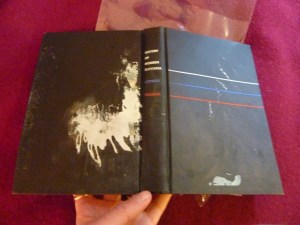
Last August, I took another look through the family collection of books about Czechoslovakia. What I found was a copy of “HISTORY OF MODERN SLOVAKIA” by Jozef Lettrich, which had, sadly, been overlooked in a damp corner of the house.
034
But in spite of mold damage, I put it in a mylar sleeve and kept it nearby, because the book mentioned Pavel Fabry (Vladimir Fabry’s father) as one of the first to be imprisoned in a concentration camp on March 30, 1939, in the state prison of Ilava.
036
I recognized the book immediately, since I had seen at least a half dozen photostatic copies in my archive from page 144, underlined in the same places, which Pavel must have referred to in his case for reparations in Germany.
037
038
From Chapter Two, “Under the Swastika”, pages 143-144:

“When prisons were no longer adequate, the Slovak Government issued an order on March 24, 1939, “concerning the imprisonment of the enemies of the Slovak State.” […] This order authorized the Minister of Interior to “arrange for the jailing of persons whose past and present activities give reason to fear that they would continue to obstruct the building of the Slovak State.” The Minister of the Interior was further authorized to create “a camp for the detention of such persons in which prisoners would be compelled to perform physical labor.” Vojtech Tuka lost no time in transforming the old state prison in Ilava into a “security camp,” the first concentration camp in Slovak history. The Ilava prison thus became the home of Slovak democrats–of authors, priests, teachers, newspapermen and statesmen, as well as of simple farmers, workmen and students. The first inmates of this camp, brought there on March 30, 1939, were: Anton Štefánek, Ján Ursíny, František Zimák, Ján Pocisk, Ferdinand Benda, Karol Hušek, Ján Paulíny-Toth, Jozef Rudinský, Pavel Fábry, Andrej Djuračka, František Třešnák, Hana Styková, Vinco Mihalus and Jozef Lettrich, three Members of Parliament, two Senators, three journalists, the Chairman of the Slovak National Party, and an actress from the Slovak National Theater. Others soon followed. In the few years of existence of the Slovak State more than 3,000 persons were to pass through the gates of the Ilava concentration camp. Some remained a few days, some for months, and others for several years. They were all sent to Ilava without trial , without judgement, without indictment, merely upon a denunciation and by administrative order of the Ministry of Interior. Tuka, on April 15, 1939, made the following characteristic statement, “Those who spread alarming rumors and false reports are obstructing our way. We have made arrangements to handle all of them in Ilava. Many of them are there now and many others will follow them there. It is your duty to denounce these instigators to the police and the Hlinka Guards, and the Slovak Government will take care of them.”

030
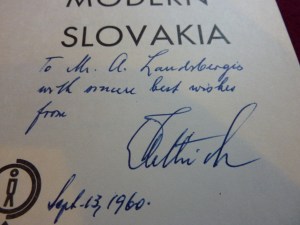
I now have another copy of this book, in very good condition, signed and inscribed by Jozef Lettrich on the title page. It was only after this that I looked at the title page of the copy I found, and it was also inscribed.
028
Title page from second copy.
040
From the copy that belonged to Pavel Fabry.

When I finally started to read it, it dawned on me that this book was written by the same Jozef Lettrich that was in prison with Pavel, and that I had letters from Lettrich – Chairman of the Slovak National Council in Czechoslovakia, who was an exile living in the United States. So I went back to the boxes. I was amazed by how this one book began to illuminate what I had missed before: letters to and from Milan Hodza – Prime Minister of Czechoslovakia; Jan Pauliny-Toth – lawyer and politician; Peter Pridavok – Chairman of the Slovak National Council in London; Juraj Slavik – Czechoslovak Ambassador to the United States; General Lev Prchala; Emil Stodola, and Kornel Filo. Pavel Fabry was seeking reparations for many of these people and others in Berlin, as their lawyer, so I have some of their testimonies, in Slovak, German and French.

But then I found two letters from Franz Karmasin, one of them signed. Franz Karmasin was state secretary for the German Minority, under President of Slovakia and Catholic Priest Jozef Tiso: an anti-semite who collaborated with Hitler and was key in making the Slovak State the first Nazi ally in the Final Solution, deporting tens of thousands of Jewish people to their extermination – he was hanged after WWII; Karmasin was also senticed to death but escaped prosecution and was living in exile in Munich. From what I was able to translate, Karmasin seems to be arguing against something Pavel said about him – and he begins his first letter in praising Pavel on his son Vlado – The Hague and Nuremberg are also mentioned. There were no letters from Pavel to Karmasin. I’ve transcribed the letters here for others to translate.

Page056

Page055

Dipl. Ing. Franz Karmasin
München 8
Trogerstaße 32

München, den 8-7. 1959

Herrn
Dr. Paul Fabry

14 Chemin Thury
Geneve

Sehr geehrter Herr Dr. Fabry!

Unsere gestrige Aussprache hat mich sehr stark an Aussprachen in der Heimat erinnert. Ich glaube, diese angenehme Atmosphäre gibt es nur jenseits der Karpaten. Ich bitte, es nicht als Anmassung zu betrachten, wenn ich Sie zu Ihrem prächtigen Sohn beglückwünsche. Er hat großen Eindruck auf mich gemacht und ich freue mich wirklich von ganzem Herzen, dass die slowakische Sache so einen hervorragenden Vertreter ihrer Interessen besitzt.
In der Kanzlei habe ich mir dann den sehr dicken Akt “Dr. Fabry” vorgenommen. Ich war froh, dass ich dies erst nachher getan habe, ich wäre sonst kaum zu der Besprechung gekommen. Ich habe sehr stark den Eindruck, dass Sie in der Darstellung und Beurteilung der Situation der Deutschen Volksgruppe in der Slowakei sich weniger von Tatsachen, als vielmehr von Gefühlen leiten liessen. Ich kann es verstehen, umsomehr, als die Grenzen zwischen Reichsdeutschen und Volksdeutschen von Aussen her nicht immer sichtbar waren und vor allem die Situation der Volksgruppe und der Volksgruppenführung nicht für eine öffentliche Diskussion geeignet war. Aber in Ihren Ausführungen sind Sie doch etwas hart, ich darf Ihnen das in aller fahrens mit Ihnen und Ihrem Herrn Sohn über diese Dinge diskutieren, jetzt ist nicht der geeignete Zeitpunkt dazu. Ich will Ihren nur zu bedenken geben, dass der deutsche evangelische Bischof Scherer, für dessen Ernennung ich mich übrigens sehr stark eingesetzt habe und fast alle evangelischen u. katholischen Pfarrer Mitglieder der Deutschen Partei waren und dass die Deutsche Partei bei den Nürnberger Verfahren ausgeklammert wurde, obwohl man den Aliierten bestimmt nicht Unkenntnis der Lage vorwerfen konnte. Auch das Dokumentenmaterial, wenn man es vollinhaltlich zur Kenntnis nimmt, spricht eine andere Sprache als Ihre Darstellungen. Die Offenheit, mit der wir gestern gesprochen haben, verpflichtet mich, Ihnen das zu schreiben.
Die Zusatzerklärung habe ich lt. Durchschlag an das Regierungspräsidium, an Dr. Virgano, Herrn Minister Dr. Tiso und Herrn Birkner geschickt. Ich bin gespannt, wie sich die Angelegenheit weiter entwickeln wird.

Hochachtungsvoll!

(Karmasin)

Page057

Copy

Dipl. Ing. Franz Karmasin
München 8
Trogerstaße 32

München, den. 8.7.1959

An das
Regierungspräsidium
Köln
Zeughausstr. 2-4

Sehr geehrte Herren!

Betr.: Dr. Paul Fabry

Ich habe die verschiedenen Schriftstücke im Falle Dr. Paul Fabry, soweit sie mir zur Verfügung stehen, nochmals durchgesehen und darf meine seinerzeitige Darstellung wie folgt ergänzen:

Ich habe dargelegt, dass die Behauptung, Dr. Fabry sei durch die Gestapo verhaften worden, falsch sei, da sich auf dem Gebiete der Slowakei keine Gestapo befunden hat. Dagegen hatten z.Zt. der Besetzung des slowakischen Staatsgebietes rechts der Waag während der Tschechenkrise durch deutsche Truppen Organe des Sicherheitsdienst Dienst gemacht. Ich glaube mich erinnern zu können – ohne es allerdings beschwören zu können -, dass durch die deutschen militärischen Kommandostellen Angehörige der Hlinkagarde (HG) und der Freiwilligen Schutzstaffel (FS) diesen Organen als Hilfskräfte zugeteilt wurden. Inwieweit sich diese im Zuge der revolutionären Ereignisse Übergriffe zuschulden kommen ließen, entzieht sich meiner Kenntnis, vor allem aber meiner und meiner Mitarbeiter Verantwortung. Sie unterstanden, falls sie sich in die Dienst der Deutschen Wehrmacht oder des SD begeben hatten, nicht mehr der Befehlsgewalt der Volksgruppe.

Zu dieser Ergänzung fühle ich mich verpflichtet einerseits, weil Aussenstehende die Unterschiede zwischen SD und Gestapo nicht ganz klar waren, andererseits weil mir im Interesse meiner ehemaligen Mitarbeiter selbst sehr viel an der Klärung dieser Angelegenheit liegt. Ich bitte, die Ergänzung in diesem sinne zur Kenntnis zu nehmen.

Hochachtungsvoll!

(Karmasin)

Translating the Fabry Family

Vlado and Pavel Fabry
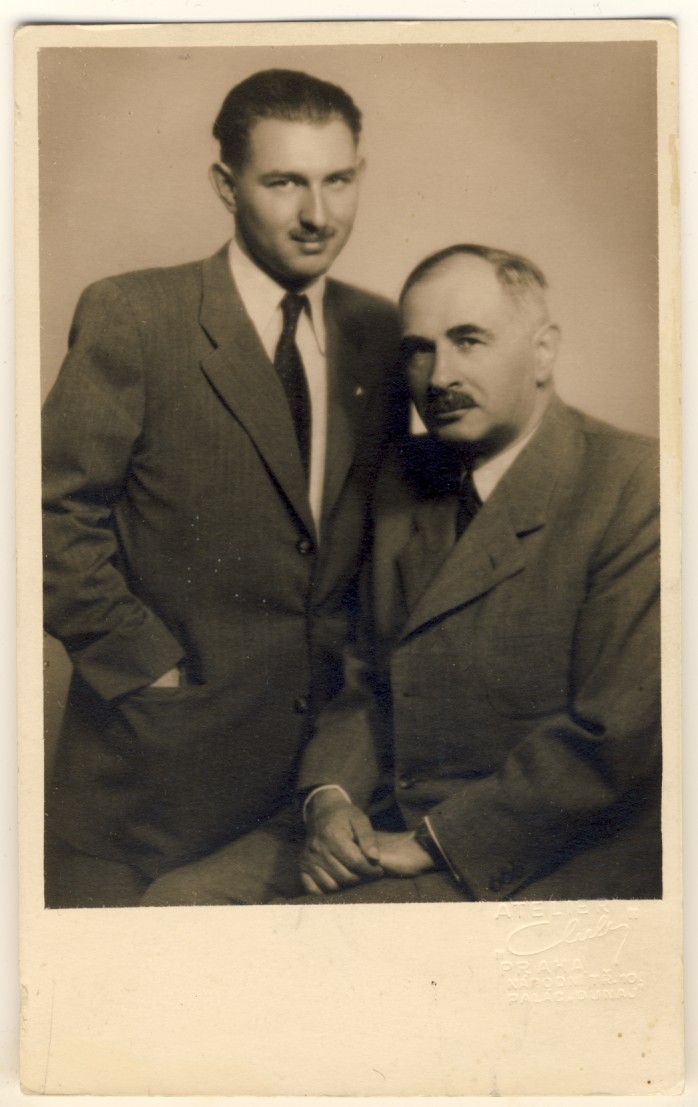
When my Slovak mother-in-law passed away, she left behind a trove of family documents dating back before the creation of Czechoslovakia in 1918. This blog is where I piece together the clues of her family – the Fabry family: Vlado, her only brother – member of the United Nations from 1946 until 1961, when he died in a plane crash on a peace mission with U.N. Secretary General Dag Hammarskjold; Pavel, her father – a lawyer, politician, and son of wealthy industrialists, and one of the first to be imprisoned and tortured in the concentration camp llava, in Czechoslovakia; Olga, her mother – daughter of land-owning aristocrats, who watched as her home was seized from her, and eventually turned into the Russian Consulate, in Bratislava, where it remains today still. My mother-in-law, whose name is also Olga, never gave up trying to get back her home – she even put it in the will, she was adamant that it be returned to the family.
Fabry Archive - Selected Photographs (114)
All of them were prolific letter writers. I am in the process of making order of nearly 25 archival boxes, translating the most intriguing documents as I go. Google Translate isn’t perfect, but I am using it to help make sense of the letters in German, French, and Slovak – not much written in English, but I am hoping to learn these languages better in time.
So far in my research, I am learning about Bela Kun, Franz Karmazin, the Comintern, Lenin Boys, Count Mihaly Karolyi, the Hlinka Gaurd, and Jozef Tiso. Czechoslovakia had both Nazis and Communists invading them, just one horror after another.
Fabry Archive - Selected Photographs (45)