
The man who calls himself King of America is a rapist and a pedophile, guilty of sexual abuse of children with his good friend Jeffrey Epstein – stop calling them “young women” when they were children! The president is sick and utterly depraved, we all know it, and whoever continues to protect this pedophile is guilty by association. The Republican Party is damned and already in hell for supporting this monster. The FBI is doing his dark bidding and destroying evidence of his crimes right now, they want us to just forget the Epstein files exist, but we will never forget what we have seen and heard – RELEASE THE FILES NOW!
King Leopold II, who was also a white supremacist and a pedophile, had the entire Congo State archives burned before he left the colony to Belgium in 1908. From Adam Hochschild’s “KING LEOPOLD’S GHOST”, chapter 19, “The Great Forgetting”:
“The Congo offers a striking example of the politics of forgetting. Leopold and the Belgian colonial officials who followed him went to extraordinary lengths to erase potentially incriminating evidence from the historical record. One day in August 1908, shortly before the colony was officially turned over to Belgium, the king’s young military aide Gustave Stinglhamber walked from the Royal Palace to see a friend in the Congo state offices next door. The midsummer day seemed particularly warm, and the two men went to an open window to talk. Stinglhamber sat down on a radiator, then jumped to his feet: it was burning hot. When the men summoned the janitor for an explanation, he replied, “Sorry, but they’re burning the State archives.” The furnaces burned for eight days, turning most of the Congo state records to ash and smoke in the sky over Brussels. “I will give them my Congo,” Leopold told Stinglhamber, “but they have no right to know what I did there.”
“At the same time the furnaces roared in Brussels, orders went from the palace to the Congo commanding the destruction of records there. Colonel Maximilien Strauch, the king’s long-time consigliere on Congo matters, later said, “The voices which, in default of the destroyed archives, might speak in their stead have systematically been condemned to silence for considerations of a higher order.” Seldom has a totalitarian regime gone to such lengths to destroy so thoroughly the records of its work. In their later quests for a higher order, Hitler and Stalin in some ways left a far larger paper trail behind them.
“The same kind of deliberate forgetting took place in the minds of the men who staffed the regime. Forgetting one’s participation in mass murder is not something passive; it is an active deed.”
*From a rally in 2018. Other than ordering the protester thrown out, notice how quiet and angry he is about seeing his picture with his good friend Jeffrey?
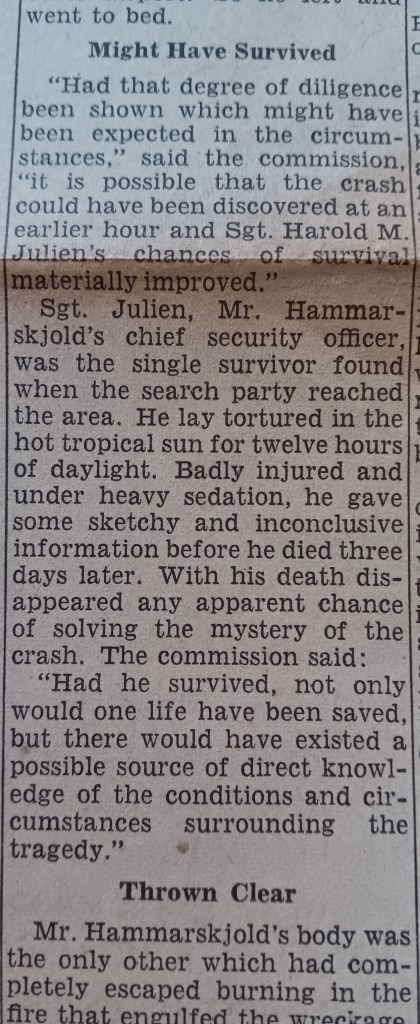
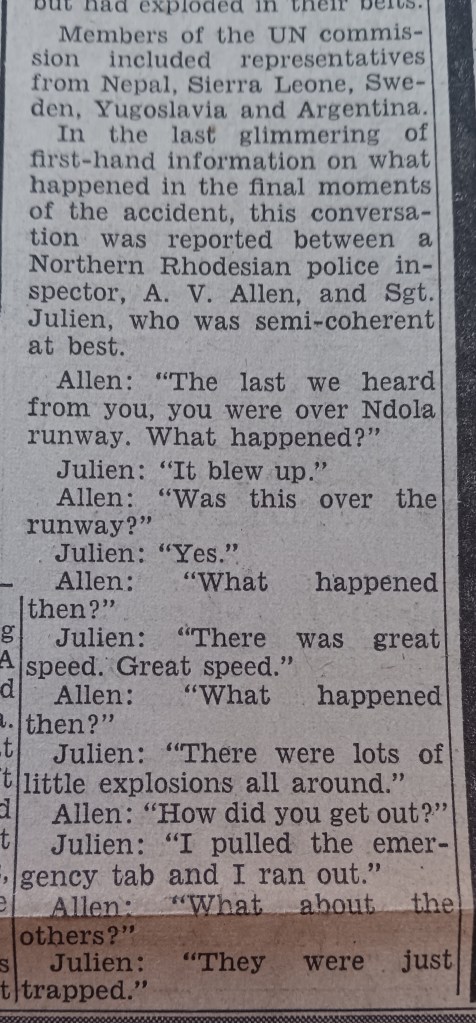
Here are more newspapers from New York, from September 19, 1961 to May 3, 1962, which support the evidence of the only survivor of the Albertina, Sgt. Harry Julien. For context of these events, please read Susan Williams’ most recent essay, published in The Yale Review, “Revisiting Dag Hammarskjold’s Mysterious Death”. Part one of this series can be found here.


From Susan Williams’ essay: “One other aspect of Gaylor’s involvement is worth noting. After the Albertina failed to land, a team of Norwegian U.N. soldiers flew to Ndola to assist in the search. Their aircraft was parked near Gaylor’s DC-3. Because of white Rhodesians’ hostility to U.N. personnel, they were not allowed to enter the airport terminal. So Gaylor’s crew invited them on board to get some food. To the surprise of U.N. soldiers, they discovered that the American plane was packed with highly sophisticated radio equipment.
“We know from other testimony that the U.S. Embassy in Leopoldville was communicating with Ndola via a U.S. aircraft, which presumably was Gaylor’s DC-3. And that may explain an intriguing aspect of the story, namely that Edmund A. Gullion, the U.S. ambassador in the Congo, sent a cable to Washington on the morning of September 18 that explicity referred to the possibility that the plane was shot down. “Hammarskjold’s plane believed lost in vicinity Rhodesian border near Ndola,” the cable read. “There is possibility he was shot down by single pilot who has harassed U.N. operations and who has been identified by one usually reliable source as van Riesseghel, Belgian, who accepted training lessons with so-called Katangan Air Force.” (The ambassador’s communique included an error — the name of the pilot in question was Jan van Risseghem.)”
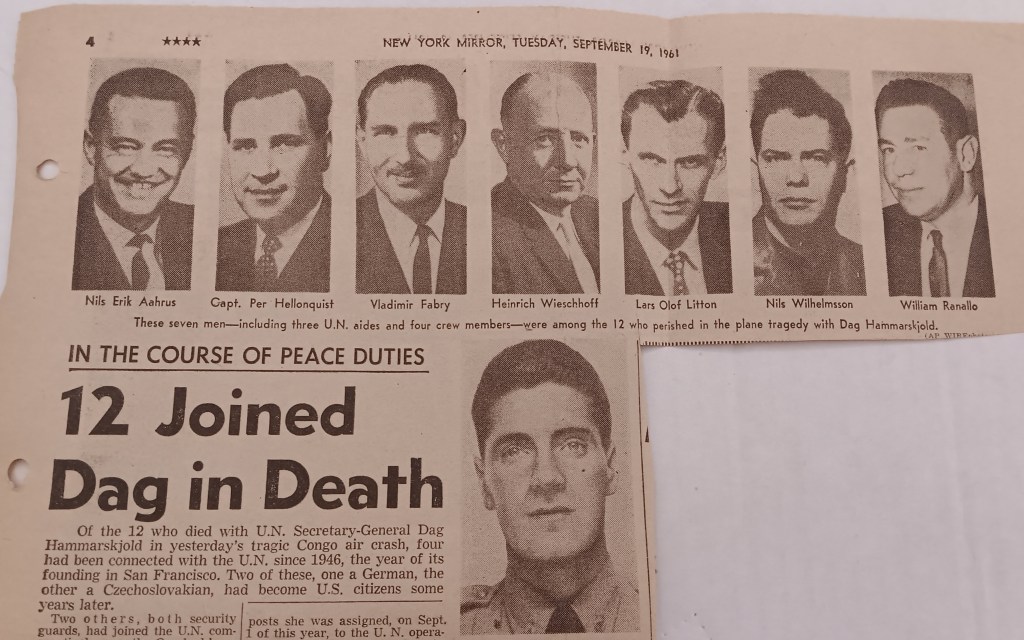
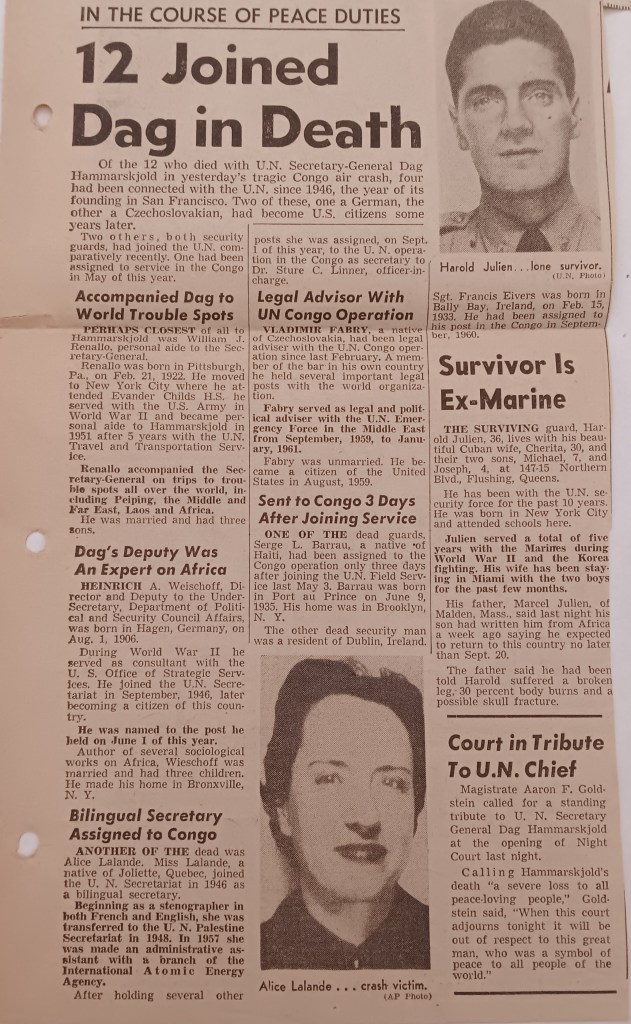

From Susan Williams’ book, “Who Killed Hammarskjold?”, pages 107 and 109: “The UN Commission supplemented its findings by employing a consultant named Hugo Blandori to carry out some background research in Ndola.” […] “Blandori included in his memorandum some observations on the appearance of Bo Virving at the Commission hearings. Virving, he reported, had put forward the theory that the Albertina had been shot down or forced down by a plane above it. He based his theory primarily on the statements of African witnesses and told Blandori that he believed the Rhodesian authorities had suppressed their evidence.
“It was Blandori’s view that the Africans giving testimony had no experience of aircraft, so didn’t know what they were talking about. But this was not the case. For one thing, the witnesses lived very near the airport and had daily experience of the comings and goings of planes; and for another, some of them, such as Timothy Kankasa, had worked with planes during the Second World War[as a signalman].”
Who was Hugo Blandori? According to this article by Jerry Dumas, “Hugo Blandori [was an] F.B.I. agent and also a YMCA regular, who died beside me on the Y handball court”. And according to this article about Anne Cioffi, who was his former secretary, Blandori was an F.B.I. agent who later became a private investigator, but I don’t know when exactly that change happened. From the article:
“I used to babysit his kids,” she said.
One day Blandori told her he needed a secretary and she took the job.
“He taught me every angle of his business,” she said, adding that was unusual in those days because women weren’t often afforded such opportunities.
Cioffi said Blandori was affiliated with former FBI agents who did private investigating all over the world and, with her as his secretary, specialized in pre-employment screenings.
“Years ago you could do that,” she said.
The company also conducted insurance and fraud investigations, and occasionally cheating-spouse cases.
“I didn’t like those very much,” said Cioffi.
She said the two worked together until the day Blandori went to play handball in Greenwich and died of a heart attack.
“He was only 50,” she said.
Cioffi said Blandori’s widow knew nothing about the business so Cioffi ran the business herself until another former FBI agent bought it.
[…]
She said her husband, Carmine, and all her connections from her time with Blandori encouraged her to get her own private investigator’s license, so that’s what she did.
“I had my own office in Norwalk,” she said saying she did a lot of work for former FBI agents and even worked on a case or two for Interpol.
“It worked out very well.”

Who was Dr. Max Frei-Sulzer? It is hard to take him seriously, considering that he investigated the authenticity of the Shroud of Turin, and he believed that Hitler’s diaries were real; and another case, which resulted in the imprisonment of an innocent man, who was released after 12 years!
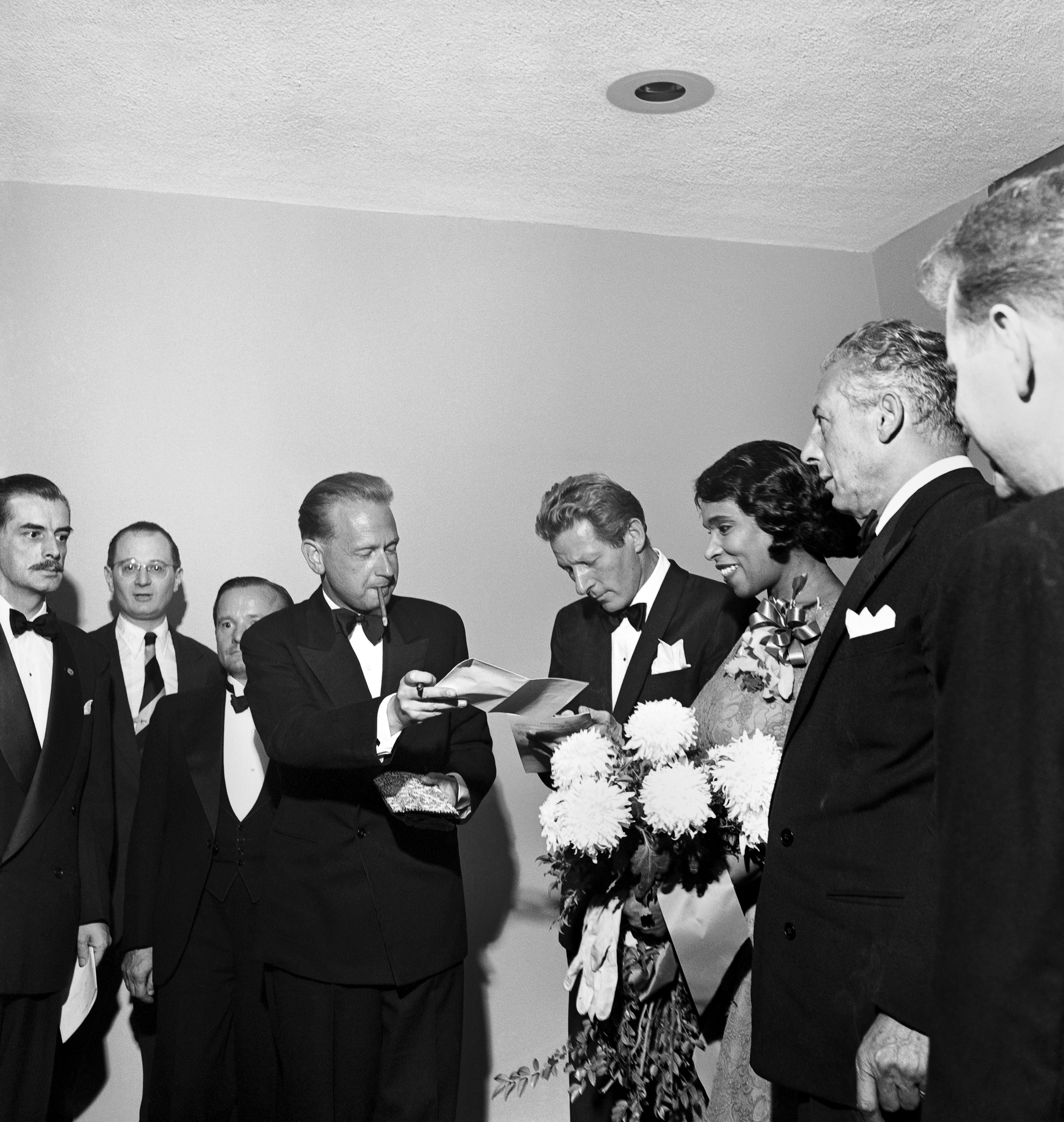
Dag Hammarskjold with Danny Kaye, Marion Anderson and Ezio Pinza
First United Nations Staff Day, 8 September 1953, UN photo
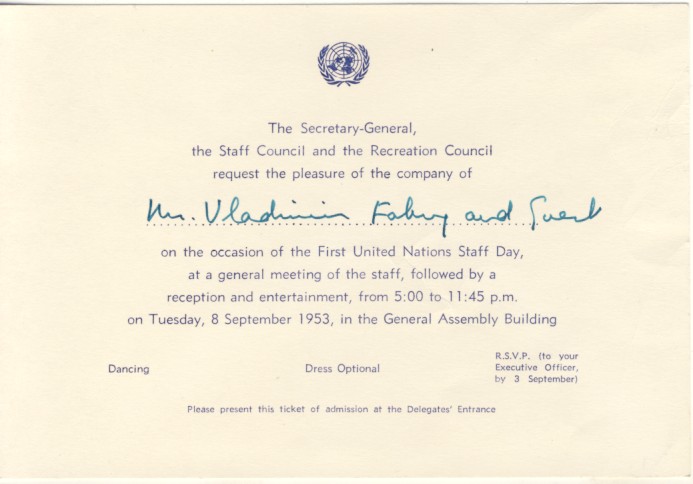
Vlado’s invitation, from the personal collection
If anyone deserved a special day of recognition, it was the UN staff of 1953, who had been slandered by the U.S. federal grand jury on 2 December 1952, saying that there was “infiltration into the U.N. of an overwhelmingly large group of disloyal U.S. citizens”. Secretary-General Trygve Lie gave the FBI carte blanche of New York Headquarters “for the convenience” – and this was after he gave his resignation, on 10 November 1952; which he gave under pressure of McCarthyism, and the Soviet Union’s refusal (for years) to recognize him as Secretary-General because of his involvement in Korea. Hammarskjold was sworn in on 10 April 1953, and he did all he could to defend and support his UN staff, and managed to get the FBI removed from UN Headquarters by November 1953.
With appreciation to the author, here are excerpts from chapter 3 of Brian Urquhart’s biography of Hammarskjold:
“On January 9 [1953], President Truman, by Executive Order 10422, introduced a procedure by which the U.S. government would provide the Secretary-General with information on U.S. candidates for employment and would empower the U.S. Civil Service Commission to investigate the loyalty of Americans already employed by the UN. In the same month, the Eisenhower administration’s new representative to the UN, Henry Cabot Lodge, Jr., as one of his first official acts asked the Federal Bureau of Investigation (FBI) to investigate all members of the U.S. mission to the UN as well as U.S. members of the Secretariat itself. For the latter purpose Lie permitted the FBI to operate in the UN Building, for the convenience, as he explained it, of the large number of Secretariat officials who would have to be interrogated and fingerprinted. To the Secretariat, the presence of the FBI in the “extraterritorial” Headquarters Building symbolized yet another capitulation to the witch-hunters.”
[…]
“Another problem inherited from Lie was the presence of the FBI in the UN Building. The extent of that agency’s activities was revealed on June 20 during an incident in the public gallery of the Security Council, when an American agent in plain clothes attempted to take a demonstrator away from the UN guards. Hammarskjold demanded a full investigation of this incident and protested vigorously to the U.S. mission. He had also learned of the case of a senior official who had been given a detailed questionnaire on his relations with various people and his views on Communism. The fact that the official had felt obliged to reply raised in Hammarskjold’s mind a serious question of principle. Did a government have the right to question a respected official of the UN with a long and good record of service on the basis solely of suspicion and rumor? Surely the proper course was for the government concerned to tell the Secretary-General of its suspicions, leaving it to him alone to decide what action, if any, should be taken and what questions should be put to the official concerned. He therefore instructed the members of the Secretariat that until he could get the FBI off the premises their reaction to inquiries about their colleagues could in no circumstances go beyond the duty of everyone to help the law. A member of the Secretariat must make it clear that there were questions that, as an international civil servant, he had no right to answer and these included questions relating to his UN work and to the activities of the UN itself, as well as the political or religious views or past relationships of himself or of his colleagues. This meant, in fact, that only nonpolitical criminal activities were a legitimate subject for investigation by the FBI. In November 1953, making use of the opportunity provided by a remark to the McCarran Subcommittee by FBI Director J. Edgar Hoover that the extraterritorial status of international organizations in the United States made it impossible for the FBI to operate on their premises, Hammarskjold asked for the immediate removal of the FBI from UN Headquarters.”
But there was still the matter of the American staff members that had been dismissed or terminated by Trygve Lie because they plead the Fifth Amendment when investigated. Hammarskjold wasn’t able to make everyone happy with his decisions, but I feel he was trying to avoid giving the McCarthy crowd any kind of foothold for future harassment.
“During the summer a U.S. federal grand jury, the International Organizations Employees Loyalty Board, and two U.S. Senate Subcommittees continued to investigate present and former American Secretariat members. On August 21 the Administration Tribunal, the Secretariat’s highest court of appeal, rendered judgments in twenty-one cases of American staff members who had appealed against their dismissal or termination by Lie for having invoked the Fifth Amendment during investigations by the U.S. authorities. The Tribunal found in favor of eleven of the applicants, awarding compensation to seven of them and ordering the reinstatement of four. Hammarskjold declined to reinstate the four on the grounds that it was “inadvisable from the points of view which it is my duty to take into consideration,” whereupon they too were awarded compensation. His decision simultaneously dismayed a large part of the UN staff, who believed that their colleagues should have been reinstated, and enraged the anti-UN faction in the United States led by Senators Joseph McCarthy and William E. Jenner, who saw it as a recommendation for the payment of some $189,000 in compensation to traitors. The attitude of the senators was later reflected in the U.S. opposition in the General Assembly to Hammarskjold’s request for an appropriation to pay the compensation awards.”
For further context, you can read the speeches Hammarskjold gave to the staff in New York and Geneva in May of 1953 on the Dag Hammarskjold Library website.
 Vlado
Vlado 