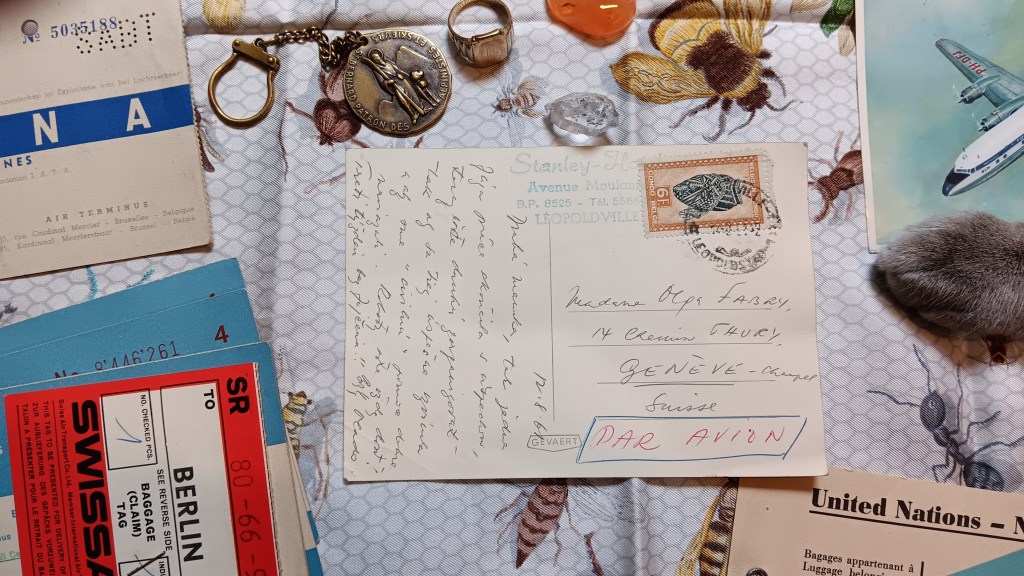
Here are two wonderful letters from Vlado to his “Mamka”. The first one was sent just after a new government was formed in former Leopoldville headed by Prime Minister Cyrille Adoula. Vlado was trying to quit smoking at the most intense time in the Congo Crisis, too! I admire his resolve at self-mastery, but he deserved that cigarette.
3.8.61
Dear Mom,
Finally, after a lot of procrastination and negotiations I formed a government and I can say with a clear conscience that it would not have happened without me. Not only did I have to flatter them and draw up the entire government program for them, but I also had to draw up the protocol on the conspiracy and the establishment of the government in the end.
After the meeting of the parliament, when everything was safely approved, I lit a cigarette for the first time in 11 days! At first, it was very difficult for me to deny myself, but now I’ve given up enough and I don’t really want to smoke, I just suck on menthol cigarettes all the time.
[Sture] Linner, the American and English ambassador, was waiting for me in the office with champagne when I came down from the parliament with the news that we have a government. Thank God I’ve managed to avoid all the journalists so far, I’m keeping my fingers crossed that it continues.
Now I have to start working on plans to get the United Nations and especially the army out of there as soon as possible without making a mess. As soon as its on the way (and if nothing happens by then) I’ll start thinking about leaving.
I will try to write to Frau Tag and [Kornel] Filo before the end of the week, but until now I have had neither the time nor the mind to do so.
Kisses
Vlado
Thanks to Miroslav Kamenik for his help translating this letter!
21.8.61
Drahá Mamka,
dúfám že si dobre dostala list čo som Ti dal poslať cez Rím a že si teraz uspokojená. Hja (MK – povzdech ve smyslu zlehčení až rezignace), musím doháňať čo sa mi pokazilo kým som bol v Europe, keď mi ?pripustili ?Laov(MK – Laos je možný, toho roku Čína a Laos navázali diplomatické styky), Číňanov a iných zloduchov do Stanleyville – teraz mám šarapatu (MK – mrzutost) s ich zlym vlivom. No dúfám že po minulom týždni veci pojdu lepšie – len Katanga eště zostáva tvrdý oriešok.
Poslední list od Teba je datovaný 13 augusta, poslaný 14 augusta – išel tyždeň. Držím sa eště ?úzdy ako nefajčiar.
Bozky
Vlado
→ Dear Mom,
I hope you received the letter I sent you via Rome and that you are now satisfied (at ease?). Hya (MK – „hja“, sigh in the sense of belittling and resignation), I have to catch up with what went wrong while I was in Europe, when they ?allowed ?Laos(MK – Laos is possible, that year China and Laos established diplomatic relations), Chinese and other bad guys to Stanleyville – now I have a quarrel (MK – annoyance) with their bad influence. But I hope that after last week things will go better – only Katanga remains a tough nut to crack.
The last letter from you is dated August 13, sent August 14 – a week has passed. I am still holding on to the ?bridle like a non-smoker.
Here are more newspapers from New York, from September 19, 1961 to May 3, 1962, which support the evidence of the only survivor of the Albertina, Sgt. Harry Julien. For context of these events, please read Susan Williams’ most recent essay, published in The Yale Review, “Revisiting Dag Hammarskjold’s Mysterious Death”. Part one of this series can be found here.
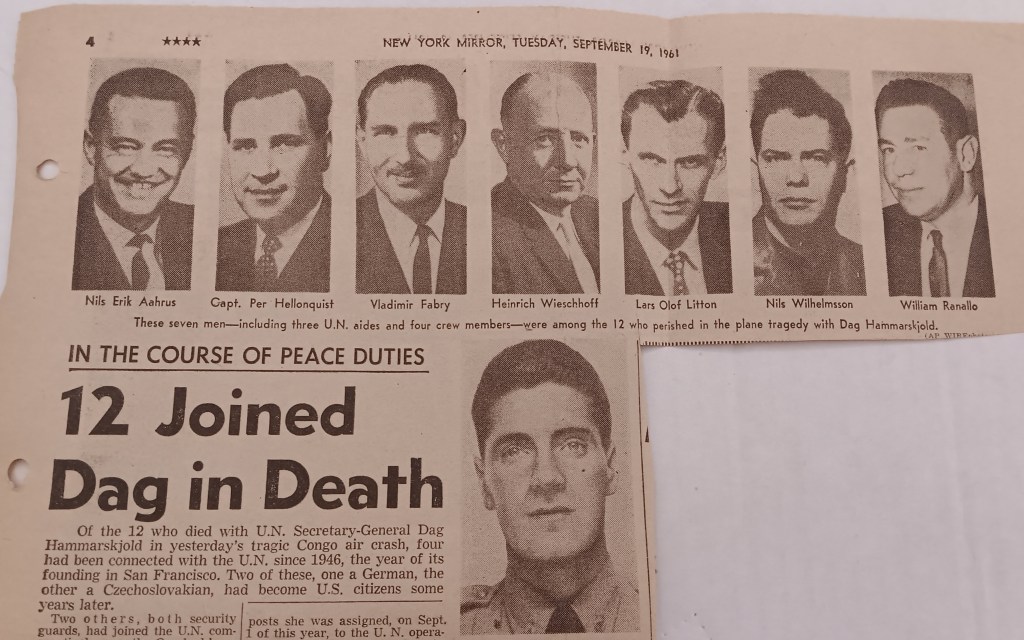
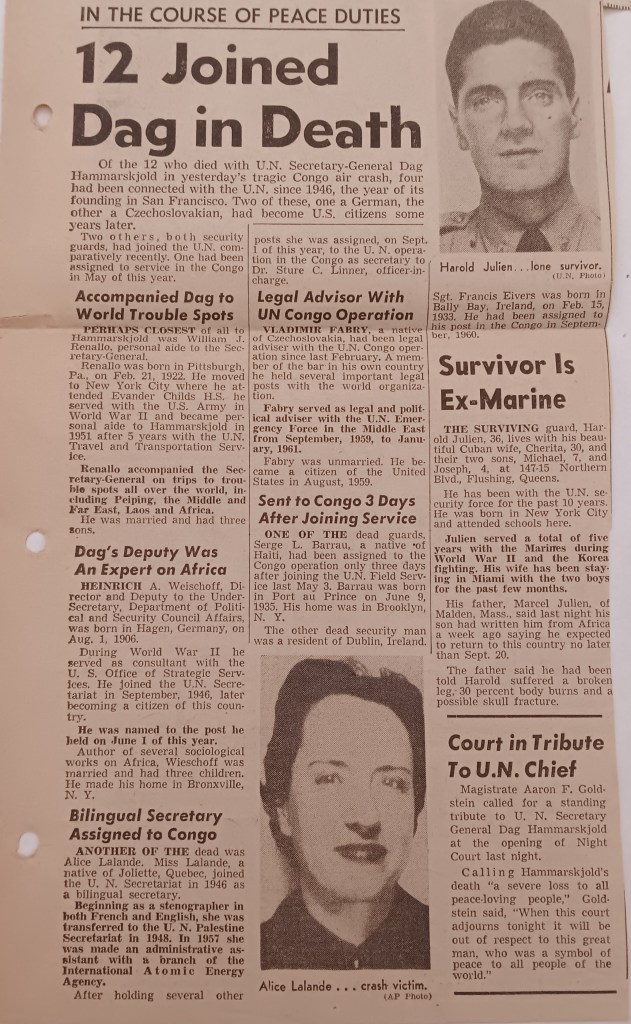
The NYT, 19 September 1961. From article “Hostile Jet Cited in Crash”: “Jacques Poujoulat, personal assistant to Dr. Sture C. Linner, chief of the United Nations mission in the Congo, described the circumstances off the ill-fated flight. He said he “could not answer” when he was asked whether the possibilty that the plane might have been shot down could be ruled out. He declared, however, that the United Nations had been “unable to make daylight flights” because of constant attacks by enemy jet aircraft. He said that the timing of the Secretary General’s night flight to Northern Rhodesia was “at least partly” because of the attacks by enemy aircraft.”The NYT, 19 September 1961. “[Poujoulat] said that seven hours after the plane took off from Leopoldville yesterday an “unidentified aircraft” flew over Ndola airport and that at about the same time the police reported a “flash in the sky.”The NYT, 19 September 1961. “The jet fighter has been the greatest single threat to the United Nations troops in Katanga, the pilot, who flies two planes alternately, has been strafing and bombing United Nations forces in Elisabethville, Kamina and Jadotville every day. United Nations officials believe that one of the two planes is being reloaded and refueled while the other is in action. The United Nations announced yesterday that three Ethiopian jet fighters were “on their way” to Katanga to oppose enemy fighter planes. Today it was learned from qualified sources that the planes had not arrived because British authorities in Uganda had refused to let them make a refueling stop.”New York Herald Tribune, 19 September 1961. From article “Survivor Says Blasts Shook Plane”: “The wreck was reported first spotted by a Negro charcoal burner, then by a Royal Rhodesian Air Force crew. It was still smouldering when a ground search party arrived in mid-afternoon.”New York Mirror, 19 September 1961New York Mirror, 19 September 1961. Col. Don Taylor is a typo for Col. Don Gaylor, who was sent to Ndola by the Pentagon on September 15. “Col. Don Taylor[sic], U.S. air attache in Pretoria, South Africa, who circled the wreck area until ground parties arrived, said it seemed obvious the plane was making an approach to Ndola Airport when it crashed about six miles away. Taylor said it looked to him as though the pilot misjudged the height and that the plane’s undercarriage caught in tree tops.”
From Susan Williams’ essay: “One other aspect of Gaylor’s involvement is worth noting. After the Albertina failed to land, a team of Norwegian U.N. soldiers flew to Ndola to assist in the search. Their aircraft was parked near Gaylor’s DC-3. Because of white Rhodesians’ hostility to U.N. personnel, they were not allowed to enter the airport terminal. So Gaylor’s crew invited them on board to get some food. To the surprise of U.N. soldiers, they discovered that the American plane was packed with highly sophisticated radio equipment.
“We know from other testimony that the U.S. Embassy in Leopoldville was communicating with Ndola via a U.S. aircraft, which presumably was Gaylor’s DC-3. And that may explain an intriguing aspect of the story, namely that Edmund A. Gullion, the U.S. ambassador in the Congo, sent a cable to Washington on the morning of September 18 that explicity referred to the possibility that the plane was shot down. “Hammarskjold’s plane believed lost in vicinity Rhodesian border near Ndola,” the cable read. “There is possibility he was shot down by single pilot who has harassed U.N. operations and who has been identified by one usually reliable source as van Riesseghel, Belgian, who accepted training lessons with so-called Katangan Air Force.” (The ambassador’s communique included an error — the name of the pilot in question was Jan van Risseghem.)”
New York Mirror, 19 September 1961New York Mirror, 19 September 1961The NYT, 20 January 1962. “NDOLA, Northern Rhodesia, Jan. 19 (Reuters) — Two planes passed over Ndola shortly before Mr. Hammarskjold and fifteen other persons died in the air crash near here, a witness told an inquiry here today. T. J. Kankasa, an African municipal official, told the Rhodesian federal inquiry that one of the planes had its lights on and appeared to be a transport while the other was a “smaller aircraft without lights.” “It seemed as if the smaller plane was beaming lights on the large aircraft,” he said.”
From Susan Williams’ book, “Who Killed Hammarskjold?”, pages 107 and 109: “The UN Commission supplemented its findings by employing a consultant named Hugo Blandori to carry out some background research in Ndola.” […] “Blandori included in his memorandum some observations on the appearance of Bo Virving at the Commission hearings. Virving, he reported, had put forward the theory that the Albertina had been shot down or forced down by a plane above it. He based his theory primarily on the statements of African witnesses and told Blandori that he believed the Rhodesian authorities had suppressed their evidence.
“It was Blandori’s view that the Africans giving testimony had no experience of aircraft, so didn’t know what they were talking about. But this was not the case. For one thing, the witnesses lived very near the airport and had daily experience of the comings and goings of planes; and for another, some of them, such as Timothy Kankasa, had worked with planes during the Second World War[as a signalman].”
Who was Hugo Blandori? According to this article by Jerry Dumas, “Hugo Blandori [was an] F.B.I. agent and also a YMCA regular, who died beside me on the Y handball court”. And according to this article about Anne Cioffi, who was his former secretary, Blandori was an F.B.I. agent who later became a private investigator, but I don’t know when exactly that change happened. From the article:
“I used to babysit his kids,” she said.
One day Blandori told her he needed a secretary and she took the job.
“He taught me every angle of his business,” she said, adding that was unusual in those days because women weren’t often afforded such opportunities.
Cioffi said Blandori was affiliated with former FBI agents who did private investigating all over the world and, with her as his secretary, specialized in pre-employment screenings.
“Years ago you could do that,” she said.
The company also conducted insurance and fraud investigations, and occasionally cheating-spouse cases.
“I didn’t like those very much,” said Cioffi.
She said the two worked together until the day Blandori went to play handball in Greenwich and died of a heart attack.
“He was only 50,” she said.
Cioffi said Blandori’s widow knew nothing about the business so Cioffi ran the business herself until another former FBI agent bought it.
[…]
She said her husband, Carmine, and all her connections from her time with Blandori encouraged her to get her own private investigator’s license, so that’s what she did.
“I had my own office in Norwalk,” she said saying she did a lot of work for former FBI agents and even worked on a case or two for Interpol.
“It worked out very well.”
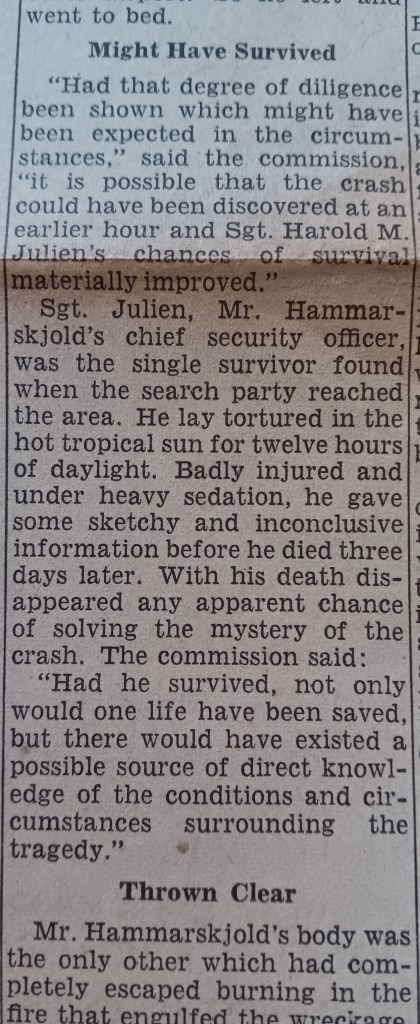
The NYT, 3 May 1962, “Cause of Hammarskjold Crash Still a Mystery as Inquiry Ends”: “[…] Dr. M. Frei-Sulzer, a Swiss police official, who was appointed by the commission to examine the wreckage of the Secretary General’s plane, which crashed near Ndola, Northern Rhodesia, attributed the disaster to the plane’s low altitude as it approached the airfield at Ndola after it had been cleared by the tower for landing.” [note: The Albertina was equipped with radar!] […] “Dr. Frei-Sulzer reported that “the only abnormal fact was the dangerously low altitude of the aircraft in relation to the airport elevation, probably due to human failure.” Dr. Frei-Sulzer is chief of the scientific department of the Zurich police and professor of science at the University of Zurich.” […] “The commission, which was appointed by the General Assembly last October, completed its report in Geneva March 8, three weeks before Dr. Frei-Sulzer submitted his findings to it.” […] “The [UN] commission criticized Rhodesian authorities for the fact that the wreckage was not found until fifteen hours after the crash. It said that Harold Julien, a United Nations guard who died several days after the crash, would have had a better chance for survival if the Rhodesians had shown more diligence. A report by the Royal Medical Board of Sweden said that a post-mortem indicated that, contrary to reports at the time, the Secretary General “lived for a certain period of time after the crash.” It said that he was the only person aboard the plane who had completely escaped burns.” […] “The Rhodesian and Swedish doctors agreed that bullets found in bodies of Mr. Hammarskjold’s guards had been exploded by the fire that consumed the wreckage and had not been fired from a weapon. Their finding were supplemented by Dr. Frei-Sulzer, who reported that there were no bullet holes in the plane and no evidence of explosives that would have been needed for a time bomb or other means of sabotaging the plane. However, the United Nations Commission examined at length the question whether a Fouga Magister fighter plane of the Katanga forces, “which had been operating against the United Nations in Katanga,” or some other plane [note: De Havilland Dove], had shot down the United Nations craft. It noted the reports of the Rhodesian inquiry board that the plane did not have sufficient range to fly from its base at Kolwezi and that the pilot had stated that it was on the ground on the night of the tragedy.”
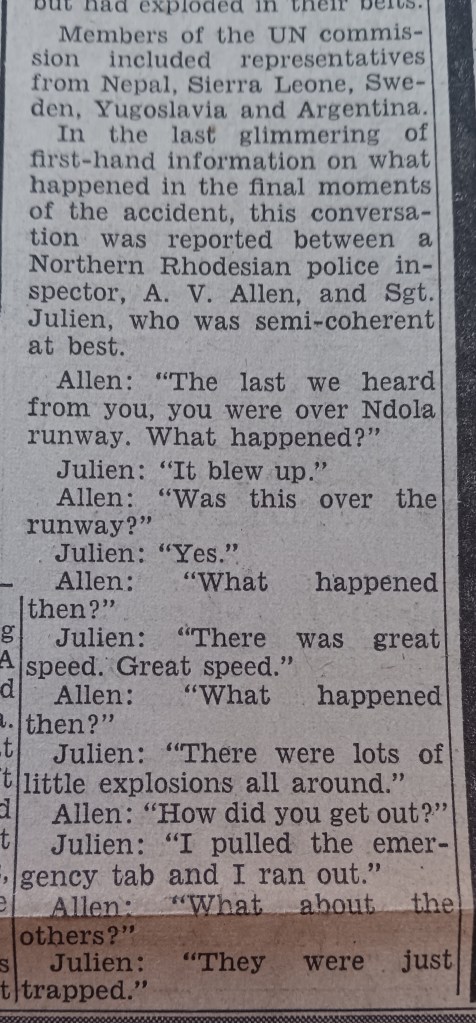
New York Herald Tribune, 3 May 1962, This article continues the narrative of down-playing and discounting the testimony of Sgt. Harry Julien, “Dag’s Death Probe: Still a Whodunit”: “Sgt. Harold Julien, Mr. Hammarskjold’s chief security officer, was the single survivor found when the search party reached the area. He lay tortured in the hot tropical sun for twelve hours of daylight. Badly injured and under heavy sedation, he gave some sketchy and inconclusive information before he died three days later. With his death disappeared any apparent chance of solving the mystery of the crash.” New York Herald Tribune, 3 May 1961. From the same article, “Dag’s Death Probe”: […]In the last glimmering of first-hand information on what happened in the final moments of the accident, this conversation was reported between a Northern Rhodesian police inspector, A. V. Allen, and Sgt. Harold Julien who was semi-coherent at best. Allen: “The last we heard from you, you were over Ndola runway. What happened?” Julien: “It blew up.” Allen: “Was this over the runway?” Julien: “Yes.” Allen: “What happened then?” Julien: “There was great speed. Great speed.” Allen: “What happened then?” Julien: “There were lots of little explosions all around.” Allen: “How did you get out?” Julien: “I pulled the emergency tab and I ran out.” Allen: “What about the others?” Julien: “They were just trapped.”
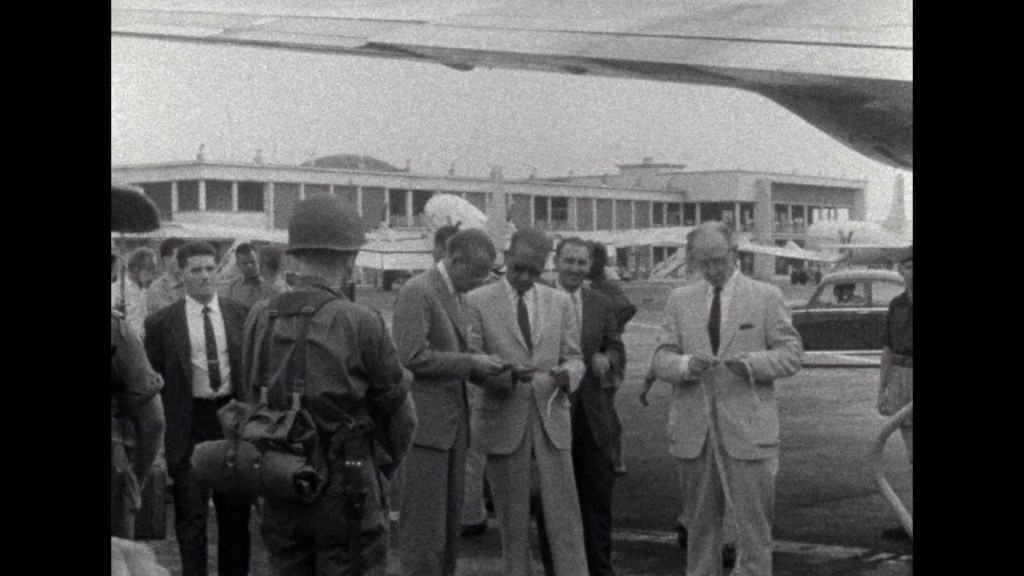
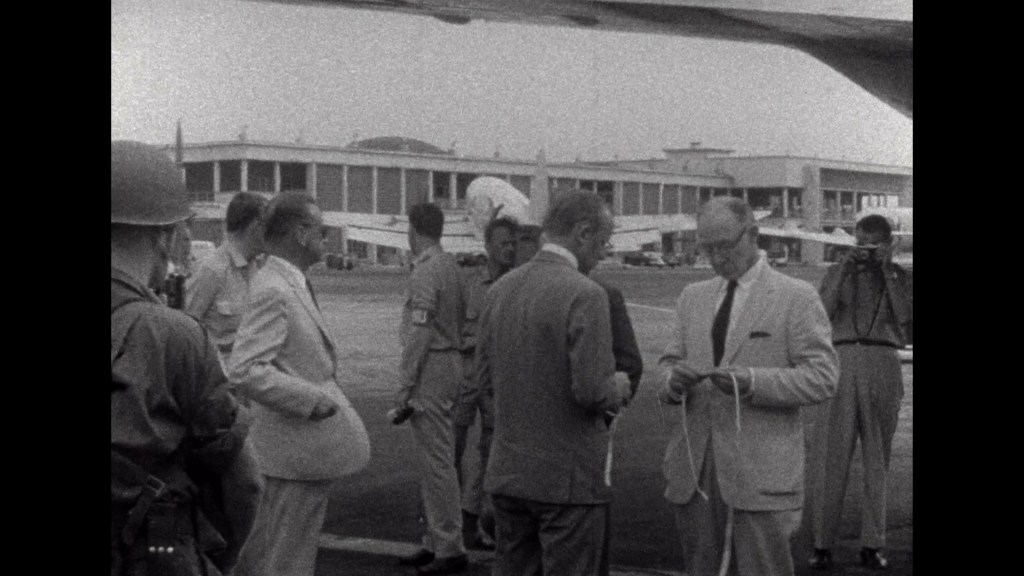
S-G Dag Hammarskjold center(in dark sunglasses), Sture Linner on his left, smiling Vlado right behind Dag, and Heinrich A. Wieschhoff. At N’djili airport, former Leopoldville, now Kinshasa, DR Congo.To the right of Hammarskjold is Sture Linner (Vlado hidden behind Linner), Heinrich A. Wieschhoff, and the very photographer who took the last photo of Vlad and Dag that I have.The moment the photo was taken! Whenever I think of Vlado, I smile. He looks back once……takes another look back……one last backward glance before heading into the unknown, but he was so hopeful and happy! There is Alice Lalande, in a cheerful flower print dress, right behind a UN security guard – so brave!
At the Hotel Le Royal, we had an office adjacent to the one occupied by Sture Linnér.
On the day Dag Hammarskjöld took off from Leopoldville, that Sunday, I was not supposed to work.
But, as Fabry’s secretary, and since he only worked with me, they sent some military staff in a Jeep to pick me up and bring me back to Le Royal.
They found me sitting at a cafe terrace, since I believe they always kept an eye on us for safety.
I went back to my office and worked all afternoon, until the plane departed.
* Vladimir Fabry
That day, when I arrived at my office, Vladimir Fabry immediately requested to dictate some telegrams. I spent the whole afternoon doing that: typing messages, then bringing them to the « Chiffre » for them to be coded accordingly with the recipient’s identity.
By the time I was finished, they were getting ready to leave for the airport.
Before leaving, Vladimir Fabry was so thrilled.
Happy as a kid who was just offered a new toy.
Albeit a very reserved character, he was practically jumping on his feet.
He came into my office and said excitingly:
« Monique, I am leaving with the Secretary-General! I am trusting you with my car keys! »
He had to be very happy, for he would never have done such a thing otherwise.
His car was an official UN vehicle.
He told me I could use all the time during his absence.
God knows Leopoldville is a very large town, with great distances between the various locations.
I used the car until, of course, I handed it back to the UN, since Fabry never returned.
I remember seeing their cars leaving Le Royal in convoy.
I went through these events with an innocent mind as I could only partially grasp what was going.
I would mostly type messages dictated by Fabry, messages that were generally meant for New York.
The last message I typed from them was dictated by M. Hammarskjöld himself. The recipient was Paul-Henri Spaak.
(nota: the Belgian Foreign Minister)
But I cannot remember its content (nota: requesting Belgian assistance to put an end to the criminal deeds of a mercenary pilot named « van Riessenghem »).
I was so intimidated that I must have skipped two or three words he dictated.
I had never met Hammarskjöld and I was so young then (nota : she was 24).
I saw Dag Hammarskjöld every day between 13 and 17 September 1961, since he occupied Sture Linnér’s office.
“There is no sun without shadow, and it is essential to know the night.” – Albert Camus, The Myth of Sisyphus
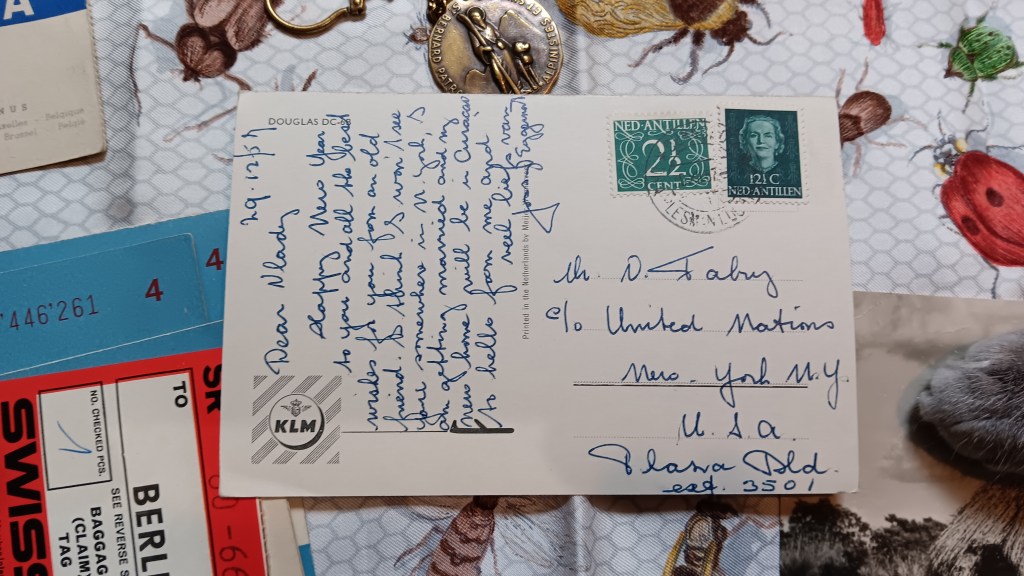
Archival assistance and emotional support from Farfel. Swissair ticket stubs from 29 December 1960 to 10 February 1961; Vlado’s father, Pavel, died of a heart attack in Berlin 19 December 1960. Sabena ticket stub appears to be from 1956, date is unclear. St. Bernard medal retrieved from the Albertina crash site, Ndola, 17-18 September 1961.KLM postcard addressed to Vlado, care of the United Nations, New York, N.Y., “The Flying Dutchman”, Douglas DC-6B.KLM postcard reverse, 29 December 1957: “Dear Vlady, Happy New Year to you and all the best wishes for you from an old friend. I think I won’t see you somewhere in N. York, I am getting married and my new home will be in Curacao…” Farfel picks his favorite postcard from Vlado, sent from former Leopoldville, Democratic Republic of the Congo, now Kinshasa.Reverse of postcard from Vlado, 12 August 1961, to his mother, “Maminka”, Madame Olga Fabry. A better look at the real photo postcard from Vlado, purchased from the “Stanley-Hotel, Avenue Moulaert”.Vlado’s signet ring, retrieved from the Albertina crash site, Ndola, 17-18 September 1961.
“The struggle itself towards the heights is enough to fill a man’s heart. One must imagine Sisyphus happy.” – Albert Camus, The Myth of Sisyphus
Many thanks to Madame Rime, and to Maurin Picard for this interview and supporting the Hammarskjold investigation, and to David Glaser for promoting this blog and the life of Vlado Fabry – merci beaucoup to all who have contributed to this site!
Interview with Monique Rime Cégel
3 May 2020
Switzerland
Summary
– Monique Cégel, 83, was Vladimir Fabry’s secretary in Leopoldville in 1961
– She worked at the Hotel Le Royal between December 1960 and January 1962
– She knew Alice Lalande and Harold Julien very well
– She was working extra hours on 17 September 1961
– She typed Dag Hammarskjöld’s last message to Paul Henri Spaak, requesting Belgium to stop « van Riessenghem »
– She remembers there were serious doubts about UN communications being intercepted
– Vladimir Fabry did most of the research regarding Katanga mercenaries during the summer of 1961
– She remembers Dag Hammarskjöld’s collaborators tried to deter him from flying unescorted
– She does not think Sture Linnér was intended to fly along, as he had to stay in Leopoldville to liaise and work proper transmissions
– She flew to Ndola with Mahmoud Khiary on 19 September 1961 to type the ceasefire agreement with Moise Tshombe
– She saw the crash site right above her plane window prior to landing and was horrified
– She recalls smoldering debris and the « long line » of burnt forest
– She found a very hostile atmosphere in Northern Rhodesia
– She met a very disdainful Lord Alport
– She was not allowed to join Mahmoud Khiary at the hospital to visit Harold Julien
* * *
I was Vladimir Fabry’s secretary, at the Hotel Le Royal, Leopoldville (Congo).
I worked there for the UN mission in Congo from December 1960 to January 1962, as secretary detached from the Atomic Agency (IAEA) in Vienna.
I kept working for the UN in Geneva until 1976, mostly through freelancing contracts. Then my husband and I moved to the city of Bulle.
I met my husband in 1961 in Congo!
He was a representative for major Swiss companies of the time, including Schindler and Vega, and was selling chemical products to the university of Lovanium.
I became a Swiss citizen, after getting married with him.
I was French (and I still am), and was born in Paris.
* Sunday 17 September 1961
At the Hotel Le Royal, we had an office adjacent to the one occupied by Sture Linnér.
On the day Dag Hammarskjöld took off from Leopoldville, that Sunday, I was not supposed to work.
But, as Fabry’s secretary, and since he only worked with me, they sent some military staff in a Jeep to pick me up and bring me back to Le Royal.
They found me sitting at a cafe terrace, since I believe they always kept an eye on us for safety.
I went back to my office and worked all afternoon, until the plane departed.
* Vladimir Fabry
That day, when I arrived at my office, Vladimir Fabry immediately requested to dictate some telegrams. I spent the whole afternoon doing that: typing messages, then bringing them to the « Chiffre » for them to be coded accordingly with the recipient’s identity.
By the time I was finished, they were getting ready to leave for the airport.
Before leaving, Vladimir Fabry was so thrilled.
Happy as a kid who was just offered a new toy.
Albeit a very reserved character, he was practically jumping on his feet.
He came into my office and said excitingly:
« Monique, I am leaving with the Secretary-General! I am trusting you with my car keys! »
He had to be very happy, for he would never have done such a thing otherwise.
His car was an official UN vehicle.
He told me I could use all the time during his absence.
God knows Leopoldville is a very large town, with great distances between the various locations.
I used the car until, of course, I handed it back to the UN, since Fabry never returned.
I remember seeing their cars leaving Le Royal in convoy.
I went through these events with an innocent mind as I could only partially grasp what was going.
I would mostly type messages dictated by Fabry, messages that were generally meant for New York.
The last message I typed from them was dictated by M. Hammarskjöld himself. The recipient was Paul-Henri Spaak.
(nota: the Belgian Foreign Minister)
But I cannot remember its content (nota: requesting Belgian assistance to put an end to the criminal deeds of a mercenary pilot named « van Riessenghem »).
I was so intimidated that I must have skipped two or three words he dictated.
I had never met Hammarskjöld and I was so young then (nota : she was 24).
I saw Dag Hammarskjöld every day between 13 and 17 September 1961, since he occupied Sture Linnér’s office.
* Can you recall Hammarskjöld’s state of mind?
I remember he was not very agreeable. He seemed really sad, not at all in a communicative mood. « You do this, this has to be done ». We were in the midst of a serious crisis with Katanga, obviously.
* Were there long sleepless nights at Le Royal?
I did not spend those ones with them, but I had a similar experience during the previous months. When you are assigned to someone high ranking, you did not count your days and your nights. With all the crises we went through, there were many sleepless nights at Le Royal.
* Harold Julien
I knew Harold Julien very well, as he was the Chief Security Officer in Leopoldville. Being M. Fabry’s secretary, I was granted the use of a car.
This in turn created some serious trouble, because we were taken hostage with a Swiss colleague of mine by Mobutu’s troops for 24 hours. The time was around end January or early February 1961.
They had spotted my car, I believe, due to the UN flags on it, and surrounded our house with two small armoured cars. There were rumors that the UN was bent on disarming the Congolese National Army. And we had been poorly inspired to move in a house across the street from Mobutu’s barracks along the river – a magnificent location, it was indeed.
Then the witchhunt began against all UN staff.
This is the only time in my life I was really scared.
I called the French embassy asking for their help, as I was a French citizen. Their answer was very … kind: « you work for the UN, hence you are no longer considered as a French citizen for us. There is nothing we can do for you ».
Since my colleague was Swiss, she called the Swiss embassy and they immediately answered. « Yes of course, we will come and rescue you ».
They arranged for a motorized convoy of Swiss people, with friends and colleagues of my future husband, led by the Red Cross delegate M. Olivet, who was killed another day.
(nota: Georges Olivet, 34, was killed in an ambulance on 12 December 1961, amidst heavy fighting in Elisabethville, Katanga)
They parlayed with Mobutu’s soldiers, who pretty quickly removed their blockade and let us go free.
* Saturday 16 September, Lord Lansdowne meets Dag Hammarskjöld. Did you get word of a stormy exchange?
No, I do not remember that gentleman.
I did not hear anything, although I was there that day and was working in the nearby room. If there had been loud voices, a shouting match,
I would have heard something.
But it does not mean it did not take place, as my memory could be failing me.
There were indeed many high ranking visitors in Sture Linnér’s office, and I did not always necessarily get a look at them.
* Did Dag Hammarskjöld’s collaborators try to deter him from flying unescorted?
That is true, since I remember I heard about it.
They did try to deter him.
There were rumors that they were « waiting » for him in Katanga. There were Tshombe’s two Fougas.
(nota: in September 1961, the UN still believed two remaining Fouga were operational, as there was actually only one left, « 93 », the other one bing grounded awaiting spare parts)
When we heard about the crash, we immediately thought: « Tshombe’s Fougas did it ».
Personnally, I just could not imagine such a thing: who would want to shoot down the UN Secretary General?
I really thought this was just an accident, at least until after I left Congo early 1962.
If I had known … I was so scared in the air. I could never have boarded a plane.
But since I had no clue of what happened, I departed very easily when told to, without any further stress.
* Was Sture Linnér supposed to join the mission and fly along with Dag Hammarskjöld, as he later commented?
I was not at Ndjili airport but I would be surprised if he was intending to fly with them. It was logical for him to stay in Leo and liaise. That would be surprising if true.
Alice Lalande, she had to be part of the travelling party, since she was in charge of sensitive equipments, these Enigma machines. Besides, the Secretary-General needed an assistant like her. In her daily job, Alice was handing over paperwork to all the secretaries. She was a perfectly bilingual Canadian.
* Did Dag Hammarskjöld know that UN communications were intercepted?
I do not know, but it was a serious question for everyone in Leopoldville.
I had worked for weeks with Vladimir Fabry on the issue of the « frightfuls », these mercenaries.
I made dozens of photocopies from these documents that had been somehow collected and that had to do with these mercenaries. Vladimir Fabry worked a great deal on this issue. We did an extensive research on these documents. I am sorry that I did not have enough political awareness, to show an interest in the content of these documents.
* Monday 18 September 1961
Personnally, I did not get word of the crash when I arrived at the office on the next day. The other secretaries were doing a funny face, which was a bit intriguing. I made it late to the office due my long working hours on Sunday. I thought there was a dreadful atmosphere, but nobody told me anything. They did not dare tell me what had happened, probably because I was working so closely with M. Fabry. I only found out the same evening when I came home and my future husband told me: « did you hear what happened to Hammarskjöld ? »
* The crash site
When Mahmoud Khiary took off for Ndola, I came along.
(nota: on Tuesday 19 September 1961, in order to negotiate a ceasefire with Moïse Tshombé, as it was theoretically the case for Dag Hammarskjöld two days earlier)
I boarded the plane with him. If I had known the crash was foul play, I would never have come along with Khiary. This was so sudden, that I did not have the time to bring any equipment, not even a typing machine, as Alice Lalande had done.
We departed for Ndola. Prior to landing, while flying low over the forest, we managed to see the crash site from up close
(nota: the whole area was forested back then)
This memory will stay with me forever.
We spotted the wreckage, these scattered debris of an aircraft, what was left of it. This long line of burnt forest. It was terrible. I am still emotional about it, as I speak. I happened to realize the people I knew so well were only charred remains by now.
Alice Lalande, to begin with, who was basically my boss.
The security officers, such as Harold Julien.
I remember Alice’s dress with the flowery design. It sent cold shivers down my spine when I realized the plane had crashed and burnt that way. I though My God, she must have burnt so quickly. It was terrifying.
* Ndola, 19 September 1961
When we arrived in Ndola, there was this man, Lord Alport, welcoming us – so to say – at the airport. He was very cold. An extremely disagreeable character, very full of himself and every inch a British aristocrat. Still he invited our delegation for lunch in his home. I was just a secretary sitting at the end of the table with the security officers, but I found him disdainful towards us .
(nota : Khiary was not particularly welcome, since Tshombe had notified Linnér he agreed to negotiate a ceasefire with anyone but Khiary, whom he deemed responsible for launching Operation Morthor on 13 September 1961 – which is at least partially true)
Our mission was not very welcome.
Then we headed for the actual ceasefire negotiations with Moïse Tshombe, but I did not directly take part in the negotiations. The British mission there lent me a typing machine, whose keyboards had none of the French accents, which made my task very dfficult. I did however type all the ceasefire documents.
We stayed two or three days in Ndola.
Mahmoud Khiary and the delegation visited Harold Julien in the hospital. I was not allowed to join them.
1961 was a terrible year in my life. Annus horribilis, as the Queen Mother would say.
There was my being taken hostage, then Hammarskjöld’s crash, then the murder of 13 Italian air crew.
(nota: massacred by the crowd who mistook them with Belgian paratroopers in Kindu on 11 or 12 November 1961)
One of them was 25 and a very good friend of mine.
He had been at my wedding two weeks before, on 28 October 1961, along with Sture Linnér’s wife, whom I called Madame Linnér, of course, and also Jacques Poujoulat.
This day of September 1961, this Sunday the 17th. In my old age, I still cannot fathom what unfolded that day. It is still with me. It will stay with me until my last breath.
My name is Tara Burgett, I am an independent researcher and archivist, and the author of this blog dedicated to Vladimir “Vlado” Fabry. My husband, Victor, is the nephew of Vlado, the only child of Vlado’s sister, Olinka. When Olinka passed away in 2009, we discovered a trove of papers and photos stuffed in old suitcases in the house in New York; recognizing their importance, we packed them up and brought them to Washington state, and since then I have made it my mission to share the family story with the world.
Vlado and sister Olinka with his Buick and Bambi hood ornamentVlado and Olinka in Switzerland
“Sheila considered her time in New York to be some of the happiest days of her life. She roomed with her dearest friend, a gorgeous Czechoslovakian socialite named Desa Pavlu. The two of them must have left a trail of broken hearts throughout Manhattan. Sheila had a proposal of marriage from a young man named Arthur Gilkey. She declined, and shortly thereafter, he perished while ascending K2. Sheila was also courted by a chap named Vladimir “Vlado” Fabry. Vlado died with Dag Hammerskjold[sic] in The Congo[sic]. It seems that Vlado may have been connected with the CIA. Sheila said she could never see herself marrying Vlado because of his “very round bottom”.”
The more time I spent reading and translating the letters and documents, the more I realized how important it was that I speak up for Vlado and his family. The Fabry family were the targets of intentional and malicious slander, in revenge for their fierce resistance to both Nazi and communist invasions of Czechoslovakia, and sharing their archive has been my way of setting the record straight.
Vlado and his mother Olga Fabry – Maminka – Geneva, 17 April 1948
Vlado studied Law and Political Science at Comenius University in Bratislava, following in the footsteps of his father, Pavel Fabry, who was also a lawyer. Before joining the United Nations Legal Department in 1946, Vlado served as Personal Secretary to the Minister of Commerce in Prague. Vlado and his father were both very romantic and unconventional characters, who loved music, poetry, travel, and all kinds of adventure; they were not afraid to stand up for their beliefs, even in the face of danger and threats of death.
Vlado hugging his father good-bye at Prague airport, June 1946Vlado and Pavel in Switzerland
After the communist coup d’etat in 1948, the whole family were forced to flee Czechoslovakia, and lived as political refugees in Switzerland. Vlado was often on the move, working for the UN in many countries, including New Zealand, Indonesia, Ghana, Egypt, and Congo, but he would stay with his parents in Geneva whenever he was on leave, at 14 Chemin Thury.
Vlado and Maminka in SwitzerlandVlado with his parents, Geneva, Switzerland, 14 Chemin ThuryBreakfast in Geneva, 14 Chemin ThuryVlado at work, Geneva, Switzerland, 14 Chemin Thury
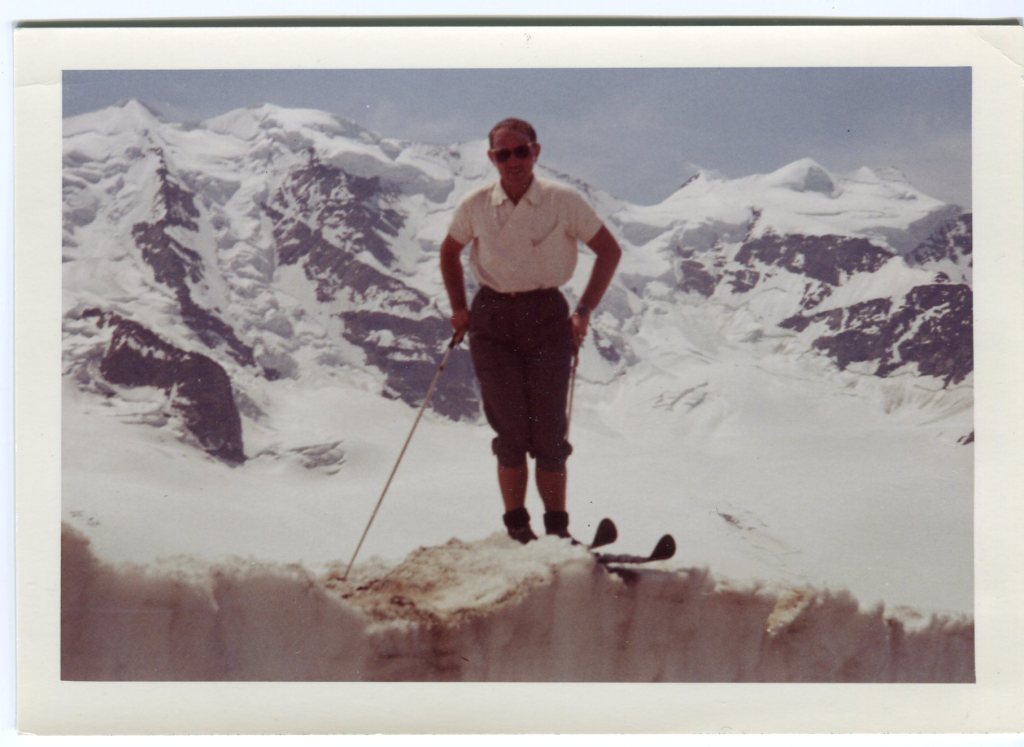
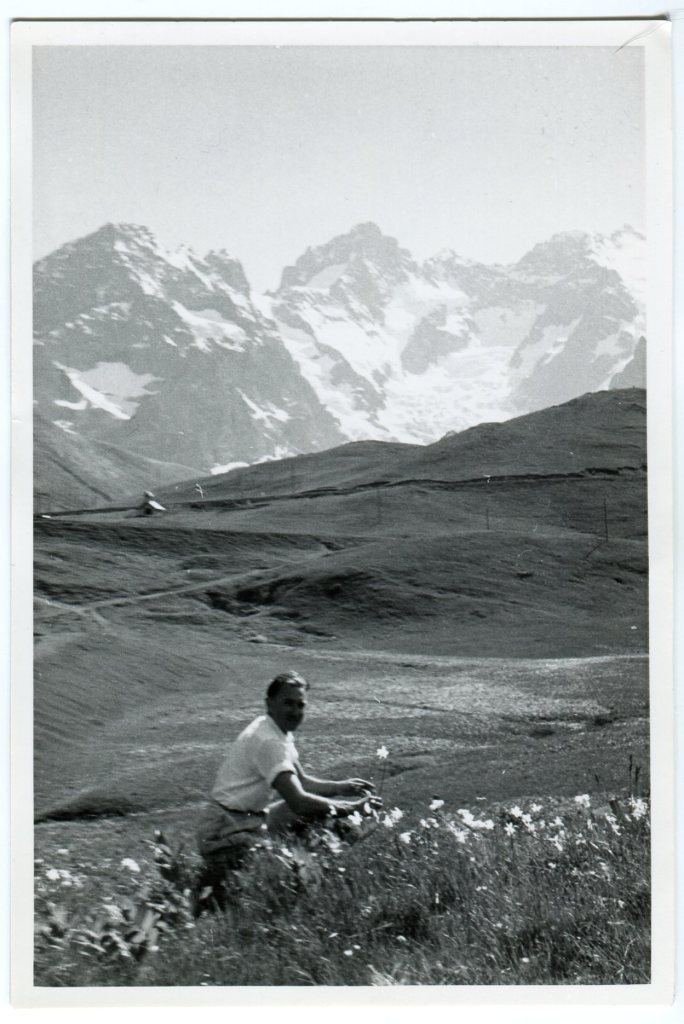
Vlado was loved by many of his colleagues at the UN, for his kindness and hospitality, and for his enthusiasm for skiing, mountain climbing, as well as his intellect and charm.
Vlado in Geneva
I could say more about his personality, but I feel the letters Vlado left behind, and the letters of his friends and family who knew him, say it best. He was an example of courage that anyone who knew him tried to follow, and is an inspiration to me, personally.
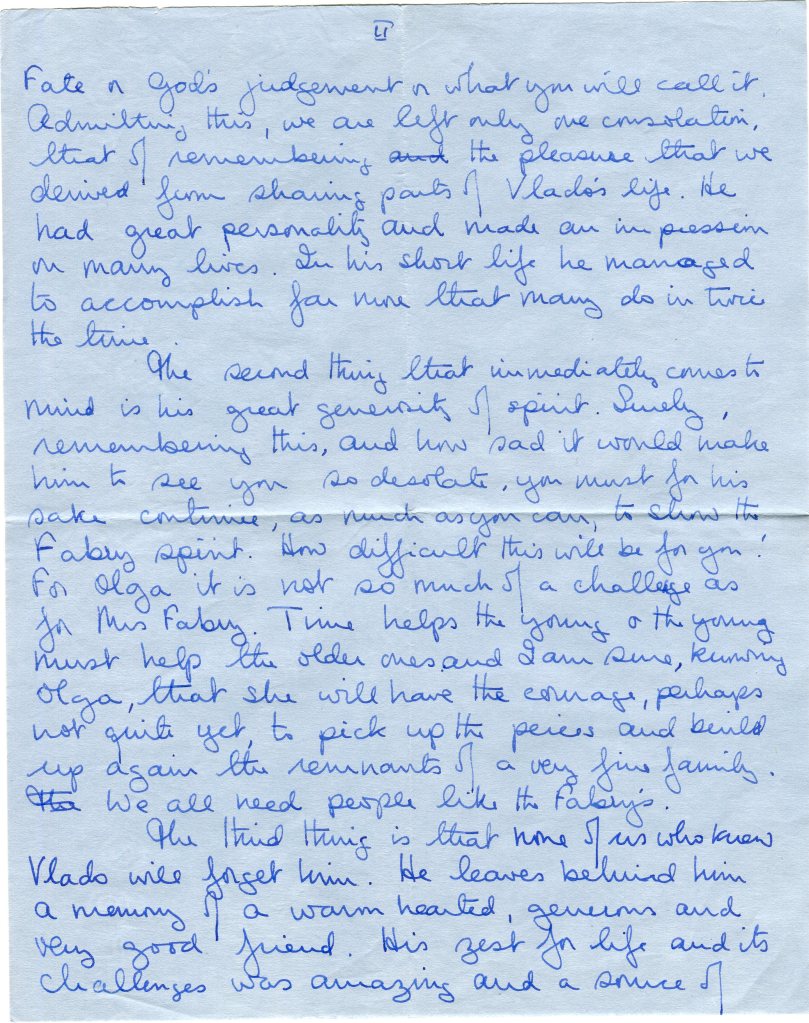
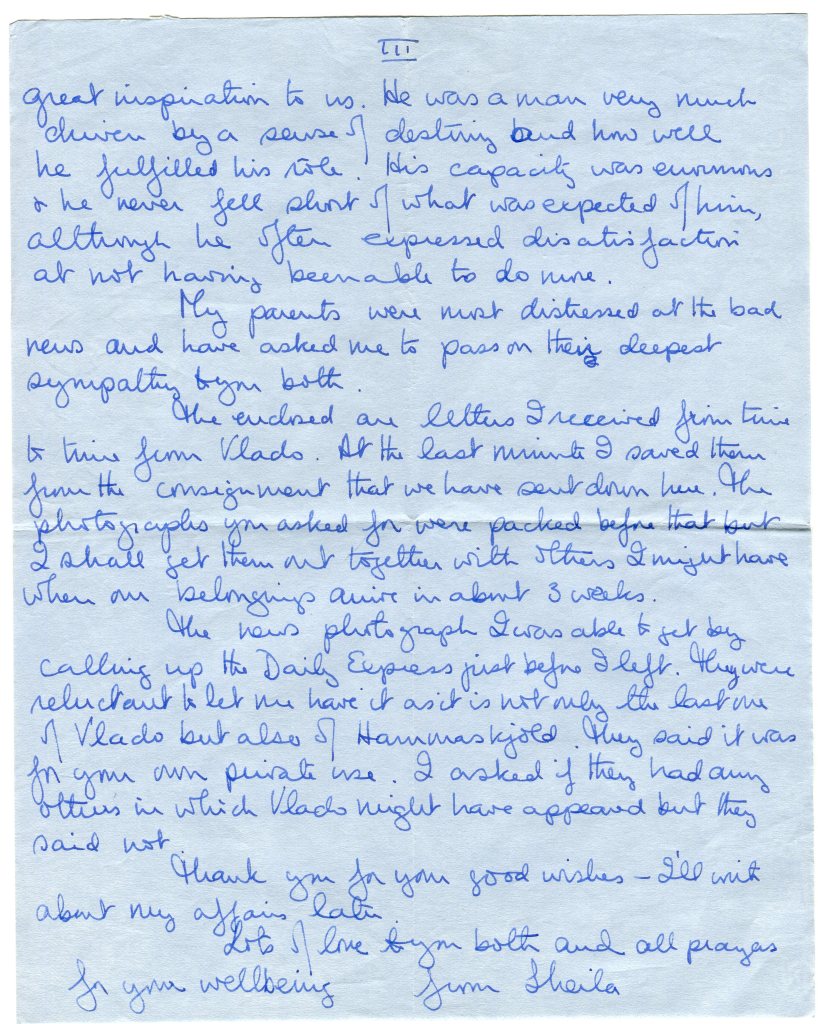
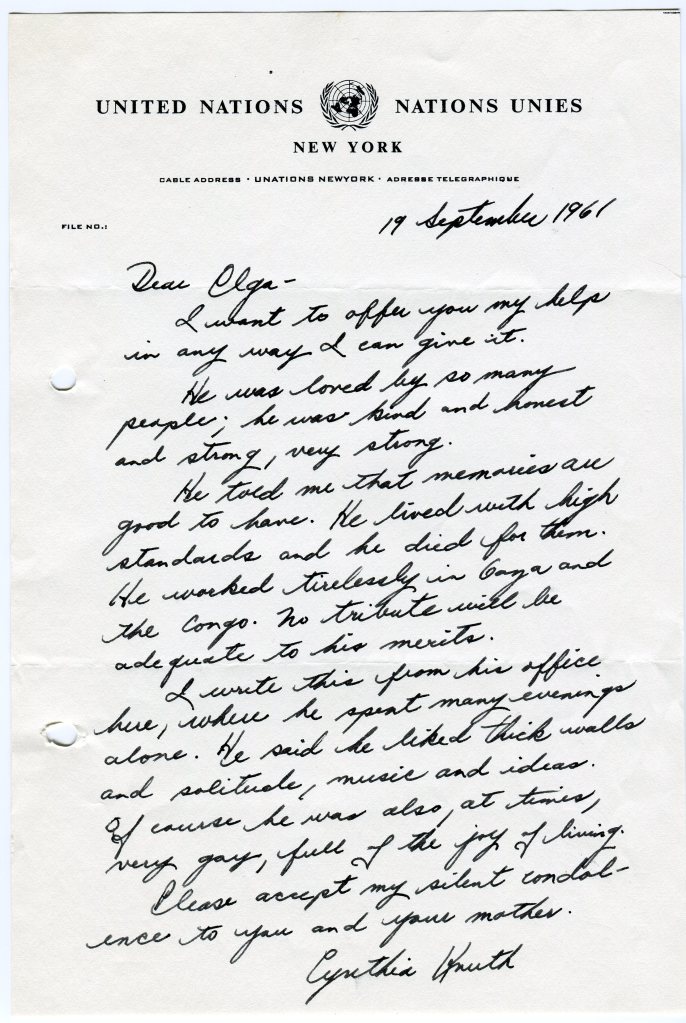
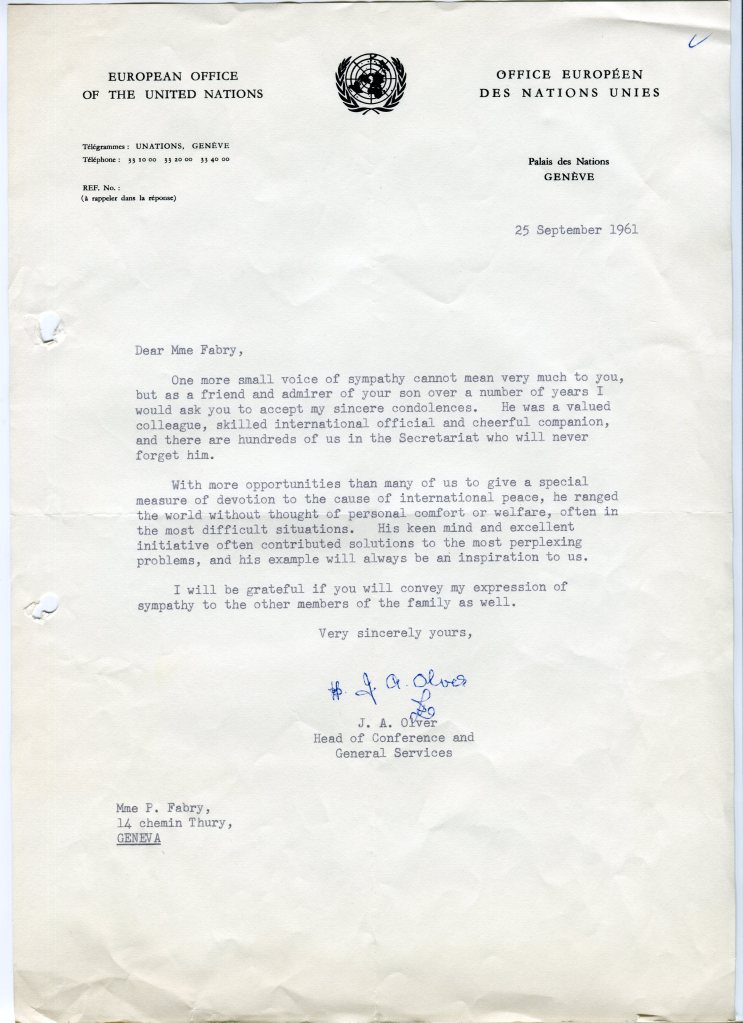
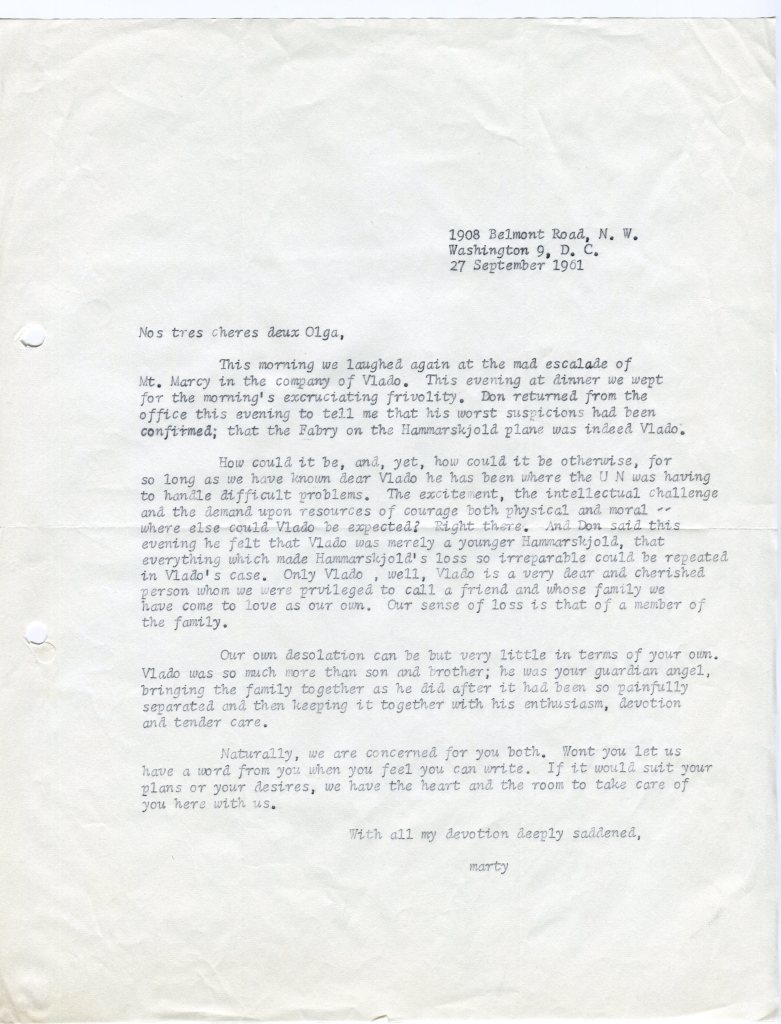
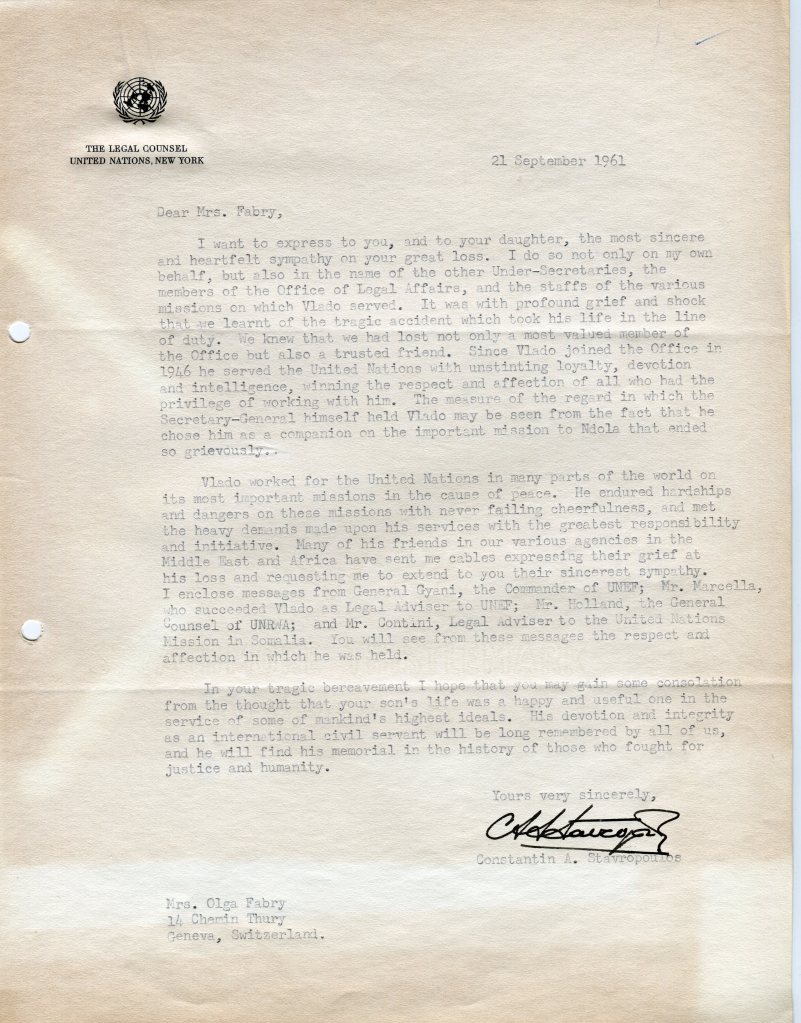
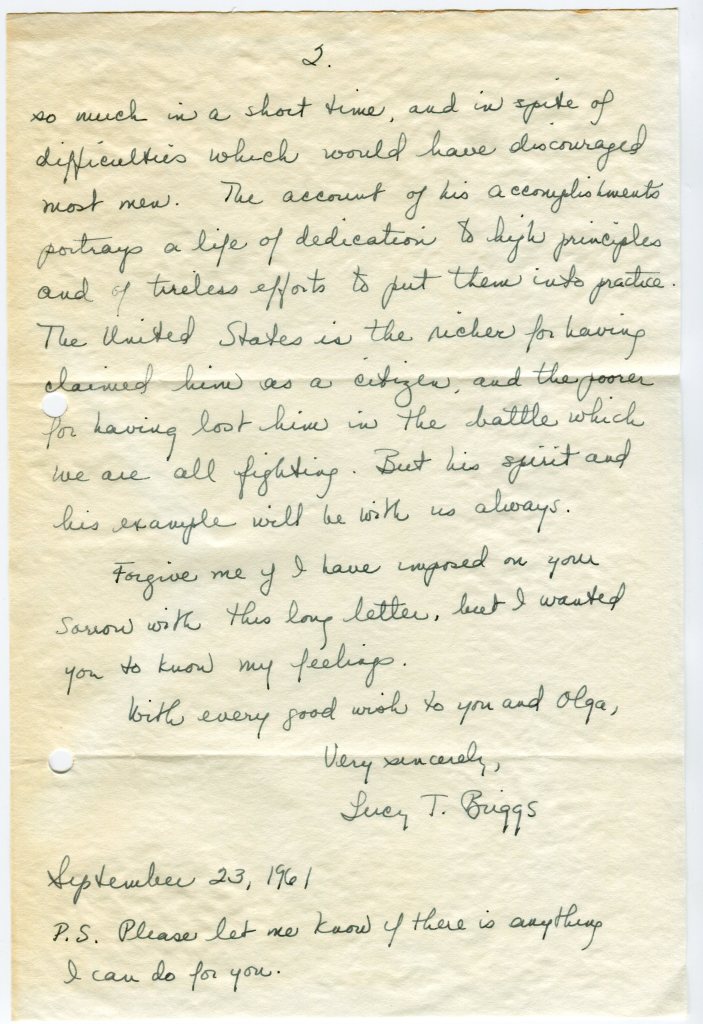
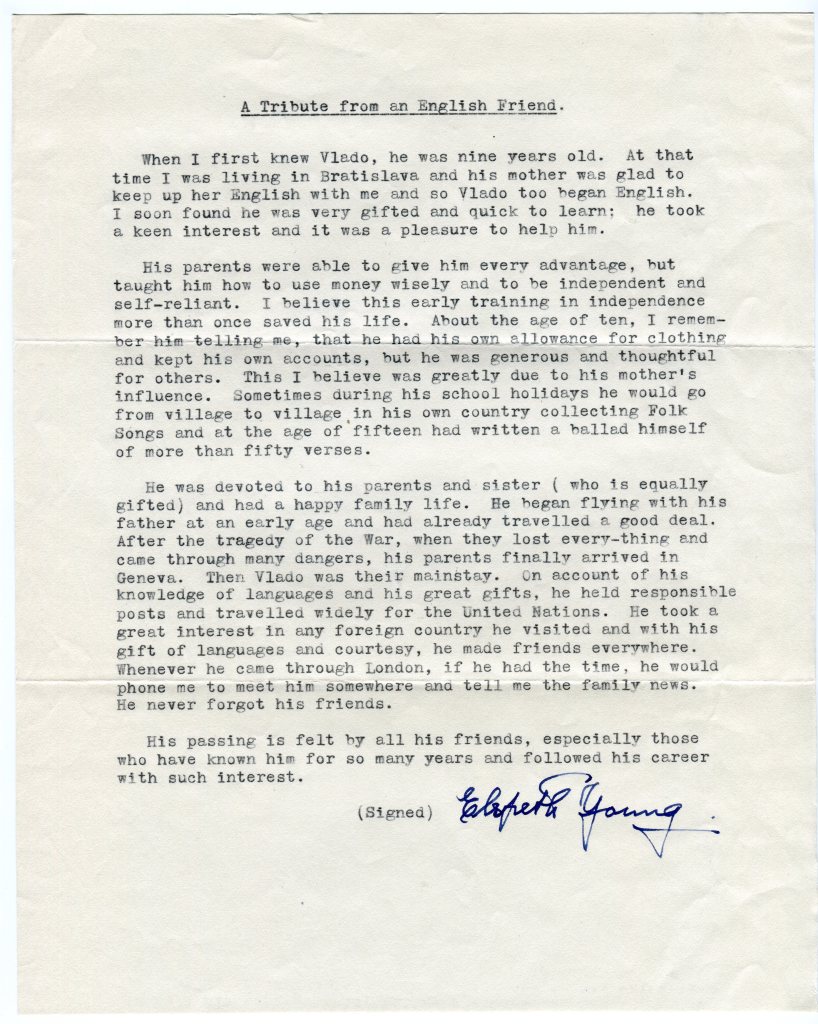
Condolence letter from Mary Sheila Dean MarshallLast photo of Vlado and Dag Hammarskjold, from Daily Express, included in letter from Mary Sheila Dean MarshallCondolence letter from Cynthia KnuthCondolence letter from Zeno F. MarcellaCondolence letter from John A. OlverCondolence letter from Bernard T. TwightCondolence letter from Marty and Don DaviesFriends of Vlado, in Geneva, Marty and Don DaviesCondolence letter from Constantin A. StavropoulosCondolence letter from “Dody”Condolence letter from Lucy T. Briggs, daughter of Ambassador Ellis O. Briggs, who served in the Foreign Service – she is the friend that gave Vlado “Bambi” – which you can see Vlado attaching to the hood ornament of his Buick, in the header photo of this blog.Condolence letter from Monique Cegel (now Madame Rime), Vlado’s personal secretary in former Leopoldville, now Kinshasa, room 632 Le RoyalTribute to Vlado from Elspeth Young
The United Nations will be 75 years old this October 24th, and when I see how certain member nations react to having their human rights abuses pointed out to them, how they bully and attempt to silence others, interfere with elections, poison their tea, kidnap, arrest, dismember them, or shoot down their planes, it only reaffirms how important the UN truly is; how important it is that all nations be able to come together and communicate honestly with each other for peace. The UN makes a difference in so many lives every day around the world, and it made a huge difference in the lives of the Fabry family, pretty much saving Vlado’s life by giving him a legal position in 1946 and getting him out of Prague – Vlado was lucky to live to age 40.
In May of this year, I was sent an interview of Vlado’s personal secretary at Hotel Le Royal in Leopoldville(now Kinshasa), from Maurin Picard, author of “Ils Ont Tue Monsieur H”, and she says she “had worked for weeks with Vladimir Fabry and the issue of the “frightfuls”, these mercenaries.
“I made dozens of photocopies from these documents that had been somehow collected and that had to do with these mercenaries. Vladimir Fabry worked a great deal on this issue. We did an extensive research on these documents.”
She gives her recollection of 17 September 1961: “That day, when I arrived at my office, Vladimir Fabry immediately requested to dictate some telegrams. I spent the whole afternoon doing that: typing messages, then bringing them to the “chiffre” for them to be coded accordingly with the recipient’s identity.
By the time I was finished, they were getting ready to leave for the airport.
Before leaving, Vladimir Fabry was so thrilled.
Happy as a kid who was just offered a new toy.
Albeit a very reserved character, he was practically jumping on his feet.
He came into my office and said excitedly: “M******, I am leaving with the Secretary-General! I am trusting you with my car keys!”
He had to be very happy, for he would never have done such a thing otherwise. His car was an official UN vehicle. He told me I could use it all the time during his absence.”
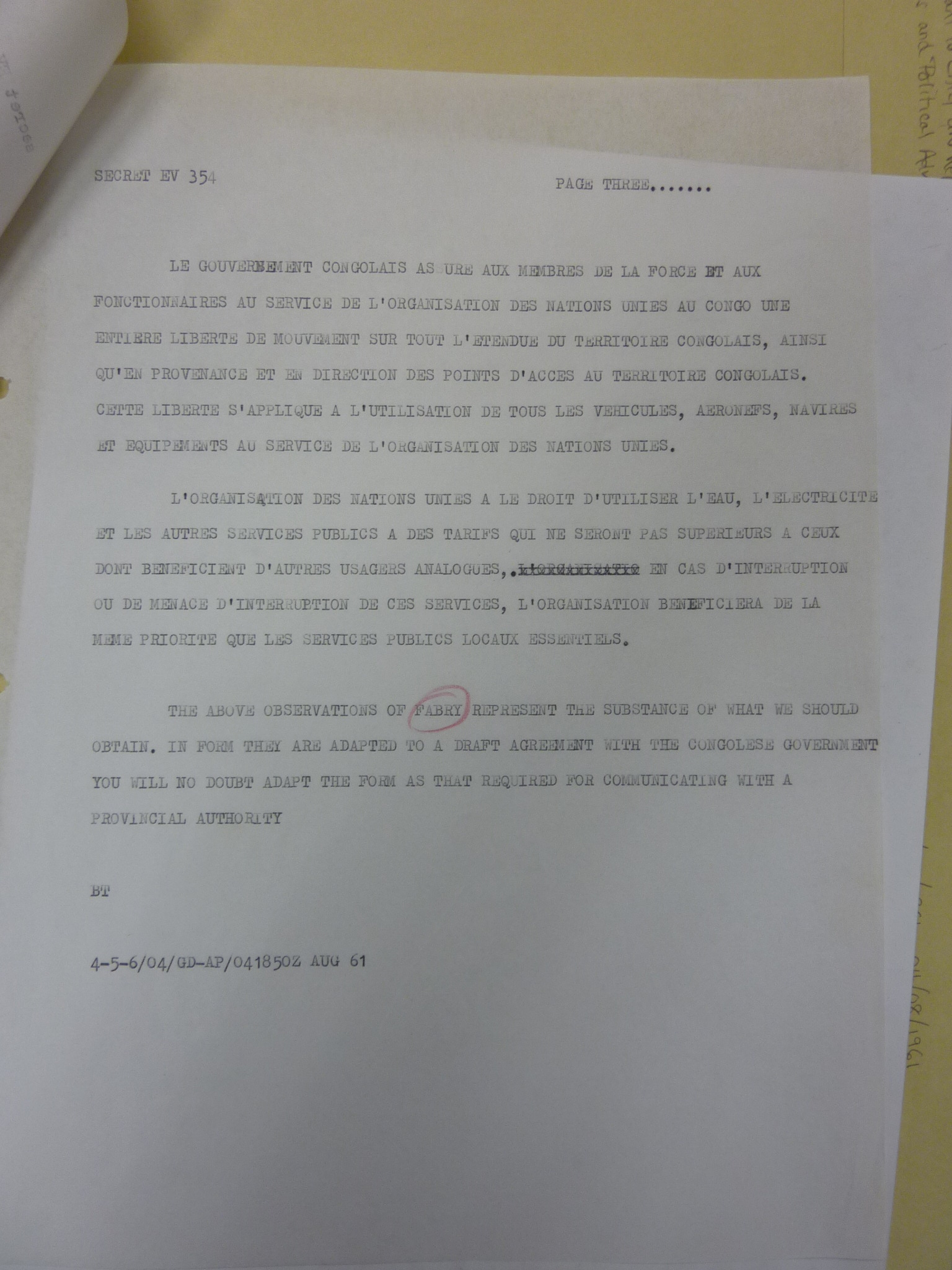
In connection to mercenaries, here is one more document of interest I found during my visit to the UN archives in May 2015, concerning Vlado and Operation Rum Punch; when 79 mercenaries working for Katanga were arrested on 28 August 1961. From Series 0793-0012-81, with folder description “UNOC: Mercenaries, Fabry”, a letter from Conor Cruise O’Brien to Michel Tombelaine in English, with the legal advice of Vladimir Fabry in French:
From the family of UN officer Peter J. Hazou, I am proud to share their contribution of photos and memories from 1961, and a letter from the former Leopoldville, now Kinshasa, that was written on this day, 55 years ago.
Dag Hammarskjold, center, in white suit, his bodyguard William Ranallo at far left, and Peter J. Hazou at right in dark suit with lapel pin.
From reverse of UN photo: “SECRETARY-GENERAL LEAVES FOR CONFERENCE WITH CONGO PREMIER. UN 72653 -United Nations, Leopoldville, September, 1961. Secretary-General Dag Hammarskjold leaves UN Headquarters in Leopoldville on his way to meet Congolese Premier, Cyrille Adoula. The Secretary-General was consulting with Premier Adoula on the Katanga dispute.”
Friday, September 15, 1961
Dear Abboud and family,
We are still here in Congo and still enjoying ourselves. Peter has decided to stay a while longer as it is to our advantage financially, and so we will remain here in Congo until the end of November, 1961. At that time we are planning to take a three week cruise from Point Noir in French Congo and go up West Africa, stopping at a different port each day and ending up in Casablanca and then going to Marseille, where we will take a plane home. It will be a very interesting trip. It will get us home in cold Winter weather, though. We would stay longer but we have our house empty at home and that is a responsibility. We have registered Linda at Sacre Coeure school where they speak only French. She doesn’t know any yet but will learn quickly. In two months she won’t speak it perfectly but it will be better than nothing.
Sunday we all went on another boat ride up the Congo River. We stopped at a few islands and on one was a small African village. The children were interested in seeing how the people live. It was on the French Congo side. It is fun to go on these sandy islands. People swim from there but we don’t because the Congo River is brown and has strong currents which would pull one downstream quickly. Someone saw a crocodile once but we never did.
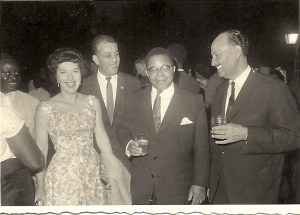
I take the children to the pool often because they love it. Linda swims a bit now, and Petey uses the tube. Tennis is available but I haven’t been able to get Peter to play much. He is still gaining weight but this week he intends to go on a diet. Linda has gotten very tall, and Petey is maturing nicely. I am happy that you are all well. We received your letter and it was good to get all your news. It is good Marcos is still globe-trotting, and I am glad it has been a good tourist season. I hope the weather remains pleasant for you. Over here it is still pleasantly cool, and we have rainy days now and then. The heavy rains will be coming soon and also the warm weather. Yesterday I taught our house boy to cook stuffed cabbage and Peter loved it. Also, I cook spaghetti occasionally because the family loves it. Sunday nights we sit at the outdoor gelateria and have Italian ice cream. Sometimes we go to the football matches (the Nigerians are good players) and sometimes we go to the movies, and so the time goes. There are still many cocktail parties, and the enclosed picture was taken at an Indian Officers’ one under a huge tent.
Wednesday [13 September 1961], Dag [Hammarskjold] came in and Peter was the protocol officer for the government at the airport. He greeted Adoula, Gizenga, Mobutu and Momboko[?-TB] when they arrived and then he made all the arrangements. When the S-G’s plane arrived he went up to meet him with Linner and Gen.[McKeown]. The Congolese and Nigerian bands played and it was a very nice welcome.
Tonight we will attend a big reception given by the Sec. General. This is a very crucial week here in the Congo. There is heavy fighting in Katanga, and at the huge UN army base. Last night the planes of UN personnel arrived from there as they were evacuated for safety. Don’t worry about us, though, as we are quite safe in Leopoldville as the fighting is far away. Peter is taking care of settling the refugees comfortably. If there is any big job Peter is asked to do it because they know it will get done properly. Because of this, Peter is working hard and practically running the big UN operation here but feels he doesn’t get the appreciation he deserves from headquarters, who do not realize he is working so hard because some of the other men are not capable of handling their jobs and so it falls on Peter. But it is a satisfaction to handle jobs well. He set up the whole Lovanium operation, which was tremendous and cost a million dollars. He used to have a private radio connection with it when it was locked in session, although he was one of the few people who had complete access to it. Too bad he didn’t take pictures there. We all hope the Katanga situation resolves itself quickly without civil war breaking out.
Well, Linda will start school Monday and we are glad about it. Tomorrow we will take a trip across the river to Brazzaville and look the town over. It is much smaller than Leopoldville. The past few days were warm and the hot season is starting to come in. It isn’t uncomfortable yet, though. I guess it is getting cooler in Bethlehem and the tourists are fewer. It is amazing to think that we will be having another great trip next Summer and will be with you again. I guess we can never complain about the United Nations! The children send kisses to each one of you and they are constantly drawing pictures which they say are for you. They are too bulky to send, though. Take good care of yourselves and keep in good spirits and health.
Love, Winnie
[At end of letter, Peter Hazou writes in pen:]
Dear Abboud,
I am sorry I have not been able to write more often since I have not been able to find the time. Thank you for your letters which arrive here via New York much quicker than in the past. As soon as we return to New York (about 17 December 1961) I shall resume a more regular correspondence. I am tired but healthy and I am sure the boat trip from the Congo to Marseille will do me a lot of good. My love to Mother, Victoria, Jamil and Mary and of course to yourself. I shall take a few days off and will write you a more detailed letter. The S-G will return to New York after tomorrow. The news from Katanga this evening is quite bad. I hope things improve. Love, Peter
Boat rides on the Congo River, Peter Hazou and family, 1961
Peter Hazou, Congo, 1961
First page of Lovanium Operation report from Hazou, who did tremendous work to organize all the details for the Lovanium conference to happen, dated 23 August 1961, with photo and ONUC Lovanium pass. Hazou worked for the United Nations for over three decades, from 1947 until 1978.
Peter and Winnie Hazou at left, with Sergeant Harold Julien second from right. This is likely the photo of the Indian Officer’s cocktail party mentioned in the letter, it is undated. The son of Winnie Hazou recalls: “She told me that she told Harry [Julien] at the reception how very lucky he was to be going on the mission to Katanga with the S-G”.
Hazou with unidentified person, possibly at same Indian Officer’s Party.
Invitation to the reception for Dag Hammarskjold, at La Deviniere, 15 September 1961
At reception for Hammarskjold, on the terrace at La Deviniere, Peter and Winnie with unidentified person.
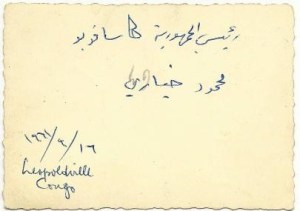
La Deviniere terrace, Peter and Winnie Hazou, Joseph Kasa-Vubu, and S. Habib Ahmed
Here is the reverse of the last photo, which is dated in arabic 16 September 1961. Though she writes in the letter to Abboud that the reception for Hammarskjold was on the 15th, Winnie Hazou told her family later on that the reception was the night before the flight, the 16th, which also contradicts the date on the invitation, but the days leading up to the flight were intense with fighting, so it’s very possible that the date was moved at the last minute.
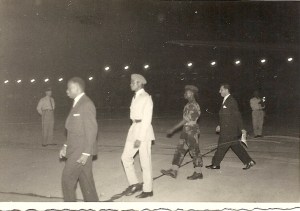
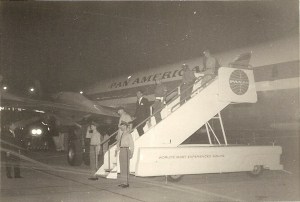
Prime Minister Cyrille Adoula, far left, with Peter Hazou on right, at Ndjili airport, Leopoldville, to transfer the 16 fallen to the Pan-Am plane.
Leopoldville, Pan-Am transport of fallen
The son of Peter and Winnie was only four years old at the time of the crash, but he remembers how he heard the news about Hammarskjold. He was at a luncheon for wives of diplomats with his mother, when the news came that Hammarskjold’s plane was announced missing, and the luncheon ended abruptly. He knew that something was wrong when his father came home in the middle of the day, which was very unusual for him. And then he saw his parents crying together. When the bodies of the fallen arrived in Leopoldville, he was on the observation deck at Ndjili airport with his family, and still recalls the intense sadness and solemnity of the people around him.
It took many people to run the United Nations Operation in the Congo, and I am glad to pay tribute to the memory of a colleague of Vlado, who no doubt grieved his death as well.
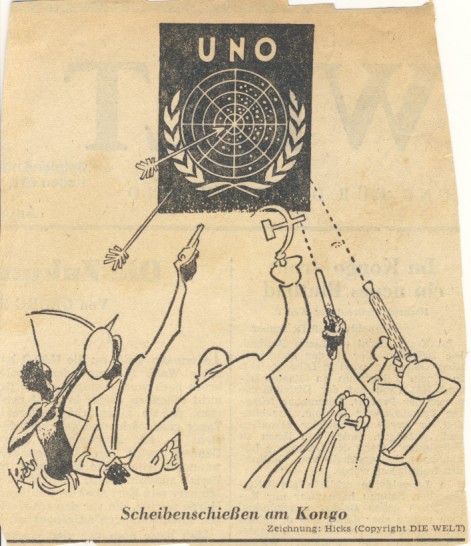
“Target shooting at the Congo” (DIE WELT clipping from Fabry archive)
Back in January, I posted one of three letters that were sent to me from the Archive of Sir Roy Welensky, the last Prime Minister of the Federation of Rhodesia and Nyasaland; written by High Commissioner of South Africa, H.L.T. Taswell, and marked “TOP SECRET”. Since they don’t appear to be available anywhere else, I decided to publish the other two letters here today, in full (emphasis mine).
12th October, 1961
TOP SECRET
SECRETARY FOR EXTERNAL AFFAIRS.
PRETORIA
The Federation and the Katanga
At Sir Roy’s request, I had an interview with him this morning.
He told me that there were certain things he would like to have brought to the notice of our Prime Minister. One of them was that he had had a talk about ten days ago with Tshombe. The interview took place at Sir Roy’s request and Tshombe was flown to the airport at Salisbury with two Katanga Ministers. They spoke for about five hours in secrecy.
While he did not always think too much of the black man as a statesman, Sir Roy said, he was greatly impressed with Tshombe’s ability and sincerity. Sir Roy told Tshombe he had arranged the meeting because he felt there were certain points he wished to stress and hoped he would take his advice.
Sir Roy told him that it was impossible for him to try to fight the whole Afro-Asian bloc on his own and that it was essential to avoid a further clash with the U.N. which could be disastrous particularly with Nehru, his greatest enemy, doing everything he could to crush the Katanga completely.
The Katanga was the first setback the Afro-Asian bloc had suffered in Africa and it was therefore essential that he, Tshombe, should do all he could to capitalize on it. He must play his cards extremely well. As a start, it was most desirable that he should have talks with Adoula and reach a Congo settlement. He suggested that he should insist that all outsiders, including the United Nations, be excluded from the talks. Furthermore, any agreement reached with Adoula should be on a phased basis. No irrevocable step should be taken and each successive phase of a settlement should only be put into operation when each previous step had been carried out in an entirely satisfactory manner. Sir Roy hoped too that Tshombe would move in the direction of a federation in which a certain degree of autonomy would be retained by the Katanga.
Tshombe accepted this advice with much gratitude and since his return it appears that he has been working in this direction.
In so far as the United Kingdom and the Katanga were concerned, Sir Roy said his tactics all along had been to keep the United Kingdom fully informed on how he viewed developments. He had given them advance warning all along of trouble and had forecast developments with accuracy.
The United Kingdom, however, had preferred to close their eyes to all this and to let the United Nations go ahead unchecked.
When the Indians moved into the Elisabethville Post Office last month and the fighting started, Sir Roy delivered an ultimatum to the United Kingdom. He said that regardless of what the Federation’s legal position might be he was going to aid Tshombe. The Federal Air Force was at the alert and unless the United Kingdom took steps at once to the check the United Nations he was ordering the RRAF into action.
“While Tshombe and I could not have taken on the world we could have cleared up that U.N. bunch in no time. And that, ‘he smiled’ would really have started something.”
This ultimatum infuriated the United Kingdom and Sir Roy’s public statement that the British were going back on assurances they had given regarding the Katanga so incensed Mr. Sandys that he said he would have no further dealings with Sir Roy.
Driven into a corner, however, and fearful of the consequences for themselves of any federal armed intervention, the United Kingdom brought pressure to bear on the United Nations and the United States for a cease fire.
Since then Sir Roy has been pressing a reluctant U.K. to take further action by supplying them with information on the U.N. violations of the ceasefire and their military build up. He has been asking the United Kingdom what justification there is for example for the bringing in of Canberra bombers and jet fighters when the Katanga has only one Fouga jet trainer. The United Kingdom are now finally reacting favourably to all this and their influence on the Americans and U.N. is discernible.
In this connection, he mentioned that a further U.N. attack on Tshombe was expected this past week-end but it had not materialized. The danger of such an attack, incidentally, was the motive behind the issue of Sir Roy’s statement last Saturday. The text was telegraphed to you.
We believe that O’Brien’s recall for consultation is imminent and that he is unlikely to return to the Congo.
While Tshombe and his regime are by no means out of the woods, Sir Roy believes that they now have a reasonable chance of survival.
Touching on the Indians, Sir Roy said that one of the main reasons for their use was that other troops, particularly the Tunisians, had shown themselves to be extremely faint hearted. When the action started in the Katanga, the Tunisians had refused to leave Leopoldville.
Sir Roy, however, does not underestimate Indian motives. Referring to the report of an agreement between Lumumba and [Rajeshwar] Dayal for the settlement of two million Indians in the Congo, he stated that he had heard that documentary proof of this was available but he had not yet been able to lay his hands on it.
Referring to the Indian military build-up, he said he hoped we fully appreciated the grave danger it presented to us as far as S.W.A. was concerned.
His security people had information that a further contingent of Indian troops had arrived at Dar-es Salaam on October 8th on an American transport ship. The name of the vessel was something like “Blatchford”.
Touching on the question of foreign mercenaries, Sir Roy mentioned that the Federation had taken a man by the name of Browne off one of the two Dove aircraft that came up from South Africa recently on their way to the Katanga.
Sir Roy said they have proof that Browne was working for both sides – the U.N. and the Katanga. This is the man Col. Zinn spoke to the Commandant-General about when he visited South Africa recently.
After the interview I asked Federal security what they knew against him specifically. They replied that the white Katanga security people had long suspected Browne of double dealings. Also, when he was taken prisoner of the U.N., along with other mercenaries, earlier this year he was released “almost in a matter of minutes” while the others were detained. As a personality too federal security have no time for him and do not trust him in the least. His British passport was impounded by the United Kingdom High Commissioner here and he has been declared a prohibited immigrant by the Federal Government. He may since have made his way into the Katanga.
On the subject of Dag Hammarskjoeld’s [sic] death, Sir Roy said that he was preparing to have an enquiry take place under the chairmanship of the Chief Justice of the Federation, Sweden and I.C.A.O. would be invited to attend and he hoped to obtain another judge from a neutral country such as Switzerland. He would insist that the enquiry be a public one as there were certain things he felt should come out in the open and not be hushed up.
Hammarskjoeld’s plane left Leopoldville in such secrecy that even the United Nations Commander there did not have details of the flight. The plane had sufficient petrol on board when it started out for 13 hours flight. When it was over Ndola it still had sufficient fuel for another 8 hours. The plane had taken a round about route to avoid Katanga. There were 7 guards on board and a large quantity of ammunition. The general impression gained was that all were greatly afraid of an attack by the Katanga jet. The plane circled Ndola but did not ask for permission to land. There is reason to believe that the pilot may even had made a mistake in the altitude of Ndola and confused it with that of a place with a similar name in Angola.
Hammarskjoeld’s bag of documents was intact and could not be opened as it had a special locking device. Various parties tried their best to gain control of the bag. It was finally handed to the U.N. Representative. The Swedish Minister in South Africa was one of those who made strong endeavours to secure it. The Minister, Sir Roy said, gave the impression here of being an unpleasant character who required watching.
Turning to the Federation’s own present position, Sir Roy seemed very heartened by the removal of McLeod as Colonial Secretary and by the increasing feeling among Conservatives that the British Government should go more slowly in its African policy and that the interests of the white man should be protected.
The situation in Northern Rhodesia was also improving. Kaunda was being more and more discredited and his campaign of violence had backfired on him considerably. The Northern Rhodesia Government was distributing posters showing the damage done to schools and this was having a telling effect on the the Chiefs. The United Federal Party was now actively backing Katilungu of the A.N.C. with funds and helping him in his campaign. He was following closely behind Kaunda on his tour through parts of Northern Rhodesia and meeting with considerable success.
Although Heinriche and the Campbell, Booker Carter group were also backing Katilungu Anglo-American’s position was not very clear. Rhodesia’s Selection Trust, it seemed, did not approve of the idea at all. They had backed Kaunda very strongly, Sir Roy added, and Kaunda was also McLeod’s choice as leader of Northern Rhodesia.
He remarked incidentally that neither Anglo-American nor RST contributed financially to the United Federal Party any longer. (In a recent report I commented that I had heard these companies had recently restored their support. The information was given to me by an opposition M.P.)
Sir Roy did not touch on Dr. Banda directly. He just nodded his head and smiled when I commented that Banda would find himself very isolated if Katilungu were to come to terms with the United Federal Party. Sir Roy just did not seem to worry what happened to Banda.
During my interview I referred to our desire to overfly Federal territory in order to map our border. Sir Roy’s reaction was “Of course you can. Go ahead”. At the request of the Secretary for External Affairs here I have, however, put the request in writing and hope to have a formal reply shortly.
On defence generally Sir Roy did not say anything special but he gave me to understand that he would like to see Mr. Caldicott visit South Africa shortly.
Sir Roy said that he thought our Minister’s statement at the U.N. was a very sound one indeed and that Afro Asian reaction showed that body up in its true light. I gave Sir Roy a full copy of the Minister’s statement.
While one has gained the impression all along here that the Federal Prime Minister has been Tshombe’s main champion, the additional information Sir Roy gave me today shows just what lengths he was prepared to go to help the Katanga. But for the great pressure he brought to bear on the United Kingdom I think Katanga would have collapsed by now – and the U.N. and the Indians would no doubt have had more time to devote to S.W.A.
We can be extremely thankful that our Federal buffer to the north has as capable and resolute a Prime Minister as Sir Roy. We can be glad too that he has as skilled and well informed a Secretary for External Affairs as Mr. F.N.N. Parry. Both, moreover, show an exceptional amount of goodwill towards our country.
H.L.T. Taswell
High Commissioner
——————————————————————————————————-
2nd December, 1961
TOP SECRET
SECRETARY FOR FOREIGN AFFAIRS
PRETORIA
The Federation and the Dangers Ahead.
“The wind of change speech which Macmillan made in Cape Town was originally to have been made by Butler but it was postponed because of Strijdom’s death.”
That is what Sir Roy told me in the strictest confidence when I had an interview with him this morning. He asked too that the information be passed only to the Prime Minister, our Minister of Foreign Affairs and yourself.
He revealed this piece of information while talking about the great dangers facing Southern Africa.
Sir Roy, as you know, has just recently returned from London and Lisbon. Salazar, he said, is a worried, disillusioned and perturbed man who finds it extremely difficult to understand why his friends have turned against him.
“I am not disillusioned by Britain’s attitude” Sir Roy went on “I have known the British too long. If they tell you one thing now you can be almost certain that they mean exactly the opposite.
“A few weeks before McLeod was switched to another cabinet post I was assured” Sir Roy continued “that no such change was contemplated. Now I am assured that Macmillan will fight the next election. That just about convinces me that he will shortly resign in favour of Butler.”
Macmillan, Sir Roy added, has aged about five years mentally since he last saw him and will accordingly not be able to hold the reins of government much longer.
The present British trend to get out of Africa as quickly as possible is nothing new, he continued, it has been part of a plan for several years. Men like Lennox-Boyd and Home who developed such close and sound personal relations with people in British territories in Africa have been deliberately pushed aside. The British Government do not want people in top positions who have given firm assurances abroad which it would now be embarrassing for them to withdraw. The British want their hands free.
It was at this stage of the conversation that Sir Roy mentioned the wind of change speech in Cape Town.
Shortly before this he had said that “we in this country are on our own. I fully realize that.” He added that there was a tremendous danger of Southern Africa being cut off altogether of arms. The United Kingdom, he said, were selling fighter aircraft to the Federation at top prices. America on the other hand was supplying Yugo Slavia [sic] with aircraft at a nominal price of $10,000 each. Russia was now giving Migs to African states free of charge in order to help them in their struggle for freedom.
In the face of all this he went on, he was disgusted to see that Denmark had just refused to supply any further arms to Portugal. He deplored Israel’s action in voting for sanctions against us and added “I hope your Prime Minister is bending every possible effort to produce an atomic bomb in South Africa.”
Sir Roy stated that during he recent visit to London he had accused the British Government of deliberately going against the white man in Africa and of letting the Federation down at every turn. He told them too that he knew from information he had received in London that they were trying to put obstacles in the way of supplying arms to South Africa and, in turn, to stop the Federation from obtaining anything from the South.
The British Government hotly denied all this.
At present, Sir Roy went on, he could draw all he wanted from Kenya and Aden. Those bases would, however, one day close down and the only British base left in Africa would be the Federation.
It is interesting to speculate at this point whether Sir Roy’s strong remarks in London could not have had some bearing on the favourable negotiations which our Commandant-General and our Secretary for Defence were able to conduct in London recently.
Turning to the Indians in the Katanga, Sir Roy said that he had someone sitting in Dar-es-Salaam and watching troop movements. It was quite clear that more Indians were going into the Katanga than were coming out. Apart from the question of build up of U.N. strength it seemed probable that many Indians were being moved into the Congo as settlers. He confirmed that Indians were making an economic survey and taking an intense interest in mines.
“There is a great deal on the military side which I would like our Minister of Defence to discuss with your people urgently” Sir Roy went on “and I hope he can get down to see you very shortly. I don’t think this matter should be delayed too long.”
Turning to the Federation’s internal affairs Sir Roy remarked that economically the situation was much better than it had been expected to be at this time. Politically too the position looked hopeful.
A month or two ago Sir Roy declared that provided agreement could be reached internally with the constituent territories there would be little need for a review of the Federal Constitution. The British Government would be presented with a fait accompli and have to accept it as such.
I asked Sir Roy what progress he was making in this direction. He replied that Banda had already indicated his willingness to meet him after Maudlin’s present visit was over.
In so far as Northern Rhodesia was concerned Kaunda had already had a talk with Roberts, the leader of the United Federal Party there. Sir Roy has little time for Kaunda personally, however, he has reason to believe that Kaunda was at one time in an asylum and is mentally unstable. He doubts if he has full control of UNIP.
Barotseland, Sir Roy feels, is very much on his side and adamantly opposed to falling under a black nationalist government in Northern Rhodesia. The Federal authorities have provided the territory with a legal adviser to keep it fully informed and advise it on tactics when talking to the British Government.
Expressing confidence that it would eventually be possible to reach an agreement Sir Roy concluded “we will have no Congo here and if Britain tries to force one on us we will defend ourselves at gunpoint.”
This interview was one I had asked for prior to going on leave. As I entered his room, however, Sir Roy remarked that he presumed I had come in response to his request. When I explained that I had not, he said “but I told my people I wanted to see you. How is it these things go wrong?”
Looking back on my talk with him, I would say that Sir Roy is much more worried about the current dangers to the Federation than he cared to admit.
If the Katanga collapses, the Federation will be on its own. If attacked from outside it is very doubtful how long the Federation will be able to hold out on its own. Every effort will no doubt be made to hold the line of rail Northern Rhodesia and the Copperbelt and Southern Rhodesia.
With internal unrest fomented by the UNIP in Northern Rhodesia and by the NDP in Southern Rhodesia, to say nothing of trouble from Banda and from the dissident white elements, the position could be extremely difficult. Our buffer in the North could easily disappear leaving the path open for an attack on South West Africa and ourselves.
I should accordingly not be surprised to find that Mr. Caldicott’s proposed visit to South Africa, is to learn what our attitude is likely to be in the event of an attack on the Federation.
The following is the latest information available on the make up of the Federation’s population—
Whites: S.R. 220,610/ N.R. 74,600/ Nys. 8,730/ Total 303,940
Asians: S.R. 6,990/ N.R. 7,740/ Nys. 10,580/ Total 25,310
Others: S.R. 10,540/ N.R. 1,910/ Nys. 1,500/ Total 13,950
Blacks: S.R. 2,920,000/ N.R. 2,410,000/ Nys. 2,880,000/ Total 8,210,000
———————————————————————–
Total: S.R. 3,158,140/ N.R. 2,494,250/ Nys. 2,900,810/ Total 8,553,200
In assessing the problems which face the Federation one must not underestimate the drive, determination and dynamic personality of Sir Roy who stand head and shoulders about all other politicians in this country.
(Vlado the mountain climber – click photo to enlarge)
After the death of Vlado Fabry on September 18, 1961, there were many letters of condolence sent to Mrs. Fabry, Vlado’s mother, from around the world. One such letter I found recently, written on UNOC stationary, is from the Italian United Nations legal expert Giorgio Pagnanelli, posted from the UNOC in Leopoldville, Republic of Congo, October 10, 1961. Only a month later, on November 11 or 12, 1961, 13 Italian airmen, members of the UNOC working to maintain peace, were brutally murdered by Congolese troops; Giorgio Pagnanelli was asked to make a report on the 13 murdered men for U.N. Security Council.
Dear Mrs. Fabry,
Please do accept my apologies for the delay in answering your letter.
Vlado’s death has left such a vacuum which will be very difficult to fill. I still cannot adapt myself to the tragic reality and sometimes I refuse to accept it. Dr. [Sture] Linner told me of your brief encounter in Geneva. I trust that Vlado’s belongings and papers have already reached you.
I am enclosing herewith a few things which were very dear to Vlado – a poster, showing his beloved mountains [Tatras] – which I gave to him and he had in his office – I enclose also an edelweiss – Vlado brought it back from his short visit in Switzerland: he kept it in a little vase in front of your picture (a color photograph taken in the mountains). [The edelweiss was still in the envelope!-T]
I am also sending newspapers and other publications.
Dear Mrs. Fabry, it is very true , indeed, that nothing could console the soul of a loving mother in a lost (sic) of her son; words or expressions of sympathy are within [indecipherable word] limits but sorrow goes hither and beyond these terms – I wish to say, however, that whenever I am tired, disappointed or frustrated in a job where we are expected to accomplish [indecipherable word], I remember Vlado, his courage, his strength, his belief in right things, his devotion to the U.N., then I feel that I should try to be like him – this feeling is shared by many here in the ONUC. As the New York Times pointed out, he was “a one man brain trust”. Since his arrival he organized, analyzed, solved every political, legal, administrative problem. People here used to say: “All right, we do not know the answer, let us ask Dr. Fabry”. He found it.
Vlado spoke very often of his “Mamuska” and his sister Olga. Once I told him that his mother would not have liked to see him working 19 hours a day; he simply answered: “Yes, I know, but she would understand”. On Sundays he used to take some exercise – He ran for one or two hours around the golf [?] court then arrived at the office saying that he had taken a little walk….
Dear Mrs. Fabry, Unfortunately I do not have a picture of Vlado. Once he showed me one with his beloved parents (a color photo where he is seated on the armchair with his father) – if you have an extra picture of Vlado, I’d like very much to have it.
Please do not hesitate to write me for anything you might desire.
Affectionately,
Giorgio Pagnanelli
Leg. Officer UNOC
Le Royal
Room 650
Leopoldville, Congo
The following is an excert from the NYT article “U.N. BRACES FOR ITS CONGO TASK”, by Henry Tanner, dated September 24, 1961:
Dr. Sture C. Linner, the head of the United Nations mission … lost his private secretary and, in Dr. Vladimir Fabri[sic] he lost what he had once called his “one-man brain trust”. Dr. Fabri officially the legal councilor, had in fact been the mission’s thinker who analyzed events and suggested decision.
Dr. Sture Linner was also on the plane headed to Leopoldville, but Hammarskjold told him that he was needed in Kinshasa; so he stayed behind, and escaped the tragic fate of the others.
I would like to add one more excerpt from the September 29, 1961 edition of SECRETARIAT NEWS, from the U.N. Headquarters in New York; which includes the obituaries of William Ranallo, Heinrich A. Wieschhoff, Alice Lalande, Serge L. Barrau, Harold M. Julien, Francis Eivers, as well as Vlado, who is remembered here:
To his more difficult tasks Dr. Fabry brought the disciplined energy, courage, and careful preparation characteristic of a serious mountain climber–which, in fact, he was.
An enthusiastic sportsman–expert skier and horseman as well as mountaineer–Dr. Fabry was concerned to share these interests and, far from scorning the beginners or less agile among his friends and co-workers, encouraged them. He himself frequently enjoyed a solitary climb to his office on the thirty-fourth floor, a feat discovered by a colleague who, after seeing him emerge from a staircase door, jokingly asked whether he had walked upstairs, and was answered with a quick smile and “yes”.










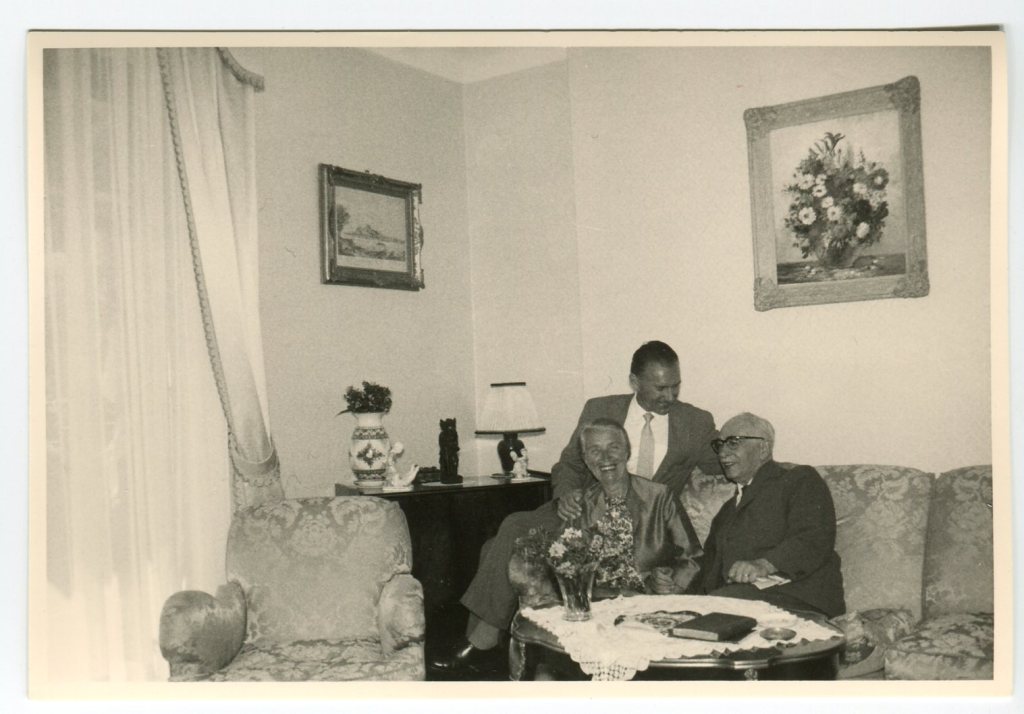
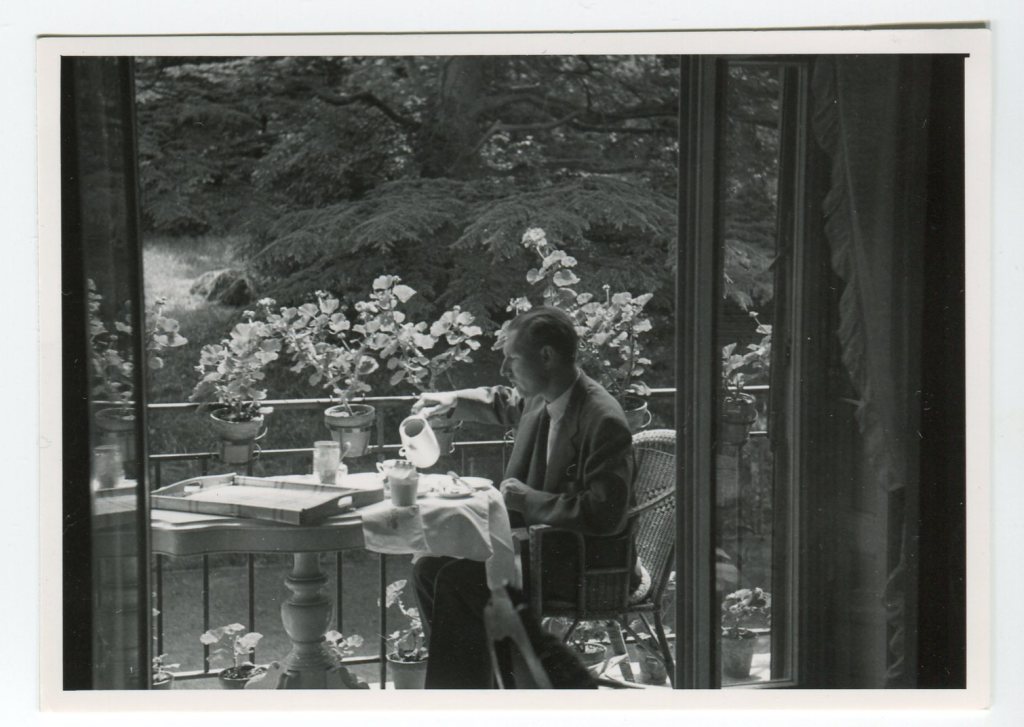
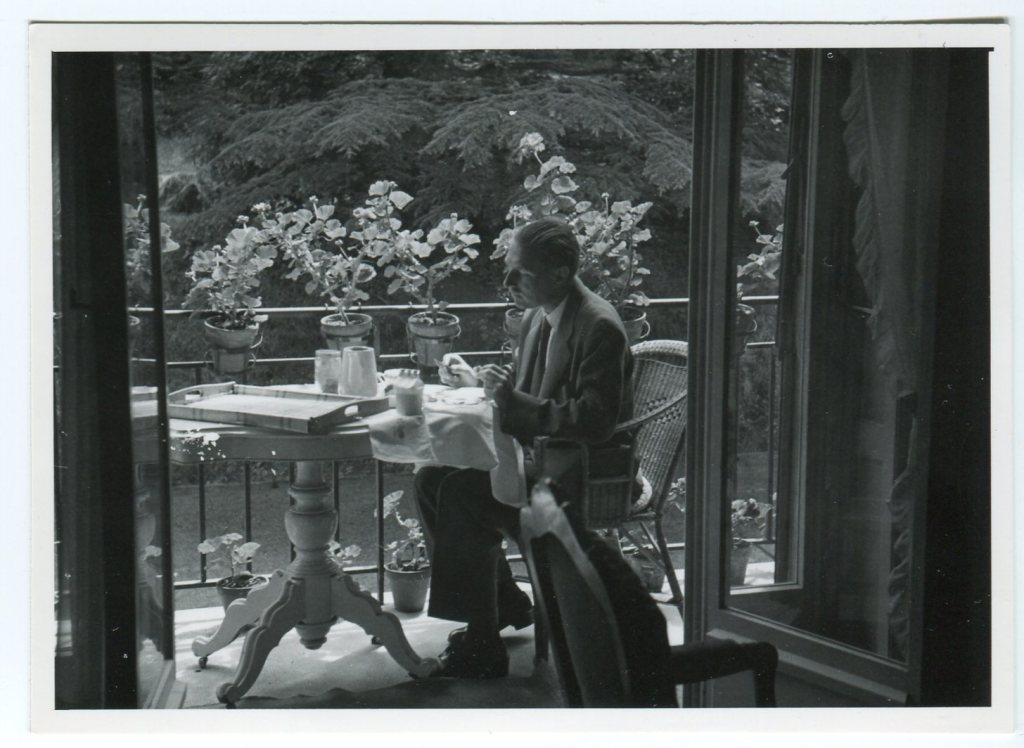























 Vlado
Vlado 