
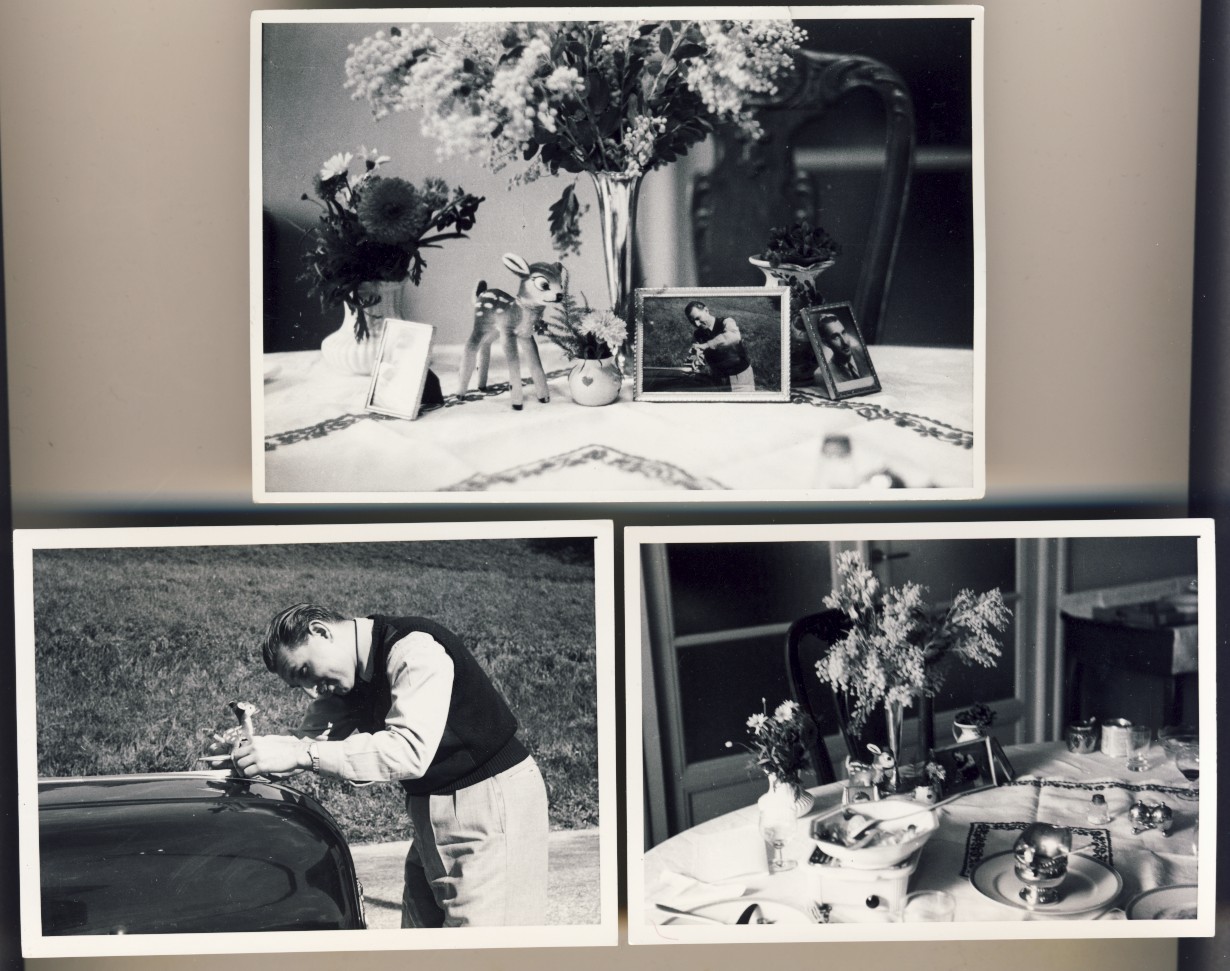
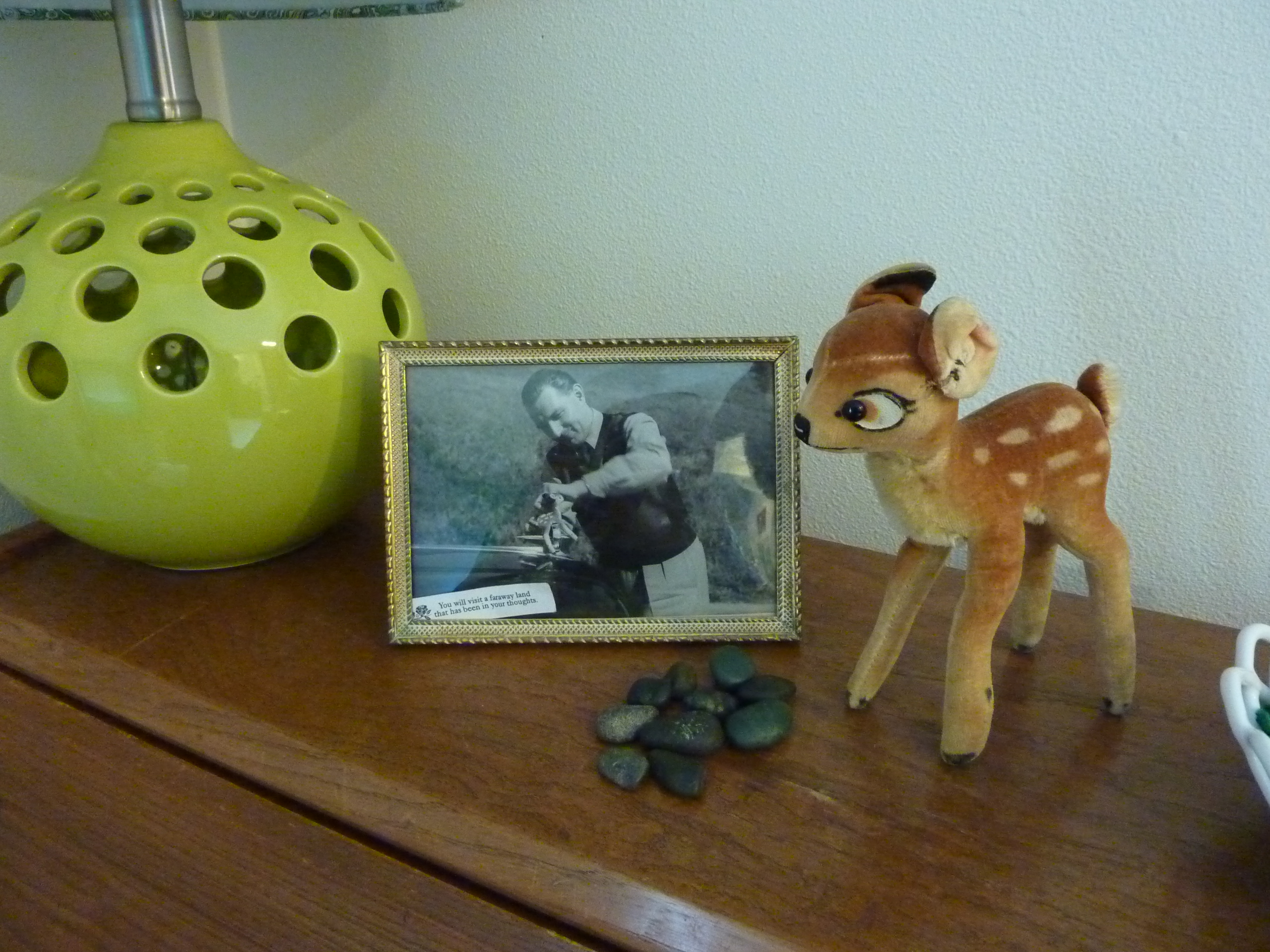
When I first began to sort through the family papers, I found a little stuffed “Bambi”, with a necklace around it’s neck, and a bright green four-leaf clover with a tiny red ladybug hanging from the chain. Then I found the photo of Vlado securing Bambi to the hood ornament of his Buick, which I use as my header on this blog. The Fabry family called themselves “the four-leaf clover”, because they knew they were lucky; and in the books of Olga Fabry, I found hundreds of four-leaf clovers, falling out of the pages. This totally charmed me, because I love to collect four-leaf clovers, too. I’ve been wearing the necklace ever since I found it, and I keep Bambi on my desk.
This is a photo of Dr. Pavel Fabry with Bambi:

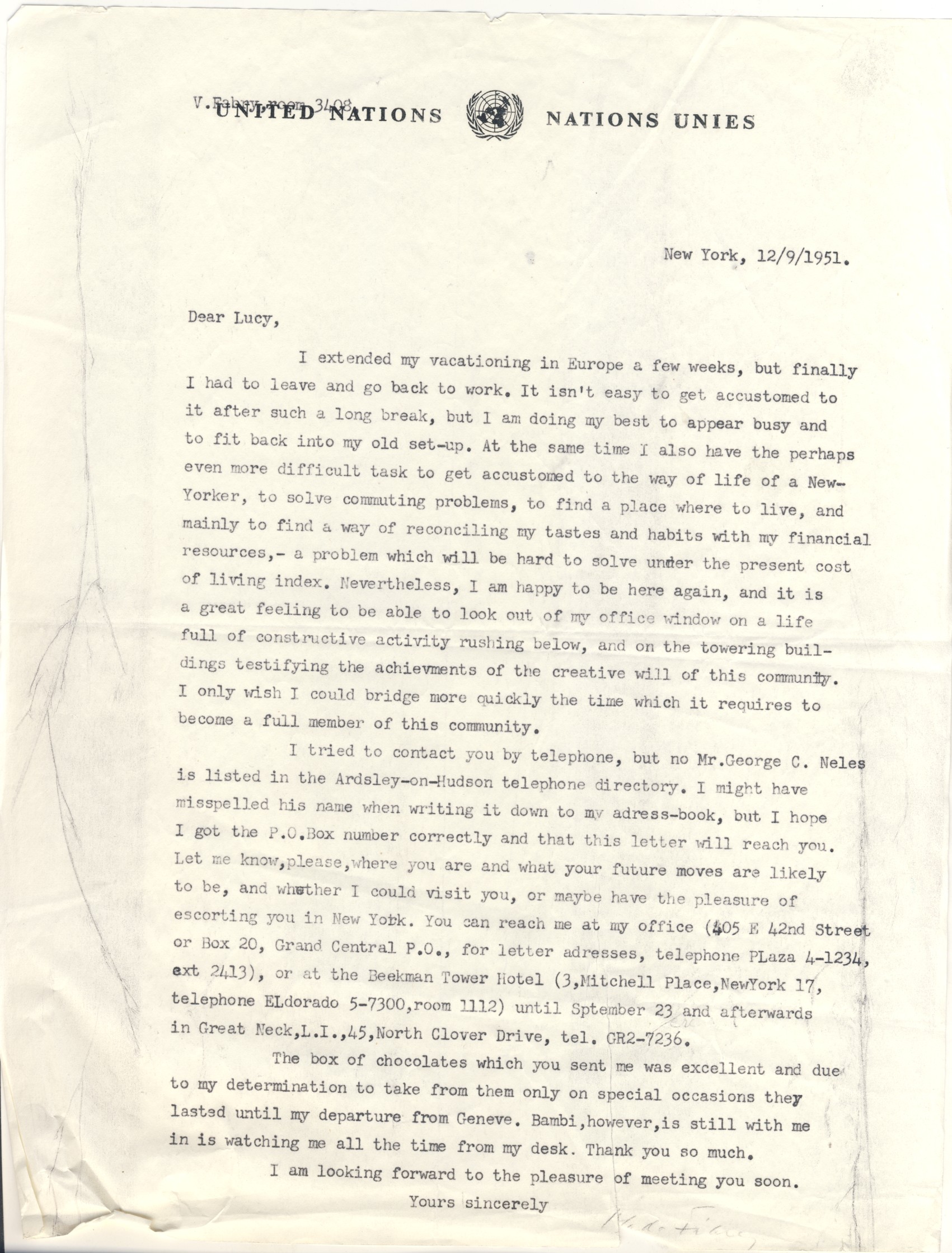
This is a letter to Lucy T. Briggs, who gave Bambi to Vlado – I don’t know who she is yet, but she gave him the gift before she’d even met him (click image to read):
I found these other pictures of Bambi being displayed with the photo, right after I took almost the same photo.
Tag Archives: Vlado Fabry
Statement of Samuel Bellus, November 30, 1956
I don’t know who Samuel Bellus is yet, but here is his statement on behalf of Mrs. Olga Fabry – Vlado’s mother:
I, Samuel Bellus, of 339 East 58th Street, New York 22, New York, hereby state and depose as follows:
That this statement is being prepared by me at the request of Mrs. Olga Viera Fabry, nee Palka, who formerly resided in Bratislava, Czechoslovakia, but since 1948 has become a political refugee and at present resides at 14, Chemin Thury, Geneva, Switzerland;
That I have known personally the said Mrs. Olga Viera Fabry and other members of her family and have maintained a close association with them since the year 1938, and that I had opportunity to observe directly, or obtain first hand information on, the events hereinafter referred to, relating to the persecution which Mrs. Olga Viera Fabry and the members of her family had to suffer at the hands of exponents of the Nazi regime;
That in connection with repeated arrests of her husband, the said Mrs. Fabry has been during the years 1939 – 1944 on several occasions subject to interrogations, examinations and searches, which were carried out in a brutal and inhumane manner by members of the police and of the “Sicherheitsdienst” with the object of terrorizing and humiliating her;
That on a certain night on or about November 1940 Mrs. Fabry, together with other members of her family, was forcibly expelled and deported under police escort from her residence at 4 Haffner Street, Bratislava, where she was forced to leave behind all her personal belongings except one small suitcase with clothing;
That on or about January 1941 Mrs. Fabry was ordered to proceed to Bratislava and to wait in front of the entrance to her residence for further instructions, which latter order was repeated for several days in succession with the object of exposing Mrs. Fabry to the discomforts of standing long hours without protection from the intense cold weather and subjecting her to the shame of making a public show of her distress; and that during that time humiliating and derisive comments were made about her situation in public broadcasts;
That the constant fear, nervous tension and worry and the recurring shocks caused by the arrests and deportations to unknown destinations of her husband by exponents of the Nazi regime had seriously affected the health and well-being of Mrs. Fabry during the years 1939 – 1944, so that on several such occasions of increased strain she had to be placed under medical care to prevent a complete nervous breakdown; and
That the facts stated herein are true to the best of my knowledge and belief.
Letter of Appointment to the UN, 1946
I am just beginning to learn about the first UN Secretary-General, Trygve Lie, who resigned from his office on November 10, 1952, after seven years of service.
On April 7, 1953, Trygve Lie stepped down and Swedish diplomat Dag Hammarskjold was elected UN Secretary-General. The transcript of the General Assembly that day is most interesting, if only to see how different the view of Soviets are from the rest of the assembly in their response to the resignation of Mr. Lie.
In 1950, the UN General Assembly voted to extend Lie’s term for another 3 years, but the Soviet Union refused to recognize Lie as Secretary-General because of his support of the UN intervention in Korea in 1950 (The Soviets didn’t get along with Hammarskjold either, and wanted to have “troika” at the UN, rather than just the one Secretary-General, because they believed Hammarskjold was a puppet of the US).
Trygve Lie also lost his support from the United States, after Senator Joseph McCarthy accused him of appointing staff “disloyal” to the US. Perhaps McCarthy didn’t like that Lie once gave Leon Trotsky permission to settle in Norway after he was exiled from the Soviet Union. In any case, Joe McCarthy was insane, and he was the one disloyal to the US – he didn’t care who he destroyed for his own political gain.
And on that note, here is a scan of Vladimir Fabry’s appointment to the UN in 1946, signed by Trygve Lie.
(click photo to enlarge)

Statement of Dr. Fedor Hodza
Dr. Fedor Hodza made this statement at the service for Dr. Vladimir Fabry at the Lutheran Church, Geneva, Switzerland, on Thursday, September 28, 1961:
The Slovak family, dispersed all over the wide world, bows in painful grief over the mortal remains of one of her distinguished sons. Once again a Slovak life has been extinguished, a noble life – already successful and which still promised so much – the life of your friend and mine, Mr. Vladimir Fabry.
It is a difficult and sad task for me to bid him farewell. Difficult, because I would not like to say more than his modesty would bear without dismay. Sad, because I had a great affection for him.
Yet his modesty and our sorrow must give place to the truth. And the truth is that the tragic death of Vladko Fabry is a cruel and woeful loss, not only for his mother and sister, not only for his relations, not only for his friends. It is a loss for his larger, national family as well as for that high humanitarian ideal which he served with such devotion.
Though today we are sorrowfully thinking of his untimely end and grieved as we are, we should not forget his life which should be a consolation to his loved ones and an example to us.
As a young and inexperienced lawyer he worked his way up in a relatively short time to a position of responsibility in an institution of such importance as the United Nations. He advanced with success amid older and more experienced colleagues from all parts of the world. He won confidence for his firm character, esteem for his good work, affection for his pleasant disposition. Within a short time he was entrusted with difficult, responsible and often dangerous tasks. The evidence of his personal success are the missions which he carried out in critical times, in widely differing regions of the globe, in India, in Indonesia, in the Near East, and finally in the unfortunate Congo.
It can be said that there was hardly a situation in the international development of the last ten years where Vladko was not present as a worker, defender and soldier in the service of peace among nations. Whenever and wherever this uncertain peace which is our lot was threatened, we saw him among those who were sent to pacify, to counsel, to persuade and help to preserve it.
By his talent and education, by work and experience so grimly won, by his conviction and energy, Vladko rose above the circle of narrower interests and lower aims and engaged himself fully in the service of higher good and loftier ideal.
It is not easy to be an officer of the highest international institution if it does not live – because it cannot – according to the letter and still less according to the spirit of its charter; when the peace which it is called to preserve is not a just peace – and there is no other; when freedom and independence of nations – which is the basis of its existence and the main purpose of its mission – are denied to those who already know the art of government and given to those who have still to learn.
But Vladko Fabry was not just an officer of an institution created to help humanity to live in peace and harmony. Personally, in his conscience, he considered himself to be a servant of probably the highest and most precious accomplishment of Western civilization, which prescribes that laws have to respect the good of all and that they have to be administered without regard to personal, class and even national interests.
The convinced patriot that he was, Vladko joined the ranks of the pioneers of constructive internationalism. He was aware that by helping to secure and protect the precarious independence of the new nations he was working at the same time for his own homeland, hoping that freedom and justice would return again to his beloved Slovakia.
He also participated directly in the great experiment of international life, and experiment which was designed to complement by deed the traditional debates and resolutions of the United Nations which too often remain unheeded. One such deed was the intervention of international armed forces in the Congo. It seems that the world is not yet ripe for actions of this kind. Vladko was among those who gave their lives on the altar of a new era in the life of humanity, and era full of promise but hardly yet born.
Let it please our Lord that his sacrifice was not in vain. Dead martyrs often achieve more for the ideals they believed in than living prophets.
So this is how we see Vladko Fabry, as man, worker, fighter. Such was his short but fruitful life.
How could we forget his love of nature and especially of mountains which seemed to attract him irresistibly? Was not his love an expression of that idealism which inspired all his endeavors? Were not the mountains to him a kind of challenge to accomplish a difficult and dangerous task, in solitude, in silence, without spectators and their acclaim? For him the mountains were not just a place of repose or sport. They were a kind of spiritual necessity. Up there he felt at home, there he was happy. Perhaps they reminded him of his native land Liptov, and Turiec and of our High Tatras.
As he was demanding in his work so he was modest in his private life. He disliked luxury and ostentation. His searching mind was forever disclosing new vistas, enlarging his horizons, acquiring new knowledge and experience. He learned because he wanted to know, he thought because he was aiming for excellence.
His gentle manners and good heart won him many friends in all parts of the world and today, on this last journey, he is accompanied by the affection and gratitude of so many.
In this last moment of farewell we remember also his late, eminent father who by the force of his personality marked the national life of Slovakia and contributed to her political and economic growth. We bow with profound respect before the grief so courageously borne by his loving mother and sister. If words are unable to soothe their pain perhaps the knowledge that Vladko lived a beautiful, rich and useful life will give them a measure of consolation until merciful time heals the deep wound.
Dear Vladko, it is time to say good bye. We remember you such as you were and hold you in our thoughts: A loving son, an affectionate brother, a devoted friend, a faithful child of your country, who dedicated his life to the service of humanity.
Vlado and Guapa Mia
This is one of many letters from Vlado to “Guapa Mia” in Madrid (He writes to her in English, she writes back to him in French), dated 28/7/1953:
Guapa Mia,
This time it is not entirely my fault for not writing so long,- I had to wait for your new address in Madrid. June was a very bad month for me; lots of work, financial worries caused by the declining/ and sometimes plummeting/ stock market, a round of social functions and the heat added to my natural antipathy to writing, and by the time I decided that I simply MUST make myself to write, I realized that it was too late for the letter to reach you in Geneva.
I was glad to hear that you have taken so well to your new “part-time” job/ I would never admit that to work six hours a day could be considered full employment/- and I am sure that under the brilliant sun and society of Madrid you will shine even more than ever with radiant beauty. Also, I believe, the gallant and temperamental caballeros will be a more deserving background against which your charm can find the proper appreciation, than Geneva’s dullish “burghers”. Spain seems to be in a big vogue among the city’s smart set, everybody who is somebody seems to be on his or hers way there this year, I wonder whether they have already learned that you have moved there?- I get stinking mad every time I learn of some lucky bird who is on his way to fly over, and wish to be in his place. But no luck,- with the special session of the General Assembly due in August, I will have no vacation at all this summer.
I got bitten by a reading bug lately – all my free evenings this month I spent here in my office/ which is air-conditioned, cool and dry/ reading and average of one book per evening. I reread Ortega y Gassett‘s Revolt of the Masses yesterday, and found it/ apart from fascinating reading/ a wonderful apology for my way of life. It looks as if he had exactly known what my thoughts, ambitions and ways of life will be when he depicted the non-common man and I found great comfort in his philosophy. It’s a pity that more people do not agree with his ideas, I might be better off if they would. Otherwise I am in the throes of my periodically recurring struggle to find absolute moral standards of behavior by reason – a wearisome substitute for faith or the ability to conform to conventions. This time I am following the approach of analyzing the progress of life in the universe, mans position in it, the characteristics by which his development to the present position was achieved,- and trying to deduce from the past road the direction in which the road ahead should lie, and which landmarks to take as guides. It’s all much more complicated than simply being able to accept revelations, dogmas of a church or the party-line, but it also is much more satisfactory.
As far as my body is concerned, I am trying to make up the enforced lack of exercise/ I can’t go riding in this heat, and living in the city I do not have the possibility to go for a round of golf before coming to the office/ by a strict reducing diet. I have only half-a-dozen oranges, a steak, or some chops, and two or three eggs in the morning,- no pancakes, bacon or ham, and no bread, butter or marmalade,- nothing for lunch except, if I am working late, some yogurt or fruit in the afternoon and lots of coffee without sugar, and only meat or fish, raw vegetables, salad or fruit for dinner,- no potatoes, soup, cheese or dessert,- and I drink skimmed milk with my meat instead of wine or beer. I lost 27 lb in the last five weeks, and can count all my ribs now. The only thing that throws me back from time to time is if I am invited to dinner- but everybody has left town now for holidays, so it does not happen more often than once or twice a week.
Most of my weekends i spend lately within 200 miles of New York,- somehow I lost enthusiasm for moving around. Only once I went to Northern Maine, some 1000 km from here, where friends of mine have bought an island with the most beautiful forests of huge pine trees, and marvelous cliffs falling hundreds of meters into the open Atlantic Ocean. They keep there a horse-breeding farm and have excellent thoroughbreds, a small fleet of yachts and sailing boats, and a small private golf-course, so there is plenty of things to do there during the weekend. They have five daughters, which all had their boy-friends visiting them/ I am a friend of the parents and was rather peeved at the deferrent and respectful way with which they treated me, as if I was fifty and not thirty-two/; each of the girls has her own little house, the three eldest had theirs completed last year, and the other two are being built this year from prefabricated parts, all is done without the help of a single laborer or architect. I helped in putting up the roof of one house and installing bathroom plumbing in the other. So it was quite instructive, apart from being good fun and a bit of muscle stretching.
Well, that’s about all that is to be reported about the dull life of an old bachelor. I am now looking forward to hear more how you are getting on. By the way, my parents send me your most amusing letter in which you described how you were tested in the office, I received it the same day as your letter directly to me.
With best wishes of much happiness,- and be good.
Love and Kisses,
Vlado
Letters of Condolence
So much of my time is spent sorting through a lot of dusty old papers, but what amazing things I find. Here is a telegram from the first African-American Nobel Peace Prize winner, Ralph Bunche – political scientist, academic and diplomat – with a message from the King of Sweden (Bunche’s work includes the creation and adoption of the UN Declaration of Human Rights):
(click photos to enlarge)

And this letter – I’m not sure who Major General Amin Hilmey II is, but perhaps someone reading this will give me a clue:

UNOC Leopoldville, Republic of Congo, 1961

(Vlado the mountain climber – click photo to enlarge)
After the death of Vlado Fabry on September 18, 1961, there were many letters of condolence sent to Mrs. Fabry, Vlado’s mother, from around the world. One such letter I found recently, written on UNOC stationary, is from the Italian United Nations legal expert Giorgio Pagnanelli, posted from the UNOC in Leopoldville, Republic of Congo, October 10, 1961. Only a month later, on November 11 or 12, 1961, 13 Italian airmen, members of the UNOC working to maintain peace, were brutally murdered by Congolese troops; Giorgio Pagnanelli was asked to make a report on the 13 murdered men for U.N. Security Council.
Dear Mrs. Fabry,
Please do accept my apologies for the delay in answering your letter.
Vlado’s death has left such a vacuum which will be very difficult to fill. I still cannot adapt myself to the tragic reality and sometimes I refuse to accept it. Dr. [Sture] Linner told me of your brief encounter in Geneva. I trust that Vlado’s belongings and papers have already reached you.
I am enclosing herewith a few things which were very dear to Vlado – a poster, showing his beloved mountains [Tatras] – which I gave to him and he had in his office – I enclose also an edelweiss – Vlado brought it back from his short visit in Switzerland: he kept it in a little vase in front of your picture (a color photograph taken in the mountains). [The edelweiss was still in the envelope!-T]
I am also sending newspapers and other publications.
Dear Mrs. Fabry, it is very true , indeed, that nothing could console the soul of a loving mother in a lost (sic) of her son; words or expressions of sympathy are within [indecipherable word] limits but sorrow goes hither and beyond these terms – I wish to say, however, that whenever I am tired, disappointed or frustrated in a job where we are expected to accomplish [indecipherable word], I remember Vlado, his courage, his strength, his belief in right things, his devotion to the U.N., then I feel that I should try to be like him – this feeling is shared by many here in the ONUC. As the New York Times pointed out, he was “a one man brain trust”. Since his arrival he organized, analyzed, solved every political, legal, administrative problem. People here used to say: “All right, we do not know the answer, let us ask Dr. Fabry”. He found it.
Vlado spoke very often of his “Mamuska” and his sister Olga. Once I told him that his mother would not have liked to see him working 19 hours a day; he simply answered: “Yes, I know, but she would understand”. On Sundays he used to take some exercise – He ran for one or two hours around the golf [?] court then arrived at the office saying that he had taken a little walk….
Dear Mrs. Fabry, Unfortunately I do not have a picture of Vlado. Once he showed me one with his beloved parents (a color photo where he is seated on the armchair with his father) – if you have an extra picture of Vlado, I’d like very much to have it.
Please do not hesitate to write me for anything you might desire.
Affectionately,
Giorgio PagnanelliLeg. Officer UNOC
Le Royal
Room 650
Leopoldville, Congo
The following is an excert from the NYT article “U.N. BRACES FOR ITS CONGO TASK”, by Henry Tanner, dated September 24, 1961:
Dr. Sture C. Linner, the head of the United Nations mission … lost his private secretary and, in Dr. Vladimir Fabri[sic] he lost what he had once called his “one-man brain trust”. Dr. Fabri officially the legal councilor, had in fact been the mission’s thinker who analyzed events and suggested decision.
Dr. Sture Linner was also on the plane headed to Leopoldville, but Hammarskjold told him that he was needed in Kinshasa; so he stayed behind, and escaped the tragic fate of the others.
I would like to add one more excerpt from the September 29, 1961 edition of SECRETARIAT NEWS, from the U.N. Headquarters in New York; which includes the obituaries of William Ranallo, Heinrich A. Wieschhoff, Alice Lalande, Serge L. Barrau, Harold M. Julien, Francis Eivers, as well as Vlado, who is remembered here:
To his more difficult tasks Dr. Fabry brought the disciplined energy, courage, and careful preparation characteristic of a serious mountain climber–which, in fact, he was.
An enthusiastic sportsman–expert skier and horseman as well as mountaineer–Dr. Fabry was concerned to share these interests and, far from scorning the beginners or less agile among his friends and co-workers, encouraged them. He himself frequently enjoyed a solitary climb to his office on the thirty-fourth floor, a feat discovered by a colleague who, after seeing him emerge from a staircase door, jokingly asked whether he had walked upstairs, and was answered with a quick smile and “yes”.
Congressional Record September 25, 1961
Since I’m not finished translating a document in German, I will give you a document written in English, from the Monday, September 25, 1961 Congressional Record: “Extension of Remarks of Hon. William W. Scranton of Pennsylvania in the House of Representatives”
Mr. SCRANTON. Mr. Speaker, in the tragic air crash in which the world lost the life of Dag Hammarskjold, we also suffered the loss of the life of Dr. Vladimir Fabry, the legal adviser to the United Nations operations in the Congo.
In the following statement by John C. Sciranka, a prominent American Slovak journalist, many of Dr. Fabry’s and his esteemed father’s attributes and good deeds are described. Dr. Fabry’s death is a great loss not only for all Slovaks, but for the whole free world.
Mr Sciranka’s statement follows:Governor Fabry (Dr. Fabry’s father) was born in Turciansky sv. Martin, known as the cultural center of Slovakia. The Communists dropped the prefix svaty (saint) and call the city only Martin.
The late assistant to Secretary General Hammarskjold, Dr. Vladimir Fabry, inherited his legal talents from his father who studied law in the law school at Banska Stavnica, Budapest, and Berlin. The old Governor before the creation of Czechoslovakia fought for the rights of the Slovak nation during the Austro-Hungarian regime and was imprisoned on several occasions. His first experience as an agitator for Slovak independence proved costly during his student days when he was arrested for advocating freedom for his nation. Later the military officials arrested him on August 7, 1914, for advocating a higher institute of education for the Slovakian youth in Moravia. This act kept him away from the front and held him back as clerk of the Bratislava court.
He was well equipped to aid the founders of the first Republic of Czechoslovakia, which was created on American soil under the guidance and aid of the late President Woodrow Wilson. After the creation of the new republic he was made Governor (zupan) of the County of Saris, from which came the first Slovak pioneers to this city and county. Here he was confronted with the notorious Communist Bela Kun, who made desperate efforts to get control of Czechoslovakia. This successful career of elder Governor Fabry was followed by elevation as federal commissioner of the city of Kosice in eastern Slovakia.
But soon he resigned this post and opened a law office in Bratislava, with a branch office in Paris and Switzerland. The Governor’s experience at the international court gave a good start to his son Vladimir, who followed in the footsteps of his father. During World War II the elder Fabry was imprisoned by the Nazi regime and young Vladimir was an underground resistance fighter.
Dr. Vladimir Fabry, 40-year-old legal adviser to Secretary Dag Hammarskjold with the United Nations operation in Congo, who perished in the air tragedy, was born in Liptovsky Svaty Mikulas Slovakia. He received his doctor’s degree in law and political science from the Slovak University in Bratislava in 1942 and was admitted to the bar the following year. He was called to the United Nations Secretariat in 1946 by his famous countryman and statesman, Dr. Ivan Kerno, who died last winter in New York City after a successful career as international lawyer and diplomat and who served with the United Nations since its inception. Dr. Vladimir Fabry helped to organize postwar Czechoslovakia. His family left the country after the Communist putsch in February 1948. His sister Olga is also in the service of the United Nations in New York City [as a Librarian.-T]. His father, the former Governor, died during a visit to Berlin before his 70th birthday, which the family was planning to celebrate on January 14, 1961, in Geneva.
Before going to the Congo in February, Dr. Fabry had been for a year and a half the legal and political adviser with the United Nations Emergency Force in the Middle East. In 1948, he was appointed legal officer with the Security Council’s Good Offices Committee on the Indonesian question. He later helped prepare legal studies for a Jordan Valley development proposal. He also participated in the organization of the International Atomic Energy Agency. After serving with the staff that conducted the United Nations Togaland plebiscite in 1956, he was detailed to the Suez Canal clearance operation, winning a commendation for his service.
Dr. Vladimir Fabry became a U.S. citizen 2 years ago. He was proud of his Slovak heritage, considering the fact that his father served his clerkship with such famous Slovak statesmen as Paul Mudron, Andrew Halasa, Jan Vanovic, and Jan Rumann, who played important roles in modern Slovak history.
American Slovaks mourn his tragic death and they find consolation only in the fact that he worked with, and died for the preservation of world peace and democracy with such great a leader as the late Dag Hammarskjold.
Translating the Fabry Family
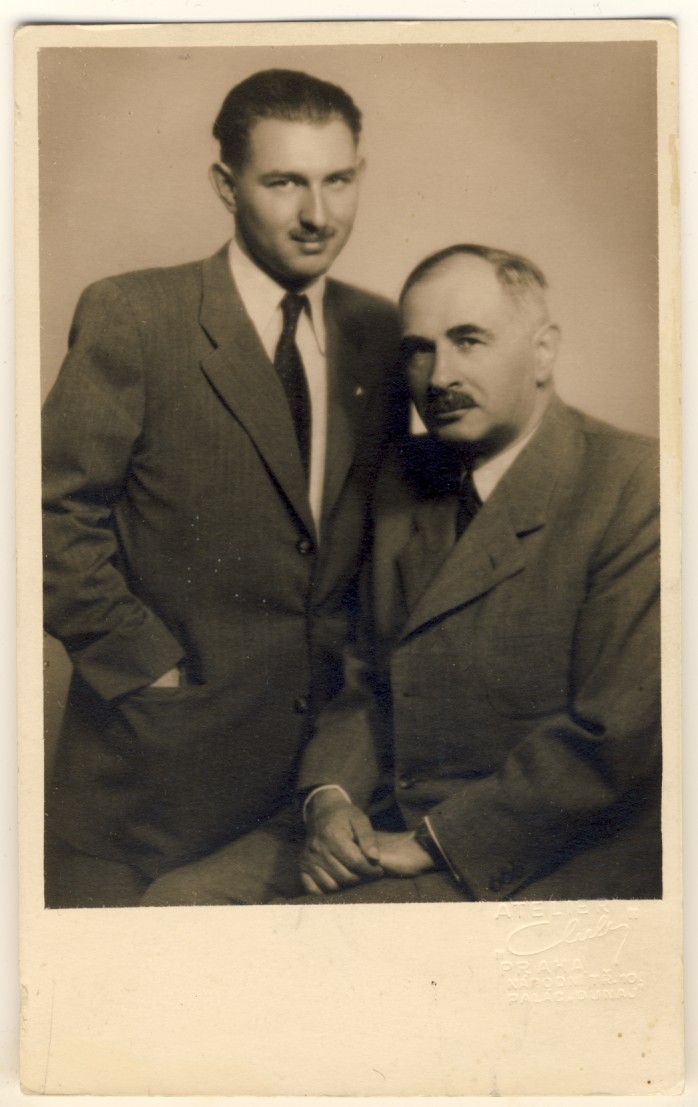
When my Slovak mother-in-law passed away, she left behind a trove of family documents dating back before the creation of Czechoslovakia in 1918. This blog is where I piece together the clues of her family – the Fabry family: Vlado, her only brother – member of the United Nations from 1946 until 1961, when he died in a plane crash on a peace mission with U.N. Secretary General Dag Hammarskjold; Pavel, her father – a lawyer, politician, and son of wealthy industrialists, and one of the first to be imprisoned and tortured in the concentration camp llava, in Czechoslovakia; Olga, her mother – daughter of land-owning aristocrats, who watched as her home was seized from her, and eventually turned into the Russian Consulate, in Bratislava, where it remains today still. My mother-in-law, whose name is also Olga, never gave up trying to get back her home – she even put it in the will, she was adamant that it be returned to the family.
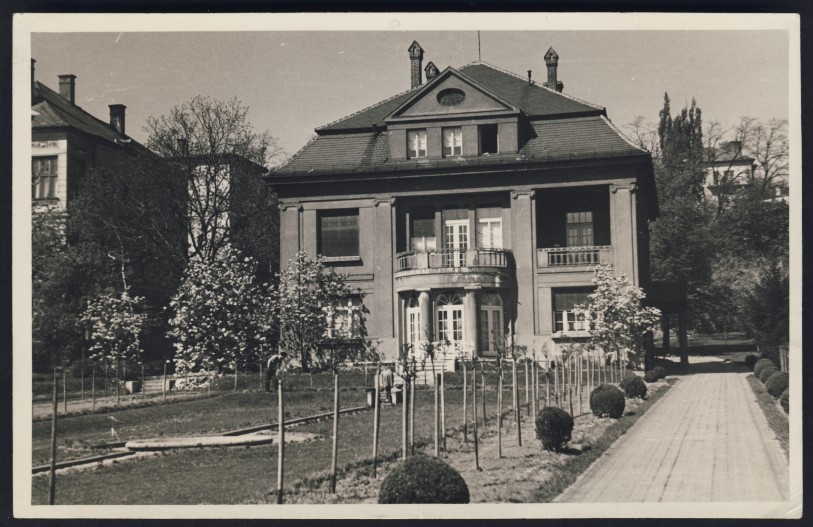
All of them were prolific letter writers. I am in the process of making order of nearly 25 archival boxes, translating the most intriguing documents as I go. Google Translate isn’t perfect, but I am using it to help make sense of the letters in German, French, and Slovak – not much written in English, but I am hoping to learn these languages better in time.
So far in my research, I am learning about Bela Kun, Franz Karmazin, the Comintern, Lenin Boys, Count Mihaly Karolyi, the Hlinka Gaurd, and Jozef Tiso. Czechoslovakia had both Nazis and Communists invading them, just one horror after another.
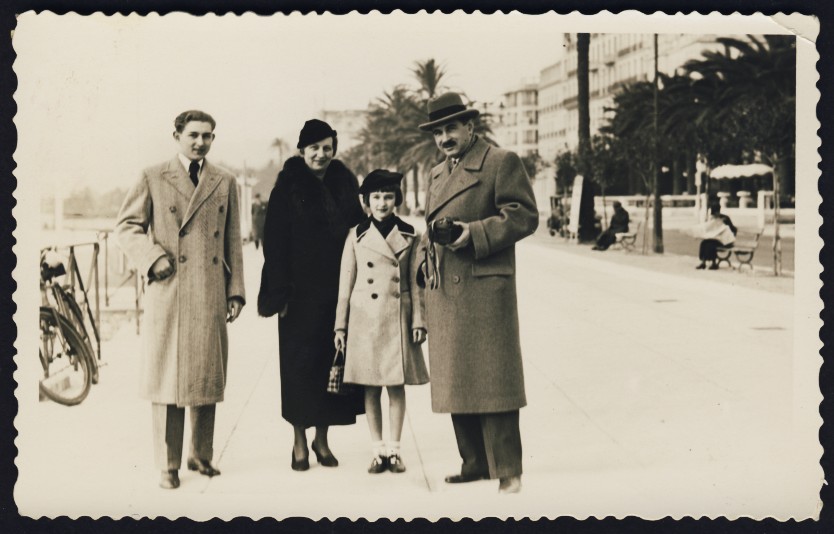
Vlado and Sheila
When looking up the name “Vlado Fabry” on the internet, the only thing I find, other than the details of the plane crash with Dag Hammarskjold, where he is called by his proper name, “Vladimir”, is a memoriam to Mary Sheila Dean Marshall(written by her son Chris Marshall) born in Argentina on July 18th, 1929, to British parents Austin and Ada Deane. It is also posted on the Rockville Consortium for Science website, where Sheila was founder and president . Here is the paragraph that made me laugh out loud:
“Sheila considered her time in New York to be some of the happiest days of her life. She roomed with her dearest friend, a gorgeous Czechoslovakian socialite named Desa Pavlu. The two of them must have left a trail of broken hearts throughout Manhattan. Sheila had a proposal of marriage from a young man named Arthur Gilkey . She declined, and shortly thereafter, he perished while ascending K2. Sheila was also courted by a chap named Vladimir “Vlado” Fabry. Vlado died with Dag Hammerskjold[sic] in The Congo[sic]. It seems that Vlado may have been connected with the CIA. Sheila said she could never see herself marrying Vlado because he had a “very round bottom.”
I was only a little annoyed that someone was using the words of one dead person to slag off another dead person, because it was just too funny to read about Vlado’s “very round bottom” on the internet. I would like to point out to Mr. Marshall, though, that his statement that “Vlado may have been connected with the CIA” is, as yet, an opinion; but Mr. Marshall’s father – Sheila’s husband – was a CIA operative from 1952-1967, and that’s a fact. But now that he’s got me wondering, I’ll be checking that out, too.
In a letter, sent from Vlado in New York to his father in Geneva, December 20, 1954, he says about Sheila:
“I decided I must look Sheila over a bit better. She seems to fit not only my bill but also that of maman; gaiety, naturalness, nine years younger than me, etc, — and at the same time poise, intelligence, dependability and brains; she is of mixed culture too, — part Argentinian, part English, part US. So I shall investigate. But nothing more, don’t worry!”
I’m going to try and avoid making untrue statements here. I’ll be writing things down as I make my discoveries, which means I’ll be learning as I go – and there is much to learn. And because I appreciate the discovery of Chris Marshall, and his mother, I want to share the letter of condolence I found that Sheila wrote to my mother-in-law, and to Mrs. Fabry, after Vlado’s death (Mr. Pavel Fabry, Vlado’s father, had died only a year before this tragic event, so I can only imagine the grief of the two women); dated October 26th, 1961, and sent c/o N.I.S.E.R., University College, Ibadan, Nigeria:
My Dear Olga and Mrs Fabry,
Ever since I heard the awful news I have been meaning to write to you, but what with getting Mike’s [Sheila’s husband] three children off to boarding school, packing up the house, leaving London on Oct. 1st and then straightening our stomachs out here, this is the first day that I feel like myself again. Your letter, Olga, arrived yesterday and I was very glad to have it but of course most upset at your obvious and quite natural distress.
All the time I was packing and sewing on name tapes and travelling down I had one thought at the back of my mind:–what can I say to the Fabrys? How can anything help? But there are things to be said and I’m sure that what I have to say will have been said by Vlado’s other friends but they bear repeating this once and even more times.
The first thing is that you of all people should have been spared this tragedy and Vlado was a man that the world and his friends needed. However, I have long ago found out and I’m sure you did before me, that it is useless to question Fate or God’s judgement or what you will call it. Admitting this, we are left only one consolation, that of remembering the pleasure that we derived from sharing part of Vlado’s life. He had great personality and made an impression on many lives. In his short life he managed to accomplish far more that many do in twice the time.
The second thing that immediately comes to mind is his great generosity of spirit. Surely, remembering this, and how sad it would make him to see you so desolate, you must for his sake continue, as much as you can, to show the Fabry spirit. How difficult this will be for you! For Olga it is not so much of a challenge as for Mrs. Fabry. Time helps the young and the young must help the older ones. And I am sure, knowing Olga, that she will have the courage, perhaps not quite yet, to pick up the pieces and build up again the remnants of a very fine family. We all need people like the Fabrys.
The third thing is that none of us who knew Vlado will forget him. He leaves behind him a memory of a warm hearted, generous and very good friend. His zest for life and its challenges was amazing and a source of great inspiration to us. He was a man very much driven by a sense of destiny and how well he fulfilled his role. His capacity was enormous and he never fell short of what was expected of him, although he often expressed disatisfaction at not having been able to do more.
My parents were most distressed at the bad news and have asked me to pass on their deepest sympathy to you both.
The enclosed are letters [I have not located these letters yet.-T] I received from time to time from Vlado. At the last minute I saved them from the consignment that we have sent down here. The photographs you asked for were packed before that but I shall get them out together with others I might have when our belongings arrive in about 3 weeks.The news photograph [have not located this photo yet.-T] I was able to get by calling up the Daily Express just before I left. They were reluctant to let me have it as it is not only the last one of Vlado but also of Hammerskjold. They said it was for your own personal use. I asked if they had any other in which Vlado might have appeared but they said not.
Thank you for your good wishes – I’ll write about my affairs later.
Lots of love to you both and all prayers for your wellbeing.
From Sheila
Last Image of Vlado Fabry
This is the final film footage of Dag Hammarskjold, on his way to attempt cease-fire negotiations – September 17, 1961 – before the plane “crashed” near Ndola, Northern Rhodesia, now Zambia. This is also the last footage of Vlado Fabry; legal advisor to the UN in the Congo, and my deceased mother-in-law’s only brother; who can be seen boarding the plane between the 19-23 second mark, turning his head for one last look behind him.
 Vlado
Vlado 