Here are more newspapers from New York, from September 19, 1961 to May 3, 1962, which support the evidence of the only survivor of the Albertina, Sgt. Harry Julien. For context of these events, please read Susan Williams’ most recent essay, published in The Yale Review, “Revisiting Dag Hammarskjold’s Mysterious Death”. Part one of this series can be found here.
The NYT, 19 September 1961. From article “Hostile Jet Cited in Crash”: “Jacques Poujoulat, personal assistant to Dr. Sture C. Linner, chief of the United Nations mission in the Congo, described the circumstances off the ill-fated flight. He said he “could not answer” when he was asked whether the possibilty that the plane might have been shot down could be ruled out. He declared, however, that the United Nations had been “unable to make daylight flights” because of constant attacks by enemy jet aircraft. He said that the timing of the Secretary General’s night flight to Northern Rhodesia was “at least partly” because of the attacks by enemy aircraft.”The NYT, 19 September 1961. “[Poujoulat] said that seven hours after the plane took off from Leopoldville yesterday an “unidentified aircraft” flew over Ndola airport and that at about the same time the police reported a “flash in the sky.”The NYT, 19 September 1961. “The jet fighter has been the greatest single threat to the United Nations troops in Katanga, the pilot, who flies two planes alternately, has been strafing and bombing United Nations forces in Elisabethville, Kamina and Jadotville every day. United Nations officials believe that one of the two planes is being reloaded and refueled while the other is in action. The United Nations announced yesterday that three Ethiopian jet fighters were “on their way” to Katanga to oppose enemy fighter planes. Today it was learned from qualified sources that the planes had not arrived because British authorities in Uganda had refused to let them make a refueling stop.”New York Herald Tribune, 19 September 1961. From article “Survivor Says Blasts Shook Plane”: “The wreck was reported first spotted by a Negro charcoal burner, then by a Royal Rhodesian Air Force crew. It was still smouldering when a ground search party arrived in mid-afternoon.”New York Mirror, 19 September 1961New York Mirror, 19 September 1961. Col. Don Taylor is a typo for Col. Don Gaylor, who was sent to Ndola by the Pentagon on September 15. “Col. Don Taylor[sic], U.S. air attache in Pretoria, South Africa, who circled the wreck area until ground parties arrived, said it seemed obvious the plane was making an approach to Ndola Airport when it crashed about six miles away. Taylor said it looked to him as though the pilot misjudged the height and that the plane’s undercarriage caught in tree tops.”
From Susan Williams’ essay: “One other aspect of Gaylor’s involvement is worth noting. After the Albertina failed to land, a team of Norwegian U.N. soldiers flew to Ndola to assist in the search. Their aircraft was parked near Gaylor’s DC-3. Because of white Rhodesians’ hostility to U.N. personnel, they were not allowed to enter the airport terminal. So Gaylor’s crew invited them on board to get some food. To the surprise of U.N. soldiers, they discovered that the American plane was packed with highly sophisticated radio equipment.
“We know from other testimony that the U.S. Embassy in Leopoldville was communicating with Ndola via a U.S. aircraft, which presumably was Gaylor’s DC-3. And that may explain an intriguing aspect of the story, namely that Edmund A. Gullion, the U.S. ambassador in the Congo, sent a cable to Washington on the morning of September 18 that explicity referred to the possibility that the plane was shot down. “Hammarskjold’s plane believed lost in vicinity Rhodesian border near Ndola,” the cable read. “There is possibility he was shot down by single pilot who has harassed U.N. operations and who has been identified by one usually reliable source as van Riesseghel, Belgian, who accepted training lessons with so-called Katangan Air Force.” (The ambassador’s communique included an error — the name of the pilot in question was Jan van Risseghem.)”
New York Mirror, 19 September 1961New York Mirror, 19 September 1961The NYT, 20 January 1962. “NDOLA, Northern Rhodesia, Jan. 19 (Reuters) — Two planes passed over Ndola shortly before Mr. Hammarskjold and fifteen other persons died in the air crash near here, a witness told an inquiry here today. T. J. Kankasa, an African municipal official, told the Rhodesian federal inquiry that one of the planes had its lights on and appeared to be a transport while the other was a “smaller aircraft without lights.” “It seemed as if the smaller plane was beaming lights on the large aircraft,” he said.”
From Susan Williams’ book, “Who Killed Hammarskjold?”, pages 107 and 109: “The UN Commission supplemented its findings by employing a consultant named Hugo Blandori to carry out some background research in Ndola.” […] “Blandori included in his memorandum some observations on the appearance of Bo Virving at the Commission hearings. Virving, he reported, had put forward the theory that the Albertina had been shot down or forced down by a plane above it. He based his theory primarily on the statements of African witnesses and told Blandori that he believed the Rhodesian authorities had suppressed their evidence.
“It was Blandori’s view that the Africans giving testimony had no experience of aircraft, so didn’t know what they were talking about. But this was not the case. For one thing, the witnesses lived very near the airport and had daily experience of the comings and goings of planes; and for another, some of them, such as Timothy Kankasa, had worked with planes during the Second World War[as a signalman].”
Who was Hugo Blandori? According to this article by Jerry Dumas, “Hugo Blandori [was an] F.B.I. agent and also a YMCA regular, who died beside me on the Y handball court”. And according to this article about Anne Cioffi, who was his former secretary, Blandori was an F.B.I. agent who later became a private investigator, but I don’t know when exactly that change happened. From the article:
“I used to babysit his kids,” she said.
One day Blandori told her he needed a secretary and she took the job.
“He taught me every angle of his business,” she said, adding that was unusual in those days because women weren’t often afforded such opportunities.
Cioffi said Blandori was affiliated with former FBI agents who did private investigating all over the world and, with her as his secretary, specialized in pre-employment screenings.
“Years ago you could do that,” she said.
The company also conducted insurance and fraud investigations, and occasionally cheating-spouse cases.
“I didn’t like those very much,” said Cioffi.
She said the two worked together until the day Blandori went to play handball in Greenwich and died of a heart attack.
“He was only 50,” she said.
Cioffi said Blandori’s widow knew nothing about the business so Cioffi ran the business herself until another former FBI agent bought it.
[…]
She said her husband, Carmine, and all her connections from her time with Blandori encouraged her to get her own private investigator’s license, so that’s what she did.
“I had my own office in Norwalk,” she said saying she did a lot of work for former FBI agents and even worked on a case or two for Interpol.
“It worked out very well.”
The NYT, 3 May 1962, “Cause of Hammarskjold Crash Still a Mystery as Inquiry Ends”: “[…] Dr. M. Frei-Sulzer, a Swiss police official, who was appointed by the commission to examine the wreckage of the Secretary General’s plane, which crashed near Ndola, Northern Rhodesia, attributed the disaster to the plane’s low altitude as it approached the airfield at Ndola after it had been cleared by the tower for landing.” [note: The Albertina was equipped with radar!] […] “Dr. Frei-Sulzer reported that “the only abnormal fact was the dangerously low altitude of the aircraft in relation to the airport elevation, probably due to human failure.” Dr. Frei-Sulzer is chief of the scientific department of the Zurich police and professor of science at the University of Zurich.” […] “The commission, which was appointed by the General Assembly last October, completed its report in Geneva March 8, three weeks before Dr. Frei-Sulzer submitted his findings to it.” […] “The [UN] commission criticized Rhodesian authorities for the fact that the wreckage was not found until fifteen hours after the crash. It said that Harold Julien, a United Nations guard who died several days after the crash, would have had a better chance for survival if the Rhodesians had shown more diligence. A report by the Royal Medical Board of Sweden said that a post-mortem indicated that, contrary to reports at the time, the Secretary General “lived for a certain period of time after the crash.” It said that he was the only person aboard the plane who had completely escaped burns.” […] “The Rhodesian and Swedish doctors agreed that bullets found in bodies of Mr. Hammarskjold’s guards had been exploded by the fire that consumed the wreckage and had not been fired from a weapon. Their finding were supplemented by Dr. Frei-Sulzer, who reported that there were no bullet holes in the plane and no evidence of explosives that would have been needed for a time bomb or other means of sabotaging the plane. However, the United Nations Commission examined at length the question whether a Fouga Magister fighter plane of the Katanga forces, “which had been operating against the United Nations in Katanga,” or some other plane [note: De Havilland Dove], had shot down the United Nations craft. It noted the reports of the Rhodesian inquiry board that the plane did not have sufficient range to fly from its base at Kolwezi and that the pilot had stated that it was on the ground on the night of the tragedy.”
New York Herald Tribune, 3 May 1962, This article continues the narrative of down-playing and discounting the testimony of Sgt. Harry Julien, “Dag’s Death Probe: Still a Whodunit”: “Sgt. Harold Julien, Mr. Hammarskjold’s chief security officer, was the single survivor found when the search party reached the area. He lay tortured in the hot tropical sun for twelve hours of daylight. Badly injured and under heavy sedation, he gave some sketchy and inconclusive information before he died three days later. With his death disappeared any apparent chance of solving the mystery of the crash.” New York Herald Tribune, 3 May 1961. From the same article, “Dag’s Death Probe”: […]In the last glimmering of first-hand information on what happened in the final moments of the accident, this conversation was reported between a Northern Rhodesian police inspector, A. V. Allen, and Sgt. Harold Julien who was semi-coherent at best. Allen: “The last we heard from you, you were over Ndola runway. What happened?” Julien: “It blew up.” Allen: “Was this over the runway?” Julien: “Yes.” Allen: “What happened then?” Julien: “There was great speed. Great speed.” Allen: “What happened then?” Julien: “There were lots of little explosions all around.” Allen: “How did you get out?” Julien: “I pulled the emergency tab and I ran out.” Allen: “What about the others?” Julien: “They were just trapped.”
I am a bit slow in posting the latest Hammarskjold investigation news, but here is the link to the 2022 UN report from Judge Othman, which was released at the beginning of November. Many thanks to Judge Othman, and to all “individual researchers and non-State entities” who have been responsible for providing “almost all new information generated between 2020 and 2022”. From page 9 of the report: “Despite the decrease in the amount of information identified by Member States, the amount and quality of new information provided by individuals and non-State entities highlights that additional information is highly likely to exist in Key Member States’ records and archives.” As a reminder, those “Key Member States” are South Africa, United Kingdom, and the United States. From page 34 of the report: “…a small number of Member States, which have been identified as being almost certain to hold relevant information, appear to have been the least willing to provide further disclosure.”
From the Fabry archive, I have recently discovered a new stack of international newspapers from the 19th-27th of September 1961. Here are two papers from London, both from the 19th of September:
This paper has a different photo of Alice Lalande I have not seen before.It is interesting to note that “1,800 aircraft men threaten strike” was at the De Havilland factory in Portsmouth, makers of the De Havilland Dove that were supplied to the air force of Katanga, Avikat, in 1961.From George Gale: “And above all [Hammarskjold] had the Congo itself, this vast land filled with ignorant and bewildered tribes untutored in the art of governing themselves, on which to experiment, with which he and his servants could learn the craft of rule.” I find it funny that the Daily Express “OPINION” column is not written by anyone in particular.This article mentions that “…an African[Black] charcoal burner was the first man to find the smouldering wreckage.”
Many thanks to Madame Rime, and to Maurin Picard for this interview and supporting the Hammarskjold investigation, and to David Glaser for promoting this blog and the life of Vlado Fabry – merci beaucoup to all who have contributed to this site!
Interview with Monique Rime Cégel
3 May 2020
Switzerland
Summary
– Monique Cégel, 83, was Vladimir Fabry’s secretary in Leopoldville in 1961
– She worked at the Hotel Le Royal between December 1960 and January 1962
– She knew Alice Lalande and Harold Julien very well
– She was working extra hours on 17 September 1961
– She typed Dag Hammarskjöld’s last message to Paul Henri Spaak, requesting Belgium to stop « van Riessenghem »
– She remembers there were serious doubts about UN communications being intercepted
– Vladimir Fabry did most of the research regarding Katanga mercenaries during the summer of 1961
– She remembers Dag Hammarskjöld’s collaborators tried to deter him from flying unescorted
– She does not think Sture Linnér was intended to fly along, as he had to stay in Leopoldville to liaise and work proper transmissions
– She flew to Ndola with Mahmoud Khiary on 19 September 1961 to type the ceasefire agreement with Moise Tshombe
– She saw the crash site right above her plane window prior to landing and was horrified
– She recalls smoldering debris and the « long line » of burnt forest
– She found a very hostile atmosphere in Northern Rhodesia
– She met a very disdainful Lord Alport
– She was not allowed to join Mahmoud Khiary at the hospital to visit Harold Julien
* * *
I was Vladimir Fabry’s secretary, at the Hotel Le Royal, Leopoldville (Congo).
I worked there for the UN mission in Congo from December 1960 to January 1962, as secretary detached from the Atomic Agency (IAEA) in Vienna.
I kept working for the UN in Geneva until 1976, mostly through freelancing contracts. Then my husband and I moved to the city of Bulle.
I met my husband in 1961 in Congo!
He was a representative for major Swiss companies of the time, including Schindler and Vega, and was selling chemical products to the university of Lovanium.
I became a Swiss citizen, after getting married with him.
I was French (and I still am), and was born in Paris.
* Sunday 17 September 1961
At the Hotel Le Royal, we had an office adjacent to the one occupied by Sture Linnér.
On the day Dag Hammarskjöld took off from Leopoldville, that Sunday, I was not supposed to work.
But, as Fabry’s secretary, and since he only worked with me, they sent some military staff in a Jeep to pick me up and bring me back to Le Royal.
They found me sitting at a cafe terrace, since I believe they always kept an eye on us for safety.
I went back to my office and worked all afternoon, until the plane departed.
* Vladimir Fabry
That day, when I arrived at my office, Vladimir Fabry immediately requested to dictate some telegrams. I spent the whole afternoon doing that: typing messages, then bringing them to the « Chiffre » for them to be coded accordingly with the recipient’s identity.
By the time I was finished, they were getting ready to leave for the airport.
Before leaving, Vladimir Fabry was so thrilled.
Happy as a kid who was just offered a new toy.
Albeit a very reserved character, he was practically jumping on his feet.
He came into my office and said excitingly:
« Monique, I am leaving with the Secretary-General! I am trusting you with my car keys! »
He had to be very happy, for he would never have done such a thing otherwise.
His car was an official UN vehicle.
He told me I could use all the time during his absence.
God knows Leopoldville is a very large town, with great distances between the various locations.
I used the car until, of course, I handed it back to the UN, since Fabry never returned.
I remember seeing their cars leaving Le Royal in convoy.
I went through these events with an innocent mind as I could only partially grasp what was going.
I would mostly type messages dictated by Fabry, messages that were generally meant for New York.
The last message I typed from them was dictated by M. Hammarskjöld himself. The recipient was Paul-Henri Spaak.
(nota: the Belgian Foreign Minister)
But I cannot remember its content (nota: requesting Belgian assistance to put an end to the criminal deeds of a mercenary pilot named « van Riessenghem »).
I was so intimidated that I must have skipped two or three words he dictated.
I had never met Hammarskjöld and I was so young then (nota : she was 24).
I saw Dag Hammarskjöld every day between 13 and 17 September 1961, since he occupied Sture Linnér’s office.
* Can you recall Hammarskjöld’s state of mind?
I remember he was not very agreeable. He seemed really sad, not at all in a communicative mood. « You do this, this has to be done ». We were in the midst of a serious crisis with Katanga, obviously.
* Were there long sleepless nights at Le Royal?
I did not spend those ones with them, but I had a similar experience during the previous months. When you are assigned to someone high ranking, you did not count your days and your nights. With all the crises we went through, there were many sleepless nights at Le Royal.
* Harold Julien
I knew Harold Julien very well, as he was the Chief Security Officer in Leopoldville. Being M. Fabry’s secretary, I was granted the use of a car.
This in turn created some serious trouble, because we were taken hostage with a Swiss colleague of mine by Mobutu’s troops for 24 hours. The time was around end January or early February 1961.
They had spotted my car, I believe, due to the UN flags on it, and surrounded our house with two small armoured cars. There were rumors that the UN was bent on disarming the Congolese National Army. And we had been poorly inspired to move in a house across the street from Mobutu’s barracks along the river – a magnificent location, it was indeed.
Then the witchhunt began against all UN staff.
This is the only time in my life I was really scared.
I called the French embassy asking for their help, as I was a French citizen. Their answer was very … kind: « you work for the UN, hence you are no longer considered as a French citizen for us. There is nothing we can do for you ».
Since my colleague was Swiss, she called the Swiss embassy and they immediately answered. « Yes of course, we will come and rescue you ».
They arranged for a motorized convoy of Swiss people, with friends and colleagues of my future husband, led by the Red Cross delegate M. Olivet, who was killed another day.
(nota: Georges Olivet, 34, was killed in an ambulance on 12 December 1961, amidst heavy fighting in Elisabethville, Katanga)
They parlayed with Mobutu’s soldiers, who pretty quickly removed their blockade and let us go free.
* Saturday 16 September, Lord Lansdowne meets Dag Hammarskjöld. Did you get word of a stormy exchange?
No, I do not remember that gentleman.
I did not hear anything, although I was there that day and was working in the nearby room. If there had been loud voices, a shouting match,
I would have heard something.
But it does not mean it did not take place, as my memory could be failing me.
There were indeed many high ranking visitors in Sture Linnér’s office, and I did not always necessarily get a look at them.
* Did Dag Hammarskjöld’s collaborators try to deter him from flying unescorted?
That is true, since I remember I heard about it.
They did try to deter him.
There were rumors that they were « waiting » for him in Katanga. There were Tshombe’s two Fougas.
(nota: in September 1961, the UN still believed two remaining Fouga were operational, as there was actually only one left, « 93 », the other one bing grounded awaiting spare parts)
When we heard about the crash, we immediately thought: « Tshombe’s Fougas did it ».
Personnally, I just could not imagine such a thing: who would want to shoot down the UN Secretary General?
I really thought this was just an accident, at least until after I left Congo early 1962.
If I had known … I was so scared in the air. I could never have boarded a plane.
But since I had no clue of what happened, I departed very easily when told to, without any further stress.
* Was Sture Linnér supposed to join the mission and fly along with Dag Hammarskjöld, as he later commented?
I was not at Ndjili airport but I would be surprised if he was intending to fly with them. It was logical for him to stay in Leo and liaise. That would be surprising if true.
Alice Lalande, she had to be part of the travelling party, since she was in charge of sensitive equipments, these Enigma machines. Besides, the Secretary-General needed an assistant like her. In her daily job, Alice was handing over paperwork to all the secretaries. She was a perfectly bilingual Canadian.
* Did Dag Hammarskjöld know that UN communications were intercepted?
I do not know, but it was a serious question for everyone in Leopoldville.
I had worked for weeks with Vladimir Fabry on the issue of the « frightfuls », these mercenaries.
I made dozens of photocopies from these documents that had been somehow collected and that had to do with these mercenaries. Vladimir Fabry worked a great deal on this issue. We did an extensive research on these documents. I am sorry that I did not have enough political awareness, to show an interest in the content of these documents.
* Monday 18 September 1961
Personnally, I did not get word of the crash when I arrived at the office on the next day. The other secretaries were doing a funny face, which was a bit intriguing. I made it late to the office due my long working hours on Sunday. I thought there was a dreadful atmosphere, but nobody told me anything. They did not dare tell me what had happened, probably because I was working so closely with M. Fabry. I only found out the same evening when I came home and my future husband told me: « did you hear what happened to Hammarskjöld ? »
* The crash site
When Mahmoud Khiary took off for Ndola, I came along.
(nota: on Tuesday 19 September 1961, in order to negotiate a ceasefire with Moïse Tshombé, as it was theoretically the case for Dag Hammarskjöld two days earlier)
I boarded the plane with him. If I had known the crash was foul play, I would never have come along with Khiary. This was so sudden, that I did not have the time to bring any equipment, not even a typing machine, as Alice Lalande had done.
We departed for Ndola. Prior to landing, while flying low over the forest, we managed to see the crash site from up close
(nota: the whole area was forested back then)
This memory will stay with me forever.
We spotted the wreckage, these scattered debris of an aircraft, what was left of it. This long line of burnt forest. It was terrible. I am still emotional about it, as I speak. I happened to realize the people I knew so well were only charred remains by now.
Alice Lalande, to begin with, who was basically my boss.
The security officers, such as Harold Julien.
I remember Alice’s dress with the flowery design. It sent cold shivers down my spine when I realized the plane had crashed and burnt that way. I though My God, she must have burnt so quickly. It was terrifying.
* Ndola, 19 September 1961
When we arrived in Ndola, there was this man, Lord Alport, welcoming us – so to say – at the airport. He was very cold. An extremely disagreeable character, very full of himself and every inch a British aristocrat. Still he invited our delegation for lunch in his home. I was just a secretary sitting at the end of the table with the security officers, but I found him disdainful towards us .
(nota : Khiary was not particularly welcome, since Tshombe had notified Linnér he agreed to negotiate a ceasefire with anyone but Khiary, whom he deemed responsible for launching Operation Morthor on 13 September 1961 – which is at least partially true)
Our mission was not very welcome.
Then we headed for the actual ceasefire negotiations with Moïse Tshombe, but I did not directly take part in the negotiations. The British mission there lent me a typing machine, whose keyboards had none of the French accents, which made my task very dfficult. I did however type all the ceasefire documents.
We stayed two or three days in Ndola.
Mahmoud Khiary and the delegation visited Harold Julien in the hospital. I was not allowed to join them.
1961 was a terrible year in my life. Annus horribilis, as the Queen Mother would say.
There was my being taken hostage, then Hammarskjöld’s crash, then the murder of 13 Italian air crew.
(nota: massacred by the crowd who mistook them with Belgian paratroopers in Kindu on 11 or 12 November 1961)
One of them was 25 and a very good friend of mine.
He had been at my wedding two weeks before, on 28 October 1961, along with Sture Linnér’s wife, whom I called Madame Linnér, of course, and also Jacques Poujoulat.
This day of September 1961, this Sunday the 17th. In my old age, I still cannot fathom what unfolded that day. It is still with me. It will stay with me until my last breath.
September 17, 2021, will be the 60th anniversary of the plane crash that killed our uncle Vlado, Dag Hammarskjold, and 14 of their brave colleagues while flying on a peace mission to Ndola, and we continue to wait for justice. For this reason, I am especially grateful to those who have no direct connection to the crash, who have made it their mission to help us uncover the truth with independent research and inquiry.
In July of this year, Joseph (Joe) Majerle III shared his own analysis of the crash with all the relatives, and it is an incredibly thoughtful and moving effort to support us. The points he makes deserve serious examination, and I want everyone to read it, so I am publishing it here in full – it offers a new perspective that was eye-opening for me, and lifted my spirits. Thank you, Joe!
AN ANALYSIS OF THE EVIDENCE CONTAINED IN RHODESIAN REPORT’S ANNEXES II AND III AN D THE U.N. GENERAL ASSEMBLY REPORT A/5069 PERTAINING TO THE CRASH OF DOUGLAS DC-6B SE-BDY S/N 43559 ON SEPTEMBER 17-18, 1961
By Joseph Majerle III
PREFACE I AM NOT a professional aircraft accident investigator. I am writing this account because after reading the reports of the crash, the professional aircraft accident investigators that were tasked with determining the facts of this tragedy, or for that matter, anyone else that has viewed the evidence contained in the above–mentioned files, have not come forward and pointed out the glaring misperceptions, dismissiveness of obvious real evidence, and inappropriate focus on irrelevancies that shaped the conclusions of the reports. In addition, there is at least one aspect that I can only describe as a deliberate inaccuracy that I consider to be of decisive importance. The Annex III and U.N. A/5069 reports, following the original Board report, did not effectively question the basic premises of the Investigating Board report as presumably would have been their purpose; which is why nearly 60 years after the crash this subject is still very unresolved for a surprising number of people.
I AM PRIMARILY, an aircraft mechanic. But, I earned a private pilot’s license and had begun commercial and instrument flight training before earning any of my mechanics ratings. Before I had any ratings at all, I had already built and flown my first airplane out of salvaged, crashed, repaired and new parts. At this point, I was already self-employed in the aircraft maintenance, salvage and rebuild business. I started salvaging airplanes from crash sites in 1974, studying whatever evidence was left at the scene in an effort to understand what and how the accident happened. With the advent of the Internet and the posting of Civil Aeronautics Board (CAB) and National Transportation Safety Board (NTSB) accident reports online, I have been able to read many reports going back to at least to the mid 1930’s because I was interested in learning what was known about particular incidents that I had heard about as a youngster, and for well into adulthood.
I decided to abandon thoughts of becoming a professional pilot because at the time there were probably ten newly qualified commercial and airline transport pilots competing for every available job opening, and operators had their pick of the best. In the maintenance field, however, it was the opposite story; at the flight school there was only one mechanic, recently licensed, and not very confident at all in his abilities. As an experienced, but not yet licensed mechanic, I assisted him in getting the flight school’s grounded aircraft operational again. For all intent and purpose, I have never been without work since.
I do not think it is inappropriate that I should be the person to write this report. What is required here is a broad-based, general knowledge of aviation, aircraft, their operations. I do not think an investigator has to have a DC-6 type rating to know how they are operated; provided one consults pilots with the rating to confirm what published documents like airplane flight manuals and Approved Type Certificate (A.T.C.) specifications say. Here in Alaska, it is very possible that we currently have the largest base of DC-6 experience operating, on a daily basis, in the world. I have known a great many DC-6 type rated pilots in my lifetime, to say nothing of having been related to one by marriage.
Any reader who wants to challenge what I state in this document is urged to consult with their own “expert(s)”. I do not claim to be an expert on any aspect of this; however every DC-6 expert that I consulted throughout this process confirmed readily what I thought to be the case when I presented them with the evidence. So that is why I think that it is time to reexamine what actually happened during the crash, as opposed to what most of the world thinks happened. Because, the two are very different.
It is not within my area of expertise to speculate on the “why” of what caused the precipitating action of this accident. I have read a number of reports and books over recent years that attempt to tackle that subject, but I have nothing to contribute to what other researchers, with apparent objective credibility, have amassed.
I am, however, bothered enough by the acceptance of the original Rhodesian premises by the world at large and former U.N. officials, and the effect these misconceptions have had on the descendants, relatives, and friends of the victims, crew and passengers, that I am submitting this document to whom it may concern.
PREMISES The Annex II report sets a number of premises that have gone unquestioned. They are, and I will attempt to order them in terms of occurring chronology, as follows:
That the aircraft crashed during the course of making a “normal instrument approach”.
That the aircraft was not on fire prior to its collision with the anthill on the ground.
That the crew could be faulted for not having transmitted a declaration of emergency during the approach.
That the crew could be faulted for the wreckage being found with the landing lights in the off position.
That the captain could be faulted for not having broadcast all of his intentions to the destination airport, especially in an area known to be hostile to U.N. personnel. These points, in addition to others, are where I will begin.
THE INSTRUMENT APPROACH Annex II, part 3, par. 12.6 “. . .hit trees and the ground at a shallow angle of 5 degrees or less, at what appears to have been normal approach speed, at an altitude of 4357 feet MER (?) with its undercarriage locked down, flaps partially extended, and with all four engines developing power and all the propellers in the normal pitch range, heading towards the Ndola radio beacon on a landing approach.”
There are four main parts of this statement to be addressed. They are to be considered in light of the aircrafts position in relation to the Ndola airport, which according to Annex II Part 1 par. 1 item 1.1 was “From Ndola aerodrome control tower 8.05 nautical miles on a true bearing 279 degrees.” 8.05 nautical miles is over 9.25 statute miles, from the airport at which it was intending to land.
01. “Normal approach speed” in my experience is based upon the aircraft’s stall speed, landing speed, and minimum control speed in multi-engine aircraft. It varies with combinations of all of the above and is normally calculated in percentages above the stall speed, which itself varies with differing weights, centers of gravity, bank angle, flap/high-lift device deployment, etc. In standard airport traffic area there is also a speed limit of 156 knots (180 mph.) Since the beginning of the age of the jumbo jets and the airports from which they operate, the speed restrictions have been raised because many of that class of aircraft have higher stall speeds than 156 knots (180 mph.), so for them, there is only the 250 knots (288 mph.) below 10,000 feet rule, which I believe applies to all airspace complying with ICAO rules.
Normal approach speed, at that stage of the approach, should have been 160 knots (184 mph.) or even more in this case, with this captain concerned about the possibility of armed, hostile aircraft in the general area. In consultation with a DC-6 captain, he said except in very unusual circumstances the standard instrument approach speed up to the final approach fix, which in this case was the Ndola NDB, 2.5 nautical miles, 2.875 statute miles from the runway end, would be 160 knots (184 mph.) Maximum flap extension speed is 139 knots (160 mph.)
The point that needs to be made here, and clearly with no ambiguity, is that there would have been no reason whatsoever in a normal instrument approach, especially in good weather conditions, to have had the aircraft slowed down to landing configuration while over 9 miles away from the airport. Standard procedure would be to begin deploying landing flaps and landing gear upon reaching the final approach fix, which in this case was the Ndola NDB (non directional beacon), approx. 3 miles from the runway, which is a fairly average distance for an NDB or a VOR (very high frequency omni-directional range) to be situated to a runway. That the aircraft was found configured for landing at the farthest point it was going to reach away from the airport during its instrument approach, means that the pilot would have had to slow-fly it throughout all of the rest of the approach procedure to a landing at the airport. There is absolutely nothing normal about that. This was the very first thing that struck me when I initially read the report. It is indicative, however, OF A LANDING ATTEMPT AT THE LOCATION WHERE IT CAME TO REST.
02. “. . .with its undercarriage locked down, flaps partially extended, . . .” The DC-6 series aircraft have a stall speed of approximately 80 knots (92 mph.), and consequently a lower approach speed than the jet airliners that replaced them beginning in the 1960’s. The closest replacement is the Boeing 737 series, which like the DC-6 have an approximately 30,000 lb. payload and were generally intended to operate from the same runways that the DC-series used. While the Boeing will neither take off or land and stop in as short a distance as a DC-6 due to its higher stall and approach speeds, the differences are not gigantic. For this project I consulted a Boeing 737 captain whose career spanned the 737-200 series thru the 900 series, and was told, again, that landing gear and landing flap settings were deployed upon reaching the final approach fix, which is generally approximately 3 miles from the end of the runway. This, in an aircraft with higher approach and landing speeds.
Wing flaps increase both lift and drag, and were originally developed to enable an aircraft to make steeper approaches to land without increasing speed that would need to be bled off during rollout after touchdown, in other words to shorten the landing to a stop distance. That they would also reduce the takeoff distance and improve the climb performance was a secondary consideration. Annex II part 10 par. 10.3.4.2 states that all indications were that the flaps were in the 30 degree position. I would estimate that this is approximately optimal for lift and slow flight which would be desirable for the lowest approach and landing speed based upon experience with numerous different types of aircraft; I have flown a number of different airplanes with flap deployment angles beyond 35 degrees and noticed that at angles much beyond 35 resulted in much higher drag components than lift components and engineering books generally support that observation based on wind tunnel testing. The higher angles of extension were generally useful only for bleeding off excess altitude quickly in situations where a pilot wanted to get a lot closer to the ground in a hurry. To my experience, 30 degrees was optimal landing flap in many, but not all, types. Again, it is indicative OF A LANDING ATTEMPT AT THE LOCATION WHERE IT CAME TO REST.
03. “. . .with all 4 engines developing power . . .” 10.1.4 states “. . . the four engines were broken from their mountings and severely damaged by impact and subsequent fire . . . .” Examination of photographs in the appendix reveals that engines #1, 2, and 3 had fallen to the ground after the aluminum nacelle structures melted away in the fire subsequent to coming to rest, and the straight steel tube struts of the actual engine mounts are still straight and attached to the engines. Furthermore, the above mentioned engines are all still in the approximate positions they would have occupied on the wing with only the #4 engine having detached in the crash sequence, and it is laying in probably very close proximity to where it was wrenched from the wing during the cartwheel arc.
The second thing that struck me upon first viewing the wreckage plan is that almost the entire aircraft is still in one place.10.2.1 “The main wreckage was contained in an area approximately 60 feet by 90 feet . . . .”
The DC-6 is almost exactly 100 feet long with a 117’6” wingspan, which means after it came to rest and cooled down the whole of the main wreckage would fit within the same rectangle as its original size. The wreckage plan, as surveyed, indicates that the vast majority of its original parts ended up oriented in the approximate positions that they occupied prior to the crash. In other words, throughout the crash sequence, very little of the aircraft was displaced from itself until very close to the end of its movement. This indicates a low energy crash with a very slow speed impact, at least relative to even minimum flying speed, to say nothing of a 160 knot instrument approach speed. 160 knots (184 statute mph.) is a velocity of almost exactly 270 feet per second. The wreckage plan length of 760 ft. from first point of treetop contact to ground strike of the fuselage nose (10.1.1) is approximately one half of what I have observed to occur in unintentional controlled flight into terrain (CFIT) crashes during my time in this business. It is, however, in addition to viewing the appendix photographs of the site that were taken from the ground and from the air, completely consistent with the path of an aircraft with an 80 knot stall speed being intentionally landed.
Aircraft that are only capable of even 120 knots in unintentional CFIT crashes generally never resemble an airplane by the time all of the parts come to a stop, their propellers are almost never still attached to the engines, their landing gear are almost never anywhere near where they were originally attached, and their tail groups when broken off have usually broken the control cables in overload displaying a “broomstraw” effect. In this case, when the tailcone broke off in the cartwheel there wasn’t enough energy left to pull the cables apart. If I had to estimate the minimum speed required to disintegrate the nose section of the fuselage such as is displayed in the wreckage plan and what can be seen of the remains in the photographs, I would say that it would require at most only about 50 to 60 knots to do that kind of damage. It was explained to me in 1986 by a good friend that was a DC-6 captain at that time, that the 4-engine DC-series had a somewhat fragile nose landing gear structure but not unusually so compared to other makes in it’s class; but when they tore out of the fuselage it often did a lot of other damage and could possibly make the incident beyond economic repair. I saw an example of that just last fall (2020) where a DC-4 had its nose landing gear torn out in a ditch at barely more than walking speed; the damage extended through both sides of the factory break joint where the nose (flight deck, cockpit) section attaches to the forward fuselage section and the operator decided that it was beyond economical repair, according to a conversation with his director of maintenance. This should reflect no discredit on the part of the designers; from personal experience repairing nose landing gear damage on many different types of nosewheel type airplanes it is generally a fragile part of all of them.
04. “. . .and all the propellers in the normal pitch range, . . .” This statement stretches ambiguity beyond limits. The Hamilton Standard 43E60/6895A-8 propellers such as were installed on SE-BDY (of which I have owned several sets and still possess a crate full of hub and dome parts) has a normal pitch range of approximately 90 degrees from neutral for feathering and forward thrust and maybe 20 degrees aft of neutral for reverse thrust. 10.3.4.4 states: “Inspection of the propeller stop ring assemblies confirmed that the angular setting of all propellers was in the constant speed range.”
First, the stop rings do not determine the constant speed range; they are only the outer limits of the blade travel, at full feather and full reverse. The constant speed range is a function of the engine driven governor and the distributor valve assembly housed within the hub and dome and is sensed with electrical switches attached to the blades and actuated with an electric motor driven oil pump mounted on the engine reduction gear nose case immediately behind the propeller hub, with a rubber/spring lip seal interfacing the parting surfaces. The only way to determine the angular setting of the blades in this installation is to measure with a propeller protractor against the rotational axis.
Second, the constant speed range is also a function of the engine turning at a high enough RPM for the governor to supply enough boosted oil pressure to operate the distributor valve to keep the blades off of the low pitch stop, which in reversing propellers such as these is again a function of the distributor valve. But for the purposes of this analysis, that is not important.
Third, the photographic evidence, is what is important. The U.N. report appendix contains photographs with 16-digit letter/number codes, of which I saved fifteen to a file, beginning with S-0727-0004-01-00002, and following will be referencing the last two digits. I will reference the individual blades in clock face numbers, as viewed from the rear of the engine looking forward as is standard practice.
It is difficult to differentiate between engine#1 and engine#4 because there were fewer views of #4, but both could be identified by orientation with the wreckage plan. It is readily apparent that both of these had almost identical damage to their blades, except that the third blade on #4 is not visible. Photo 07 shows #4 with the 10 o’clock blade in standard reverse thrust position. The 2 o’clock blade has had its spring pack drives sheared in overload during the ground strike and has rotated on its pivot axis into an approximate reverse feather position, with its trailing edge forward instead of its leading edge when in standard feather mode. This indicates that its leading edge struck the ground hard enough to shear the spring packs while the leading edge of the blade was rotated aft of its plane of rotation, in other words while at a reverse thrust angle. With 2 of the 3 blades coming to rest in a reverse thrust angle, I think it’s safe to assume that the propeller was fully operating in the reverse thrust mode at time of impact.
The #1 engine is well represented in the photographs, with all blades visible. Photo 16 shows the 10 o’clock blade in standard reverse thrust position, spring packs intact. The 2 o’clock blade is in reverse feather position, spring packs sheared as per the same blade on the #4 engine, and the 6 o’clock blade is also in standard reverse thrust position, spring packs intact, but has bent aft throughout its length progressively to the tip which is common when rotation is coming to a stop while the engine and airframe behind it are still moving forward. That the propellers on engines #1 and #4 are far less damaged than the ones on #2 and #3 is partially due to the fact that they were mounted higher on the wings due to wing dihedral, and didn’t penetrate the ground as deeply when they struck.
Photo 07 shows #2 engine with its 2 o’clock blade rotated into a reverse feather position also, spring packs sheared. The broken off shank of what would be the 10 o’clock blade is in standard feather position, spring packs intact. What would be the 6 o’clock blade is not visible in this view, and I haven’t found any other photos showing it, but based on its proximity to the ground I think it’s reasonable to assume that it also was sheared off during its ground strike.
Photo 33 shows #3 engine, which reveals its 2 o’clock blade broken off at what I would estimate at most to be its 25” station, which is measured from the propeller shaft centerline. It is clearly in a standard reverse thrust position, spring packs intact. The 10 o’clock blade is broken off 1.5” to 2” outboard of the hub clamp halves, so close to its round shank section that its angular position is inconclusive. The 6 o’clock blade has broken off inside of the hub clamp halves through the blade bushing bore; it obviously fragmented into a number of pieces. As with all three of the other engine’s propellers, I think it is reasonable to assume that the #3 propeller was fully in the reverse thrust mode when the blades struck the ground. I would deduce from the condition of the #3 propeller that it was positioned to penetrate the ground the deepest and most solidly of the four. The #3 engine also received by far the most fire damage after coming to rest most likely due to its proximity to the most remaining fuel in the right hand wing. I will discuss this in more detail later.
I have thought long and hard about how to estimate how much power the engines were developing at the moment the propellers struck the ground, and it is a difficult question. The propeller blades were group 4, an early post-war development and were the strongest of all the Hamiltons ever built for piston engines, generally used only on the latest and most powerful post-war radial engines. I am not aware of any empirical strike strength tests, which is not to say that Hamilton Standard didn’t conduct any, I just haven’t heard about them. If I had to guess I would estimate that it would require a high-cruise manifold pressure setting to shear them off and break them through the blade bore bushing hole as is evident in the photos. The captain clearly had gotten the throttles well forward and was making a lot of reverse thrust before the nose landing gear collapsed and the nose and propellers hit the ground.
THE WRECKAGE PLAN The Annex II wreckage plan and the photographs of the descent path appear to show a deliberate, controlled descent with directional control maintained all the way to the anthill, as though it was intentional, and I am suggesting that it was.
I had difficulty scaling the exact measurements of where the small parts that were torn from the aircraft came to rest relative to the initial tree contact, and varying figures are given for the height of the anthill from 9 to 12 feet, which I would have thought would be consistent with the whole site having been charted by professional surveyors, but in reality this is not important.
What is important is to realize that only 760 feet from initial treetop contact the aircraft was rolling with all three landing gear on the ground, right side up, travelling in a straight line, directionally under control.
At some point not far from the anthill the left wing bottom skins were breached, presumably by a tree trunk, the top of which would have been broken off by the wing leading edge and spar(s), opening up one or more fuel bays and dumping their contacts to the ground in a concentrated area, which fueled the incinerated area shown at that location in the wreckage plan. As stated earlier, this would contribute to the reason that the #1 and #2 engines on the left side of the aircraft were less heavily fire damaged post-crash than the engines on the right side. However, the overall strength of the main wing box structure remained sufficiently adequate to retain its basic shape to provide the arm about which the entire aircraft would pivot upon striking close to the base of the anthill, leading edge down, and not be sheared off at that point. Obviously, the wing leading edge outboard of the engines is what actually contacted the anthill, and initiated the cartwheel, as both of the left hand engines stayed with the wing and came to rest close to their original positions on the wing.
At some point close to the anthill, (and somebody could probably do a better job of quantifying the actual measurement from the wreckage plan), but it is not marked as such, the nose landing gear structure was overloaded in the undisturbed forest terrain and collapsed. Which is to say that the oleo strut and its retraction/extension linkage was torn from its mounting structure and its broken pieces were spread along the ground from forward movement of the rest of the aircraft behind it. I looked long and hard in the wreckage plan to find the exact point where the nose gear departed, but could only find reference to a “steel shaft” alongside the base of the anthill, and couldn’t find it in the photos. Presumably, the “steel shaft” was the nose strut piston tube, which is a steel tube approximately 5” in diameter, and it was about where I would have expected it to be in this case. Other associated parts of the nose gear system were a little farther along the path, again where I would have expected them to be. I could find no reference to where the nosewheel and tire came to rest, which is important from the standpoint of knowing how long it was on the ground before failing, which was in some measure the fate sealer for the crew and passengers. I did find reference to an unidentified portion of wheel rim on the right hand side of the path and well before the anthill, but whether it was from the nosewheel or one of the dual main wheels may never be known. Photo 19 shows one of the main landing gear assemblies with the remains of both tires and wheels in place and another photo shows the same for the other MLG, so it is certain that all of the main wheel tires stayed in place throughout. While on the subject of the main landing gear, the DC-6 MLG units retract forward into their nacelle bays, and their retraction/extension links for normal operation on the ground loads the links in tension, which for metallic structures allows them to be at their strongest, especially in terms of retaining their shape when loaded. The photos show that the links had failed in compression and had bent, which would be expected to happen upon the main wheels striking the ground while traveling backwards during the cartwheel, and partially retracting back into their nacelle bays. But, effectively, they stayed in place throughout the crash, again indicative of a relatively low speed occurrence.
As stated above, shortly after landing with all three landing gear on the ground, close to the anthill, at probably the worst possible location and time, with all four engines evenly at fairly high power settings in reverse thrust in what would have been a desperate attempt to slow the momentum of the aircraft and get it stopped, (but what is in reality standard operating procedure), the nose landing gear collapsed, instantly dropping the nose section of the belly and fuselage to the ground, pivoting on the main wheel axles. When this happened, the propeller blades began contacting the ground, bending and breaking them off, and the wing leading edge from end to end rotated downwards, drastically lowering in height. As the fuselage nose belly skins, stringers, formers etc. began crushing and tearing away it allowed the wing leading edge to get even closer to the ground, until the left side contacted the anthill nearer the base than the top, which initiated the cartwheel. Had the nose gear remain in place, there is at least a chance that a relatively level wing might have been able to ride up and over it and the aircraft’s momentum to remain linear, and with even a few more seconds of reverse thrust as braking action, the survival odds would have increased dramatically.. The noted fragment of wheel rim found along the glide path, if from the single nosewheel, and if large enough to have allowed the tire to depart from the wheel, I think in this terrain would have guaranteed the failure of the nose gear assembly.
I think a further word here about center of gravity is appropriate. SE-BDY as it departed Leopoldville was handicapped with a forward C.G. (center of gravity), with little or no aft cabin load. The DC-6, as with all large airliners, was designed to carry its nominal 15-ton payload distributed throughout the cabin from end to end and as with most aircraft have the load approximately centered on the wing, since that is what is supporting everything. In this case, with the passengers and their gear in the forward part of the cabin, the C.G. would have been well toward its forward limit, known as nose heavy. This means that the pilot, under any circumstance, would have a harder time holding the nose off the ground with the elevators than if there was weight in the fuselage behind the main wheels assisting him with the balance.
I have flown airplanes with only the pilots in the front seats and nothing in the aft cabin where the nosewheel could not be held off the runway whatsoever upon landing. With power at idle, when the main wheels touched the nosewheel slammed to the runway instantly because the C.G. was well forward of the mains. At least three different DC-6 pilots I have known over the years have told me that they much preferred flying them with a somewhat aft C.G. because of the better balance. In this case however, I think it could be listed as a contributing factor to the deadliness because after getting the main wheels to the ground, with the propellers in reverse and no accelerated air flow over the elevators, the captain was unlikely to have been able to keep the nosewheel from slamming to the ground immediately and beginning the sequence of breakup of the forward fuselage structure.
ABOUT THOSE ALTIMETERS . . . There are numerous references throughout the reports about the barometric altimeters, three each, forming one of the major premises upon which the reports conclusions are based. So many, in fact, that I am not going to bother referencing them here. The Board (Annex II) and the Commission (Annex III) both spared no expense to prove beyond any shadow of doubt that the their Air Traffic Control (ATC) had properly informed the crew of the altimeter setting and that Transair had properly maintained their instruments and aircraft, as well, and that there should be no discredit reflected upon the servants of and the country hosting the visitors. If those visiting aircrews could not pay attention to their altimeters and keep from flying into the ground while executing an otherwise exemplary instrument approach it was not the host’s fault.. There is one very major problem with this.
There were four altimeters installed in this aircraft. The fourth altimeter was an “AVQ-10 Receiver Transmitter (Radar) “, per Annex II Par. 6.2 Page 15, line 3. That, and a reference on the “Enlarged Portion of Wreckage Plan” to a “Radio Altimeter” on the extreme left hand side of the page are the only times throughout all of the original reports that its existence was ever mentioned. And it was decisively important.
Mankind had long awaited a means to know exactly how far the ground was below you and how far away an obstacle was in front of you while making instrument approaches. Barometric pressure gauge instruments were reliable but didn’t give you all the information you really wanted and needed for making truly blind instrument approaches. With the WWII British development of the cavity magnetron, which made radar small enough to be carried aboard aircraft, it was a short step away to build an accurate radar altimeter. The DC-6 was among the very first of the postwar civil aircraft to be fitted with them. By then, airlines couldn’t afford not to have them. And all of the pilots that I have ever known use them when they have them during instrument approaches especially when near the ground. They tell me that they are a very reassuring and confidence-building device.
It is inconceivable that captain Hallonquist was not using the radar altimeter, if he needed an altimeter at all, throughout the portion of the instrument approach that the aircraft completed. Barometric altimeters are fine for flight where there are large safe heights above ground level and sufficiently accurate for keeping airplanes at known levels relative to each other but when you start getting close to the ground in conditions of poor or no visibility the radar altimeter is what is going to tell you where the ground or a solid object is in front of you.
I mentioned above about needing an altimeter at all. In the USA, in order to qualify for a private pilot certificate, a student must accomplish a certain number of landings and fly a certain number of hours at night during official after-sunset periods, (night time). This must be accomplished visually, under official VFR (visual flight rules) conditions. I am fairly certain that the rules to qualify for airman certificates in Sweden or the UK would be pretty similar, and in fact for all ICAO (International Civil Aviation Organization) countries. Without access to his logbooks, it’s a foregone conclusion to assume that with over 7800 flight hours captain Hallonquist was competent and comfortable with night VFR landings. On the night in question, the weather 38 minutes before the crash, per Annex II chap. 5 par.5.3 page 14, the visibility was 5 to 10 miles with slight smoke haze, with ceiling not given, but presumably nil cloud cover from the last prior routine weather observation, 3-1/2 hours before. So there is no reason to assume that the crew couldn’t see where the ground was.
Prior to the advent of aircraft with auto-land capability, which was probably not until at least the mid-1970’s and to my knowledge didn’t come into service until the early 1980’s, all, at least all civilian airplane landings were made visually by the human pilot. Even instrument landings were made visually, even when the approaches were made coupled to an autopilot. If at some minimum height above the ground at some certain distance from the end of the runway, and these numbers varied with different airports and with differently equipped aircraft, the pilot could not see the end of the runway to land the approach was called missed, power was applied and the aircraft climbed away to either try the approach again or proceed to an alternate airport where the weather was hopefully better. But all landings required the pilot, at some point, to see the runway visually. And the pilot was only using the altimeter to know where to not descend below. To this day, the vast majority of airplane landings worldwide are still done this way.
Upon reaching Ndola, the aircraft established communications with the tower informing them that they had the airport in sight. At that point the captain could have made a VFR landing within the airport traffic area (ATA) without following the instrument approach procedure. Transair company policy was that if the crew was unfamiliar with an airport, and captain Hallonquist had never been to Ndola before, an instrument approach was to be made. The captain could have ignored this but he was obviously the type of person that would rather follow the rules and go by the book than ever have to explain in the future why he did not. I fully understand this philosophy, it is how I’ve tried to live my own life. It can be well imagined that for an instant it crossed his mind that he could just set up and land while he was right there, but he knew that an instrument approach was just a few minutes more, no big deal, we can see the ground, no appreciable weather. In other words, he didn’t really need an altimeter to tell him where the ground was. He could see the ground. And the radar altimeter told him exactly how high above the ground he was.
THE PRECIPITATING EVENT To my observation, in the study of aircraft accidents throughout the course of my life, there is almost always a precipitating event that sets off a chain of actions, reactions, counteractions, etc. that results in the crashed aircraft somewhere on the surface of earth. In this case, it is known from Annex II that the captain communicated to Ndola tower that all was well and within minutes the aircraft was being incinerated with its own wing fuel and that fifteen of the sixteen occupants lives had ended, and that the last would succumb in less than a week. That person, Sgt. Harold Julien, was the only eyewitness to the crash.
To my experience, eyewitness testimony is considered evidence in a court of law, at least in this country. I am unfamiliar with Rhodesian law in the 1960’s, but in the USA in the 1960’s Sgt. Julien’s statements would have been considered evidence in a crash investigation. Since there is no other actual evidence to the contrary, and testimony of ground observers about the airport over-flight and entry to the instrument approach procedure are insufficiently conclusive to determine externally what the precipitating event was, it seems logical to me that Sgt. Julien’s statements, as brief as they are, are the only thing that can be considered as evidence in a search for the cause of the chain of events leading to the crash.
In the UN Commission report, par. 129., Senior Inspector Allen testified to the U.N. Commission that he spoke with Sgt. Julien and asked him three questions; 1. “What happened? He said: ‘It blew up’.” 2. “Was this over the runway? And he said ‘Yes’. “ 3. “What happened then? And he replied: ‘There was great speed—great speed’.” “It blew up—” “—over the runway.”
I have read all three of these reports several times and still don’t understand the reluctance of the investigators, including the U.N. and the Swedish observers, to not make those six words the central point, the number one item on the list of where to begin to find the truth about what happened. Especially from the standpoint of determining whether or not there is fault to be assigned to the flight crew.
Assuming Sgt. Julien was belted into any seat in the forward cabin, looking out the side window on whichever side he was sitting on, he may or may not have had a view of the lighted runway and the town of Ndola but it is likely that the captain would have informed the passengers that they had arrived overhead Ndola and would be setting up to land there. It would have been the last thing he could identify location-wise and anywhere in that vicinity for him would be “over the runway”. I don’t know if Inspector Allen was deliberately trying to trip him up or why he asked him if it was over the runway when he knew that the aircraft had overflown the runway and not blown up there, but, it seems to me, it was an unusual question to ask a person in Sgt. Julien’s condition. What I am getting at here is that Sgt. Julien knew where the runway was and that the aircraft had blown up. They sound like lucid answers to me, and not as though he was thinking about horses or submarines, for example.
In my view, in light of all of the data and evidence of all of the pages of all of the reports and the information displayed in all of the images of all of the photographs in the U.N. file, the only thing I can see that qualifies as a precipitating event is Sgt. Julien’s: “It blew up”. And he was the only one left that was there when it happened.
Airplanes have been blowing up for a long time, in fact for almost as long as they’ve been in existence. There is a lot of video of it happening; I can think of footage that I’ve seen going back to the 1920’s. And I’ve been on-scene to ones within seconds to minutes after the explosion. I’ve salvaged wrecks after the fact, and studied the effects of explosions on structures and materials.
To my experience and observation, on metallic structures, if some event ignites the fuel vapors, it is the vapors that explode and the still-liquid fuel then burns, but the explosive event is by then over. During the explosion some weak area in or near a seam will give way and tear open, leaving, in effect, a chimney from which the burning fuel would exhaust. In aluminum stressed-skin wet wing or bladder tank explosions, there is usually a torn section of skin along a rib or a stringer or even a spar, (weakened because of the drilled holes for rivets) that has opened up and from which the the fire burned upward out. I have never seen an example where the fire burned downward; only upward. Presumably, because heat rises.
In viewing video of air combat, of which many hours exist of footage of most of the combatant countries back to at least WWII, when an airplane being shot at catches fire and smoke begins trailing behind, it is subtle but noticeable that the flames are still burning upward and the smoke is trailing slightly upward.
Another thing that struck me when I was standing near a burning airplane at night, while the fire department was trying to extinguish it with water, which was rather ineffective, was how brightly a gasoline fire lit up the sky in the dark.
As stated earlier, aircraft fuel tanks have been blowing up resulting in the destruction of the aircraft for a long time, for a number of reasons. The incendiary (tracer) bullet was developed during WWI to ignite the hydrogen gas in enemy airships and observation balloons, and was very effective, not only for that purpose but also to ignite the fuel in airplane fuel tanks. As TWA 800 proved in 1996, chafing electrical wiring after arcing long enough could blow a hole through an aluminum alloy sheet and ignite fuel vapors that would explode the tank so violently that it initiated an inflight breakup. About two weeks after that, right here in Alaska an engine failure on a DC-6 led to a chain of events that resulted in ignition of one of the wing fuel tanks which was left to burn long enough to result in the wing folding up and an inflight breakup. Electrostatic discharge (ESD)(static electricity) igniting empty or only partially full fuel tanks was known to have damaged or destroyed (I am going by memory here) about 25 civilian turbojet airliners and comparable heavy military aircraft (bombers, tankers, transports) combined since the introduction of the jet age. For that reason, after an airliner lands at an airport and taxis to its gate and shuts down, along with chocking the wheels a ground cable is attached to a fitting in the structure to remove the static charge it has built up while flying through the air. An airline line mechanic colleague tells me that he has measured as much as 50 volts upon making that connection.
But ESD is unlikely to have been the cause of the explosion that SE-BDY experienced. However, the explosion that Sgt. Julien described is most likely to have been the precipitating event that caused captain Hallonquist to make the decision to get the airplane on the ground, now, immediately if not sooner.
FORCED LANDINGS Forced landings have happened throughout history for nearly countless reasons, but several of the reasons account for the vast majority of the occurrences. Topping the list would be engine failure; if your engine fails you have no choice but to put it down wherever you happen to be. That would be in the involuntary forced landing category. In the voluntary forced landing category, and some statistical database could prove me wrong, but to my experience inflight fire would be at the top. I have before me a list of seven airplanes that I had some thread of connection to in some form or other that were force landed by their pilots into whatever terrain was below them at that moment because it was the only chance they had to stay alive. One of the seven, the aforementioned DC-6, technically doesn’t qualify as an attempted forced landing, because of the captain’s indecision, but all of them resulted in aircraft that never flew again, and in five of the seven all survived, but with some minor injuries. In the other two, there were no survivors. The incidents I am referring to here all occurred in Alaska since 1977, and it is likely that there have been others that never came to my attention. All seven of them were due to inflight fires. One of the seven was a new customer of mine, but the aircraft was one I had never and was destined to never work on.
After almost five months of examining these three reports, the conclusion I would draw is that the case of SE-BDY fits into the category of a voluntary attempted forced landing due to an inflight explosion and fire that was successful until its final seconds, and then an unseen and un-seeable solid object ended its chance for a successful termination.
THE LAST ACTIONS I will attempt to re-create the final minutes of the flight of SE-BDY based on the information in the reports, as I would visualize it to have to have occurred. I want to remind the reader that the largest airplane that I have ever steered through the sky was a DC-3, which is for all practical purposes not all that different from a DC-6. The ancillary control systems in the DC-6 were substantially different in being mostly electrical relay controlled, it had two more engines, and there were more systems in general such as anti-detonant injection (water/methanol) for the engines, reversing propellers, BMEP gauges for fine-tuning engine power and fuel mixture, etc.; it is a considerably more complex machine. But for the purposes of understanding what actions were taken and their results, it would have been basically as follows:
01. The aircraft has descended from the east toward Ndola from its reported maximum cruise altitude of 16,000 ft. and establishes communications with the control tower. It has just flown a long trip, far out of its way to avoid aircraft hostile to U.N. personnel and has avoided radio transmissions as much as possible to avoid detection. The captain states his intentions to enter the NDB instrument approach and is told to report reaching 6000 ft. There are no further communications with the tower.
02. It is likely that at last communication with the tower that the aircraft was already at 6000 ft., based on airport personnel statements and the extreme likelihood that the captain already had the Ndola approach plate in front of him, and had based his descent rate into Ndola to arrive near the minimum descent altitude (MDA) for the area.
03. The aircraft turns onto the outbound course leg and airspeed adjusted to at least 160 knots indicated airspeed. The Ndola approach plate in the U.N. report appendix gave times for approaches at 180 and 200 knots in addition; there is no way to ever know what speed was actually used. My best guess is that it would have been 160 knots.
04. At some point approximately but probably more than half way on the outbound leg course the precipitating event occurs. There is a bang, a flash of light, and then a constant partial illumination of the night sky on the left side of the aircraft.
05. The captain looks out the left cabin window and sees a section of the upper wing skin torn open upwards, with bright yellow flames billowing rearward behind that area. It is possible that he can feel some diminished lift component from the spoiler-effect of the damaged wing skin on that side, and may have moved the aileron trim to compensate.
06. Seeing this, the captain realizes quickly that they cannot expect the wing to last long enough for them to make it the three or more minutes it would take to get back to the Ndola runway; that they probably have only some number of seconds to live. He determines that he is going to land the airplane onto the ground in front of him, whatever that looks like, before the airplane breaks up. He is not going to waste the time it takes to inform Ndola tower of the situation; flight crews generally never do. Investigators wish they would.
07. With his right hand he reaches up and pulls the throttles back; with his left he holds some back pressure on the elevators and with his right hand then starts trimming the elevators nose up. Airspeed begins to decrease, heading toward flap extension speed.
08. The captain has already told the first officer and flight engineer his intentions; they are assisting him in the other physical actions necessary to configure the aircraft for slow flight and landing. It’s possible that the first officer is also assisting him in holding pressure on the ailerons to keep the wings level.
09. The aircraft is slowing down into flap extension range, beginning to descend, the captain is trimming the nose up on and off, waiting to get down to landing gear extension speed, for a large drag component to bleed off the excess altitude. The captain is nominally staying on the turn-back arc of the instrument approach.
10. The aircraft has slowed enough for landing flap angle, then landing gear speed is reached and the captain calls for gear down.
11. With the aircraft slowed well down, in an effort to speed the descent and get rid of the excess altitude, the captain pushes the nose down with the elevators. The wind noise increases, and with the nose down attitude the occupants get a sense of “great speed”, but in reality the DC-6’s landing profile is comparatively steeply nose down in normal conditions, opposite that of jet airliners, that land steeply nose up. The large double-slotted wing flaps, and modest wing loading allow for impressively steep descents at comparatively low airspeeds.
12. Seeing and sensing the proximity to the treetops, the captain begins putting back pressure on the control column, judging the round-out with the experience of 1445 hours in DC-6’s, and rolls out of the procedure turn onto the return course to the NDB. He is possibly helped in his depth perception sight picture by some of the small campfires that the local charcoal makers have burning sprinkled around the general area. He probably doesn’t need landing lights; they are useful for illuminating reflective objects and lighter colored areas/objects, but can be only distracting if there is nothing light to reflect.
13. Having leveled off just above the treetops, the captain retards the throttles to idle and holds back pressure on the elevators and adds more nose up trim to relieve the pressure, bleeding off more speed toward the stall. It is possible that the thought occurs to him for a few thousandths of a second that if he makes it through this, in the future he will insist on having some ballast in the tail on these otherwise fairly empty charter trips. Now would be a good time to be a bit tail-heavy.
14. The aircraft is gently settling, the treetops are beginning to brush the belly, the propellers are chopping off twigs, there are probably some unfamiliar sounds resulting from this.
15. The ever-increasingly sized tree branches are clattering off the sides of the fuselage from the propellers now, the sounds of tree trunks snapping off beneath the belly and wings can be heard clearly. A somewhat larger tree trunk contacts the left wing leading edge a little inboard of the tip rib and shears through the light skin, stringers, etc. and the wing tip falls away to the ground. That left wing just can’t be held up quite level, but the aircraft is still traveling straight, into a little darker darkness.
16. The captain throws the propeller switches into the reverse thrust position as a group with his right hand and when the propellers start translating he reaches for the throttles and begins advancing them forward.
17. The aircraft is halfway or more to the ground and the trees are breaking off lower and lower. The manifold pressures are coming well up and the engines are roaring, the propellers are chopping off ever-increasing sizes of limbs and trunks. The reverse thrust in addition to the arresting effect of the bending and breaking trees are having an effect; the aircraft is well below stall speed now. Landing gear doors are being battered and tearing off, as well as pieces of wing skin, wing flap skin, and possibly horizontal stabilizer leading edge skin.
18. The aircraft has made it to the ground; all three landing gear are on the forest floor. The burning left wing has not had enough time to shed molten sections of skin yet, due to the occurrence at pattern height and the captain’s immediate decision to get the airplane on the ground.
19. The left wing pushes over a larger tree, probably just outboard of the main wheels that doesn’t surrender easily and tears a sizeable hole through the bottom wing skins, instantly dumping a significant quantity of already burning fuel onto the ground.
20. Some or all of the flight deck crew could possibly, for some very small fraction of a second, think that this might turn out OK. They are on the ground, upright, still largely in one piece, all still strapped into their seats, uninjured.
21. The aircraft at this time is effectively a 38-ton bulldozer, mowing down trees on a forest floor that has probably been undisturbed for centuries, if not millennia; I don’t know the history of that area. Except that it’s not built like a bulldozer, and I doubt that one has ever been built that would move at whatever speed it was going at this moment on its own. The nose landing gear at this time cannot withstand the combination of ground roughness, imposed weight, speed, possibly flat or even missing tire, and/or other unknown factors, and collapses, tearing out and further weakening the surrounding structure. The forward fuselage and nose section have pushed the nose gear down to its collapse, and relieved of its resistance continue to plunge downward, crushing and tearing the light aluminum structure to pieces as the forward shifting center of gravity exacerbates the situation even further, as it is effectively standing what originally was a 100 ft. long fuselage on its end.
22. Immediately after this, with the nose section disintegrating, the wing leading edges rotated downward, and well powered-up engines and propellers slicing the ground, the left wing leading edge contacts near the base of the anthill, and the 38 ton mass with still considerable momentum rotates around it, side-loading the second fuselage section that attaches presumably to the front spar section of the wing, ultimately severing it.
I don’t think I need to go any farther with this; I assume the reader knows the rest of the story.
For the aircraft to have been found as described and photographed in the reports, it would have had to happen generally as I have described. A type-rated DC-6 captain could certainly provide more and better detail of the specifics of operations and actions, and a mechanic with a lot of DC-6 experience could provide more and better detail of how things worked in this case, and here in Alaska there is and has been a lot of DC-6 experience, but to my knowledge none have researched this case and come forward with their observations. I suspect that most who are currently alive are unaware of it. I don’t think I had heard of it until maybe ten years ago at the most. But, those who were aware of it at the time, even as children, have kept the account of the crash alive, and rightfully so, as it is an injustice to the memory of those whose lives were cut short.
In my view, the flight crew did everything right. I can’t see a single place where I wouldn’t have done the same thing in that situation. I can’t imagine that approach through the trees and the touchdown on the forest floor to have been accomplished more skillfully by anyone I’ve ever heard of, Eric Brown or Bob Hoover, anybody. I can only hope that I would instantly swallow my fear and act decisively in a similar situation, as this captain and crew did. They are as shining an example to all that it can be done, as others I have known and have heard of have done, as there is.
To me, it is really, and I mean really, obvious what happened there.
I have written this for the offspring, the relatives, and friends of the victims, in hopes that the dark cloud of implication that has surrounded this crew, completely unreasonably I believe, for some six decades now, can finally be lifted.
Joseph (Joe) Majerle III Anchorage, Alaska July 2021
Our grandfather Pavel “Tata/Tatusko” Fabry, sharing his love of photography with his son, Vladimir “Vlado” Fabry; circa 1920s.
Baby Vlado held by unidentified person, with “Maminka”, our grandmother Olga Fabry-Palka. Vlado was born on 23 November 1920, in Liptovský svätý mikuláš, Czechoslovakia.
Baby Vlado – those ears!
Vlado having a nap.
Vlado’s only sibling, sister Olga “Olinka”, arrives home; she was born 5 October 1927, in Bratislava, Czechoslovakia. Their mother, Olga Fabry-Palka, on far right, dressed in black; brother Vlado is on the left, wearing knee socks and black buckled shoes. This photo, and the rest that follow, show the home our family built in Bratislava – it was seized by the Communists in the coup d’état of 1948, handed over as a gift to Russia, and has ever since been occupied as their embassy. You can see recent photos of our home by searching for “Russian Embassy Bratislava”.
Olinka and Vlado with a nanny.
Maminka, Vlado and Olinka playing in the garden.
Olinka with Tatusko.
Admiring the long stemmed roses that Maminka planted.
This photo, and the two following, were taken around 1930.
Olinka with a friend, Maminka in background.
Mother and daughter, so happy!
These two photos are undated, but it looks like Vlado got what he wanted for his birthday! I’m so glad that these photos were saved, but some of them have curled from improper storage. The American Library Association(ALA) website has advice here, for those of you wondering how to safely flatten your old photos.
Bambi! This was Vlado and Olinka’s pet deer – Olinka told us the story about their deer, that it jumped the fence and crashed the neighbor’s wedding party, eating all the cake – and then the police were chasing it all over town!
Olinka and friend.
Pavel Fabry very likely colorized these photos with his set of Caran d’Ache pencils, some of which we are still using! Dated July 1927.
Vlado and his sister had pretty much the same haircut for a while, but this is Vlado on the stairs.
Marked on back “rodina Fabry v Bratislava” – Fabry family in Bratislava. I recognize Olga Fabry-Palka and her mother, but I am unable to identify the others at this time. The next few photos, showing guests visiting the house, are unmarked – help with identification is appreciated!
Here is one of Vlado, the hat and beard don’t disguise!
Pavel, Vlado, Olga, and Olinka, and a chocolate cake, in the dining room.
Vlado with unidentified guests, waiting for cake!
The family all together!
There are more photos, but first, here are important documents which tell the story of our family and home in Bratislava:
Drafts of Pavel Fabry’s Curriculum Vitae, 11 September 1952, printed here:
“Pavel Svetozar FABRY, LLD, was born on January 14th, 1891 of an old family of industrialists and businessmen. After graduating in business administration, he studied law, attaining the degree of Doctor of Law; passed the bar examinations; and successfully completed the examinations required to qualify for judgeship.
During World-War-I, Mr. Fabry served as officer in an artillery division as well as in the service of the Army’s Judge Advocate-General. He became the first Secretary of the Provisional National Council established to prepare the liberation of Slovakia and the orderly transfer of its administration to the Czechoslovak Government. After the foundation of the Czechoslovak Republic, he was appointed Prefect (chief Government official) for the Eastern part of Slovakia.
When the Communist armies of the Hungarian Government of Bela Kun attacked Slovakia in 1919, Mr. Fabry was named High Commissioner Plenipotentiary for the defense of Eastern Slovakia. In this function he was entrusted with the co-ordination of the civil administration with the military actions of the Czechoslovak Army and of the Allied Military Command of General Mittelhauser. His determined and successful effort to prevent Eastern Slovakia to fall under the domination of Communist Armies – the victorious results of which contributed to the fall of the Communist regime in Hungary – drew on Mr. Fabry the wrath of the Communist leaders; they declared him the “mortal enemy of the people”, led violent press campaigns against him and attacked him overtly and covertly continually and at every opportunity.
After the consolidation of the administrative and political situation of Slovakia, Mr. Fabry left the Government service and returned to his private practice as barrister. He specialized in corporation law and his assistance was instrumental in the founding and expansion of a number of industrial enterprises. He became Chairman or one of the Directors of Trade Associations of several industrial sectors, particularly those concerned with the production of sugar, alcohol, malt and beer. He was elected Chairman of the Economic Committee of the Federation of Industries, and played the leading role in several other organizations. He also was accredited as Counsel to the International Arbitration Tribunal in Paris.
Among civic functions, Mr. Fabry devoted his services particularly to Church, acting as Inspector (lay-head) of his local parish and as member of the Executive Committee of the Lutheran Church of Czechoslovakia. His appointment as delegate to the World Council of Churches’ meeting in Amsterdam in 1948 prompted his arrest by the Communist Government.
Although Mr. Fabry never stood for political office nor for any political party function, he was well known for his democratic and liberal convictions, and for the defense of these principles whenever his activities gave him the opportunity to do so. He earned himself a reputation in this respect which brought him the enmity of the adversaries of democracy from both the right and the left. He became one of the first Slovaks to be sent to a concentration camp following the establishment of a Pro-German fascist regime in 1939. His release could later be arranged and he was able to take active part in the underground resistance movement against the occupant; for this activity the German secret police (Gestapo) ordered his pursuit and execution in 1945, but he was able to escape the death sentence. In spite of his resistance record (or perhaps because of it), Mr. Fabry was among those arrested by the Russian Army, on the instigation of the Communist Party which could not forget his anti-Communist activities dating back all the way to 1919. Due to pressure of public opinion Mr. Fabry’s imprisonment at that time was very short; but when Communist seized power in Czechoslovakia in 1948, they did not miss the opportunity to settle accounts with him. He was removed from all his offices, his property was confiscated, he was imprisoned and subjected to a third degree cross-examination taking six months. No confessions of an admission which could have served as a basis for the formulation of an accusation could, however, be elicited from Mr. Fabry, and he managed to escape from the prison hospital where he was recovering from injuries inflicted during the examination. He succeeded to reach Switzerland in January 1949, where he has continued in his economic activities as member of the Board of Directors, and later President, of an enterprise for the development of new technologies in the field of bottling and food conservation. He was also active in assisting refugees and was appointed as member of the Czechoslovak National Council-in-exile.”
And this, from the September 25, 1961 Congressional Record: “Extension of Remarks of Hon. William W. Scranton of Pennsylvania in the House of Representatives”:
“Mr. SCRANTON. Mr. Speaker, in the tragic air crash in which the world lost the life of Dag Hammarskjold, we also suffered the loss of the life of Dr. Vladimir Fabry, the legal adviser to the United Nations operations in the Congo.
In the following statement by John C. Sciranka, a prominent American Slovak journalist, many of Dr. Fabry’s and his esteemed father’s attributes and good deeds are described. Dr. Fabry’s death is a great loss not only for all Slovaks, but for the whole free world.
Mr Sciranka’s statement follows:
Governor Fabry (Dr. Fabry’s father) was born in Turciansky sv. Martin, known as the cultural center of Slovakia. The Communists dropped the prefix svaty (saint) and call the city only Martin.
The late assistant to Secretary General Hammarskjold, Dr. Vladimir Fabry, inherited his legal talents from his father who studied law in the law school at Banska Stavnica, Budapest, and Berlin. The old Governor before the creation of Czechoslovakia fought for the rights of the Slovak nation during the Austro-Hungarian regime and was imprisoned on several occasions. His first experience as an agitator for Slovak independence proved costly during his student days when he was arrested for advocating freedom for his nation. Later the military officials arrested him on August 7, 1914, for advocating a higher institute of education for the Slovakian youth in Moravia. This act kept him away from the front and held him back as clerk of the Bratislava court.
He was well equipped to aid the founders of the first Republic of Czechoslovakia, which was created on American soil under the guidance and aid of the late President Woodrow Wilson. After the creation of the new republic he was made Governor (zupan) of the County of Saris, from which came the first Slovak pioneers to this city and county. Here he was confronted with the notorious Communist Bela Kun, who made desperate efforts to get control of Czechoslovakia. This successful career of elder Governor Fabry was followed by elevation as federal commissioner of the city of Kosice in eastern Slovakia.
But soon he resigned this post and opened a law office in Bratislava, with a branch office in Paris and Switzerland. The Governor’s experience at the international court gave a good start to his son Vladimir, who followed in the footsteps of his father. During World War II the elder Fabry was imprisoned by the Nazi regime and young Vladimir was an underground resistance fighter.
Dr. Vladimir Fabry, 40-year-old legal adviser to Secretary Dag Hammarskjold with the United Nations operation in Congo, who perished in the air tragedy, was born in Liptovsky Svaty Mikulas Slovakia. He received his doctor’s degree in law and political science from the Slovak University in Bratislava in 1942 and was admitted to the bar the following year. He was called to the United Nations Secretariat in 1946 by his famous countryman and statesman, Dr. Ivan Kerno, who died last winter in New York City after a successful career as international lawyer and diplomat and who served with the United Nations since its inception. Dr. Vladimir Fabry helped to organize postwar Czechoslovakia. His family left the country after the Communist putsch in February 1948. His sister Olga is also in the service of the United Nations in New York City [as a Librarian.-T]. His father, the former Governor, died during a visit to Berlin before his 70th birthday, which the family was planning to celebrate on January 14, 1961, in Geneva.
Before going to the Congo in February, Dr. Fabry had been for a year and a half the legal and political adviser with the United Nations Emergency Force in the Middle East. In 1948, he was appointed legal officer with the Security Council’s Good Offices Committee on the Indonesian question. He later helped prepare legal studies for a Jordan Valley development proposal. He also participated in the organization of the International Atomic Energy Agency. After serving with the staff that conducted the United Nations Togaland plebiscite in 1956, he was detailed to the Suez Canal clearance operation, winning a commendation for his service.
Dr. Vladimir Fabry became a U.S. citizen 2 years ago. He was proud of his Slovak heritage, considering the fact that his father served his clerkship with such famous Slovak statesmen as Paul Mudron, Andrew Halasa, Jan Vanovic, and Jan Rumann, who played important roles in modern Slovak history.
American Slovaks mourn his tragic death and they find consolation only in the fact that he worked with, and died for the preservation of world peace and democracy with such great a leader as the late Dag Hammarskjold.”
The C.V. of Pavel Fabry from 17 December 1955, which I translated a while back; the letterhead on this first page is from the Consulate General of the Federal Republic of Germany, Geneva.
This is the C.V. of our grandmother Olga Fabry, which I have not yet translated. The following statement was made on her behalf, from 30 November 1956:
“I, Samuel Bellus, of 339 East 58th Street, New York 22, New York, hereby state and depose as follows:
That this statement is being prepared by me at the request of Mrs. Olga Viera Fabry, nee Palka, who formerly resided in Bratislava, Czechoslovakia, but since 1948 has become a political refugee and at present resides at 14, Chemin Thury, Geneva, Switzerland;
That I have known personally the said Mrs. Olga Viera Fabry and other members of her family and have maintained a close association with them since the year 1938, and that I had opportunity to observe directly, or obtain first hand information on, the events hereinafter referred to, relating to the persecution which Mrs. Olga Viera Fabry and the members of her family had to suffer at the hands of exponents of the Nazi regime;
That in connection with repeated arrests of her husband, the said Mrs. Fabry has been during the years 1939 – 1944 on several occasions subject to interrogations, examinations and searches, which were carried out in a brutal and inhumane manner by members of the police and of the “Sicherheitsdienst” with the object of terrorizing and humiliating her;
That on a certain night on or about November 1940 Mrs. Fabry, together with other members of her family, was forcibly expelled and deported under police escort from her residence at 4 Haffner Street, Bratislava, where she was forced to leave behind all her personal belongings except one small suitcase with clothing;
That on or about January 1941 Mrs. Fabry was ordered to proceed to Bratislava and to wait in front of the entrance to her residence for further instructions, which latter order was repeated for several days in succession with the object of exposing Mrs. Fabry to the discomforts of standing long hours without protection from the intense cold weather and subjecting her to the shame of making a public show of her distress; and that during that time humiliating and derisive comments were made about her situation in public broadcasts;
That the constant fear, nervous tension and worry and the recurring shocks caused by the arrests and deportations to unknown destinations of her husband by exponents of the Nazi regime had seriously affected the health and well-being of Mrs. Fabry during the years 1939 – 1944, so that on several such occasions of increased strain she had to be placed under medical care to prevent a complete nervous breakdown; and
That the facts stated herein are true to the best of my knowledge and belief.”
The first page of Pavel’s C.V., 1955.
This is my translation of the last three pages of Pavel’s C.V., pages 11-13, with photos included to compare and help improve the translation:
“After the Persecution Today
“As the so-called Russian Liberation Army in Slovakia – consuming (raubend) more than liberating – invaded our city, I was immediately arrested and led into the basement of the NKVD, where I found quite a few others arrested. The public, especially the workers in awareness that I freed from deportation a few days before, chose to stand up and with the deputation of workers demanded the immediate release from liability. But the commander of the NKVD also had the deputation arrested and had me lead them into the cellar. The workers union had accumulated in front of the Villa and vigorously demanded the release from liability, whereupon the commander turned to the High command in Kosice, whereupon we were released – seven and a few, but the rest were to be deported to Siberia. The NKVD commander later said I was arrested on the basis of the request of the Hungarian Communists, because I, as High Commissioner in 1919, acted so harshly (so schroff) against the troops of Bela Kun. And he said that if I was released now, I would not be spared Siberia.
The public had reacted sharply. I immediately became an honorary citizen of the circle and an honorary member of the National Committee, elected unanimously, and I was given the two highest honors.
The spontaneous demonstrations of the public gave me the strength to forcefully intervene against many attacks, and also to help my fellow Germans and give confirmation that they behaved decently during the Hitler era, and to stifle all individual personal attacks of vengeance in the bud. As I have already mentioned, I was able to help the internees that they not go to the Soviet zone, as was planned, but were sent to West Germany and Austria. I was a daily visitor to collection centers and in prisons, to help where help was justified.”
“My parlous state of health has not allowed me to carry my work further. The law firm I have has only a limited representation of associates, and these are only my best performing workers.
After the Communist coup performed by Russian Deputy Foreign Minister [Valerian] Zorin for the Communists, the time is broken up with invoices to settle for my work against Communism as High Commissioner in 1919. And on the instructions of the insulted Mátyás Rákosi I was first of all relieved of all my functions and representatives, and subjected to all possible harassment, interrogations, etc. When I went to the delegation, as elected President of the Financial and Economic Committee of the General Assembly of the World Council of Churches, in Amsterdam, and was asked for my passport, I was arrested on the pretext of excessive imaginary charges. My whole fortune was taken, all accounts were confiscated and my Villa locked with furnishings, clothes, supplies, and everything, since it was the Consul-General of Russia; and on the same evening I was arrested as a “National Gift”, the nation was taken over, and in the night the Russians transferred the land register.
And so, my health still shattered by the persecution these Nazi monsters caused, they transferred me to the locked section of the hospital to make interrogations there. After seven months detention [In another document it says only 6 months, which I will include here, after this testimony.-T] the workers and employees of some companies succeeded to liberate me in the night on January 21-22, 1949, and led me to a kamion near the border. I had foreseen that the police would know about my escape during the night, and that’s why I escaped (uberschreitete ?) to the Hungarian border with Austria, and again by the Austrian border, since I was immediately searched with many dogs.
I managed with the help of my friends to leave the Soviet zone disguised, and made it to Switzerland where I anticipated my wife and daughter. [I have an audio recording of Olga Fabry, Pavel’s daughter, where she says that her father escaped from the prison hospital dressed as a nun, and made it across the Swiss border by train, hiding inside a beer barrel.-T]
The Swiss authorities immediately received me as a political refugee and assured me of asylum, and issued all the necessary travel documents.”
“To this day I am constantly witness to the most amiable concessions by the Swiss authorities.
In my description of illness, my activity in Switzerland is already cited.
Accustomed to the work of life, and since my health no longer permits regular employment, I have adopted the assistance of refugees. Since Geneva was the center of the most important refugee organizations, I was flooded with requests by the refugees of Western Europe.
I took part on the board of the Refugee Committee in Zurich and Austria, after most refugees came from Slovakia to Austria, and I had to check very carefully if there were any refugees that had been disguised. I was then elected as President of the Refugee Committee, but on the advice of the doctors treating me I had to adjust this activity, because through this work my health did not improve. Nevertheless, I succeeded in helping assist 1200 refugees in the decisive path of new existence.
Otherwise, I remain active in the Church organizations. All this human activity I naturally consider to be honorary work, and for this and for travel I never asked for a centime.
Since I am more than 62 years old, all my attempts to find international employment failed, because regulations prohibit taking on an employee at my age. It was the same case with domestic institutions.
My profession as a lawyer I can exercise nowhere, since at my age nostrification of law diplomas was not permitted. To start a business or involvement I lacked the necessary capital – since I have lost everything after my arrests by the Communists, what had remained from the persecution.
And so I expect at least the compensation for my damages in accordance with the provisions applicable to political refugees.”
Credentials for Pavel Fabry to attend the First Assembly of the World Council of Churches in Amsterdam, as a representative of the Evangelical church in Slovakia, signed by the bishop of the general church, dated 22 March 1948.
This is a photocopy of a photostatic copy, a statement written by the General Secretary and the Assistant General Secretary of the World Council of Churches, Geneva, dated 25 March 1948:
“To whom it may concern: This is to certify that Dr. Pavel FABRY, Czechoslovakian, born 14.1.1891[14 January] at Turčiansky Sv Martin, has been appointed as participant in the First General Assembly of the World Council of Churches, to be held in Amsterdam, Holland, from August 22nd to September 4th 1948.
We shall appreciate any courtesy on the part of Dutch and other consular authorities shown to participants in order to facilitate their coming to Amsterdam.”
From what I am able to translate, these next two documents seem to be asking Pavel to ‘voluntarily’ give up a lot of money or else, dated 1 March and 1 April 1948:
Attacks against Pavel Fabry were made in the communist newspaper PRAVDA, all clippings are from 1948, one is dated by hand 26th of August:
From 4 October 1948, this letter was written to Olinka, who was a student in 1947 at St. George’s School, Clarens, Switzerland:
“[…]We had Czech visitors a few days ago, a Mr. and Mrs. Debnar [sp?] from Bratislava, and we were deeply distressed to hear from him that Mr. Fabry had been taken off to a camp. Very, very much sympathy to you all[…]”
This is a letter from Vlado to Constantin Stavropoulos, written while he was on assignment for the United Nations in Indonesia, dated 10 October 1948. Vlado was asking for help in getting another assignment, so he could be closer to his family who needed him. I am appreciating more and more the emotional strain Vlado was under while writing this. Trygve Lie was the Secretary-General of the United Nations at this time.
“It’s more than a month now, that I received your cable that there is a possibility of an assigment for me in the Palestine commision, and that you will write me more about it – but I didn’t hear about the assignment anything since. The news which here and there trickle through from Paris or Geneva are not too good. They seem to indicate that I am not welcome there, not only as official, but not even as a visitor and that I should wander around or hide myself as a criminal. It looks as if the administration of my department /and from what they say, the administration of the whole organization as well/ would consider me as an outcast, who in addition to his other sins adds a really unforgivable one – that he behaves and expects treatment as if he would not be an outcast /at least that is what I understood from a letter written to my mother, that I should have voluntarily resigned a long time ago/. Excuse my bitterness – but I am simply not able to understand the attitude which is still taken against me – neither from the legal point of view of my rights and obligations under my existing contract, neither from a moral and ethical point of view which an organization representing such high aims to the outside must surely have towards itself. Sometimes I am [wondering], if the best would not be to let it come to a showdown and have it over once and for ever – it really is getting and obsession under which I have to live and to work all the time, specially since the UN employment means not only mine, but also my mothers and sisters /and maybe my fathers/ security and status. But exactly this consideration of my family’s dependence on it make me cautious and give me patience to try to get along without too much push. But, on the other hand, my cautiousness and fear to risk too much put me in the position of a beggar for favour, which is ipso facto a very bad one -/people who don’t care, or at least don’t show that they care, achieve things so much easier/- and which in addition I do not know how to act properly.[…]”
Further evidence comes from Washington state, U.S.A., from the Spokane Daily Chronicle 19 September 1961, “Crash Victim Known in City”:
“Vladimir Fabry, killed in the plane crash that claimed the life of Dag Hammarskjold yesterday in Northern Rhodesia, visited Spokane three years ago.
Fabry, U.S. legal adviser to the United Nations in the Congo is a close friend of Teckla M Carlson, N1727 Atlantic, and he and his sister, Olga, also a UN employee, were her house guests in 1958.
A travel agent, Mrs. Carlson first met Fabry in 1949 at Geneva after he had succeeded in having his father released from a concentration camp. The Spokane woman said they have exchanged letters since that time.”
Vaclav Havel, 17 November 1989, honoring Jan Opletal and others who died in the Prague protests of 1939. This was the start of the Velvet Revolution, which ended on 29 December 1989 with Vaclav Havel elected as President of Czechoslovakia, the end of 41 years of Communist rule.
Before continuing with the next documents and photos from 1990 to 2002, here is a copy of a letter dated 14 April 1948, from Dr. Ivan Kerno, who was Assistant to the Secretary-General Trygve Lie at the United Nations, and head of the legal department, giving his commendation of Vlado’s work. Dr. Kerno was instrumental in Vlado getting his position at the U.N., and was a good friend to the family.
Dr. Kerno’s son, Ivan, who was also a lawyer, would later help Vlado’s sister Olga in 1990, as they were both seeking restitution, and needed someone to investigate the status of their houses in Prague and Bratislava. This fax from Prague is addressed to Mr. Krno, dated 20 November 1990, from lawyer Dr. Jaroslav Sodomka. Dr. Sodomka writes that the Fabry house was “taken in 1951-52[the dates are handwritten over an area that looks whited-out] and later donated to the USSR (1955)[the date and parentheses are also handwritten over a whited-out area].”
“[…]As for Mrs. Burgett I shall also get the remaining extracts; here the problem is clear, be it under the small restitution law or under the rehabilitation law, the house will not be restituted as it became property of the USSR and the Czechoslovak government – probably the Ministry of Foreign Affairs – will have to provide the compensation.”
In response to this fax, Ivan Kerno writes to Sodomka, 7 December 1990:
“[…]please do not take any action with the authorities in connection with her house. She wants a restitution of her house, namely, to receive possession of the house, and is not interested in receiving a monetary compensation.
I have read in the New York Times this morning that the Czechoslovakian government has announced that it will compensate persons who have been politically persecuted or jailed under the former regime. This is a clear indication that the present government considers the actions of the former Communist government to have been illegal. It is also a definite precedent for the restitution of family homes which were illegally taken by the previous government and handed over to a foreign government.[…]”
This map shows our property in Bratislava, outlined in red:
From 3 January 1991, Sodomka once again writes to confirm that the house was confiscated in 1951, and donated to USSR in 1955:
“[…]As for your client Fabry, I think that it would be appropriate to address the demand for the restitution directly to the Chairman of the Slovak Government as it was the Slovak Government which has donated the house in 1955 to the USSR Government. This matter also is not touched by the small Restitution Law, the confiscation took place already in 1951 but I think that it would be appropriate to start to speak already now with the Slovak Government.[…]”
Olga Fabry returned to Czechoslovakia with her husband in June 1992, for the first time since her exile, to see the house. This next letter is dated 27 April 1992, and is addressed to Consul General Mr. Vladimir Michajlovic Polakov, Russian Consulate General, Bratislava:
“Dear Sir,
I would like to request an appointment with you on June 17th or 18th 1992 whichever would be convenient.
I plan to be in Bratislava at that time and would like to discuss with you matters pertaining to the villa that my parents built, where I was born and grew up and which now houses your Consulate.
I would greatly appreciate it if you would be kind enough to let me know in writing when I can see you. Thank you.
Sincerely,
Olga Burgett nee Fabry”
This is an undated letter from the Russian embassy in Bratislava(our house), the postal cancellation is hard to decipher but appears to be from June 5 1992, and there is a written note to “HOLD Away or on Vacation”. This may have arrived while Olga and her husband were already in Czechoslovakia – finding this waiting back home in New York, I can only imagine how she must have felt! This contradicts what Lawyer Sodomka told her, but it confirms Pavel’s testimony: the house was taken in 1948.
“Dear Mrs. Burgett,
With reference to your letter dated 27.04.1992 we inform you that at your request you have the opportunity to survey the villa while your stay in Bratislava. But we attract your attention to the fact that all the matters, pertaining to the right of property for the villa you should discuss with C.S.F.R. Foreign Office. Since 1948 the villa is the property of the Russian Federation and houses now Gen. cosulate[sic] of Russia.
Yours faithfully
Secretary of the Gen. consulate of Russia in Bratislava
S. Rakitin”
These photos were taken in June 1992, during Olga’s visit. The roses Maminka planted were still growing strong.
These two are undated, unmarked.
Lastly, the most recent photos I have, dated 25 July 2002, and the roses were still blooming.
When you search for images of the “Russian Embassy Bratislava”, you see the roses have all been removed now, and there is a new tiered fountain, but if you can ignore the flag of Russia and the gilded emblem of the federation hanging off the balustrade, it still looks like our house!
And now, because love is the reason I tell this story for my family, I leave you with my favorite photos of Pavel and Olga Fabry, who did so much good out of love!
My sincere thanks and appreciation to Judge Othman for his hard work on the Hammarskjold investigation, and for his 25 October 2017 report. Once again, I want to reaffirm my complete support of the United Nations investigation, and I stand with Judge Othman with the strong conviction that there should be unconditional cooperation and transparency from anyone who has information about the death of our relatives. There are no good reasons to obstruct this official investigation, and I will continue to speak up for truth and justice for Vlado.
In memory of the 16 who died in Ndola, here is some of the collection from my mother-in-law, Olga Fabry, who carefully saved all the documents and mementos I share here. Vlado was only 40 years old when he died, a man who was very much loved by his family and friends, and my thoughts are with all the relatives around the world who remember their family on this day. The struggle against racism and white supremacy continues for us, let us not forget their example of courage to resist, and to fight for justice.
Program from the first wreath laying ceremony at UN Headquarters, one year after the crash, 17 September 1962:
Invitation from Acting Secretary-General, U Thant, to Madame Fabry:
Letter and commemorative UN stamps from U Thant to Olga Fabry:
Signatures from UN staff were collected from all over the world to fill this two-volume set of books in memory of Vladimir Fabry:
Signatures from UN Headquarters in New York include Ralph Bunche, and his wife Ruth:
Signatures from Geneva Headquarters and a message from John A. Olver:
Telegrams from friends in every country:
Among them, a message of sympathy from the King of Sweden relayed through Ralph Bunche:
And a cable from Jozef Lettrich:
UN cables express the loss of a dear friend and highly valued colleague:
Newspaper clippings from 1961 and 1962, the first one with a photo of Olga Fabry and her mother at the funeral in Geneva, Switzerland:
The investigation will coming up for review in the General Assembly, and for those who think we should give up and be quiet about it already after all these years, Dag Hammarskjold said it best: “Never, “for the sake of peace and quiet,” deny your own experience or convictions.”
“[…]Ban [Ki-moon] noted that the UK had stuck to its position last year that it had no further documentation to show the UN investigation. He appended a letter sent in June by the British permanent representative to the UN, Matthew Rycroft, saying “our position remains the same and we are not able to release the materials in question without any redactions”.
Rycroft added “the total amount of information withheld is very small and most of the redactions only consist of a few words”.
The wording of the letter echoed a similar letter, turning down the UN request for more information, the UK sent in June 2015, which said that “no pertinent material” had been found in a “search across all relevant UK departments”.
In reply the UN legal counsel, Miguel de Serpa Soares, reminded Rycroft of the shared responsibility of the UN and its member states “to pursue the full truth” about Hammarskjold’s death, and asked him to confirm that the search of “all relevant UK departments” included security and intelligence agencies.
In reply, Rycroft simply quoted the former UK foreign secretary Philip Hammond telling parliament that the foreign office had “coordinated a search across all relevant UK departments”.
“I think the British response is extraordinary. It’s very brisk and curt and evasive,” said Susan Williams, a British historian at the School of Advanced Study, University of London, whose book Who Killed Hammarskjold: The UN, The Cold War and White Supremacy in Africa, revealed new evidence that helped persuade the UN to open a new investigation into the crash near Ndola, in what was then the British colony of Northern Rhodesia, now Zambia.
Part of that evidence was a report from a British intelligence officer, Neil Ritchie, who was in the area at the time of the crash and who was trying to organise a meeting between Hammarskjold and a rebel leader from neighbouring Congo, where the UN secretary general was trying to broker a truce.
“This was British territory and they had a man on the ground. It doesn’t make them responsible for the crash but it does indicate they knew a lot of what was going on,” Williams said, adding it was “highly unlikely” that Ritchie’s report which she found in an archive at Essex University, was the only British intelligence report coming the area at the time.”
On 28 August 2016, Dr Mandy Banton (Senior Research Fellow, Institute of Commonwealth Studies), Henning Melber (Senior adviser/director emeritus, The Dag Hammarskjold Foundation), and David Wardrop (Chairman, United Nations Association Westminster Branch) published letters together in the Guardian, “UK’s lack of transparency over plane crash that killed Dag Hammarskjold”. From Melber:
“The US and British responses to the efforts by the United Nations to further explore the circumstances of the plane crash at Ndola should be an embarrassment to all citizens in these countries (and elsewhere), who have an interest in seeking clarification of what happened. The reports so far already present sufficient evidence that there is more to it than what the official government responses are willing to admit.
This form of denial through non-compliance with legitimate demands for access to information is tantamount to obstruction and sabotages the sincere efforts to bring closure to one of the unsolved cases involving western states and their security operations. Such an arrogant attitude further dents the image of those who claim to be among civilized nations then and now.”
“[…]it is highly likely that some member states of the UN, especially but not only the US, hold records or transcripts of cockpit transmissions in the minutes before the plane came down. If so, these may well put the cause of the crash, whatever it was, beyond doubt. But neither the US National Security Agency, which has gradually resiled from its admission to our commission that it held two relevant records, nor, as Dr Banton’s letter (29 August) suggests, the UK government, has so far responded with any vigour to the secretary-general’s plea for cooperation.”
“There was also evidence that the N.S.A. was monitoring the airwaves in the Ndola region, almost certainly from one of two American aircraft parked on the tarmac. Our inquiry therefore asked the agency for any relevant records it held of local radio traffic before the crash. The agency replied that it had three records “responsive” to our request but that two of those were classified top secret and would not be disclosed.
At its close, my commission recommended that the United Nations follow up this lead. The General Assembly appointed a three-person panel, which repeated our request to the N.S.A. This time, the agency replied that the two documents were not transcripts of radio messages as Southall had described and offered to let one of the panel members, the Australian aviation expert Kerryn Macaulay, see them. This she did, reporting that the documents contained nothing relevant to the cause of the crash.
This makes it difficult to understand how those two documents were initially described as “responsive” to a request explicitly for records of radio intercepts, or why they were classified top secret. It raises doubts about whether the documents shown to Ms. Macaulay were, in fact, the documents originally identified by the N.S.A. The recent denial that there is any record of United States Air Force planes’ being present at Ndola increases the impression of evasiveness.”
**** From the Ohio State Bar Association (OSBA) website, “What You Should Know About Obstruction of Justice”:
“Q: Does obstruction of justice always involve bribery or physical force?
A: No. One particularly murky category of obstruction is the use of “misleading conduct” toward another person for the purpose of obstructing justice. “Misleading conduct” may consist of deliberate lies or “material omissions” (leaving out facts which are crucial to a case). It may also include knowingly submitting or inviting a judge or jury to rely on false or misleading physical evidence, such as documents, maps, photographs or other objects. Any other “trick, scheme, or device with intent to mislead” may constitute a “misleading conduct” form of obstruction.”
There were 74 co-sponsors to the resolution, including Zambia, Slovakia, the Czech Republic, Sweden, Haiti, South Africa, Ireland, Canada, Belgium, Germany, and France. Every nationality of those who died in 1961 has been represented, with one very notable exception: The United States. It is for this very reason I write today, I will not be silent in my support, because American citizens died for peace, and they and Vlado deserve the respect of their country.
In a statement made by Swedish Ambassador Olof Skoog, who introduced the resolution to the President of the UN General Assembly, he said “The pursuit of bringing clarity to the circumstances of the incident is particularly important to the families of all 16 victims – some of whom are present today – but also to the UN as an organization and it should remain so also for all of us as we try to come together to continue the work left unfinished by his premature death.”
It was a little more than a year ago that I was first contacted by one of the relatives, who has been instrumental in gathering us all over the world, and uniting us together to send group letters and emails to UN members in support of this investigation. Many have also written personally to UN members and heads of state to make our appeal, myself included, and I am thankful to those who were kind to respond. It gave me a lot of hope to receive a letter in reply from Swedish State Secretary for Foreign Affairs Annika Soder, dated November 20, 2014, the day after the new Swedish Government decided to take the initiative to table the resolution to support the Hammarskjold investigation.
What has not been fully appreciated by the public, and is not being reported in the news anywhere, is the quiet, behind-the-scenes efforts of all the relatives that have united for justice, and who have been paying close attention to the progress of the investigation. It’s not just my family and a handful of others that are speaking up – there are a total 105 relatives that are committed in standing together in support, so we cannot be dismissed as just a few conspiracy theorists. There are relatives to represent every person who died in the crash, with the only exception being Alice Lalande of Canada; though many people, not only the relatives, did all they could to find family that could speak up on her behalf.
I haven’t written much about the investigation recently, but I want to express today how extremely proud I am to belong to this group of dedicated and courageous people, and to be able to give them my support here, it is truly an honor.
From the family archive, here is the program from the United Nations memorial service for Secretary-General Dag Hammarskjold, and the 15 others who died with him, on 17 September 1961, while on a peace mission to Ndola. As the anniversary nears, I send kind thoughts to all who have been touched by this event. Included in the memorial program, held on 28 September 1961, is an address by the late Secretary-General Dag Hammarskjold “on the occasion of the United Nations Day Concert, 24 October 1960” – it is one of Hammarskjold’s shorter speeches, but full of his warmth and optimism for humanity, so I have transcribed it here.
To further appreciate Hammarskjold’s sentiment towards music, to feel a little of what he felt when he listened to Beethoven, I have included the Christmas Day 1989 Berlin performance of Beethoven’s Ninth Symphony, conducted by Leonard Bernstein, in celebration of the fall of the Berlin Wall – it is perfection, one of the most beautiful and moving concerts of all time.
(click images to enlarge)
IN MEMORIAM, 17 SEPTEMBER 1961
Dag Hammarskjold Per Hallonquist H.A. Wieschhoff Nils-Eric Aahreus Vladimir Fabry Lars Litton William Ranallo Nils Goran Wilhelmsson Alice Lalande Harald Noork Harold M. Julien Karl Erik Rosen Serge L. Barrau S.O. Hjelte Francis Eivers P.E. Persson
28 SEPTEMBER 1961
“ADDRESS GIVEN BY THE SECRETARY-GENERAL ON THE OCCASION OF THE UNITED NATIONS DAY CONCERT, 24 OCTOBER, 1960”
It is the tradition that the Organization marks United Nations Day with a concert including the final movement of Beethoven’s Ninth Symphony. Today we shall, for the first time in this hall, listen to the symphony in its entirety.
It is difficult to say anything, knowing that the words spoken will be followed by this enormous confession of faith in the victorious human spirit and in human brotherhood, a confession valid for all times and with a depth and wealth of expression never surpassed.
When the Ninth Symphony opens we enter a drama full of harsh conflict and dark threats. But the composer leads us on, and in the beginning of the last movement we hear again the various themes repeated, now as a bridge toward a final synthesis. A moment of silence and a new theme is introduced, the theme of reconciliation and joy in reconciliation. A human voice is raised in rejection of all that has preceded and we enter the dreamt kingdom of peace. New voices join the first and mix in a jubilant assertion of life and all that it gives us when we meet it, joined in faith and human solidarity.
On his road from conflict and emotion to reconciliation in this final hymn of praise, Beethoven has given us a confession and a credo which we, who work within and for this Organization, may well make our own. We take part in the continuous fight between conflicting interests and ideologies which so far has marked the history of mankind, but we may never lose our faith that the first movements one day will be followed by the fourth movement. In that faith we strive to bring order and purity into chaos and anarchy. Inspired by that faith we try to impose the laws of the human mind and of the integrity of the human will on the dramatic evolution in which we are all engaged and in which we all carry our responsibility.
The road of Beethoven in his Ninth Symphony is also the road followed by the authors of the Preamble and of the Charter. It begins with the recognition of the threat under which we all live, speaking as it does of the need to save succeeding generations from the scourge of war which has brought untold sorrow to mankind. It moves on to a reaffirmation of faith in the dignity and worth of the human person, and it ends with the promise to practice tolerance and live together in peace with one another as good neighbours and to unite our strength to maintain peace.
This year, the fifteenth in the life of the Organization, is putting it to new tests. Experience has shown how far we are from the end which inspired the Charter. We are indeed still in the first movements. But no matter how deep the shadows may be, how sharp the conflicts, how tense the mistrust reflected in this hall and in this house, we are not permitted to forget that we have too much in common, too great a sharing of interests and too much that we might lose together, for ourselves and for succeeding generations, ever to weaken in our efforts to surmount the difficulties and not to turn the simple human values, which are our common heritage, into the firm foundation on which we may unite our strength and live together in peace.
It’s been a while since we’ve heard Vlado’s “voice”, so here are a few letters between him and his friends, Don and Marty Davies, from 1955. Their fondness for Vlado is obvious, but it was Marty who wrote these wonderful letters. We don’t get to learn exactly what happened to the Davies car, but there was an accident on the road to La Berarde; and Vlado was being a know-it-all about the altitude of Col d’Izoard with Don, which prompted a “scolding” from Marty. Vlado refers in one letter to a dispute with a Czech Ambassador in Washington about his passport renewal, and I have included scans of the documents in regards to that. Also included are the condolence letters from Don and Marty to Vlado’s mother and sister, from September 1961.
But first, a few photos of the Davies in Geneva – at the UN Palais and Parc de Eaux Vives – and one with Maminka.
21/II/1955
Dear Don and Marty,
you might remember the little Indian chappie called Radhakrishnan who was precis-writer for the GOC and UNCI (if you still remember what that stood for!) – he used his savings from various currency operations etc to make a trip to New York and was taken by Foster to see the Empire State Building. Asked for his impression, he said simply: “It reminds me of sex.” Poor Foster speculated for a while about the symbolic implications of that comment and finally asked point blank for an explanation – which was “but everything reminds me of sex.” Mutatis mutandis (and there’s quite a bit of mutatis, I hasten to add) I’m in the same predicament – everything seems to remind me of the Davieses. To start with – a year ago was the momentous date when I tried to introduce you to the noble sport of skiing and found a response enthusiastic beyond all my expectations; also, last weekend I spend at Mrs Cornwall’s Lodge in North Creek,- although this time both days were perfectly sunny and there was no need to have recourse to crossword-puzzles; going up I was caught speeding practically at the same spot as when we drove up to make our concerted attack on Mt. Marcy:- happily I was able to talk myself out of it; and so on ad infinitum. In other words, I miss you.
I started the New Year with a rather successful party, featuring the traditional roasted pig without the corresponding (also traditional) stinked-in apartment,- but things started going wrong thereafter. I tried to cold-shoulder an infected throat, hoping that the infection will get disgusted and leave if I don’t pay any attention to it, and ended up with a bad bronchitis which kept me at home for two weeks. It may have lasted longer but for the fact that at the end of two weeks came the weekend when I was assigned by the Appalachian Mountain Club to lead a 15-mile crosscountry excursion, my first leading assignment and so I decided to do my duty, fever or no fever. It turned out to be a blizzard day, and breaking tracks through two feet of new snow with a fifty pound rucksack on my back proved to be just the right medicine for my bug,- they took flight in absolute panick even before we finished the trip. I hope I discouraged them permanently from trying to return.
Your postcard from Garmisch had the foreseeable effect, it made me turn a proper green with envy and spoiled my working efficiency for the rest of the day while I was mulling over in my mind the more pleasant alternatives to my enforced location behind a steel grey desk in a steel grey room under a steel grey sky. Would also be interested to know how you made out in Vienna – bit of home territory for me, you know-, whether it was able to shower on you a sample of its old-time Gemuetlichkeit. Don’t take all your vacation time now – I am still hoping that I may get some assignment to Europe this year, and this time I would like to spend a bit more time with you than last year.
My office activities got somewhat expanded into related channels. I was elected representative on the staff committee, i.e. made a shop steward in our trade union,- I have the smallest unit in terms of number of staff but the only one who represents three Under-Secretaries; and I got stuck with the chairmanship of the UN Ski-Club..- Lonely Hearts Club would probably be really a better name, we have 97 girls and 14 men as members (not to speak of some married couples),-some of the girls quite charming little things [but] I still have a lot of troubles chasing after my bachelor-friends and trying them to induce to come as guests on our weekend excursions. I am probably getting to be known as a hopeless lecher, arriving every weekend to a ski-lodge with a carfull (up to six) of different girls. Good thing I have my visa in the bag, I would never have gotten through the investigation after this.
Remember me to your father, please,- you don’t know how wonderfully comforting it felt to know there are kind and thoughtfull people who not only are willing to help us, but will go out of there way in doing so and in taking the initiative themselves. In your words of the understatement of the year: Nice guy, really. God bless him.
Don’t you suppose you could take Mr. Hammarskjold aside and explain that a very important mission takes you to Europe practically immediately, it is a mission in the best interests of the UN, peace and the fellowship of mankind. You know, the usual sort of stuff. You will be happy to report to him personally of your findings and recommendations. This is by way of telling you our time is up, almost. Plans of this moment are for our departure the twenty-second of June for –guess?? Algiers. Don is going to be something called Public Affairs Officer, much better than visa-stamping, but Algiers is not Paris. Since the French insist the problem there is an internal one which does not concern the UN I fear we can’t expect to see you there. I’m so sad. Paris is heavenly even if it is gray and rainy all the time. It is a divine, divine city and I don’t want to leave.
My only hope of getting you over here before we leave is to tell you we’re making the grand tour south to Marseille, to make you so envious you can’t bear the thought of our doing the Route d’Ete via the Col d’Isere, Col du Galibier, Col Izoard so we can see Briancon and Barcelonnette and you’ll come over to drive south with us. Oh, I know, I know, this isn’t by any means the route to Marseille. We’re going to Vienne for dinner and theatre in the amphi—-. What else can you do in an amphitheatre except theatre? And then we do the mountains. Suddenly, unexpectedly inexplicably Don has taken a fancy to mountains. He like them. Does this sound reasonable to you? Me, neither. I’ve just wound up ten pages to the family which sort of explains the typing, I’m typed out but I’m hoping that with sufficient warning of what is in the wind you will take a plane this way. Not only has Don taken a fancy to mountains, he is also fancying sightseeing. This is not to be believed. He drags ME sightseeing. For an entire year I’ve been apologizing at the same time I’ve been insisting on seeing things. Don used to go wash the car while I did churches or chateaux. Now he has the bug and it has bitten him badly. Won’t you come? Can’t you come? Don’t you think your family would like to see you?
We had such a nice visit with your family one evening ages ages back. I was then going to write you immediately to tell you how well he looked and how full of beans and plans he seemed. Goodness he is such a cutey. We’ve both got pretty sweet fathers. I’d be willing to bet he is all hot and bothered about the possibilities in Czechoslovakia now that Austria has been released. My poor darling of a Pop, though, just when he was getting all set to come to Europe for a long holiday, had a stroke. The news cut my heart in shreds simply because I couldn’t visualize Daddy as a cripple. I didn’t count on the incredible spirit which moves the old boy. Nothing is impossible. At his age, with his heart he has stunned the doctors. Instead of spending the entire summer in California as they has thought necessary, they leave for home the middle of June with Pop back on his feet, navigating, weakly, true, but determined that this will not stop him. The subject of a trip to Europe has been brought up again….He belongs to a tougher breed than any of his children.
Italy was great fun. Another time I’ll forget the existence of Rome which is a dull and singularly unattractive city and just concentrate all travel in the north of Italy. Those wondrous hill towns, each more delightful than the next….The news of the move to Algiers was here on our return. Fine thing to come home to.
Don has had his scolding; it is now your turn. The two of you were acting like a couple of children. This has absolutely nothing to do with the incident on the road to La Berarde. It was an “accident” in the real sense of the word, unexpected, unavoidable, unpremeditated. Pfft, we forget about it.
But, Vlado, what earthly difference does the precise altitude of the Col d’Izoard make? What great importance does St. Andre’s location on or not on a lake make? There are times when exactitude is frightfully important and insistence upon upmost precision may mean the difference between life and death. But, when Don reads from a travel folder that the Col d’Izoard is blank number of meters high and you flatly contradict him, he can only think that you think he is a stupid oaf because you know the Col is at least blank plus X. I know your reaction because it is one I’ve had to discipline myself to overcome. Fourteen years of discipline because I don’t want to contradict Don and be rude or hurt his feelings. I’ve had to learn that if I disagree or know Don’s position is not right, I must find a way around answering him that will not be contradicting him. Often it means keeping my own counsel if the matter has no great significance; at other times the subject has to be tossed around indirectly until Don sees by himself. Flattery works much better than insult and contradiction often sounds like insult. Contradiction makes conversation impossible….I could watch Don hedging his ideas to protect himself from being pounced upon, hedging them in such a way as to be completely meaningless and thus making himself look exactly the way you made him feel……..Therefore the sullen clouds.
I know now why three squabbling children used to get on Mother’s nerves — yes it is, no it isn’t, it is too, it isn’t either, you’re crazy, I am not, you are too and on and on ad nauseum. And that’s the end of the scolding. Let’s forget it too.
I’ve been told no mountain-climbing here before October, so, unless you can be persuaded to postpone your next summer holiday until Fall, we probably wont see you again till we get home on leave….Thank you for Moustiers Ste. Marie and the very thoughtful call to Marseille. Without you we would have known neither.
Love, marty
time flies,- it just knocks my breath out when I stop to think that it is three months since I waved you good-bye at the Roches Blanches in Cassis,- it still seems like last week. I better start recapitulating what I did since to realize how much time I let go by before writing you.
I had a lovely week with mother, Olga and a friend of hers in the Dolomites – each early morning I popped off for a climb while the ladies were resting and picking wild-flowers, and by the time the clouds started gathering in the afternoon, I was back and off we went to the next place. I stopped for a few days of skiing in Cervinia,- went up the Breithorn /4200m/ on skis in shorts, and was roasting through my seventh skin with a tan which even now is still around. Was joined by some friends, fellow-climbers from the Appalachian Mountain Club, in Chamonix for a week’s climbing in the Aiguilles, interspersed with afternoon picknicks in the valley in which Olga and another girl joined up. And then the vacation was over with a blow and back through an empty Paris bereft of your presence and on to New York. Stops in Iceland and Gander, with temperatures near freezing and icy gales, a cold /non-pressurized/ plane, and the shock of landing in New York on the hottest day of the year, and being left standing in our warm clothing and weighted down by assorted luggage on the blazing hot concrete apron in the middle of the relentless afternoon sun. Struggling with heat and humidity through a rather erraticly[sic] unpleasant summer, to be relieved only by the blow and deluge of hurricanes. Apartment hunting /my South-African landlords decided not to have any babies for a while and gave up their “maternity ward” apartment, forcing me to look for a new one/ – but found a very nice place /apt.14-D, 2, Beekman Place, N.Y.22/ a stone’s throw from the office, high up, with unencumbered view over the East River, with the green of the UN garden right under me, bookcases lining not only the living-room and study, but also the bedroom up to the ceiling, and plenty of air,- and I managed to push the price down to 125 a month which is still within my means. A couple of weekends at the shore and one in the White Mountains, and then I took up rock-climbing again and am now hard on it, climbing every weekend. Am spending most of the evenings getting acquainted with the book supply,- see very few people.
Soon after my arrival in New York I was called by my former neighbour from Riverdale, who has taken over /together with three other associates/ the controlling interest in the Muldrow Aerial Survey Corp., a well-established company producing geological maps, surveys, etc. He offered me a job as the manager of their subsidiary company in Calgary /a Canadian corporation/, at a salary of $1.000 monthly, 2% of the sales /another $1.000 monthly/ and expense account including car, club memberships, etc. It was a very tempting offer – it would have meant considerably higher earnings /some 500 $ more monthly after taxes, taking into account that some of my present expenses e.g. car would have been borne by the company/, and a chance to get into private business a few stories about the ground-floor level. However, after a lot of thinking, I refused the offer. Immigration told me that as an employee of a Canadian corporation, I could not maintain my american residence for purposes of acquiring citizenship; the higher earnings seemed more than outbalanced by the lesser security of the job /I had my permanent contract here confirmed, and I have a promotion “in the works”/; the prospect of spending my working day in selling was rather dismal when compared with the pleasure and stimulation that my present job gives me; and last but not least, the prospect of exchanging my independent private life for one where I would have to keep up with the Joneses, backslap prospective customers and be a gregarious “regular” fellow seemed gloomy indeed. So I guess I shall remain an international civil servant for some time to come – offers like that are not falling from heaven each day.
To end this long egotistic tirade – I just had received a registered letter from the Czech Ambassador in Washington asking me to set a date at which it would be convenient to discuss with him personally the question of renewal of my passport /a similar letter was also sent to other emigrees in UN employ/. This is one of the occasions where I wish I was not an international civil servant bound by the rules of diplomatic curtesy[sic] towards an official of one of the Member-governments, so that I could answer the letter in a language appropriate to the occassion!
Before I close, there are two things I want to do. First, to apologize for my behaviour at the Route des Alpes,- I am sincerely sorry to have so stupidly spoiled such a nice trip, and my only and true excuse is that I did not realize what I was doing. My thanks to Marty for opening my eyes. Secondly, to inquire after the health of Mlle. Fregate and about the status of her doctor’s bills – did the insurance company pay up?- Because if not, my offer to cover them still stands, and I will feel much better with a slimmer bank account and a quieter conscience than the other way around. So please let me know.
These four documents were paper-clipped together. Click to enlarge.
Here is the letter from Czech Ambassador Dr. Karel Petrzelka:
A copy of Vlado’s reply to the Ambassador:
Here is a letter to Administrative Officer of the UN Bureau of Personnel, Miss Mary McKenna, asking if there are any objections before he sends his reply.
11 October
Miss Mary McKenna, Administrative Officer
Bureau of Personnel
V. Fabry
1. As I have informed you by telephone, I have received a letter from the Czech Ambassador in Washington suggesting that “in the matter of your passport it may be necessary to hold person to person negotiations on this question”, and offering three alternative dates on which I may visit his office.
2. I consider myself stateless and I am at present residing in the United States on an immigration visa obtained in accordance with provisions made for immigration of displaced persons; after fulfilling the required period of permanent residence in this country, I intend to apply for United States citizenship. For reasons which I trust are known to the Bureau of Personnel, I cannot in good conscience comply with the suggestion made by the Czech Ambassador.
3. On the other hand, I realize that the staff regulations, while not requiring me to give up my national sentiments or political and religious convictions, impose on me the duty to exercise the reserve and tact incumbent upon me by reason of my international status. Consequently, after consultation with my superiors, I decided to send a polite reply to the letter of the Czech Ambassador. The English translation of my reply would read as follows:
“Sir,
In acknowledging the receipt of your letter of 17 September 1955, I should like to inform you courteously that I do not intend to avail myself of your offer to hold person to person negotiations with regard to the granting of a passport, as this issue has become irrelevant(literal translation: as this question has lost its object)”.
I intend to send this reply on Friday, October 14th, unless directed otherwise by the Bureau of Personnel.
And a message to Vlado from Mary McKenna: “The Office of Personnel has no objections to your letter to the Czech Ambassador but we do not, of course, accept the responsibility of approving it.”
*******************************************************************
And now, the letters of condolence from Marty and Don:
1908 Belmont Road, N.W.
Washington 9, D.C.
27 September 1961
Nos tres cheres deux Olga,
This morning we laughed again at the mad escalade of Mt. Marcy in the company of Vlado. This evening at dinner we wept for the morning’s excruciating frivolity. Don returned from the office this evening to tell me that his worst suspicions had been confirmed; that the Fabry on the Hammarskjold plane was indeed Vlado.
How could it be, and, yet, how could it be otherwise, for so long as we have known dear Vlado he has been where the UN was having to handle difficult problems. The excitement, the intellectual challenge and the demand upon resources of courage both physical and moral — where else could Vlado be expected? Right there. And Don said this evening he felt that Vlado was merely a younger Hammarskjold, that everything which made Hammarskjold’s loss so irreparable could be repeated in Vlado’s case. Only Vlado, well, Vlado is a very dear and cherished person whom we were privileged to call a friend and whose family we have come to love as our own. Our sense of loss is that of a member of the family.
Our own desolation can be but very little in terms of your own. Vlado was so much more than son or brother; he was your guardian angel, bringing the family together as he did after it had been so painfully separated and then keeping it together with his enthusiasm, devotion and tender care.
Naturally, we are concerned for you both. Wont you let us have a word from you when you feel you can write. If it would suit your plans or your desires, we have heart and the room to take care of you here with us.
It was not until today that I heard about the other members in Mr. Hammarskjold’s plane, and received confirmation of the identities. My first thought was for you. Where are you and what can we do to help?
I found late today that you both are in Geneva – or at least the telegram said “the family” is there.
We grieve for you and our hearts are with you in this difficult time. You must know, of course, that you have our affectionate sympathy.
Please let us know if we can be of assistance. If you plan to return to the United States perhaps we can be of some help in that way.
We would like to be with you now but since I am on post in Washington and will be assigned here for two more years, we cannot see you at least for a while if you are in Europe. But please let us know if there is anything we can do to ease your problems.
It wouldn’t be Christmas without a Christmas card, so here is one for you. I don’t know who the people pictured are, but they do look merry! This was sent to Vlado – United Nations Box 20 Grand Central Station – with no return address.
And inside – a mysterious and amusing poem! From who??
Strange
silent
mono-one
with
leaping
liver
.
.
rule
yourself
epistolary
at-home
too
.
.
.
(Wednesday
nights)
.
.
.
.
or
send
me
a card
with
a spotted
Swiss
cow
.
.
.
.
.
And now for the good news: The Resolution put forward by Sweden passed in the United Nations General Assembly today – and now there are 56 co-sponsors from around the world! Is someone trying to restore my faith in humanity? To all who have contributed in some part to this worthy effort, my thanks and gratitude!
“Target shooting at the Congo” (DIE WELT clipping from Fabry archive)
Back in January, I posted one of three letters that were sent to me from the Archive of Sir Roy Welensky, the last Prime Minister of the Federation of Rhodesia and Nyasaland; written by High Commissioner of South Africa, H.L.T. Taswell, and marked “TOP SECRET”. Since they don’t appear to be available anywhere else, I decided to publish the other two letters here today, in full (emphasis mine).
12th October, 1961
TOP SECRET
SECRETARY FOR EXTERNAL AFFAIRS.
PRETORIA
The Federation and the Katanga
At Sir Roy’s request, I had an interview with him this morning.
He told me that there were certain things he would like to have brought to the notice of our Prime Minister. One of them was that he had had a talk about ten days ago with Tshombe. The interview took place at Sir Roy’s request and Tshombe was flown to the airport at Salisbury with two Katanga Ministers. They spoke for about five hours in secrecy.
While he did not always think too much of the black man as a statesman, Sir Roy said, he was greatly impressed with Tshombe’s ability and sincerity. Sir Roy told Tshombe he had arranged the meeting because he felt there were certain points he wished to stress and hoped he would take his advice.
Sir Roy told him that it was impossible for him to try to fight the whole Afro-Asian bloc on his own and that it was essential to avoid a further clash with the U.N. which could be disastrous particularly with Nehru, his greatest enemy, doing everything he could to crush the Katanga completely.
The Katanga was the first setback the Afro-Asian bloc had suffered in Africa and it was therefore essential that he, Tshombe, should do all he could to capitalize on it. He must play his cards extremely well. As a start, it was most desirable that he should have talks with Adoula and reach a Congo settlement. He suggested that he should insist that all outsiders, including the United Nations, be excluded from the talks. Furthermore, any agreement reached with Adoula should be on a phased basis. No irrevocable step should be taken and each successive phase of a settlement should only be put into operation when each previous step had been carried out in an entirely satisfactory manner. Sir Roy hoped too that Tshombe would move in the direction of a federation in which a certain degree of autonomy would be retained by the Katanga.
Tshombe accepted this advice with much gratitude and since his return it appears that he has been working in this direction.
In so far as the United Kingdom and the Katanga were concerned, Sir Roy said his tactics all along had been to keep the United Kingdom fully informed on how he viewed developments. He had given them advance warning all along of trouble and had forecast developments with accuracy.
The United Kingdom, however, had preferred to close their eyes to all this and to let the United Nations go ahead unchecked.
When the Indians moved into the Elisabethville Post Office last month and the fighting started, Sir Roy delivered an ultimatum to the United Kingdom. He said that regardless of what the Federation’s legal position might be he was going to aid Tshombe. The Federal Air Force was at the alert and unless the United Kingdom took steps at once to the check the United Nations he was ordering the RRAF into action.
“While Tshombe and I could not have taken on the world we could have cleared up that U.N. bunch in no time. And that, ‘he smiled’ would really have started something.”
This ultimatum infuriated the United Kingdom and Sir Roy’s public statement that the British were going back on assurances they had given regarding the Katanga so incensed Mr. Sandys that he said he would have no further dealings with Sir Roy.
Driven into a corner, however, and fearful of the consequences for themselves of any federal armed intervention, the United Kingdom brought pressure to bear on the United Nations and the United States for a cease fire.
Since then Sir Roy has been pressing a reluctant U.K. to take further action by supplying them with information on the U.N. violations of the ceasefire and their military build up. He has been asking the United Kingdom what justification there is for example for the bringing in of Canberra bombers and jet fighters when the Katanga has only one Fouga jet trainer. The United Kingdom are now finally reacting favourably to all this and their influence on the Americans and U.N. is discernible.
In this connection, he mentioned that a further U.N. attack on Tshombe was expected this past week-end but it had not materialized. The danger of such an attack, incidentally, was the motive behind the issue of Sir Roy’s statement last Saturday. The text was telegraphed to you.
We believe that O’Brien’s recall for consultation is imminent and that he is unlikely to return to the Congo.
While Tshombe and his regime are by no means out of the woods, Sir Roy believes that they now have a reasonable chance of survival.
Touching on the Indians, Sir Roy said that one of the main reasons for their use was that other troops, particularly the Tunisians, had shown themselves to be extremely faint hearted. When the action started in the Katanga, the Tunisians had refused to leave Leopoldville.
Sir Roy, however, does not underestimate Indian motives. Referring to the report of an agreement between Lumumba and [Rajeshwar] Dayal for the settlement of two million Indians in the Congo, he stated that he had heard that documentary proof of this was available but he had not yet been able to lay his hands on it.
Referring to the Indian military build-up, he said he hoped we fully appreciated the grave danger it presented to us as far as S.W.A. was concerned.
His security people had information that a further contingent of Indian troops had arrived at Dar-es Salaam on October 8th on an American transport ship. The name of the vessel was something like “Blatchford”.
Touching on the question of foreign mercenaries, Sir Roy mentioned that the Federation had taken a man by the name of Browne off one of the two Dove aircraft that came up from South Africa recently on their way to the Katanga.
Sir Roy said they have proof that Browne was working for both sides – the U.N. and the Katanga. This is the man Col. Zinn spoke to the Commandant-General about when he visited South Africa recently.
After the interview I asked Federal security what they knew against him specifically. They replied that the white Katanga security people had long suspected Browne of double dealings. Also, when he was taken prisoner of the U.N., along with other mercenaries, earlier this year he was released “almost in a matter of minutes” while the others were detained. As a personality too federal security have no time for him and do not trust him in the least. His British passport was impounded by the United Kingdom High Commissioner here and he has been declared a prohibited immigrant by the Federal Government. He may since have made his way into the Katanga.
On the subject of Dag Hammarskjoeld’s [sic] death, Sir Roy said that he was preparing to have an enquiry take place under the chairmanship of the Chief Justice of the Federation, Sweden and I.C.A.O. would be invited to attend and he hoped to obtain another judge from a neutral country such as Switzerland. He would insist that the enquiry be a public one as there were certain things he felt should come out in the open and not be hushed up.
Hammarskjoeld’s plane left Leopoldville in such secrecy that even the United Nations Commander there did not have details of the flight. The plane had sufficient petrol on board when it started out for 13 hours flight. When it was over Ndola it still had sufficient fuel for another 8 hours. The plane had taken a round about route to avoid Katanga. There were 7 guards on board and a large quantity of ammunition. The general impression gained was that all were greatly afraid of an attack by the Katanga jet. The plane circled Ndola but did not ask for permission to land. There is reason to believe that the pilot may even had made a mistake in the altitude of Ndola and confused it with that of a place with a similar name in Angola.
Hammarskjoeld’s bag of documents was intact and could not be opened as it had a special locking device. Various parties tried their best to gain control of the bag. It was finally handed to the U.N. Representative. The Swedish Minister in South Africa was one of those who made strong endeavours to secure it. The Minister, Sir Roy said, gave the impression here of being an unpleasant character who required watching.
Turning to the Federation’s own present position, Sir Roy seemed very heartened by the removal of McLeod as Colonial Secretary and by the increasing feeling among Conservatives that the British Government should go more slowly in its African policy and that the interests of the white man should be protected.
The situation in Northern Rhodesia was also improving. Kaunda was being more and more discredited and his campaign of violence had backfired on him considerably. The Northern Rhodesia Government was distributing posters showing the damage done to schools and this was having a telling effect on the the Chiefs. The United Federal Party was now actively backing Katilungu of the A.N.C. with funds and helping him in his campaign. He was following closely behind Kaunda on his tour through parts of Northern Rhodesia and meeting with considerable success.
Although Heinriche and the Campbell, Booker Carter group were also backing Katilungu Anglo-American’s position was not very clear. Rhodesia’s Selection Trust, it seemed, did not approve of the idea at all. They had backed Kaunda very strongly, Sir Roy added, and Kaunda was also McLeod’s choice as leader of Northern Rhodesia.
He remarked incidentally that neither Anglo-American nor RST contributed financially to the United Federal Party any longer. (In a recent report I commented that I had heard these companies had recently restored their support. The information was given to me by an opposition M.P.)
Sir Roy did not touch on Dr. Banda directly. He just nodded his head and smiled when I commented that Banda would find himself very isolated if Katilungu were to come to terms with the United Federal Party. Sir Roy just did not seem to worry what happened to Banda.
During my interview I referred to our desire to overfly Federal territory in order to map our border. Sir Roy’s reaction was “Of course you can. Go ahead”. At the request of the Secretary for External Affairs here I have, however, put the request in writing and hope to have a formal reply shortly.
On defence generally Sir Roy did not say anything special but he gave me to understand that he would like to see Mr. Caldicott visit South Africa shortly.
Sir Roy said that he thought our Minister’s statement at the U.N. was a very sound one indeed and that Afro Asian reaction showed that body up in its true light. I gave Sir Roy a full copy of the Minister’s statement.
While one has gained the impression all along here that the Federal Prime Minister has been Tshombe’s main champion, the additional information Sir Roy gave me today shows just what lengths he was prepared to go to help the Katanga. But for the great pressure he brought to bear on the United Kingdom I think Katanga would have collapsed by now – and the U.N. and the Indians would no doubt have had more time to devote to S.W.A.
We can be extremely thankful that our Federal buffer to the north has as capable and resolute a Prime Minister as Sir Roy. We can be glad too that he has as skilled and well informed a Secretary for External Affairs as Mr. F.N.N. Parry. Both, moreover, show an exceptional amount of goodwill towards our country.
H.L.T. Taswell
High Commissioner
——————————————————————————————————-
2nd December, 1961
TOP SECRET
SECRETARY FOR FOREIGN AFFAIRS
PRETORIA
The Federation and the Dangers Ahead.
“The wind of change speech which Macmillan made in Cape Town was originally to have been made by Butler but it was postponed because of Strijdom’s death.”
That is what Sir Roy told me in the strictest confidence when I had an interview with him this morning. He asked too that the information be passed only to the Prime Minister, our Minister of Foreign Affairs and yourself.
He revealed this piece of information while talking about the great dangers facing Southern Africa.
Sir Roy, as you know, has just recently returned from London and Lisbon. Salazar, he said, is a worried, disillusioned and perturbed man who finds it extremely difficult to understand why his friends have turned against him.
“I am not disillusioned by Britain’s attitude” Sir Roy went on “I have known the British too long. If they tell you one thing now you can be almost certain that they mean exactly the opposite.
“A few weeks before McLeod was switched to another cabinet post I was assured” Sir Roy continued “that no such change was contemplated. Now I am assured that Macmillan will fight the next election. That just about convinces me that he will shortly resign in favour of Butler.”
Macmillan, Sir Roy added, has aged about five years mentally since he last saw him and will accordingly not be able to hold the reins of government much longer.
The present British trend to get out of Africa as quickly as possible is nothing new, he continued, it has been part of a plan for several years. Men like Lennox-Boyd and Home who developed such close and sound personal relations with people in British territories in Africa have been deliberately pushed aside. The British Government do not want people in top positions who have given firm assurances abroad which it would now be embarrassing for them to withdraw. The British want their hands free.
It was at this stage of the conversation that Sir Roy mentioned the wind of change speech in Cape Town.
Shortly before this he had said that “we in this country are on our own. I fully realize that.” He added that there was a tremendous danger of Southern Africa being cut off altogether of arms. The United Kingdom, he said, were selling fighter aircraft to the Federation at top prices. America on the other hand was supplying Yugo Slavia [sic] with aircraft at a nominal price of $10,000 each. Russia was now giving Migs to African states free of charge in order to help them in their struggle for freedom.
In the face of all this he went on, he was disgusted to see that Denmark had just refused to supply any further arms to Portugal. He deplored Israel’s action in voting for sanctions against us and added “I hope your Prime Minister is bending every possible effort to produce an atomic bomb in South Africa.”
Sir Roy stated that during he recent visit to London he had accused the British Government of deliberately going against the white man in Africa and of letting the Federation down at every turn. He told them too that he knew from information he had received in London that they were trying to put obstacles in the way of supplying arms to South Africa and, in turn, to stop the Federation from obtaining anything from the South.
The British Government hotly denied all this.
At present, Sir Roy went on, he could draw all he wanted from Kenya and Aden. Those bases would, however, one day close down and the only British base left in Africa would be the Federation.
It is interesting to speculate at this point whether Sir Roy’s strong remarks in London could not have had some bearing on the favourable negotiations which our Commandant-General and our Secretary for Defence were able to conduct in London recently.
Turning to the Indians in the Katanga, Sir Roy said that he had someone sitting in Dar-es-Salaam and watching troop movements. It was quite clear that more Indians were going into the Katanga than were coming out. Apart from the question of build up of U.N. strength it seemed probable that many Indians were being moved into the Congo as settlers. He confirmed that Indians were making an economic survey and taking an intense interest in mines.
“There is a great deal on the military side which I would like our Minister of Defence to discuss with your people urgently” Sir Roy went on “and I hope he can get down to see you very shortly. I don’t think this matter should be delayed too long.”
Turning to the Federation’s internal affairs Sir Roy remarked that economically the situation was much better than it had been expected to be at this time. Politically too the position looked hopeful.
A month or two ago Sir Roy declared that provided agreement could be reached internally with the constituent territories there would be little need for a review of the Federal Constitution. The British Government would be presented with a fait accompli and have to accept it as such.
I asked Sir Roy what progress he was making in this direction. He replied that Banda had already indicated his willingness to meet him after Maudlin’s present visit was over.
In so far as Northern Rhodesia was concerned Kaunda had already had a talk with Roberts, the leader of the United Federal Party there. Sir Roy has little time for Kaunda personally, however, he has reason to believe that Kaunda was at one time in an asylum and is mentally unstable. He doubts if he has full control of UNIP.
Barotseland, Sir Roy feels, is very much on his side and adamantly opposed to falling under a black nationalist government in Northern Rhodesia. The Federal authorities have provided the territory with a legal adviser to keep it fully informed and advise it on tactics when talking to the British Government.
Expressing confidence that it would eventually be possible to reach an agreement Sir Roy concluded “we will have no Congo here and if Britain tries to force one on us we will defend ourselves at gunpoint.”
This interview was one I had asked for prior to going on leave. As I entered his room, however, Sir Roy remarked that he presumed I had come in response to his request. When I explained that I had not, he said “but I told my people I wanted to see you. How is it these things go wrong?”
Looking back on my talk with him, I would say that Sir Roy is much more worried about the current dangers to the Federation than he cared to admit.
If the Katanga collapses, the Federation will be on its own. If attacked from outside it is very doubtful how long the Federation will be able to hold out on its own. Every effort will no doubt be made to hold the line of rail Northern Rhodesia and the Copperbelt and Southern Rhodesia.
With internal unrest fomented by the UNIP in Northern Rhodesia and by the NDP in Southern Rhodesia, to say nothing of trouble from Banda and from the dissident white elements, the position could be extremely difficult. Our buffer in the North could easily disappear leaving the path open for an attack on South West Africa and ourselves.
I should accordingly not be surprised to find that Mr. Caldicott’s proposed visit to South Africa, is to learn what our attitude is likely to be in the event of an attack on the Federation.
The following is the latest information available on the make up of the Federation’s population—
Whites: S.R. 220,610/ N.R. 74,600/ Nys. 8,730/ Total 303,940
Asians: S.R. 6,990/ N.R. 7,740/ Nys. 10,580/ Total 25,310
Others: S.R. 10,540/ N.R. 1,910/ Nys. 1,500/ Total 13,950
Blacks: S.R. 2,920,000/ N.R. 2,410,000/ Nys. 2,880,000/ Total 8,210,000
———————————————————————–
Total: S.R. 3,158,140/ N.R. 2,494,250/ Nys. 2,900,810/ Total 8,553,200
In assessing the problems which face the Federation one must not underestimate the drive, determination and dynamic personality of Sir Roy who stand head and shoulders about all other politicians in this country.
Here is another brief article about Alice Lalande, who died with Dag Hammarskjold, which was sent on to me by Susan Williams. Because there is so little information about the 15 others who died with the Secretary General, I would like to use this blog as a place to share their stories, too. I encourage people to please contact me, if you have news clippings or anything else you are willing to share about these brave people. I would be glad to honor them here.
City Woman Served UN 15 Years
UNITED NATIONS, Sept. 19–
Alice Lalande, a bilingual Montrealer who served the UN for 15 years, died in a Northern Rhodesia plane crash with UN Secretary General Dag Hammarskjold yesterday because he placed such high value on her services.
The 48-year-old Montrealer was a favorite of the late Mr. Hammarskjold. Every time he went abroad and was able to borrow Miss Lalande from his own overseas officers Mr. Hammarskjold did so.
For a brief period Miss Lalande was secretary to Canadian General E. L. M. Burns, now Canadian disarmament adviser here, then commander of United Nations emergency forces on the Gaza strip. She went directly from the Gaza strip to Leopoldville in the former Belgian Congo when the UN first became involved late in the summer of 1960.
Miss Lalande, whom Mr. Hammarskjold seconded for his personal staff shortly before the fatal flight from Leopoldville, was personal secretary to the chief of the UN’s Congo operations, Sture Linner.
Miss Lalande joined the UN secretariat on June 24, 1946.
Born in Joliette, Que., Feb. 6, 1913, Miss Lalande worked at the University of Montreal after graduating as a secretary from a Montreal business school. She was a stenographer in French and English in the languages division of the UN department of conference and general services from June 24, 1946 to May 21, 1948, when she became a bilingual secretary in the office of the assistant secretary general in that department.
In June 1948 she was transferred to the UN Palestine secretariat as a secretary, and in January 1951 she became a secretary with the UN conciliation commission for Palestine in Jerusalem. In 1954 she returned to UN Headquarters as a secretary in the office of the assistant secretary general for social affairs.
In 1956 she served as a bilingual secretary with the United Nations educational, scientific and cultural organization, in Paris, for three months. Later in 1956 she returned to UN Headquarters and served with the department of economic and social affairs.
Several months ago, I was sent something serious that has been troubling me, and I have been reticent to write about it, because I wanted to be more informed before giving my opinion.
The anonymous source that sent me the scans of letters from the archive of Roy Welensky (I have three, one of them is published here), also sent photos of the crash site and wreckage of the Albertina in Ndola. Some of the photos I recognized from Susan Williams book Who Killed Hammarskjold?, but many I had never seen before.
In one photo, labelled “Offloading wreckage of DC-6B SE-BDY prior to burial at Ndola airport”, you see white men standing around, talking to each other, while black men work to offload the wreckage from the back of a truck into a pit, which has been made by a nearby bulldozer that is preparing to flatten everything before burying it all. I don’t understand why the plane had to be buried, it makes no sense to me. Is it normal to bury planes like this? I’ve never heard of such a thing.
In another photo, labelled “Location of levelled site with “burial party” Messrs. J.D. Williams (Ndola Airport Manager) H.C. Bowell (Aircraft Engineer) M.C.H. Barber (Director of Civil Aviation) and M. Madders (Chief Aircraft Engineer)”, you see these four white men, standing side by side in the bulldozer tracks of the freshly covered grave of the Albertina, smiling, hands on hips, a pipe in the mouth of the Ndola Airport Manager. They look rather pleased with themselves.
But the most troubling thing I received were the autopsy photos of Dag Hammarskjold, six of them. I don’t know how many people have seen these photos, but they are shocking, and very sad. The post mortem of Hammarskjold makes no mention of the playing card that was placed in his shirt collar (an ace of spades, supposedly, which was from decks of playing cards found scattered at the scene) but there it was, very clearly seen in the three photos taken at the crash site. The card also appears to have been adjusted to its side in one photo. Even if it was placed there as a sick joke, it certainly lends a sinister note to the whole macabre scene. The three photos from the crash site show him on a stretcher, his clothes unburned and intact, his face streaked with blood, and the other three were taken in the mortuary, but there is no photo evidence of the actual place where Hammarskjold’s body was found. I wish I could publish these photos, so people could see for themselves, but I’ve been asked to keep them private.
Having seen them, I found myself very upset at Brian Urquhart after reading this passage he wrote in his biography of Hammarskjold:
“Hammarskjold was thrown clear of the wreckage and alone among the victims, was not burned at all. Although the post mortem showed that he had probably lived for a short time after the crash, his injuries–a severely fractured spine, several broken ribs, a broken breastbone, a broken thigh, and severe internal hemorrhaging–were certainly fatal. He was lying on his back near a small shrub which had escaped the fire, his face extraordinarily peaceful, a hand clutching a tuft of grass.”
Did Urquhart look at the same photos I did? Because the face of Hammarskjold does not look “extraordinarily peaceful” to me, it looks beaten and bloodied. And just like the post mortem report, Urquhart makes no mention of the obvious playing card. What was the point of this omission, if not to cover up the horror of the situation? These are just my observations.
Unfortunately, Urquhart was of the opinion that the testimonies of African witnesses who saw the Albertina followed closely by smaller planes just before the crash, and any other theory of murder, were just “fantasy”, as he writes in the epilogue of the biography:
“Although there is a large–and still growing–literature on Hammarskjold’s death, it is significant that none of those who cling to the idea that he was murdered in one way or another have seen fit to demand a new inquiry or to present serious evidence. The main conspiracy theories put forward are mutually exclusive–if one is true, all the others must be false–and so far none of them is backed by anything more than rumor, speculation, and fantasy.”
Urquhart wrote this back in 1972, but I wonder if he still holds the same opinion after reading Susan Williams book, and the September 2013 Report from the Hammarskjold Commission. After all these years have gone by, I have to ask, why is there still so much secrecy about what happened to Hammarskjold?
From the estate of Vladimir Fabry, here are a few items of interest. First, the “Notice of Death” from Ndola, Northern Rhodesia:
(click images to enlarge)
The same notice would have been sent to the families of the other crash victims, who should be remembered here for their sacrifice:
H. A. Wieschoff
William Ranallo
Alice Lalande
Harold M. Julien
Serge L. Barrau
Francis Eivers
Per Hallonquist
Nils-Eric Aahreus
Lars Litton
Nils Goran Wilhelmsson
Harald Noork
Karl Erik Rosen
S.O. Hjelte
P.E. Persson
The post mortem of Vlado says his body was badly burned, and that he was identified by a monogrammed signet ring, so it was surprising to find this letter, and to learn I was in possession of at least one artifact from the crash:
November 9, 1961
ESTATE OF VLADIMIR FABRY
Memorandum re contents of a sealed package delivered by Geneva Headquarters of United Nations to Miss Olga I. Fabry on October , 1961.
The box was tied with brown cord and the cord sealed with a metal U.N. seal. Attached to the box was an envelope from the United Nations Organization in the Congo marked “Urgent, Confidential”, addressed to Mr. John Olver of the the European office of the United Nations in Geneva. The envelope was marked “If Mr. Olver is absent, to be opened by Mr. A. Marx, Chief of Personnel.”
On opening the envelope it was found to contain a letter marked “Confidential”, dated September 29, 1961 addressed to Mr. Olver and signed by Mr. B. Grunzweig. The letter concerned the estate of the late Dr. Vladimir Fabry and stated that the writer understood that the package contained partially destroyed or burned money, travellers’ checks and notebooks belonging to Dr. Fabry. It was requested that the package be delivered to Dr. Fabry’s family, since it might be possible to recover some of the money contained therein. A copy of the letter is attached hereto.
On breaking the seal and opening the package, it was found to contain an envelope in which the following documents and currency were enclosed, all party burned and in the case of some of the currency, badly burned and difficult to decipher. The badly burned currency was in a separate envelope. On the top of the package of burned currency there appeared to be a partially burned folded bill on which the letters “llars” appeared. From what could be seen of the bill, it appeared to be U.S. currency, the denomination unknown. The bills in this package are compacted and stuck together, and they are badly burned. For that reason no attempt was made to separate these bills in order that the same in their present condition might be presented to the proper U.S. officials for examination.
The other contents of the envelope are the following:
1. A number of identification cards of the late Dr. Fabry.
2. American Express travellers’ checks partially burned on one side although readily decipherable, consisting of seven checks of $20 each bearing serial numbers Z35-790-419/425.
3. U.S. currency partially burned along one side but decipherable, consisting of 3 $10 bills and 5 $1 bills.
4. 2 Swiss 20 franc notes, partially burned along one side but readily decipherable.
5. 3 Belgian franc notes in denominations of 20, 50 and 100, respectively.
6. One singed blank airmail envelope.
7. One St. Bernard’s medal.
Though I have looked, I have found no sign of the burned notebooks. Here is all that remains from the crash, from the last moments of Vlado’s life, one St. Bernard’s medal, which I now carry as my own good luck charm:
Having spent so much time thinking about the life of Vlado Fabry, it has been impossible not to care about the way he died, and to want to know the truth about what happened. I’ve been reading every book and article I can find on the subject, but, for me, just reading the 1962 reports of the UN and Rhodesian Commissions investigation of the crash has been very revealing, especially in regards to Fouga Magisters which, I am convinced, shot down the Secretary General’s plane and caused it to crash on the night of 17/18 September, 1961. There were many Africans who saw one or two smaller planes following the DC-6 SE-BDY, but when they were interviewed by the Rhodesian and UN Commissions, they were treated like ignorant children and their testimonies were dismissed as fantasy. I learned a lot more about their treatment in Goran Bjorkdahl and Jacob Phiri’s excellent 2013 article for INTERNATIONAL PEACEKEEPING, Eyewitnesses: The Hammarskjold Plane Crash. From the article, here is one particularly awful comment from UN consultant Hugo Blandiori:
‘Thus, when it is taken into consideration that some of the African witnesses had lack of knowledge in air-plane identification, were of limited learning and might have been motivated by personal or political reasons, it becomes difficult in assessing the truth of their statements…As a consequence, I am of the opinion that the testimony of the African witnesses to the effect that they saw one or two small crafts flying along with SE-BDY just prior to its crash, has to be accepted with a grain of salt’.
I have provided here a few excerpts from both the Rhodesian and United Nations Commission, in order for you to appreciate the context of the following letter, which was written by former High Commissioner of South Africa, H.L.T.Taswell, on 29 September 1961, and was found in the archive of former Prime Minister of the British territory of the Central African Federation Sir Roy Welensky. A scan of the letter was sent to me by an anonymous source. I’m not positive if this particular letter is still considered “TOP SECRET”, but it won’t be anymore. It belongs in the public domain.
“At the outset we would say no reason was suggested, and we cannot think of one, why anyone who might have been able to attack this aircraft from the air should ever have wanted to attack it as it carried Mr. Hammarskjold on the mission he was then undertaking.”
(Federation of Rhodesia and Nyasaland, Report of the Commission on the Accident Involving Aircraft SE-BDY, chaired by Sir John Clayden, Chief Justice of the Federation, presented to the Federal Assembly, Salisbury, Federation of Rhodesia and Nyasaland; February 1962; Annex III, p.20, par.10)
“On landing at Leopoldville [the morning of 17 September 1961], [Flight Engineer] Wilhelmson had reported that SE-BDY had been fired on at the takeoff from Elisabethville. A thorough inspection of the aircraft was accordingly carried out under the supervision of Chief Mechanic Tryggvason of Transair. In the course of the inspection it was found that number 2 engine (inboard port) had been struck by a bullet, which had penetrated the engine cowling and hit the exhaust pipe. The exhaust pipe was replaced and the plane refueled to a total of ten tons.”
(…)
“The Commission further notes that no flight plan for the SE-BDY was transmitted to Salisbury. The Commission has taken into consideration the conditions existing in the Congo at the time and in particular the danger of an attack from the “Fouga Magister” which explains this departure from the rules governing commercial aviation. Indeed, the system of aeronautical communications cannot ensure the secrecy of messages”
(…)
“It is also relevant to observe that, because of the danger of an attack from the “Fouga Magister”, most of the flights in the Congo at the time were undertaken at night”
(…)
“The possibility of other aircraft being in the area of Ndola at the time of the crash was examined. Since the “Fouga Magister” of the Katangese Armed Forces had been operating against the United Nations in Katanga, the possibility of its reaching Ndola was examined by the Rhodesian Board of Investigation and the Rhodesian Commission of Inquiry. It was established that it could not have made the flight from its normal base in Kolwezi to Ndola and returned to Kolwezi since the distance is greater than its operational range. It was also stated by its captain and others that the “Fouga” was on the ground at Kolwezi the night of 17/18 September and could not have operated that night. This evidence is not entirely conclusive since the captain admitted before the Rhodesian Commission of Inquiry that on at least one occasion the “Fouga” had taken off from an unpaved track. While this track was said to be at an even greater distance from Ndola, nothing would appear to preclude the use of a track within range of Ndola. Nevertheless, there is no evidence that the “Fouga” was in the vicinity of Ndola on the night of the crash.”
(…)
“The Commission has, however, been informed that no radar watch was maintained in the Ndola area during the evening and night of 17 September 1961 and, therefore, the possibility of an “unknown aircraft” cannot be entirely excluded.”
(…)
“Certain witnesses testified that they saw or heard a second, or even third, plane. In particular, some of these testified that they saw a second smaller aircraft flying close to SE-BDY after it had passed over the airport or immediately before the crash and that the smaller aircraft was beaming lights on the larger. The Commission visited with some of these witnesses the spots from which their observations had been made and endeavored to obtain an understanding of their testimony. The Commission considers that several of these witnesses were sincere in their accounts of what they believed they saw.
The Commission is also of the opinion, however, that those witnesses may have misinterpreted their observations and reported some incidents which may not in fact have occurred in the way or at the time that they believed when they testified before the Commission.”
(United Nations General Assembly, Report of the Commission of the Investigation into the Conditions and Circumstances Resulting in the Tragic Death of Mr. Hammarskjold and the Members of the Party Accompanying Him, chaired by Rishikesh Shaha (UN A/5069); 24 April 1962; par. 69, 82, 89, 135, 136)
“TOP SECRET”
Salisbury S.R.
29th September, 1961
Dear Mr. Jooste,
As you will know, I had correspondence, during your absence, with our Minister regarding a suggestion made by Mr. Harper, Leader of the Opposition in Southern Rhodesia, that we assist in the establishment of an English language paper in this territory. The Minister’s reply is dated 5th September, 1961.
I have since had a further talk with Mr. Harper and explained the position to him. He will be visiting South Africa one of these days to have a discussion with Minister de Klerk on our Immigration laws. I will write to you again in due course on this matter.
Another approach for the establishment of an English language paper in Southern Rhodesia has since been made to me. It comes from quite a different quarter – namely from Mr. John Gaunt, Independent Member for Lusaka West, Northern Rhodesia, in the Federal Assembly. Particulars of Mr. Gaunt, taken from page 940-92 of the Who’s Who of Southern Africa 1961 are attached.
Mr. Gaunt is a colourful, outspoken and irrepressible politician who has a considerable following in this country. I would be inclined to describe him as the Arthur Marlow of the Federation. He is a fighter, a strong protagonist of the maintenance of white civilisation, yet not a supporter of our Government’s policy in its entirety. At the same time he is not an open or malicious critic of ours but a good friend.
A summary of what Mr. Gaunt had to say during the interview is attached.
Very briefly, his suggestion is that we make about £300,000 available through commercial interests in South Africa for the establishment of an English language paper here. This would be in opposition to the Argus press which is dedicated to the appeasement of “black nationalism” and aims at inducing whites to hand over control to a black majority as quickly as possible.
If £300,000 seems a great deal of money it should, he says, be borne in mind that it is barely the cost of a medium size commercial aircraft.
Mr. Gaunt does not feel that the proposed paper could dedicate itself to applying our racial policy in this country. The position here has already changed too much for that. But what it could do is ensure that the present constitution is rigorously adhered to. The Governments in Southern Rhodesia and the Federation should not be allowed to use the present constitution just as a temporary measure and as a means of sliding towards a still more liberal constitution.
Mr. Gaunt also feels that this paper would be able to further South Africa’s interests greatly by concentrating on favourable positive information. Such a paper if air mailed to South Africa each day could also serve a valuable purpose in our country and would assist the Government.
Mr. Gaunt would like to be made editor-in-chief so that he could give the correct slant to reports. He does not want to be responsible in any way for the financial side.
To me this idea of an independent paper has great appeal. Any opposition here is completely frustrated through having no paper. The Argus group is so powerful, moreover, that it could go far to breaking even the most established politician who does not follow its particular line – and I do not exclude Sir Roy Welensky.
Nearly two years ago Anglo-American and NST[? abbreviation unclear] withdrew their financial support of the United Federal Party. It looked then as if they were going to support Todd who was given a tremendous boost by the press because of his liberal line. Now the U.F.P. are following the liberal line themselves, Todd is in the background, Anglo-American and NST[?]have, I hear, restored their financial support of the U.F.P. and the Argus press are supporting the party. That the United Federal Party have been forced to toe the line by Argus press is no secret to us in South Africa.
The future say of the white man in the Government of this country does not look rosy. Banda has control in Nyasaland, Kaunda may, through British action, still attain a similar position in Northern Rhodesia. Southern Rhodesia’s new constitution could be merely the first step towards giving greater say to the black man here. The Federal constitution when revised must follow the pattern of the constitutions of the three constituent territories. That means infinitely greater say for the black man in the Federal Assembly. Such say will have to be very considerable indeed if Banda is to be induced to stay in the Federation.
Sir Roy and the United Kingdom are already at loggerheads over the talks on the Federal constitution. Sir Roy wanted them now. The United Kingdom wants postponement, no doubt with the object of further appeasement in Northern Rhodesia and conditioning of white feeling to a black majority government.
There is strong and bitter feeling in this country against the United Kingdom. Given an independent press it could be fanned to a point where the United Kingdom could be seriously embarrassed, and where Southern Rhodesia could still be saved, where it could break from the Federation and become independent. There are many influential men here would gladly grasp a weapon like an independent paper.
There are many seeds of discontent. This week we heard rumours of a serious division in the Federal Cabinet. The Deputy Governor of the Bank of Rhodesia and Nyasaland, told me only a few days ago too that the financial picture here is far from rosy. The “expected” recovery after the Southern Rhodesia referendum has not materialized. The number of people who voted “yes” at that referendum and now feel they were duped and should have voted “no” is increasing. Properly exploited this discontent could have a marked influence when Southern Rhodesia goes to the polls in about a year’s time.
If the United Federal Party and the Argus press continue unchecked, it is merely a matter of time before our buffer zone north melts away. With an independent paper we could stave that day off and could even preserve the Southern Rhodesia[border? word obscured]with its 215,000 whites(2,630,000 blacks).
As Mr. Gaunt points out it is surely to our interest to have the main struggle for survival take place in Southern Rhodesia rather in South Africa.
A Canadian group is now negotiating for the purchase of African Newspapers here. One can imagine the kind of vitriol the Canadians would be capable of using against us.
The “Citizen”, Mr. Gaunt says, could be bought by us for a song. An immediate start could be made with a paper. Improvements could follow.
The Argus will try to kill any independent paper and financial losses must be expected. But would they not be worthwhile? We are fighting for our lives. They are fighting for a black majority government, for cheap labour and greater profits.
H.L.T. Taswell
High Commissioner
This letter perfectly illustrates how propaganda works, and it’s a history lesson on racism, and the lengths men will go to defend their right to it. Even though the Fouga Magister is a small fighter jet, the sentence about an independent paper being less expensive to purchase to defend their racial policy than “a medium size commercial aircraft” gave me a chill, because this written only 11 days after the crash. No wonder they hated Hammarskjold so much – what was the fragrance of life to the African was the stench of death to white rule.
In my first post, I uploaded a video from Youtube by HammarskjoldProject, showing the final images of Dag Hammarskjöld and the UN members boarding the plane that would crash near Ndola, September 18, 1961. I’ve spent a good deal of time looking at images of Vlado and his most distinctive features are his ears, his broad smile and his high cheekbones, which is how I recognized him in the video, climbing the stairs for the last time.
Here is one of the last known photos of Vlado and Hammarskjöld, taken by the Daily Express, which was sent with a condolence letter by Mary Sheila Dean Marshall from Ibadan, Nigeria. The photo is of the back of his head, but the ears are unmistakably Vlado’s. The letter, and the obituary of Marshall that galvanized me to begin my research about Vlado, is posted here.
**Update: This photo was cropped. The expanded photo and more is included in later posts, found here and here.
This is the final film footage of Dag Hammarskjold, on his way to attempt cease-fire negotiations – September 17, 1961 – before the plane “crashed” near Ndola, Northern Rhodesia, now Zambia. This is also the last footage of Vlado Fabry; legal advisor to the UN in the Congo, and my deceased mother-in-law’s only brother; who can be seen boarding the plane between the 19-23 second mark, turning his head for one last look behind him.


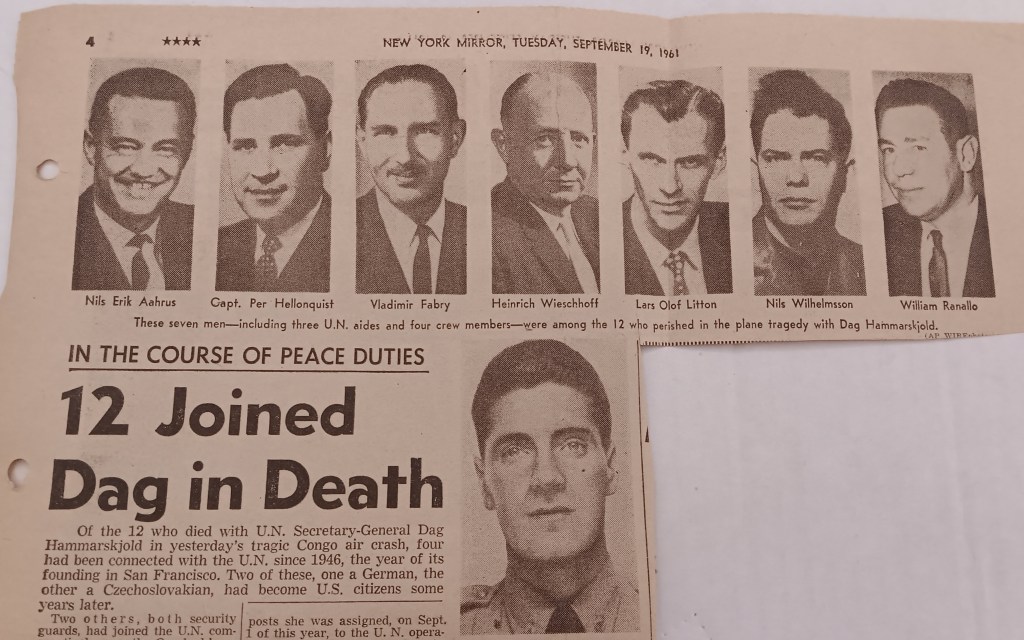
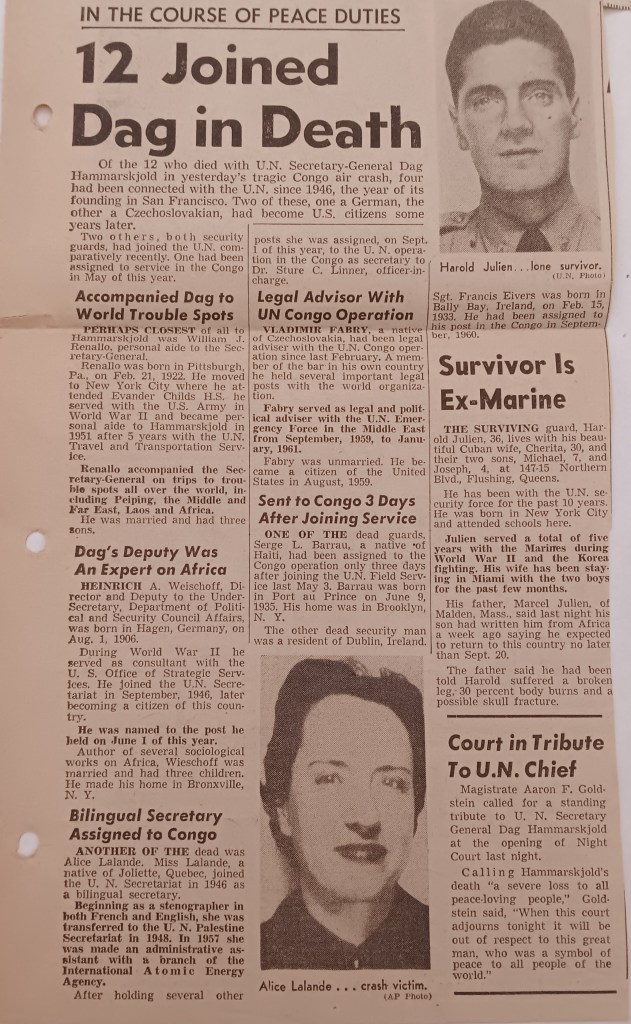


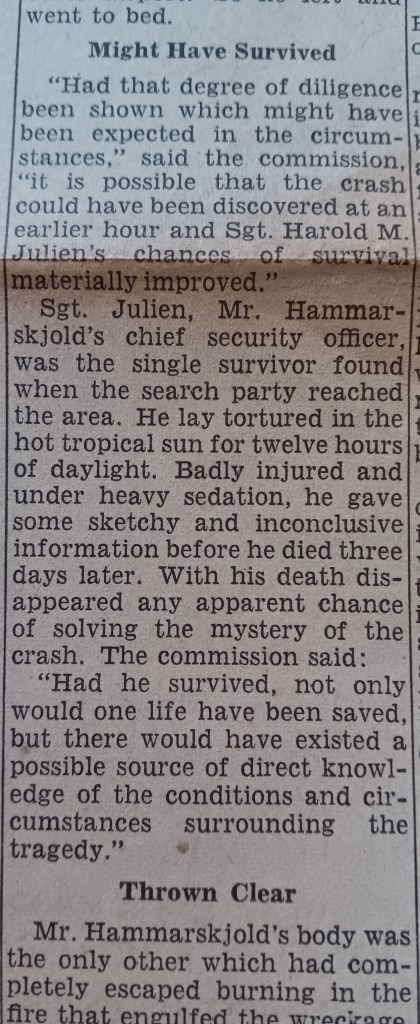
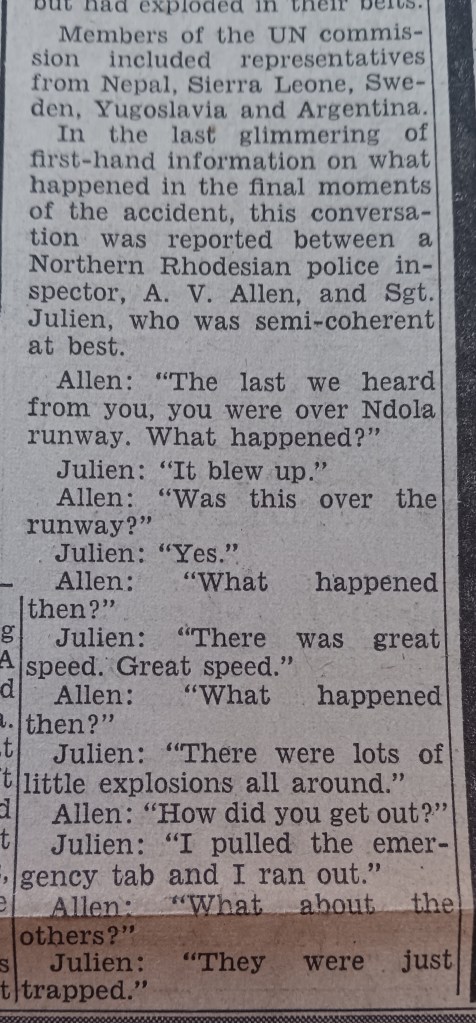
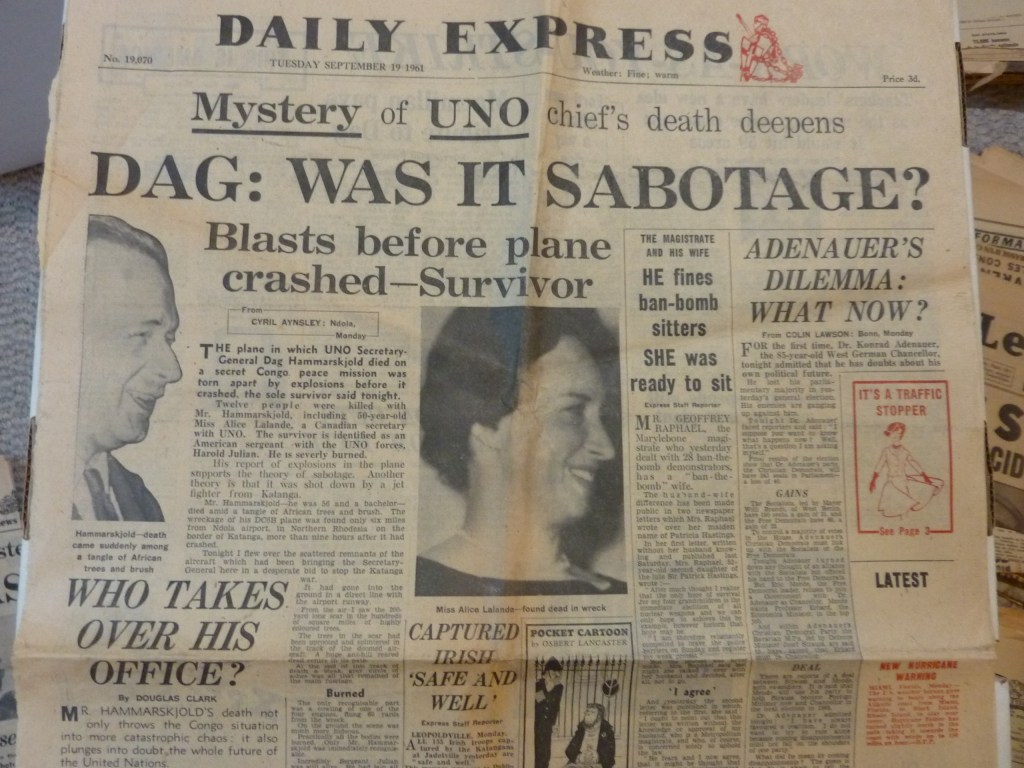
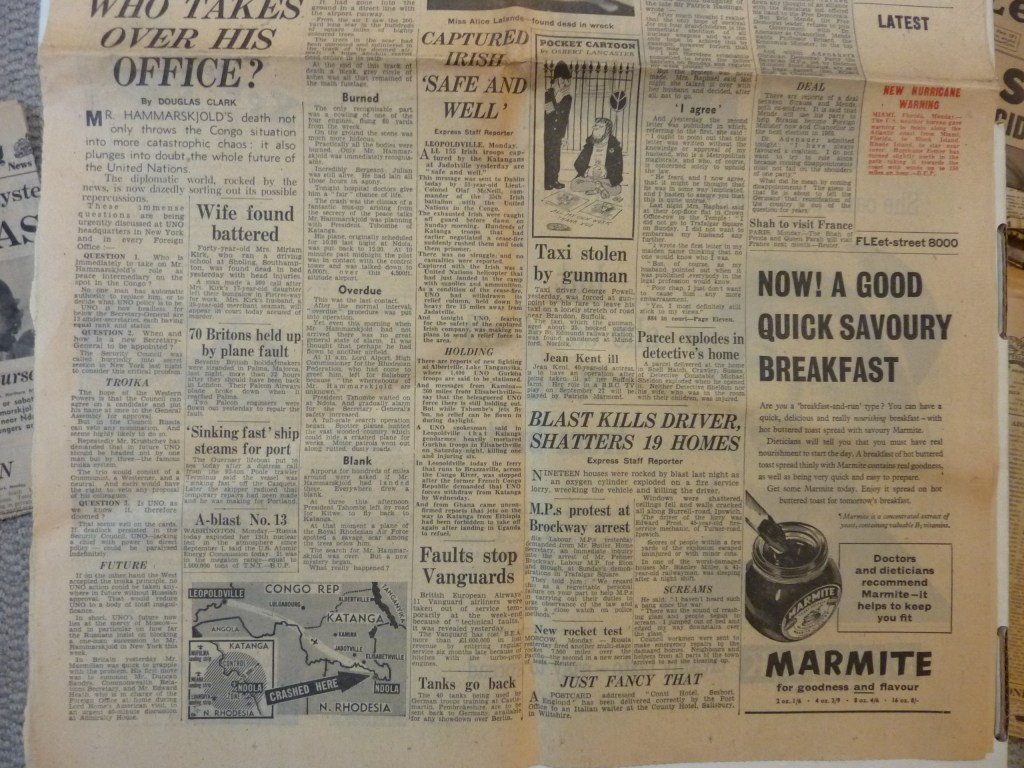
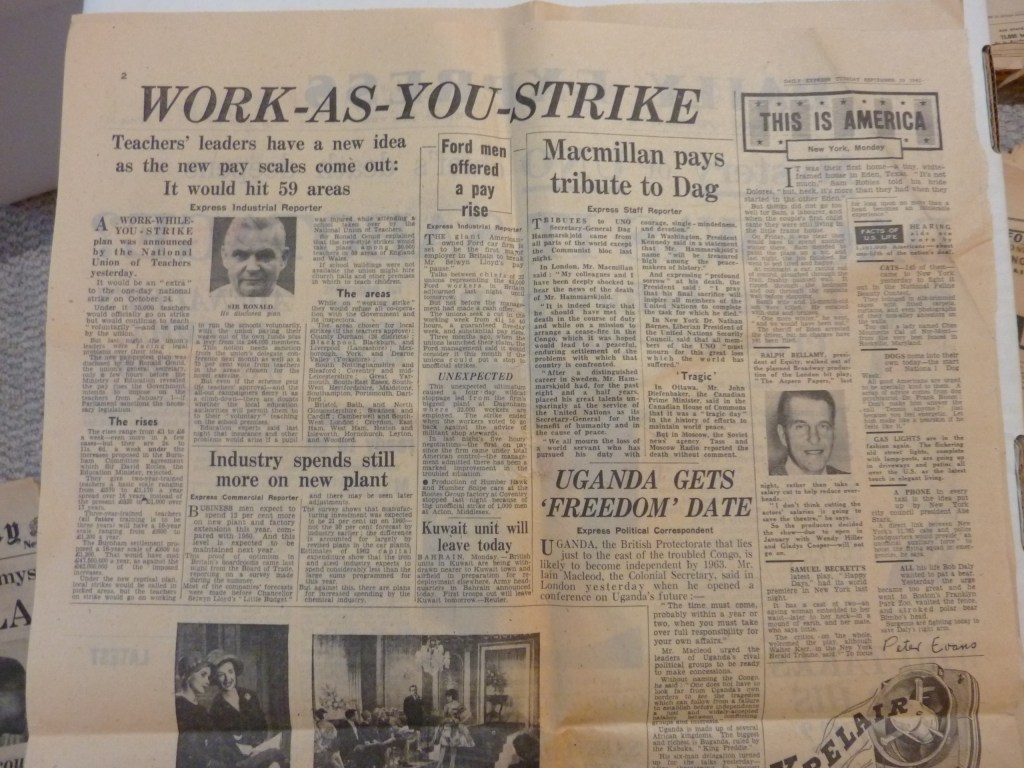
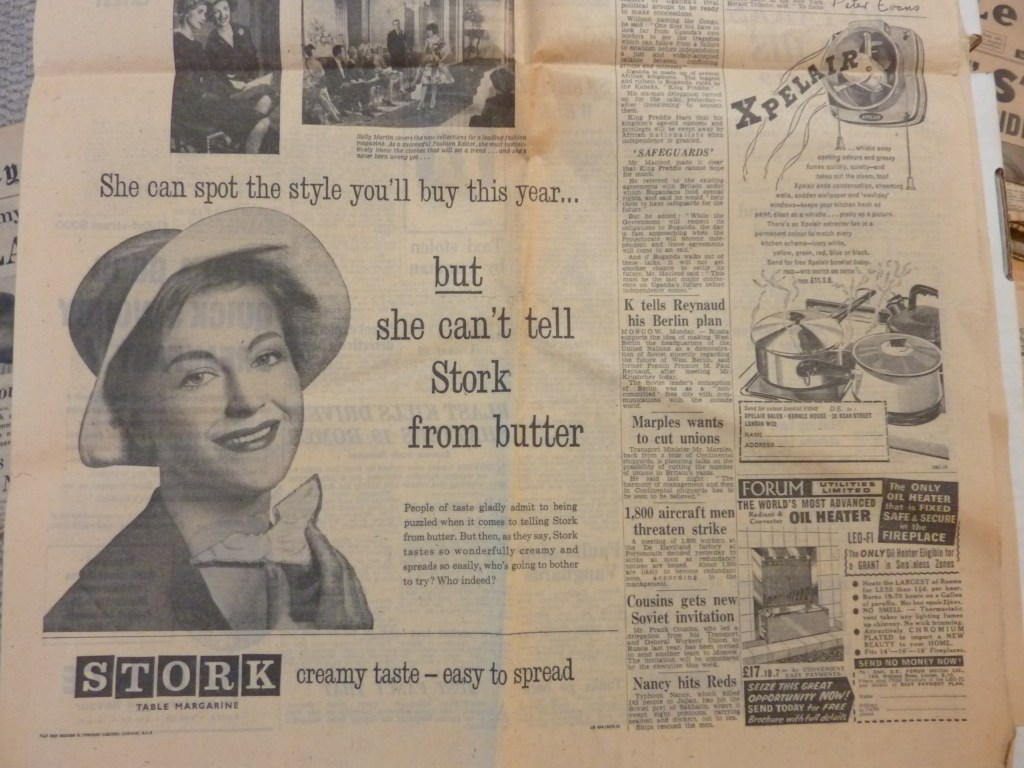


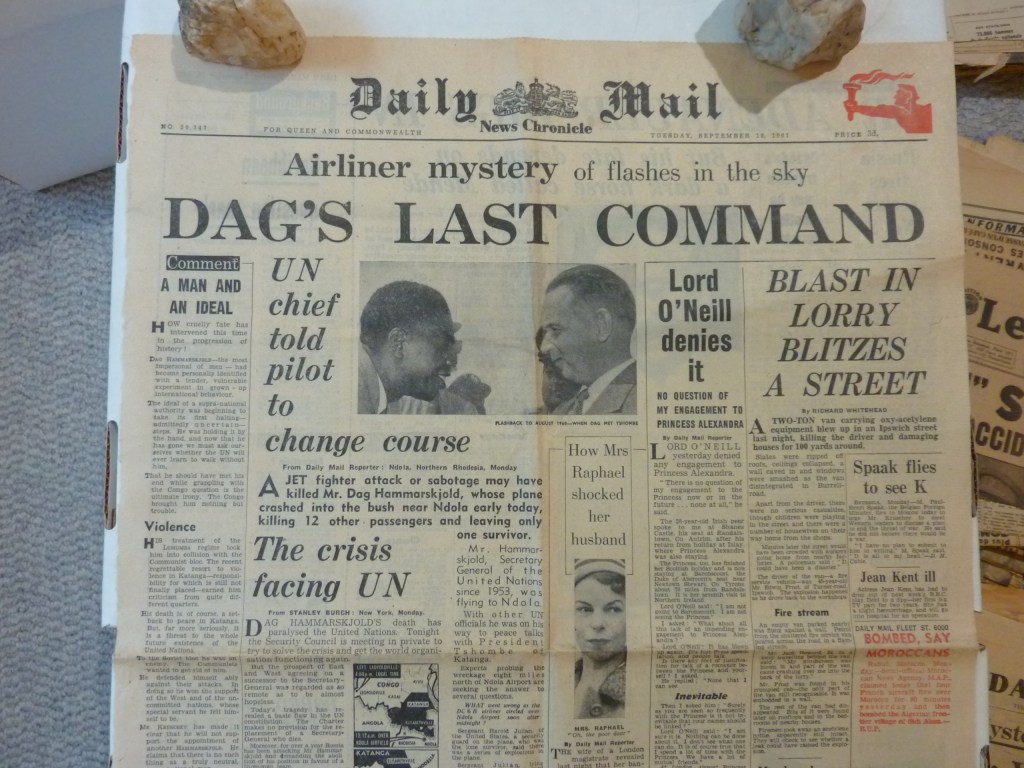
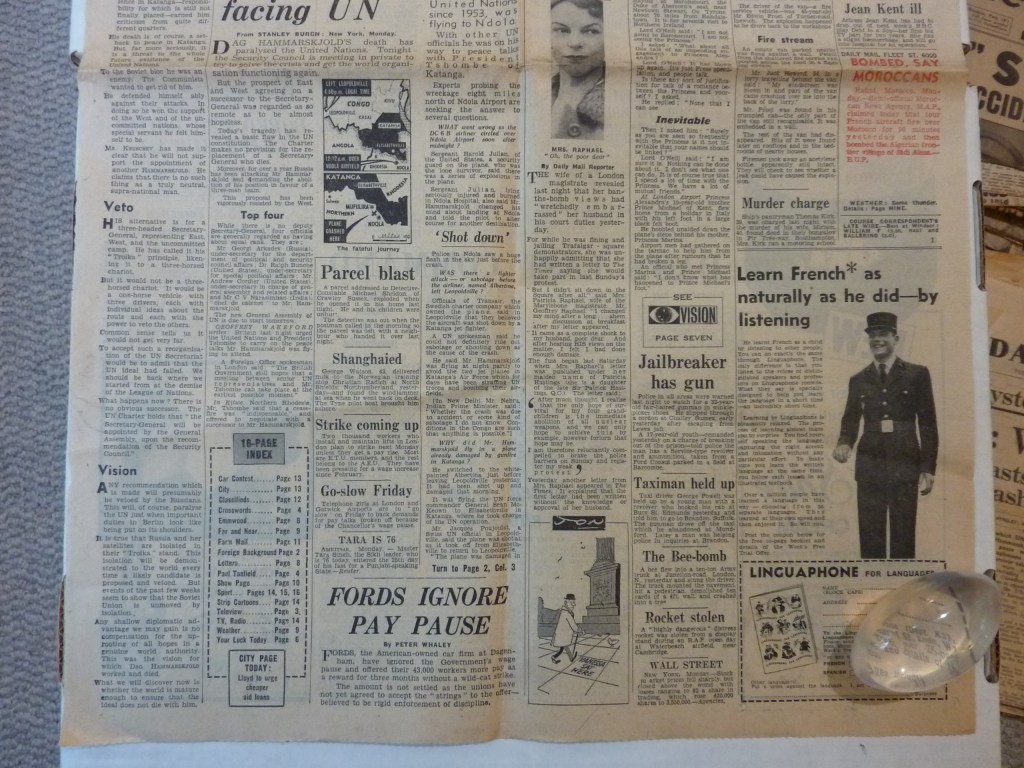

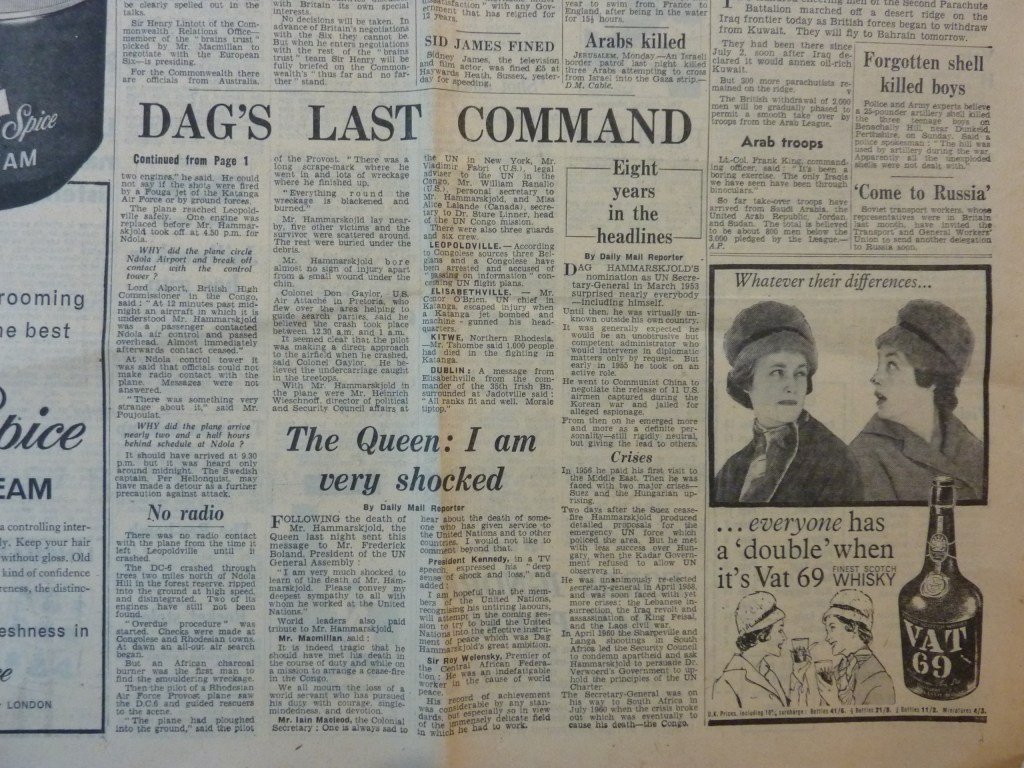


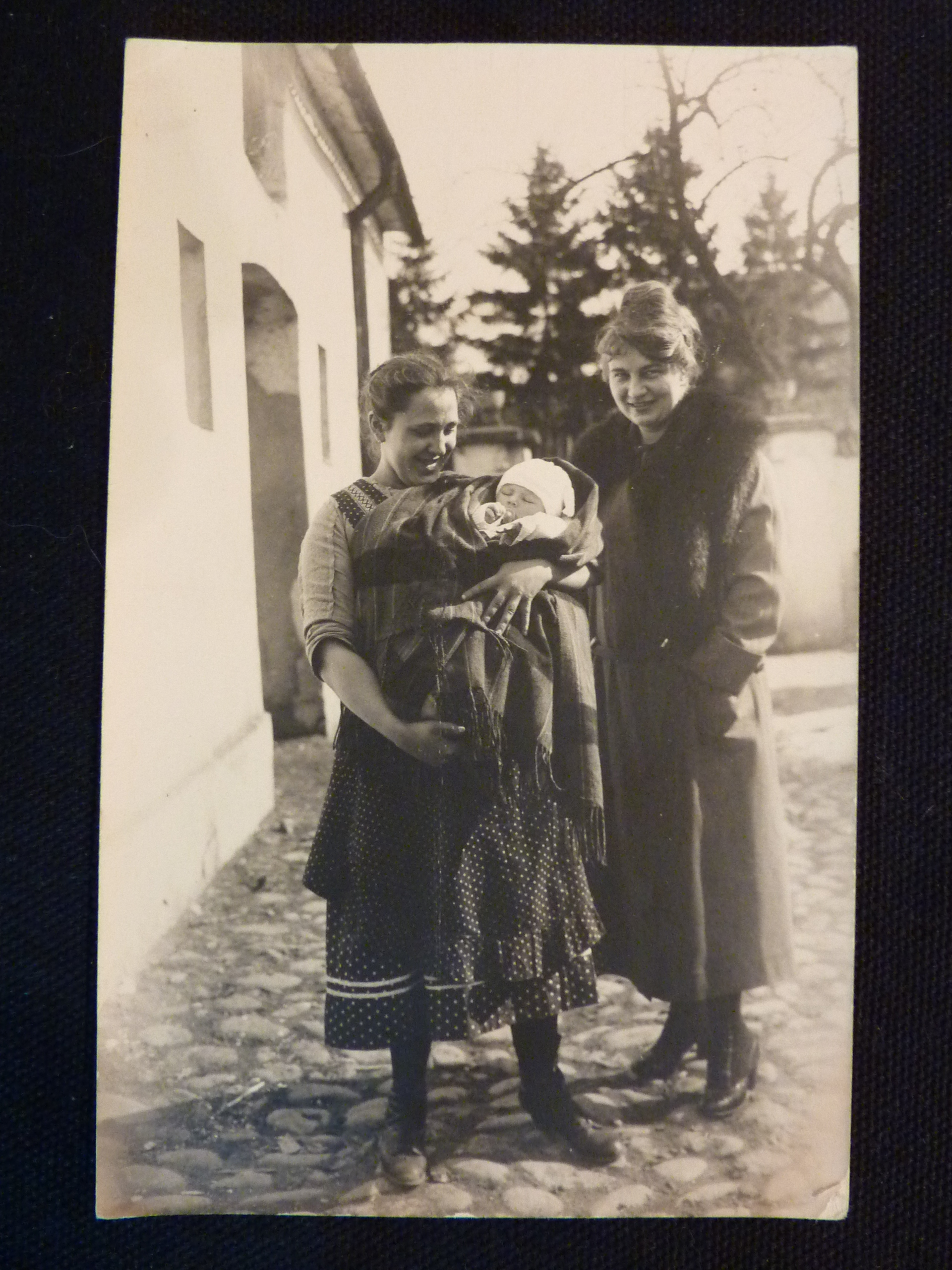


















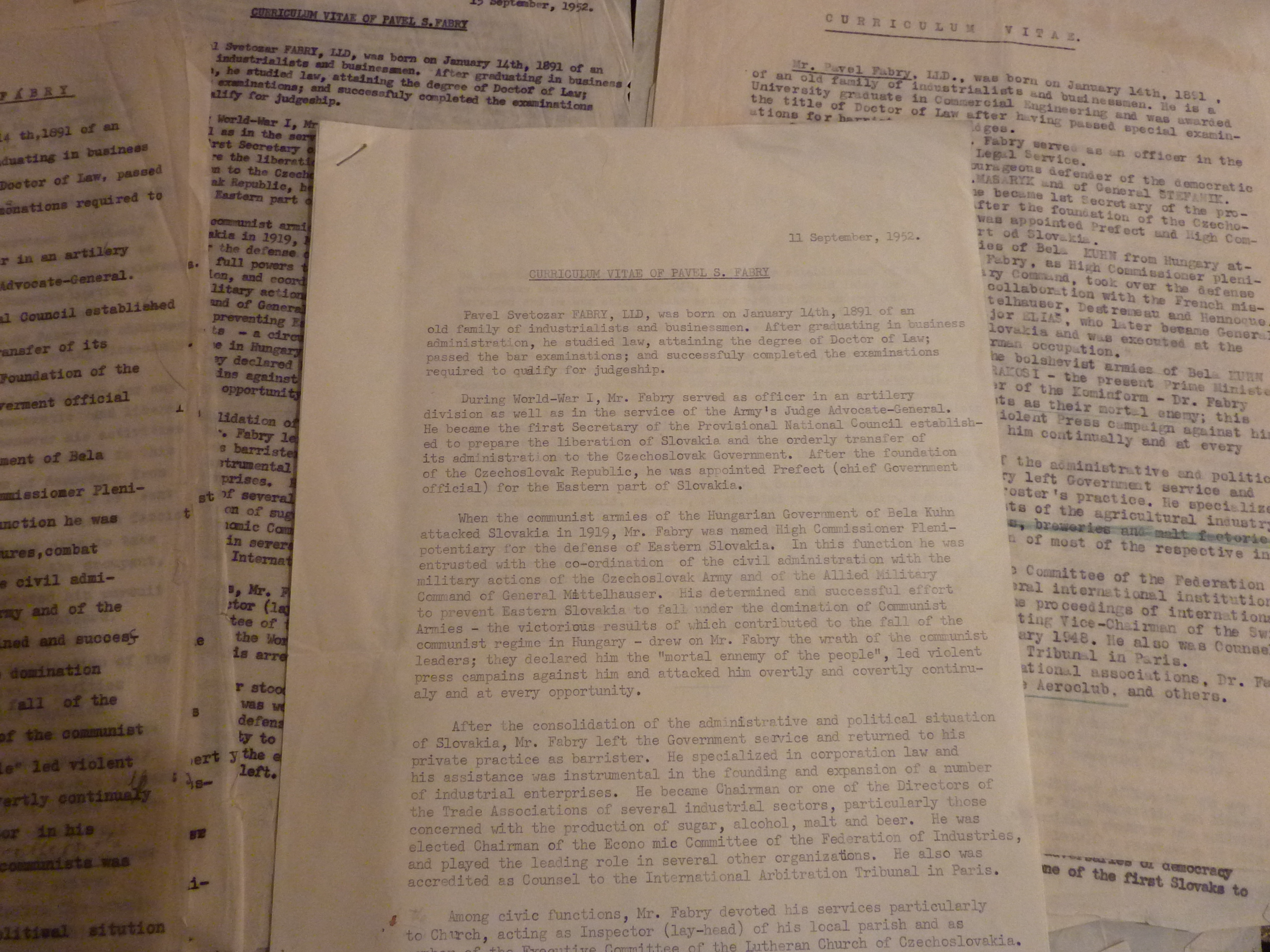
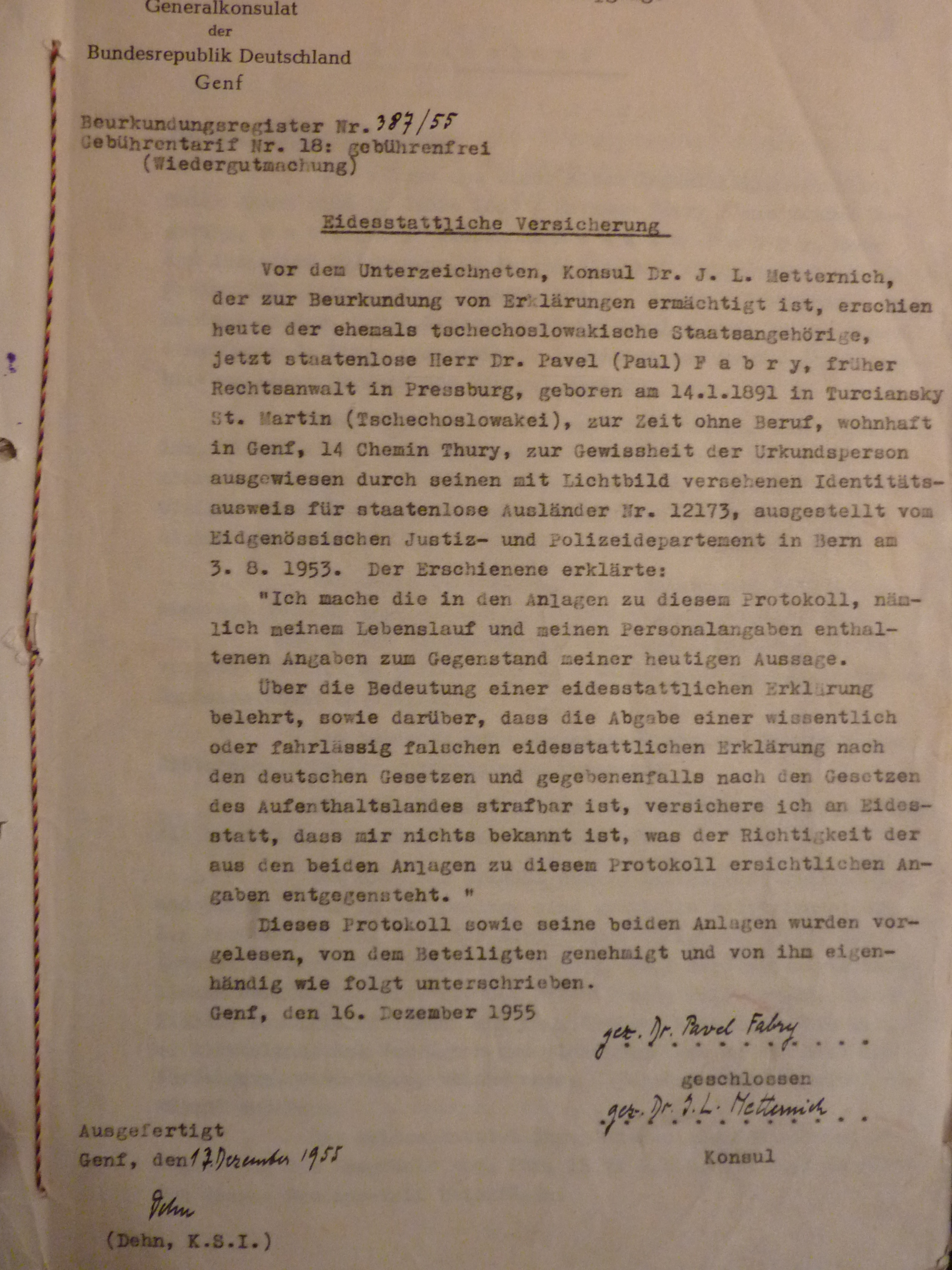
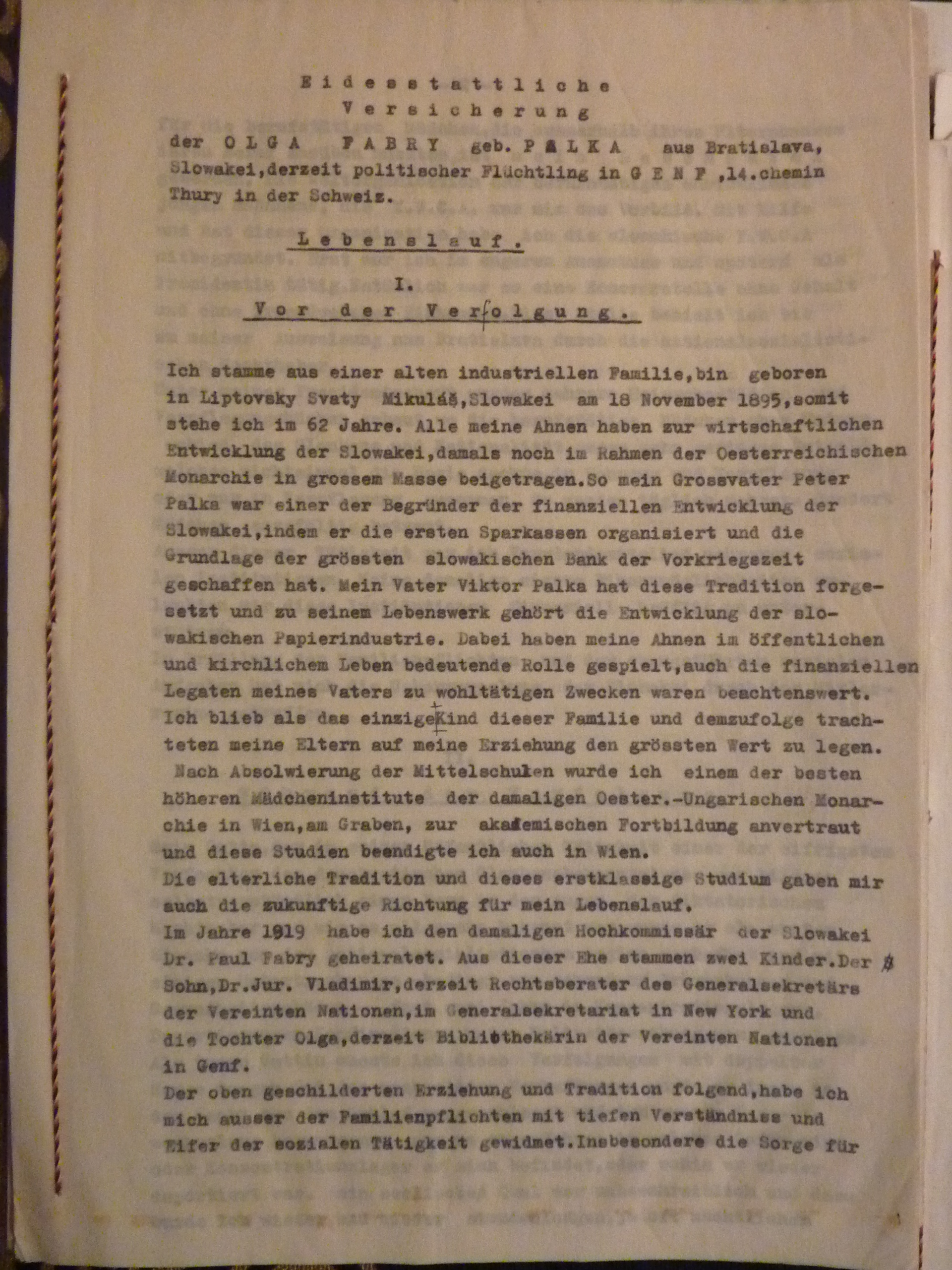
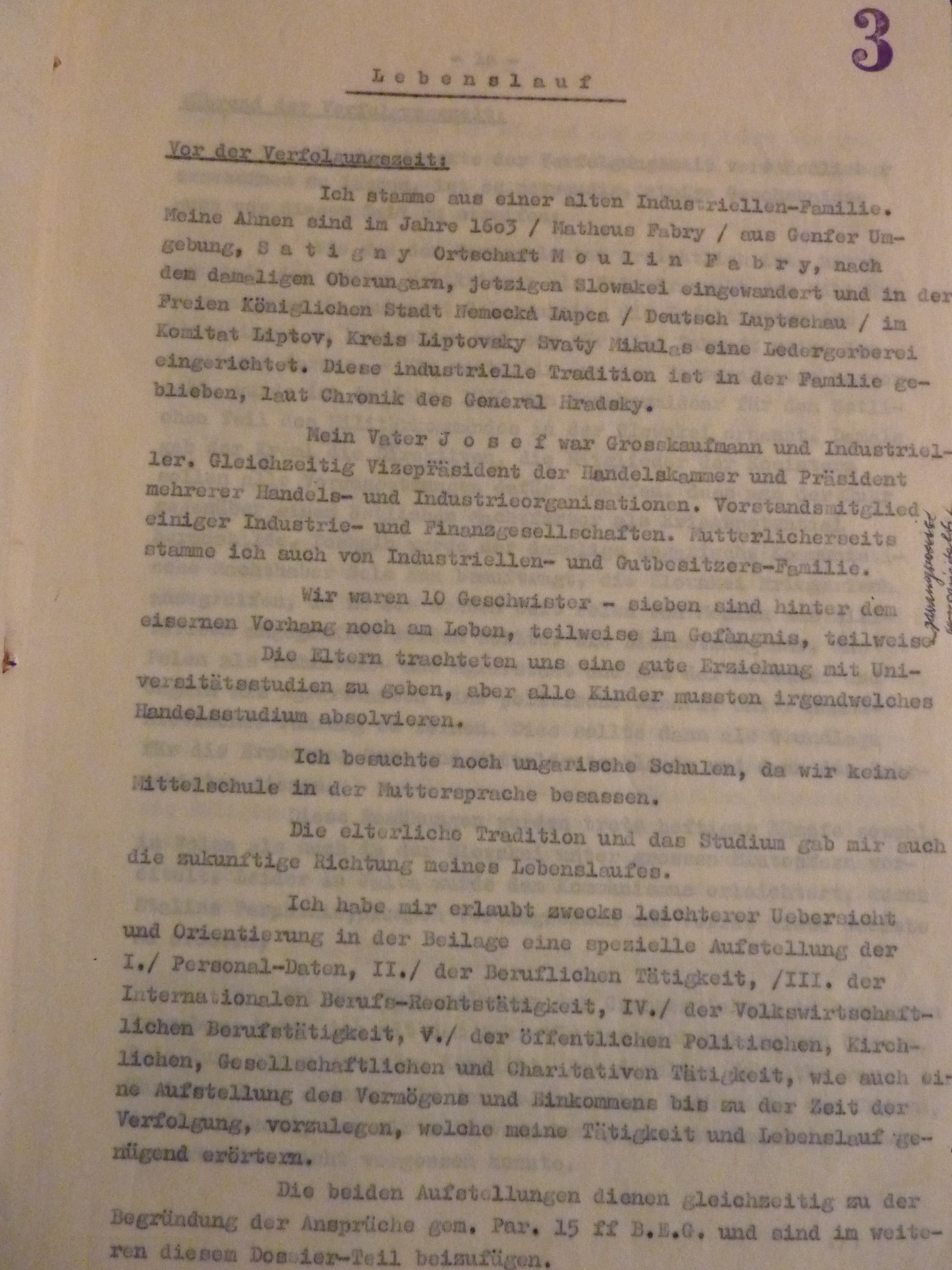
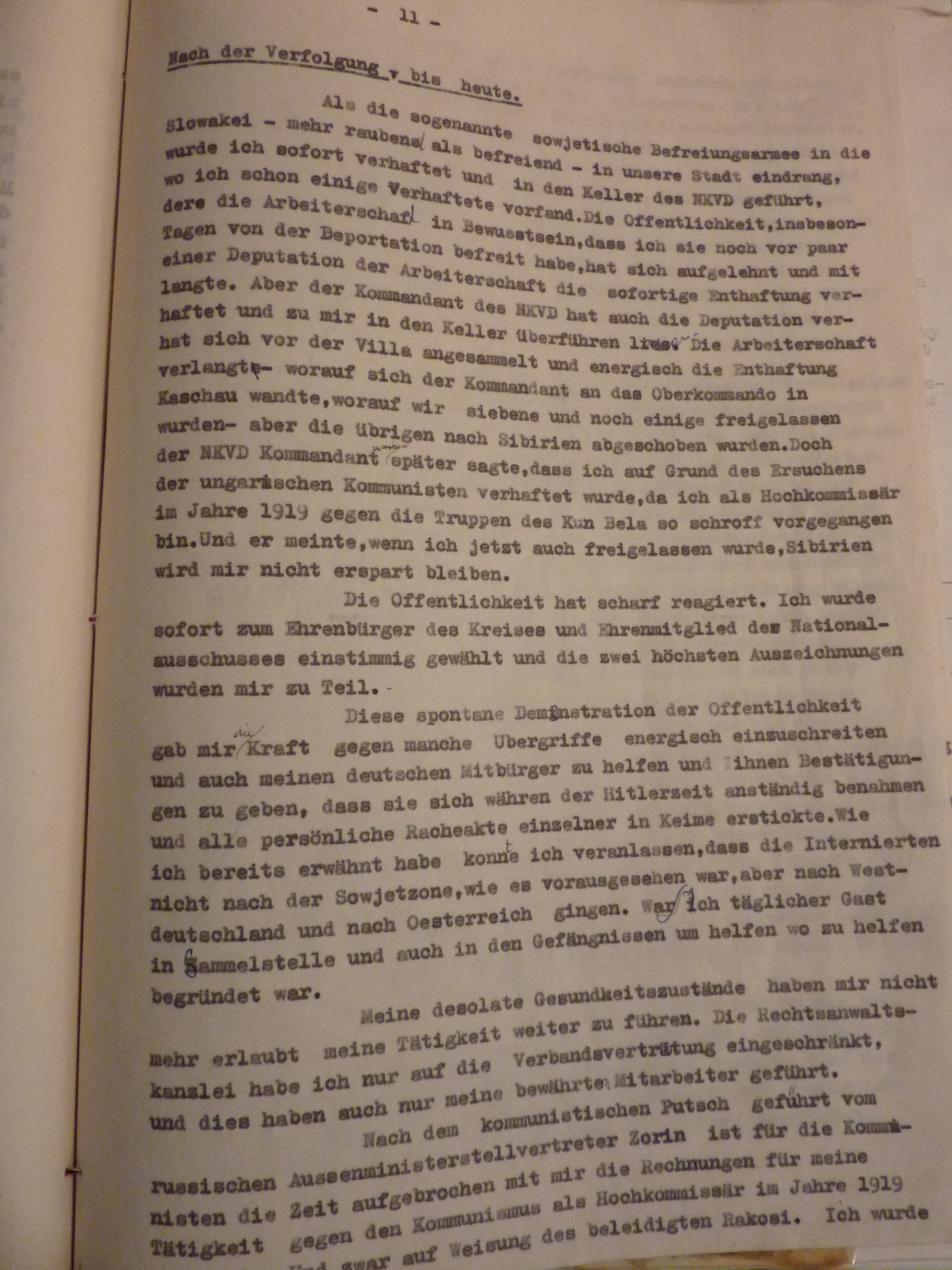

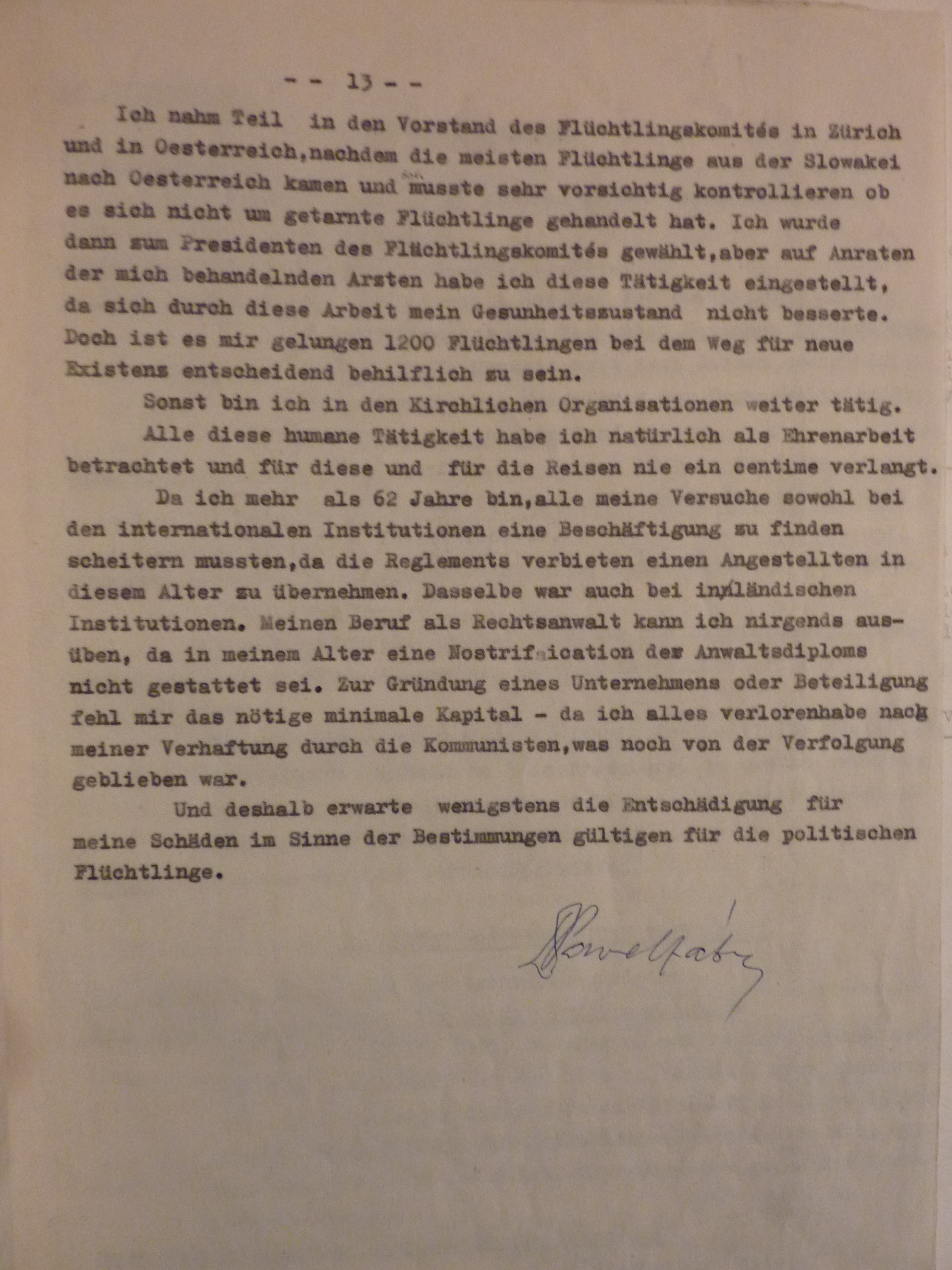

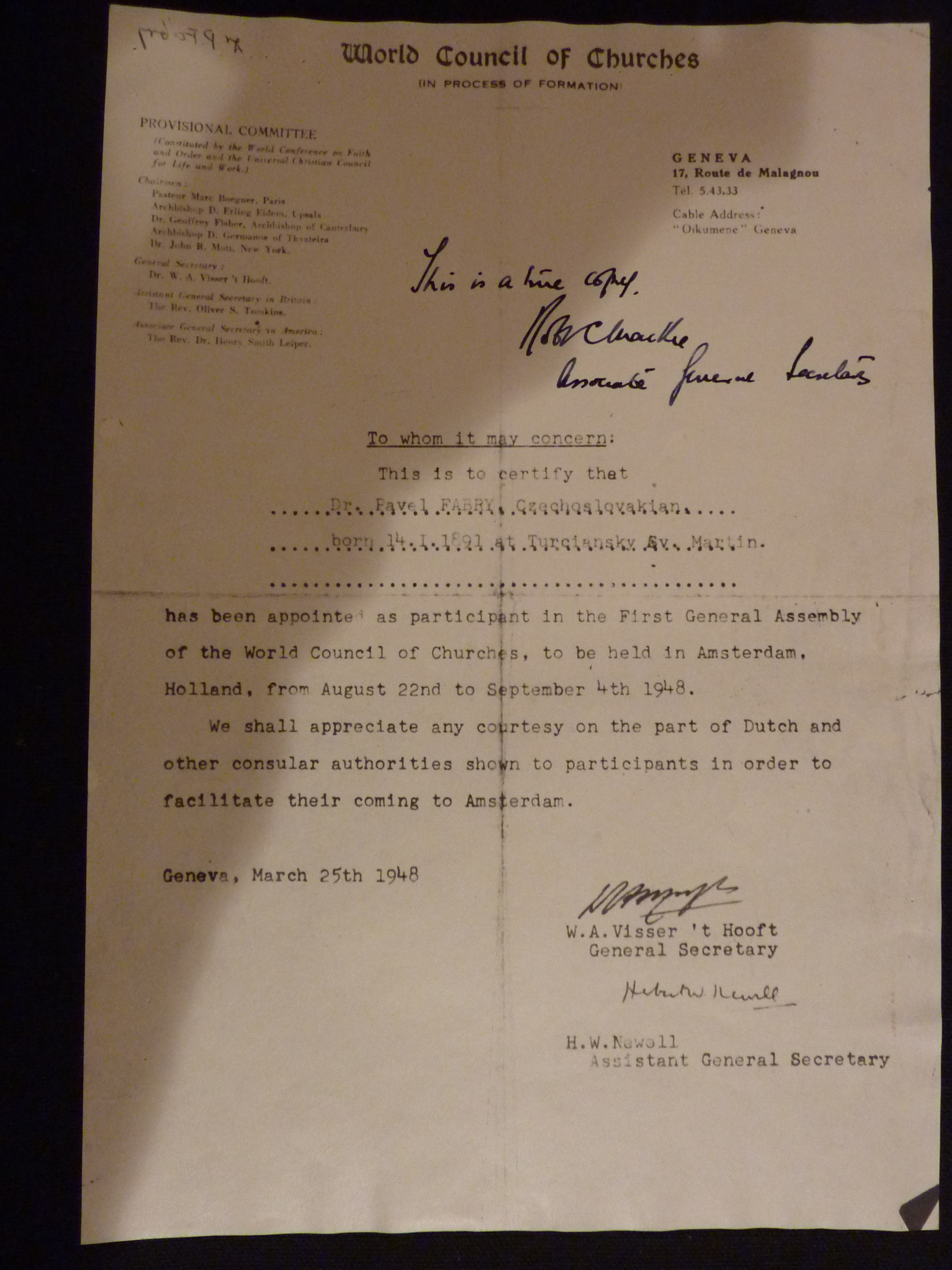
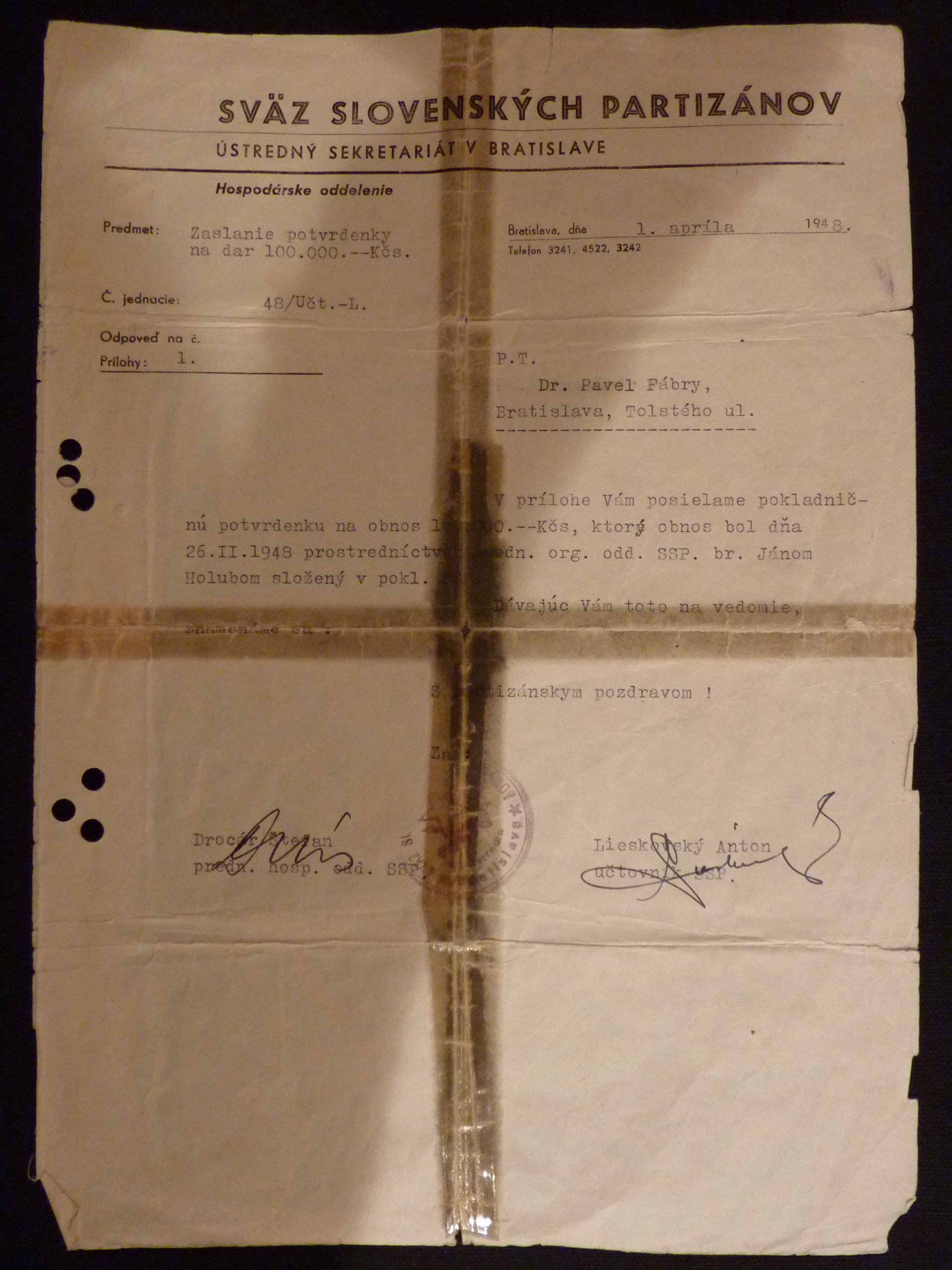
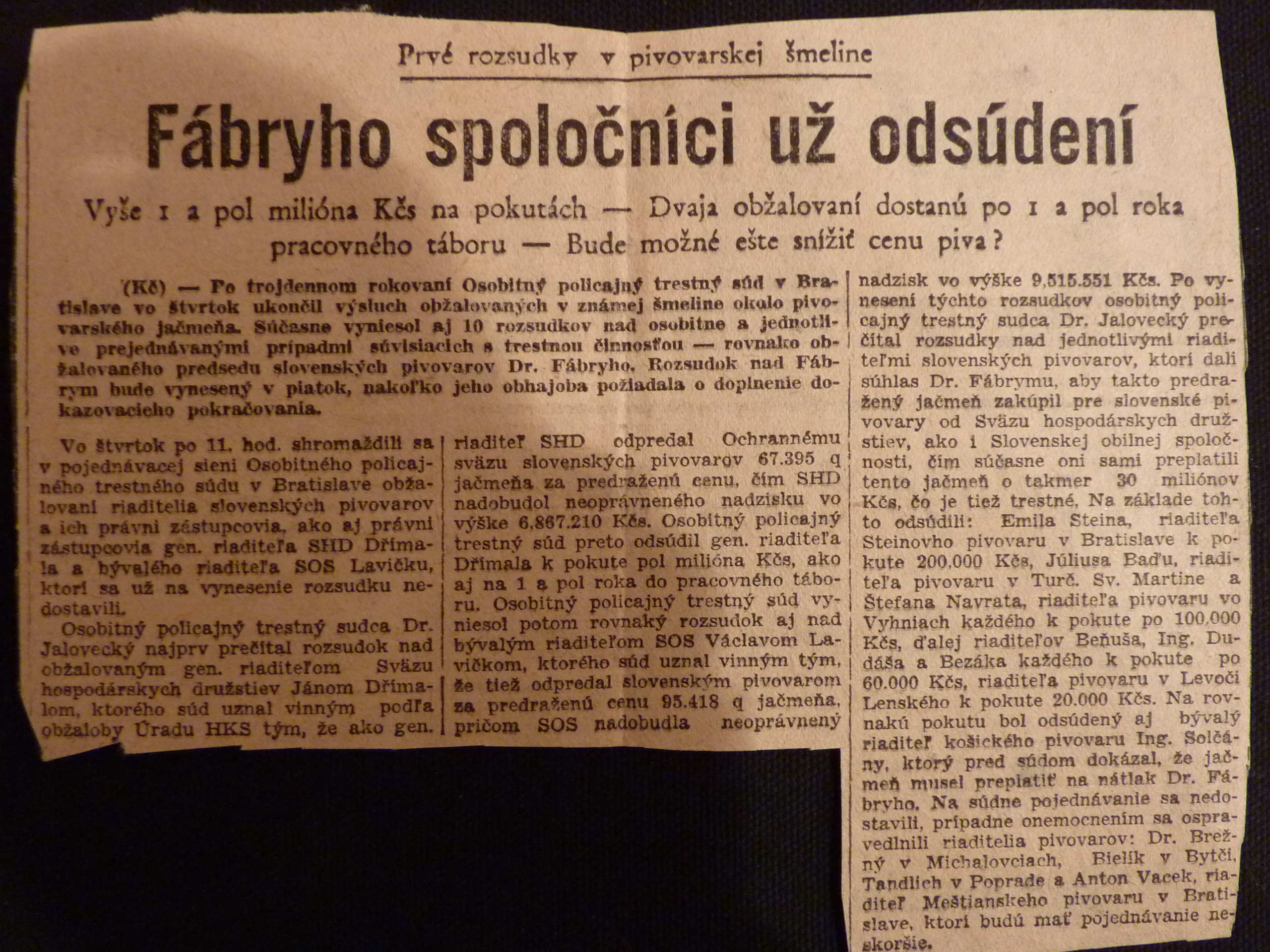
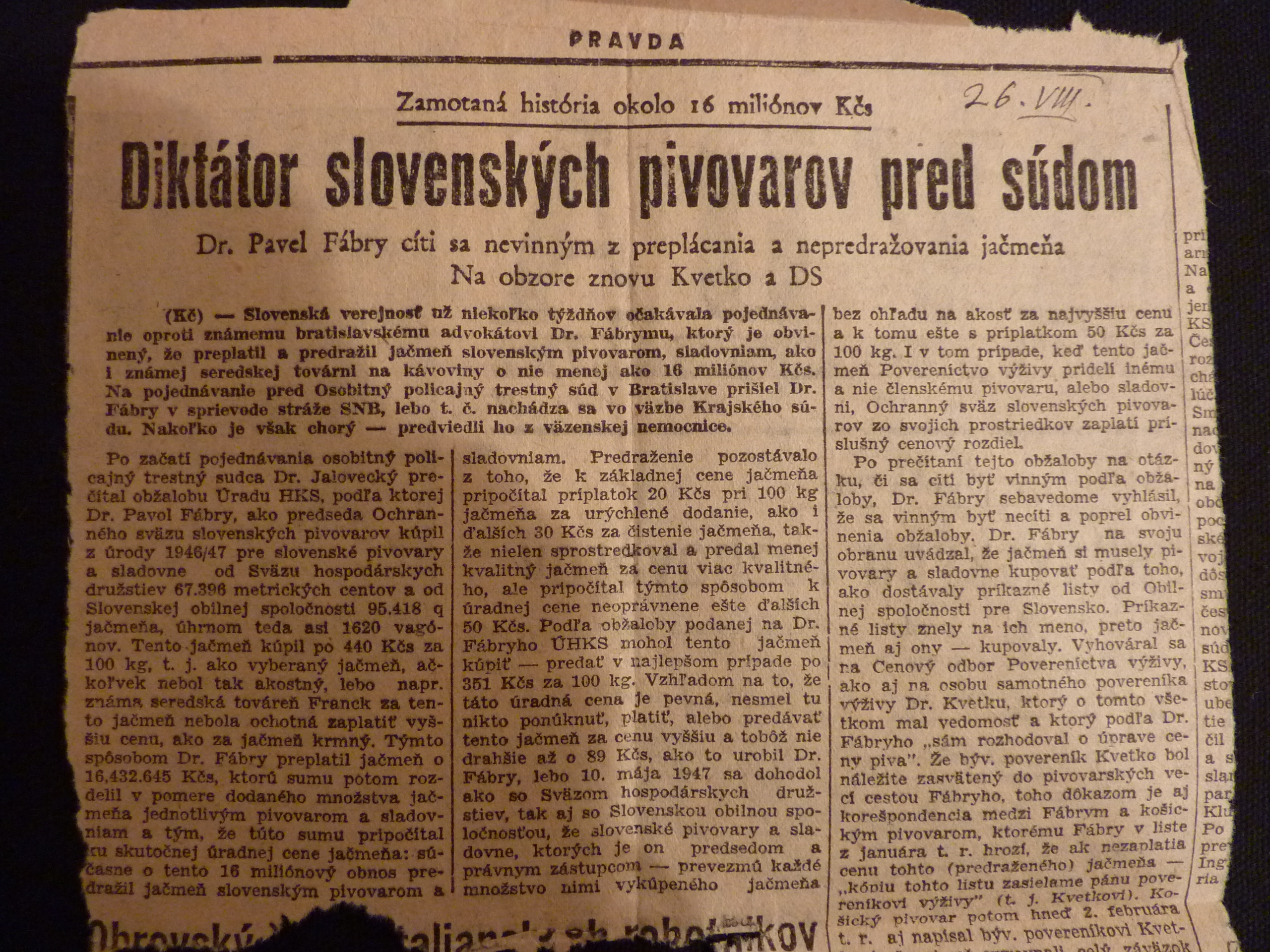
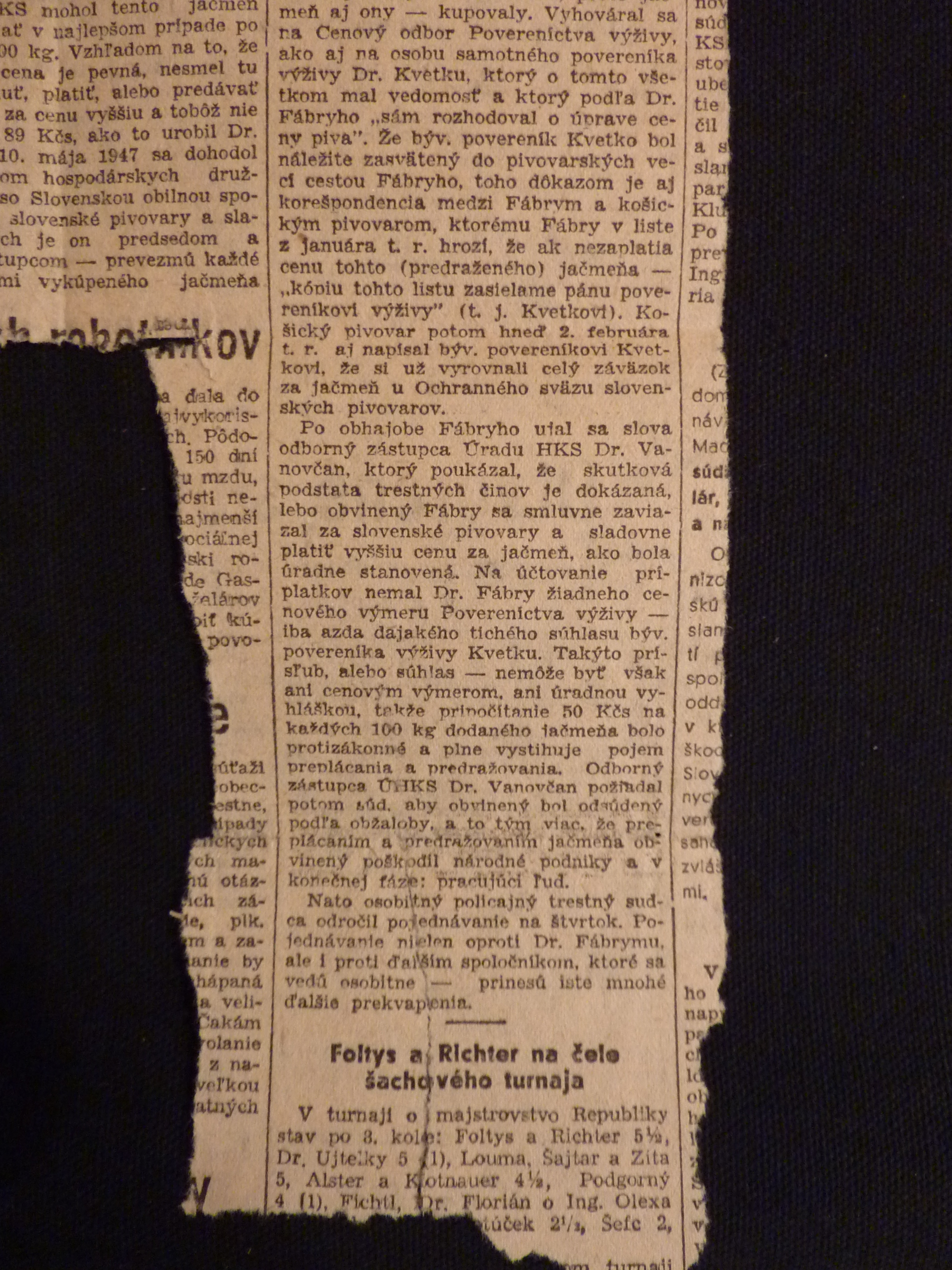


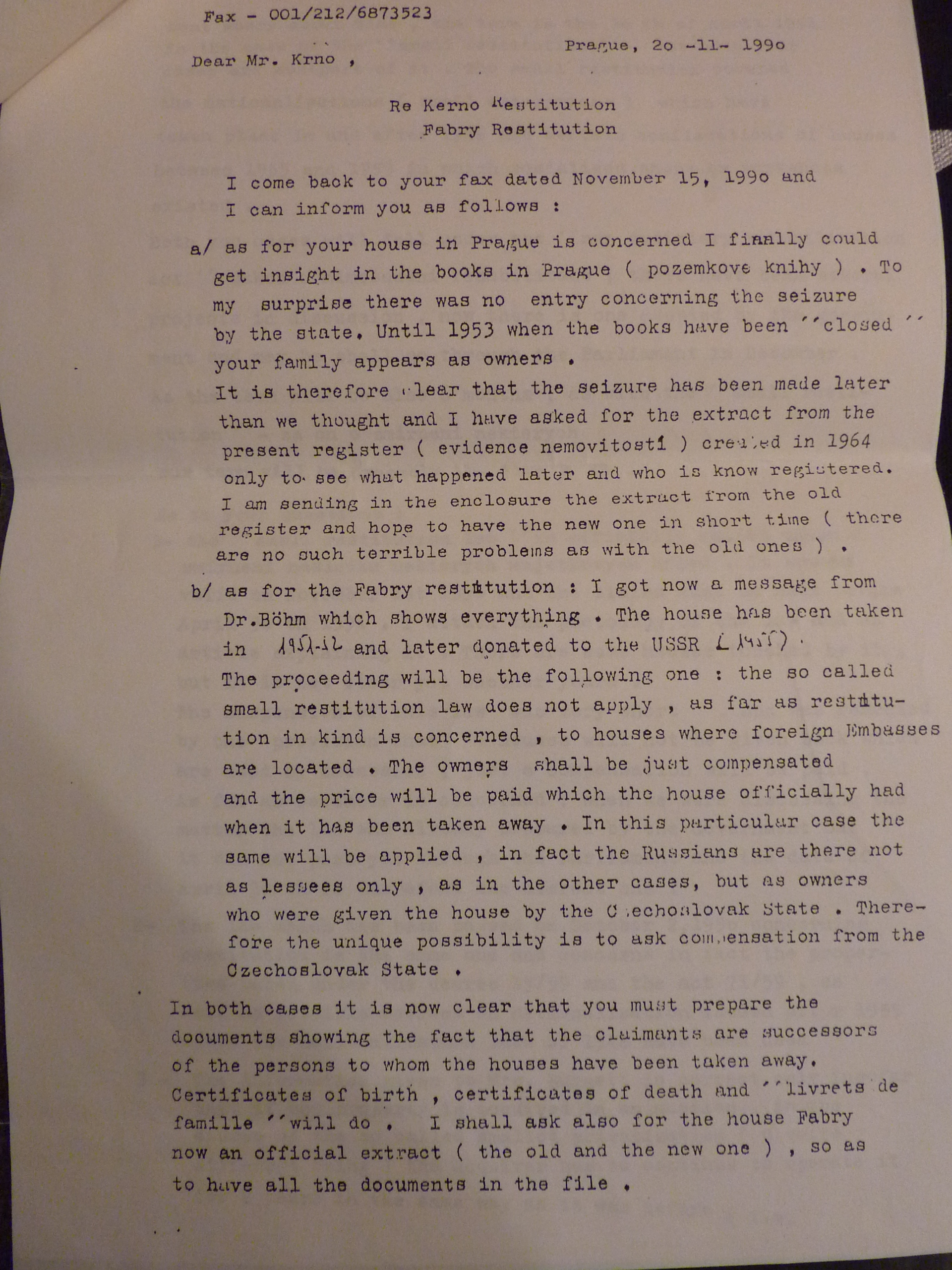

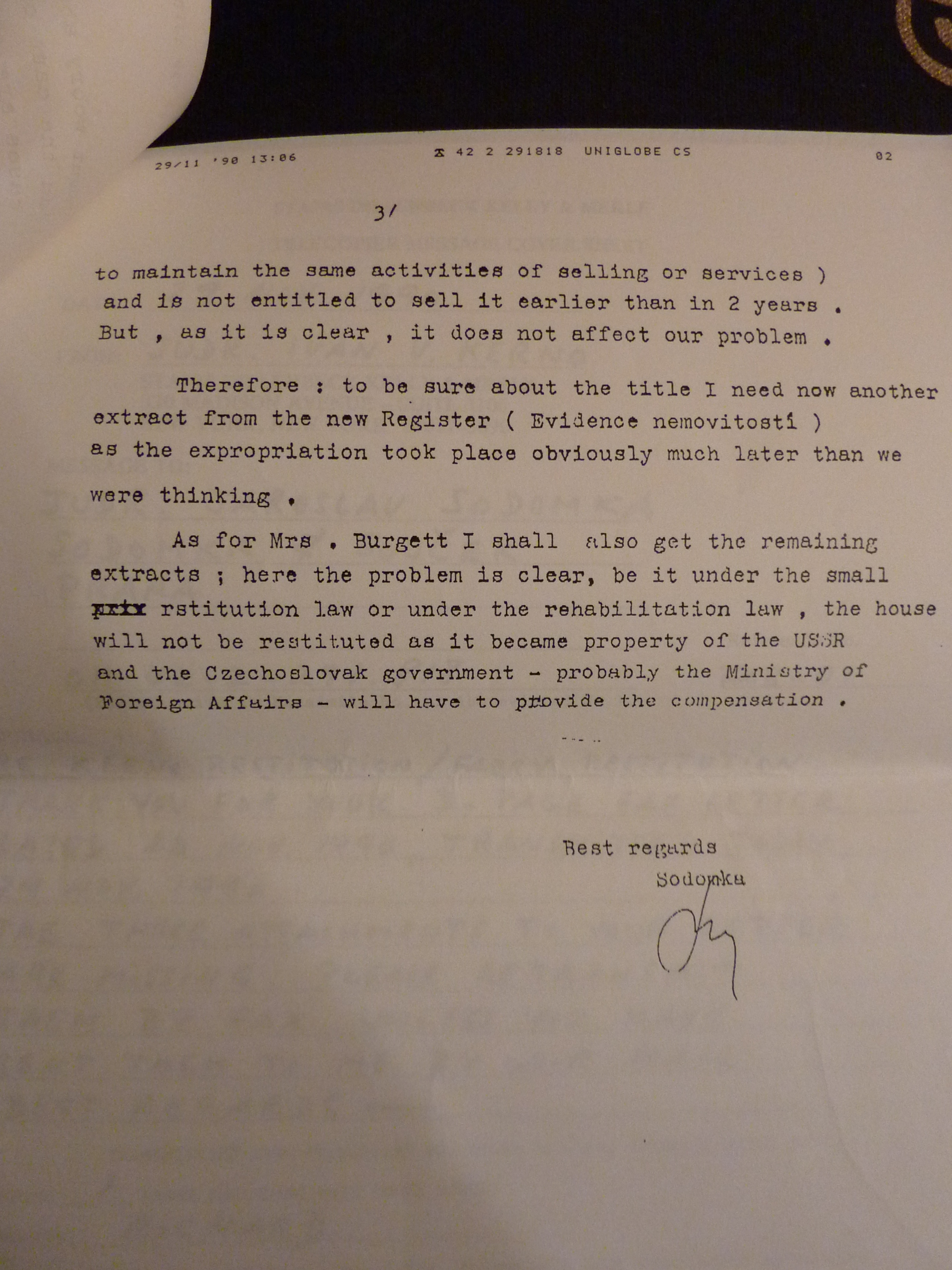


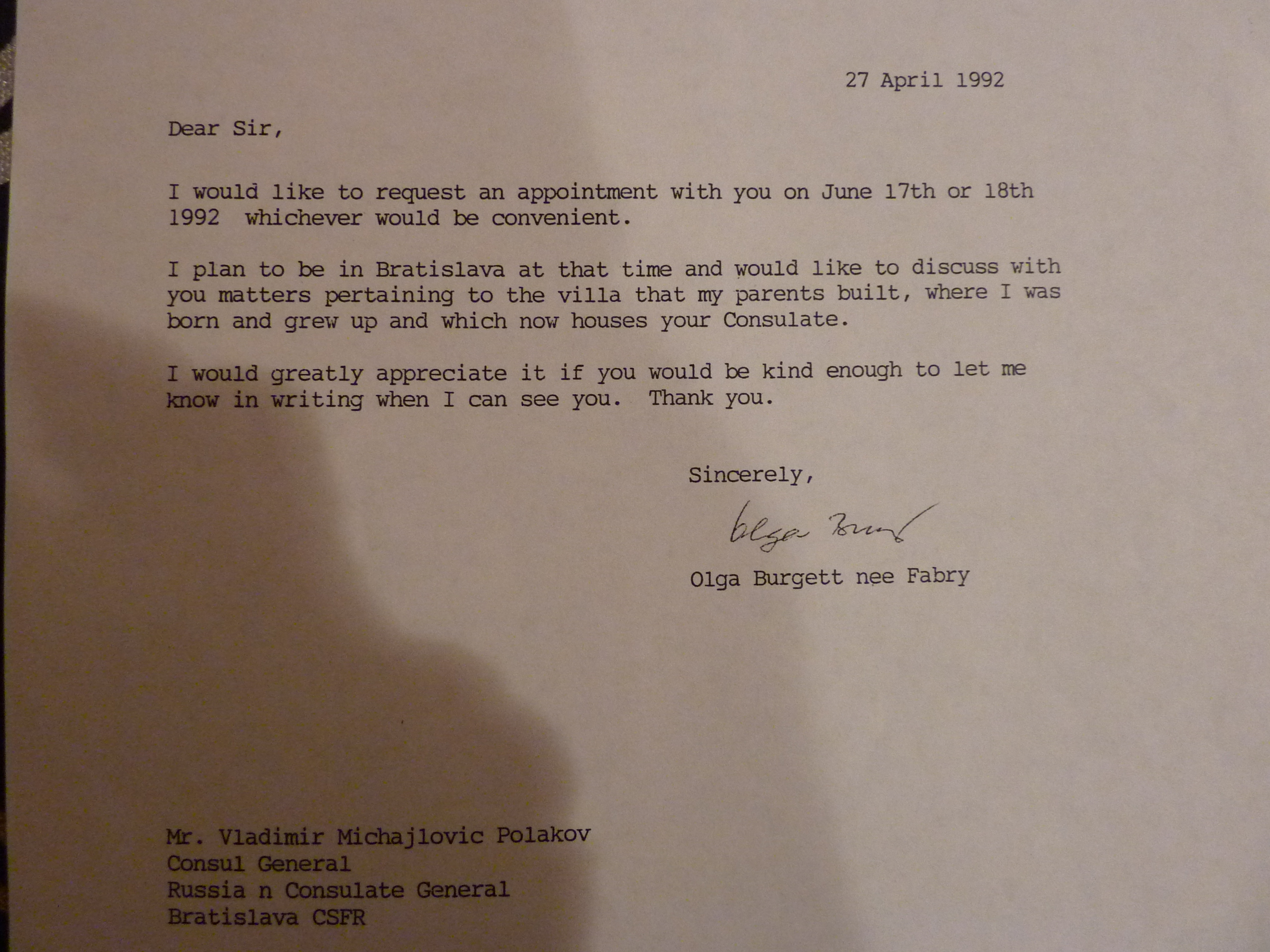
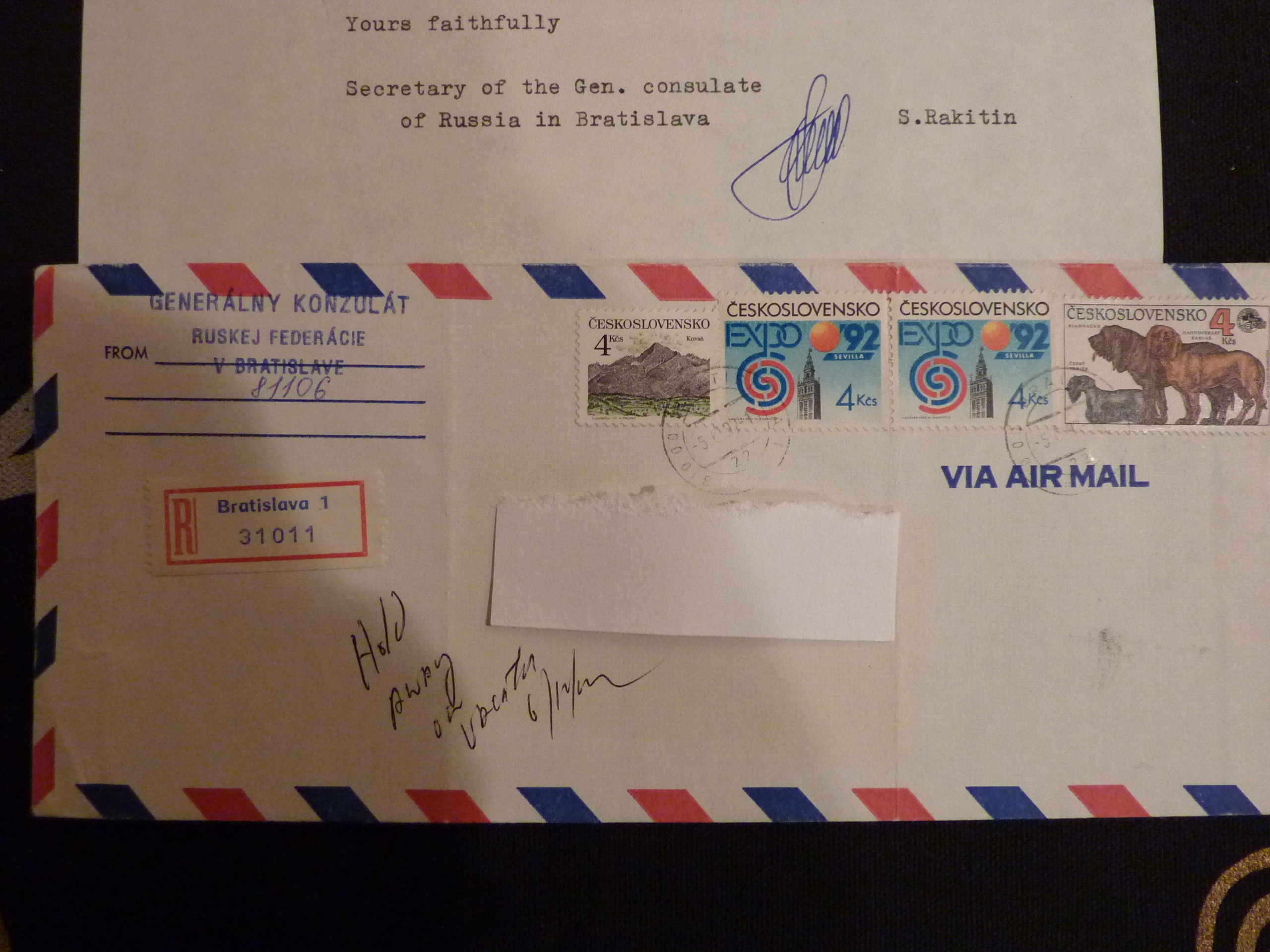









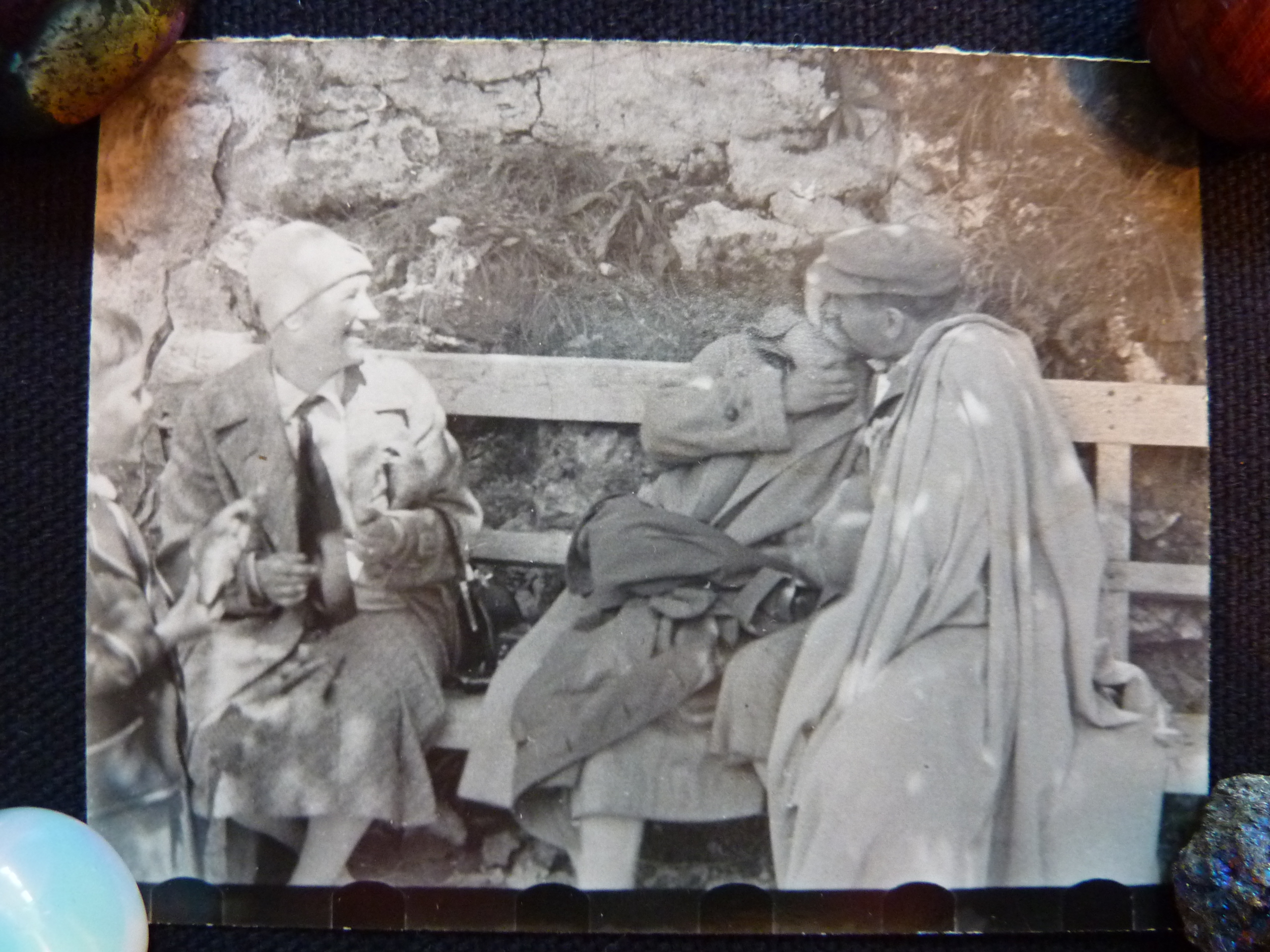
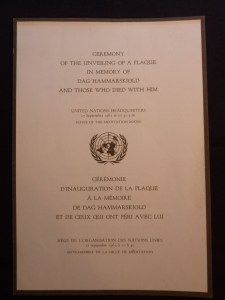
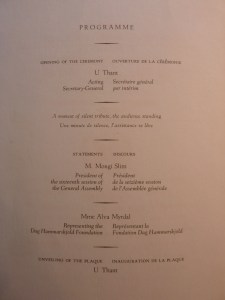

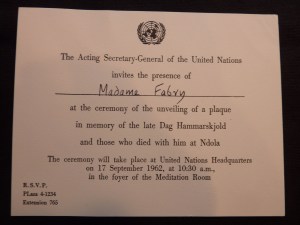



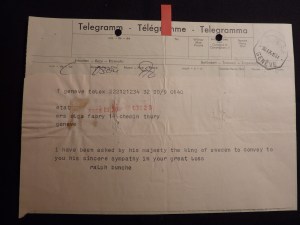
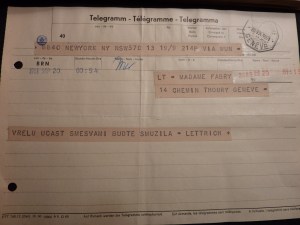

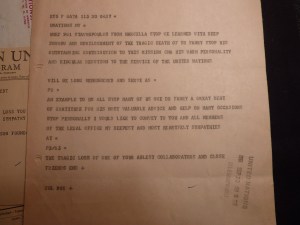
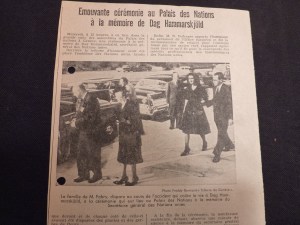


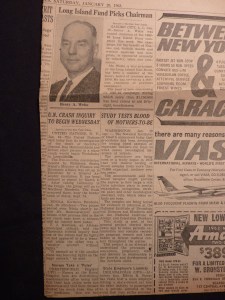


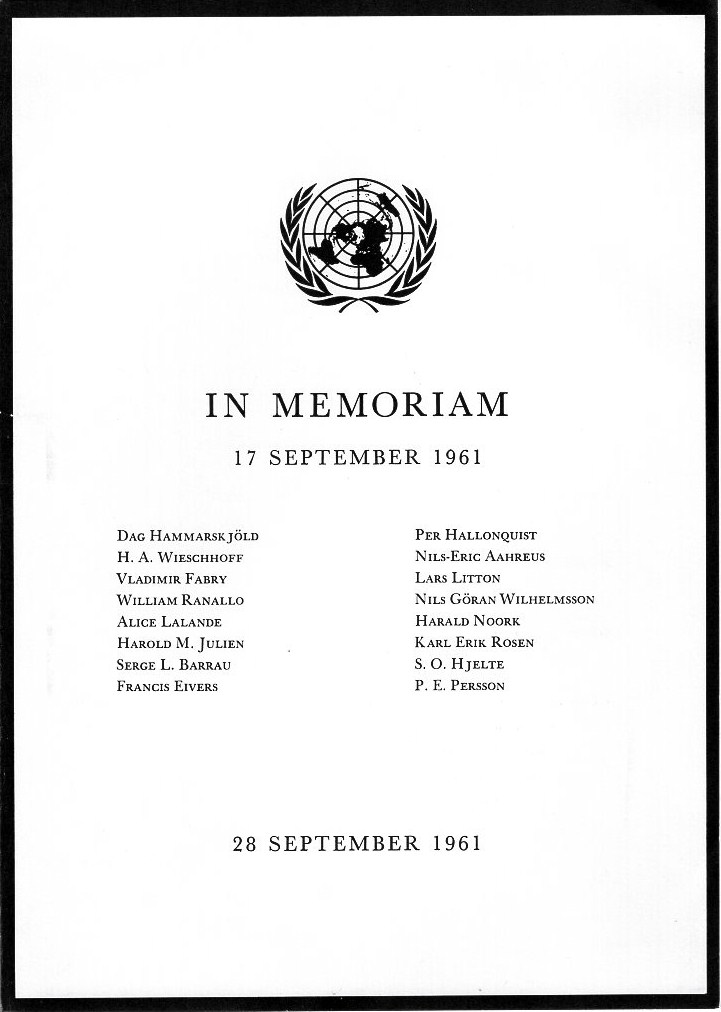

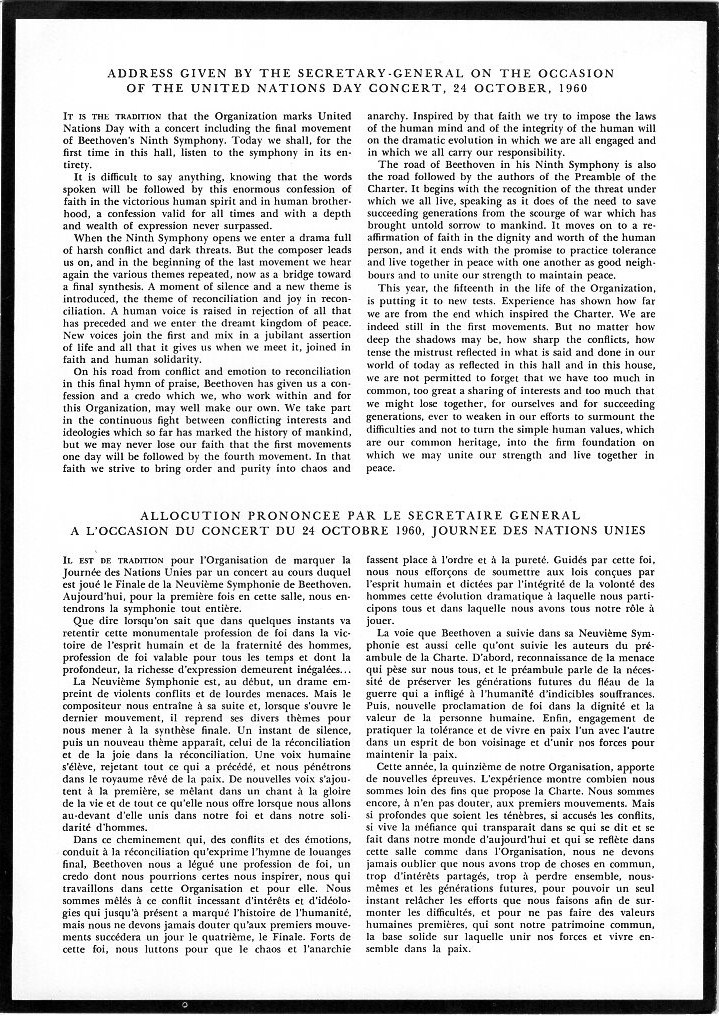


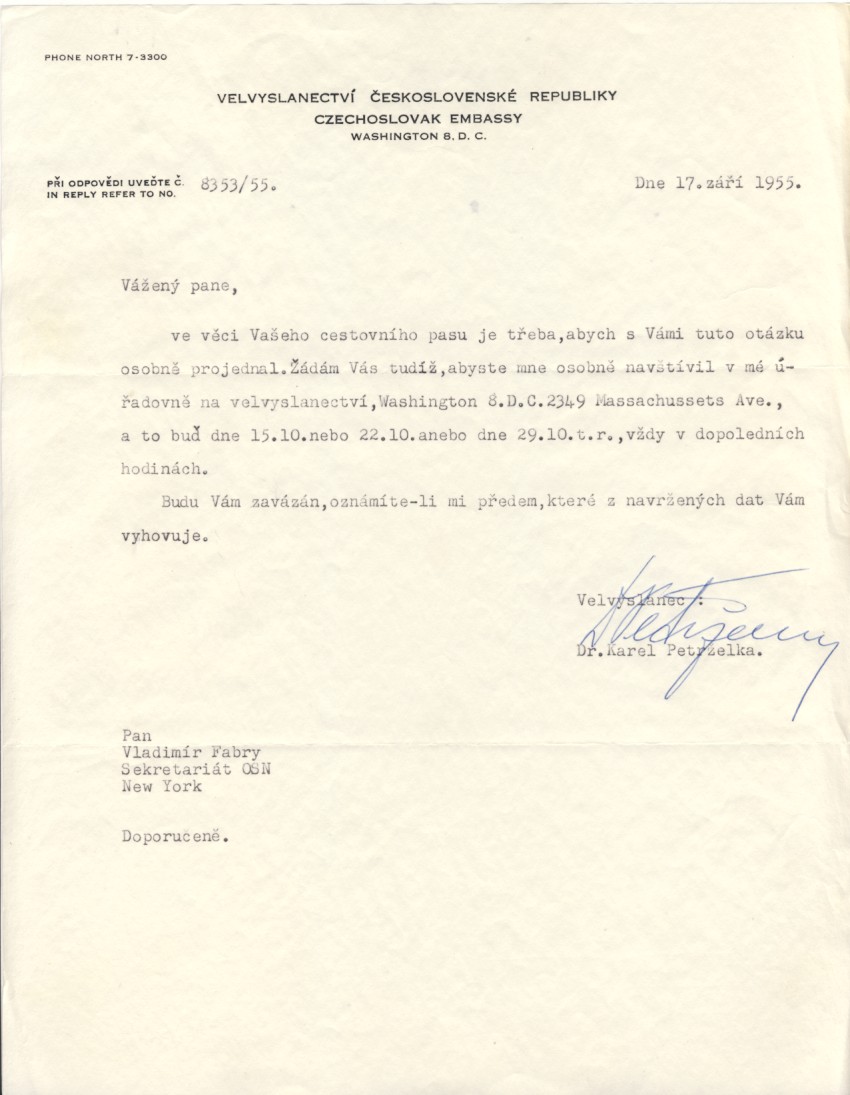

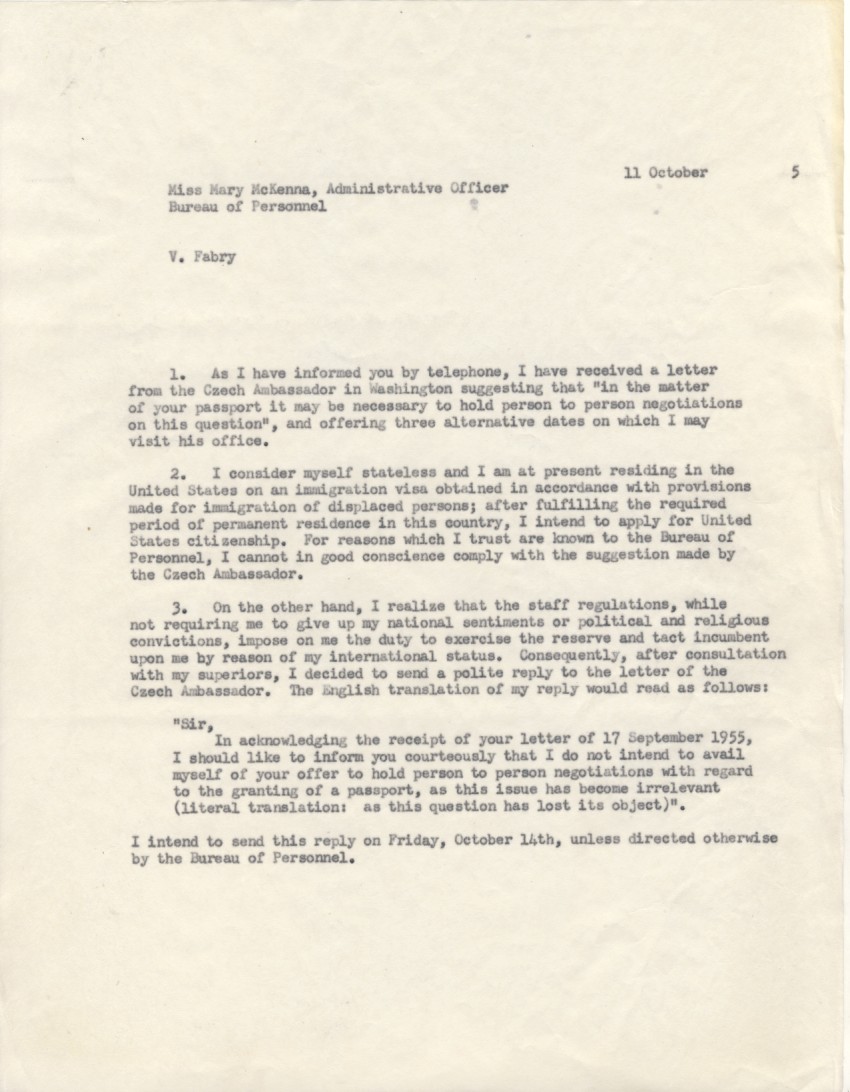


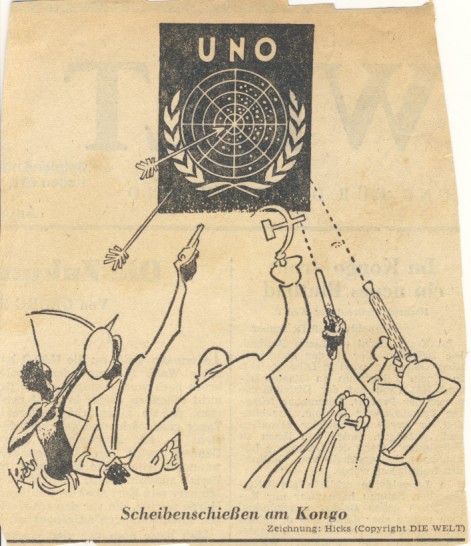
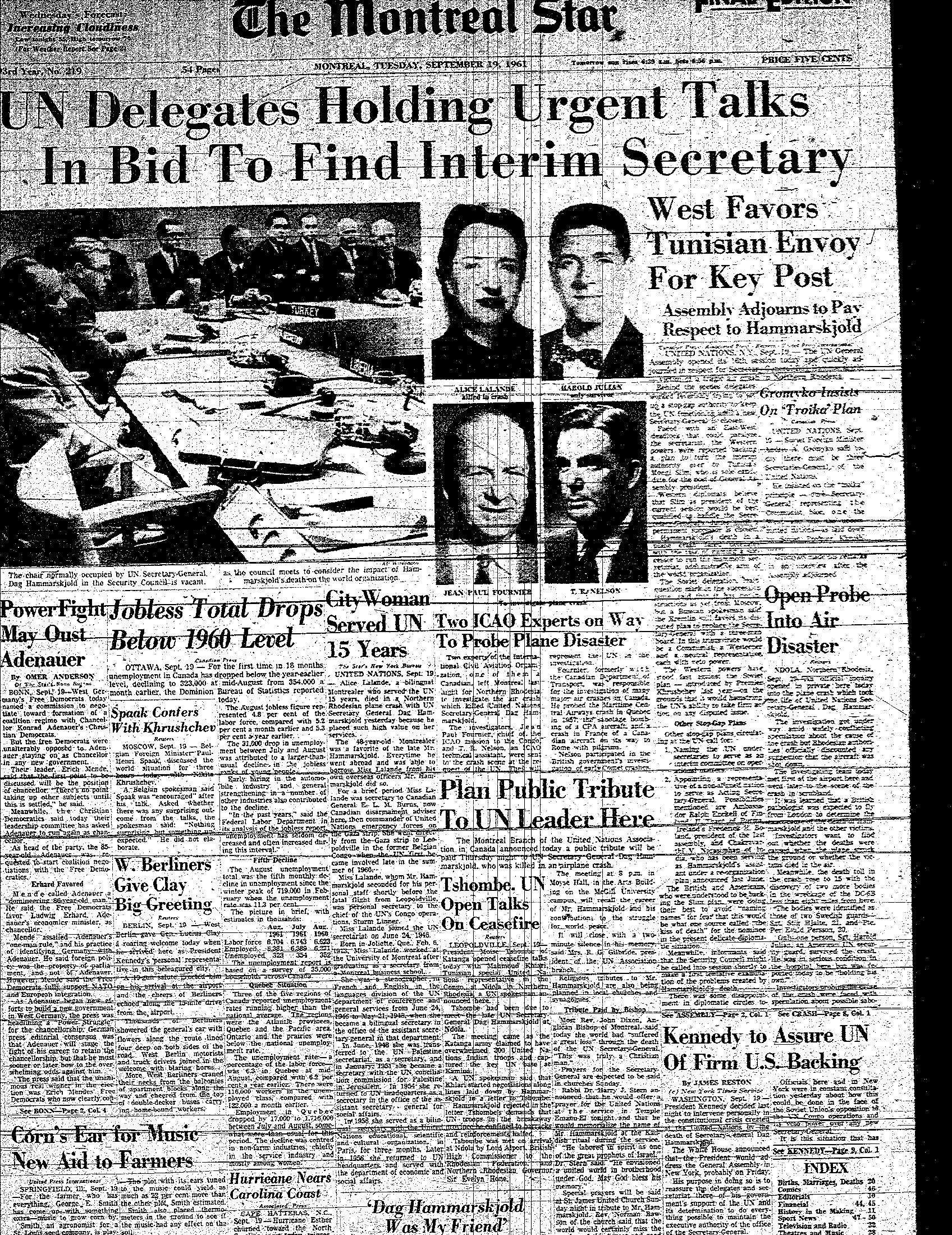

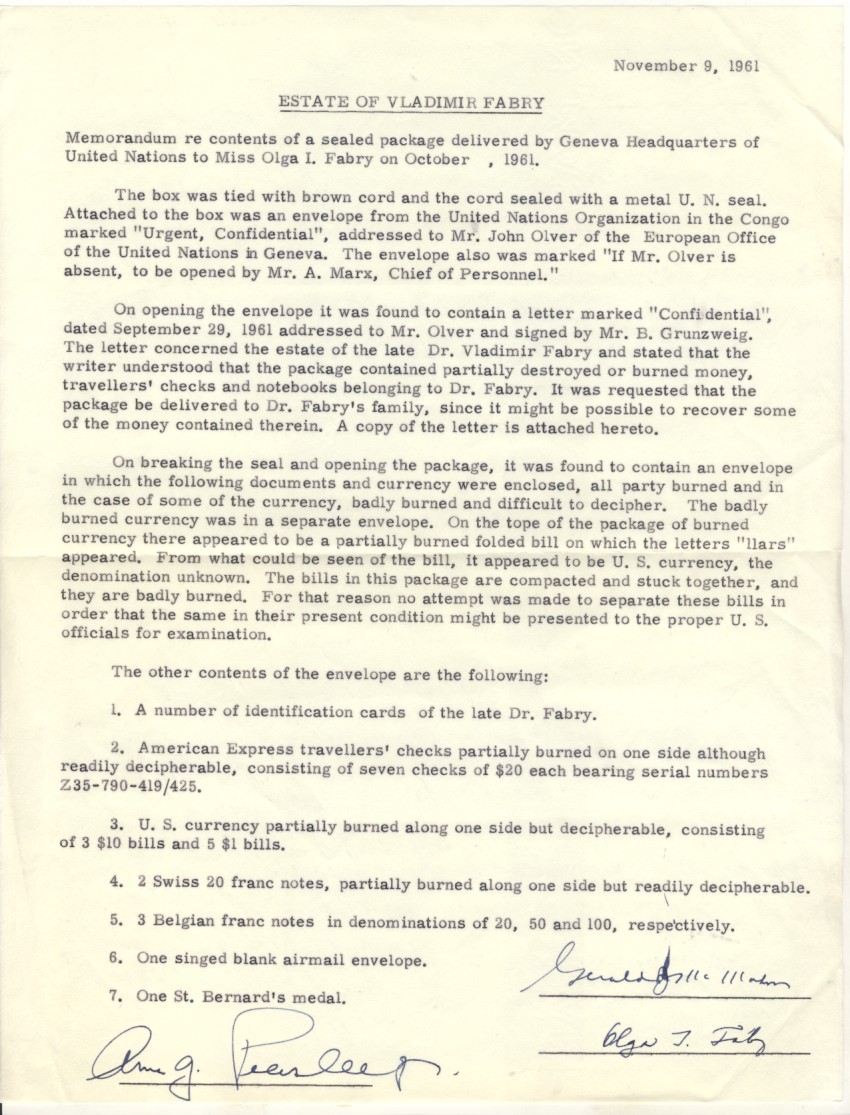



 Vlado
Vlado 