Category Archives: Czechoslovakia

No Sun Without Shadow

“There is no sun without shadow, and it is essential to know the night.” – Albert Camus, The Myth of Sisyphus

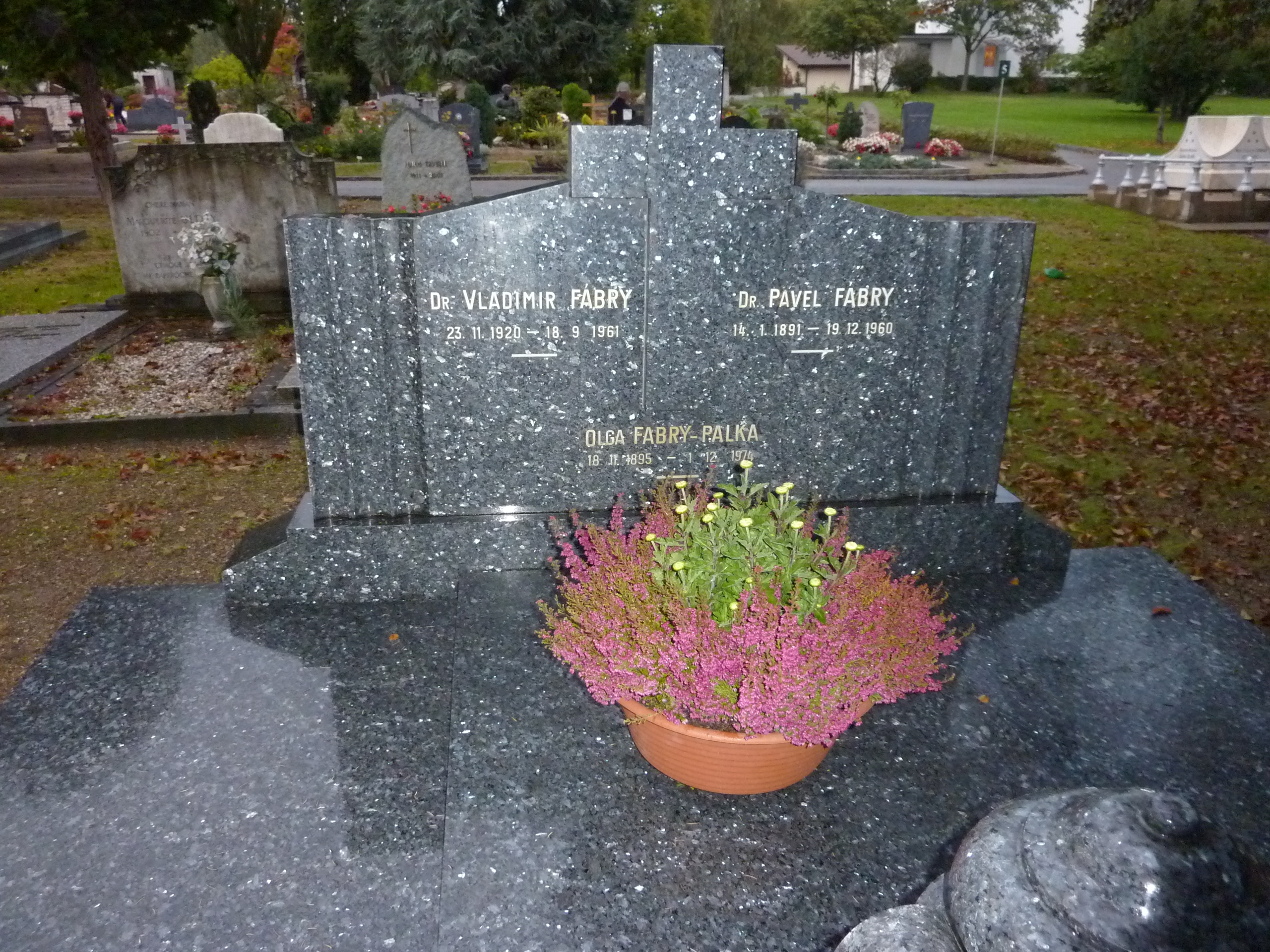
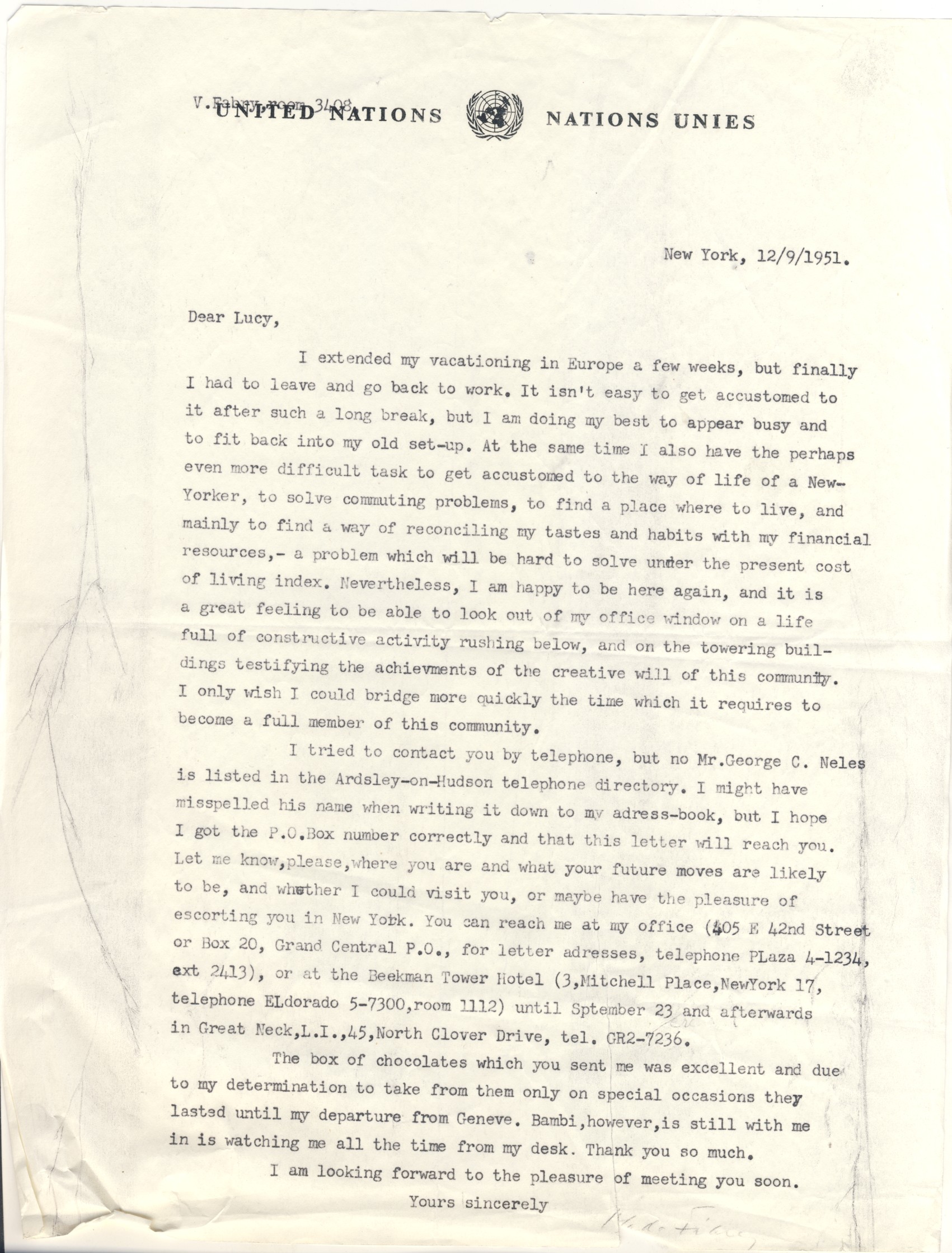
Archival assistance and emotional support from Farfel. Swissair ticket stubs from 29 December 1960 to 10 February 1961; Vlado’s father, Pavel, died of a heart attack in Berlin 19 December 1960. Sabena ticket stub appears to be from 1956, date is unclear. St. Bernard medal retrieved from the Albertina crash site, Ndola, 17-18 September 1961.
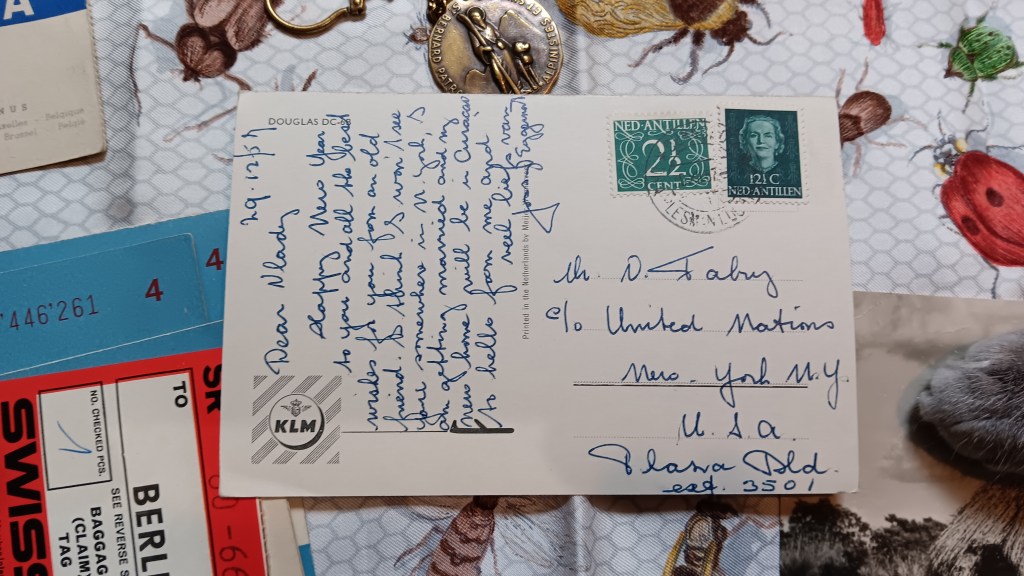
KLM postcard addressed to Vlado, care of the United Nations, New York, N.Y., “The Flying Dutchman”, Douglas DC-6B.
KLM postcard reverse, 29 December 1957: “Dear Vlady, Happy New Year to you and all the best wishes for you from an old friend. I think I won’t see you somewhere in N. York, I am getting married and my new home will be in Curacao…”
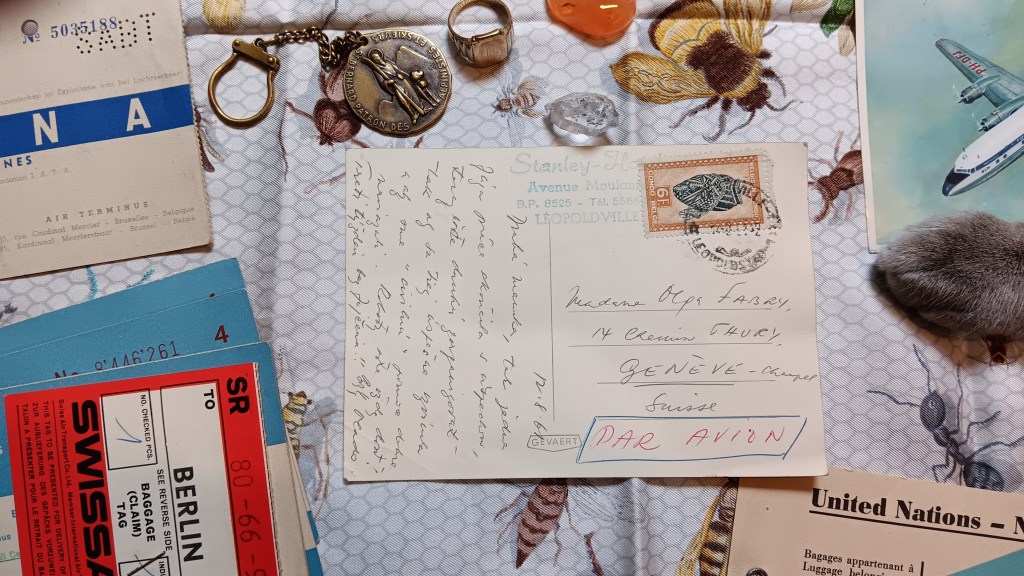
Farfel picks his favorite postcard from Vlado, sent from former Leopoldville, Democratic Republic of the Congo, now Kinshasa.
Reverse of postcard from Vlado, 12 August 1961, to his mother, “Maminka”, Madame Olga Fabry.
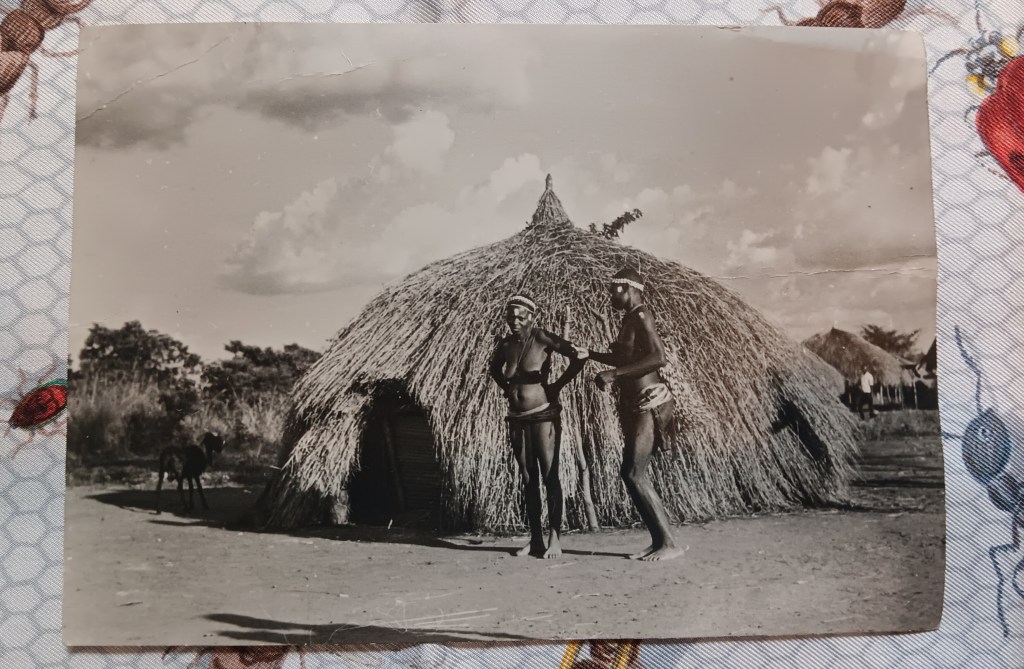
A better look at the real photo postcard from Vlado, purchased from the “Stanley-Hotel, Avenue Moulaert”.
Vlado’s signet ring, retrieved from the Albertina crash site, Ndola, 17-18 September 1961.

“The struggle itself towards the heights is enough to fill a man’s heart. One must imagine Sisyphus happy.” – Albert Camus, The Myth of Sisyphus

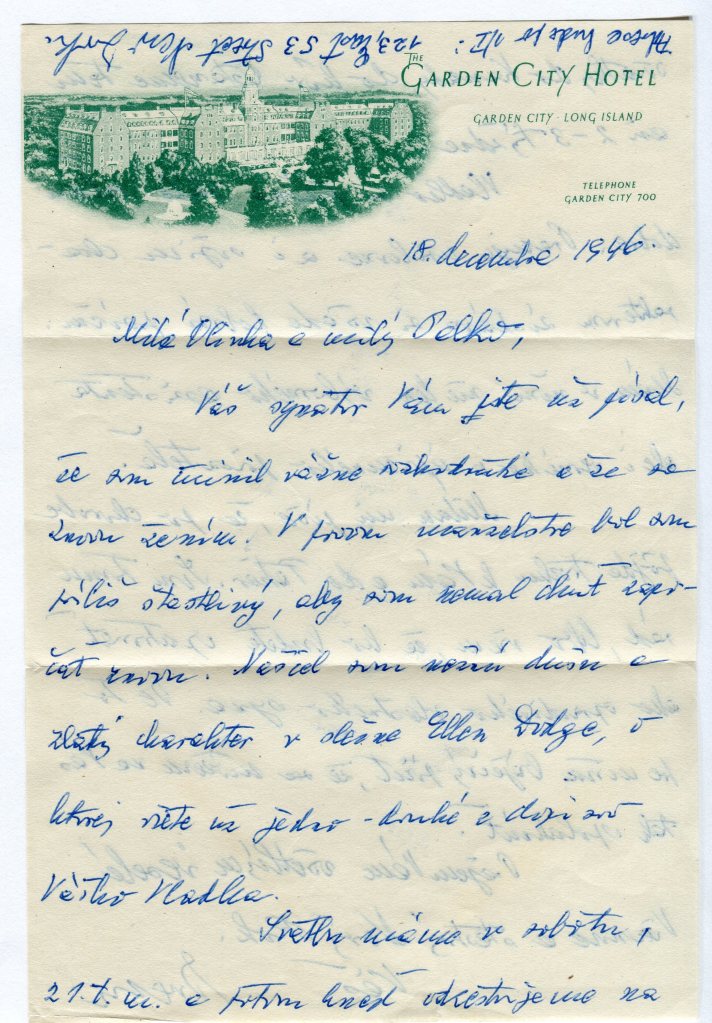
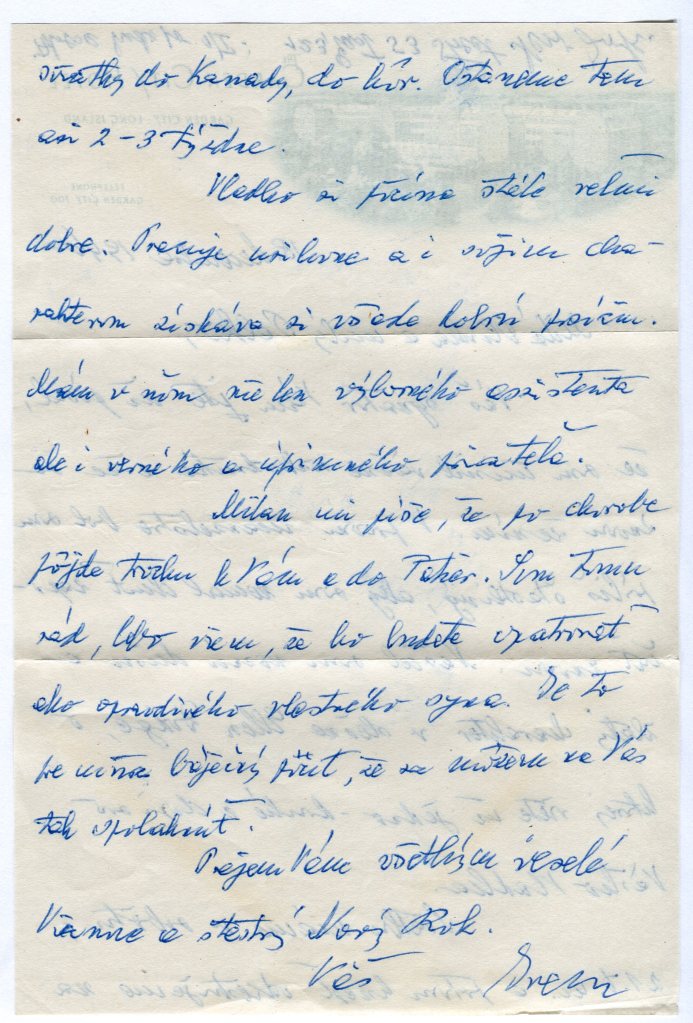
Letter from Ivan S. Kerno, 18 December 1946

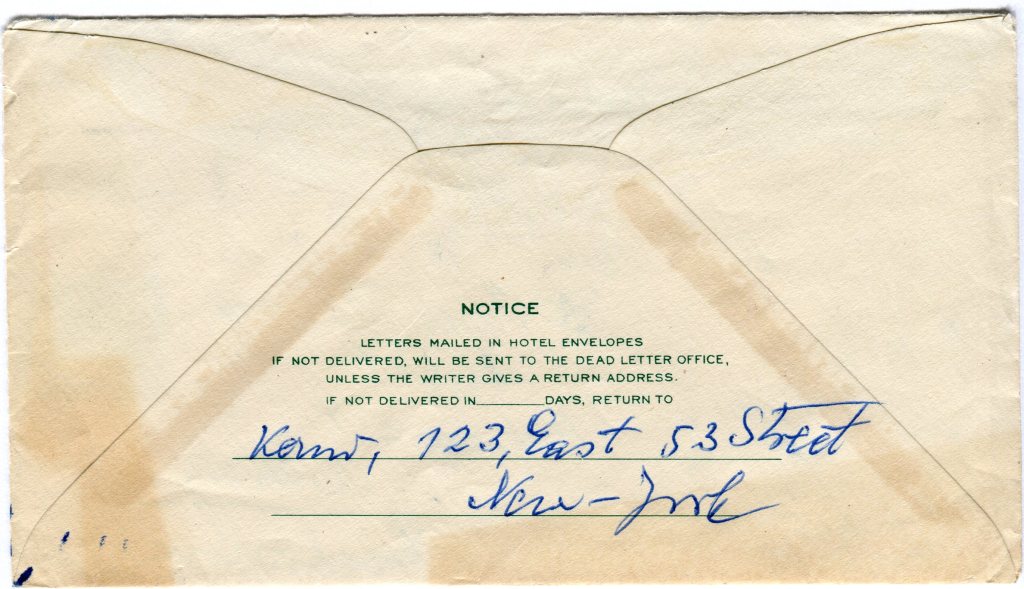
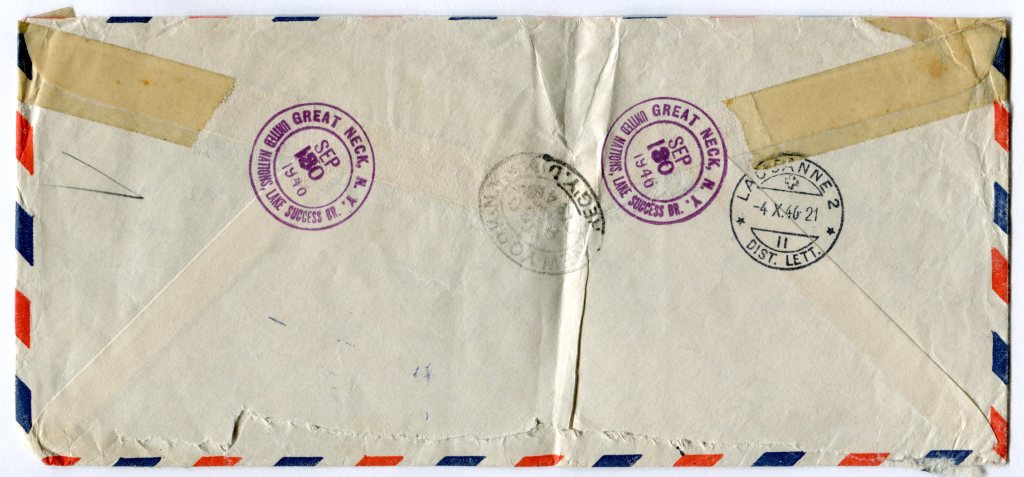
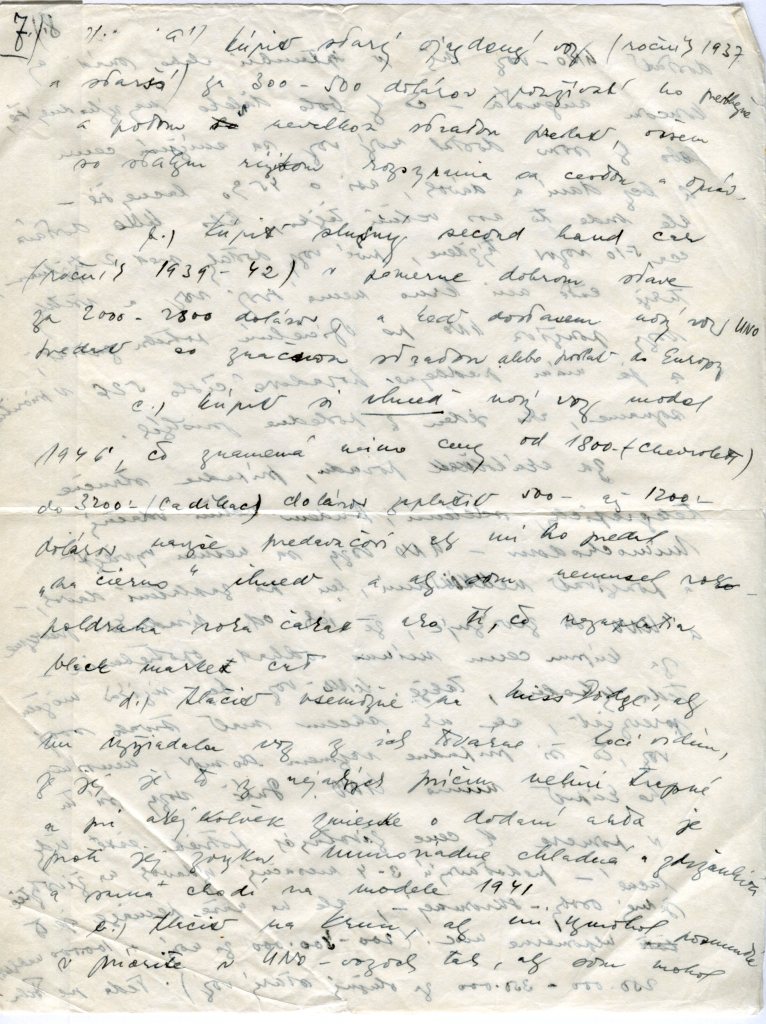
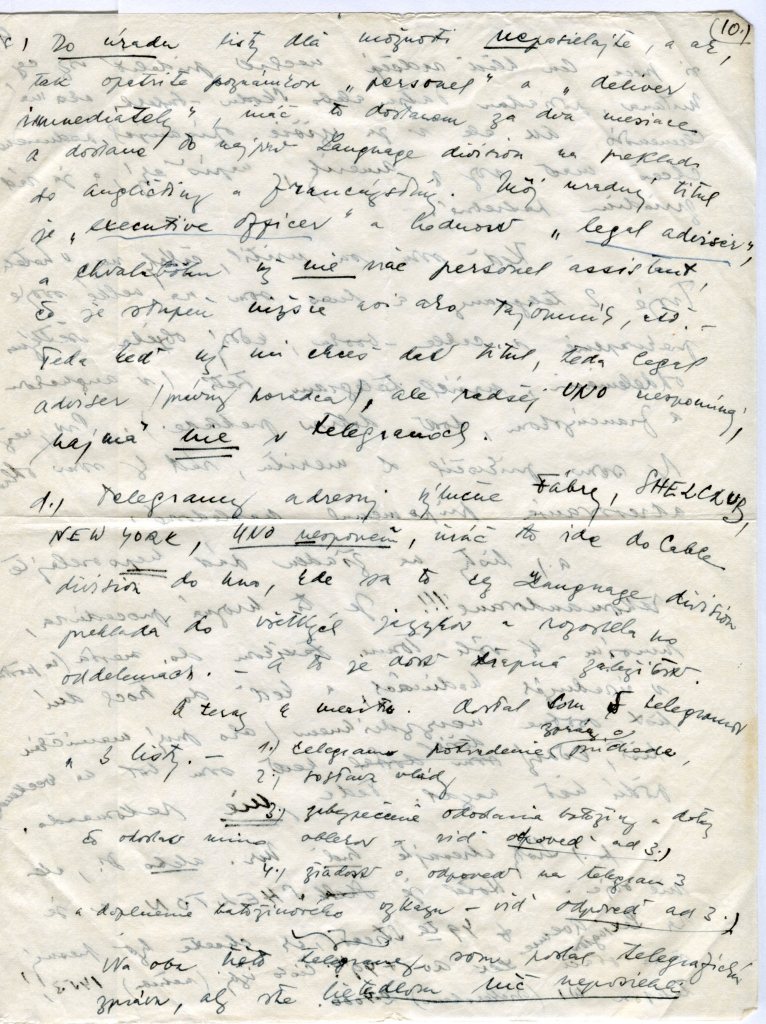
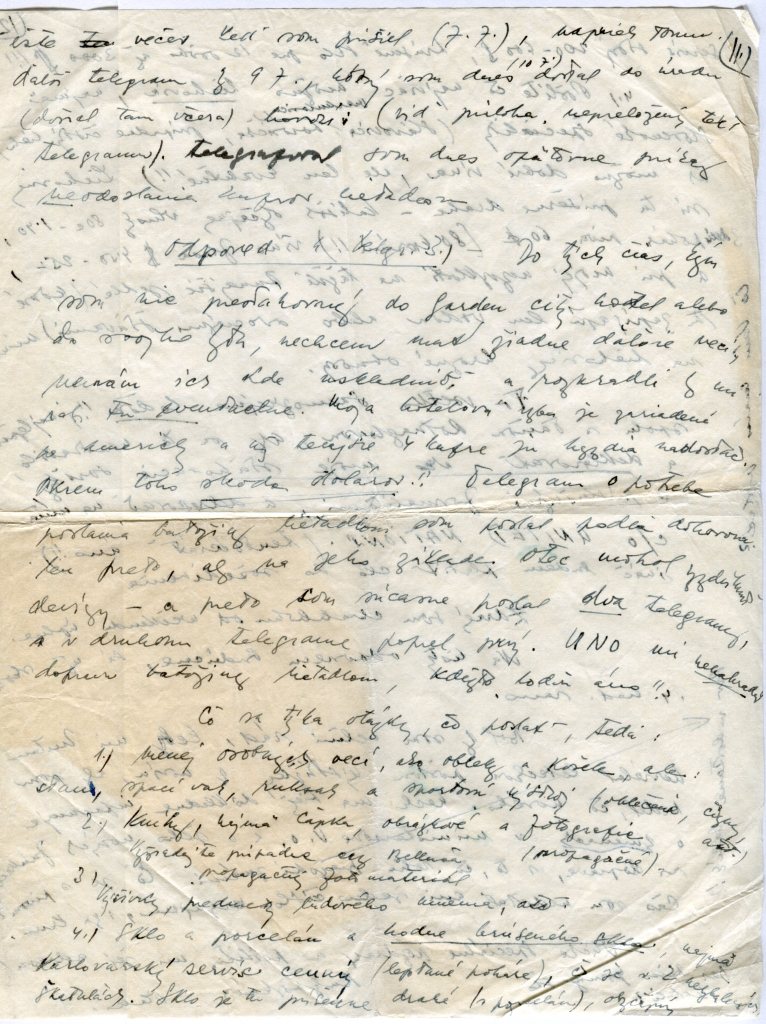
My husband Victor is the nephew of Vlado Fabry, the only child of Vlado’s sister Olinka. When Olinka passed away in 2009, we discovered a trove of papers and photos stuffed in old suitcases in the house in New York; we packed them up and brought them to Washington state, and since then I have made it my mission to share the family story with the world. The photo above shows one of these suitcases, which was originally owned by Ivan S. Kerno – Slovak lawyer and family friend, who was Assistant to Secretary-General Trygve Lie and was head of the United Nations Legal Department. We have many letters from Ivan Kerno, but here is one from Garden City, Long Island, New York, from 1946, the year Vlado joined the Legal Department of the United Nations; addressed to Vlado’s father, Pavel Fabry, in Bratislava, Czechoslovakia, to our family home that is still illegally occupied by the Russian Federation, since the coup d’etat of 1948.

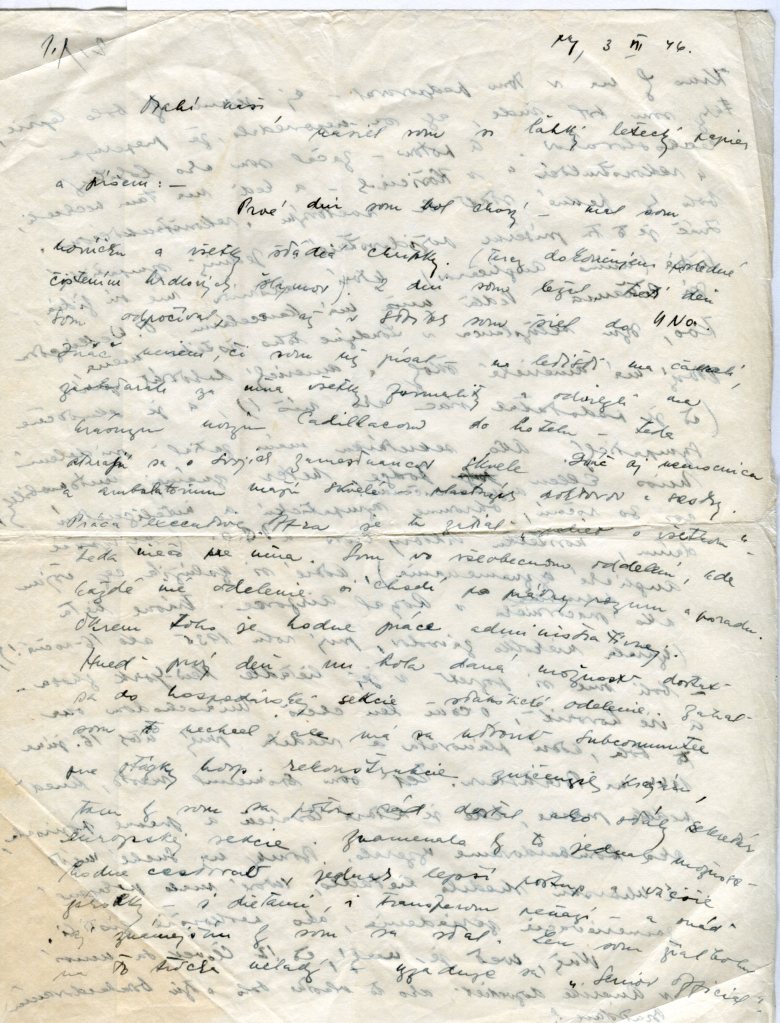
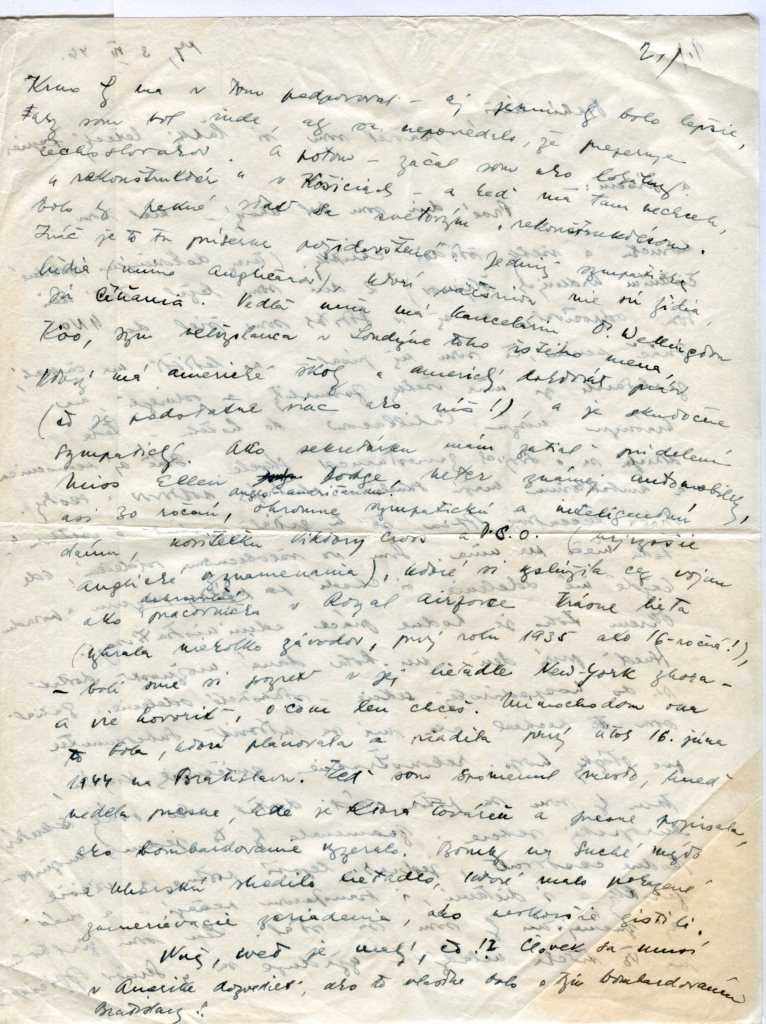
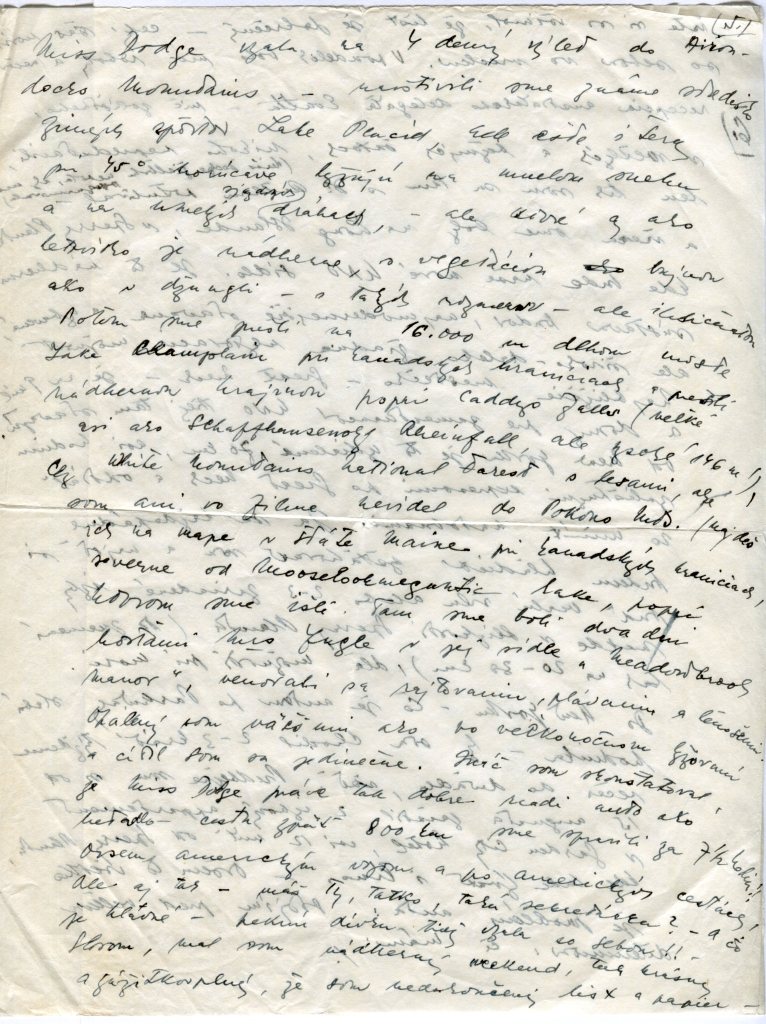
Letters from Vlado in New York, 1946

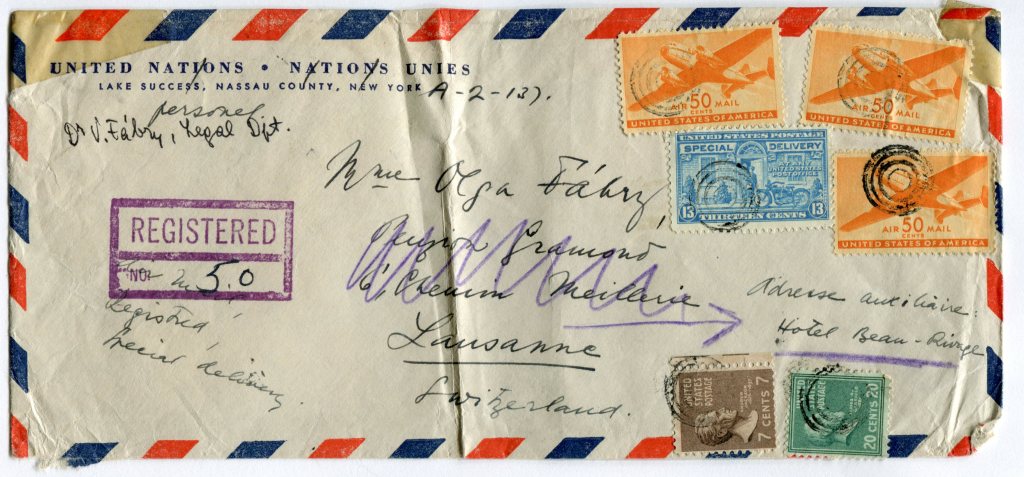
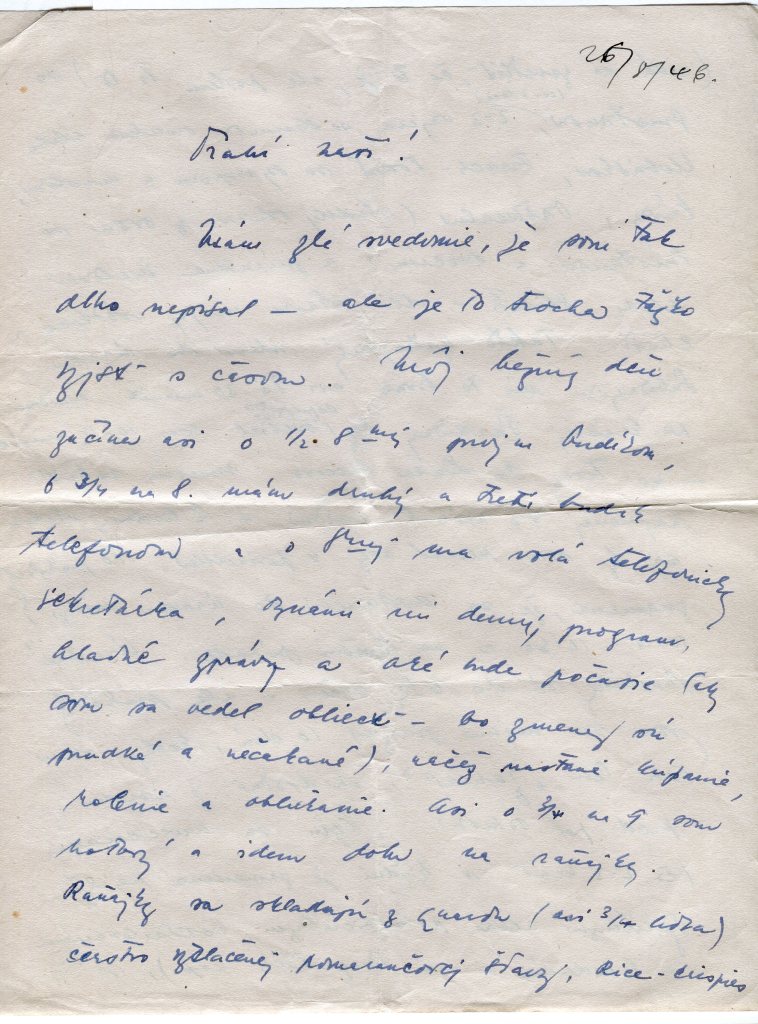
Here are two letters in Slovak from Vlado in New York, written in July and August of 1946, shortly after his arrival in the States. At this time, the United Nations Headquarters were located in Lake Success, NY, in the Sperry Gyroscope Company factory. The first letter, written to his sister Olinka in Lausanne, Switzerland, is on onion skin paper and is not getting any younger; it is hard to decipher because Vlado wrote on both sides of the paper, but, for those determined to know what he was up to and wrote, it is not impossible to translate! Ďakujem for the help!

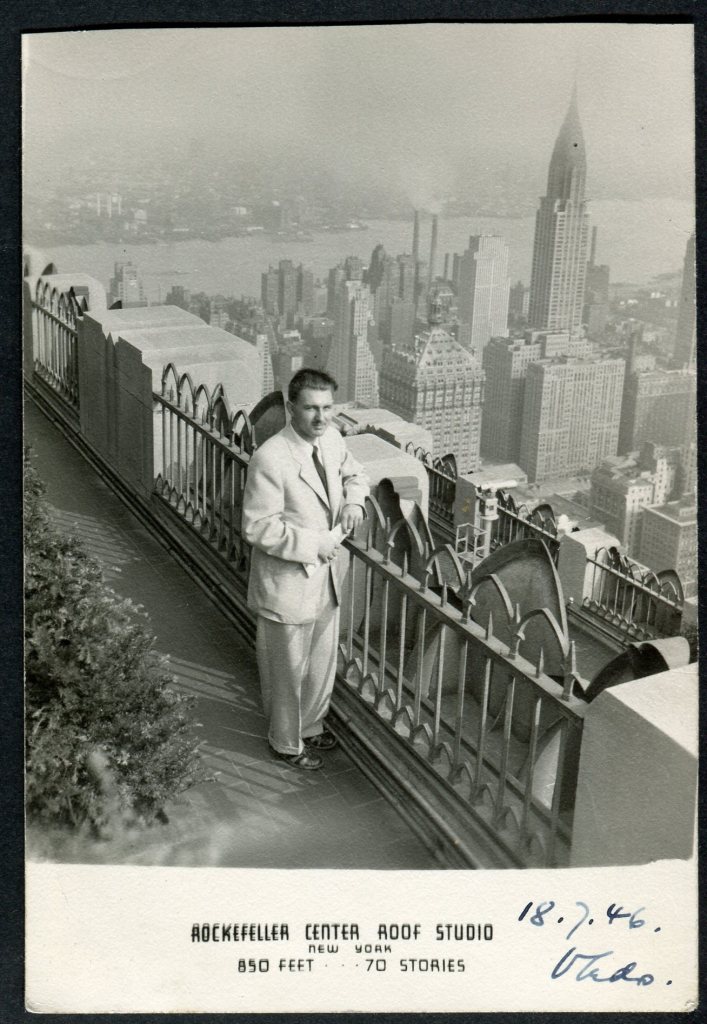
Vlado at Rockefeller Center Rooftop, NYC, 18 July 1946

Good Bye, Czechoslovakia!

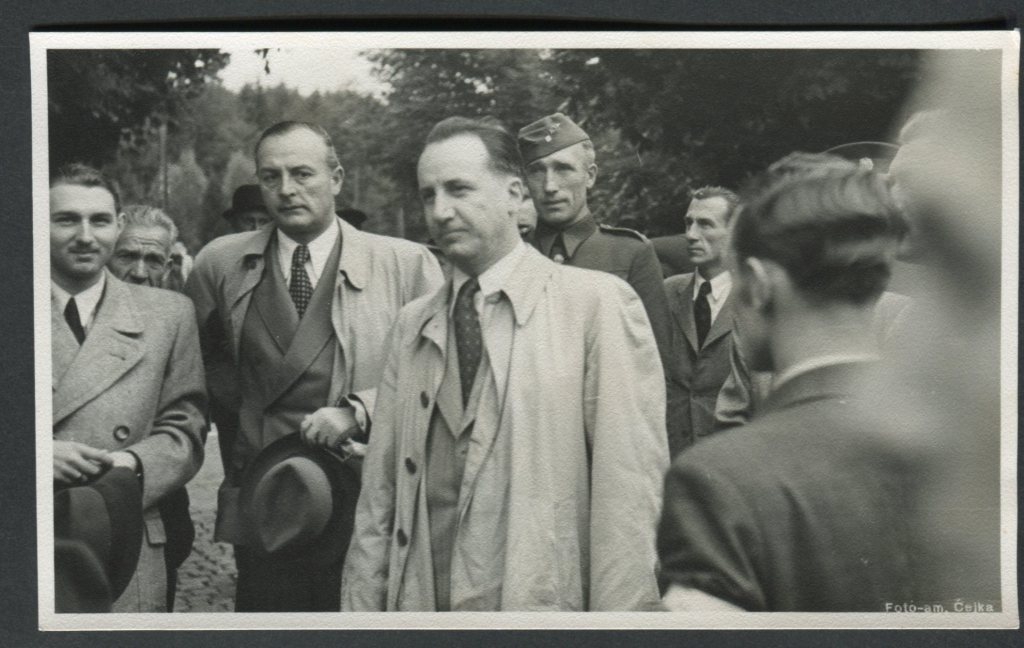
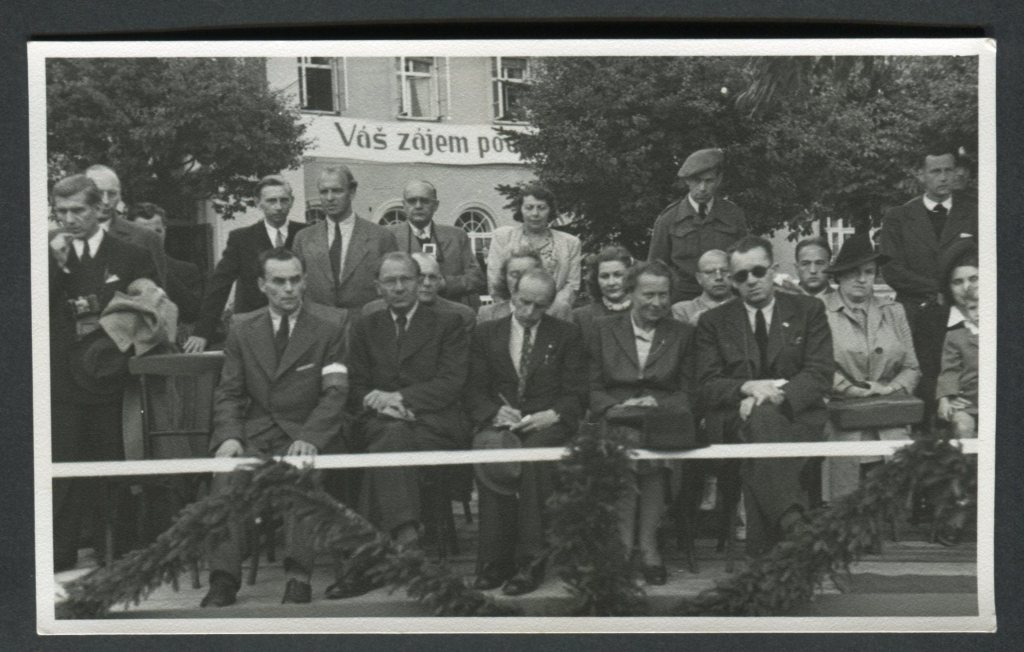
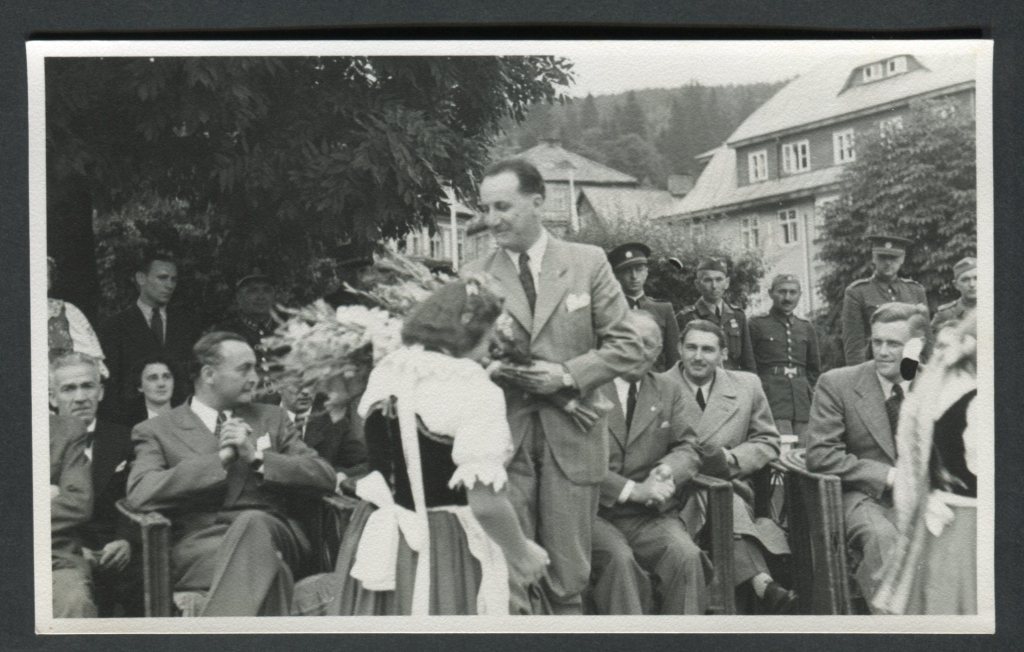
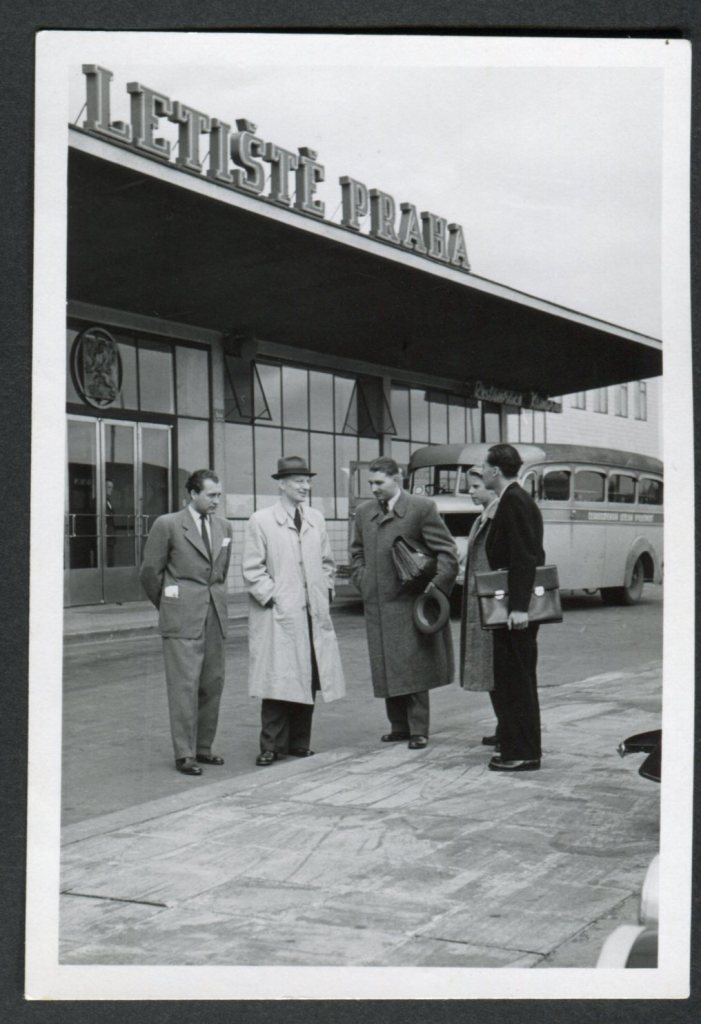
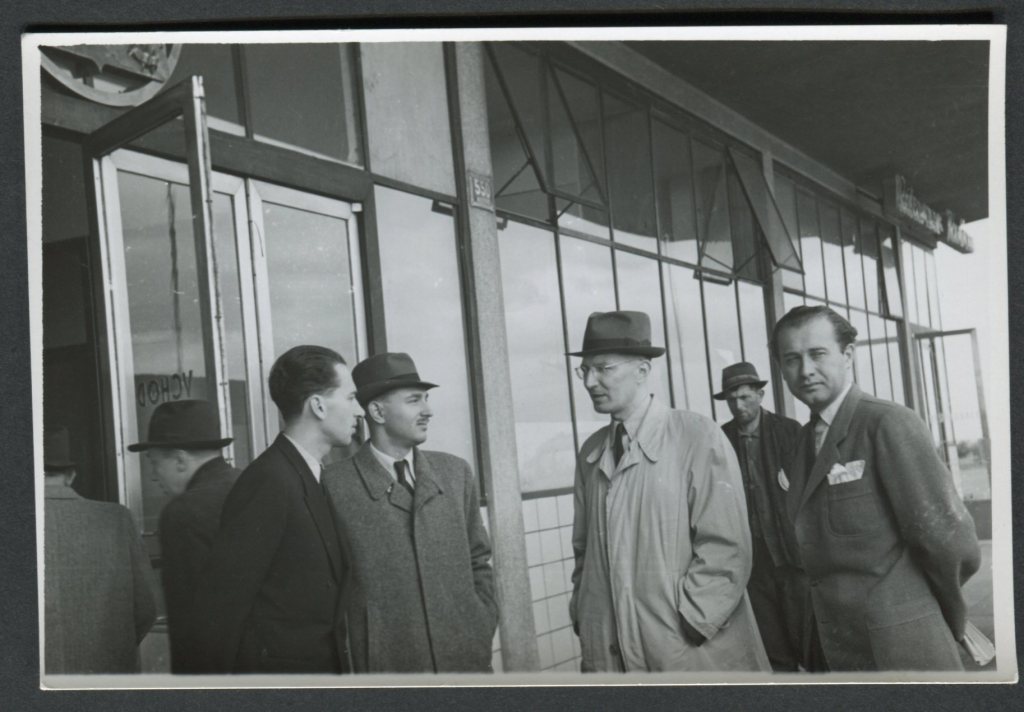
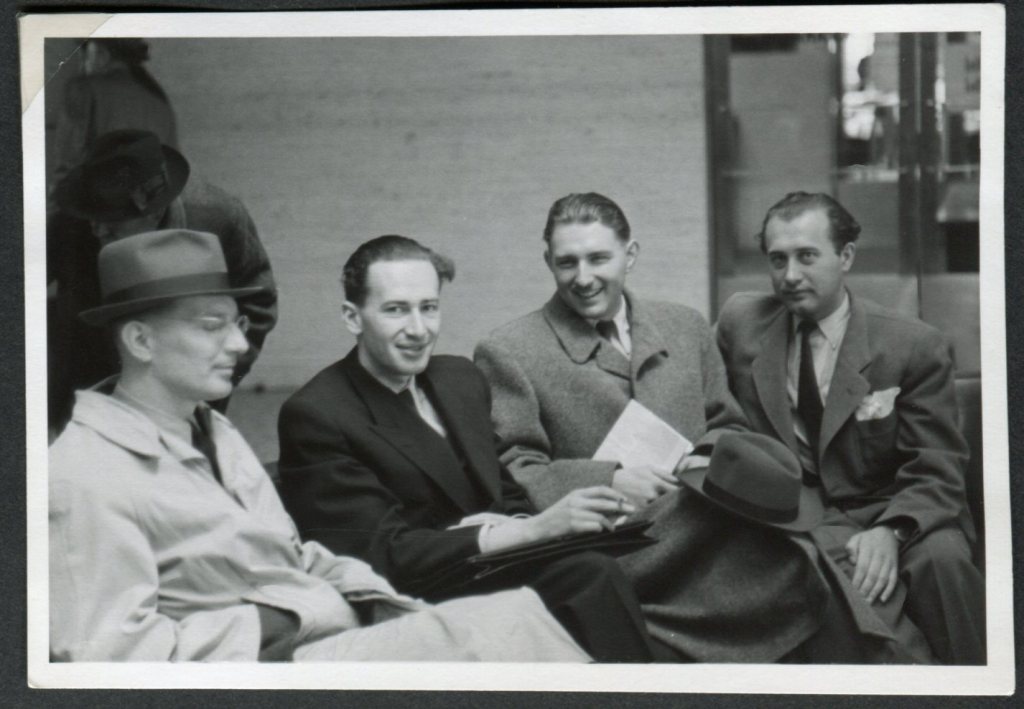
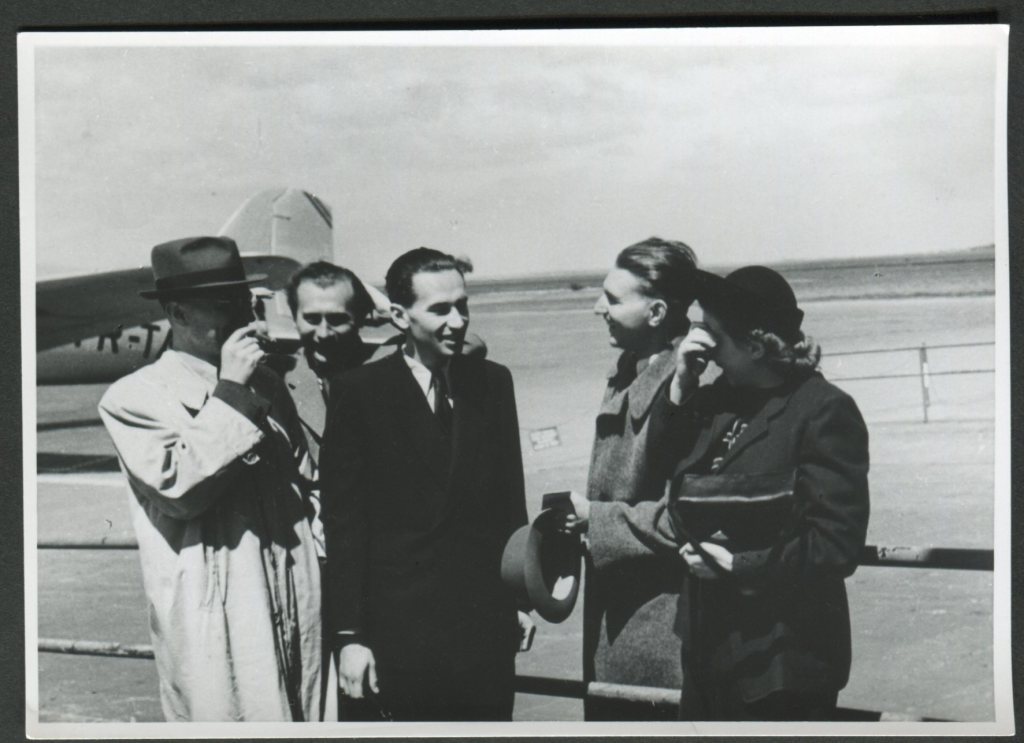
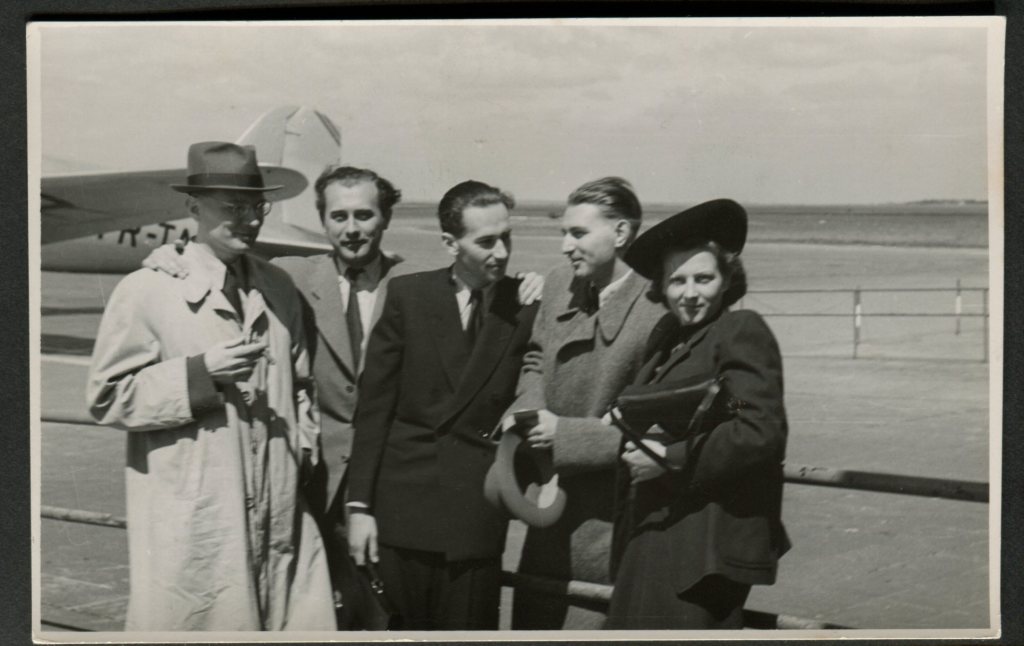
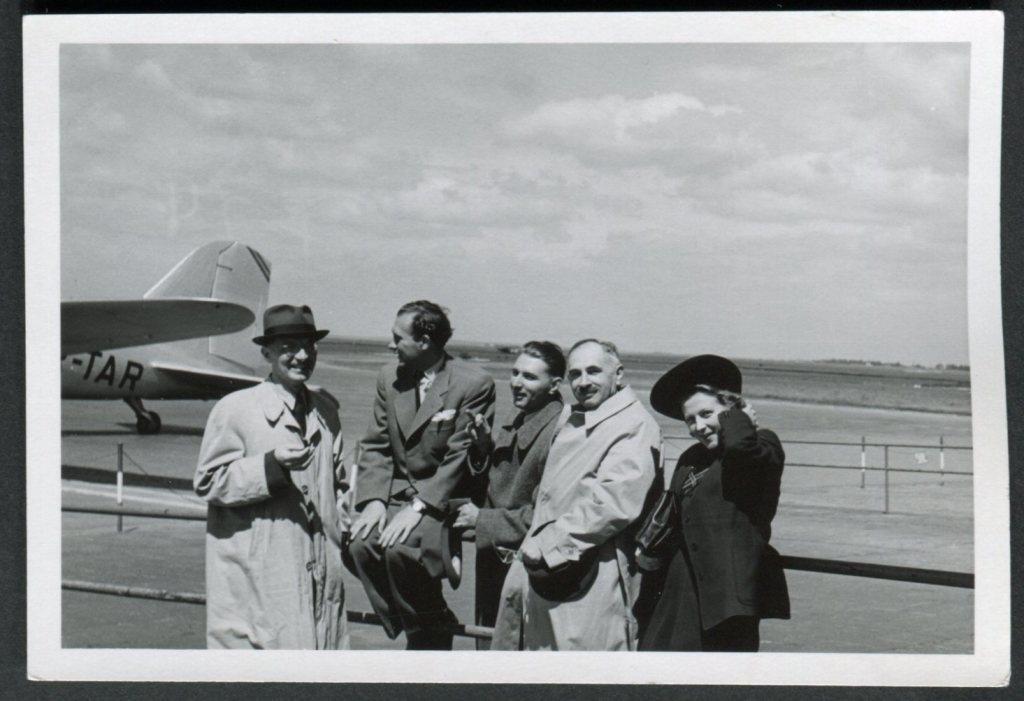
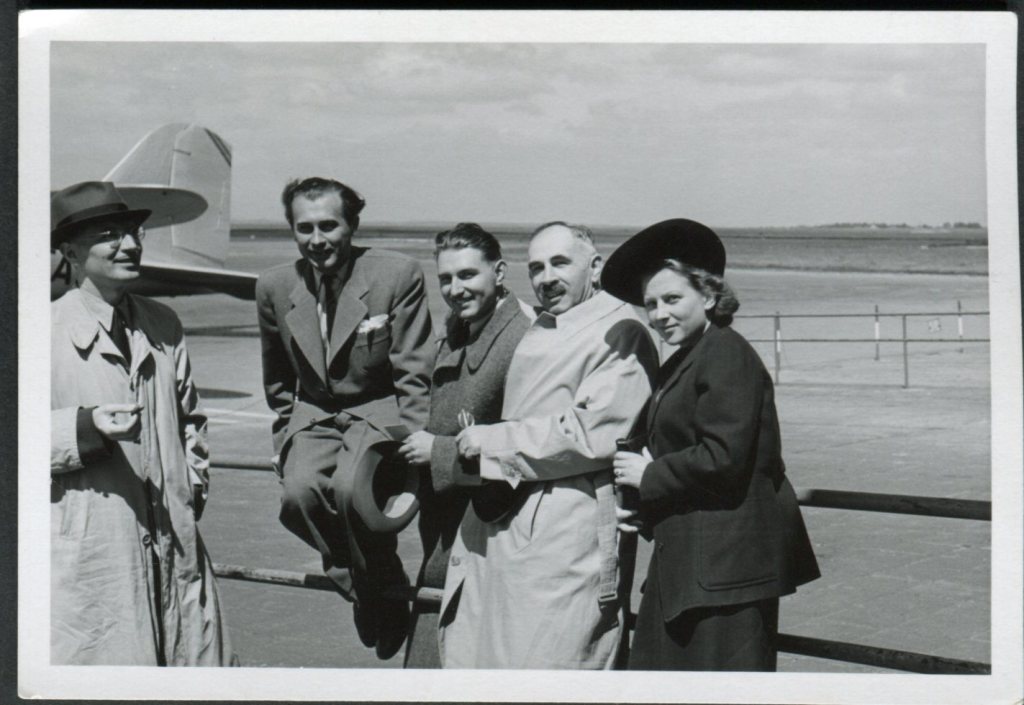
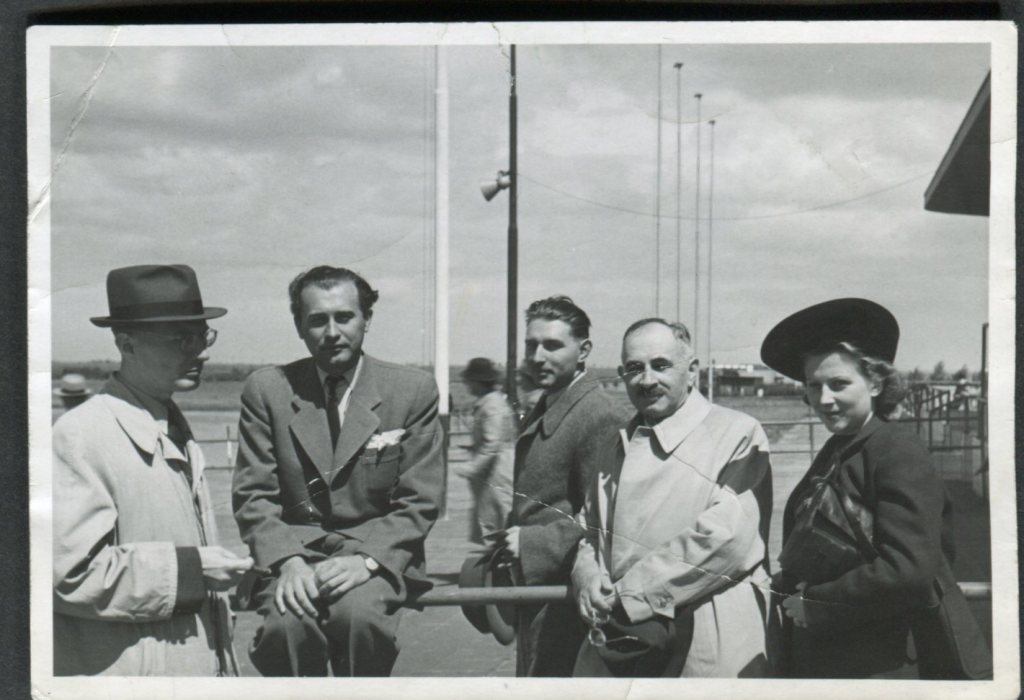
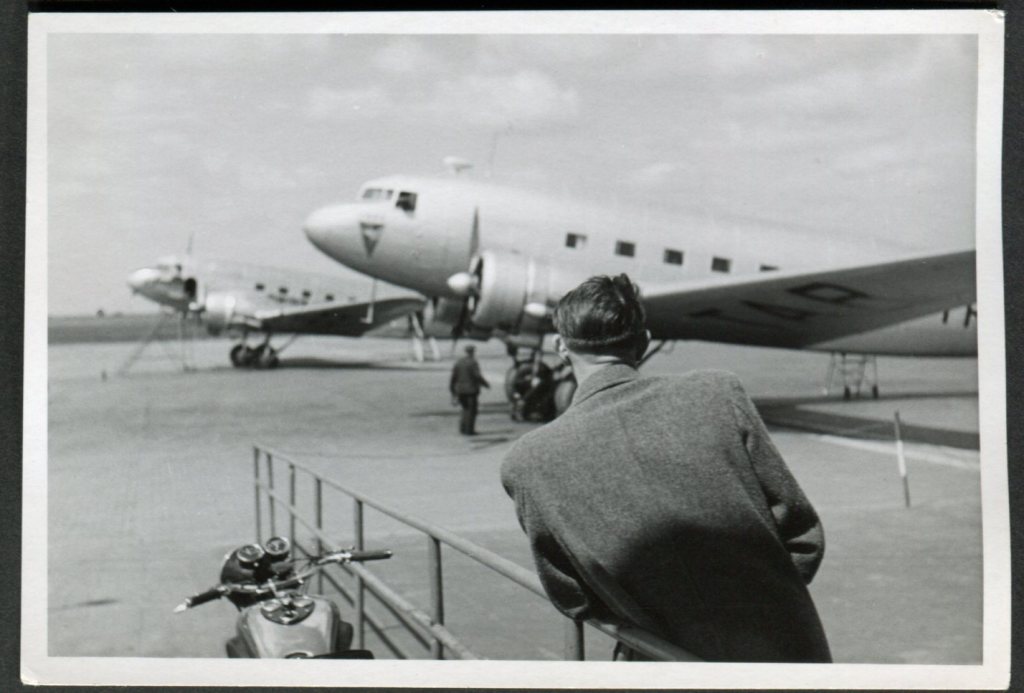
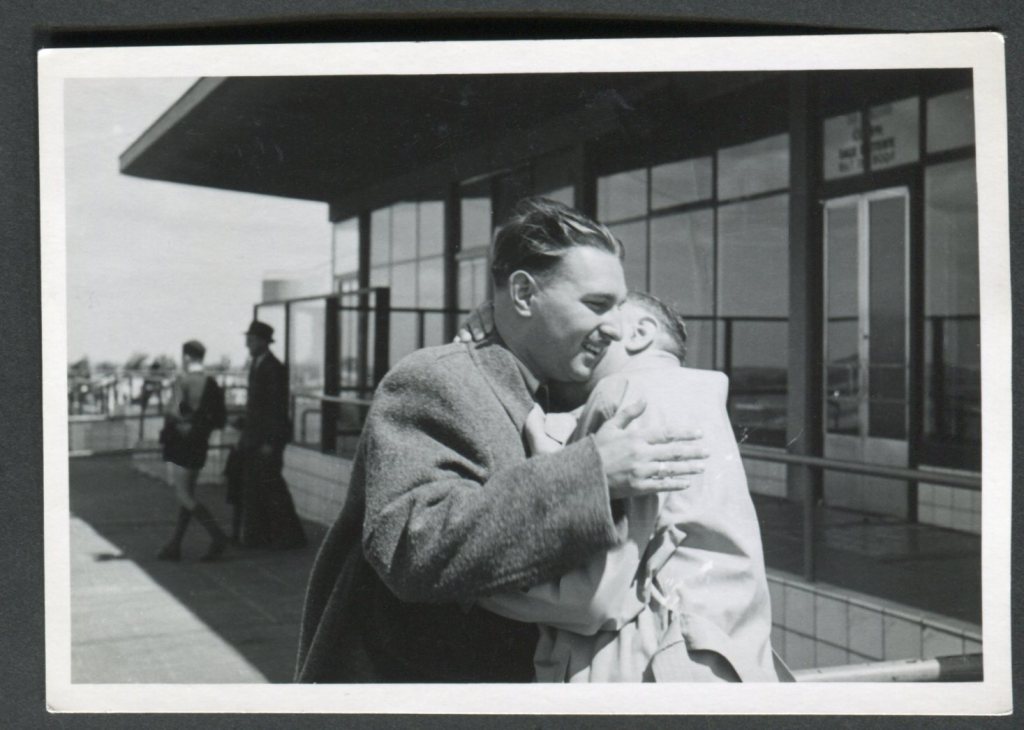
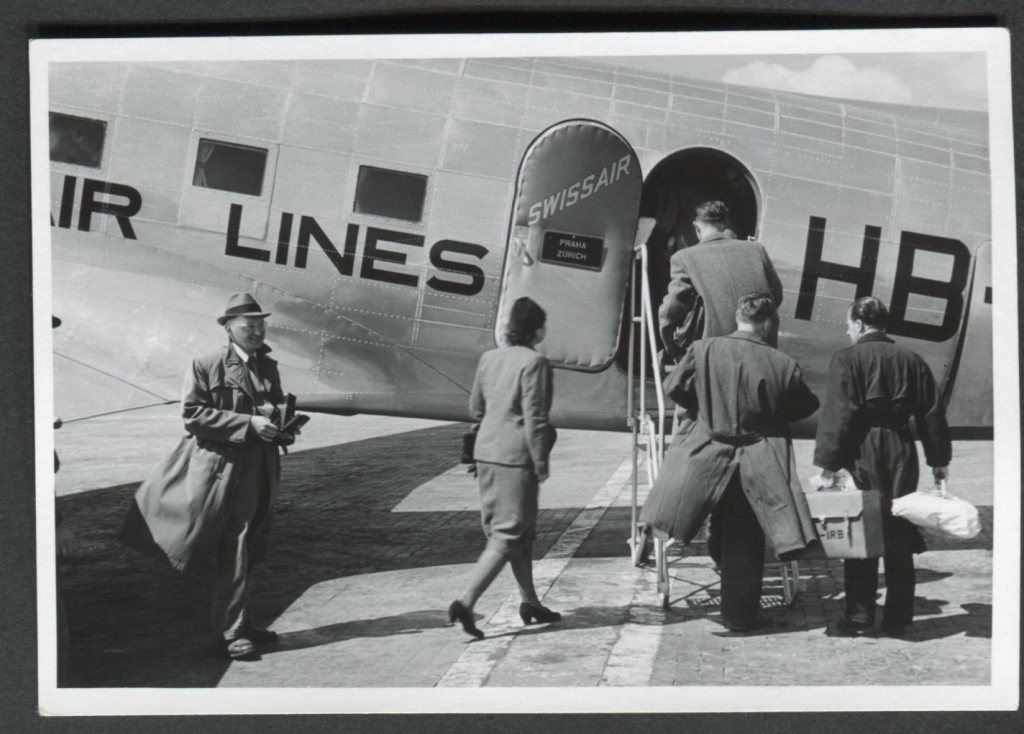
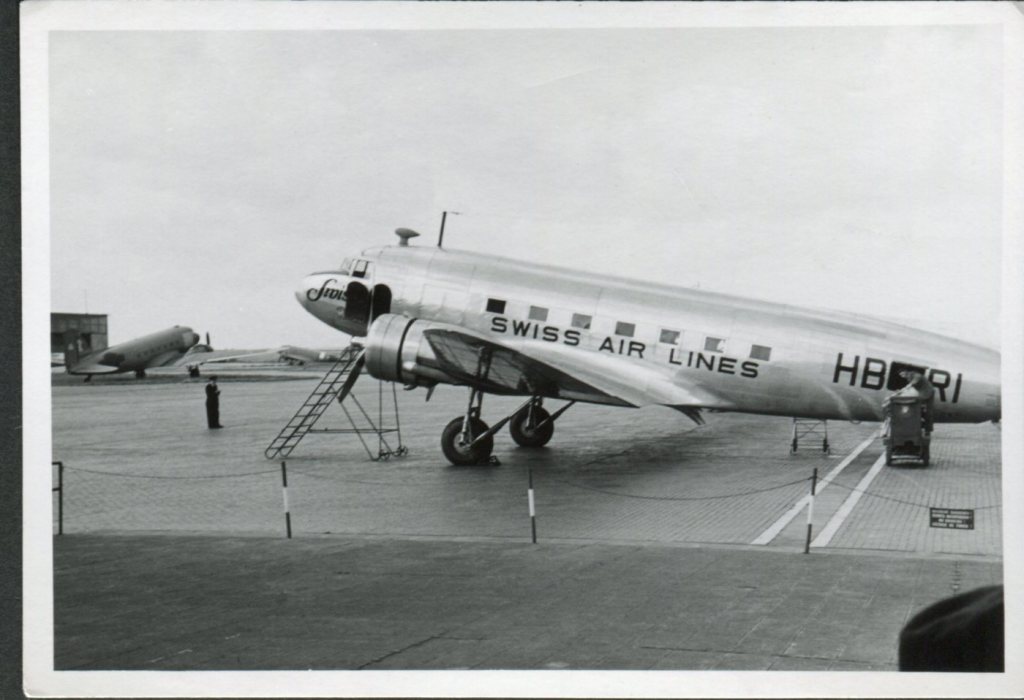
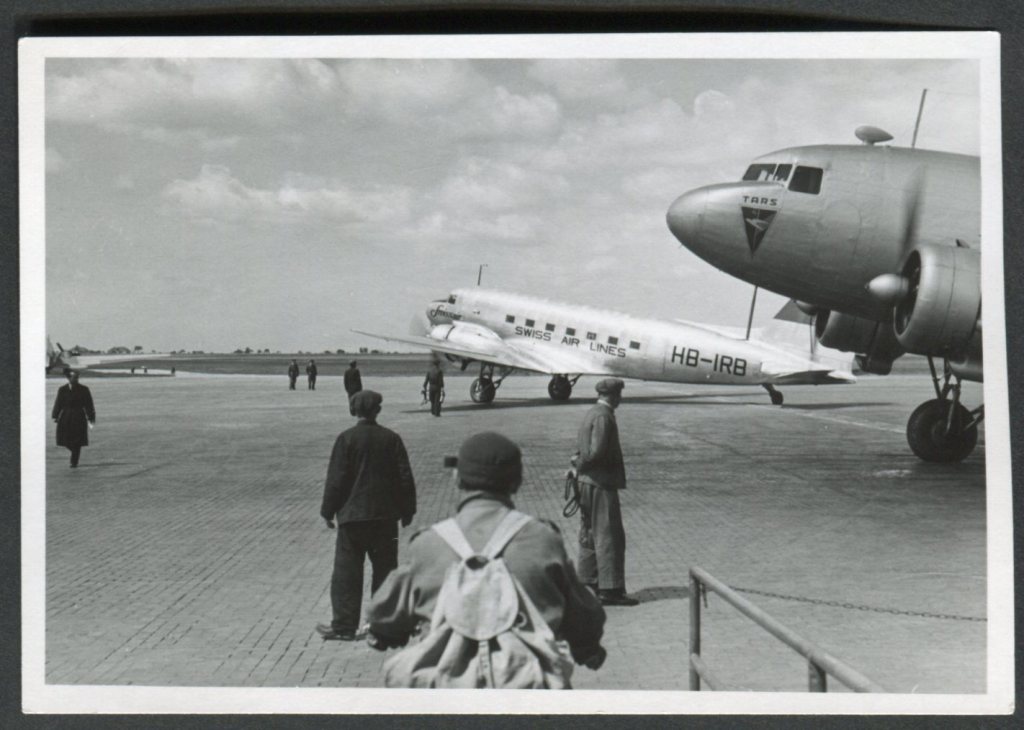
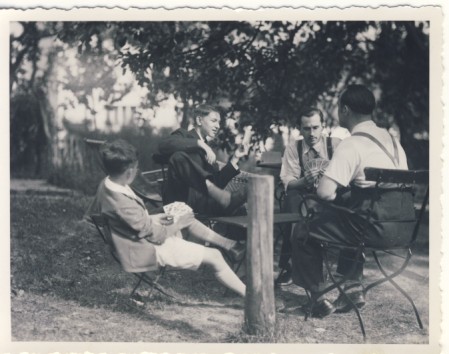
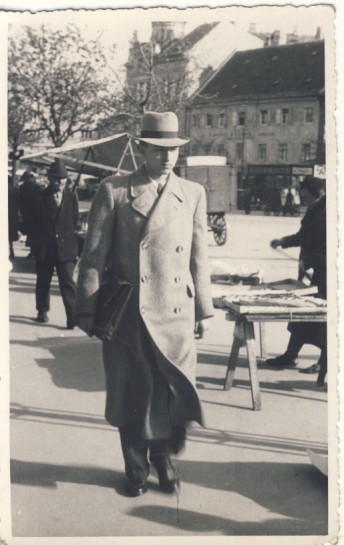
In June 1946, Vlado Fabry left his position as Personal Secretary to the Minister of the Interior in Prague, to join the Secretariat of the United Nations in New York. He packed his bags, said farewell to his friends and family, and said good bye forever to Czechoslovakia. The following photos are from Prague, showing Vlado at an undated political gathering, and his departure in June at the airport on a Swissair flight to Zurich.

Vlado Fabry, Prague, circa 1946

A National Gift to the People of Slovakia

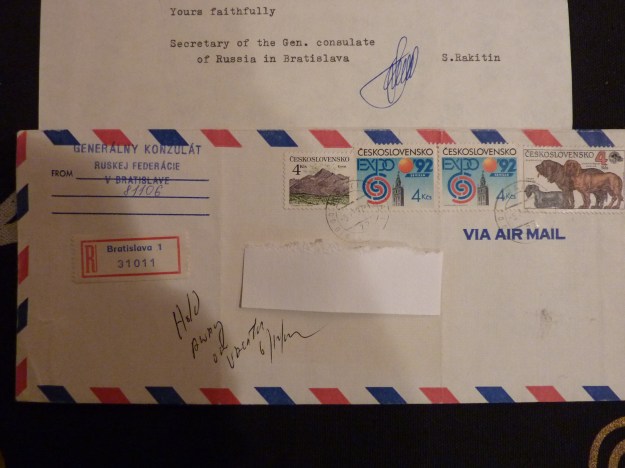
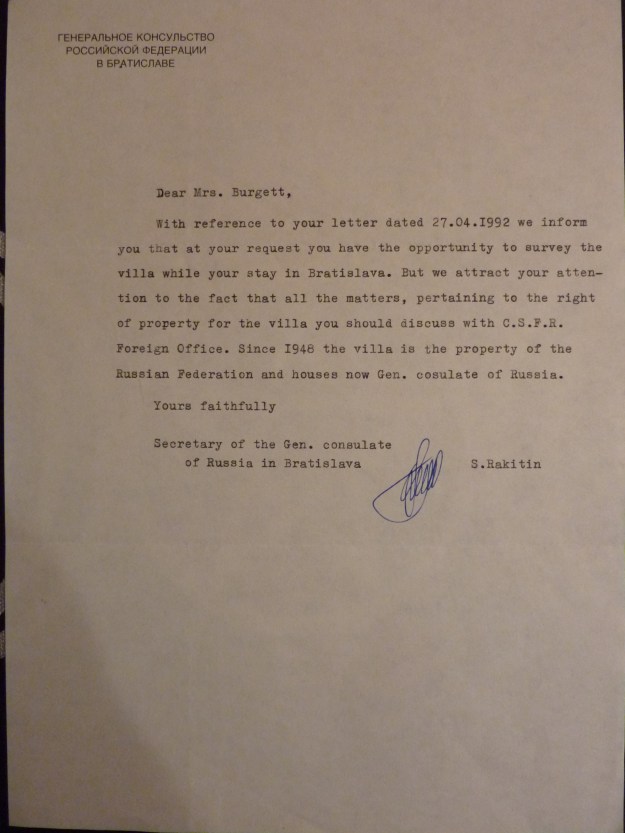
Letter from Russian Consulate, Bratislava, to my mother-in-law Olga Fabry-Burgett; June 1992.
Letter from the Secretary of the Gen. consulate S. Rakitin, admitting that our home was taken in 1948; which corroborates the personal testimony of Pavel Fabry.

Excerpt from C.V. of Pavel Fabry, 1955:

“After the Communist coup [February 1948] performed by Russian Deputy Foreign Minister [Valerian] Zorin for the Communists, the time is broken up with invoices to settle for my work against Communism as High Commissioner in 1919. And on the instructions of the insulted Mátyás Rákosi I was first of all relieved of all my functions and representatives, and subjected to all possible harassment, interrogations, etc. When I went to the delegation, as elected President of the Financial and Economic Committee of the General Assembly of the World Council of Churches, in Amsterdam, and was asked for my passport, I was arrested on the pretext of excessive imaginary charges. My whole fortune was taken, all accounts were confiscated and my Villa locked with furnishings, clothes, supplies, and everything, since it was the Consul-General of Russia; and on the same evening I was arrested as a “National Gift”, the nation was taken over, and in the night the Russians transferred the land register.”

My mother-in-law Olinka spent her whole life fighting to get the family home back from the Russians, but I will not be following in her footsteps – I want peace and to be happy! It is the sincere wish of myself and my family, that the Fabry home be donated to the city of Bratislava, as a gift to the people of Slovakia; to be of good use and service for the community, and that the garden be enjoyed by all people, as a memorial to our beloved ancestors.

The time has come for Russia to find a new home in Bratislava for their Consulate, obtained by legal means and not by brute force.

FREE ALEXEI NAVALNY!

Poem for Vlado

Fabry Archive - Selected Photographs (86)

Looking through the family papers today, I found a poem by Olinka Fabry, written in tribute of her brother Vlado.  I share it here with love to the both of them.

To Vlado

You died, as you lived –

not fearless, nor reckless,

but wisely bargaining

the single coin of life

for the one thing it is worth,

to bargain for

not for the siren song of gold

nor for the temptation of flesh

nor for the praise of men –

but to help life bloom and sing

and save it from withering away

For while we procrastinated

while we withdrew and barricaded ourselves in our insides

you stepped out –

with a pick and the rope, climbed to the top

into the streaming sunshine of bullets

and called to the man, behind the bush

to come out and talk over his grievance….

Now that it’s consummated,

we see it well, this hard won lesson:

not for the thrill

nor to subdue the mountain

but to steel the gaze

at the edge of the abyss

so when time comes

for the free man

he shall not flinch,

he shall not be found wanting.

Enter now in the hall of fame

of our small mountainfolk,

join the heroes standing around

the famous cliff – straight as candles –

you who wrote their courage in the sky

for all the world to see.

Of you I sing on this foreign shore

gentle as white wool of our lambs

hard as the granite of our cliffs.

You shall not walk again the mountain path

but your name shall be whispered

when the forest sings


Letters from Sumitro

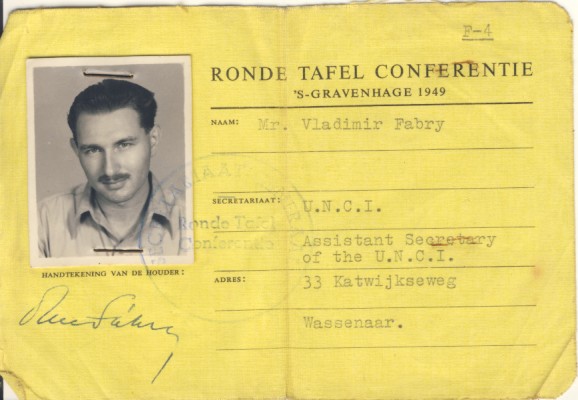
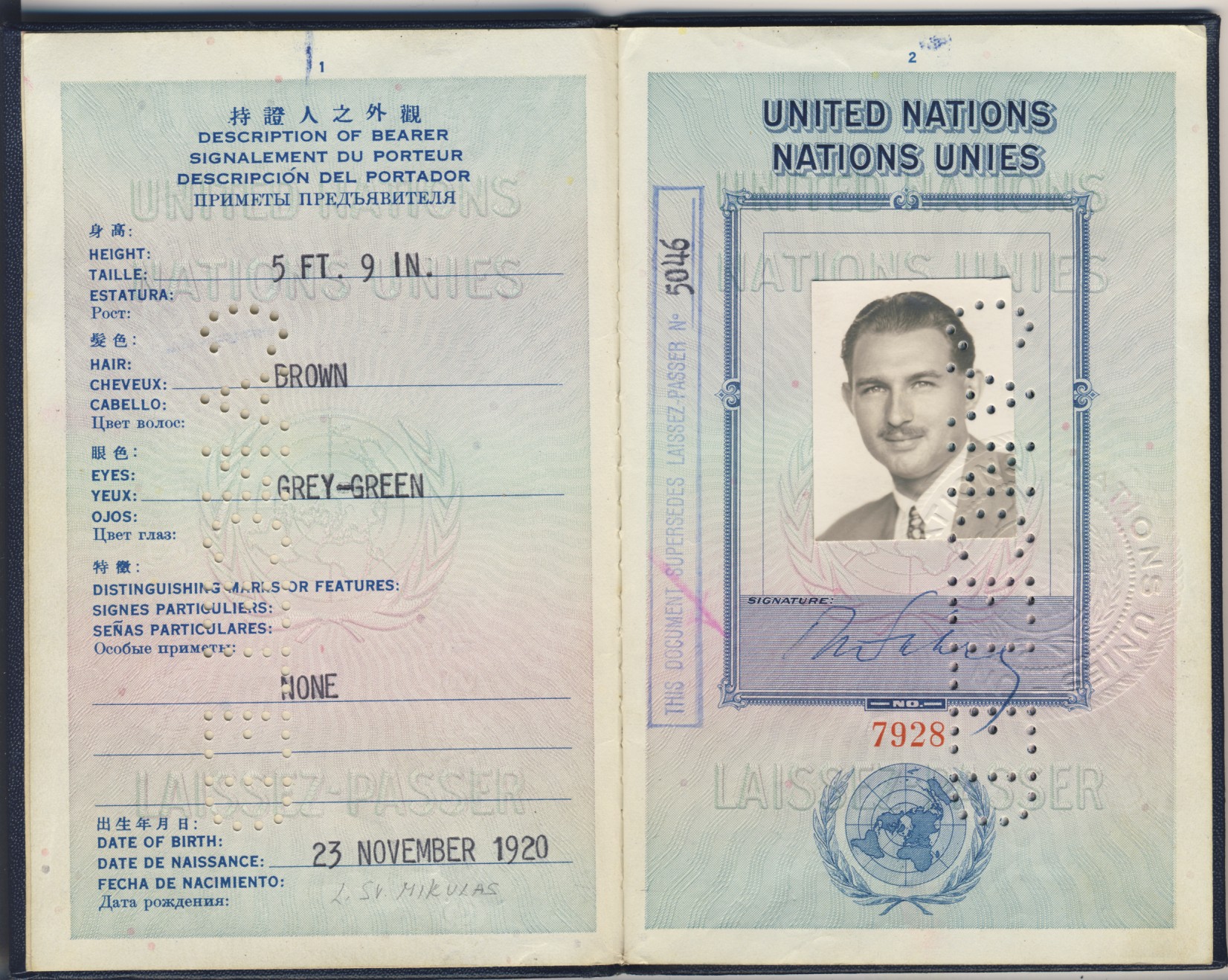
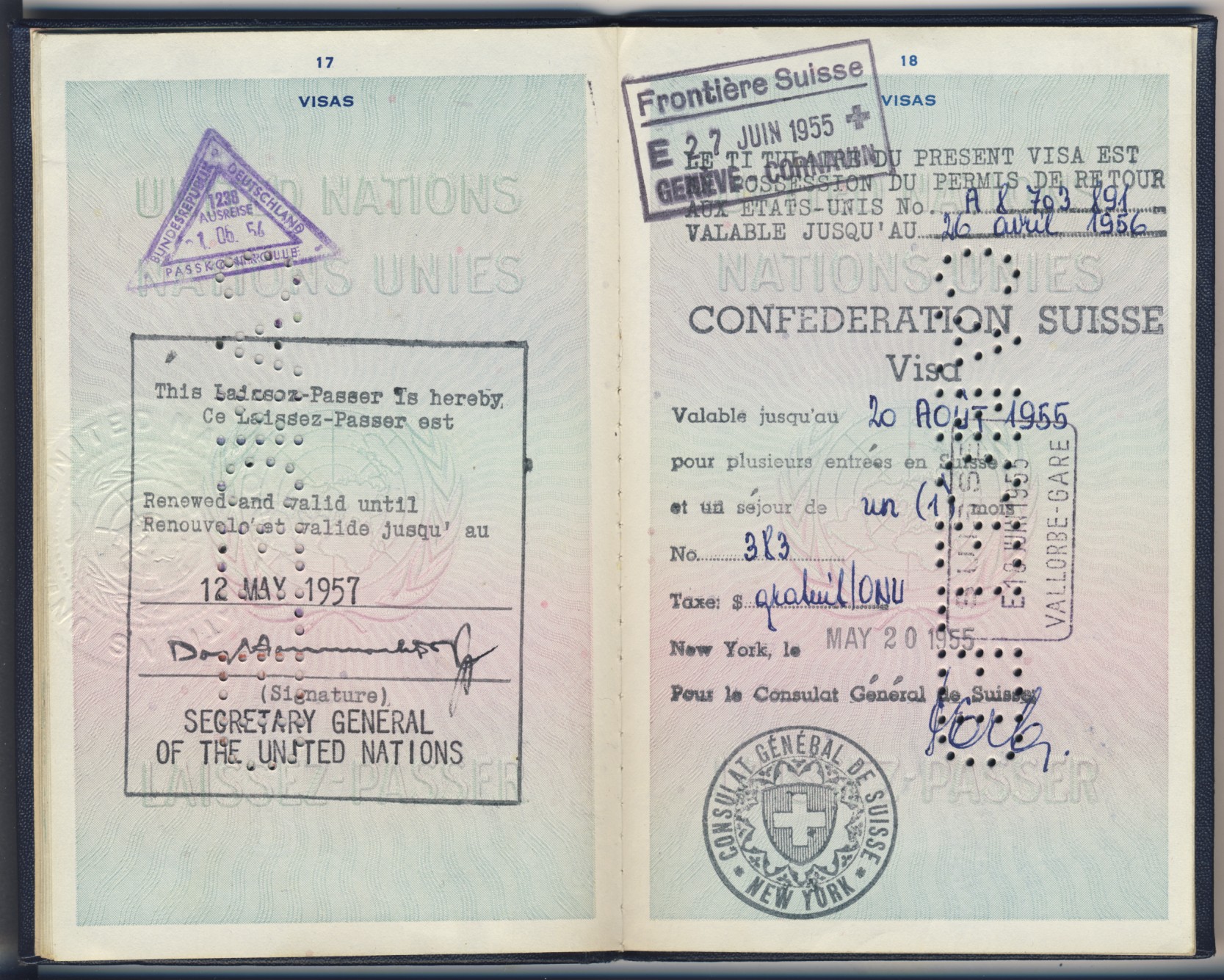
From 1949 to 1951, Vlado was working for the United Nations in Indonesia, during the time of independence from the Dutch. Due to the complications of being a political exile from Czechoslovakia, Vlado had only a temporary passport – until October 1952, when he finally received his UN Laissez-Passer. Here is one alternative ID, a ‘Tourist Introduction Card’ from the Government of India:
India Tourist Card
India Tourist Card II
Sumitro Djojohadikusumo (not to be confused with General Sumitro)was the only Indonesian with a doctorate in economics after independence in 1949, and had been Deputy Head of the Indonesian delegation to the UN Security Council, so he and Vlado were colleagues. While going through the 1951 box of papers again, I found two letters – one for Vlado’s sister and one for his mother, with Indonesian letterhead, handwritten and signed by Sumitro. It shouldn’t surprise me that Sumitro came to be friends with Vlado and his family, and that their example of kindness moved him to open his heart to others, but I had no idea how fond he was of Vlado’s sister!
Sumitro letter Olinka

Stockholm, June 15, 1951

Merea Guerida,

Enfant-terrible? Non, – enfant cherie with eyes as lovely as ever to remember and a voice as sweet as ever can be: sweet, soft and gentle –

You asked me (“a penny?”), when I wrote those words in my brochure what I referred to: a general truth, people in Indonesia or personal reflections? I think it was a combination of all three. You see, I have long learned to see situations of Indonesia always as an integral part of a general trend, the strive for betterment, the urge of mankind for improvement and progress, although many times specimens of mankind itself seem to turn the clock back more or less deliberately. Nonetheless, all of us individually have our responsibility as to the fate of others —

Sumitro letter Olinka II

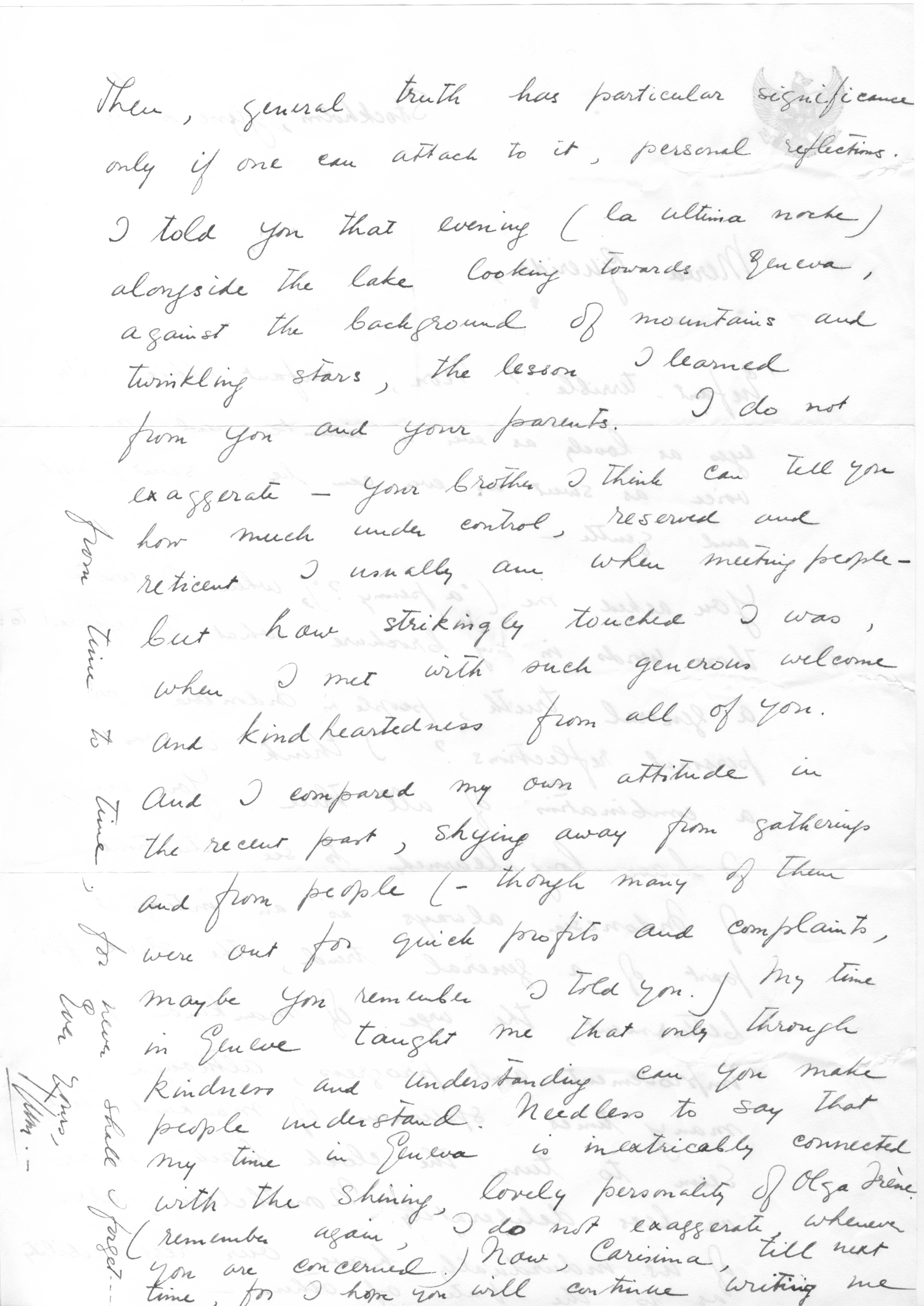
Then, general truth has particular significance only if one can attach to it, personal reflections. I told you that evening (la ultima noche) alongside the lake looking towards Geneva, against the background of mountains and twinkling stars, the lesson I learned from you and your parents. I do not exaggerate – your brother I think can tell you how much under control, reserved and reticent I usually am when meeting people – but how strikingly touched I was, when I met with such generous welcome and kindheartedness from all of you. And I compared my own attitude in the recent past, shying away from gatherings and from people (- though many of them were out for quick profits and complaints, maybe you remember I told you.) My time in Geneve taught me that only through kindness and understanding can you make people understand. Needless to say that my time in Geneva is inextricably connected with the shining, lovely personality of Olga Irene. (remember again, I do not exaggerate, wherever you are concerned.) Now, Carisima[sp?], till next time, for I hope you will continue writing me from time to time, for never shall I forget….

Ever Yours,
Sumitro

Here is the letter he wrote to Mrs. Fabry, with an apology regarding Vlado’s sister:
Sumitro letter Mrs Fabry

Dear Mrs Fabry,

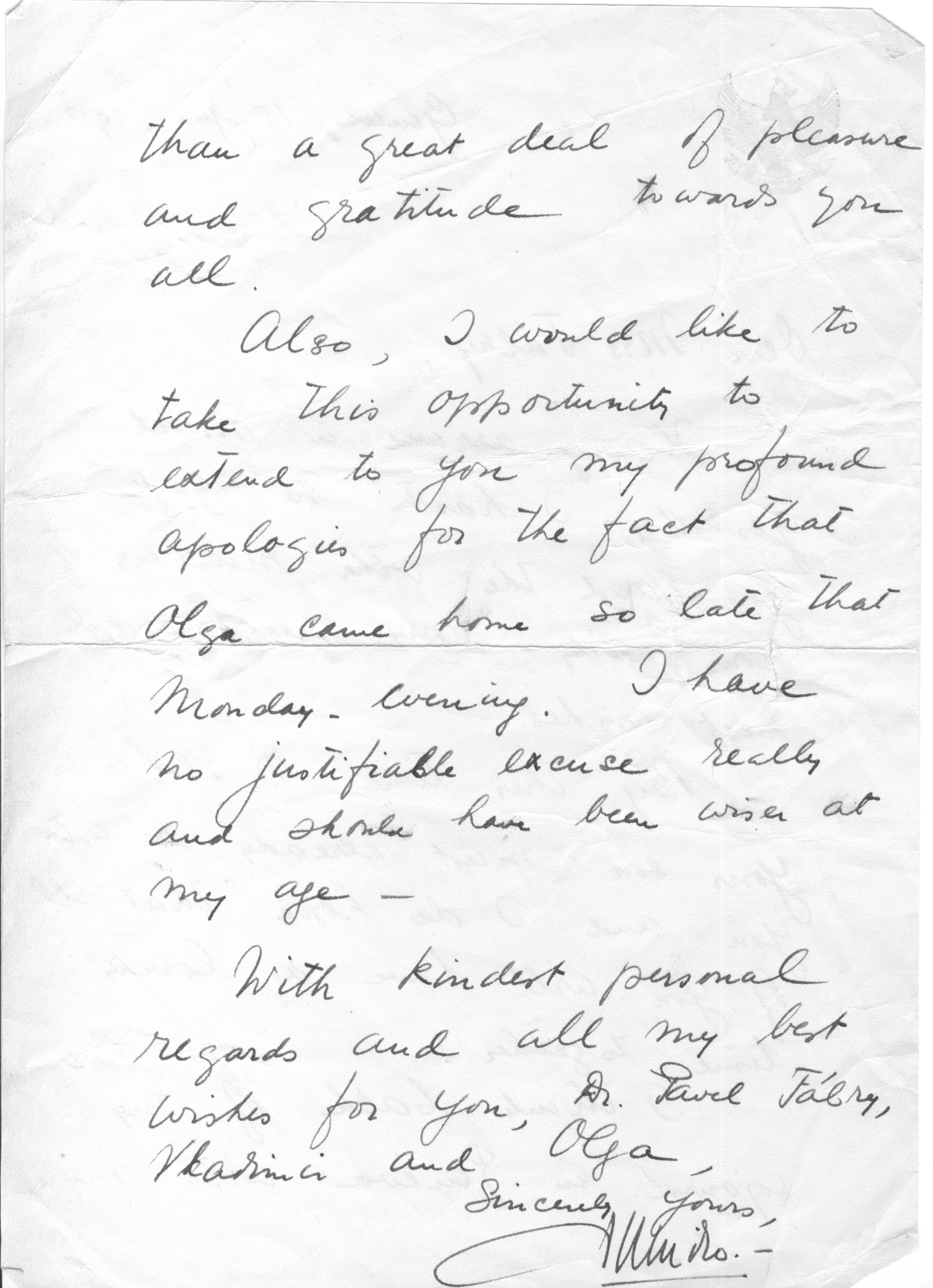
Having arrived in Stockholm yesterday I hasten to send you and the other members of your family, my greetings and best wishes. By this time Dr Vladimir, your son must already be with you and I do hope that all of you will have a lovely time together. I think back of my sojourn in Geneva with more than a great deal of pleasure and gratitude towards you all.

Sumitro letter Mrs Fabry II

Also, I would like to take this opportunity to extend to you my profound apologies for the fact that Olga came home so late that Monday-evening. I have no justifiable excuse really and should have been wiser at my age — With kindest personal regards and all my best wishes for you, Dr Pavel Fabry, Vladimir and Olga,

Sincerely yours,
Sumitro

I wonder if Sumitro got a scolding at the door from Maminka? He didn’t sound very sorry about coming home late in his letter to Olga!

Help with Slovak Translation

“Sometimes the key arrives long before the lock. Sometimes a story falls in your lap.”

–Rebecca Solnit “The Faraway Nearby”

Olinka at Christmas

Though it is clear that I love the Fabry family very much, what might be difficult to believe is that I was not accepted by my mother-in-law, Olinka, and that I only met her once before she died. As much as I wanted to know her, there just wasn’t enough time, and I was very sad about that. So, you can understand how these papers have been a gift to me, to be able to get to know who Olinka was, to understand why she was difficult and the hell she had been through – I think of her with compassion and forgiveness.

Besides being a great cook(see photo above), one of the qualities I admire most about her was her skill at many languages – she was as gifted as her brother Vlado.

Here are a few pieces of ephemera from Olinka’s career:
Olinka ephemera

It would have been easy for her to translate this document from the Prison de Saint Antione in Geneva(which is now the Palais de Justice), dated 1949, but it is not so easy for me. Who was in the prison? And why? Was it her father, Pavel? I am posting this here in hopes that Slovak readers will want to contribute a translation, if only to ease my curiosity. Please help!
(click image to enlarge)
Prison de Saint Antione

Vlado and Don and Marty and the Czech Ambassador

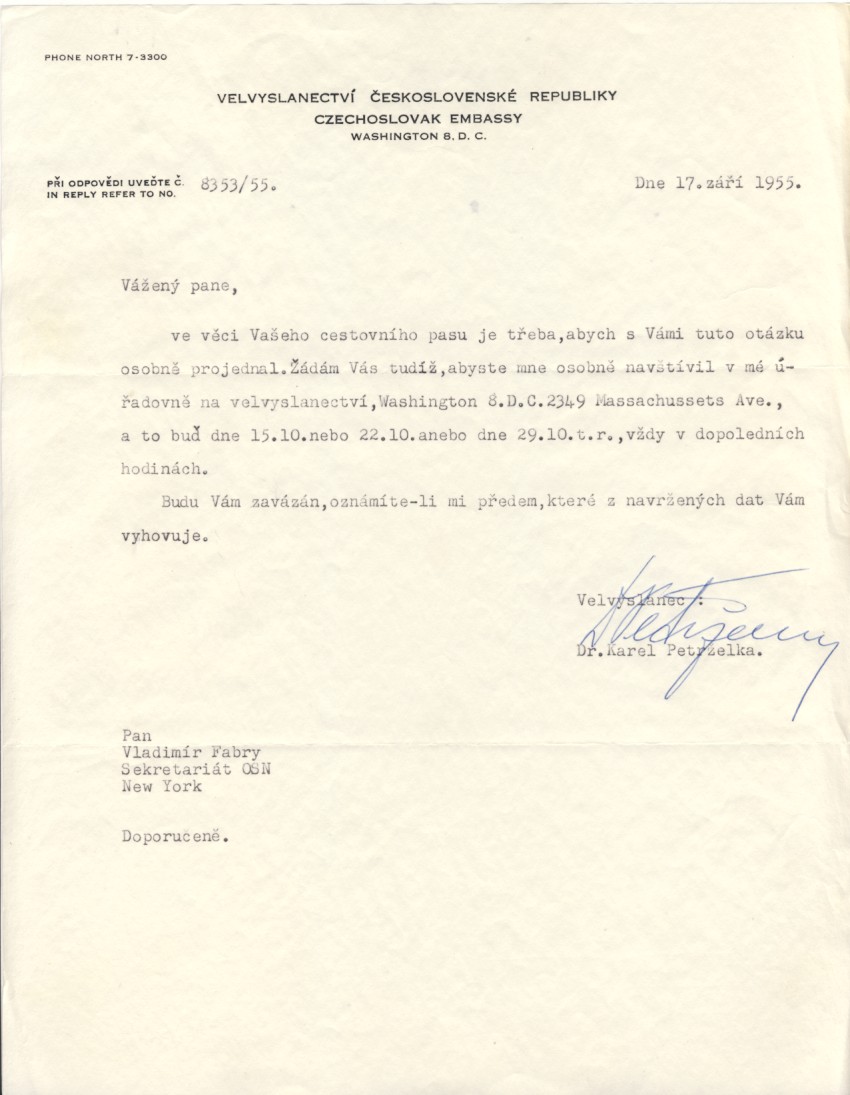
It’s been a while since we’ve heard Vlado’s “voice”, so here are a few letters between him and his friends, Don and Marty Davies, from 1955. Their fondness for Vlado is obvious, but it was Marty who wrote these wonderful letters. We don’t get to learn exactly what happened to the Davies car, but there was an accident on the road to La Berarde; and Vlado was being a know-it-all about the altitude of Col d’Izoard with Don, which prompted a “scolding” from Marty. Vlado refers in one letter to a dispute with a Czech Ambassador in Washington about his passport renewal, and I have included scans of the documents in regards to that. Also included are the condolence letters from Don and Marty to Vlado’s mother and sister, from September 1961.

But first, a few photos of the Davies in Geneva – at the UN Palais and Parc de Eaux Vives – and one with Maminka.
Don and Marty Davies Geneva

Don and Marty Davies Parc de Eaux Vives II

Don and Marty Davies Parc de Eaux Vives

21/II/1955

Dear Don and Marty,

you might remember the little Indian chappie called Radhakrishnan who was precis-writer for the GOC and UNCI (if you still remember what that stood for!) – he used his savings from various currency operations etc to make a trip to New York and was taken by Foster to see the Empire State Building. Asked for his impression, he said simply: “It reminds me of sex.” Poor Foster speculated for a while about the symbolic implications of that comment and finally asked point blank for an explanation – which was “but everything reminds me of sex.” Mutatis mutandis (and there’s quite a bit of mutatis, I hasten to add) I’m in the same predicament – everything seems to remind me of the Davieses. To start with – a year ago was the momentous date when I tried to introduce you to the noble sport of skiing and found a response enthusiastic beyond all my expectations; also, last weekend I spend at Mrs Cornwall’s Lodge in North Creek,- although this time both days were perfectly sunny and there was no need to have recourse to crossword-puzzles; going up I was caught speeding practically at the same spot as when we drove up to make our concerted attack on Mt. Marcy:- happily I was able to talk myself out of it; and so on ad infinitum. In other words, I miss you.

I started the New Year with a rather successful party, featuring the traditional roasted pig without the corresponding (also traditional) stinked-in apartment,- but things started going wrong thereafter. I tried to cold-shoulder an infected throat, hoping that the infection will get disgusted and leave if I don’t pay any attention to it, and ended up with a bad bronchitis which kept me at home for two weeks. It may have lasted longer but for the fact that at the end of two weeks came the weekend when I was assigned by the Appalachian Mountain Club to lead a 15-mile crosscountry excursion, my first leading assignment and so I decided to do my duty, fever or no fever. It turned out to be a blizzard day, and breaking tracks through two feet of new snow with a fifty pound rucksack on my back proved to be just the right medicine for my bug,- they took flight in absolute panick even before we finished the trip. I hope I discouraged them permanently from trying to return.

Your postcard from Garmisch had the foreseeable effect, it made me turn a proper green with envy and spoiled my working efficiency for the rest of the day while I was mulling over in my mind the more pleasant alternatives to my enforced location behind a steel grey desk in a steel grey room under a steel grey sky. Would also be interested to know how you made out in Vienna – bit of home territory for me, you know-, whether it was able to shower on you a sample of its old-time Gemuetlichkeit. Don’t take all your vacation time now – I am still hoping that I may get some assignment to Europe this year, and this time I would like to spend a bit more time with you than last year.

My office activities got somewhat expanded into related channels. I was elected representative on the staff committee, i.e. made a shop steward in our trade union,- I have the smallest unit in terms of number of staff but the only one who represents three Under-Secretaries; and I got stuck with the chairmanship of the UN Ski-Club..- Lonely Hearts Club would probably be really a better name, we have 97 girls and 14 men as members (not to speak of some married couples),-some of the girls quite charming little things [but] I still have a lot of troubles chasing after my bachelor-friends and trying them to induce to come as guests on our weekend excursions. I am probably getting to be known as a hopeless lecher, arriving every weekend to a ski-lodge with a carfull (up to six) of different girls. Good thing I have my visa in the bag, I would never have gotten through the investigation after this.

Remember me to your father, please,- you don’t know how wonderfully comforting it felt to know there are kind and thoughtfull people who not only are willing to help us, but will go out of there way in doing so and in taking the initiative themselves. In your words of the understatement of the year: Nice guy, really. God bless him.

With best wishes to you all-
Vlado

***********************************************************************

25 May 1955

Dearest Vlado —

Don’t you suppose you could take Mr. Hammarskjold aside and explain that a very important mission takes you to Europe practically immediately, it is a mission in the best interests of the UN, peace and the fellowship of mankind. You know, the usual sort of stuff. You will be happy to report to him personally of your findings and recommendations. This is by way of telling you our time is up, almost. Plans of this moment are for our departure the twenty-second of June for –guess?? Algiers. Don is going to be something called Public Affairs Officer, much better than visa-stamping, but Algiers is not Paris. Since the French insist the problem there is an internal one which does not concern the UN I fear we can’t expect to see you there. I’m so sad. Paris is heavenly even if it is gray and rainy all the time. It is a divine, divine city and I don’t want to leave.

My only hope of getting you over here before we leave is to tell you we’re making the grand tour south to Marseille, to make you so envious you can’t bear the thought of our doing the Route d’Ete via the Col d’Isere, Col du Galibier, Col Izoard so we can see Briancon and Barcelonnette and you’ll come over to drive south with us. Oh, I know, I know, this isn’t by any means the route to Marseille. We’re going to Vienne for dinner and theatre in the amphi—-. What else can you do in an amphitheatre except theatre? And then we do the mountains. Suddenly, unexpectedly inexplicably Don has taken a fancy to mountains. He like them. Does this sound reasonable to you? Me, neither. I’ve just wound up ten pages to the family which sort of explains the typing, I’m typed out but I’m hoping that with sufficient warning of what is in the wind you will take a plane this way. Not only has Don taken a fancy to mountains, he is also fancying sightseeing. This is not to be believed. He drags ME sightseeing. For an entire year I’ve been apologizing at the same time I’ve been insisting on seeing things. Don used to go wash the car while I did churches or chateaux. Now he has the bug and it has bitten him badly. Won’t you come? Can’t you come? Don’t you think your family would like to see you?

We had such a nice visit with your family one evening ages ages back. I was then going to write you immediately to tell you how well he looked and how full of beans and plans he seemed. Goodness he is such a cutey. We’ve both got pretty sweet fathers. I’d be willing to bet he is all hot and bothered about the possibilities in Czechoslovakia now that Austria has been released. My poor darling of a Pop, though, just when he was getting all set to come to Europe for a long holiday, had a stroke. The news cut my heart in shreds simply because I couldn’t visualize Daddy as a cripple. I didn’t count on the incredible spirit which moves the old boy. Nothing is impossible. At his age, with his heart he has stunned the doctors. Instead of spending the entire summer in California as they has thought necessary, they leave for home the middle of June with Pop back on his feet, navigating, weakly, true, but determined that this will not stop him. The subject of a trip to Europe has been brought up again….He belongs to a tougher breed than any of his children.

Italy was great fun. Another time I’ll forget the existence of Rome which is a dull and singularly unattractive city and just concentrate all travel in the north of Italy. Those wondrous hill towns, each more delightful than the next….The news of the move to Algiers was here on our return. Fine thing to come home to.

Love, m.a.

*******************************************************************

Hotel St. George
Alger
6 July 1955

Dearest Vlado —

Don has had his scolding; it is now your turn. The two of you were acting like a couple of children. This has absolutely nothing to do with the incident on the road to La Berarde. It was an “accident” in the real sense of the word, unexpected, unavoidable, unpremeditated. Pfft, we forget about it.

But, Vlado, what earthly difference does the precise altitude of the Col d’Izoard make? What great importance does St. Andre’s location on or not on a lake make? There are times when exactitude is frightfully important and insistence upon upmost precision may mean the difference between life and death. But, when Don reads from a travel folder that the Col d’Izoard is blank number of meters high and you flatly contradict him, he can only think that you think he is a stupid oaf because you know the Col is at least blank plus X. I know your reaction because it is one I’ve had to discipline myself to overcome. Fourteen years of discipline because I don’t want to contradict Don and be rude or hurt his feelings. I’ve had to learn that if I disagree or know Don’s position is not right, I must find a way around answering him that will not be contradicting him. Often it means keeping my own counsel if the matter has no great significance; at other times the subject has to be tossed around indirectly until Don sees by himself. Flattery works much better than insult and contradiction often sounds like insult. Contradiction makes conversation impossible….I could watch Don hedging his ideas to protect himself from being pounced upon, hedging them in such a way as to be completely meaningless and thus making himself look exactly the way you made him feel……..Therefore the sullen clouds.

I know now why three squabbling children used to get on Mother’s nerves — yes it is, no it isn’t, it is too, it isn’t either, you’re crazy, I am not, you are too and on and on ad nauseum. And that’s the end of the scolding. Let’s forget it too.

I’ve been told no mountain-climbing here before October, so, unless you can be persuaded to postpone your next summer holiday until Fall, we probably wont see you again till we get home on leave….Thank you for Moustiers Ste. Marie and the very thoughtful call to Marseille. Without you we would have known neither.
Love, marty

****************************************************************

23.IX.1955

Dear Don and Marty,

time flies,- it just knocks my breath out when I stop to think that it is three months since I waved you good-bye at the Roches Blanches in Cassis,- it still seems like last week. I better start recapitulating what I did since to realize how much time I let go by before writing you.

I had a lovely week with mother, Olga and a friend of hers in the Dolomites – each early morning I popped off for a climb while the ladies were resting and picking wild-flowers, and by the time the clouds started gathering in the afternoon, I was back and off we went to the next place. I stopped for a few days of skiing in Cervinia,- went up the Breithorn /4200m/ on skis in shorts, and was roasting through my seventh skin with a tan which even now is still around. Was joined by some friends, fellow-climbers from the Appalachian Mountain Club, in Chamonix for a week’s climbing in the Aiguilles, interspersed with afternoon picknicks in the valley in which Olga and another girl joined up. And then the vacation was over with a blow and back through an empty Paris bereft of your presence and on to New York. Stops in Iceland and Gander, with temperatures near freezing and icy gales, a cold /non-pressurized/ plane, and the shock of landing in New York on the hottest day of the year, and being left standing in our warm clothing and weighted down by assorted luggage on the blazing hot concrete apron in the middle of the relentless afternoon sun. Struggling with heat and humidity through a rather erraticly[sic] unpleasant summer, to be relieved only by the blow and deluge of hurricanes. Apartment hunting /my South-African landlords decided not to have any babies for a while and gave up their “maternity ward” apartment, forcing me to look for a new one/ – but found a very nice place /apt.14-D, 2, Beekman Place, N.Y.22/ a stone’s throw from the office, high up, with unencumbered view over the East River, with the green of the UN garden right under me, bookcases lining not only the living-room and study, but also the bedroom up to the ceiling, and plenty of air,- and I managed to push the price down to 125 a month which is still within my means. A couple of weekends at the shore and one in the White Mountains, and then I took up rock-climbing again and am now hard on it, climbing every weekend. Am spending most of the evenings getting acquainted with the book supply,- see very few people.

Soon after my arrival in New York I was called by my former neighbour from Riverdale, who has taken over /together with three other associates/ the controlling interest in the Muldrow Aerial Survey Corp., a well-established company producing geological maps, surveys, etc. He offered me a job as the manager of their subsidiary company in Calgary /a Canadian corporation/, at a salary of $1.000 monthly, 2% of the sales /another $1.000 monthly/ and expense account including car, club memberships, etc. It was a very tempting offer – it would have meant considerably higher earnings /some 500 $ more monthly after taxes, taking into account that some of my present expenses e.g. car would have been borne by the company/, and a chance to get into private business a few stories about the ground-floor level. However, after a lot of thinking, I refused the offer. Immigration told me that as an employee of a Canadian corporation, I could not maintain my american residence for purposes of acquiring citizenship; the higher earnings seemed more than outbalanced by the lesser security of the job /I had my permanent contract here confirmed, and I have a promotion “in the works”/; the prospect of spending my working day in selling was rather dismal when compared with the pleasure and stimulation that my present job gives me; and last but not least, the prospect of exchanging my independent private life for one where I would have to keep up with the Joneses, backslap prospective customers and be a gregarious “regular” fellow seemed gloomy indeed. So I guess I shall remain an international civil servant for some time to come – offers like that are not falling from heaven each day.

To end this long egotistic tirade – I just had received a registered letter from the Czech Ambassador in Washington asking me to set a date at which it would be convenient to discuss with him personally the question of renewal of my passport /a similar letter was also sent to other emigrees in UN employ/. This is one of the occasions where I wish I was not an international civil servant bound by the rules of diplomatic curtesy[sic] towards an official of one of the Member-governments, so that I could answer the letter in a language appropriate to the occassion!

Before I close, there are two things I want to do. First, to apologize for my behaviour at the Route des Alpes,- I am sincerely sorry to have so stupidly spoiled such a nice trip, and my only and true excuse is that I did not realize what I was doing. My thanks to Marty for opening my eyes. Secondly, to inquire after the health of Mlle. Fregate and about the status of her doctor’s bills – did the insurance company pay up?- Because if not, my offer to cover them still stands, and I will feel much better with a slimmer bank account and a quieter conscience than the other way around. So please let me know.

All the best and lots of love – Vlado

*************************************************************

These four documents were paper-clipped together. Click to enlarge.

Here is the letter from Czech Ambassador Dr. Karel Petrzelka:
Czech Ambassador dispute 1955 IV

A copy of Vlado’s reply to the Ambassador:
Czech Ambassador dispute 1955 III

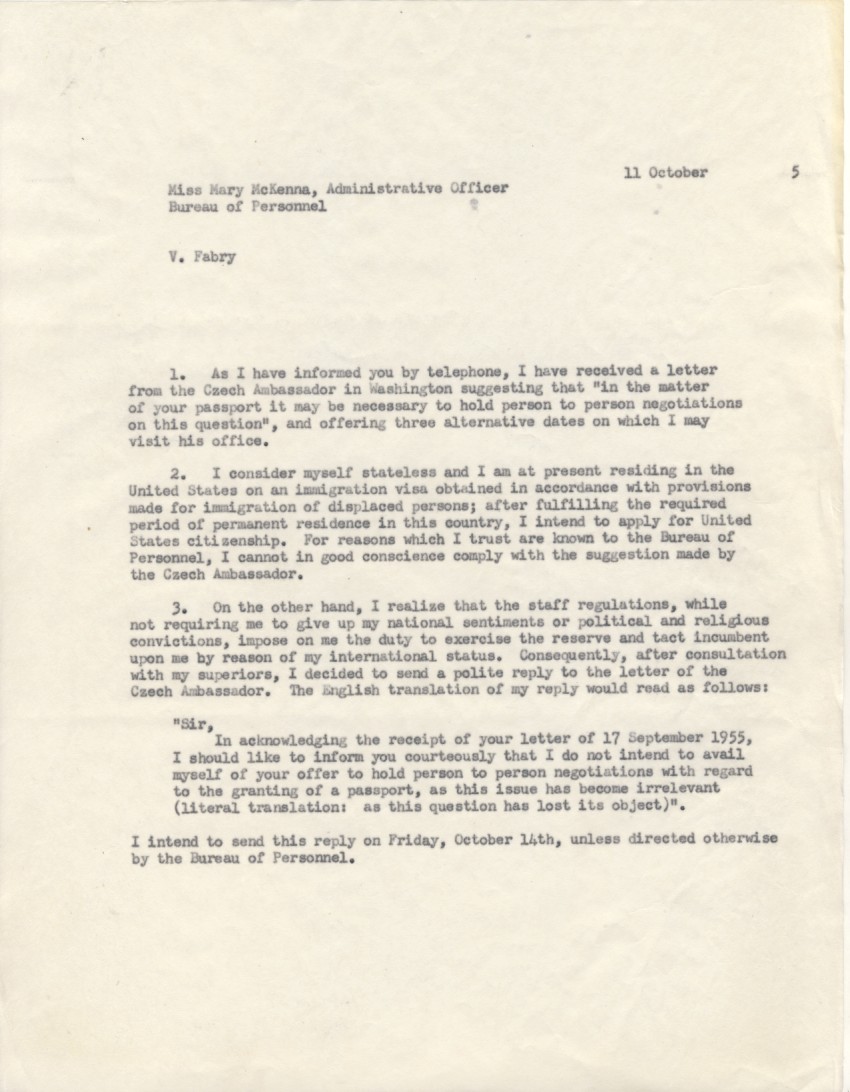
Here is a letter to Administrative Officer of the UN Bureau of Personnel, Miss Mary McKenna, asking if there are any objections before he sends his reply.
Czech Ambassador dispute 1955 II

11 October

Miss Mary McKenna, Administrative Officer
Bureau of Personnel

V. Fabry

1. As I have informed you by telephone, I have received a letter from the Czech Ambassador in Washington suggesting that “in the matter of your passport it may be necessary to hold person to person negotiations on this question”, and offering three alternative dates on which I may visit his office.

2. I consider myself stateless and I am at present residing in the United States on an immigration visa obtained in accordance with provisions made for immigration of displaced persons; after fulfilling the required period of permanent residence in this country, I intend to apply for United States citizenship. For reasons which I trust are known to the Bureau of Personnel, I cannot in good conscience comply with the suggestion made by the Czech Ambassador.

3. On the other hand, I realize that the staff regulations, while not requiring me to give up my national sentiments or political and religious convictions, impose on me the duty to exercise the reserve and tact incumbent upon me by reason of my international status. Consequently, after consultation with my superiors, I decided to send a polite reply to the letter of the Czech Ambassador. The English translation of my reply would read as follows:

“Sir,
In acknowledging the receipt of your letter of 17 September 1955, I should like to inform you courteously that I do not intend to avail myself of your offer to hold person to person negotiations with regard to the granting of a passport, as this issue has become irrelevant(literal translation: as this question has lost its object)”.

I intend to send this reply on Friday, October 14th, unless directed otherwise by the Bureau of Personnel.

And a message to Vlado from Mary McKenna: “The Office of Personnel has no objections to your letter to the Czech Ambassador but we do not, of course, accept the responsibility of approving it.”

Czech Ambassador dispute 1955

*******************************************************************
And now, the letters of condolence from Marty and Don:

1908 Belmont Road, N.W.
Washington 9, D.C.
27 September 1961

Nos tres cheres deux Olga,

This morning we laughed again at the mad escalade of Mt. Marcy in the company of Vlado. This evening at dinner we wept for the morning’s excruciating frivolity. Don returned from the office this evening to tell me that his worst suspicions had been confirmed; that the Fabry on the Hammarskjold plane was indeed Vlado.

How could it be, and, yet, how could it be otherwise, for so long as we have known dear Vlado he has been where the UN was having to handle difficult problems. The excitement, the intellectual challenge and the demand upon resources of courage both physical and moral — where else could Vlado be expected? Right there. And Don said this evening he felt that Vlado was merely a younger Hammarskjold, that everything which made Hammarskjold’s loss so irreparable could be repeated in Vlado’s case. Only Vlado, well, Vlado is a very dear and cherished person whom we were privileged to call a friend and whose family we have come to love as our own. Our sense of loss is that of a member of the family.

Our own desolation can be but very little in terms of your own. Vlado was so much more than son or brother; he was your guardian angel, bringing the family together as he did after it had been so painfully separated and then keeping it together with his enthusiasm, devotion and tender care.

Naturally, we are concerned for you both. Wont you let us have a word from you when you feel you can write. If it would suit your plans or your desires, we have heart and the room to take care of you here with us.

With all my devotion deeply saddened,

Marty

*******************************************************************

Sept. 27, 1961

Very dear friends,

It was not until today that I heard about the other members in Mr. Hammarskjold’s plane, and received confirmation of the identities. My first thought was for you. Where are you and what can we do to help?

I found late today that you both are in Geneva – or at least the telegram said “the family” is there.

We grieve for you and our hearts are with you in this difficult time. You must know, of course, that you have our affectionate sympathy.

Please let us know if we can be of assistance. If you plan to return to the United States perhaps we can be of some help in that way.

We would like to be with you now but since I am on post in Washington and will be assigned here for two more years, we cannot see you at least for a while if you are in Europe. But please let us know if there is anything we can do to ease your problems.

We both send our love. Bon courage.

Donald Davies

Bon Anniversaire, Vlado!

Happy Birthday Vlado

This is my early birthday gift to Vlado, who was born 23 November 1920. Above is a special birthday drawing from Vlado’s father, one of my favorites, showing the United Nations building rising above the clouds.

Much of my impression of Vlado comes from looking at photos, so I thought I should publish more of them, to show how much he loved life. Enjoy!

Vlado the Hero 1942
Vlado the Hero, circa 1942

Vlado in mountains 5
Mountain climbing is a nice diversion from studying law – get this poor kid in a suit some proper climbing gear!

Vlado in mountains 4
Vlado is serene in the Tatra mountains.

Vlado in mountains 3
Bearded in the mountains of New Zealand.

Vlado in mountains 2
Picking Narcissus is the Swiss Alps.

Vlado in mountains
On a hike with a bouquet of flowers!

Vlado dans la plage
Dans la plage avec un livre.

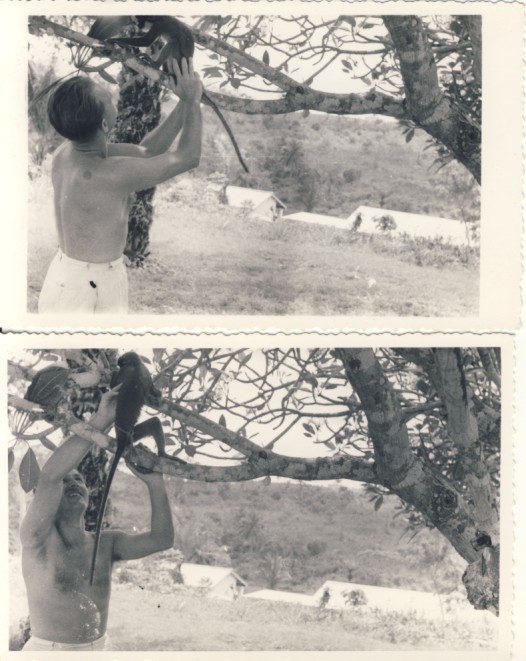
Vlado with monkey Ghana 1956
Making friends with monkeys in Ghana.

Vlado and Tatulo
On a cruise with Tatulo.

Vlado and Maminka 2

Vlado and Maminka
In the mountains with Maminka.

Vlado and Olinka
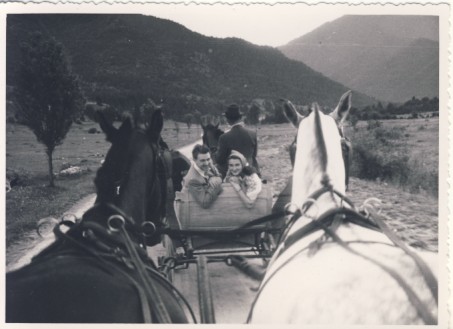
Taking a horse-drawn carriage ride with Olinka in the Czechoslovakian countryside.

Vlado UN 7
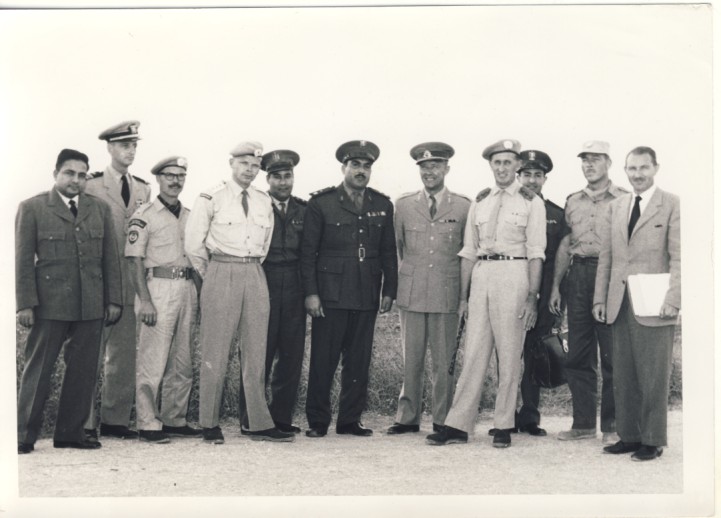
Vlado loved his work with the United Nations. Is this Major General Amin Hilmey II with Vlado?

Vlado UN 6

Vlado UN 5
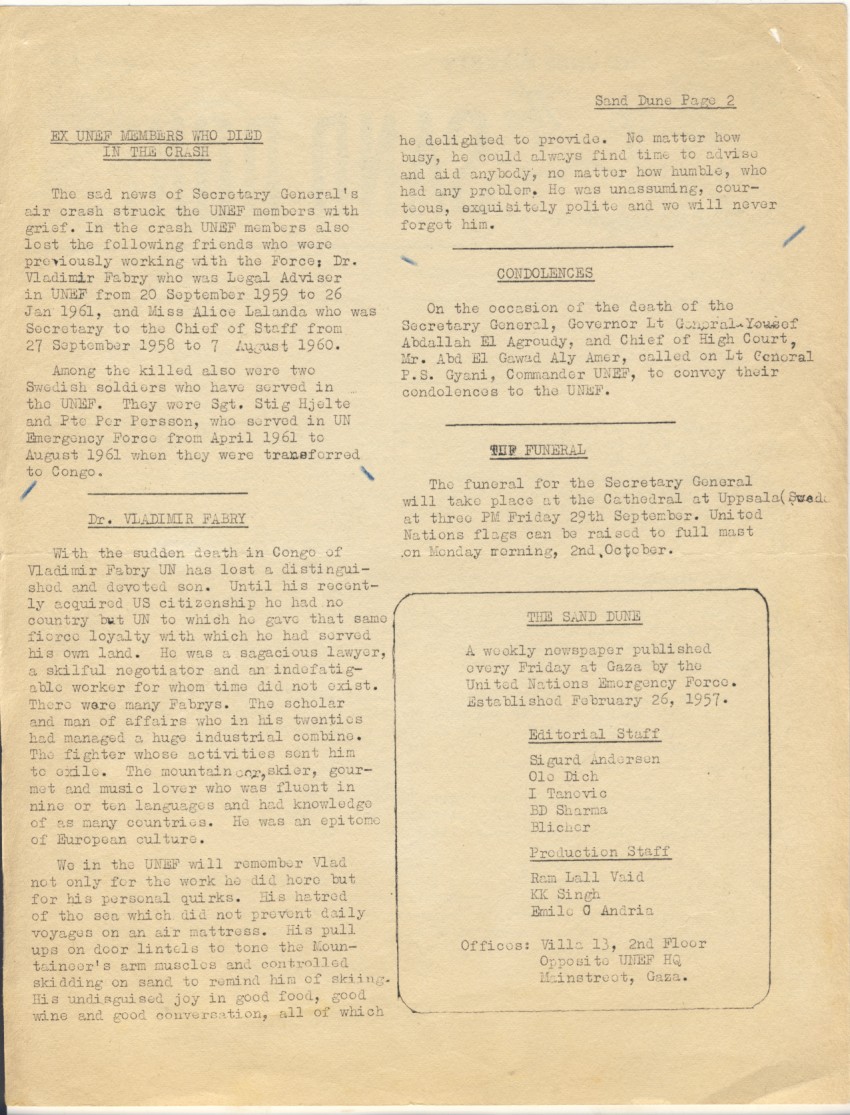
I am still trying to figure out who the people are in these photos, but Vlado looks pretty happy to be there. This may have been in Gaza, having something to do with the UNEF.

Vlado UN 4

Vlado UN 3
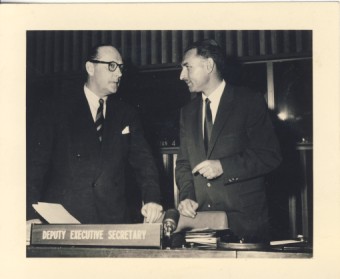
At work at the United Nations in New York.

Vlado UN 2
Steamy in Indonesia.

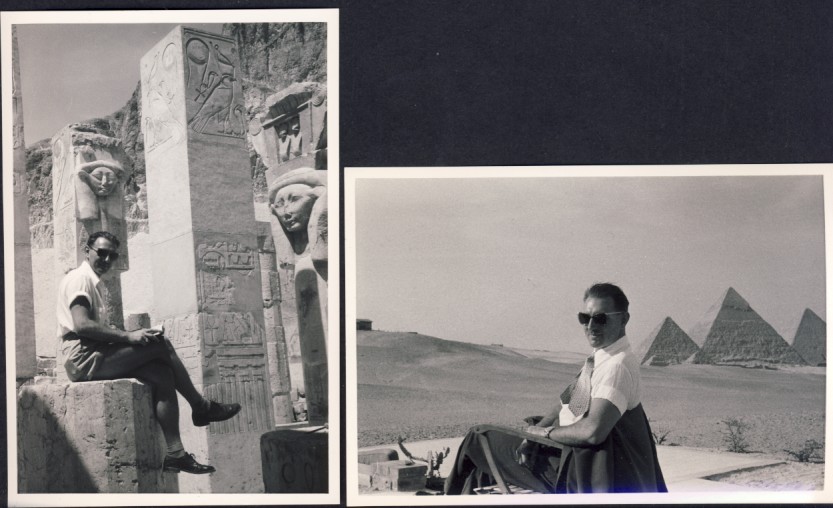
Vlado UN
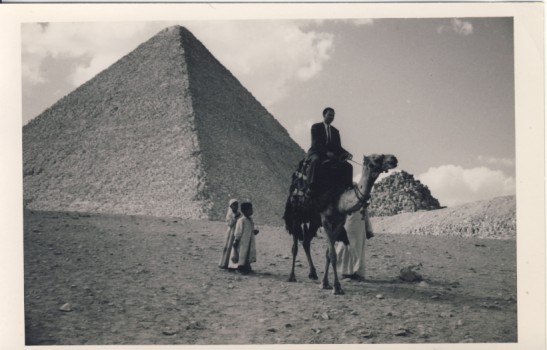
Taking the ‘bus’ in Egypt.

Vlado pret a manger 2
Food was another great pleasure in life – here is Vlado enjoying a typically elegant Swiss breakfast in Geneva…

Vlado pret a manger
…et pret a manger dans les montagnes.

Fabry Family
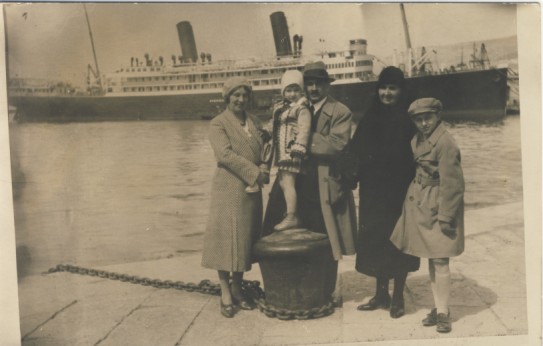
He came from a family that enjoyed life, and enjoyed spending time together. The woman dressed in black is Vlado’s beloved grandmother.

Fabry Family 2
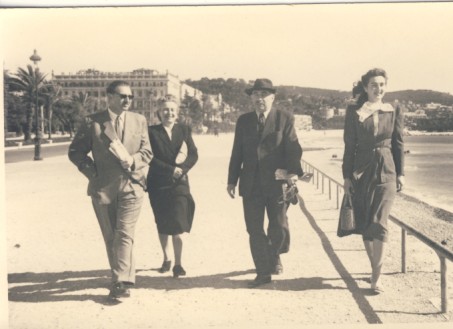
Here are the Fabrys looking fabulous on the promenade – is this Cannes?

Vlado Buick 2
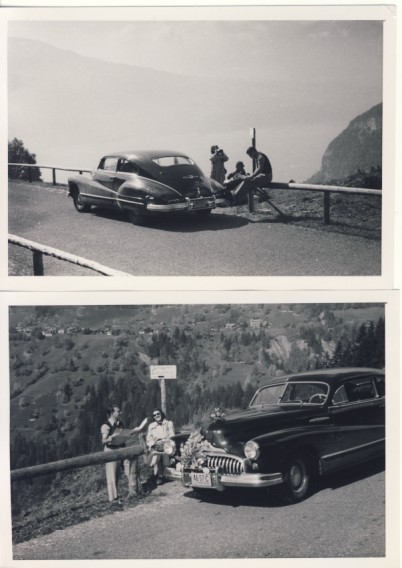
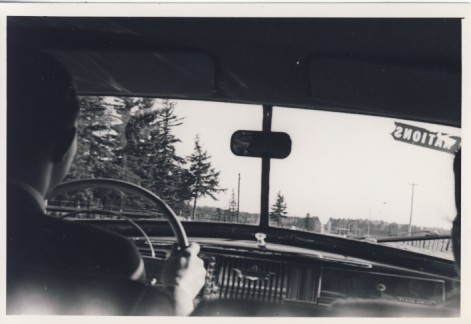
And last of all, a collection of photos featuring Vlado’s Buick, which he loaned out to all his friends whenever they were in Geneva – causing a few disagreements over who used it more than others!

Vlado Buick 3

Vlado Buick 4

Vlado Buick

Like Father, Like Son

Curve of Longing For Family
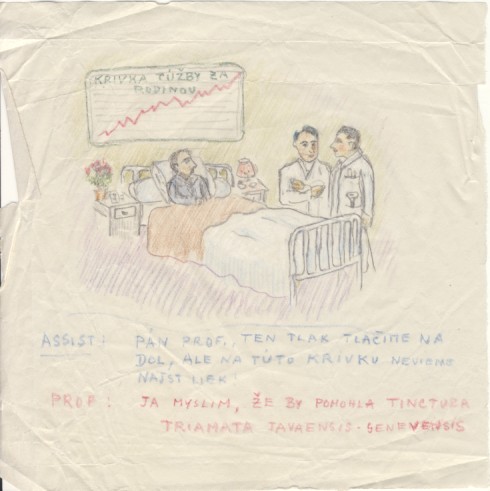
One thing I really admire about Pavel Fabry, is how affectionate he was in the letters he wrote to his family. Here is a little sketch of Pavel’s, with him in a hospital bed, a graph behind him that says in Slovak “Curve of Longing For Family”. The doctors are saying they have no cure for this “curve”, and Professor Fabry says he thinks a “Javaensis-Genevensis” tincture is what he needs. This was likely drawn during the late 40’s – early 50’s – when Vlado was working for Independence in Indonesia, Olinka and Maminka were refugees in Switzerland, and Pavel was in a hospital recovering from torture in a concentration camp, in the now former Czechoslovakia. Pavel’s sense of humor here shows he was living life on his terms, that he followed his convictions, and that he was willing to endure suffering for a just cause – a true romantic.

Fall in Love and Lose Weight
Then there are times when I am a little annoyed with him, like with this undated letter, sent to Vlado around the time he was working on the Suez Canal Clearance project in 1957, most likely before the project was finished. Pavel is telling him that he has to lose weight in two weeks, before their family vacation together (which would end with Vlado coming down with Hepatitis, and the weight loss that came with his illness). Then he says with all the tempting food of the Norwegians, Swedes, Canadians and Indians in the desert, that he would have to ride a horse at full gallop all day just to keep fit. He gives Vlado the advice to fall in love to lose weight, but not too happily, so he doesn’t fall apart at the end of it. Really, as if Vlado didn’t have enough to worry about, he has his father telling him he is too fat and needs to go on a diet! He is right though, that falling in love is great for weight loss, but he must have thought Vlado had some kind of superpowers to find a girl to fall in love with on the spot!

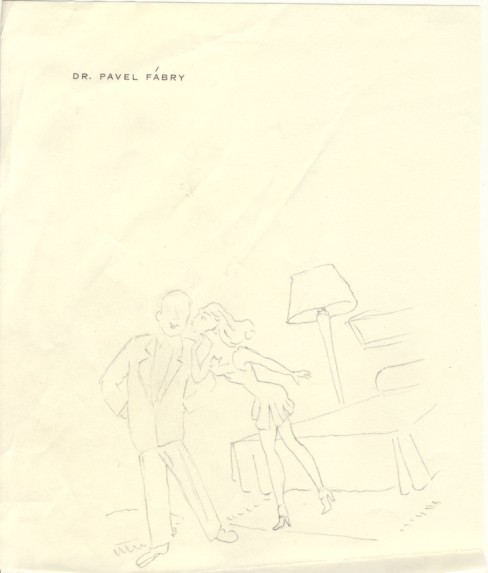
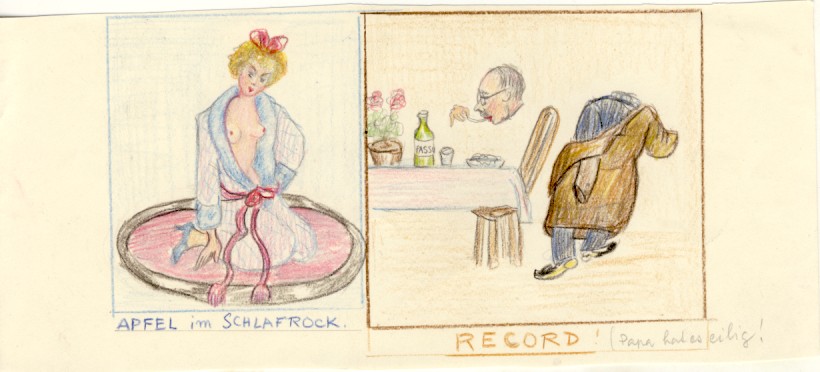
If Vlado was a romantic, it was because Pavel set quite an example for him. Romance was never far from Pavel’s mind, as can be seen in this little boudoir sketch (click to enlarge):
Pavel boudoir sketch
What is she whispering in his ear, I wonder?

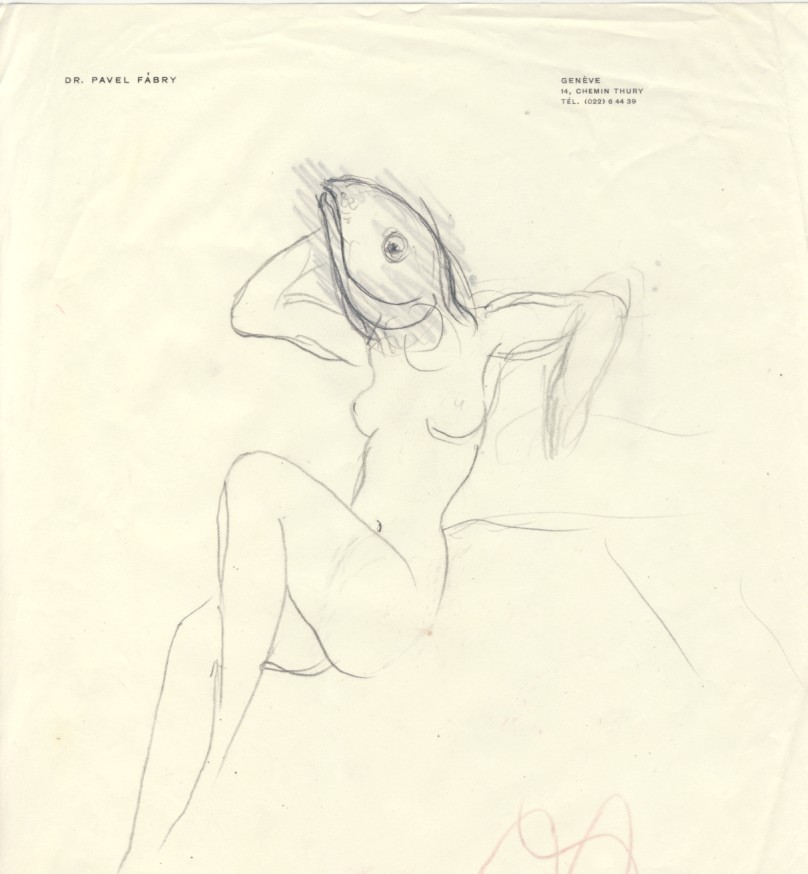
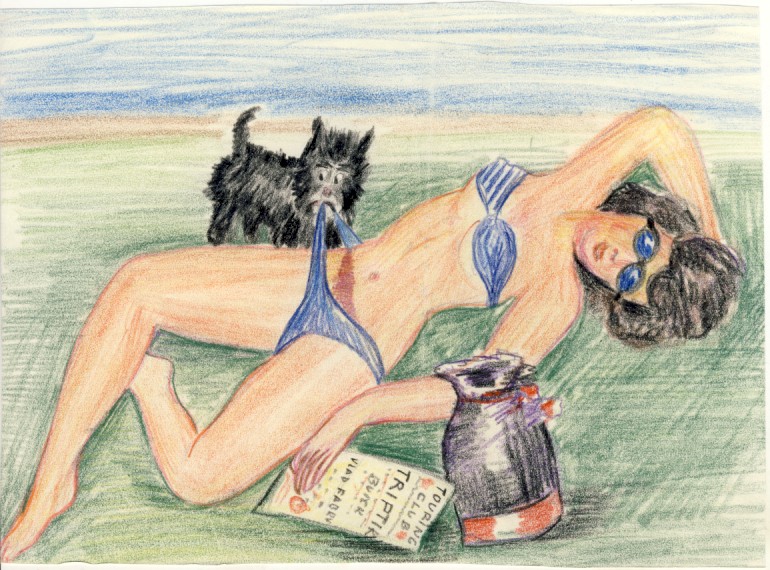
Sometimes, thoughts of love and food were in competition, like in his surreal sketch of a fish woman:
Pavel La Peche

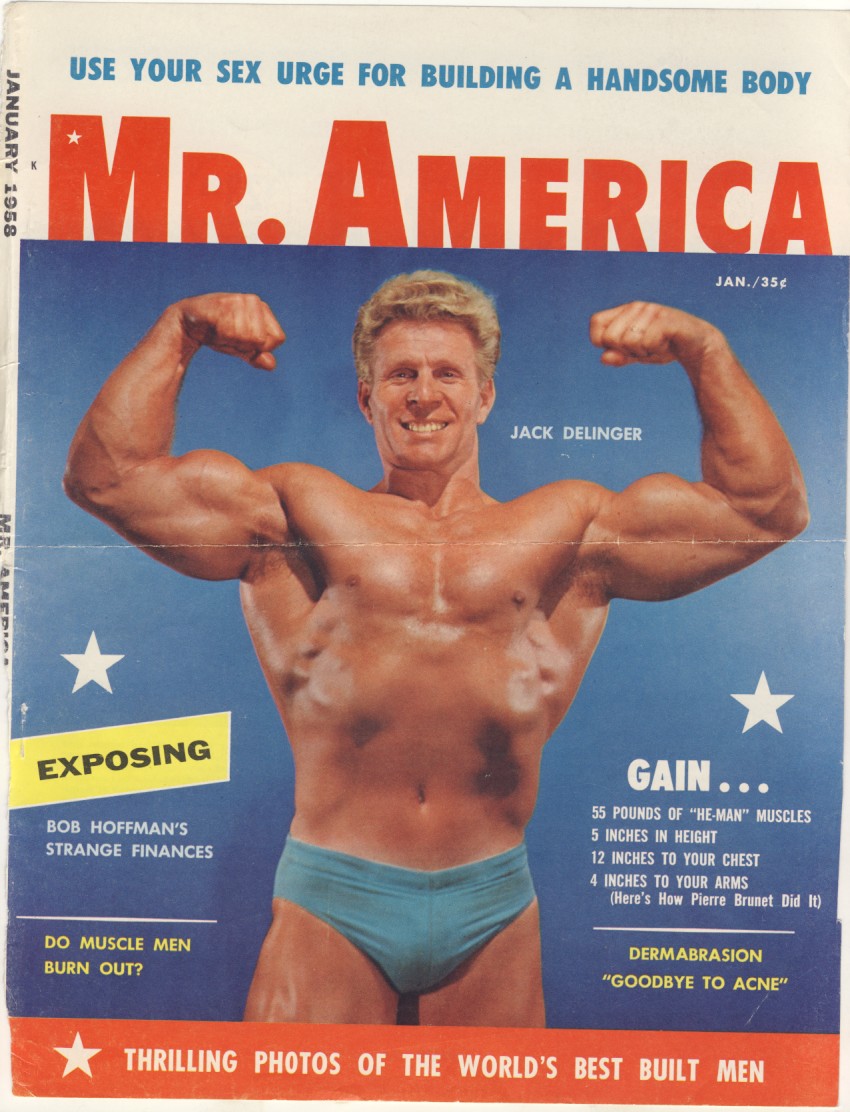
Keeping to the subject of romance, in another post, we read the love letters of Vlado and Mary Liz, with the last letter written in September 1957. There are no more love letters written by Vlado after that, but I found a portion of a Mr. America magazine, from January 1958, with a cover banner that reads “USE YOUR SEX URGE FOR BUILDING A HANDSOME BODY”:
Mr. America Jan. '58

Who knows if Vlado was trying to control his “urge”, or what, but romance may have been distracting him from larger goals in his life. I think Pavel was not much different than Maminka, in that he wanted Vlado to find a nice girl to marry – but I also think he took vicarious pleasure in hearing about Vlado’s carefree romantic life as a bachelor.

Vlado left some heart-sick women in his wake, as is shown in this last letter from 1959, written by a woman who wasn’t over Vlado at all, and whose impending marriage brought to mind funerals and drowning. This letter is more a distress call than anything else, which makes it a very funny read!

March 4, 1959

Dear Vlado,

Now it looks as if I may be in NY at last, but for the most unexpected of reasons – on a honeymoon! Probably, April 12-25.

I’ve been so interested to notice in how many ways marriage is like death! First, probably the only reason so barbarous a rite as a wedding has lasted so long in our streamlined society is probably the same reason the funeral has – i.e. sociologists say that all the transactions involved in planning a funeral take the bereaved’s mind out of the depths & the same goes for the bride, bereaved of her freedom!

Marrying is also like drowning in that you suddenly relive your past – at least your past loves & all my former boyfriends have come parading their images across my minds eye – & I must say, Vlado, that as I go through my card file, choosing addresses to send announcements to, each card brings up a little doubt, but the most difficult card to process was yours! Isn’t that funny, because I had dated other boys a lot more than you & I was just as inflamed over them.

It’s just that when I think of me settling down to air force protocol (he’s in for 10 more years!) I think of your verve; & when I think of those forever churning conversation on the base about TDY’s, PFR’s, ER reports etc., I dream of the day you, Otto & I went to the woods and captured those flagstones in such a unique way!

When I ask my 3 F’s (friends, family, fiance) what they would think of my sort of going to NY to get my trousseau & choose my silver pattern & all, they retort “and get that Czech at the U.N. out of your system? You’d never come back.” I shall always wonder if I couldn’t have made you come crawling & writhing out of your shell (if there’d been time) like a tortoise does when the Indians tie him above the fire so he will squirm into the soup pot! But my fiance says I’d better marry him without travelling to NY, because regrets are better than despair….

This stationary is a memento from our bi-family conclave to plan the bash (it will be April 11 at the ——City Community Christian Church – I dare you to come & stand up when the preacher asks “If there be anyone who denies that they should be married…”). His family is from Texarkana, long time friends of my folks, but we conclaved on neutral ground – in Fayetteville!

I do hope some sort of wife won’t open this letter, although I’m sure she would be understanding; otherwise she couldn’t have married you! But just in case I wish there was something I could say which would make me sure you’d know who sent the letter, so I wouldn’t have to sign my name, but I have a strong suspicion that you’ve taken many a girl hiking in the rain, driven her to help her pack on Bank Street – & even many admirers have sent you wooden pigs & sustenance pills when you were in Africa! So I’ll just have to say,

so long,

———–

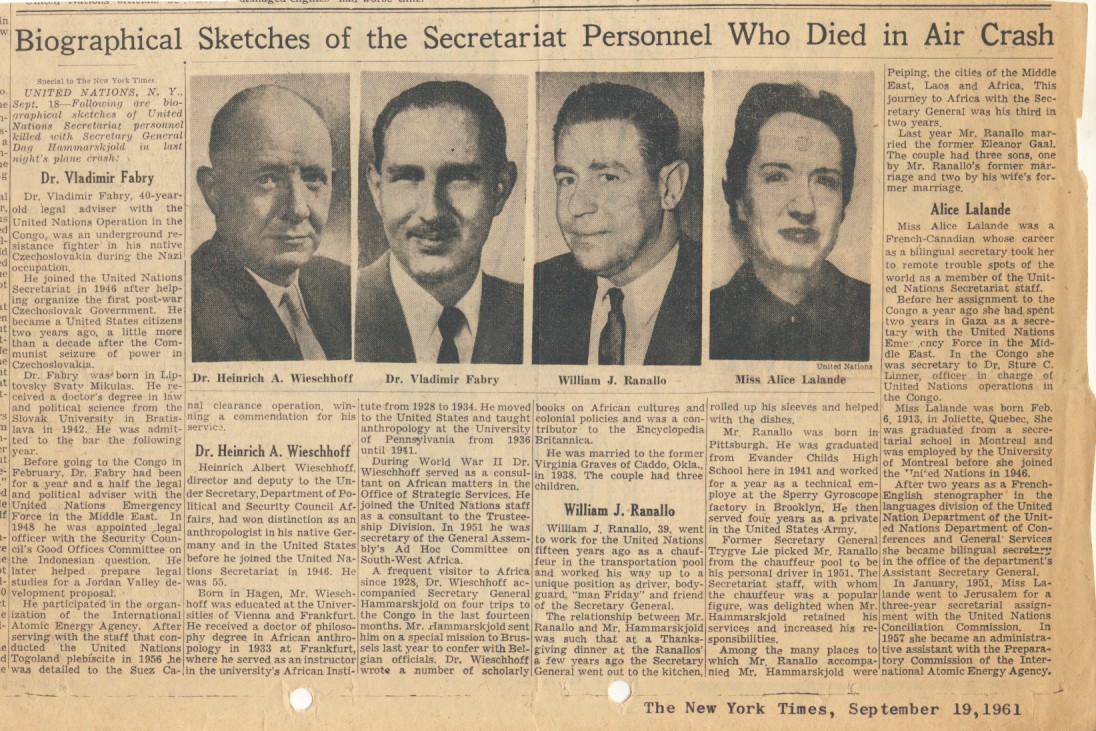
“Biographical Sketches of the Secretariat Personnel Who Died in Air Crash”

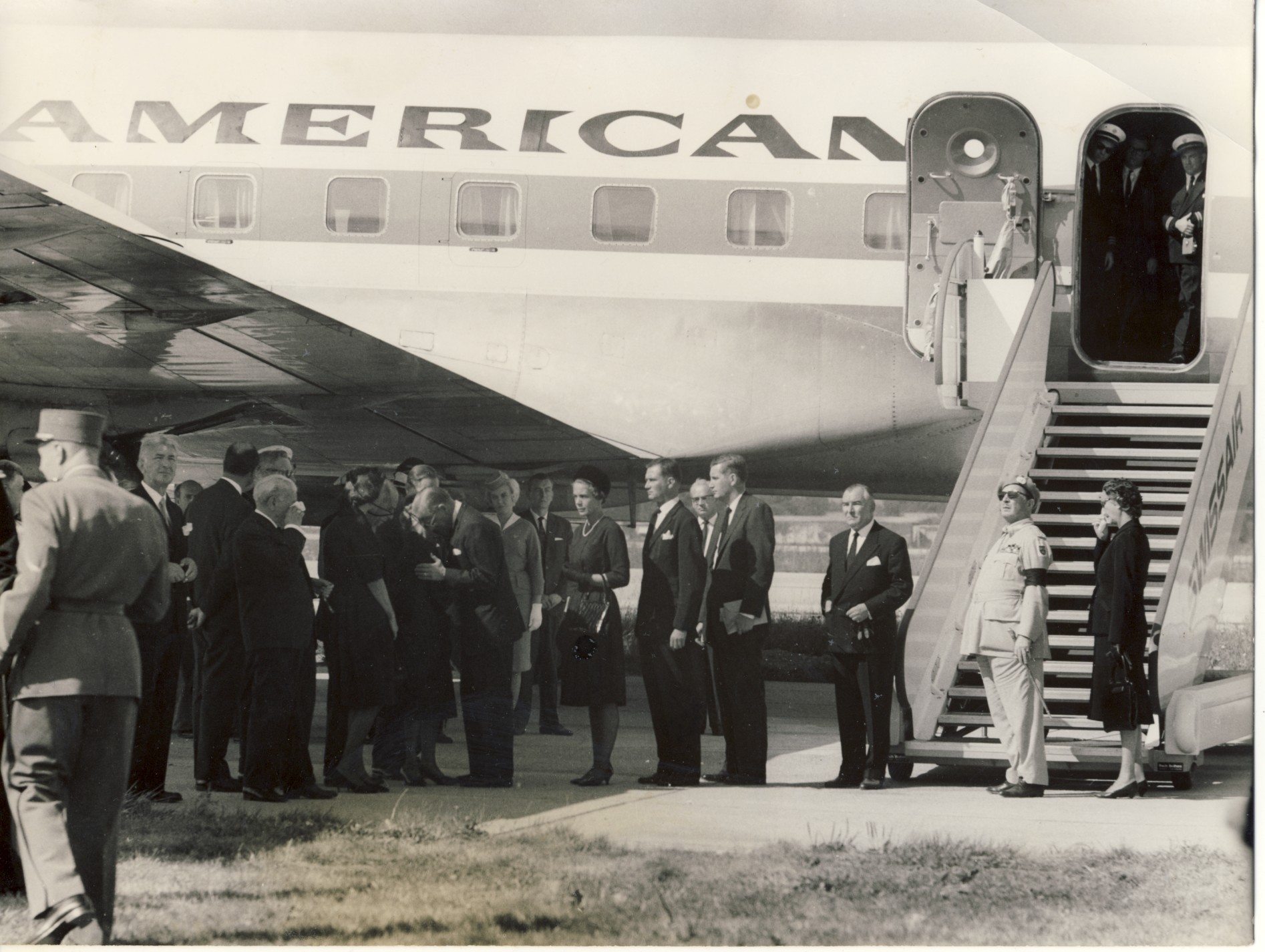
Here is a 19 September 1961 article from the New York Times, paying tribute to Heinrich A. Weischhoff, Vladimir Fabry, William J. Ranallo, and Alice Lalande – but no mention of the other passengers who perished. The full article is transcribed below.
NYT Obituaries 1961

United Nations, N.Y., Sept. 18–Following are biographical sketches of United Nations Secretariat personnel killed with Secretary General Dag Hammarskjold in last night’s plane crash:

Dr. Vladimir Fabry
Dr. Vladimir Fabry, 40-year-old legal adviser with the United Nations Operation in the Congo, was an underground resistance fighter in his native Czechoslovakia during the Nazi occupation.

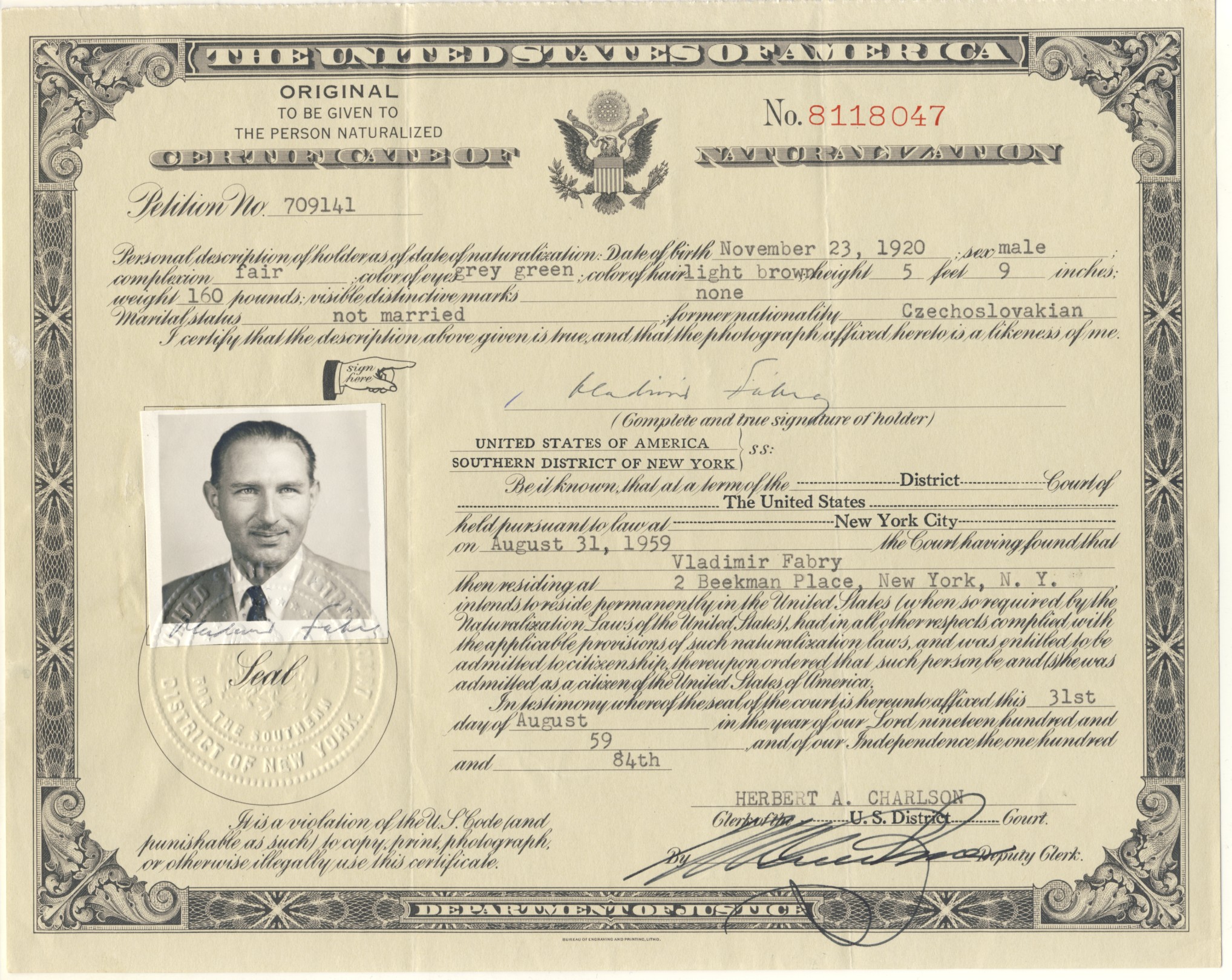
He joined the United Nations Secretariat in 1946 after helping organize the first post-war Czechoslovak Government. He became a United States citizen two years ago, a little more than a decade after the Communist seizure of power in Czechoslovakia.

Dr. Fabry was born in Liptovsky Svaty Mikulas. He received a doctor’s degree in law and political science from the Slovak University in Bratislava in 1942. He was admitted to the bar the following year.

Before going to the Congo in February, Dr. Fabry had been for a year and a half the legal and political adviser with the United Nations Emergency Force in the Middle East. In 1948 he was appointed legal officer with the Security Council’s Good Offices Committee on the Indonesian question. He later helped prepare legal studies for a Jordan Valley developing proposal.

He participated in the organization of the International Atomic Energy Agency. After serving with the staff that conducted the United Nations Togoland plebiscite in 1956 he was detailed to the Suez Canal clearance operation, winning a commendation for his service.

Dr. Heinrich A. Wieschhoff

Heinrich Albert Wieschhoff, director and deputy to the Under Secretary, Department of Political and Security Council Affairs, had won distinction as an anthropologist in his native Germany and in the United States before he joined the United Nations Secretariat in 1946. He was 55.

Born in Hagen, Mr. Wieschhoff was educated at the University of Vienna and Frankfurt. He received a doctor of philosophy degree in African anthropology in 1933 at Frankfurt, where he served as an instructor in the university’s African Institute from 1928 to 1934. He moved to the United States and taught anthropology at the University of Pennsylvania from 1936 until 1941.

During World War II Dr. Wieschhoff served as a consultant on African matters in the Office of Strategic Services. He joined the United Nations staff as a consultant to the Trusteeship Division. In 1951 he was secretary of the General Assembly’s Ad Hoc Committee on South-West Africa.

A frequent visitor to Africa since 1928, Dr. Wieschhoff accompanied Secretary General Hammarskjold on four trips to the Congo in the last fourteen months. Mr. Hammarskjold sent him on a special mission to Brussels last year to confer with Belgian officials. Dr. Wieschhoff wrote a number of scholarly books on African cultures and colonial policies and was a contributor to the Encyclopedia Britannica.

He was married to the former Virginia Graves of Caddo, Okla., in 1938. The couple had three children.

William J. Ranallo

William J. Ranallo, 39, went to work for the United Nations fifteen years ago as a chauffeur in the transportation pool and worked his way up to a unique position as driver, bodyguard, “man Friday” and friend of the Secretary General.

The relationship between Mr. Ranallo and Mr. Hammarskjold was such that at a Thanksgiving dinner at the Ranallo’s a few years ago the Secretary General went out to the kitchen, rolled up his sleeves and helped with the dishes.

Mr. Ranallo was born in Pittsburgh. He was graduated from Evander Childs High School here in 1941 and worked for a year as a technical employee at the Sperry Gyroscope factory in Brooklyn. He then served four years as a private in the United States Army.

Former Secretary General Trygve Lie picked Mr. Ranallo from the chauffeur pool to be his personal driver in 1951. The Secretariat staff, with whom the chauffeur was a popular figure, was delighted when Mr. Hammarskjold retained his services and increased his responsibilities.

Among the many places to which Mr. Ranallo accompanied Mr. Hammarskjold were Peiping, the cities of the Middle East, Laos and Africa. This journey to Africa with the Secretary General was his third in two years.

Last year Mr. Ranallo married the former Eleanor Gaal. The couple had three sons, one by Mr. Ranallo’s former marriage and two by his wife’s former marriage.

Alice Lalande

Miss Alice Lalande was a French-Canadian whose career as a bilingual secretary took her to remote trouble spots of the world as a member of the United Nations Secretariat staff.

Before her assignment to the Congo a year ago she had spent two years in Gaza as a secretary with the United Nations Emergency Force in the Middle East. In the Congo she was secretary to Dr. Sture C. Linner, officer in charge of United Nations operations in the Congo.

Miss Lalande was born Feb. 6, 1913, in Joliette, Quebec. She was graduated from a secretarial school in Montreal and was employed by the University of Montreal before she joined the United Nations in 1946.

After two years as a French-English stenographer in the languages division of the United Nations Department of Conferences and General Services she became bilingual secretary in the office of the department’s Assistant Secretary General.

In January, 1951, Miss Lalande went to Jerusalem for a three-year secretarial assignment with the United Nations Conciliation Commission. In 1957 she became an administrative assistant with the Preparatory Commission of the International Atomic Energy Agency.

Tatusko

Here are just a few photos of Vlado’s “Tatusko”, Pavel Fabry, and some more of his charming illustrations. He didn’t seem to lose his enjoyment for living, or his sense of humor, even after all he had been through in Czechoslovakia. I have re-posted the C.V. of Pavel at the end of this, for those of you unfamiliar with this heroic human. I recommend you click on the drawings to enlarge – they are hilarious.

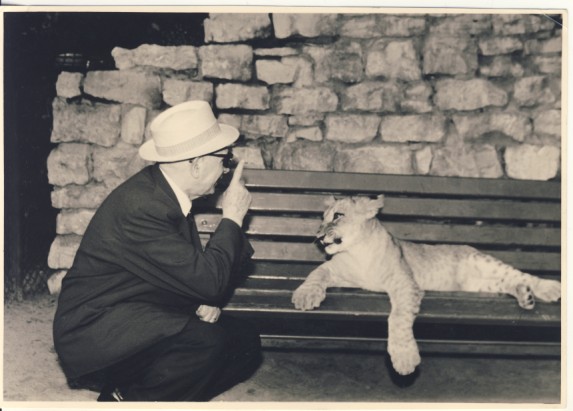
Pavel and Tiger Cub

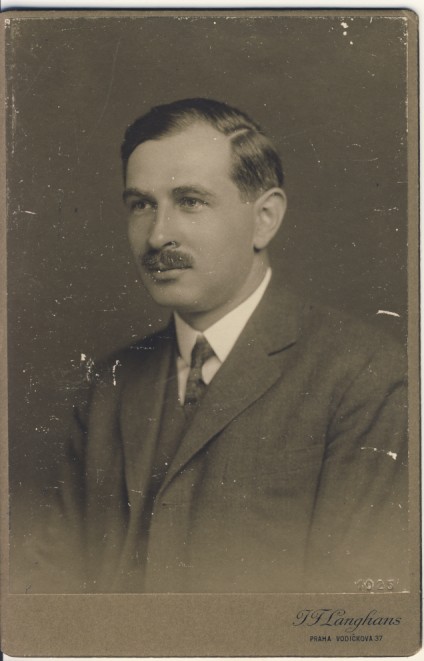
Pavel Fabry Praha 1925

Pavel Fabry 2

Pavel Fabry

Pavel Fabry (2)

Pavel Fabry 2 (2)

Pavel Easter egg letter

Pavel Fabry drawing 2

Pavel Fabry drawing 3

Pavel Fabry drawing 5

Pavel Fabry drawing 4

Pavel Svetozar FABRY, LLD, was born on January 14th, 1891 of an old family of industrialists and businessmen. After graduating in business administration, he studied law, attaining the degree of Doctor of Law; passed the bar examinations; and successfully completed the examinations required to qualify for judgeship.

During World-War-I, Mr. Fabry served as officer in an artillery division as well as in the service of the Army’s Judge Advocate-General. He became the first Secretary of the Provisional National Council established to prepare the liberation of Slovakia and the orderly transfer of its administration to the Czechoslovak Government. After the foundation of the Czechoslovak Republic, he was appointed Prefect (chief Government official) for the Eastern part of Slovakia.

When the Communist armies of the Hungarian Government of Bela Kun attacked Slovakia in 1919, Mr. Fabry was named High Commissioner Plenipotentiary for the defense of Eastern Slovakia. In this function he was entrusted with the co-ordination of the civil administration with the military actions of the Czechoslovak Army and of the Allied Military Command of General Mittelhauser. His determined and successful effort to prevent Eastern Slovakia to fall under the domination of Communist Armies – the victorious results of which contributed to the fall of the Communist regime in Hungary – drew on Mr. Fabry the wrath of the Communist leaders; they declared him the “mortal enemy of the people”, led violent press campaigns against him and attacked him overtly and covertly continually and at every opportunity.

After the consolidation of the administrative and political situation of Slovakia, Mr. Fabry left the Government service and returned to his private practice as barrister. He specialized in corporation law and his assistance was instrumental in the founding and expansion of a number of industrial enterprises. He became Chairman or one of the Directors of Trade Associations of several industrial sectors, particularly those concerned with the production of sugar, alcohol, malt and beer. He was elected Chairman of the Economic Committee of the Federation of Industries, and played the leading role in several other organizations. He also was accredited as Counsel to the International Arbitration Tribunal in Paris.

Among civic functions, Mr. Fabry devoted his services particularly to Church, acting as Inspector (lay-head) of his local parish and as member of the Executive Committee of the Lutheran Church of Czechoslovakia. His appointment as delegate to the World Council of Churches’ meeting in Amsterdam in 1948 prompted his arrest by the Communist Government.

Although Mr. Fabry never stood for political office nor for any political party function, he was well known for his democratic and liberal convictions, and for the defense of these principles whenever his activities gave him the opportunity to do so. He earned himself a reputation in this respect which brought him the enmity of the adversaries of democracy from both the right and the left. He became one of the first Slovaks to be sent to a concentration camp following the establishment of a Pro-German fascist regime in 1939. His release could later be arranged and he was able to take active part in the underground resistance movement against the occupant; for this activity the German secret police (Gestapo) ordered his pursuit and execution in 1945, but he was able to escape the death sentence. In spite of his resistance record (or perhaps because of it), Mr. Fabry was among those arrested by the Russian Army, on the instigation of the Communist Party which could not forget his anti-Communist activities dating back all the way to 1919. Due to pressure of public opinion Mr. Fabry’s imprisonment at that time was very short; but when Communist seized power in Czechoslovakia in 1948, they did not miss the opportunity to settle accounts with him. He was removed from all his offices, his property was confiscated, he was imprisoned and subjected to a third degree cross-examination taking six months. No confessions of an admission which could have served as a basis for the formulation of an accusation could, however, be elicited from Mr. Fabry, and he managed to escape from the prison hospital where he was recovering from injuries inflicted during the examination. He succeeded to reach Switzerland in January 1949, where he has continued in his economic activities as member of the Board of Directors, and later President, of an enterprise for the development of new technologies in the field of bottling and food conservation. He was also active in assisting refugees and was appointed as member of the Czechoslovak National Council-in-exile.

Young Vlado in Photos

The Fabrys came from such a different world than mine, and maybe that is why I can so appreciate the big complicated story of their life, and why I want to devote myself to study and translating to make sense of it. When I get frustrated about not having enough time to research, I take comfort in reading about other biographers, like Antony Thomas, who took over a decade to write his brilliant book “Rhodes: The Race for Africa” – but I will talk more about that book later.

Here is a collection of young Vlado photos that leave a great impression of his grand life in Czechoslovakia. The photos are undated, but they are circa 20’s and 30’s, since Vlado was born in 1920. (Click on images to enlarge)

Young Vlado Bratislava

Fabry portrait

Vlado Olinka in carriage

Vlado w sister Olinka

Vlado and pony

Vlado Bratislava erector set

Vlado and Tatulo w bear

Vlado w dear friends

Vlado plays cards

Vlado pours champagne

Serious Vlado

Portrait of a Bachelor: 1952

King Throstle Beard Indonesia

Vlado, a.k.a. “King Throstle Beard”, at work in Indonesia

Before I begin with the letters of 1952, there is one letter from January of 1951 that needs to be included here first – from Madeline – who met Vlado when he spent 3 weeks in New Zealand in 1950, and she was a big fan of his beard. She writes to him again, one last time in January of 1952. Also included in the romantic cast of 1952 are “Sweet Little Darling”, a.k.a “The Little One”, and “Guapa mia carinosa”, a.k.a. “My sweet tenderheart”. There is also one letter to Boka, Vlado’s Secretary at the UN. I almost need a chart to keep track of their names! Vlado must have had a hard time getting to know a girl, never being in one place very long, and he must have felt lonely.

New Zealand Government Tourist Bureau

The Hermitage Mount Cook, New Zealand

January 1951

Dearest King Throstle Beard,

It was the nicest Christmas surprise receiving your letter and the pictures. The pictures, I think, are very good, and I’ve just now been having a peep at them. I received your letter on Christmas Eve, so you can see how good Santa is to some of his favourites. I really was beginning to think that brilliant young diplomat ex. room 17 P/B had forgotten all about poor little insignificant Madeline Long, frequenter of room 17, but not of the bath. because King Thros. does like a little privacy/ Though Madeline found it very hard to leave room 17, and King Thros. helped her not one little bit. I don’t know that I can do much about that job of Inspector-General of the New Zealand Tourist Trade, but you could be a little old hermit at the Hermitage, and I could clean out your cave, and steal you a bone when you get hungry. You don’t like the sound of that? You should have been here Xmas Eve. We looked under all the tables and beds for a man with a beard, but nary a whisker could be found.

Everything has been very gay, and the weather just perfect. Last night the most beautiful moon was looking so lonely, with no one to sit under her, and I did think that Vladimir Fabry might have popped in for just a half hour or so, but then he probably would have found it rather hard to get away, because there is a transport strike on just now, and he would not have caught that 1.p.m. bus to Queenstown. My, I wish that strike had happened a couple of months ago. I do feel unhappy for you having to spend Christmas in that Mad house that you call it. Seems so far removed from anything of that nature here, except of course, when everybody goes a little mad with gaiety especially Madeline Long. Know her? I don’t think you should. I’ve been playing lots of tennis lately and doing a good deal of climbing, but somehow or other, somewhere along the way something happens to my wind, and I look a great sad sack. I’m going away to stay in one of the huts for a couple of nights soon, feel that it would be just grand to be way up in the mountains on these balmy nights. Could you ask Vladimir if he would like to join me? Or maybe he’s just too busy telling all those madhouse inhabitants how to get out of one sticky bit into another. It’s so hot today I could sit here with just nothing on and be quite happy, or maybe a blade of grass to keep the locals happy. I thought I had better use my speedy typewriter, because you probably would find it rather difficult to read the things I write down. I was going to send you a cable and wish you a very happy New Year, but when I looked up the little book of words and saw the exorbitant charges, I quickly shut it again, and thought I had best settle for a letter. When a girl is saving her all to travel and see something of this wide wicked world before she is too old and senile to care anymore, that’s when she begins to think that money is money, and a little more is better that a little less. Afternoon tea is on and as we have a regular circus in the office every day now for that little event, I can’t concentrate on what I’m saying to Vladimir, and that would never do. I do hope you find a wee moment to write me again, and tell me what is happening to your present and your future. I too have thought of you so, often, but I never dreamt you would be doing so of me. And even if we should never see each other again that you should write and let me have your feelings is something very precious to always have with me.

Much Love,

Madeline

Great Neck 4/1/1952

Milá Boka,

Above all, thank you for your two letters,- really, I would have never dreamed to hope that you would write me so much, the ratio used to be normally 3 to 1 in my favour,- but I do appreciate it, and I was very pleased and happy. I hope that by now you have recovered from the strains of family-life and that no permanent damage was inflicted on you. My mother wrote me that she liked you very, very much / which does not surprise me/, and the next line was that she wishes me for the new year a fine bride /and a grandchild/ and that she hopes that I will make the best possible choice. I wonder how much the second line was a reflection of the sentiments expressed in the first! I was very glad to hear your voice on Christmas, it was a very nice present, but it made me a little bit sad to think how perfect it would have been to be for the Holidays in Geneva, and having around me EVERYBODY I like. I was a bit scared of Christmas first, in Indonesia I was all the time looking forward to this one when I would be back from the “exile” and in surroundings where I could really feel in a holiday mood. Then I suffered the invasion of Milan and his friends during Thanksgiving,/it was really awful/, and looked with great apprehension at the arrival of Ivan. But he is the real opposite of his brother as far as consideration for others is concerned. We got quite friendly together always consulted each other on our moves and tried to respect each others wishes, and as a whole had a good time. I liked his friends, and of course their age and interests were more in line with mine than in Milan’s case. So it was quite nice. For Christmas Eve I had your father and Tana, Tana Makovická, Milan Ondruš and Karol, – we made up the Christmas tree together, had a Slovak dinner, gave each other presents, and has Slovak music from the records, as well as something less than music from our throats /meaning that we were singing/. Also a nice roaring fire and the scent of pine – and smoke all over the house. Also for New Year’s Eve I was with Tana, we had dinner with Milan O. at your place, and then went together to a terribly stuffy party where we saw the New Year come to the accompanying of Bible- reading, and kept singing “Drink of my eyes and you will not need any wine” – and there was no wine. So we decided that to welcome the New Year with a glass of milk could bring its wrath, postponed its arrival officially for one hour, left the party at 12.40 and dived for the next bar, where we properly wetted our thirsty throats with champagne, and drank our homage to it in this more appropriate liquid. After that we went to a party of Tana’s Airlines-friends, and had a good time,- finishing in New York, and with a hamburger and coffee at Prexy’s /the radio was admonishing us the whole evening that “death has no holidays, and if you have to have one for the road, make it coffee”, so I obeyed/. We became quite good friends with Tana, and I like her quite a bit now. Well, to come back to your letters and to answer your questions therein:- the green light refers to The One an Only One /what did he do in London, by the way, and why did he not come to expect the New Year in your company/, green of course being the “go ahead” sign, and “no turns allowed while the light is green” is a common traffic sign on boulevards, which I adapted to your case as meaning that you cannot enter any Lovers Lanes on the side while you still drive full speed on the main road of your desires, with The One giving you the “go ahead” sign, but only as far as he is concerned and not for turning towards others. A bit complicated as I wrote now, but I guess you will understand now what I meant. I gave a present to Shine, but not Virginia, – and I received nothing from either. Also I gave my present for the grab-bag at the Office party. As far as the župan [trans.: bathrobe or dressing gown.-TB] is concerned – I have my own intelligence service, but not Olga. I am glad you liked it, I hope my mother bought what I wanted. How did you get on with my papa – I hope he didn’t throw any tantrums while you were there, he gets so easily excited. Why did they not take you out on a car trip to the mountains – is Uncle Bucko ill, or what? As far as my job is concerned, the following developments took place: 1./ I saw Szeming-Sze, and the Geneva job is definitely out of the question. 2./ Marshall Williams told me that they intend to fill the Trusteeship post by internal promotion,- but nothing has been decide so far. 3./ They do have a post in Narcotics, – in Rey’s Section, they considered me and asked for my file just before Christmas. As far as I learned form Lande, I would be satisfactory except that Rey would like to have somebody English-born, as all of his Section are non-Englishmen and he has difficulties in drafting reports, etc. He told me, however, that if they would not find anybody else, or if I had enough push, my chances would be good. 4./ I saw Martinez-Cabanas and Barbosa, the Personnel Officer of TAA on several occasions. They have now two posts in my grade – and area officer for Bolivia /where I can hardly qualify because of lack of Spanish/, and one for Eastern Europe and the Near East. I would be very keen on the second job, it would be ideal from many points of view, and I think I could make a success out of it. But apparently they want to have somebody from the area, and are now in touch with the Yugoslav Government to get them a candidate. I could not speak with M-C about the job / I learned about it from Barbosa only the day before his departure/, and B. was rather reluctant about the whole thing. I had the impression, however, that it would not be impossible to get the job if M-C would agree, and if Hausner /who is Barbosa’s Superior/ would state that job-less staff members have to be given priority consideration before outsiders are recruited. I will ask Olga to take it up with M-C, and perhaps you could find a way of getting Hausner interested – unless, of course, you think that I should not overdo it and push myself too hard for this particular job. I aslo received and assurance that there may be further jobs in their new budget, but it is not expected that they would be approved before February,- so I would have to remain on my present post until March at least. Well, I think that’s all – I heard nothing more about Human Rights – did you? And please, do continue to be a sweet girl and keep me posted on what is happening at your end of the world!

All the very best in the New Year and lots of love,

Vlado

Suva, Fiji

15th Jan 52

Good Morning King T.

I was entirely delighted and surprised to receive your card, but as you see from the above it had to leave the Hermitage and come across to Fiji. I have been going the usual round of living here since May last year, and loving it. Such an entirely different life – much more romantic than that dull unimaginative New Zealand. It had its moments of course, when the King Throstlebeards of this world decided to hop around the mountains for a few days. Just imagine you living in great big New York! I think it a good thing that you have left that horrid Indonesia, because from what I have heard and gathered from running my little eyes over newspapers from time to time there seems to be a lot of stray bullets and even worse things popping round over there. It would be just terrible to think of bullets sneaking around that nice beard. (You are still wearing it I presume.) Have been extremely lucky here with accommodation – in common with the rest of the world today there seems to be a perpetual moan over the housing situation.. However, your friend Mad Long has got herself all set up in one of the prettiest little houses around. It has been built about two years only, and is nice and clean and modern and – everything. Living with another girl of course, and we have a Fijian girl to do all chores. I have often thought about you and wondered what you are doing, so you can just imagine how nice it was to receive your card. As you have probably guessed I am working with Tasman Empire Airways, and using their writing paper and time for my letter writing. The office is undergoing extensive renovations, and by this time next week I shall be sitting in one of the most swept up business places in Suva. In fact, we’re trying to persuade our Manager to put us into sarong type of frocks with hibiscus flowers tucked in odd places on our persons, just to have a tropical effect you know. You can just imagine how this conservative British atmosphere would react. I guess you have much more interesting and necessary things to do than read letters from me to you. Many thanks again for remembering me at Christmas, and lots of nice things to you for the New Year. I am enclosing a small picture of me taken at the back of the house looking ever so tropical.

Mad Long

Great Neck

10/3/52

My dear Little One,

It’s ages since I wrote you last / you see, I admit it freely/, but I have not forgotten you nor stopped to feel towards you the sweet, soft and warm longing that I had ever since we parted last summer. It’s just that I didn’t feel like writing, or that I had a lotsfull of other things to do, or that I was much too tired to write, or some other thing happened. And also, I did not get so much to hear from you to be coaxed into a real effort of writing – to wit, I received only one picture-postcard the last two months. I believe that you will be probably back from your skiing holiday by now,- and I hope that you managed to have lots of fun without getting any parts of your anatomy into a loose-flapping state. Also, that you got some sun after all. Also that you do not think any more of skiing as something difficult, but that you ski by now as easily as you think /or rather that you came to that blissful stage of skiing where it is enough to think of a movement,- and lo and behold, your skis and body do it all by themselves!/ I sincerely hope that I may have a chance to see you perform before this years snow melts completely away, although I still have no concrete clues as to whether and when that may be. I did quite a bit of skiing this year myself, practically every weekend since New Year. That also partially accounts for my backlog in correspondence – and sleep. The winter was rather mild around NY, so I had always to drive at least 700 miles each weekend to get to and from the snow – and that’s nearly as much as from Holland to Switzerland. I didn’t get any chance so far to get away for longer than from Friday 6 p.m. to Monday 9 a.m., and consequently had to spend practically every Friday and Sunday night, or at least the greater part of it, behind the steering wheel. My former skiing partner from the Tatras is now in New York also, so we usually went together, and it was a bit like old times again. Unfortunately, he does not drive, and anyhow, he usually slept the whole journey through. Occasionally we took along some company, but usually I had only Little Carrot Nibbler /remember the little fellow?/ and memories of you to keep me company. I tried also to keep up my horseback riding, and occasionally manage to squeeze in an hour or so before going to the office. But mostly I am just too tired and sleepy to get up at six, and besides it is not such a pleasure to ride now on soft ground and in the usually cold and wet and dark mornings. So I seldom ride more than two days each week. Helenka’s Slovak cooking and my sedentary life ganged up on me, and I have gained 15 lb. since I came back. I’m a real fatty again. It is true that after each weekend’s exertions I manage to lose three or four pounds, but that only increases my appetite, and before Tuesday is over, the weight is back again, usually with interest. I guess I better become reconciled with the idea of a nice potbelly. My social life continues very active. I had invitations to some of the plushiest events of the Mardi-Gras season, and the moths didn’t get much chance to get into my tails and dinner-jacket this year. I am getting quite cynical about those things which worries me a bit,- the other evening I caught myself calculating the real-estate and property value of each girl with whom I went to dance and felt quite ashamed. But I made a few friends among the Wall-Streeters, and I am now following closely the Big Board, share-value analyses and earning-prospects, and hope to use the stray bits of information which I am getting from here and there to improve a bit my financial situation by putting my savings to work for me on the Market. With nearly half of my salary going to Geneva, and life in New York being expensive as it is, I sorely need some additional source of income. If only one would have more time for those things – but the UN is such an old fashioned type of Organization which demands its employees to work for the money it pays them, so I have to steal the time from where I can, mostly sleep and correspondence and reading. Besides, I started to learn Spanish, and that takes some of my time too. I still do not know what my future assignment in the UN will be – ce n’est que le provisoire qui dure seems to be a very true saying, and my temporary assignment to the Legal Department still continues. But I already have my eyes cast on something – the post of legal adviser to the Technical Assistance Administration, it’s a new, important outfit, where I might have chances to advance, an interesting and central job, and a chance to learn a lot. The post is still in doubt, the Legal Department doesn’t want to give up its prerogatives and let another outfit create a legal post, but I think that it will be set up eventually, and then I will have to go really to work to beat the competition which probably will start for the post. But at least I know now what I want. Well, I think I wrote you about all what there is new about me. Still two questions to answer from your 1/1 letter: I spent Christmas in my house, having invited a dozen homeless Slovaks and made a real Slovak Christmas Dinner, with Slovak songs, traditional dances under the Christmas Tree, gifts, and so on. I enjoyed it a lot. For New Year I had four invitations into private homes, and I took them in turn,- the stuffiest first, and the gayest at the end. And what did you do?

The letter ends here, with the last page missing. We learn soon enough why Vlado is learning Spanish. But first, the most amusing letter of 1952 is the last letter from “The Little One”:

The Hague

17th April 1952.

My dear Vlado,

Here at long last is a letter from me. I am so sorry that it took so long, but lately I have been very busy. The reason for this is, now please hold tight to your chair or whatever you are sitting on, that I am going to be married. It is all rather quick and I would have written before had I known it myself, but as my husband to be has to be back in Indonesia in the beginning of May we decided to get married before he is going. I have no idea what you will think of this, but as you suggested in another letter that I had better look out for a husband, I don’t think you will mind too much. I am awfully sorry in a way, as it will be ages before I will see you and there will be no more holidays with you, but one can’t have ones cake and eat it too. I sent you an announcement of my marriage in the hope that you can read enough Dutch to make sense out of it. But before you got it I wanted to write to you myself. I hope you will wish me luck as I am sure that I will be very happy. I’ll write to you at a later date and a bit longer, if you want me to, but at the moment I have not got much time. I hope that you will write to me.

Love,

“The Little One”

Room 3478 NY, 20.11. 1952.

My sweet tenderheart,

I am going to write to you in English – it will be good for your practice, and besides I am too tired and involved in other thinking to make out anything comprehensible in Spanish. It’s nearly eleven at night, but I am still in my office waiting for my secretary to finish typing some drafts which I have to correct and get out to the night-shift for documentation. I am retroactively paying for my vacation, and have to make up the lost time. My trip here was pleasantly eventful,- while waiting in London for my plane-connections I had the chance to see the Lord Mayors Show, a big medieval pageant with all the trimmings of tradition, glitter, costume and showmanship that the English can still so well produce /the Spaniards also, I don’t doubt that, but I never had the opportunity to see and compare/. Then, after a very rugged flight with icing conditions up to 8000 feet and 250km/h headwinds above, our plane was forced to change course and land in Iceland for refueling. After persuading the authorities that I was not carrying mouth-and-hoof-disease, and an assorted waiving with Laissez-Passer and other documents, I was permitted to leave the international airport, hopped in a taxi, and went exploring the countryside. I could not see much in the darkness, but still managed to get some good views of one of the geysers in the car’s headlights, and get an impression of the force of the waterfalls from their thunderous ramblings, their spray and the darkness of the abyss in which the river disappeared./I sent you a picture of them how they look in day-time, hope you had received it./ New York greeted me with sunshine and a summery breeze so warm that I felt silly even in my light coat. I can’t imagine Geneva in snow. Most of my time I spent apartment hunting, a rather difficult predicament in view of my expensive tastes and thinning bank-account. I finally had to make a compromise /slanted quite heavily in favour of the bank-account/ and settled yesterday for a place on 37 East 83rd Street in Manhattan /which, incidentally, is my new address if you should care to write me/. It’s what they call here a three-and-half room apartment, consisting of a small bedroom, a fairly large living room, a kitchen in a wall closet, and entrance hall in which, if one is thin, it is even possible to turn around, and a good-sized bathroom with a three-way shower compartment nearly as big as the bedroom. That part is the only luxurious one, and I am looking forward to some pleasurable loafing in combined water streams coming from above, below, and the three sides. The address is a good one /which is very important here/, but in spite of the fact that the apartment is on the top floor I don’t have any penthouse-like view, because the houses all around me are even higher. I also don’t have any terrace nor fireplace,- but then, I am paying some 150 $ a month less than in any of the places which had such frills, and that is also something. So as a whole I hope I did not make a mistake, and shall be able to stay there for a few months until I get tired of it. By the way, I did not have time to write all this to my family /nor will I presumably have time to do so in the near future/, so if you should Olga please relay to her the information. I am moving in this weekend. I am thinking back with little tinges of sorrow of my wonderful Geneva days – and I am experiencing something I never felt before, a feeling of loneliness and emptiness. I got so accustomed to look forward to your company in the evenings and over weekends, that somehow my subconscious came to expect it as a rightful due and not as a godsend which does not belong to the undeserving, and feels cheated and unhappy now that it does not have it. On the other hand I lost the interest in my other friends that I had here, and as a matter of fact I did not look up any of them so far. There is a vague feeling of longing and of missing in me, and the work I have is a not so unwelcome escape from it. Well, I see that I wrote more than I ever have to anybody except my family and that I am letting myself be carried away by my feelings even here in the atmosphere of stark reality and competitive fight for survival. What an “unamerican activity”! If somebody should read this I might get involved into an investigation as a “bad security risk” or one who “puts loyalty to a particular person or persons above that to the Cause”. I better stop putting things on paper. But you might by now know, even without my writing it, what goes on in my heart. Hasta la vista, guapa mia cariñosa – and I hope I can make it soon.

Love,

Vlado

New York 25.12.1952.

Guapa mia cariñosa,

It’s Christmas day and I am remembering those with whom I would have liked to be on these Holy Days. I wrote to my family yesterday, and today it is first and foremost to you that I am sending my greetings, my best wishes, and my love. I am in a slightly melancholic mood thinking of you all and regretting of not being able to be with you. And this year in particular I could have had around me all those I like, as you were at our home for Christmas dinner. However, I should not grumble, as my friends took care to make my own holidays as nice as they can be for a lonely bachelor. As a matter of fact, I had two Christmas celebrations: last weekend I was invited to a family which celebrated earlier because one of its members is expecting a baby just about now, and yesterday I had dinner under the Christmas tree with my Slovak /and some Czech/ friends, and then a party which lasted until 8 a.m. Today I had the traditional x-mas lunch of choucroute-soup with spare ribs and sausages, and another party is coming up tonight. So I could not exactly claim to be deserted, although it still does not help me from feeling lonely – nothing can replace the presence of those one loves and misses. I received your letter yesterday morning. From its feel I could guess that it contains a gift, so I did not open it until evening, when we were discovering our gifts under the tree. But then of course I was subject to all sorts of jealous questions, especially from Karol Krcmery and had great difficulty to hide away your letter. The handkerchief joined your menu guide in a place of honour on my dresser, it will be used only on exceptional occasions deserving such high esteem. I hope that my letter arrived in time and that the needle of the barometer did not move during the transport. If it did, put it back in the place where you know best it belongs. By the way, you know now what L K means, don’t you? With best wishes for the New Year, and a special wish for both of us: that we can spend a lot of it together!

Lovingly,

Vlado

When I read this last letter for the first time, I was really frustrated, because the initials “LK” are engraved on a few things, and I still don’t know what that means! After 1952, there is not much romance to be found, until 1957, when Vlado meets Mary Liz. Those letters will be posted next, in a series.

Respect For The Word

Vlado and Hammarskjold full image

Respect for the word is the first commandment in the discipline by which a man can be educated to maturity — intellectual, emotional, and moral.
Respect for the word — to employ it with scrupulous care and in incorruptible heartfelt love of truth — is essential if there is to be any growth in a society or in the human race.
To misuse the word is to show contempt for man. It undermines the bridges and poisons the wells. It causes Man to regress down the long path of his evolution.
“But I say unto you, that every idle word that men speak…”

~ Dag Hammarskjold “Markings”

This Christmas, I bought myself a copy of Conor Cruise O’Brien’s TO KATANGA AND BACK, and the first thing I did was look for Vladimir Fabry in the index. This is what I found on pages 70-71:

Another important figure on the 6th floor at this time was Vladimir Fabry, an American citizen of Croat origin and ONUC’s legal adviser (‘Special Councelor’). Fabry was a thin-faced young man with a frequent but unamused smile and a stoop brought on by unremitting work. Even in an organization where all the key people worked excessively hard (surrounded, for no apparent reason, by large numbers of non-key officials who seemed to do no work at all) Fabry’s industry stood out. He slept little, he read nothing for pleasure, he had no vices or other hobbies, he simply worked – fourteen to eighteen hours a day. Dealing with paper he was accurate, penetrating and happy; with people he seemed on edge, as if he found them distressingly large and imprecise; and this was especially true of his relations with M Poujoulat. At this time, on first meeting Fabry, I was taken aback, mistaking his uneasy, abstracted air for personal hostility. Later, I came to respect his clarity of mind and to appreciate, and even admire, his lonely integrity. ‘I am an anti-social person’, he told me once, with melancholy pride. It was not true, but what was social in him – his fierce drive to bring some tidiness and predictability into the activities of man – took the impersonal form of a shy, jealous, exclusive loyalty to the abstract and developing idea of the United Nations. It is not unfitting that he should have met his death as he did, on the flight towards Ndola, working for Hammarskjold.

While I agree with a few things he said about Vlado, so much of this is just O’Brien’s opinion, and he doesn’t bother to fact check. Vlado is not “of Croat origin”, he was born in Liptovský Svätý Mikuláš, in the former Czechoslovakia. There is no doubt Vlado was working hard and sleeping little when O’Brien met him – considering the pressure of the situation in the Congo, Vlado was compelled to sacrifice his social life for a greater cause – but O’Brien really didn’t know Vlado as well as he thought he did.
Here are two photos of Vlado at work:
Vlado at work
Here he is in Egypt, taking in the sights:
Vlado in Egypt

Here are two letters of condolence from September 1961, from friends who knew and loved Vlado:

52 Champs Elysees
Paris

My Dear Friends,
Although it may seem selfish, I think the best way I can express my condolence and my sympathy to you is to tell you what Vlado meant to me.
I won’t tell you how much admiration or respect or affection I felt for him. I will tell you only that I think I can honestly say I considered him my best friend – and I was proud of knowing him: and I can say that all the more validly because I knew his faults as well as his virtues. I am very well acquainted with loneliness – but the thought of losing Vlado makes me feel even lonelier.
Please believe that just as I share your grief and sorrow at losing him, so also, since you can be very proud of him, I feel privileged to be able to share, even a little bit, your pride.
With very deep sorrow,
Peter Kenton

United Nations
New York, NY

Dear Olga,
I want to offer you my help in any way I can give it.
He was loved by so many people; he was kind and honest and strong, very strong.
He told me that memories are good to have. He lived with high standards and he died for them. He worked tirelessly in Gaza and the Congo. No tribute will be adequate to his merits.
I write this from his office here, where he spent many evenings alone. He said he liked thick walls and solitude, music and ideas. Of course he was also, at times, very gay, full of the joy of living.
Please accept my silent condolence to you and your mother.
Cynthia Knuth

And from the UNEF weekly, THE SAND DUNE, September 22, 1961, here is a tribute to Vlado from friends who understood his devotion to the UN:

With the sudden death in Congo of Vladimir Fabry UN has lost a distinguished and devoted son. Until his recently acquired US citizenship he had no country but UN to which he gave that same fierce loyalty with which he had served his own land. He was a sagacious lawyer, a skillful negotiator and a indefatigable worker for whom time did not exist. There were many Fabrys. The scholar and man of affairs who in his twenties had managed a huge industrial combine. The fighter whose activities sent him to exile. The mountaineer, skier, gourmet and music lover who was fluent in nine or ten languages and had knowledge of as many countries. He was an epitome of European culture.
We in the UNEF will remember Vlad not only for the work he did here but for his personal quirks. His hatred of the sea which did not prevent daily voyages on an air mattress. His pull ups on door lintels to tone the Mountaineer’s arm muscles and controlled skidding on sand to remind him of skiing. His undisguised joy in good food, good wine and good conversation, all of which he delighted to provide. No matter how busy, he could always find time to advise and aid anybody, no matter how humble, who had any problem. He was unassuming, courteous, exquisitely polite and we will never forget him.

Sand Dune Sept 1961 2
Sand Dune Sept 1961

Vlado’s Final Rest in Geneva

Just recently, I purchased the book WHO KILLED HAMMARSKJOLD?: THE UN, THE COLD WAR AND WHITE SUPREMACY IN AFRICA, written by Susan Williams, a senior research fellow at the Institute of Commonwealth Studies, University of London, and reading it has left me disturbed. It was a shock to open the book to the back page and see, for the very first time, the drawing of the wreckage plan of the Albertina. There was Vlado’s body, indicated by a circled “B 7”, not far from Dag Hammarskjold (“B 8”) and Sgt. Harold Julien (“B 16” – the only survivor of the crash, who died six days later). This book is an incredible help for my research, and I want to thank Williams for writing it. I hope the U.N. does not ignore the evidence she has presented in her book – Dag Hammarskjold’s death was not an accident, and there should be a new inquiry. Like so many good men that dared to live out their philosophy on this planet, he had to pay for it with his life.
From the family photo archive, here is Vlado’s body being delivered to Geneva on the Pan Am DC8 that carried the body of Hammarskjold and the other 14 victims, the first stop of many around the world. The UN flag that drapes his coffin was later given to Madame Fabry-Palka and her daughter Olga, and is now in our home. (click images to enlarge)
Body of Vladimir Fabry Returned to Geneva1

In this photo, Madame Fabry-Palka is consoled by a UN staff member as Olga Fabry (Vlado’s only sibling) stands nearby. I wish I knew who the other people in the photograph were – especially the man with the reflective glasses and the baton at the foot of the stairs.
Body of Vladimir Fabry Returned to Geneva2

Vlado is buried in the Cimetière du Petit-Saconnex in Geneva, next to his father – they died within 9 months of each other. Madame Olga Fabry-Palka died in 1974, and is buried there with them, also. Whenever I am in Geneva, I pay my respects to this good family, and thank them for their example of courage.
Fabry Grave Petit-Saconnex

Curriculum Vitae of Dr. Pavel Fabry, December 17, 1955, Geneva

Fabry Archive - Selected Photographs (28)
(Pavel Fabry is front and center – click on photo to enlarge)

To understand the character of Vlado Fabry, it’s important to know the character of his father – Dr. Pavel Fabry, who was imprisoned and tortured by Nazis and Communists for his opposition. When Pavel escaped from the Czechoslovak prison hospital, with the help of his friends, they dressed him as a nun and hid him inside a beer barrel on a train headed to Switzerland. In Geneva, Simone Baridon (a close friend of my mother-in-law) was with Olga Fabry the day Pavel arrived, and she remembers her bravery that day, when Olga said “Daddy is crossing the border now.”

This is the C.V. of Dr. Pavel Fabry that was written in English, and the following document was written in German – this was my first attempt at translating German, so it’s a little awkward, but the story of Pavel is still very compelling.

Pavel Svetozar FABRY, LLD, was born on January 14th, 1891 of an old family of industrialists and businessmen. After graduating in business administration, he studied law, attaining the degree of Doctor of Law; passed the bar examinations; and successfully completed the examinations required to qualify for judgeship.
During World-War-I, Mr. Fabry served as officer in an artillery division as well as in the service of the Army’s Judge Advocate-General. He became the first Secretary of the Provisional National Council established to prepare the liberation of Slovakia and the orderly transfer of its administration to the Czechoslovak Government. After the foundation of the Czechoslovak Republic, he was appointed Prefect (chief Government official) for the Eastern part of Slovakia.
When the Communist armies of the Hungarian Government of Bela Kun attacked Slovakia in 1919, Mr. Fabry was named High Commissioner Plenipotentiary for the defense of Eastern Slovakia. In this function he was entrusted with the co-ordination of the civil administration with the military actions of the Czechoslovak Army and of the Allied Military Command of General Mittelhauser. His determined and successful effort to prevent Eastern Slovakia to fall under the domination of Communist Armies – the victorious results of which contributed to the fall of the Communist regime in Hungary – drew on Mr. Fabry the wrath of the Communist leaders; they declared him the “mortal enemy of the people”, led violent press campaigns against him and attacked him overtly and covertly continually and at every opportunity.
After the consolidation of the administrative and political situation of Slovakia, Mr. Fabry left the Government service and returned to his private practice as barrister. He specialized in corporation law and his assistance was instrumental in the founding and expansion of a number of industrial enterprises. He became Chairman or one of the Directors of Trade Associations of several industrial sectors, particularly those concerned with the production of sugar, alcohol, malt and beer. He was elected Chairman of the Economic Committee of the Federation of Industries, and played the leading role in several other organizations. He also was accredited as Counsel to the International Arbitration Tribunal in Paris.
Among civic functions, Mr. Fabry devoted his services particularly to Church, acting as Inspector (lay-head) of his local parish and as member of the Executive Committee of the Lutheran Church of Czechoslovakia. His appointment as delegate to the World Council of Churches’ meeting in Amsterdam in 1948 prompted his arrest by the Communist Government.
Although Mr. Fabry never stood for political office nor for any political party function, he was well known for his democratic and liberal convictions, and for the defense of these principles whenever his activities gave him the opportunity to do so. He earned himself a reputation in this respect which brought him the enmity of the adversaries of democracy from both the right and the left. He became one of the first Slovaks to be sent to a concentration camp following the establishment of a Pro-German fascist regime in 1939. His release could later be arranged and he was able to take active part in the underground resistance movement against the occupant; for this activity the German secret police (Gestapo) ordered his pursuit and execution in 1945, but he was able to escape the death sentence. In spite of his resistance record (or perhaps because of it), Mr. Fabry was among those arrested by the Russian ARmy, on the instigation of the Communist Party which could not forget his anti-Communist activities dating back all the way to 1919. Due to pressure of public opinion Mr. Fabry’s imprisonment at that time was very short; but when Communist seized power in Czechoslovakia in 1948, they did not miss the opportunity to settle accounts with him. He was removed from all his offices, his property was confiscated, he was imprisoned and subjected to a third degree cross-examination taking six months. No confessions of an admission which could have served as a basis for the formulation of an accusation could, however, be elicited from Mr. Fabry, and he managed to escape from the prison hospital where he was recovering from injuries inflicted during the examination. He succeeded to reach Switzerland in January 1949, where he has continued in his economic activities as member of the Board of Directors, and later President, of an enterprise for the development of new technologies in the field of bottling and food conservation. He was also active in assisting refugees and was appointed as member of the Czechoslovak National Council-in-exile.

The following C.V. is addressed to the “Consulate General of the Federal Republic of Germany, Geneva”:

Curriculum Vitae (Lebenslauf)

Before the Persecution

I come from an old industrial family. My ancestors in 1603 – Matheus Fabry – from the Geneva area, Satigny Place Moulin Fabry, after the then Upper Hungary present Slovakia immigrated and in the free royal town of Nemecka Lupca – German Luptschau – in the county Liptov, Circle Liptovsky Svaty Mikulas established a tannery. This industrial tradition has remained in the family, according to the chronicles of General Hradsky.
My father Josef was a prosperous merchant and industrialist. Also Vice-President of the Chamber of Commerce and president of several trade and finance companies. Board member of some industry and financial companies. Maternally I am also descended of Industrial and Estate-owning family.
We were 10 siblings – seven are behind the Iron Curtain still alive, some of them in prison, some of them forcefully resettled.
The parents sought to give us a good education with University studies, but all children had to complete some studies in trade.
I attended Hungarian schools, because we did not have a middle school in their mother tongue.
My parents tradition and my studies gave me the future direction of my C.V.
I have allowed for easier overview and orientation in the supplements a special list of 1. Personal Data, 2. Vocational activities, 3. the International profession – Law practice, 4. The national economy – Professional activity, 5. Of the public, political, religious, social and charitable activities, as well as a line up of assets and income up to the time of the persecution, submitted, which discuss my work and resume enough.
[I don’t include the list in this post.-T]

During the time of Persecution

In order to make aspects of the persecution more understandable, it is necessary to strip some events even before this time:
As evident from the personal data, I had at the end of WWI, as a military lawyer for the military commander in Budapest, opportunity to observe the infiltration of communism and drew all my future consequences therefrom.
As can also be seen from the personnel records, I was appointed as High Commissioner Plenipotentiary for the military command of eastern Slovakia. At that time, the Kremlin gave directives to the members of the Comintern, to create all the conditions you can imagine out of the Ruhr against an eastern power, as potential factor for war. Therefore, the then Hungarian Communist leader Bela Kun was commissioned to warlike attack of Slovakia, since at the same time Poland was to be attacked by Moscow military, the objective was, from Poland as an Industry and Agricultural country, and from Slovakia and Hungary as Agricultural states, to form a political unity under Communist leadership. This should then be as the basis for conquest of East and Central Germany, and then the Ruhr territories served.
These efforts have been, in spite of fierce fighting in Poland and Slovakia, thwarted under great bloodshed. Unfortunately at Yalta was Communism facilitated, by Stalin’s perfidy, clumsy (plumpen) breach of contract, and betrayal to conquer these areas.
In negotiating the boundaries demarcating the then Bratislava, I had a sharp conflict with Bela Kun. The then Secretary of the way, was none other than the present ruler of Hungary, Mathius (Matyas) Rakosi, who could not forget me and my actions against the Communist terror gangs. Since that time, I was attacked during the entire years until WWII, at every opportunity, both in newspapers and at public rallies of the Communist Party. The communist leader Vietor asserts in his “Faklya in 1952” [Not included here.-T] that the failure of the plans of the Communist International was partly due to my vigorous defense activities. The statement that my work was supported by the Communists after the seizure of power in 1948, settled bitterly with my arrest, as will be further mentioned. The second point I would list is represented by the German-friendly setting:
As can be seen from the personnel data, the Slovak Intelligentsia before WWII was eager to visit the great German culture as close neighbors, and study them in the country of origin. Therefore, each family was trying to get their children educated in the German Universities, as well as other German institutions. So I spent the semester of 1910/11 at the University of Berlin. Of course, religion played a significant role with cultural trends, since a third of Slovaks were Augsberg Confession Protestant and wanted nothing more than to visit the land of Luther and his faith.
The great and unique education of that time has influenced my whole future life, and has quite clearly had an impact in my subsequent work in business and public. So I led as President of Industry Associations that all protocols and negotiations were bilingual, though barely 20% of all industrialists in Slovakia were of German language and nationality. The leading representatives of German diplomacy and economy were in my home, and were frequent preferred guests on my extensive hunting grounds.
It is therefore understandable, that the persecution under the Nazi Regime of Germany has hit me doubly hard. I will mention only in passing that I spent many years on my annual holiday in Germany, specifically in Reichenhall, in the Kurhaus Hotel Axelmannstein of the Seethaler family. However, I also observed at that time the undemocratic developement of the Nazis in Munich at Reichenhall, and practiced my objective critique so that I was advised to disappear from Reichenhall. I then had to follow with the establishment of the Slovak state by Hitler, immediately carried out by the exponents of the Nazi Organization.
After these explanatory notes I will venture to list my persecution during the Nazi Regime chronologically:
Even though I with the then Prime Minister Dr. Tiso and his staff maintained very friendly relations in the then state of Slovak autonomy, I was, after the creation (on Hitler’s orders) of the so-called Independent Slovak State, on command (einschreitung ?) of Nazi Franz Karmasin‘s leadership, arrested and taken by the Hlinka Guard (Slovak SS) — locked military barracks (Kasernen eingesperrt). There I was subjected to torture and abuse of the second degree. When this became public knowledge, it upset the leadership of the Slovak State, and after several days I was released.
But a week later, in late March, I was re-arrested again on the orders of Nazi Leadership (Karmasin), and transferred to the prison fortress Illava, to be held prisoner there under menschenwurdigsten (?) circumstances. I was put in the basement of this prison fortress, where the primitive central heating had long been out of operation. Days and nights, we had to spend in indescribable cold, with nothing to protect us but a few ragged horse blankets. In preparation for these inhumanities, specially chosen prisoners, I also among them, were tortured in the infamous “Koks-oder Schreckenskeller” (Coke – Kokshaufen – or Horror Cellar). They threw us in the Kokshaufen (?), covered us with a rug, so you do not see the wounds, and I, along with the Editor-in-Chief of the Newspaper Union Korman, were beaten throughout the night in the most barbarous ways. During this ordeal, my stomach and liver were so much affected that there later became ulcers on the lining of my stomach. On my way to Illava prison the transport had to be stopped, because I was vomiting blood. In spite of terrible pain, the provisional prison doctor denied me his help, with the remark that he would not because of my fall out with authorities. During the visits, however, my fellow prisoners reported of my fate, and it was an energetic intervention. There was an inspection and a physician, Dr. Pikova, took me into the prison hospital. My condition deteriorated, however, living in a dangerous manner, and I had alarmingly high blood pressure and a low temperature of 31-32 degrees celcius.
At last, I was transferred to the surgical ward of the hospital in Bratislava by Professors Carsky and Razus, and taken into treatment. In surgery they did not consider my weakened condition. For weeks I hovered between life and death. Of course, it did not look favorable that during the whole time I was heavily guarded by police inside the hospital, and had not the slightest possibility of speaking with anyone other than the doctors. After many long weeks I was finally allowed to transfer to my Villa again, of course, only under intense surveillance, day and night, in the hall of the Villa, and apart from my wife and my children no one was allowed to come in contact with me.
I had scarcely gained some new strength, when the newly appointed German Ambassador [Manfried Freiherr von] Killinger demanded the immediate surrender of my Villa and the entire facility. Killinger was already notorious when he came to Slovakia, and his crimes were well known. I refused him the provision, never concealing my general convictions, even then, though I was a sick man.
The following day an order was issued by the Nazi leadership to have me expelled from Bratislava in the night, and confiscate the Villa with everything. My one daughter was not even allowed to take her school books. I was expelled to a village in Wagtal with security guards, and I menschenunwudigsten (?) this treatment, I was almost always delivered by drunken guardsmen. After a few months, I was taken to another location, which was repeated several times, because many people had taken note of my unimaginably cruel treatment, and protested every time.
I had lodged an appeal against the expulsion, whereupon Killinger promptly dismissed the appeal and made my deportation into a life sentence. The carrying out was taken on by Presidialchef des Prasidiums (?) Dr. Koso, whereupon I was removed from the bar association and could not practice my profession. At the same time they also pointed out my son from Bratislava, stripping him of the right to University studies (weiterzustudieren). My law firm was confiscated. Together with the decision number 171/1940 a fine of 2 Million Crowns was imposed on me, and my cars and private plane were confiscated to deprive me of any possible movement or escape.
The then representative of the NSDAP (Nazi Party), Harold Steinacker, directed a criminal complaint against me for alleged criticism of Nazi leadership, and attempted to bring an action in the District Court of Trencin.
The President of the District Court, however, Dr. Sebak, was my devoted friend, because I had helped him during the war and supported him, so that he achieved the presidency of the District Court. With great skill, he was therefore able to thwart the arrest on the grounds of my parlous state of health, and to sabotage the sentencing, until my re-arrest and committal to a military prison.
At the outbreak of the uprising in Slovakia, I was together with Councillor Orsag and Colonel Black and was arrested by the Gestapo, brought to a military prison and charged again with accusations. The sustained maltreatment and prison stays, however, had deteriorated my health so that, in spite of the refusal of the prison commander Minari, the doctor summoned me in hospital medical care, also for the reason that the prison was repeatedly bombed.
When the prisoners demanded that they grant us protection in a bomb-proof cellar during the attacks, the commander said the prison had no bomb shelter; but he was willing to build one, when the prisoners would give him money. Since I was the only wealthy one among them, he demanded that sum from me, which my family had to hand over to him. The plans for the shelter had made another political prisoner, who was an architect. The construction, however, was never carried out, and some of the prisoners had to pay with their lives in the next bombing. The commander has simply embezzled the money.
From the hospital, I managed to regain freedom with the help of doctors, and put myself in the care of a private sanatorium in Smokovec in the Tatras, and after that to Mikulas.
At that time, the front was already in Dukla and the evacuation of businesses was ordered in Slovakia. The Slovak government met with the German army leaders on agreement what categories and what quantities of industrial equipment and supplies, as well as food stuffs, must be evacuated, and what proportion of the population must be left for livelihood opportunities.
There were sharp measures arranged against anyone that would violate these proposals (proporzen). Unfortunately, agreed commanders behaved “intrinsically Faust” and took everything that was available. Even the most minimal stocks of sugar, which were reserved for the population, should be “saved” for Switzerland, generally considered, however, to be a “rescue fund” created for known and unknown Nazi-Grossen (Nazi-Greats).
The sugar industry was outraged, and the chief of central supply, Dr. Vondruska, was himself powerless against these groups. With the sugar industry representatives, he intervened even with me, as a long-time lawyer of the sugar industry. There was no other way out, other than by rapid distribution to the consumers, to save this situation. The workers – the railway workers – all day and night helped with zeal, and also to cover that the allotment price of 106 Million measures had been taken.
Also with other inventories, which were reserved for the security of the population, there were similar practices.
I emphasize that only a portion of the distribution determined inventory was saved, the majority was evacuated by unconstitutional agreement – where it happened, no one knows but the participants.
Finally, in the middle of February, they wanted to evacuate the whole population of Liptov Mikulas district, including older people and those who were suspect, i.e. once we were already arrested and released we were to be deported immediately.
I was asked to intervene as delegate for the highest of ecclesiastical dignitaries, because 20 degree (gradige) cold prevailed, and there were large snow drifts, and also the district and the city had been shut down for 3 months from any traffic, without light, because the Front had been here in the country for weeks.
The commander Schuhmacher was inclined to postpone the evacuation, but demanded that in order for the soldiers to buy different things, necessary funds should be provided. But that very night. I had obtained the postponement with considerable financial sacrifice – and for my person, also. After the Front had changed in the following days, the population was rescued. However, I had all the proscribed people brought to safety at once.
For this, defending the Convention and actively deporting the shifted district humanely, I was arrested by the Gestapo in Ruzomberok and sentences to death, and also my son in absentia.
After that night, the Front had to retreat, and I was freed by the underground movement just hours before the execution, and hidden in an abandoned bunker. After reconquest the next day, the whole town was searched for me by several departments. Finally, they emptied out my apartment [His law office, I am sure, since there are other documents giving details of that seizure.-T] of all the things which, up till then, I was able to save in Bratislava, they loaded up seven trucks with it and drove away, not without first breaking open my safe, where I kept money for the guidance of industries and large estates in the amount of 2 1/2 Million Crowns. A directory contains all the stolen values, according to the insert more than 5 Million – officially confirmed. Insert submitted. [Not included here.-T]
At the end of hostilities, in the awareness that these persecutions and abuse to me was not the German people, but a power-hungry clique had done this, I have done everything to love my fellow Germans in Slovakia, to mitigate those innocent who were often subjected to reprisals. The Slovak people would never have handed over his fellow Germans to be expelled, but the higher command out of Potsdam and the pressure of the so-called Russian Liberators could not be avoided. Nevertheless, I managed that the major part of the reported families from Slovakia, from the Paprad camp, not be sent into the Soviet zone, as was already prepared, but were transferred to the Western zones and also to Austria.
In this manner, I managed to at least partially reimburse you for those times in Germany and Berlin University, in which I received the scientific foundations I have always considered to be invaluable.

After the Persecution Today

As the so-called Russian Liberation Army in Slovakia – consuming (raubend) more than liberating – invaded our city, I was immediately arrested and led into the basement of the NKVD, where I found quite a few others arrested. The public, especially the workers in awareness that I freed from deportation a few days before, chose to stand up and with the deputation of workers demanded the immediate release from liability. But the commander of the NKVD also had the deputation arrested and had me lead them into the cellar. The workers union had accumulated in front of the Villa and vigorously demanded the release from liability, whereupon the commander turned to the High command in Kosice, whereupon we were released – seven and a few, but the rest were to be deported to Siberia. The NKVD commander later said I was arrested on the basis of the request of the Hungarian Communists, because I, as High Commissioner in 1919, acted so harshly (so schroff) against the troops of Bela Kun. And he said that if I was released now, I would not be spared Siberia.
The public had reacted sharply. I immediately became an honorary citizen of the circle and an honorary member of the National Committee, elected unanimously, and I was given the two highest honors.
The spontaneous demonstrations of the public gave me the strength to forcefully intervene against many attacks, and also to help my fellow Germans and give confirmation that they behaved decently during the Hitler era, and to stifle all individual personal attacks of vengeance in the bud. As I have already mentioned, I was able to help the internees that they not go to the Soviet zone, as was planned, but were sent to West Germany and Austria. I was a daily visitor to collection centers and in prisons, to help where help was justified.
My parlous state of health has not allowed me to carry my work further. The law firm I have has only a limited representation of associates, and these are only my best performing workers.
After the Communist coup performed by Russian Deputy Foreign Minister [Valerian] Zorin for the Communists, the time is broken up with invoices to settle for my work against Communism as High Commissioner in 1919. And on the instructions of the insulted Rakosi I was first of all relieved of all my functions and representatives, and subjected to all possible harassment, interrogations, etc. When I went to the delegation, as elected President of the Financial and Economic Committee of the General Assembly of the World Council of Churches, in Amsterdam, and was asked for my passport, I was arrested on the pretext of excessive imaginary charges. My whole fortune was taken, all accounts were confiscated and my Villa locked with furnishings, clothes, supplies, and everything, since it was the Consul-General of Russia; and on the same evening I was arrested as a “National Gift”, the nation was taken over, and in the night the Russians transferred the land register.
And so, my health still shattered by the persecution these Nazi monsters caused, they transferred me to the locked section of the hospital to make interrogations there. After seven months detention [In another document it says only 6 months, which I will include here, after this testimony.-T] the workers and employees of some companies succeeded to liberate me in the night on January 21-22, 1949, and led me to a kamion near the border. I had foreseen that the police would know about my escape during the night, and that’s why I escaped (uberschreitete ?) to the Hungarian border with Austria, and again by the Austrian border, since I was immediately searched with many dogs.
I managed with the help of my friends to leave the Soviet zone disguised, and made it to Switzerland where I anticipated my wife and daughter. [I have an audio recording of Olga Fabry, Pavel’s daughter, where she says that her father escaped from the prison hospital dressed as a nun, and made it across the Swiss border by train, hiding inside a beer barrel.-T]
The Swiss authorities immediately received me as a political refugee and assured me of asylum, and issued all the necessary travel documents.
To this day I am constantly witness to the most amiable concessions by the Swiss authorities.
In my description of illness, my activity in Switzerland is already cited.
Accustomed to the work of life, and since my health no longer permits regular employment, I have adopted the assistance of refugees. Since Geneva was the center of the most important refugee organizations, I was flooded with requests by the refugees of Western Europe.
I took part on the board of the Refugee Committee in Zurich and Austria, after most refugees came from Slovakia to Austria, and I had to check very carefully if there were any refugees that had been disguised. I was then elected as President of the Refugee Committee, but on the advice of the doctors treating me I had to adjust this activity, because through this work my health did not improve. Nevertheless, I succeeded in helping assist 1200 refugees in the decisive path of new existence.
Otherwise, I remain active in the Church organizations. All this human activity I naturally consider to be honorary work, and for this and for travel I never asked for a centime.
Since I am more than 62 years old, all my attempts to find international employment failed, because regulations prohibit taking on an employee at my age. It was the same case with domestic institutions.
My profession as a lawyer I can exercise nowhere, since at my age nostrification of law diplomas was not permitted. To start a business or involvement I lacked the necessary capital – since I have lost everything after my arrests by the Communists, what had remained from the persecution.
And so I expect at least the compensation for my damages in accordance with the provisions applicable to political refugees.

Vlado: United States Citizen

With the help of the 1951 UN Convention and Protocol Relating to the Status of Refugees (UNHCR), Vlado Fabry was eventually able to become a United States Citizen on August 31, 1959, but not without troubles along the way. For one thing, it took a while before he had work at the UN in New York that kept him in the US for the required consecutive time period – he was called all over the world. But there was also trouble from the new Czechoslovak Government, who invalidated Vlado’s passport and asked the Secretary General to dismiss Vlado from the UN.
This undated Annex was found with the naturalization papers:

Annex A
To application to file petition for naturalization
Page 2, question No. 6

I am not aware of ever having committed any crime or offense, in the United States or in any other country, except for minor traffic law violations. However, in October 1940, after having organized a mass walk-out of Slovak protestant students from a Nazi-sponsored organization called the Academic Hlinka Guard, I was arrested and without formal charge, trial or hearings of any kind condemned to deportation. On 27 January 1945, I was sentenced to death by the “Sicherheitsdienst”(Gestapo) for obstructing the German war effort and participation in the Slovak liberation movement against German occupation forces. After the Communist Party seized power in Czechoslovakia, I was charged with “anti-state activities” for having expressed anti-Communist opinions and advocating freedom of private enterprise while employed as an official of the Czechoslovak Ministry of Commerce in 1945-6. As far as I know no formal trial was held on these charges, as I refused to return to Czechoslovakia when my passport was withdrawn and the Secretary-General did not deem it fit to comply with the request of the Czechoslovak Government for my dismissal from the United Nations service.
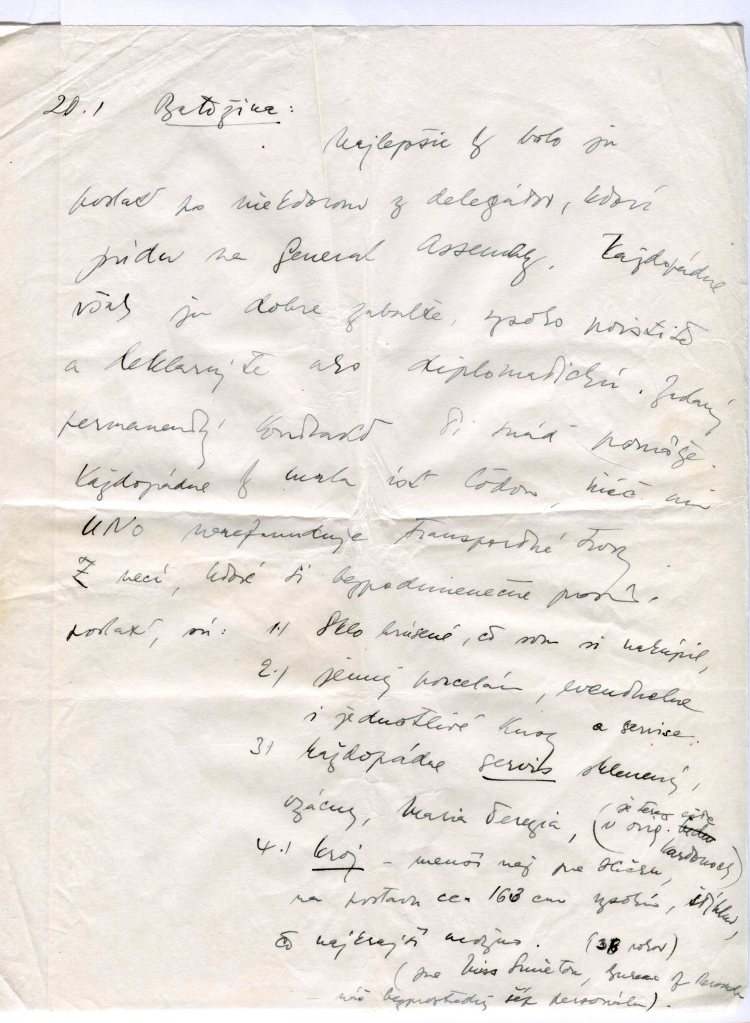
Vlado had to return to the US from his mission in Indonesia with an invalid passport, and he gives his account in this document dated August 22, 1951, addressed to Miss Alice Ehrenfeld:

Admission to the United States.
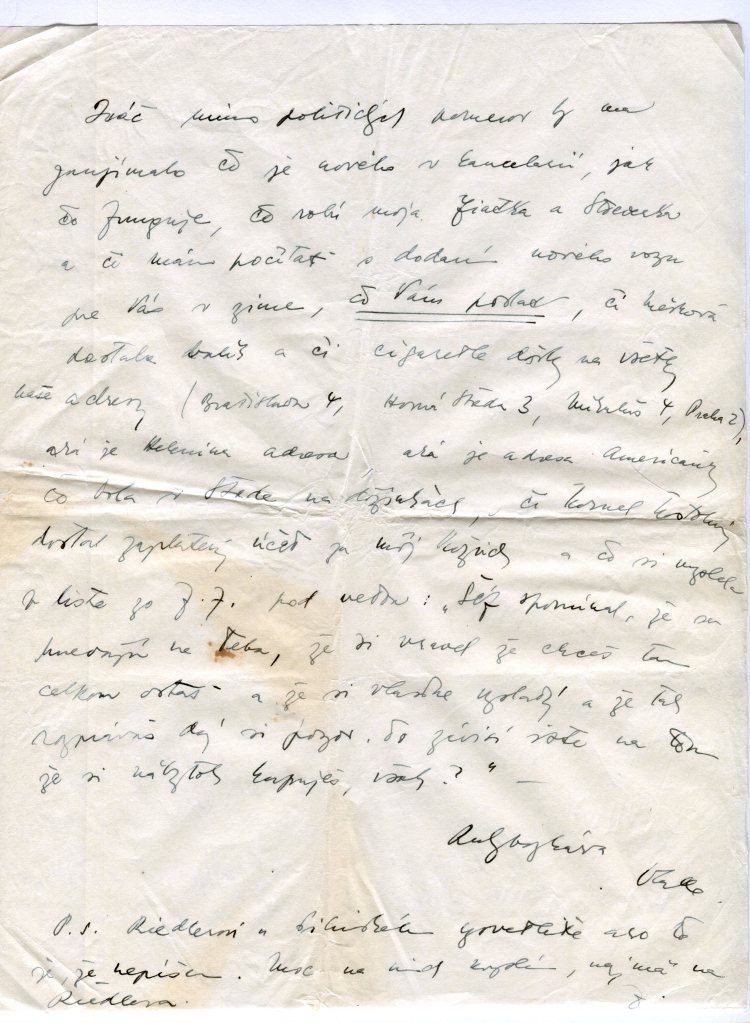
On your request, I herewith submit to you the information which you may need to deal with the question of my admission to the United States.
I was born on 23 November 1920 as a citizen of Czechoslovakia. I have been a member of the staff of the United Nations Secretariat since 15 June 1946, serving under an indeterminate (permanent) contract.
I entered the United States for the first time on 15 June 1946 and was admitted under Section 3, paragraph 7, of the Immigration Act for the duration of my status as an International Organizations Alien. In April 1948 I left the United States on an official mission, re-entered the country on 6 January 1949 and left again on 15 February 1949 to serve with the United Nations Commission for Indonesia. After completion of my duties there, I was instructed to return to Headquarters for service with the Legal Department of the Secretariat in New York.
As a consequence of my political convictions and activities, I became a displaced person after the communist coup d’état in Czechoslovakia in February 1948. The Czechoslovak Government has ceased to recognize the validity of my passport (No. Dipl. 2030/46).
I drew the attention of the competent officer in the Department to this fact when I was leaving on my mission assignment, and I received the assurance that there would be no difficulty regarding my re-admission to the United States. This assurance had been given, I understand, after consultation with the State Department.
I also explained my case to the United States Vice Consul in Djakarta, Indonesia, who was issuing my United States visa. He advised me that it was sufficient if I held my invalid passport as an identity paper, and that no difficulty would result from the fact that my visa was not stamped in a valid passport.
Upon arrival at Idlewild Airport, New York, on 20 August 1951 (7:30 A.M.), I was told by the immigration officer on duty that I could not enter the United States. I was then requested to sign an agreement according to which I was released on parole. My passport and the Alien Registration Form on which the United States visa was stamped were taken away from me with the remark that my office should undertake further steps to regularize my status and affect the release of my documents.
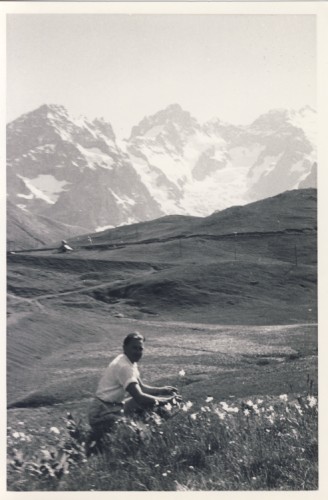
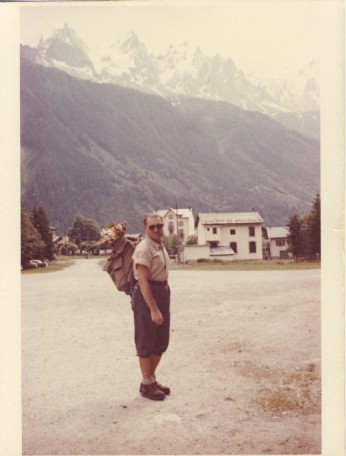
Here are some images of Vlado’s United Nations Laissez-Passer (UNLP), issued to him on October 6, 1952, and signed by the first UN Secretary General Trygve Lie:
Vlado UN passport cover
Vlado UN passport
Trygve Lie passport signature

By 1954, Vlado had long been stateless, with no place to call home. He writes to Marshall Williams, Administrative Officer, Bureau of Personnel at the UN, on May 18, 1954:

Request for permission to change visa status

1. I was notified by the United States Consulate-General in Zurich that a number on the DP immigration quota became available for me and that I should present myself at the consulate in Zurich before 27 May.

2. I should be grateful to receive permission to sign a waiver of United Nations privileges and immunities, which I understand to be a condition for the granting of a permanent residence visa. I trust that such permission will not be denied as it is essential for me, for the reasons indicated below, to acquire the right to establish a home somewhere. In view of the shortness of time given to me for appearance before the consular authorities, I should appreciate it if my request could be considered as urgent.

3. I should also like to apply for the permission to change my visa status without losing entitlement to tax reimbursement. The Report on Personnel Policy adopted by the Fifth Committee during the last session of the General Assembly states that the Secretary-General should be able to grant such permission in “exceptional and compelling circumstances”. In accordance with a statement made by the Chairman of the Advisory Committee on this subject, this provision relates to “certain officials of the Secretariat who had lost their nationality through no fault of their own and who might quite legitimately seek to acquire another”. I sincerely believe that these conditions are present in my case.

4. I have lost my nationality and I am unable to return to my country of origin because of substantiated fear of persecution on account of my political opinions and activities undertaken prior to my joining the United Nations. In the years 1945-1946, I was an active member of the Slovak Democratic Party which at that time was lawfully permitted and recognized as an instrument of the political will of the majority of the Slovak people; I also held the position of Assistant (Chef de Cabinet) to the Minister of Commerce. In accordance with my beliefs and official directives, I worked to the best of my ability on fostering the resumption of normal conditions under which trade could prosper, and on preventing the suppression by force of the right to enjoy private property and freedom of enterprise; such activity, lawful and constituting part of my official duties at the time it was undertaken, is considered criminal by the regime which since has come to power in my country. I was therefore compelled to become an expatriate, or else to make myself the object of grievous persecution. My fear of persecution is substantiated by the facts that members of my family and several of my friends had been arrested and interrogated regarding my activities; and that persons who held positions similar to mine, and did not escape abroad, were sentenced to long prison terms or maltreated to death.

5. Having thus without fault of my own lost my nationality, I consider myself legitimately entitled to seek to acquire the right to establish a permanent residence, a home, in another country. For although it is true that I have the right to stay in a country as long as I remain there in the United Nations service, I must provide for the possibility, which I hope shall not occur, that I might lose my present employment (and in any case, I shall need some place where I can reside after I reach the age limit). Moreover, being stateless and without the right to permanent residence anywhere, I am subject to many restrictions and deprivations.

6. I therefore firmly believe that I have compelling reasons for obtaining a visa status authorizing my permanent residence in the United States, and I hope that I shall be granted the permission to change my visa status without losing entitlement to tax reimbursement. I feel that it would be unjust if, having lost my nationality, I should be penalized for this misfortune by being made subject to financial burdens which I can ill afford.

Here is Vlado’s passport, renewed and signed by Dag Hammarskjold:
Dag Hammarskjold passport signature

And finally, the sought after United States Certificate of Naturalization:
Vlado Certificate of Naturalization

Friends Around the World

After I posted yesterday, I learned that Lucy T. Briggs was the daughter of Ellis O. Briggs; an Ambassador for 37 years to many countries, including Czechoslovakia; and sister to Everett Briggs. Lucy became the third member of her family to join the career Foreign Service in August 1957, and her brother, Everett, joined the year before. Vlado most likely knew Ellis Briggs, and that’s why Lucy sent him chocolates and the stuffed Bambi before she’d even met him. From the other letters I found from Lucy, the relationship doesn’t appear to be anything but friendly. I suppose when your work takes you all over the world, it’s good to have friends in many places.
Here is a letter from the UN in Indonesia, asking Vlado to meet with Miss Wiendriati Ernestina Soehadi, who was working at the Indonesian Delegation to the United Nations(click images to read):
Letter to Vlado from Indonesia
This letter comes from a place closer to my home, from Spokane, Washington, written by owner and manager of Broberg Travel Agency Teckla M. Carlson:
Letter From Teckla Carlson
And here is a letter from Vlado to Teckla, dated December 19, 1951, describing his experience of arriving at the Tibetan border the very day the Chinese Communists came to take it:

Dear Mrs. Carlson,
It was so sweet of you to remember me when you went again to Europe, and to send me a letter from your trip. I hope you had a lovely time, and brought back with you many pleasant memories. I regret only that I did not know of your trip, I would have liked to give you the address of my parents and sister in Geneva and suggest that you use my car while you were in Switzerland,- you can see so much more while travelling independently on the road. Please let me know next time!
I left the Indonesian mission in May – I was quite glad to leave the country after having spent three and a half years there. I should not be ungrateful really, it was a very valuable experience, and I had many thrilling moments and adventures, but three and a half years is a long time to spend without friends, accustomed amenities, and access to culture and professional education sources. To make it worse, the tropical climate disagreed with my constitution, I had a number of annoying local diseases, and came back 56 lb lighter than I departed. On the way back, I visited Indochina, Macao, Thailand and Burma, and spent some time in India. I made a trek to the Himalayas from Darjeeling, and luck had it that I arrived at the Tibetan frontier post on the day when the Chinese Communist officers arrived to take it over following the surrender of Tibet to the new Chinese rulers. I had planned to sneak at least for a short look-around into the Land of Monasteries, but the sight of the Red Stars rather damped my enthusiasm, and I limited myself to cross symbolically with one foot – and even that I did rather cowardly at a place screened from the sight of the frontier guards by a big rock.
In Europe, accompanied by my family, I toured by car Skandinavia beyond the Polar Circle, the Low Countries, and France and Italy. I arrived in New York late in August, and returned to my regular duties in the UN Legal Department. My home and office addresses are on top of this letter. There is not too much to be written about my life here – after the excitements of my mission assignments and of my travels it is a mere routine. I rented a house in the suburbs, recaptured my cook-housekeeper from the people to whom I had “sublet” her during my absence, renewed my relationships with former acquaintances, and in general live the well ordered life of the Suburban Commuter. When you pass through New York next time, please stop and see for yourself.
I am wishing you a Merry Christmas and all the best in the New Year, and hope to see you or at least hear of you soon.
Sincerely yours,
Vladimir Fabry

Update 9/12/13: “Crash Victim Known in City” (from the Spokane Daily Chronicle Sept. 19. 1961, p.24)

Vladimir Fabry, killed in the plane crash that claimed the life of Dag Hammarskjold yesterday in Northern Rhodesia, visited Spokane three years ago.

Fabry, U.S. legal adviser to the United Nations in the Congo is a close friend of Teckla M Carlson, N1727 Atlantic, and he and his sister, Olga, also a UN employee, were her house guests in 1958.

A travel agent, Mrs. Carlson first met Fabry in 1949 at Geneva after he had succeeded in having his father released from a concentration camp. The Spokane woman said they have exchanged letters since that time.

Vlado and Bambi

When I first began to sort through the family papers, I found a little stuffed “Bambi”, with a necklace around it’s neck, and a bright green four-leaf clover with a tiny red ladybug hanging from the chain. Then I found the photo of Vlado securing Bambi to the hood ornament of his Buick, which I use as my header on this blog. The Fabry family called themselves “the four-leaf clover”, because they knew they were lucky; and in the books of Olga Fabry, I found hundreds of four-leaf clovers, falling out of the pages. This totally charmed me, because I love to collect four-leaf clovers, too. I’ve been wearing the necklace ever since I found it, and I keep Bambi on my desk.
This is a photo of Dr. Pavel Fabry with Bambi:
Fabry Archive - Selected Photographs (191)
This is a letter to Lucy T. Briggs, who gave Bambi to Vlado – I don’t know who she is yet, but she gave him the gift before she’d even met him (click image to read):
Vlado Letter 1
I found these other pictures of Bambi being displayed with the photo, right after I took almost the same photo.
Fabry Archive - Selected Photographs (202)
Vlado photo with Bambi

Slovak Refugee Opera Singers

Here is letter from two Slovak Opera singers – Dusan Djordjevic and Maria Mattei-Djordjevic – refugees living in Geneva with four young children, seeking financial assistance to learn English and French and German for work. The letter was written in August of 1952, and the concert program, from Victoria Hall in Geneva, is from April 1953. Looks like they got the help they needed!
(click image to enlarge)
Slovak opera singer's letter1
Slovak opera singer's letter 2
Slovak opera singer's Geneva program1
Slovak opera singer's Geneva program 2
Here’s a photo of Victoria Hall in Geneva, Switzerland:

Slovak National Council in London, January 10, 1946

This photocopied document was found among the testimonies of many different refugees that Dr. Pavel Fabry represented:
Slovak National Council Telegram to UNO

SLOVAK NATIONAL COUNCIL IN LONDON
8, Wilton Crescent,
London, S.W.1.

Text of the telegram sent to the President of UNO.
10th January, 1946

The Slovak National Council, 8, Wilton Crescent, London, S.W.1., solemnly protests against the so-called Czechoslovak Delegation pretending to represent the Slovak nation at the United Nations General Assembly.
Czechoslovakia ceased to exist on March 14, 1939, when the elected representatives of the Slovak people declared Slovakia’s independence. The newly created structure, also called Czechoslovakia, the representatives of which will try to pretend representing the Slovak people, does neither territorially nor constitutionally, correspond with the defunct Czechoslovak Republic. Moreover, it has been set up against the will of the Slovak people. Contrarywise to all pledges given by the Allies to the nations of the world, the Slovak people are not permitted to [choose] the State and the form of government under which they desire to live. We claim freedom for our people and independence for our country. We demand a free, unfettered and internationally controlled plebiscite to ascertain whether the Slovak people are in favor of Czechoslovakia or whether they wish to retain their nationhood regained after one thousand years of subjugation in 1939. Slovakia cannot be represented at this Conference by a clique of usurpers, foisted on our people by foreign powers. Any commitments entered into by Mr. Benes’ emissaries in the name of the Slovak people are not binding. The Slovak people will never give up the struggle for their freedom and independence of which they have been deprived in the name of freedom for all nations.
At this opportunity we also protest against the extradition for trial to Mr. Benes‘ impostor Government of the President and members of the Government of the Republic of Slovakia by the Allied military authorities in Austria. The main “crime” of these people, according to Mr. Benes, is that they stood for the freedom and independence of Slovakia. If they or any other Slovaks are guilty of real war crimes they should be tried by independent Slovak Courts or by an impartial international Tribunal, not by a mob calling itself “People’s Court”.
Unless justice is done to the Slovak nation, living in the very heart of Europe, as well as to other nations of Central Europe, there is little hope that either the UNITED NATIONS or any other international organization will succeed in solving the problems of the European Continent in a just and lasting manner and in creating real peace.
Peter Pridavok, Chairman
Karol Vycnodil, Secretary

Statement of Samuel Bellus, November 30, 1956

I don’t know who Samuel Bellus is yet, but here is his statement on behalf of Mrs. Olga Fabry – Vlado’s mother:

I, Samuel Bellus, of 339 East 58th Street, New York 22, New York, hereby state and depose as follows:
That this statement is being prepared by me at the request of Mrs. Olga Viera Fabry, nee Palka, who formerly resided in Bratislava, Czechoslovakia, but since 1948 has become a political refugee and at present resides at 14, Chemin Thury, Geneva, Switzerland;
That I have known personally the said Mrs. Olga Viera Fabry and other members of her family and have maintained a close association with them since the year 1938, and that I had opportunity to observe directly, or obtain first hand information on, the events hereinafter referred to, relating to the persecution which Mrs. Olga Viera Fabry and the members of her family had to suffer at the hands of exponents of the Nazi regime;
That in connection with repeated arrests of her husband, the said Mrs. Fabry has been during the years 1939 – 1944 on several occasions subject to interrogations, examinations and searches, which were carried out in a brutal and inhumane manner by members of the police and of the “Sicherheitsdienst” with the object of terrorizing and humiliating her;
That on a certain night on or about November 1940 Mrs. Fabry, together with other members of her family, was forcibly expelled and deported under police escort from her residence at 4 Haffner Street, Bratislava, where she was forced to leave behind all her personal belongings except one small suitcase with clothing;
That on or about January 1941 Mrs. Fabry was ordered to proceed to Bratislava and to wait in front of the entrance to her residence for further instructions, which latter order was repeated for several days in succession with the object of exposing Mrs. Fabry to the discomforts of standing long hours without protection from the intense cold weather and subjecting her to the shame of making a public show of her distress; and that during that time humiliating and derisive comments were made about her situation in public broadcasts;
That the constant fear, nervous tension and worry and the recurring shocks caused by the arrests and deportations to unknown destinations of her husband by exponents of the Nazi regime had seriously affected the health and well-being of Mrs. Fabry during the years 1939 – 1944, so that on several such occasions of increased strain she had to be placed under medical care to prevent a complete nervous breakdown; and
That the facts stated herein are true to the best of my knowledge and belief.

Statement of Dr. Fedor Hodza

Dr. Fedor Hodza made this statement at the service for Dr. Vladimir Fabry at the Lutheran Church, Geneva, Switzerland, on Thursday, September 28, 1961:

The Slovak family, dispersed all over the wide world, bows in painful grief over the mortal remains of one of her distinguished sons. Once again a Slovak life has been extinguished, a noble life – already successful and which still promised so much – the life of your friend and mine, Mr. Vladimir Fabry.
It is a difficult and sad task for me to bid him farewell. Difficult, because I would not like to say more than his modesty would bear without dismay. Sad, because I had a great affection for him.
Yet his modesty and our sorrow must give place to the truth. And the truth is that the tragic death of Vladko Fabry is a cruel and woeful loss, not only for his mother and sister, not only for his relations, not only for his friends. It is a loss for his larger, national family as well as for that high humanitarian ideal which he served with such devotion.
Though today we are sorrowfully thinking of his untimely end and grieved as we are, we should not forget his life which should be a consolation to his loved ones and an example to us.
As a young and inexperienced lawyer he worked his way up in a relatively short time to a position of responsibility in an institution of such importance as the United Nations. He advanced with success amid older and more experienced colleagues from all parts of the world. He won confidence for his firm character, esteem for his good work, affection for his pleasant disposition. Within a short time he was entrusted with difficult, responsible and often dangerous tasks. The evidence of his personal success are the missions which he carried out in critical times, in widely differing regions of the globe, in India, in Indonesia, in the Near East, and finally in the unfortunate Congo.
It can be said that there was hardly a situation in the international development of the last ten years where Vladko was not present as a worker, defender and soldier in the service of peace among nations. Whenever and wherever this uncertain peace which is our lot was threatened, we saw him among those who were sent to pacify, to counsel, to persuade and help to preserve it.
By his talent and education, by work and experience so grimly won, by his conviction and energy, Vladko rose above the circle of narrower interests and lower aims and engaged himself fully in the service of higher good and loftier ideal.
It is not easy to be an officer of the highest international institution if it does not live – because it cannot – according to the letter and still less according to the spirit of its charter; when the peace which it is called to preserve is not a just peace – and there is no other; when freedom and independence of nations – which is the basis of its existence and the main purpose of its mission – are denied to those who already know the art of government and given to those who have still to learn.
But Vladko Fabry was not just an officer of an institution created to help humanity to live in peace and harmony. Personally, in his conscience, he considered himself to be a servant of probably the highest and most precious accomplishment of Western civilization, which prescribes that laws have to respect the good of all and that they have to be administered without regard to personal, class and even national interests.
The convinced patriot that he was, Vladko joined the ranks of the pioneers of constructive internationalism. He was aware that by helping to secure and protect the precarious independence of the new nations he was working at the same time for his own homeland, hoping that freedom and justice would return again to his beloved Slovakia.
He also participated directly in the great experiment of international life, and experiment which was designed to complement by deed the traditional debates and resolutions of the United Nations which too often remain unheeded. One such deed was the intervention of international armed forces in the Congo. It seems that the world is not yet ripe for actions of this kind. Vladko was among those who gave their lives on the altar of a new era in the life of humanity, and era full of promise but hardly yet born.
Let it please our Lord that his sacrifice was not in vain. Dead martyrs often achieve more for the ideals they believed in than living prophets.
So this is how we see Vladko Fabry, as man, worker, fighter. Such was his short but fruitful life.
How could we forget his love of nature and especially of mountains which seemed to attract him irresistibly? Was not his love an expression of that idealism which inspired all his endeavors? Were not the mountains to him a kind of challenge to accomplish a difficult and dangerous task, in solitude, in silence, without spectators and their acclaim? For him the mountains were not just a place of repose or sport. They were a kind of spiritual necessity. Up there he felt at home, there he was happy. Perhaps they reminded him of his native land Liptov, and Turiec and of our High Tatras.
As he was demanding in his work so he was modest in his private life. He disliked luxury and ostentation. His searching mind was forever disclosing new vistas, enlarging his horizons, acquiring new knowledge and experience. He learned because he wanted to know, he thought because he was aiming for excellence.
His gentle manners and good heart won him many friends in all parts of the world and today, on this last journey, he is accompanied by the affection and gratitude of so many.
In this last moment of farewell we remember also his late, eminent father who by the force of his personality marked the national life of Slovakia and contributed to her political and economic growth. We bow with profound respect before the grief so courageously borne by his loving mother and sister. If words are unable to soothe their pain perhaps the knowledge that Vladko lived a beautiful, rich and useful life will give them a measure of consolation until merciful time heals the deep wound.
Dear Vladko, it is time to say good bye. We remember you such as you were and hold you in our thoughts: A loving son, an affectionate brother, a devoted friend, a faithful child of your country, who dedicated his life to the service of humanity.