Category Archives: Fabry Family History

No Sun Without Shadow

“There is no sun without shadow, and it is essential to know the night.” – Albert Camus, The Myth of Sisyphus

Archival assistance and emotional support from Farfel. Swissair ticket stubs from 29 December 1960 to 10 February 1961; Vlado’s father, Pavel, died of a heart attack in Berlin 19 December 1960. Sabena ticket stub appears to be from 1956, date is unclear. St. Bernard medal retrieved from the Albertina crash site, Ndola, 17-18 September 1961.
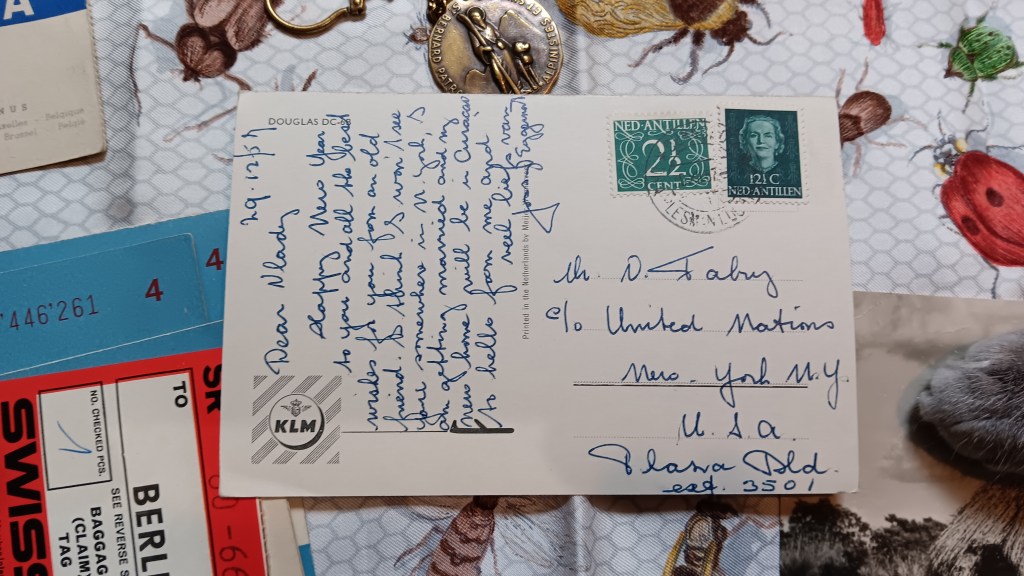
KLM postcard addressed to Vlado, care of the United Nations, New York, N.Y., “The Flying Dutchman”, Douglas DC-6B.
KLM postcard reverse, 29 December 1957: “Dear Vlady, Happy New Year to you and all the best wishes for you from an old friend. I think I won’t see you somewhere in N. York, I am getting married and my new home will be in Curacao…”
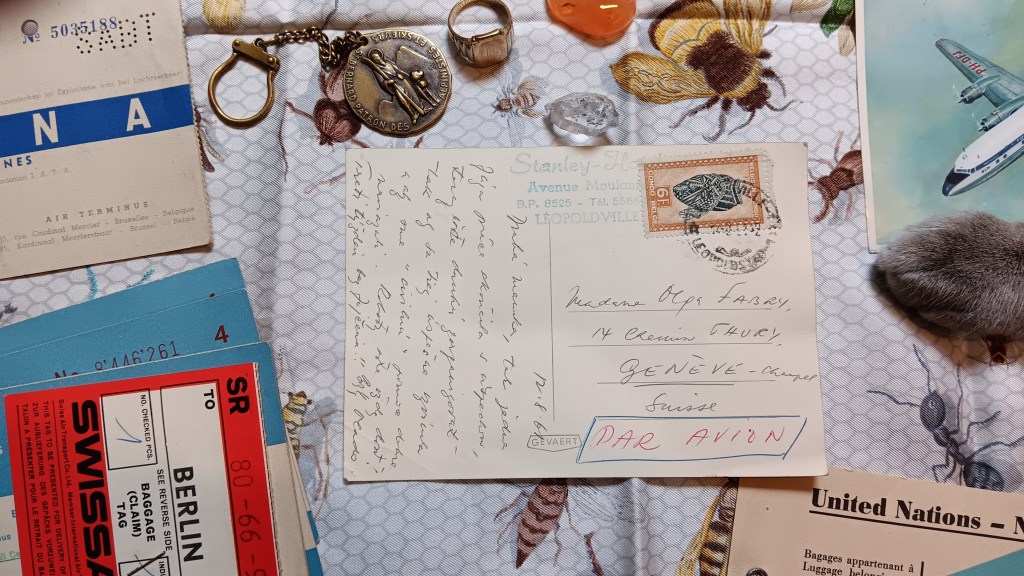
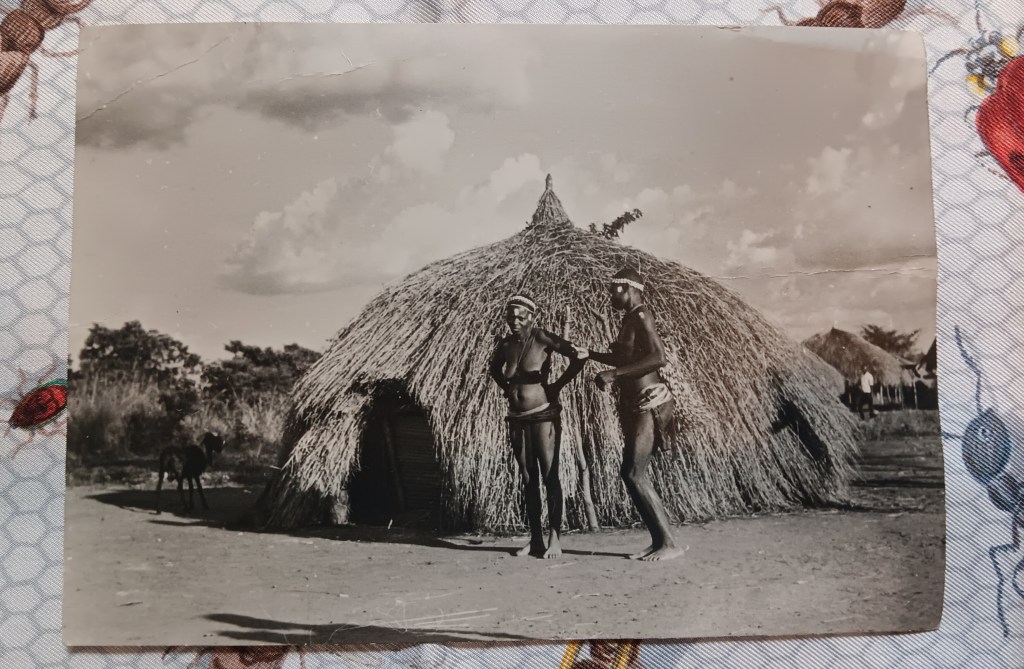
Farfel picks his favorite postcard from Vlado, sent from former Leopoldville, Democratic Republic of the Congo, now Kinshasa.
Reverse of postcard from Vlado, 12 August 1961, to his mother, “Maminka”, Madame Olga Fabry.
A better look at the real photo postcard from Vlado, purchased from the “Stanley-Hotel, Avenue Moulaert”.
Vlado’s signet ring, retrieved from the Albertina crash site, Ndola, 17-18 September 1961.

“The struggle itself towards the heights is enough to fill a man’s heart. One must imagine Sisyphus happy.” – Albert Camus, The Myth of Sisyphus

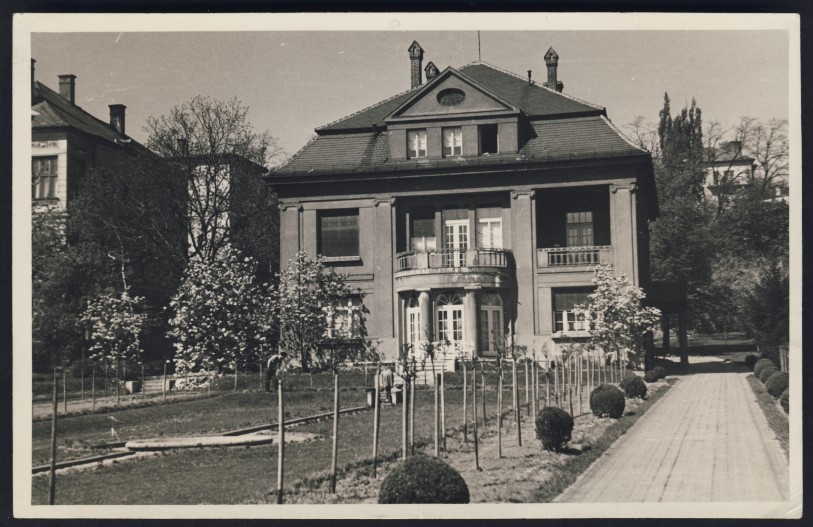
A National Gift to the People of Slovakia

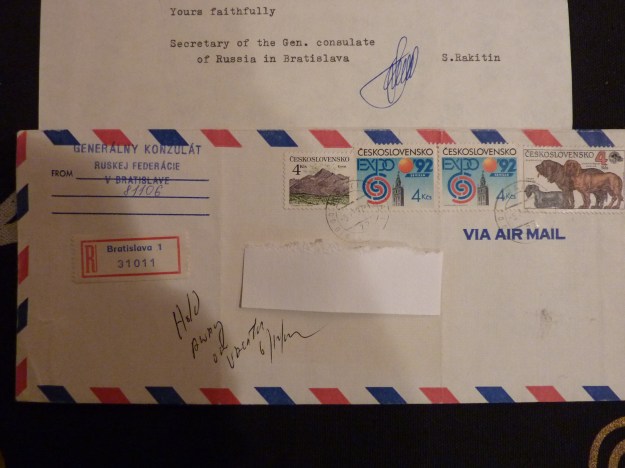
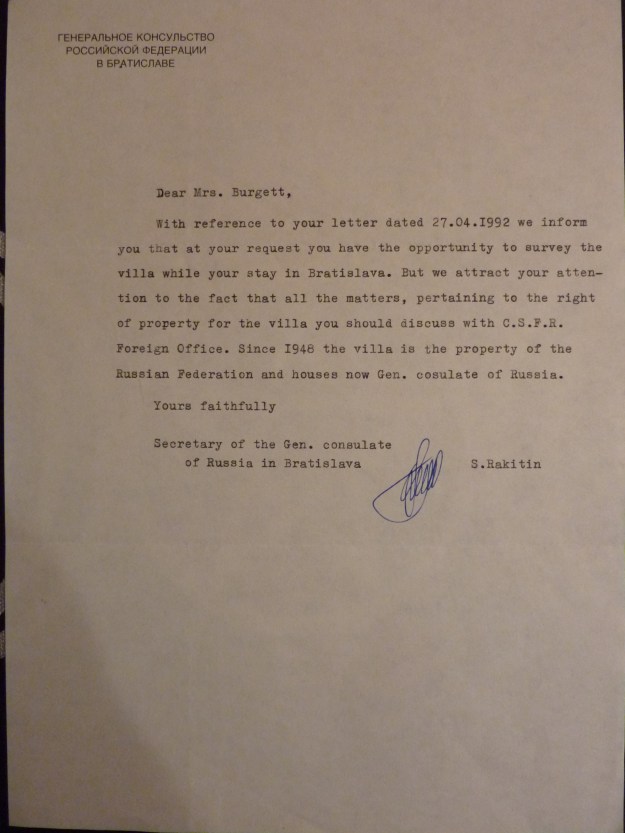
Letter from Russian Consulate, Bratislava, to my mother-in-law Olga Fabry-Burgett; June 1992.
Letter from the Secretary of the Gen. consulate S. Rakitin, admitting that our home was taken in 1948; which corroborates the personal testimony of Pavel Fabry.

Excerpt from C.V. of Pavel Fabry, 1955:

“After the Communist coup [February 1948] performed by Russian Deputy Foreign Minister [Valerian] Zorin for the Communists, the time is broken up with invoices to settle for my work against Communism as High Commissioner in 1919. And on the instructions of the insulted Mátyás Rákosi I was first of all relieved of all my functions and representatives, and subjected to all possible harassment, interrogations, etc. When I went to the delegation, as elected President of the Financial and Economic Committee of the General Assembly of the World Council of Churches, in Amsterdam, and was asked for my passport, I was arrested on the pretext of excessive imaginary charges. My whole fortune was taken, all accounts were confiscated and my Villa locked with furnishings, clothes, supplies, and everything, since it was the Consul-General of Russia; and on the same evening I was arrested as a “National Gift”, the nation was taken over, and in the night the Russians transferred the land register.”

My mother-in-law Olinka spent her whole life fighting to get the family home back from the Russians, but I will not be following in her footsteps – I want peace and to be happy! It is the sincere wish of myself and my family, that the Fabry home be donated to the city of Bratislava, as a gift to the people of Slovakia; to be of good use and service for the community, and that the garden be enjoyed by all people, as a memorial to our beloved ancestors.

The time has come for Russia to find a new home in Bratislava for their Consulate, obtained by legal means and not by brute force.

FREE ALEXEI NAVALNY!

Poem for Vlado

Fabry Archive - Selected Photographs (86)

Looking through the family papers today, I found a poem by Olinka Fabry, written in tribute of her brother Vlado.  I share it here with love to the both of them.

To Vlado

You died, as you lived –

not fearless, nor reckless,

but wisely bargaining

the single coin of life

for the one thing it is worth,

to bargain for

not for the siren song of gold

nor for the temptation of flesh

nor for the praise of men –

but to help life bloom and sing

and save it from withering away

For while we procrastinated

while we withdrew and barricaded ourselves in our insides

you stepped out –

with a pick and the rope, climbed to the top

into the streaming sunshine of bullets

and called to the man, behind the bush

to come out and talk over his grievance….

Now that it’s consummated,

we see it well, this hard won lesson:

not for the thrill

nor to subdue the mountain

but to steel the gaze

at the edge of the abyss

so when time comes

for the free man

he shall not flinch,

he shall not be found wanting.

Enter now in the hall of fame

of our small mountainfolk,

join the heroes standing around

the famous cliff – straight as candles –

you who wrote their courage in the sky

for all the world to see.

Of you I sing on this foreign shore

gentle as white wool of our lambs

hard as the granite of our cliffs.

You shall not walk again the mountain path

but your name shall be whispered

when the forest sings


Les Vacances de Monsieur Fabry

Couldn’t wait to share the treasure I found this summer, film footage of Vlado with his family in Switzerland. It may not be the best home movie ever made, but it gives me a lot of happiness to see these charming people all come to life, and to see Vlado skiing.

Štvorlístok

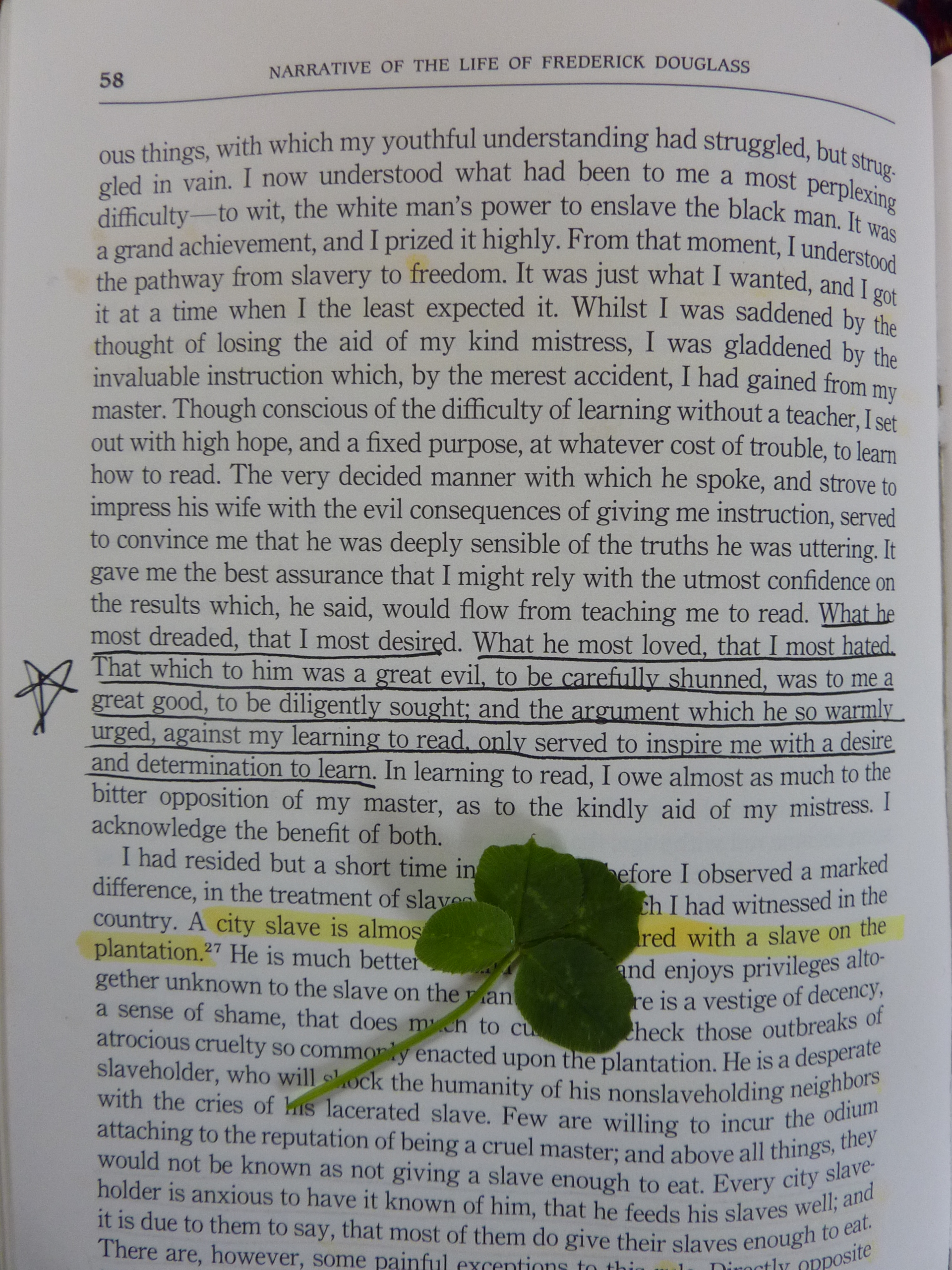
The four-leaf clover – Štvorlístok in Slovak – was the symbol of the Fabry family, and finding them and tucking them into books is something our family still does. Here is the first one of the year, a gift found by my husband, my biggest fan and number one supporter.

First Four-Leaf Clover of 2015

I’ve pressed it in my favorite book, “Narrative of the Life of Frederick Douglass” – a man who shares first place with Socrates on my list of heroes. Here is an observation by Douglass that truly inspires me:

“Very soon after I went to live with Mr. and Mrs. Auld, she very kindly commenced to teach me the A, B, C. After I had learned this, she assisted me in learning to spell words of three and four letters. Just at this point of my progress, Mr. Auld found out what was going on, and at once forbade Mrs. Auld to instruct me further, he said, “If you give a nigger an inch, he will take an ell. A nigger should know nothing but to obey his master–to do as he is told to do. Learning would spoil the best nigger in the world. Now,” said he, “if you teach that nigger (speaking of myself) how to read, there would be no keeping him. It would forever unfit him to be a slave. He would at once become unmanageable, and of no value to his master. As to himself, it could do him no good, but a great deal of harm. It would make him discontented and unhappy.” These words sank deep into my heart, stirred up sentiments within that lay slumbering, and called into existence an entirely new train of thought. It was a new and special revelation, explaining dark and mysterious things, with which my youthful understanding had struggled, but struggled in vain. I now understood what had been to me a most perplexing difficulty–to wit, the white man’s power to enslave the black man. It was a grand achievement, and I prized it highly. From that moment, I understood the pathway from slavery to freedom. It was just what I wanted, and I got it at a time when I the least expected it. Whilst I was saddened by the thought of losing the aid of my kind mistress, I was gladdened by the invaluable instruction which, by the merest accident, I had gained from my master. Though conscious of the difficulty of learning without a teacher, I set out with high hope, and a fixed purpose, at whatever cost of trouble, to learn how to read. The very decided manner with which he spoke, and strove to impress his wife with the evil consequences of giving me instruction, served to convince me that he was deeply sensible of the truths he was uttering. It gave me the best assurance that I might rely with the utmost confidence on the results which, he said, would flow from teaching me to read. What he most dreaded, that I most desired. What he most loved, that I most hated. That which to him was a great evil, to be carefully shunned, was to me a great good, to be diligently sought; and the argument which he so warmly urged, against my learning to read, only served to inspire me with a desire and determination to learn. In learning to read, I owe almost as much to the bitter opposition of my master, as to the kindly aid of my mistress. I acknowledge the benefit of both.”

Letters from Sumitro

From 1949 to 1951, Vlado was working for the United Nations in Indonesia, during the time of independence from the Dutch. Due to the complications of being a political exile from Czechoslovakia, Vlado had only a temporary passport – until October 1952, when he finally received his UN Laissez-Passer. Here is one alternative ID, a ‘Tourist Introduction Card’ from the Government of India:
India Tourist Card
India Tourist Card II
Sumitro Djojohadikusumo (not to be confused with General Sumitro)was the only Indonesian with a doctorate in economics after independence in 1949, and had been Deputy Head of the Indonesian delegation to the UN Security Council, so he and Vlado were colleagues. While going through the 1951 box of papers again, I found two letters – one for Vlado’s sister and one for his mother, with Indonesian letterhead, handwritten and signed by Sumitro. It shouldn’t surprise me that Sumitro came to be friends with Vlado and his family, and that their example of kindness moved him to open his heart to others, but I had no idea how fond he was of Vlado’s sister!
Sumitro letter Olinka

Stockholm, June 15, 1951

Merea Guerida,

Enfant-terrible? Non, – enfant cherie with eyes as lovely as ever to remember and a voice as sweet as ever can be: sweet, soft and gentle –

You asked me (“a penny?”), when I wrote those words in my brochure what I referred to: a general truth, people in Indonesia or personal reflections? I think it was a combination of all three. You see, I have long learned to see situations of Indonesia always as an integral part of a general trend, the strive for betterment, the urge of mankind for improvement and progress, although many times specimens of mankind itself seem to turn the clock back more or less deliberately. Nonetheless, all of us individually have our responsibility as to the fate of others —

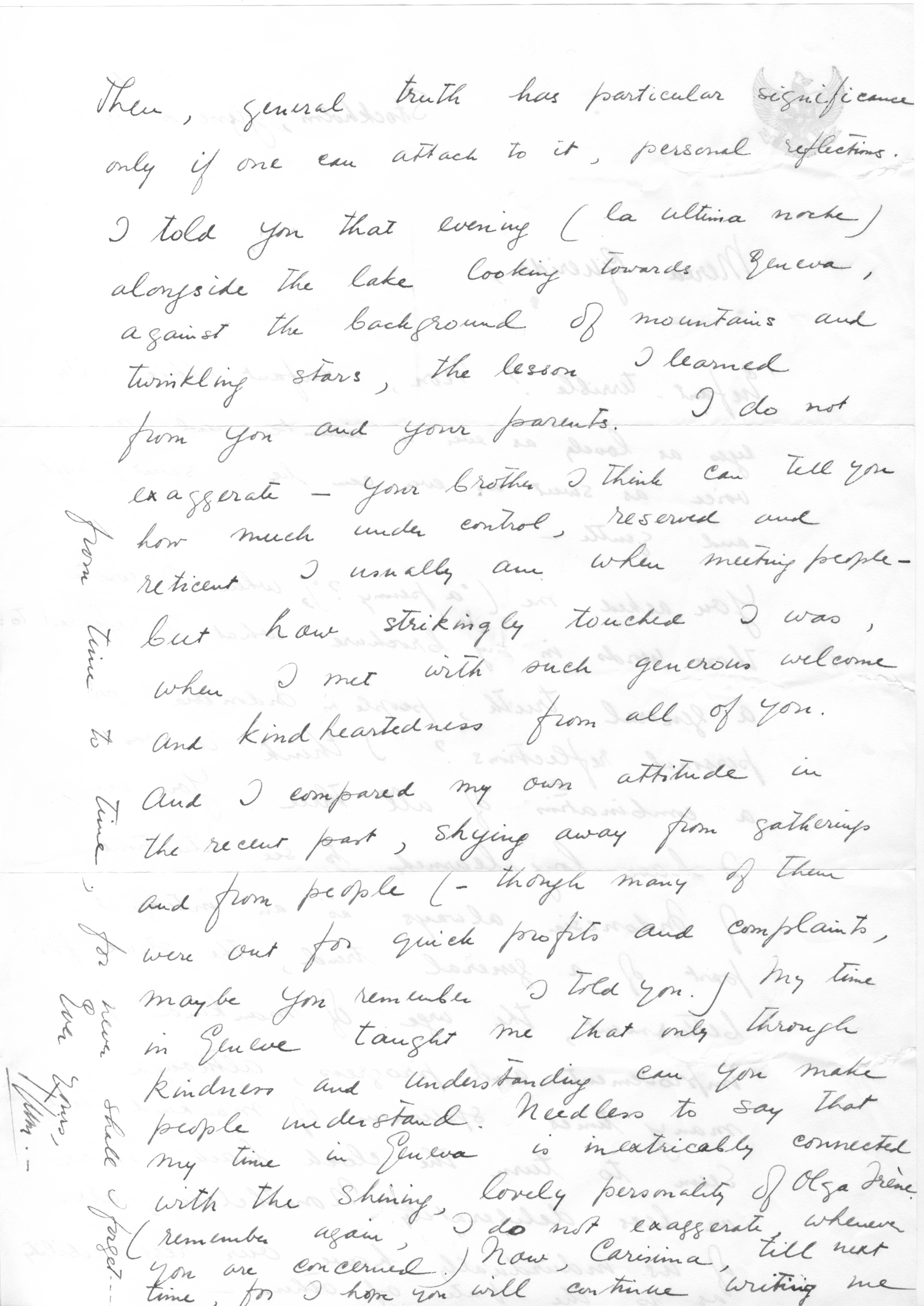
Sumitro letter Olinka II

Then, general truth has particular significance only if one can attach to it, personal reflections. I told you that evening (la ultima noche) alongside the lake looking towards Geneva, against the background of mountains and twinkling stars, the lesson I learned from you and your parents. I do not exaggerate – your brother I think can tell you how much under control, reserved and reticent I usually am when meeting people – but how strikingly touched I was, when I met with such generous welcome and kindheartedness from all of you. And I compared my own attitude in the recent past, shying away from gatherings and from people (- though many of them were out for quick profits and complaints, maybe you remember I told you.) My time in Geneve taught me that only through kindness and understanding can you make people understand. Needless to say that my time in Geneva is inextricably connected with the shining, lovely personality of Olga Irene. (remember again, I do not exaggerate, wherever you are concerned.) Now, Carisima[sp?], till next time, for I hope you will continue writing me from time to time, for never shall I forget….

Ever Yours,
Sumitro

Here is the letter he wrote to Mrs. Fabry, with an apology regarding Vlado’s sister:
Sumitro letter Mrs Fabry

Dear Mrs Fabry,

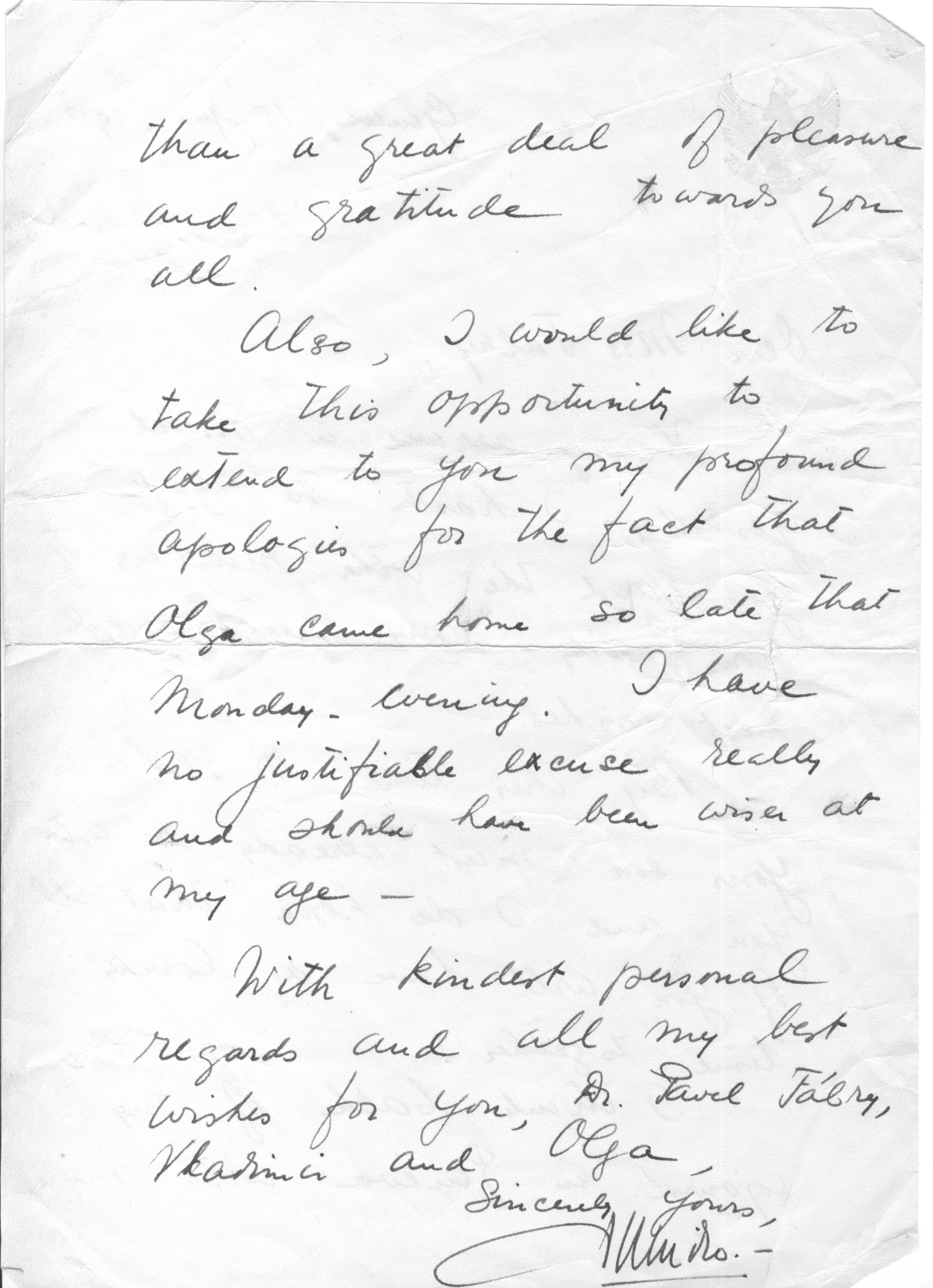
Having arrived in Stockholm yesterday I hasten to send you and the other members of your family, my greetings and best wishes. By this time Dr Vladimir, your son must already be with you and I do hope that all of you will have a lovely time together. I think back of my sojourn in Geneva with more than a great deal of pleasure and gratitude towards you all.

Sumitro letter Mrs Fabry II

Also, I would like to take this opportunity to extend to you my profound apologies for the fact that Olga came home so late that Monday-evening. I have no justifiable excuse really and should have been wiser at my age — With kindest personal regards and all my best wishes for you, Dr Pavel Fabry, Vladimir and Olga,

Sincerely yours,
Sumitro

I wonder if Sumitro got a scolding at the door from Maminka? He didn’t sound very sorry about coming home late in his letter to Olga!

Help with Slovak Translation

“Sometimes the key arrives long before the lock. Sometimes a story falls in your lap.”

–Rebecca Solnit “The Faraway Nearby”

Olinka at Christmas

Though it is clear that I love the Fabry family very much, what might be difficult to believe is that I was not accepted by my mother-in-law, Olinka, and that I only met her once before she died. As much as I wanted to know her, there just wasn’t enough time, and I was very sad about that. So, you can understand how these papers have been a gift to me, to be able to get to know who Olinka was, to understand why she was difficult and the hell she had been through – I think of her with compassion and forgiveness.

Besides being a great cook(see photo above), one of the qualities I admire most about her was her skill at many languages – she was as gifted as her brother Vlado.

Here are a few pieces of ephemera from Olinka’s career:
Olinka ephemera

It would have been easy for her to translate this document from the Prison de Saint Antione in Geneva(which is now the Palais de Justice), dated 1949, but it is not so easy for me. Who was in the prison? And why? Was it her father, Pavel? I am posting this here in hopes that Slovak readers will want to contribute a translation, if only to ease my curiosity. Please help!
(click image to enlarge)
Prison de Saint Antione

Before It Was Ghana: Photos from the U.N. Plebiscite in British Togoland, 1956

In 1956, Vladimir Fabry was assigned as Observer to the United Nations Plebiscite in British Togoland; which would vote to join the Gold Coast in May of that year, and on 6 March 1957, would become part of Ghana – the first African nation independent from colonial rule. Exciting, hopeful times for Africa, and Vlado was lucky to be there, to be a part of it.

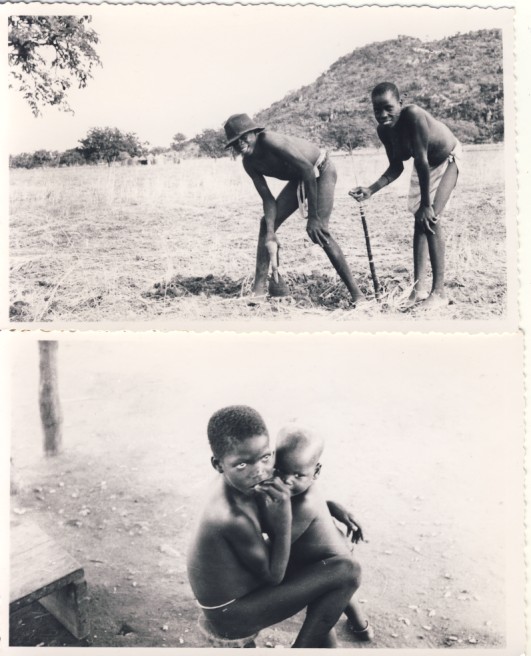
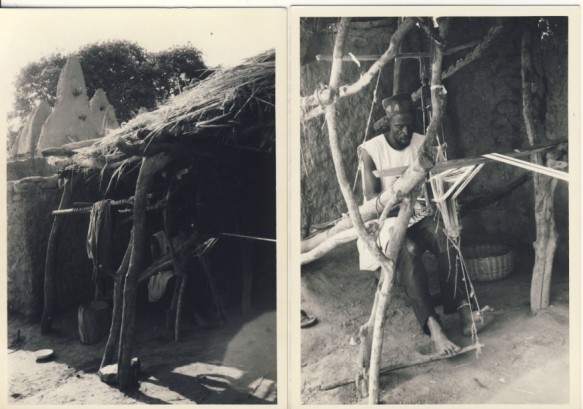
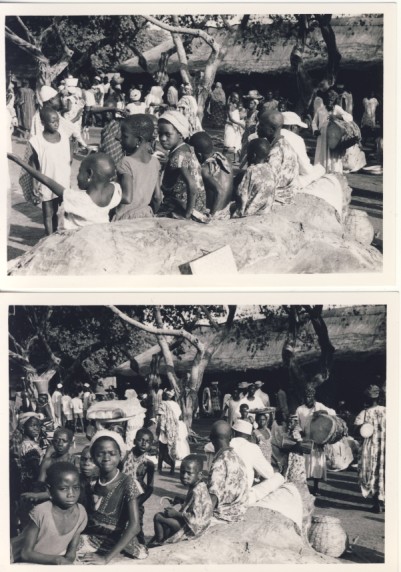
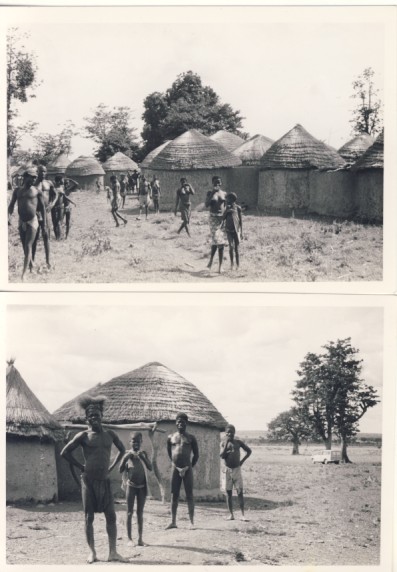
The first three photos are from the UN photo collection, showing Vlado at work. The other photos are of the people Vlado met while he was there – the future independent people of Ghana. In two of the photos, you can see a man making Kente cloth on a loom – amazing!

(click on photos to enlarge)

Vlado and R West Skinn British Togoland May 56

Vlado British Togoland April 56

Vlado and Jan Van Wyck British Togoland April 56

British Togoland Plebiscite 1
British Togoland Plebiscite 2
British Togoland Plebiscite 3
British Togoland Plebiscite 4
British Togoland Plebiscite 5
British Togoland Plebiscite 6
British Togoland Plebiscite 7
British Togoland Plebiscite 8
British Togoland Plebiscite 9
British Togoland Plebiscite 10
British Togoland Plebiscite 11
British Togoland Plebiscite 12
British Togoland Plebiscite 13
British Togoland Plebiscite 14
British Togoland Plebiscite 15
British Togoland Plebiscite 16

Like Father, Like Son

Curve of Longing For Family
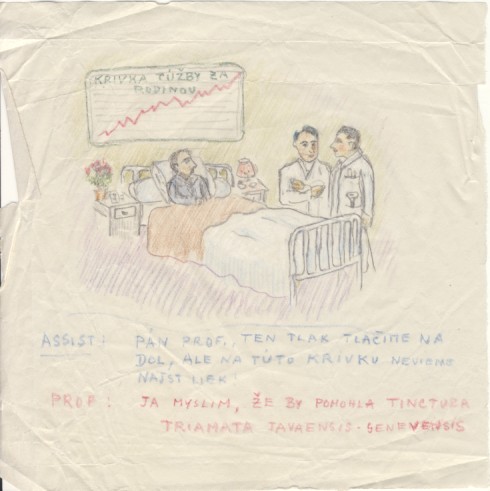
One thing I really admire about Pavel Fabry, is how affectionate he was in the letters he wrote to his family. Here is a little sketch of Pavel’s, with him in a hospital bed, a graph behind him that says in Slovak “Curve of Longing For Family”. The doctors are saying they have no cure for this “curve”, and Professor Fabry says he thinks a “Javaensis-Genevensis” tincture is what he needs. This was likely drawn during the late 40’s – early 50’s – when Vlado was working for Independence in Indonesia, Olinka and Maminka were refugees in Switzerland, and Pavel was in a hospital recovering from torture in a concentration camp, in the now former Czechoslovakia. Pavel’s sense of humor here shows he was living life on his terms, that he followed his convictions, and that he was willing to endure suffering for a just cause – a true romantic.

Fall in Love and Lose Weight
Then there are times when I am a little annoyed with him, like with this undated letter, sent to Vlado around the time he was working on the Suez Canal Clearance project in 1957, most likely before the project was finished. Pavel is telling him that he has to lose weight in two weeks, before their family vacation together (which would end with Vlado coming down with Hepatitis, and the weight loss that came with his illness). Then he says with all the tempting food of the Norwegians, Swedes, Canadians and Indians in the desert, that he would have to ride a horse at full gallop all day just to keep fit. He gives Vlado the advice to fall in love to lose weight, but not too happily, so he doesn’t fall apart at the end of it. Really, as if Vlado didn’t have enough to worry about, he has his father telling him he is too fat and needs to go on a diet! He is right though, that falling in love is great for weight loss, but he must have thought Vlado had some kind of superpowers to find a girl to fall in love with on the spot!

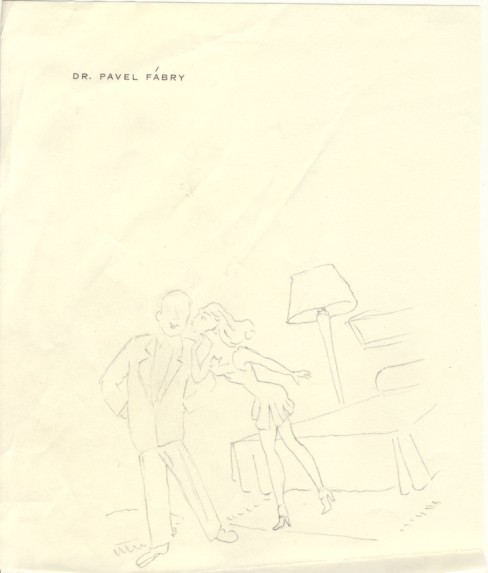
If Vlado was a romantic, it was because Pavel set quite an example for him. Romance was never far from Pavel’s mind, as can be seen in this little boudoir sketch (click to enlarge):
Pavel boudoir sketch
What is she whispering in his ear, I wonder?

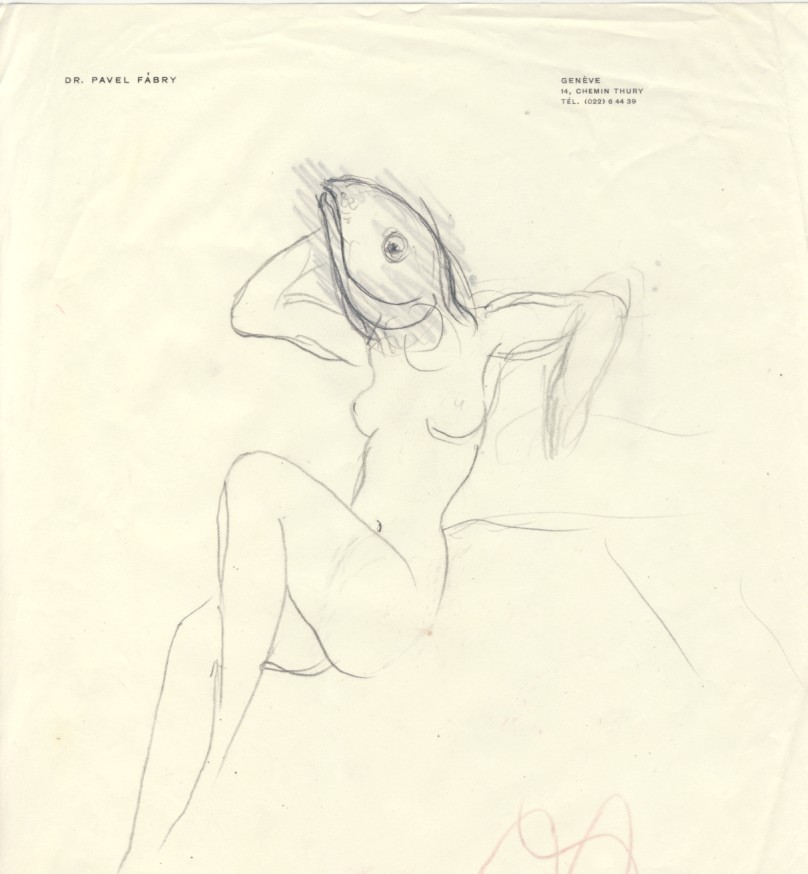
Sometimes, thoughts of love and food were in competition, like in his surreal sketch of a fish woman:
Pavel La Peche

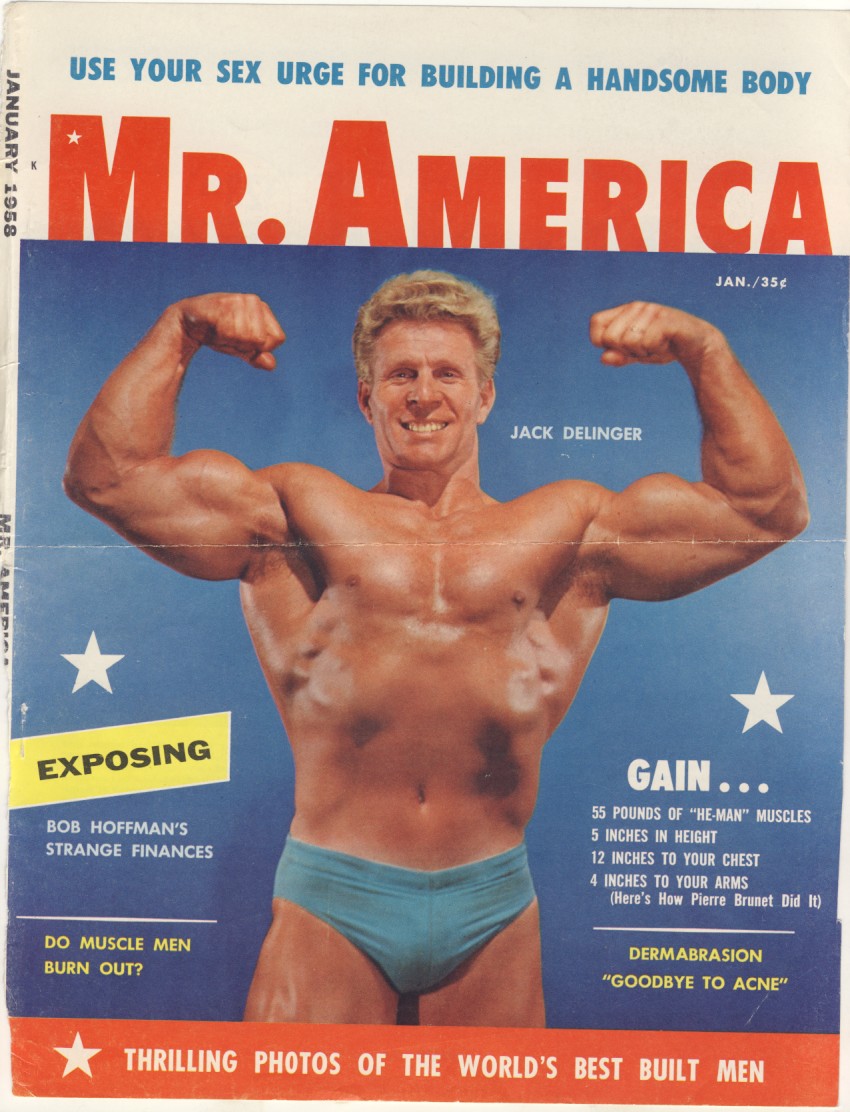
Keeping to the subject of romance, in another post, we read the love letters of Vlado and Mary Liz, with the last letter written in September 1957. There are no more love letters written by Vlado after that, but I found a portion of a Mr. America magazine, from January 1958, with a cover banner that reads “USE YOUR SEX URGE FOR BUILDING A HANDSOME BODY”:
Mr. America Jan. '58

Who knows if Vlado was trying to control his “urge”, or what, but romance may have been distracting him from larger goals in his life. I think Pavel was not much different than Maminka, in that he wanted Vlado to find a nice girl to marry – but I also think he took vicarious pleasure in hearing about Vlado’s carefree romantic life as a bachelor.

Vlado left some heart-sick women in his wake, as is shown in this last letter from 1959, written by a woman who wasn’t over Vlado at all, and whose impending marriage brought to mind funerals and drowning. This letter is more a distress call than anything else, which makes it a very funny read!

March 4, 1959

Dear Vlado,

Now it looks as if I may be in NY at last, but for the most unexpected of reasons – on a honeymoon! Probably, April 12-25.

I’ve been so interested to notice in how many ways marriage is like death! First, probably the only reason so barbarous a rite as a wedding has lasted so long in our streamlined society is probably the same reason the funeral has – i.e. sociologists say that all the transactions involved in planning a funeral take the bereaved’s mind out of the depths & the same goes for the bride, bereaved of her freedom!

Marrying is also like drowning in that you suddenly relive your past – at least your past loves & all my former boyfriends have come parading their images across my minds eye – & I must say, Vlado, that as I go through my card file, choosing addresses to send announcements to, each card brings up a little doubt, but the most difficult card to process was yours! Isn’t that funny, because I had dated other boys a lot more than you & I was just as inflamed over them.

It’s just that when I think of me settling down to air force protocol (he’s in for 10 more years!) I think of your verve; & when I think of those forever churning conversation on the base about TDY’s, PFR’s, ER reports etc., I dream of the day you, Otto & I went to the woods and captured those flagstones in such a unique way!

When I ask my 3 F’s (friends, family, fiance) what they would think of my sort of going to NY to get my trousseau & choose my silver pattern & all, they retort “and get that Czech at the U.N. out of your system? You’d never come back.” I shall always wonder if I couldn’t have made you come crawling & writhing out of your shell (if there’d been time) like a tortoise does when the Indians tie him above the fire so he will squirm into the soup pot! But my fiance says I’d better marry him without travelling to NY, because regrets are better than despair….

This stationary is a memento from our bi-family conclave to plan the bash (it will be April 11 at the ——City Community Christian Church – I dare you to come & stand up when the preacher asks “If there be anyone who denies that they should be married…”). His family is from Texarkana, long time friends of my folks, but we conclaved on neutral ground – in Fayetteville!

I do hope some sort of wife won’t open this letter, although I’m sure she would be understanding; otherwise she couldn’t have married you! But just in case I wish there was something I could say which would make me sure you’d know who sent the letter, so I wouldn’t have to sign my name, but I have a strong suspicion that you’ve taken many a girl hiking in the rain, driven her to help her pack on Bank Street – & even many admirers have sent you wooden pigs & sustenance pills when you were in Africa! So I’ll just have to say,

so long,

———–

Letter from High Commissioner of South Africa, H.L.T. Taswell, 29 September 1961

Vlado cityscene
Having spent so much time thinking about the life of Vlado Fabry, it has been impossible not to care about the way he died, and to want to know the truth about what happened. I’ve been reading every book and article I can find on the subject, but, for me, just reading the 1962 reports of the UN and Rhodesian Commissions investigation of the crash has been very revealing, especially in regards to Fouga Magisters which, I am convinced, shot down the Secretary General’s plane and caused it to crash on the night of 17/18 September, 1961. There were many Africans who saw one or two smaller planes following the DC-6 SE-BDY, but when they were interviewed by the Rhodesian and UN Commissions, they were treated like ignorant children and their testimonies were dismissed as fantasy. I learned a lot more about their treatment in Goran Bjorkdahl and Jacob Phiri’s excellent 2013 article for INTERNATIONAL PEACEKEEPING, Eyewitnesses: The Hammarskjold Plane Crash. From the article, here is one particularly awful comment from UN consultant Hugo Blandiori:

‘Thus, when it is taken into consideration that some of the African witnesses had lack of knowledge in air-plane identification, were of limited learning and might have been motivated by personal or political reasons, it becomes difficult in assessing the truth of their statements…As a consequence, I am of the opinion that the testimony of the African witnesses to the effect that they saw one or two small crafts flying along with SE-BDY just prior to its crash, has to be accepted with a grain of salt’.

I have provided here a few excerpts from both the Rhodesian and United Nations Commission, in order for you to appreciate the context of the following letter, which was written by former High Commissioner of South Africa, H.L.T.Taswell, on 29 September 1961, and was found in the archive of former Prime Minister of the British territory of the Central African Federation Sir Roy Welensky. A scan of the letter was sent to me by an anonymous source. I’m not positive if this particular letter is still considered “TOP SECRET”, but it won’t be anymore. It belongs in the public domain.

“At the outset we would say no reason was suggested, and we cannot think of one, why anyone who might have been able to attack this aircraft from the air should ever have wanted to attack it as it carried Mr. Hammarskjold on the mission he was then undertaking.”
(Federation of Rhodesia and Nyasaland, Report of the Commission on the Accident Involving Aircraft SE-BDY, chaired by Sir John Clayden, Chief Justice of the Federation, presented to the Federal Assembly, Salisbury, Federation of Rhodesia and Nyasaland; February 1962; Annex III, p.20, par.10)

“On landing at Leopoldville [the morning of 17 September 1961], [Flight Engineer] Wilhelmson had reported that SE-BDY had been fired on at the takeoff from Elisabethville. A thorough inspection of the aircraft was accordingly carried out under the supervision of Chief Mechanic Tryggvason of Transair. In the course of the inspection it was found that number 2 engine (inboard port) had been struck by a bullet, which had penetrated the engine cowling and hit the exhaust pipe. The exhaust pipe was replaced and the plane refueled to a total of ten tons.”
(…)
“The Commission further notes that no flight plan for the SE-BDY was transmitted to Salisbury. The Commission has taken into consideration the conditions existing in the Congo at the time and in particular the danger of an attack from the “Fouga Magister” which explains this departure from the rules governing commercial aviation. Indeed, the system of aeronautical communications cannot ensure the secrecy of messages”
(…)
“It is also relevant to observe that, because of the danger of an attack from the “Fouga Magister”, most of the flights in the Congo at the time were undertaken at night”
(…)
“The possibility of other aircraft being in the area of Ndola at the time of the crash was examined. Since the “Fouga Magister” of the Katangese Armed Forces had been operating against the United Nations in Katanga, the possibility of its reaching Ndola was examined by the Rhodesian Board of Investigation and the Rhodesian Commission of Inquiry. It was established that it could not have made the flight from its normal base in Kolwezi to Ndola and returned to Kolwezi since the distance is greater than its operational range. It was also stated by its captain and others that the “Fouga” was on the ground at Kolwezi the night of 17/18 September and could not have operated that night. This evidence is not entirely conclusive since the captain admitted before the Rhodesian Commission of Inquiry that on at least one occasion the “Fouga” had taken off from an unpaved track. While this track was said to be at an even greater distance from Ndola, nothing would appear to preclude the use of a track within range of Ndola. Nevertheless, there is no evidence that the “Fouga” was in the vicinity of Ndola on the night of the crash.”
(…)
“The Commission has, however, been informed that no radar watch was maintained in the Ndola area during the evening and night of 17 September 1961 and, therefore, the possibility of an “unknown aircraft” cannot be entirely excluded.”
(…)
“Certain witnesses testified that they saw or heard a second, or even third, plane. In particular, some of these testified that they saw a second smaller aircraft flying close to SE-BDY after it had passed over the airport or immediately before the crash and that the smaller aircraft was beaming lights on the larger. The Commission visited with some of these witnesses the spots from which their observations had been made and endeavored to obtain an understanding of their testimony. The Commission considers that several of these witnesses were sincere in their accounts of what they believed they saw.
The Commission is also of the opinion, however, that those witnesses may have misinterpreted their observations and reported some incidents which may not in fact have occurred in the way or at the time that they believed when they testified before the Commission.”
(United Nations General Assembly, Report of the Commission of the Investigation into the Conditions and Circumstances Resulting in the Tragic Death of Mr. Hammarskjold and the Members of the Party Accompanying Him, chaired by Rishikesh Shaha (UN A/5069); 24 April 1962; par. 69, 82, 89, 135, 136)

“TOP SECRET”

Salisbury S.R.
29th September, 1961

Dear Mr. Jooste,

As you will know, I had correspondence, during your absence, with our Minister regarding a suggestion made by Mr. Harper, Leader of the Opposition in Southern Rhodesia, that we assist in the establishment of an English language paper in this territory. The Minister’s reply is dated 5th September, 1961.

I have since had a further talk with Mr. Harper and explained the position to him. He will be visiting South Africa one of these days to have a discussion with Minister de Klerk on our Immigration laws. I will write to you again in due course on this matter.

Another approach for the establishment of an English language paper in Southern Rhodesia has since been made to me. It comes from quite a different quarter – namely from Mr. John Gaunt, Independent Member for Lusaka West, Northern Rhodesia, in the Federal Assembly. Particulars of Mr. Gaunt, taken from page 940-92 of the Who’s Who of Southern Africa 1961 are attached.

Mr. Gaunt is a colourful, outspoken and irrepressible politician who has a considerable following in this country. I would be inclined to describe him as the Arthur Marlow of the Federation. He is a fighter, a strong protagonist of the maintenance of white civilisation, yet not a supporter of our Government’s policy in its entirety. At the same time he is not an open or malicious critic of ours but a good friend.

A summary of what Mr. Gaunt had to say during the interview is attached.

Very briefly, his suggestion is that we make about £300,000 available through commercial interests in South Africa for the establishment of an English language paper here. This would be in opposition to the Argus press which is dedicated to the appeasement of “black nationalism” and aims at inducing whites to hand over control to a black majority as quickly as possible.

If £300,000 seems a great deal of money it should, he says, be borne in mind that it is barely the cost of a medium size commercial aircraft.

Mr. Gaunt does not feel that the proposed paper could dedicate itself to applying our racial policy in this country. The position here has already changed too much for that. But what it could do is ensure that the present constitution is rigorously adhered to. The Governments in Southern Rhodesia and the Federation should not be allowed to use the present constitution just as a temporary measure and as a means of sliding towards a still more liberal constitution.

Mr. Gaunt also feels that this paper would be able to further South Africa’s interests greatly by concentrating on favourable positive information. Such a paper if air mailed to South Africa each day could also serve a valuable purpose in our country and would assist the Government.

Mr. Gaunt would like to be made editor-in-chief so that he could give the correct slant to reports. He does not want to be responsible in any way for the financial side.

To me this idea of an independent paper has great appeal. Any opposition here is completely frustrated through having no paper. The Argus group is so powerful, moreover, that it could go far to breaking even the most established politician who does not follow its particular line – and I do not exclude Sir Roy Welensky.

Nearly two years ago Anglo-American and NST[? abbreviation unclear] withdrew their financial support of the United Federal Party. It looked then as if they were going to support Todd who was given a tremendous boost by the press because of his liberal line. Now the U.F.P. are following the liberal line themselves, Todd is in the background, Anglo-American and NST[?]have, I hear, restored their financial support of the U.F.P. and the Argus press are supporting the party. That the United Federal Party have been forced to toe the line by Argus press is no secret to us in South Africa.

The future say of the white man in the Government of this country does not look rosy. Banda has control in Nyasaland, Kaunda may, through British action, still attain a similar position in Northern Rhodesia. Southern Rhodesia’s new constitution could be merely the first step towards giving greater say to the black man here. The Federal constitution when revised must follow the pattern of the constitutions of the three constituent territories. That means infinitely greater say for the black man in the Federal Assembly. Such say will have to be very considerable indeed if Banda is to be induced to stay in the Federation.

Sir Roy and the United Kingdom are already at loggerheads over the talks on the Federal constitution. Sir Roy wanted them now. The United Kingdom wants postponement, no doubt with the object of further appeasement in Northern Rhodesia and conditioning of white feeling to a black majority government.

There is strong and bitter feeling in this country against the United Kingdom. Given an independent press it could be fanned to a point where the United Kingdom could be seriously embarrassed, and where Southern Rhodesia could still be saved, where it could break from the Federation and become independent. There are many influential men here would gladly grasp a weapon like an independent paper.

There are many seeds of discontent. This week we heard rumours of a serious division in the Federal Cabinet. The Deputy Governor of the Bank of Rhodesia and Nyasaland, told me only a few days ago too that the financial picture here is far from rosy. The “expected” recovery after the Southern Rhodesia referendum has not materialized. The number of people who voted “yes” at that referendum and now feel they were duped and should have voted “no” is increasing. Properly exploited this discontent could have a marked influence when Southern Rhodesia goes to the polls in about a year’s time.

If the United Federal Party and the Argus press continue unchecked, it is merely a matter of time before our buffer zone north melts away. With an independent paper we could stave that day off and could even preserve the Southern Rhodesia[border? word obscured]with its 215,000 whites(2,630,000 blacks).

As Mr. Gaunt points out it is surely to our interest to have the main struggle for survival take place in Southern Rhodesia rather in South Africa.

A Canadian group is now negotiating for the purchase of African Newspapers here. One can imagine the kind of vitriol the Canadians would be capable of using against us.

The “Citizen”, Mr. Gaunt says, could be bought by us for a song. An immediate start could be made with a paper. Improvements could follow.

The Argus will try to kill any independent paper and financial losses must be expected. But would they not be worthwhile? We are fighting for our lives. They are fighting for a black majority government, for cheap labour and greater profits.

H.L.T. Taswell
High Commissioner

This letter perfectly illustrates how propaganda works, and it’s a history lesson on racism, and the lengths men will go to defend their right to it. Even though the Fouga Magister is a small fighter jet, the sentence about an independent paper being less expensive to purchase to defend their racial policy than “a medium size commercial aircraft” gave me a chill, because this written only 11 days after the crash. No wonder they hated Hammarskjold so much – what was the fragrance of life to the African was the stench of death to white rule.

“A Desperate Personal Demand For Help”

Tara 2013 003
In 1961, even in the midst of the Congo Crisis, Vlado was doing all he could to help his family. Conor Cruise O’Brien’s observations of Vlado, in his book To Katanga and Back – that he did nothing but work and hardly slept – were fairly accurate for the time he knew him, because it seems that he was spending every spare moment attending to the unfinished legal cases of his father, Pavel Fabry, who died December 19, 1960.

From February 2, 1961, here is a letter to United Nations legal counselor Oscar Schachter from Vlado’s Maminka:

Dear Mr. Schachter,

I am sorry to take your valuable time and to disturb you with this letter. It is only the serious situation and the emergency in which I find myself after the death of my beloved husband that urge me to write this letter.

As you may know my husband was working for some years as an international lawyer with the German Government on war reparation. My husband devoted not only his effort, time, money, but finally his life to this cause. Unfortunately it was not permitted to him to finish his affairs as he died so very suddenly in the middle of his unfinished task. Vladko who was always a remarkable son is now sacrifying[sic] all his free time besides his work and his vacations to work until late at night on his father’s affairs. There are many difficulties, many hard problems to be solved, which will need patience, time, travelling and possibilities of good communications.

All these are problems which I cannot face alone, and the only person to solve them and to continue the unfinished work of my husband is my son. If we had to take a lawyer, we would have to do it in many countries of Europe and my husband has indebted himself already too much to afford so many lawyers. It is therefore only my son who is the only person to help me out in this.

My health has been weakened by the sudden loss of my husband. When I learned about the transfer of my son to Congo, it was another shock for my heart illness. I am unfortunately unable to cope alone with the situation I have mentioned as much as I don’t like to ask something, I am driven to it by this emergency. It is furthermore a situation which presents itself during our life, such as accident, illness, death and its consequences, etc. I would like to ask you to help me, Mr. Schachter. You have always been very nice to us all, a real good and understable[sic] friend and I would like to ask you not to let me down now, when I most need it.

I wonder whether it would be possible to arrange a transfer for my son to Europe – Geneva or elsewhere – so that he could easier communicate and work to finish my husband’s most urgent cases. I have never asked you anything before and I would never have, but as you can see it is a very serious situation and I am in an emergency.

It is very difficult for me to write this letter and I am doing so on my own, without my son’s knowledge. Would you please consider it as such, a desperate personal demand for help.

Many thanks for everything you will do for me to help me out. Kindest regards to Molly and to you.

As ever yours,
Olga Fabry Palka

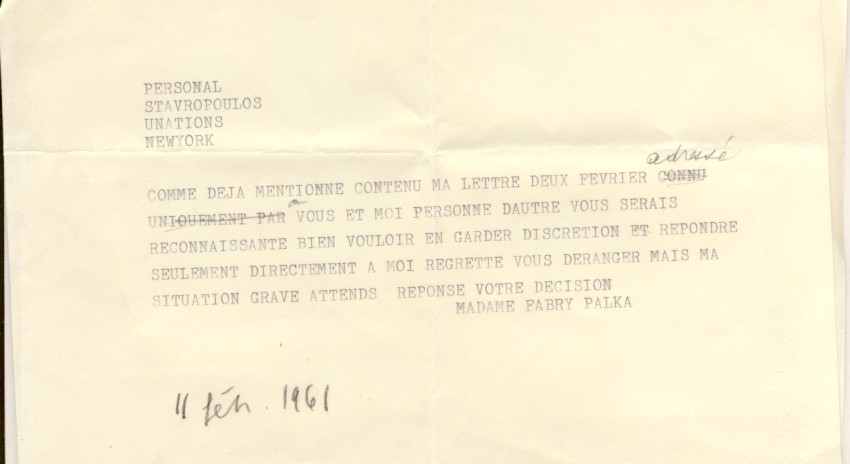
Vlado’s mother also wrote Constantin Stavropoulos for help. Here is a personal telegram she sent to him, dated February 11, 1961:

Maminka Stavropoulos telegram
(click scan to enlarge)

Vlado: United States Citizen

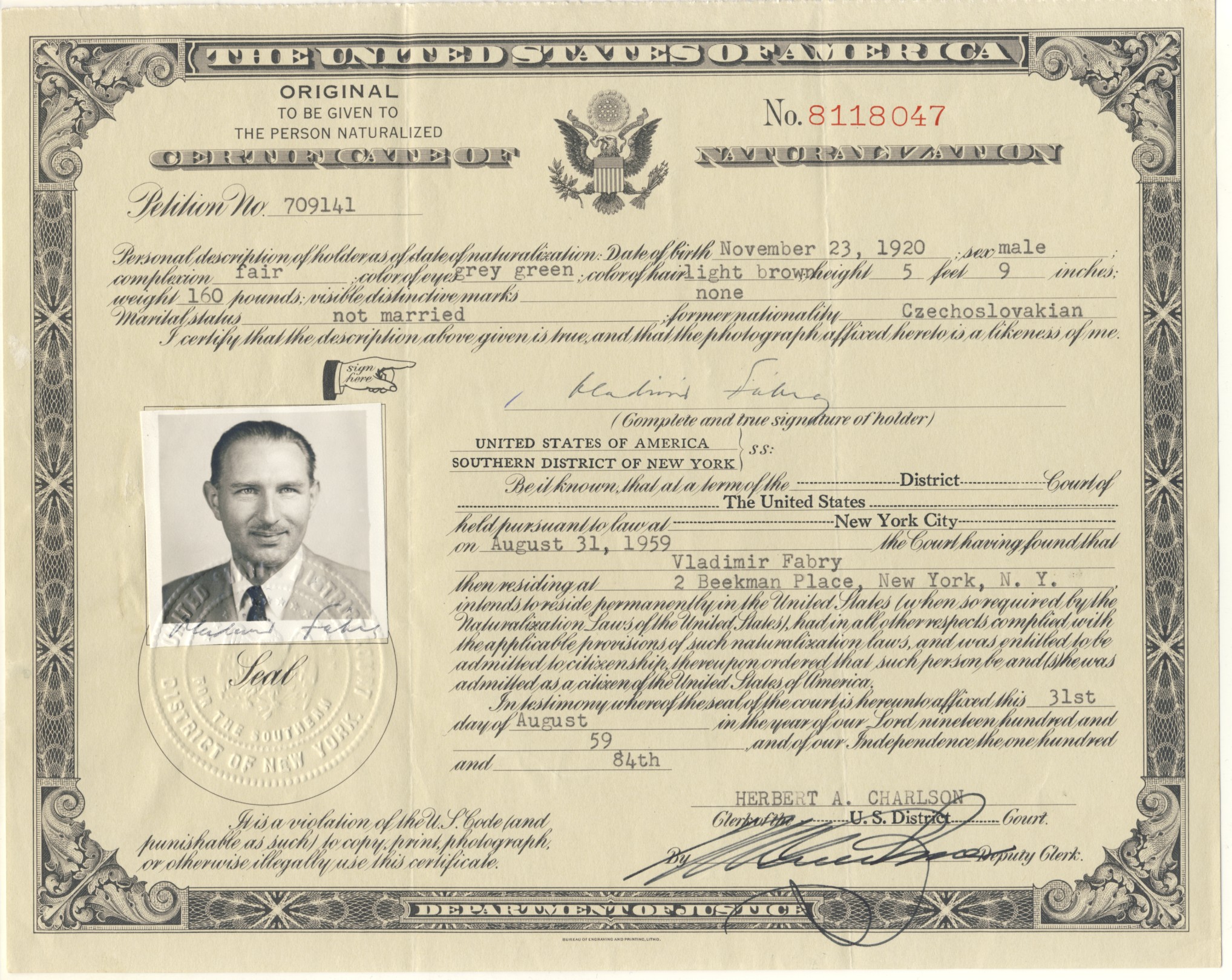
With the help of the 1951 UN Convention and Protocol Relating to the Status of Refugees (UNHCR), Vlado Fabry was eventually able to become a United States Citizen on August 31, 1959, but not without troubles along the way. For one thing, it took a while before he had work at the UN in New York that kept him in the US for the required consecutive time period – he was called all over the world. But there was also trouble from the new Czechoslovak Government, who invalidated Vlado’s passport and asked the Secretary General to dismiss Vlado from the UN.
This undated Annex was found with the naturalization papers:

Annex A
To application to file petition for naturalization
Page 2, question No. 6

I am not aware of ever having committed any crime or offense, in the United States or in any other country, except for minor traffic law violations. However, in October 1940, after having organized a mass walk-out of Slovak protestant students from a Nazi-sponsored organization called the Academic Hlinka Guard, I was arrested and without formal charge, trial or hearings of any kind condemned to deportation. On 27 January 1945, I was sentenced to death by the “Sicherheitsdienst”(Gestapo) for obstructing the German war effort and participation in the Slovak liberation movement against German occupation forces. After the Communist Party seized power in Czechoslovakia, I was charged with “anti-state activities” for having expressed anti-Communist opinions and advocating freedom of private enterprise while employed as an official of the Czechoslovak Ministry of Commerce in 1945-6. As far as I know no formal trial was held on these charges, as I refused to return to Czechoslovakia when my passport was withdrawn and the Secretary-General did not deem it fit to comply with the request of the Czechoslovak Government for my dismissal from the United Nations service.

Vlado had to return to the US from his mission in Indonesia with an invalid passport, and he gives his account in this document dated August 22, 1951, addressed to Miss Alice Ehrenfeld:

Admission to the United States.

On your request, I herewith submit to you the information which you may need to deal with the question of my admission to the United States.
I was born on 23 November 1920 as a citizen of Czechoslovakia. I have been a member of the staff of the United Nations Secretariat since 15 June 1946, serving under an indeterminate (permanent) contract.
I entered the United States for the first time on 15 June 1946 and was admitted under Section 3, paragraph 7, of the Immigration Act for the duration of my status as an International Organizations Alien. In April 1948 I left the United States on an official mission, re-entered the country on 6 January 1949 and left again on 15 February 1949 to serve with the United Nations Commission for Indonesia. After completion of my duties there, I was instructed to return to Headquarters for service with the Legal Department of the Secretariat in New York.
As a consequence of my political convictions and activities, I became a displaced person after the communist coup d’état in Czechoslovakia in February 1948. The Czechoslovak Government has ceased to recognize the validity of my passport (No. Dipl. 2030/46).
I drew the attention of the competent officer in the Department to this fact when I was leaving on my mission assignment, and I received the assurance that there would be no difficulty regarding my re-admission to the United States. This assurance had been given, I understand, after consultation with the State Department.
I also explained my case to the United States Vice Consul in Djakarta, Indonesia, who was issuing my United States visa. He advised me that it was sufficient if I held my invalid passport as an identity paper, and that no difficulty would result from the fact that my visa was not stamped in a valid passport.
Upon arrival at Idlewild Airport, New York, on 20 August 1951 (7:30 A.M.), I was told by the immigration officer on duty that I could not enter the United States. I was then requested to sign an agreement according to which I was released on parole. My passport and the Alien Registration Form on which the United States visa was stamped were taken away from me with the remark that my office should undertake further steps to regularize my status and affect the release of my documents.

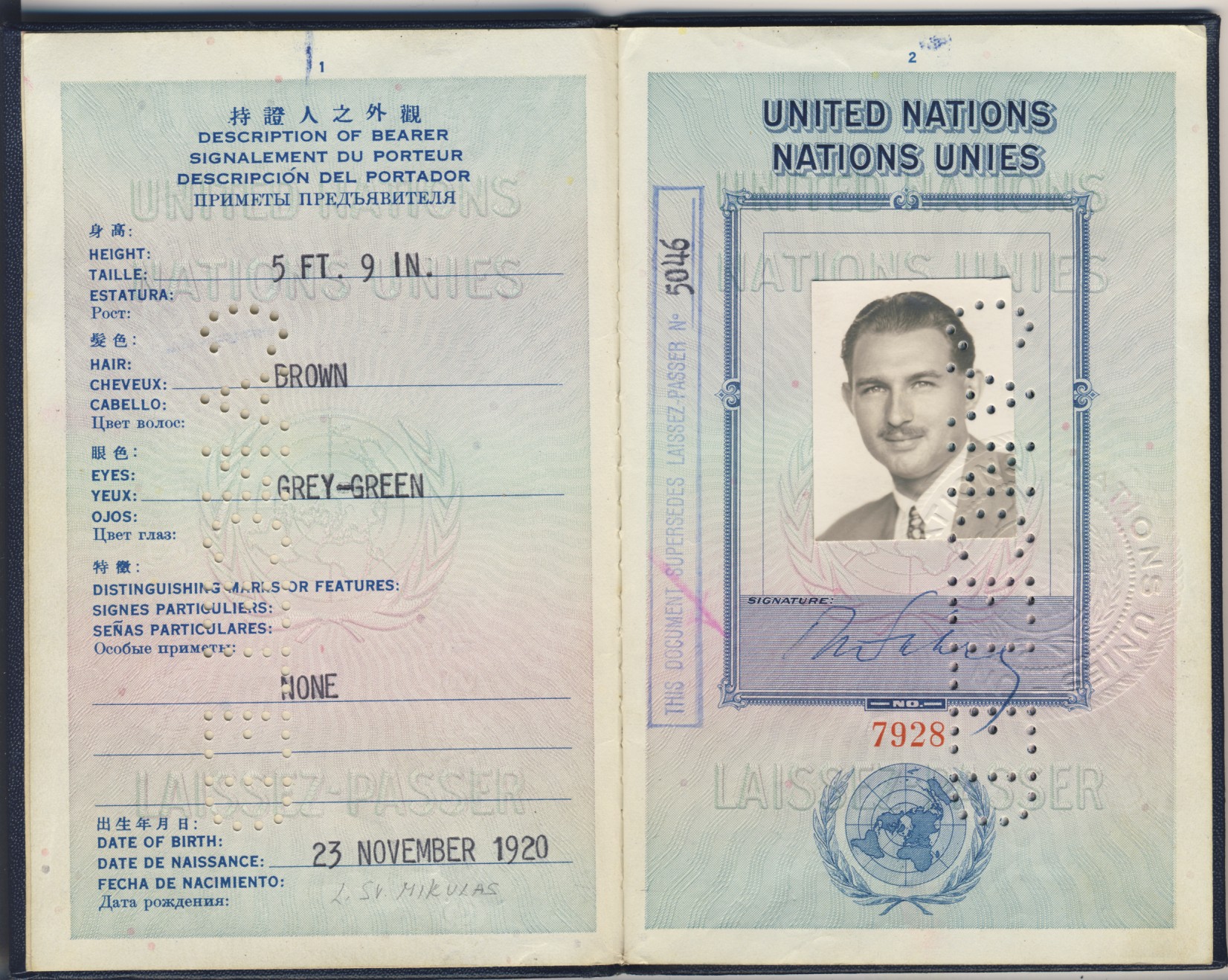
Here are some images of Vlado’s United Nations Laissez-Passer (UNLP), issued to him on October 6, 1952, and signed by the first UN Secretary General Trygve Lie:
Vlado UN passport cover
Vlado UN passport
Trygve Lie passport signature

By 1954, Vlado had long been stateless, with no place to call home. He writes to Marshall Williams, Administrative Officer, Bureau of Personnel at the UN, on May 18, 1954:

Request for permission to change visa status

1. I was notified by the United States Consulate-General in Zurich that a number on the DP immigration quota became available for me and that I should present myself at the consulate in Zurich before 27 May.
2. I should be grateful to receive permission to sign a waiver of United Nations privileges and immunities, which I understand to be a condition for the granting of a permanent residence visa. I trust that such permission will not be denied as it is essential for me, for the reasons indicated below, to acquire the right to establish a home somewhere. In view of the shortness of time given to me for appearance before the consular authorities, I should appreciate it if my request could be considered as urgent.

3. I should also like to apply for the permission to change my visa status without losing entitlement to tax reimbursement. The Report on Personnel Policy adopted by the Fifth Committee during the last session of the General Assembly states that the Secretary-General should be able to grant such permission in “exceptional and compelling circumstances”. In accordance with a statement made by the Chairman of the Advisory Committee on this subject, this provision relates to “certain officials of the Secretariat who had lost their nationality through no fault of their own and who might quite legitimately seek to acquire another”. I sincerely believe that these conditions are present in my case.

4. I have lost my nationality and I am unable to return to my country of origin because of substantiated fear of persecution on account of my political opinions and activities undertaken prior to my joining the United Nations. In the years 1945-1946, I was an active member of the Slovak Democratic Party which at that time was lawfully permitted and recognized as an instrument of the political will of the majority of the Slovak people; I also held the position of Assistant (Chef de Cabinet) to the Minister of Commerce. In accordance with my beliefs and official directives, I worked to the best of my ability on fostering the resumption of normal conditions under which trade could prosper, and on preventing the suppression by force of the right to enjoy private property and freedom of enterprise; such activity, lawful and constituting part of my official duties at the time it was undertaken, is considered criminal by the regime which since has come to power in my country. I was therefore compelled to become an expatriate, or else to make myself the object of grievous persecution. My fear of persecution is substantiated by the facts that members of my family and several of my friends had been arrested and interrogated regarding my activities; and that persons who held positions similar to mine, and did not escape abroad, were sentenced to long prison terms or maltreated to death.

5. Having thus without fault of my own lost my nationality, I consider myself legitimately entitled to seek to acquire the right to establish a permanent residence, a home, in another country. For although it is true that I have the right to stay in a country as long as I remain there in the United Nations service, I must provide for the possibility, which I hope shall not occur, that I might lose my present employment (and in any case, I shall need some place where I can reside after I reach the age limit). Moreover, being stateless and without the right to permanent residence anywhere, I am subject to many restrictions and deprivations.

6. I therefore firmly believe that I have compelling reasons for obtaining a visa status authorizing my permanent residence in the United States, and I hope that I shall be granted the permission to change my visa status without losing entitlement to tax reimbursement. I feel that it would be unjust if, having lost my nationality, I should be penalized for this misfortune by being made subject to financial burdens which I can ill afford.

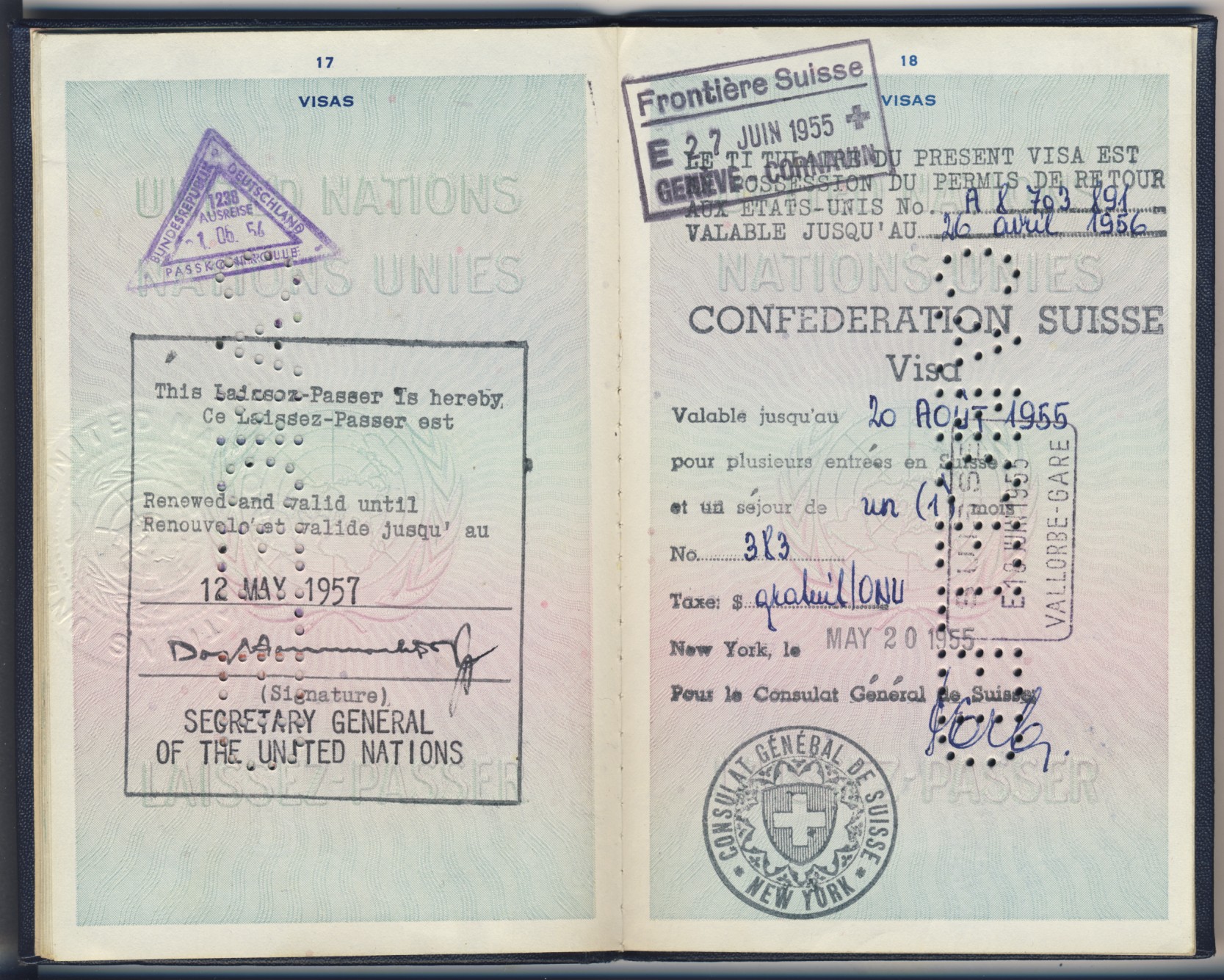
Here is Vlado’s passport, renewed and signed by Dag Hammarskjold:
Dag Hammarskjold passport signature

And finally, the sought after United States Certificate of Naturalization:
Vlado Certificate of Naturalization

How Lucy T. Briggs Met Vlado

In previous posts (here and here), I learned that Lucy T. Briggs gave the gift of “Bambi” to Vlado, and that she followed in the footsteps of her father, Career Ambassador Ellis O. Briggs, as a Foreign Service Officer. I wasn’t quite sure how they met, until I found this condolence letter recently, written to Mrs. Fabry, dated September 23, 1961:

Dear Mrs Fabry,
I was deeply shocked and saddened to learn of Vlado’s tragic loss. There are no words to express if fully, but I want you to understand that I am truly sorry, and pray that God is helping you to bear this heaviest of burdens.

I did not know Vlado very well, but I think we were friends. We met, of course, through Olga in Geneva, where I studied in 1950-51. Vlado took me skiing in Vermont the following year, one weekend, and I remember how patient he was with my slowness as a somewhat permanent beginner! Then, he and Olga came to Washington, about two or three years ago, and came to see me in Virginia where I was then living. At that time, Vlado was already moving up rapidly at the United Nations. You must indeed be very proud of him for having achieved so much in a short time, and in spite of difficulties which would have discouraged most men. The account of his accomplishments portrays a life of dedication to high principles and of tireless efforts to put them into practice. The United States is the richer for having claimed him as a citizen, and the poorer for having lost him in the battle which we are all fighting. But his spirit and his example will be with us always.

Forgive me if I have imposed on your sorrow with this long letter, but I wanted you to know my feelings.

With every good wish to you and Olga,
Very Sincerely,
Lucy T. Briggs

P.S. Please let me know if there is anything I can do for you.

Vlado and the Suez Canal

The United Nations Suez Canal Clearance Operation (UNSCO) was one of many missions that Vlado was involved with. Interesting items have been saved from this time, including a chart of the UN clearance operation schedule from January-April 1957; which shows the names of the tugs, salvage vessels and diver’s ships, with names like “Hermes and Wotan” and “Atlas”. It’s a very large chart, but I will post it here soon.
This is a photo of Vlado taking a camel to work:
Fabry Archive - Selected Photographs (43)
Here are three letters written by Vlado from Ismaïlia, Egypt, during the clearance operation – the first letter was sent to his friend and flatmate in New York, William W. Crandall, March 27, 1957:

Dear Bill,
I am afraid I shall be late with my rent this month but I left early last week for what was supposed to be a two days inspection trip into forward positions and what eventually turned out to be nine days out in the dessert (my spelling shows to you what is uppermost on my mind after a week of field rations). (And no USArmy rations, either Yugoslav or Indian, and neither of them go for fancy stuff). Anyhow, I eventually caught up with the pouch again, and the cheque is enclosed. Next time I better start thinking of the rent by midmonth.

Most of my work here is on the problem of opening up the Suez Canal and I am thoroughly enjoying the technical side of it – I am getting to be quite an expert by now on sweeping wires, parbuckling, blowing up camels (although when I heard the term the first time I could not visualize anything else then the results of a faulty digestion of the local beasts of burden), patching and pumping, as well as on the even more complex problems of dredging maintenance, rehabilitation of workshops and floating equipment, signalling systems and traffic direction that must be solved before the Canal can be opened. Less pleasurable is the realization that notwithstanding all the efforts here and the good progress of the technical operations and negotiations on the local level, nothing will come out of it until the political issues are solved by the big boys. I also got caught up by some of the problems of the Emergency Forces, although that’s not really my job, and that was quite interesting too.

I hope all is well with you – I think a bit wistfully of New England snow, this being my second skiing season that I am missing, but basking in a reliably constant sun is not too bad either, at least now while it is not too hot. But there is not much one can do for exercise – specially so as the office hours are 8am to 10pm, Monday through Sunday – and I see myself coming back as fat and flabby as King Farouk (or even worse so unless I find some suitable partner willing to engage with me in the one kind of exercise that he was practicing quite assiduously).

With Best Wishes – Vlado Fabry

This next letter is to Mary Sheila Dean Marshall, dated March 2, 1957:

My dear Sheila,
If you should catch me off my guard and jump on me with the question “how long since you left New York”, I should quite sincerely answer that it was last week or so. I keep surprising myself each time i look at the calendar and realize how time has flown. One reason why all time conceptions become blurred may be our working hours arrangement – 8am (sic!) to 10pm, Monday through Sunday, not counting overtime -; with no weekends or even solitary Sundays to mark the full stop after another elapsed week one simply never knows that another week has begun.

This having been said I am a bit at a loss what else I can write without getting at loggerheads with the UN staff rules concerning unauthorized release of confidential information. I can’t write about my private life – not only is there none but even if I had any I’m sure it would be classified as “restricted”,- everything else seems to be, including memos telling us what to do about fleas and bedbugs and summaries of news clipped from local papers. There are flocks of correspondents swarming around and of course all of them know perfectly well what we are doing and what’s going on, but still both at UNEF HQ and at the Canal Clearance Group I have to pretend as if I was an invisible man whom they could not possibly have seen emerging from a plane or car. Maybe the story about the secrecy class of documents marked as “to be destroyed before reading” was not an invention at all.

In spite of everything, I am thoroughly enjoying life and the feeling of being in the middle of it, and I feel smug and happy whenever I get a chance to stop and realize how I feel or that I feel anything at all. I don’t know whether others feel the same when they wake up to it, but judging by the grumbling about tiredness, food, vermin, roads, dust, sleeplessness, cold, heat, dirt and everything else that one constantly hears around, I may be a blissful idiot completely unaware of the black doom around me. Of course one does get a bit discouraged from time to time when after beating for hours against a stone wall one finds the efforts rewarded by a small crack, only to come back the next day and find that the wall is as solid again as it ever was, but that’s all part of the job and is more than compensated by the absolute bliss when things do move ahead. And there is always the net profit on top of it – the new experience, in particular what I was able to pick up about the salvage and navigational aids business when working on the Canal clearance problems.

With best wishes to Desa [Pavlu] and to all other friends – Love, Vlado

This last letter, dated April 7, 1957, is to Mary Liz (still don’t know her last name, but she worked for the UN), who had a sweet romance with Vlado:

My Dear One,
Sorry for the long pause in my writing. You were just about due for a letter when things started crackling in Gaza, and what with the SG’s [Secretary General Hammarskjold] visit and the rush to finish clearing not only the physical but also political obstacles standing in the way of normal traffic through the Canal, this is the first time I have a free evening since nearly a month. But I don’t regret having been caught up in the madhouse of hectic rush and strain, far from it, I feel grateful for the chance to have been right at the focal point of world history for a while – although I would be a hypocrite not to admit the sigh of relief when Stavropolous OK-ed my actions and took over the responsibility. I always boast to be able to sleep a log in any circumstances, but there was a night when I tossed around tense with worry despite the fact that I had worked 39 hours without a break and should have been tired enough. I was the only lawyer on the spot, events moved so quickly that there was no time to set opinions into code and send them to headquarters for approval, actions were taken on papers dictated right in the typewriter without a chance to reread and revise them, and for a while I was left with the nightmare of figuring out ex-pot all that could go wrong instead of having a chance to think it over in advance. But we muddled through somehow. I admit that there were days when I did not think of you at all, or at most with a quick flash of recollection swamped away before the image could get proper hold, but I am making up for it now – I literally woke up with you on my thoughts the last three mornings and you stayed with me whenever my mind lazied away from work through the day and evening.

Not much I can write about myself otherwise. I took an apartment (top floor, of course, to have an unobstructed view) with a big terrace and a contraption for beating out carpets on it that I planned to use for some chinning up exercises, but hardly made any use of it. Nor did I find time during the last month to go for my lunch-time swim and sunbath. I stayed in Cairo during the SG’s visit, but all the time could not find an hour for myself to look into a mosque or museum. And of course no time to read – although during the first month here I managed to pense books on Islam, on the pharaonic art and history, on 17th century philosophers, on Abelard, Graves’ Sargeant Lamb, Greens’ Heart of the Matter, Weller’s mediocre but for me interesting novel on “liberation” by the Russians, Dylan Thomas’ autobiography, Faulkner’s Unvanquished, a collection of Truman Capote and a few more.

Hope to get a letter from you soon – never thought I would ask anybody to write me just for writing’s sake, but your letters are very precious to me and it feels so good to read and reread them (I got three so far). Let me know how your leg feels – will you be ready for some hikes when I come back? By the way, I shall leave here around the 20th or 25th April for Europe, reach NY probably beginning June.

All my love – Vlado

And just one more extra – the footage of Hammarskjold’s visit to the Suez Canal in 1957, thanks to HammarskjoldProject on Youtube:

Last Photo of Vlado Fabry and Dag Hammarskjöld

In my first post, I uploaded a video from Youtube by HammarskjoldProject, showing the final images of Dag Hammarskjöld and the UN members boarding the plane that would crash near Ndola, September 18, 1961. I’ve spent a good deal of time looking at images of Vlado and his most distinctive features are his ears, his broad smile and his high cheekbones, which is how I recognized him in the video, climbing the stairs for the last time.
Here is one of the last known photos of Vlado and Hammarskjöld, taken by the Daily Express, which was sent with a condolence letter by Mary Sheila Dean Marshall from Ibadan, Nigeria. The photo is of the back of his head, but the ears are unmistakably Vlado’s. The letter, and the obituary of Marshall that galvanized me to begin my research about Vlado, is posted here.
Vlado and Dag Hammarskjold Last Picture

**Update: This photo was cropped. The expanded photo and more is included in later posts, found here and here.

Elspeth Young’s Tribute to Vlado

Elspeth Young had the pleasure of teaching English to Vlado Fabry in Bratislava, and here she offers her finest memories of him in tribute:
Elspeth Young Tribute to Vlado

“A Tribute from an English Friend”
When I first knew Vlado, he was nine years old. At that time I was living in Bratislava and his mother was glad to keep up her English with me and so Vlado too began English. I soon found he was very gifted and quick to learn; he took a keen interest and it was a pleasure to help him.
His parents were able to give him every advantage, but taught him how to use money wisely and to be independent and self-reliant. I believe this early training in independence more than once saved his life. About the age of ten, I remember him telling me, that he had his own allowance for clothing and kept his own accounts, but he was generous and thoughtful for others. This I believe was greatly due to his mother’s influence. Sometimes during his school holidays he would go from village to village in his own country collecting Folk Songs and at the age of fifteen had written a ballad himself of more than fifty verses.
He was devoted to his parents and sister (who is equally gifted) and had a happy life. He began flying with his father at an early age and had already travelled a good deal. After the tragedy of the War, when they lost every-thing and came though many dangers, his parents finally arrived in Geneva. Then Vlado was their mainstay. On account of his knowledge of languages and his great gifts, he held responsible posts and travelled widely for the United Nations. He took a great interest in any foreign country he visited and with his gift of languages and courtesy, he made friends everywhere. Whenever he came through London, if he had the time, he would phone me to meet him somewhere and tell me the family news. He never forgot his friends.
His passing is felt by all his friends, especially those who have known him for so many years and followed his career with such interest.
(Signed) Elspeth Young

Here is one of the many letters from Elspeth to the family, sent from London on December 16, 1956:
(click images to enlarge)
Letter from Elspeth YoungLetter from Elspeth Young 2

Postcards

Many of the postcards in the Fabry collection are of typical images from Switzerland, but there are a few that stand out in contrast.
(click images to enlarge)
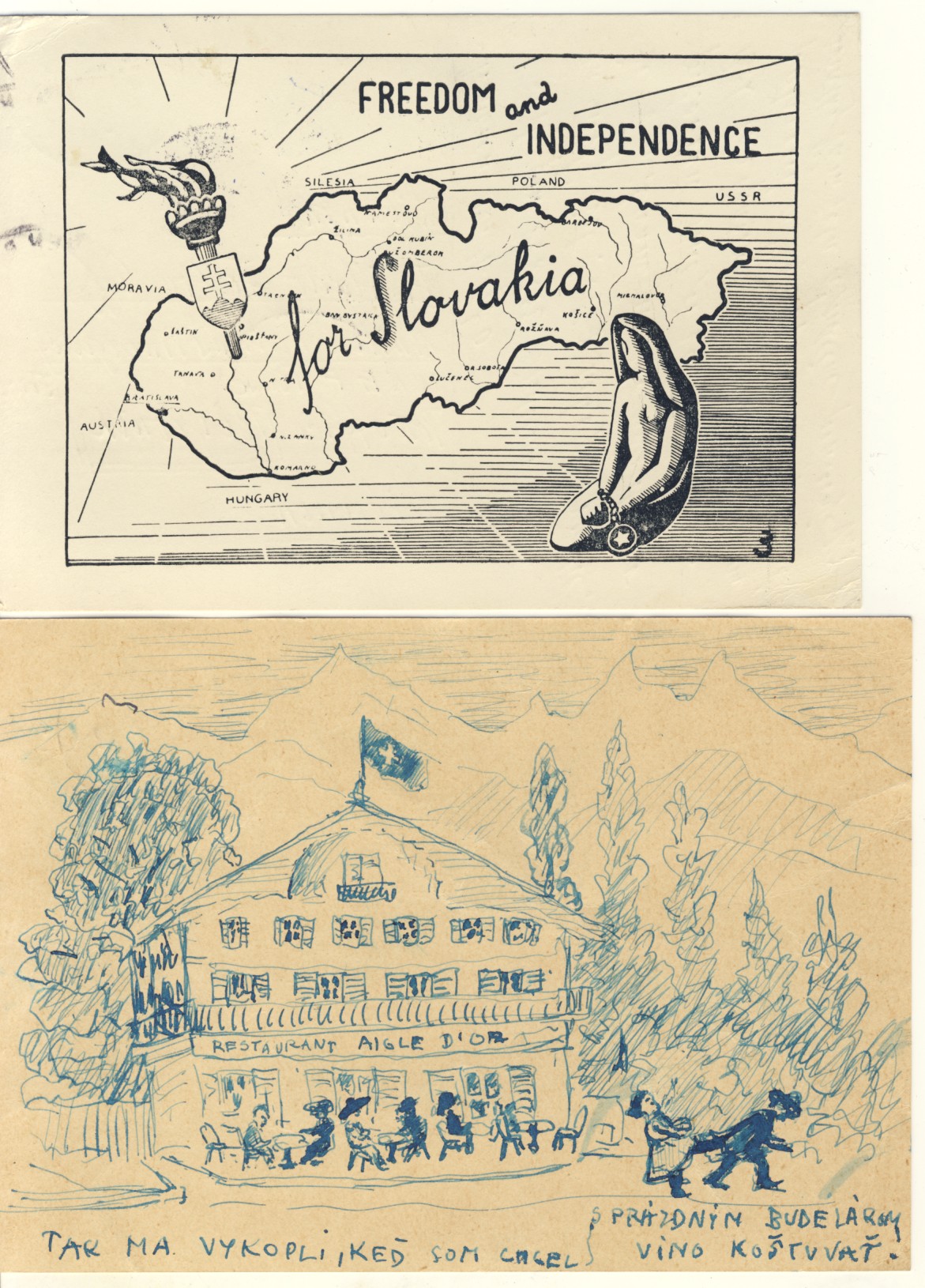
Unusual Postcards
“Freedom and Independence for Slovakia” was sent from Munich on April 12, 1960, and signed by someone named “Tiso”, but not Jozef Tiso.
The second card, drawn by Dr. Pavel Fabry and written in Slovak, was sent from Aigle, in the Swiss canton of Vaud (a place I am very fond of) on May 1, 1949. I tried to translate this, but was not successful – something about being kicked out of place (a woman appears to be kicking the backside of a man in the drawing, too).
I recognized this image immediately – Lenin’s Tomb and the Kremlin:
Lenins Tomb Postcard
The postcard is written in German and dated January 1, 1949, with stamps and cancels from both Denmark and Czechoslovakia – what makes this one even more interesting is that the card is from the Soviet Union, written in Cyrillic.
Lenins Tomb Postcard Reverse
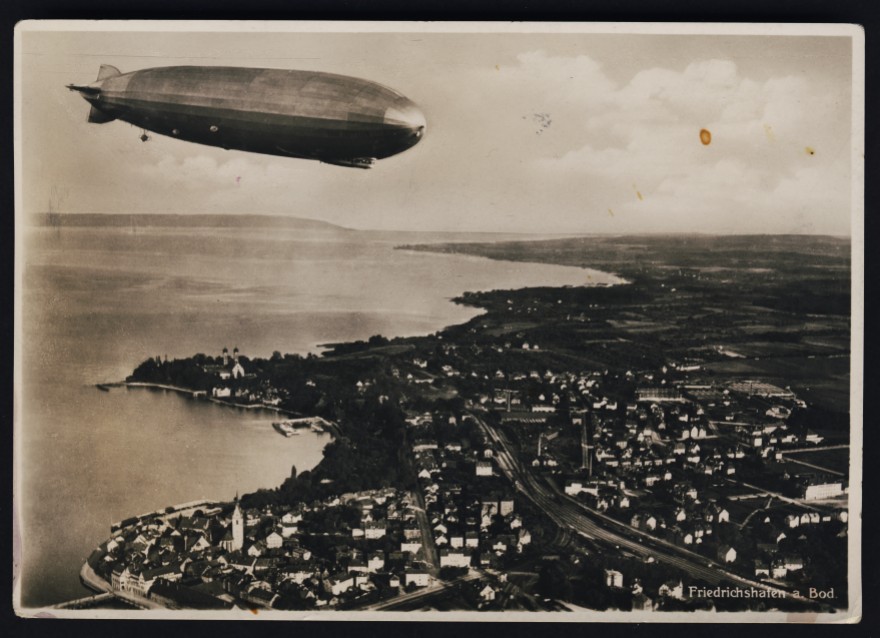
I couldn’t believe my eyes when I found this – a postcard of the Graf Zeppelin sent from the Graf Zeppelin.
Fabry Archive - Selected Photographs (61)
Fabry Archive - Selected Photographs (62)
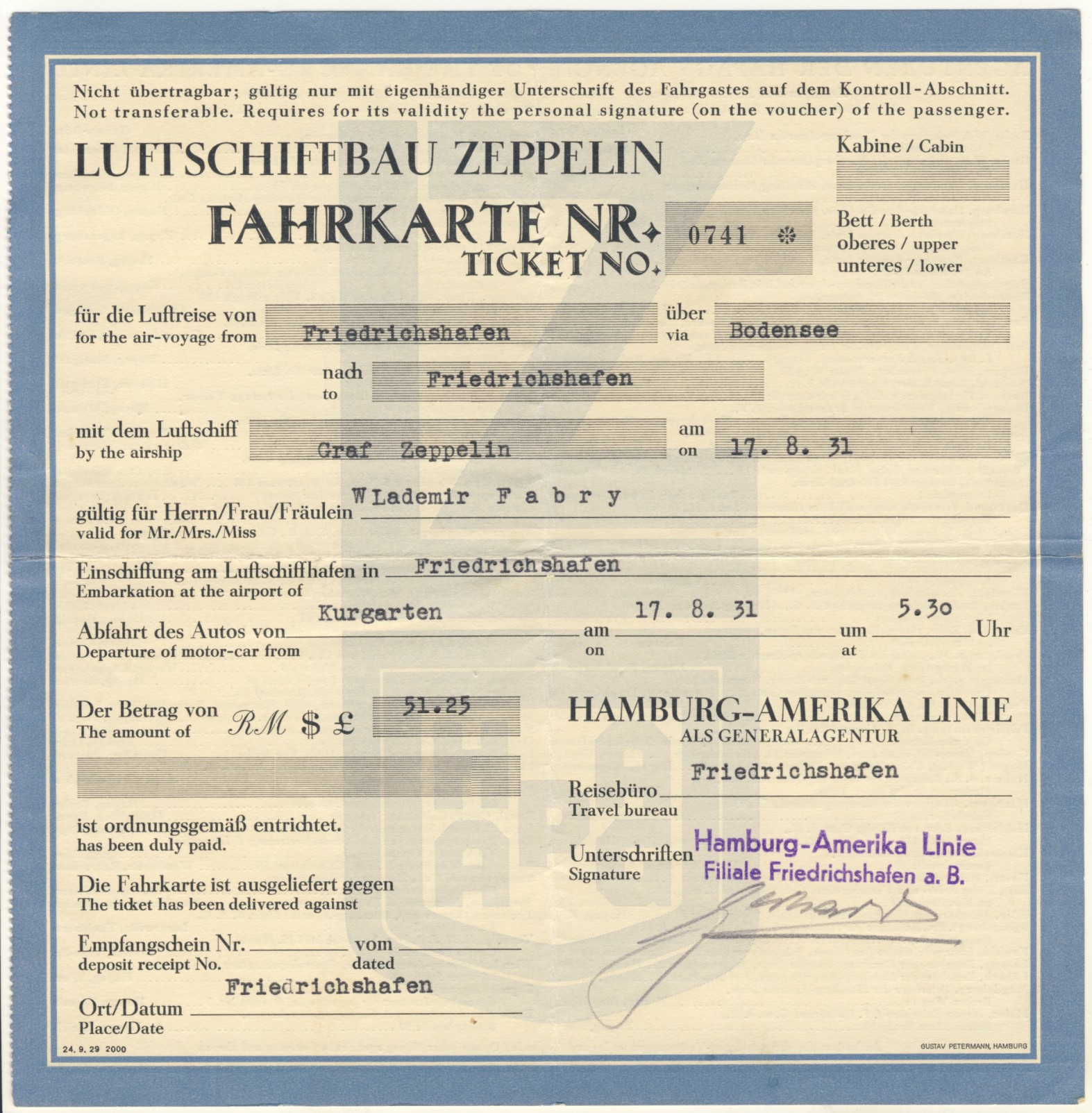
In an entirely different box of papers I found the original ticket for the Zeppelin ride, dated August 17, 1931, with the name “Wladimir Fabry”.
Graf Zeppelin Ticket
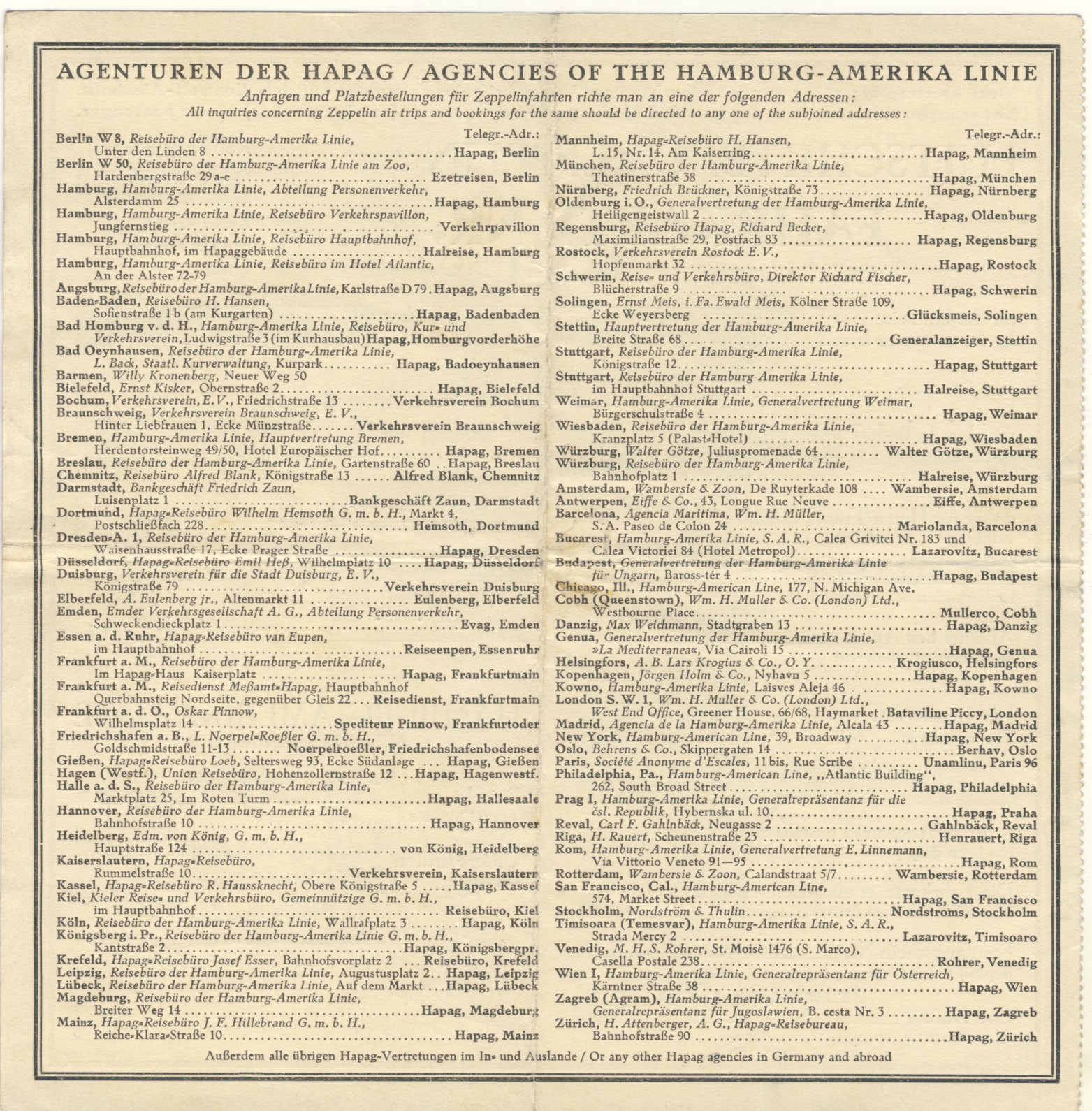
Graf Zeppelin Ticket Reverse
Lucky for him it wasn’t a ticket on the Hindenburg.

Vlado in Batavia

1948 was a very difficult year for the Fabry family, which was the time of the Communist coup d’état in Czechoslovakia. Vlado was far away from Bratislava, working in former Dutch Batavia, now Jakarta, for the United Nations Committee of Good Offices on the Indonesian Question, but his concern for his family stayed close. Vlado was devoted to the ideals of the United Nations, and making the world more peaceful, but he was torn by a greater devotion to his family. His position with the UN made many things possible for himself and his family, who were all political refugees, stateless, and fearful of being deported at any time, so it was not so easy for Vlado to ask for a post nearer his family, without sounding like he cared more about his family than his work. From a letter dated October 21, 1948, frustrated in Indonesia, Vlado writes to a member of the UN asking to be assigned to Palestine:

“Well, that would be all very nice as a position in a showdown if I would be alone and could make it without having to worry what would happen to my family if something goes wrong. As things are, I have rather to be concerned about everything, and address myself to you for help. With the indication not to appear in Paris for some time I have to rely on you and Boka, and hope that this year you will have more luck than last. I really can not work too much longer in this atmosphere of uncertainty in which I am now, without letting down either my work or my nerves, and I have to have my family sheltered somewhere, preferably in Europe, and be reasonably near to it for some time – 3 or 4 months – to give them the initial support they need. An assignment to Palestine as your assistant – which in my opinion should be for [Ivan] Kerno extremely simple, as all he has to do is to recall Kingstone and assign me instead – would be for me wonderful – it would keep me near my folks, would give me the opportunity to get a working acquaintance with the people who would decide on my transfer to trusteeship – I just learned that there were two resignations in Wishoff’s section lately – and would give me the immense advantage to work with somebody I like and esteem, and to be near to a friend again. So I pin my hopes on it.”

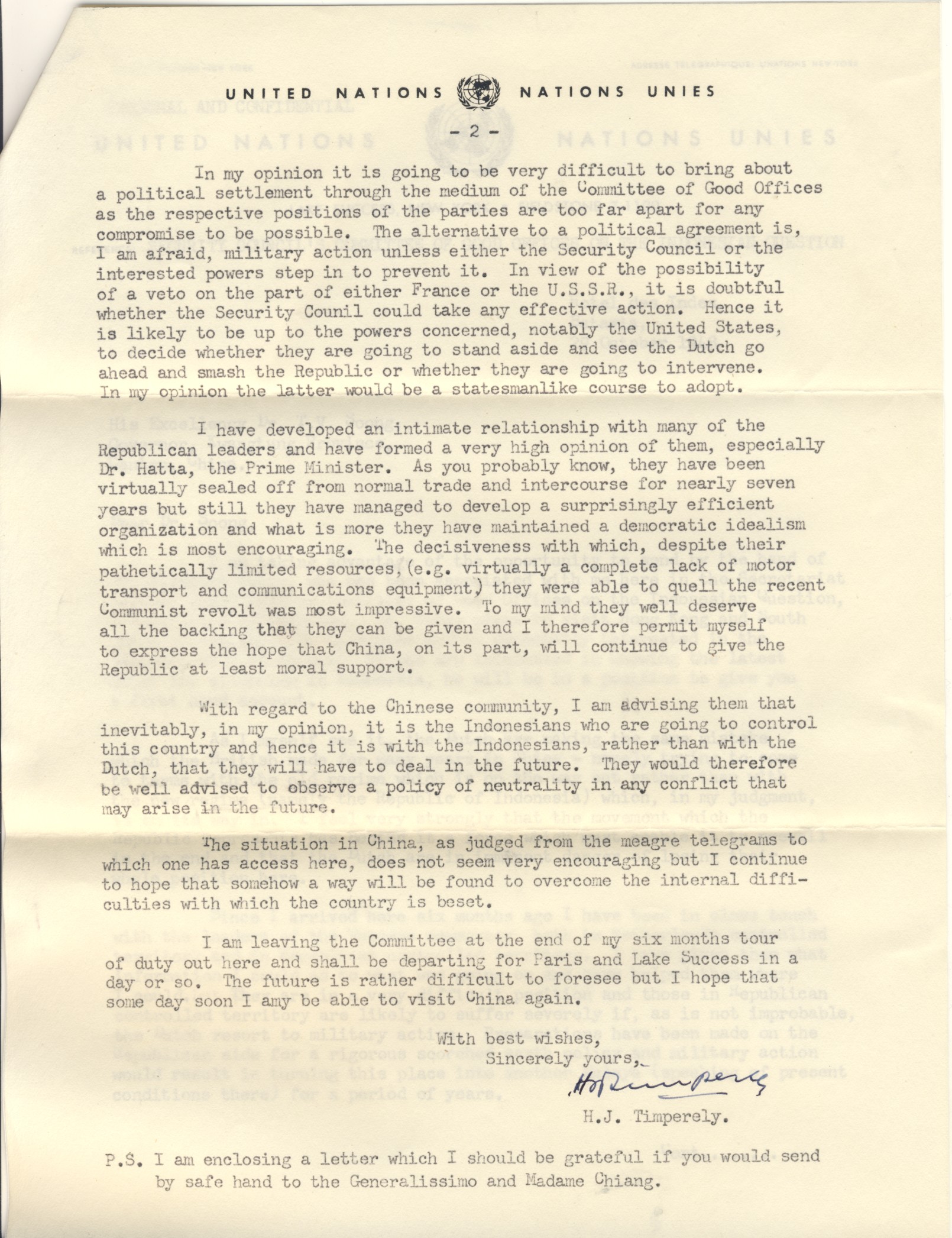
Vlado would remain in Jakarta until May 1951, as Assistant Secretary and adviser to Principal Secretary of United Nations Commission for Indonesia, but he wasn’t entirely “stuck” there – he managed to get away to Europe (most likely, to see his family) around the end of October/beginning of November 1948, with plans to visit Hong Kong and South China on his way there. Here is a letter from H.J. Timperely, sent from the Hotel des Indes and dated October 29, 1948, to His Excellency Dr. T.V. Soong in China, introducing Dr. Vladimir Fabry, and giving Timperely’s insights on the situation in Indonesia:
H.J. Timperely letter to Dr. T.V. Soong
H.J. Timperely letter to Dr. T.V. Soong 2

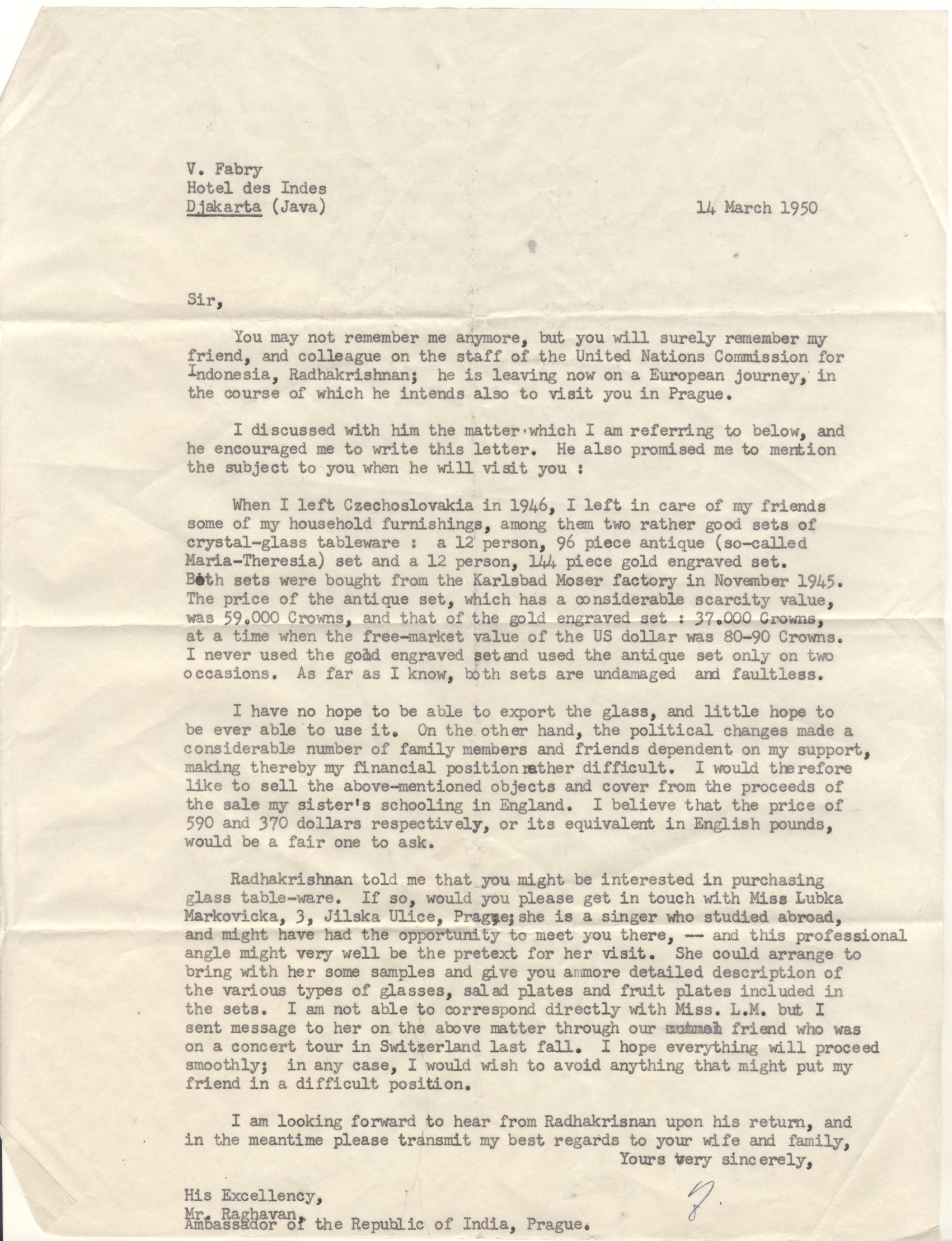
On March 14, 1950, referencing mutual friend and colleague Sarvepalli Radhakrishnan, Vlado wrote to His Excellency Mr. Raghavan, Ambassador to the Republic of India in Prague, asking if he would be interested in buying a set of crystal tableware to cover his sister’s school tuition:

Vlado letter to Ambassador Raghavan

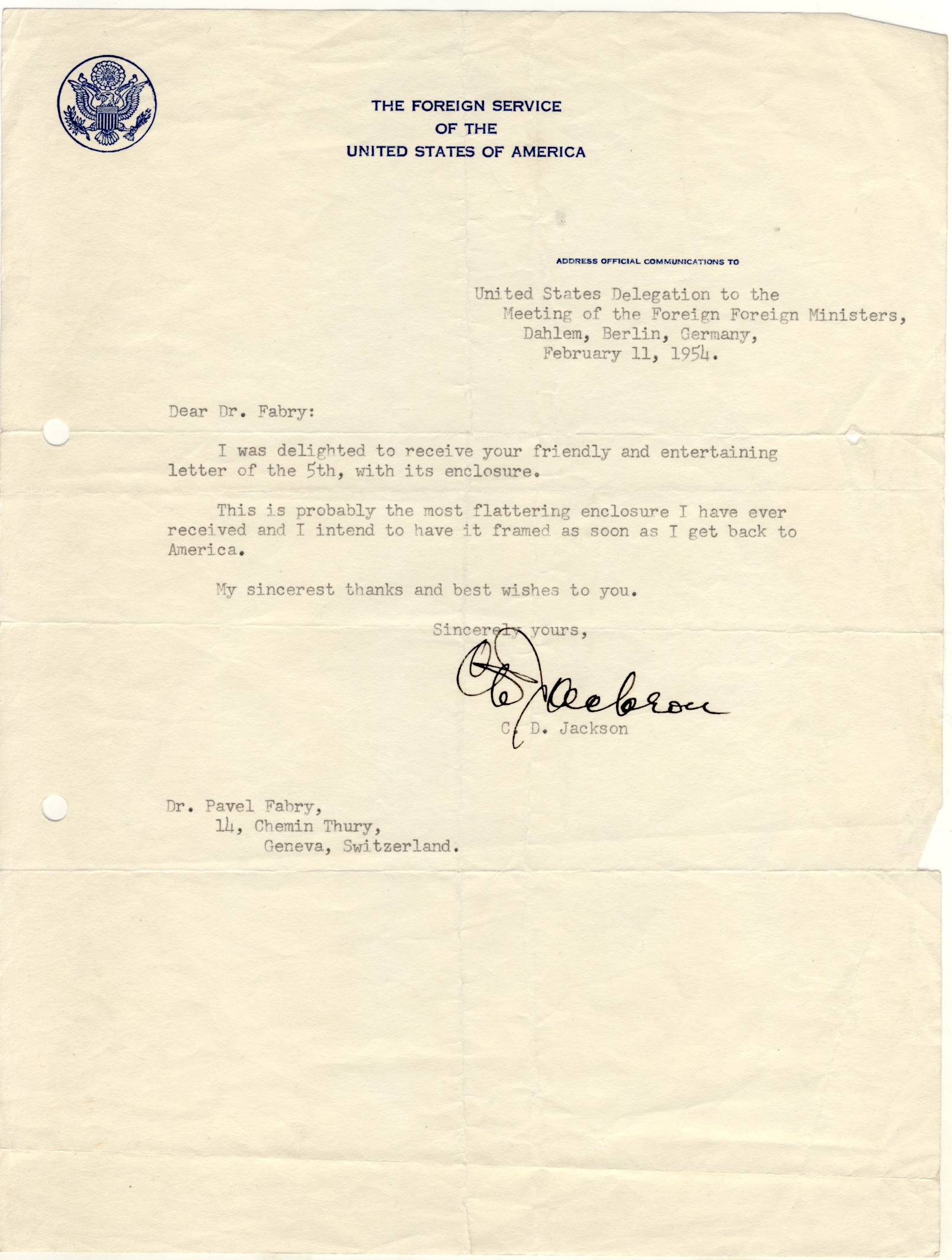
Letter from Ambassador C.D. Jackson to Dr. Pavel Fabry

On Sunday, I watched the documentary of the McCarthy hearings, “Point of Order”, for the first time, and it is a chilling piece of political theater, composed of the 36 days of televised hearings on ABC.McCarthy was obsessed with an imaginary number of Communists and spies in the State Department, and everywhere else – a number that always changed. Because of his crazy methods and complete lack of evidence, he was censured by the United States Senate. After listening to the drone of McCarthy’s voice for an hour and a half, I wondered if he wasn’t drunk through those entire hearings. He died on May 2, 1957, at the age of 48, from acute hepatitis complicated by alcoholism.

In my American public schools, I learned that history was boring and irrelevant – perhaps it was because all of my history teachers were primarily athletic coaches – but history is a thrilling adventure, and a mirror to reflect our times. How can you not be interested in all the great and horrible details?
In connection to the time of the Army-McCarthy Hearings(April 22-June 17, 1954), I present here a letter from Ambassador C.D. Jackson to Dr. Pavel Fabry, dated February 11, 1954. On this date, Jackson was working as Special Assistant to the President for International Affairs under Dwight D. Eisenhower, and this letter was sent from Berlin during the Berlin Four Power Conference; the Conference was held from January 25 – February 18, 1954. Jackson was a busy man and had a long list of important jobs, including Deputy Chief at the Psychological Warfare Division from 1944-1945, Managing Director of Time-Life International from 1945-49, President of the anti-Communist Free Europe Committee in 1951-52, presidential speech writer for Eisenhower’s 1952 campaign, adviser to the President on psychological warfare from February 1953 to March 1954, U.S. Delegate to the Ninth General Assembly at the UN in 1954, and other illustrious titles.
(click images to enlarge)

C.D. Jackson letter to Pavel Fabry
Dr. Pavel Fabry drew wonderful pictures that he sent in letters to his friends and family, so I can guess that is what he sent to Mr. Jackson. I offer you one of the finest examples of his work from my collection, “You go slowly but surely”, showing the Palais des Nations in Geneva, which he made for his daughter, Olga:
Fabry Archive - Drawings (22)
I have this one framed and hung in my office, to inspire me.
I’m curious if Jackson really did keep and frame what Pavel sent to him, and I wonder what it looked like – there is no copy of it here that I can find. The Dwight D. Eisenhower Library, in Abilene, Kansas, has the collection of Jackson’s letters from 1931-1967, so if anyone has the letter and drawing from Pavel, they do.

Vlado’s Beard Visits New Zealand

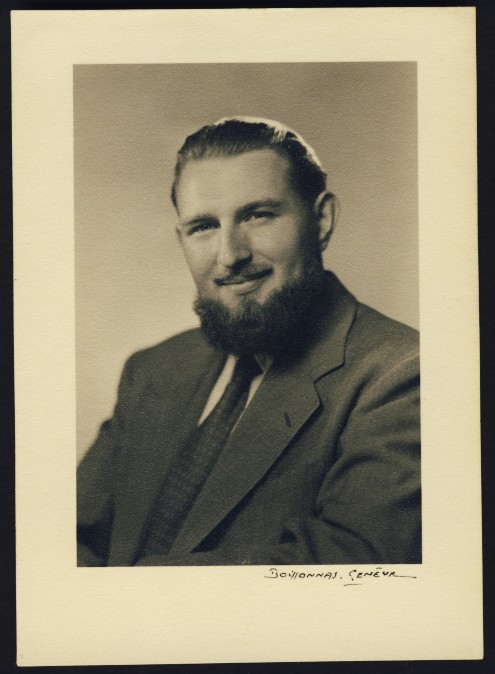
In almost all of the photos of Vlado he is clean-shaven, except for a brief period of time when he decided to grow a beard:
Fabry Archive - Selected Photographs (105)
This isn’t my favorite look for him, it makes me think of the Boers.
Here are two newspaper articles about Vlado’s visit to New Zealand in 1950, sporting his new beard in the photos (click images to read):
Vlado New Zealand newspaper
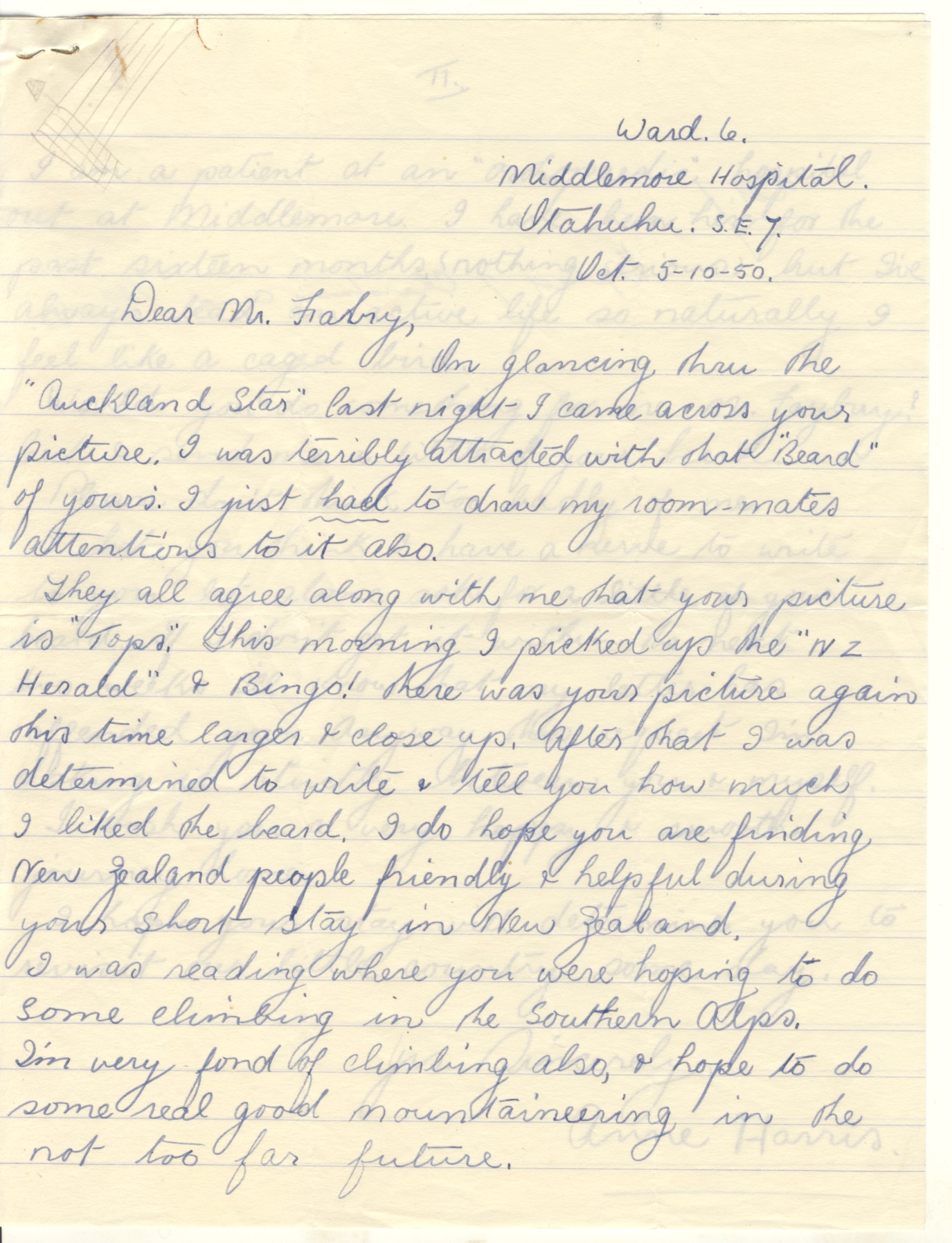
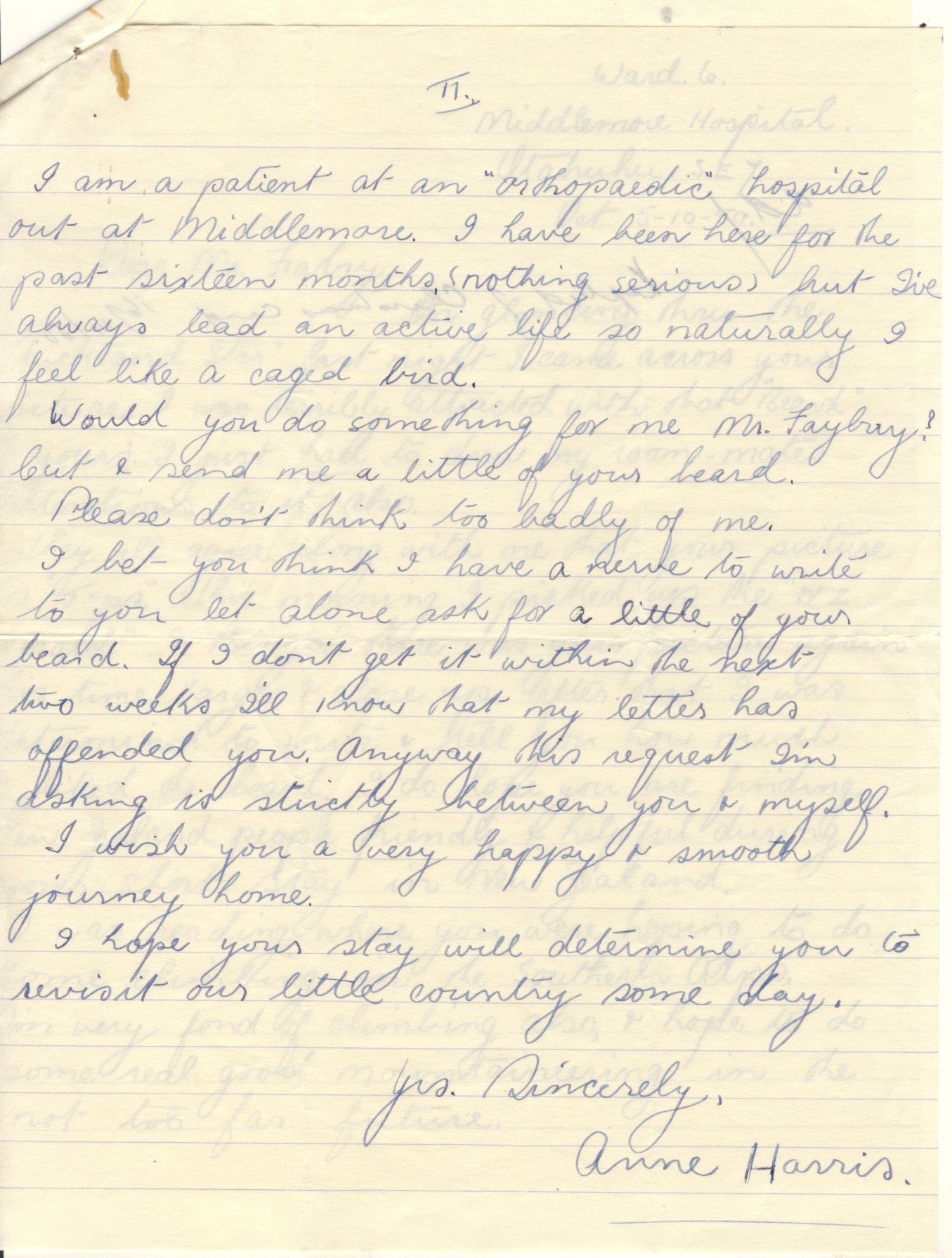
There are some women who really like beards, and Anne Harris of New Zealand is one of them. She sent Vlado this letter from Middlemore Hospital, where she had been for 16 months as a patient, asking him for a little of his beard:
Letter from Anne Harris New Zealand
Letter from Anne Harris New Zealand2
On the back of this letter, there is a note that Vlado replied with a Christmas card that year. If you’re still around, Anne, you’ll have to let me know if Vlado sent you some of his beard!

Friends Around the World

After I posted yesterday, I learned that Lucy T. Briggs was the daughter of Ellis O. Briggs; an Ambassador for 37 years to many countries, including Czechoslovakia; and sister to Everett Briggs. Lucy became the third member of her family to join the career Foreign Service in August 1957, and her brother, Everett, joined the year before. Vlado most likely knew Ellis Briggs, and that’s why Lucy sent him chocolates and the stuffed Bambi before she’d even met him. From the other letters I found from Lucy, the relationship doesn’t appear to be anything but friendly. I suppose when your work takes you all over the world, it’s good to have friends in many places.
Here is a letter from the UN in Indonesia, asking Vlado to meet with Miss Wiendriati Ernestina Soehadi, who was working at the Indonesian Delegation to the United Nations(click images to read):
Letter to Vlado from Indonesia
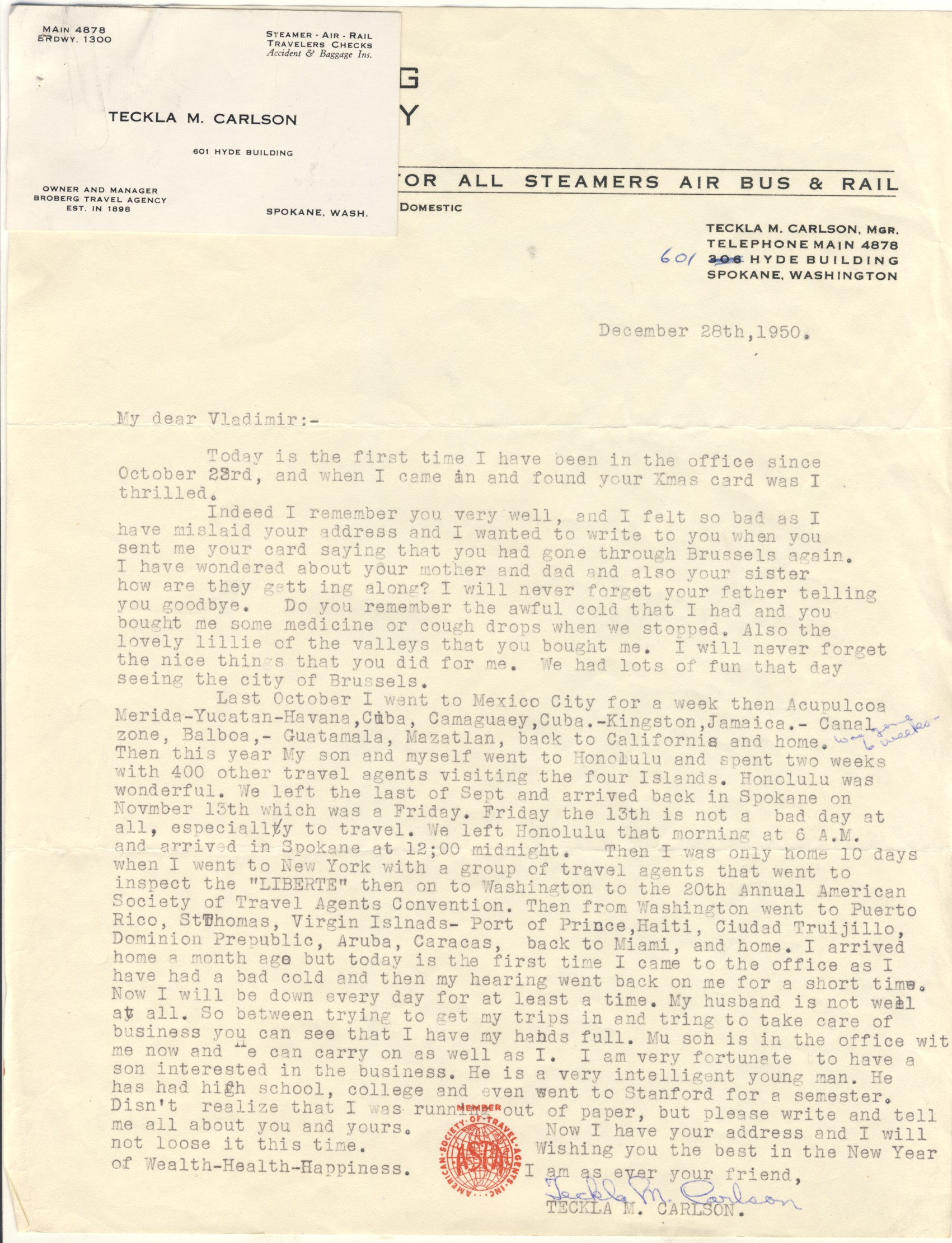
This letter comes from a place closer to my home, from Spokane, Washington, written by owner and manager of Broberg Travel Agency Teckla M. Carlson:
Letter From Teckla Carlson
And here is a letter from Vlado to Teckla, dated December 19, 1951, describing his experience of arriving at the Tibetan border the very day the Chinese Communists came to take it:

Dear Mrs. Carlson,
It was so sweet of you to remember me when you went again to Europe, and to send me a letter from your trip. I hope you had a lovely time, and brought back with you many pleasant memories. I regret only that I did not know of your trip, I would have liked to give you the address of my parents and sister in Geneva and suggest that you use my car while you were in Switzerland,- you can see so much more while travelling independently on the road. Please let me know next time!
I left the Indonesian mission in May – I was quite glad to leave the country after having spent three and a half years there. I should not be ungrateful really, it was a very valuable experience, and I had many thrilling moments and adventures, but three and a half years is a long time to spend without friends, accustomed amenities, and access to culture and professional education sources. To make it worse, the tropical climate disagreed with my constitution, I had a number of annoying local diseases, and came back 56 lb lighter than I departed. On the way back, I visited Indochina, Macao, Thailand and Burma, and spent some time in India. I made a trek to the Himalayas from Darjeeling, and luck had it that I arrived at the Tibetan frontier post on the day when the Chinese Communist officers arrived to take it over following the surrender of Tibet to the new Chinese rulers. I had planned to sneak at least for a short look-around into the Land of Monasteries, but the sight of the Red Stars rather damped my enthusiasm, and I limited myself to cross symbolically with one foot – and even that I did rather cowardly at a place screened from the sight of the frontier guards by a big rock.
In Europe, accompanied by my family, I toured by car Skandinavia beyond the Polar Circle, the Low Countries, and France and Italy. I arrived in New York late in August, and returned to my regular duties in the UN Legal Department. My home and office addresses are on top of this letter. There is not too much to be written about my life here – after the excitements of my mission assignments and of my travels it is a mere routine. I rented a house in the suburbs, recaptured my cook-housekeeper from the people to whom I had “sublet” her during my absence, renewed my relationships with former acquaintances, and in general live the well ordered life of the Suburban Commuter. When you pass through New York next time, please stop and see for yourself.
I am wishing you a Merry Christmas and all the best in the New Year, and hope to see you or at least hear of you soon.
Sincerely yours,
Vladimir Fabry

Update 9/12/13: “Crash Victim Known in City” (from the Spokane Daily Chronicle Sept. 19. 1961, p.24)

Vladimir Fabry, killed in the plane crash that claimed the life of Dag Hammarskjold yesterday in Northern Rhodesia, visited Spokane three years ago.

Fabry, U.S. legal adviser to the United Nations in the Congo is a close friend of Teckla M Carlson, N1727 Atlantic, and he and his sister, Olga, also a UN employee, were her house guests in 1958.

A travel agent, Mrs. Carlson first met Fabry in 1949 at Geneva after he had succeeded in having his father released from a concentration camp. The Spokane woman said they have exchanged letters since that time.

Vlado and Bambi

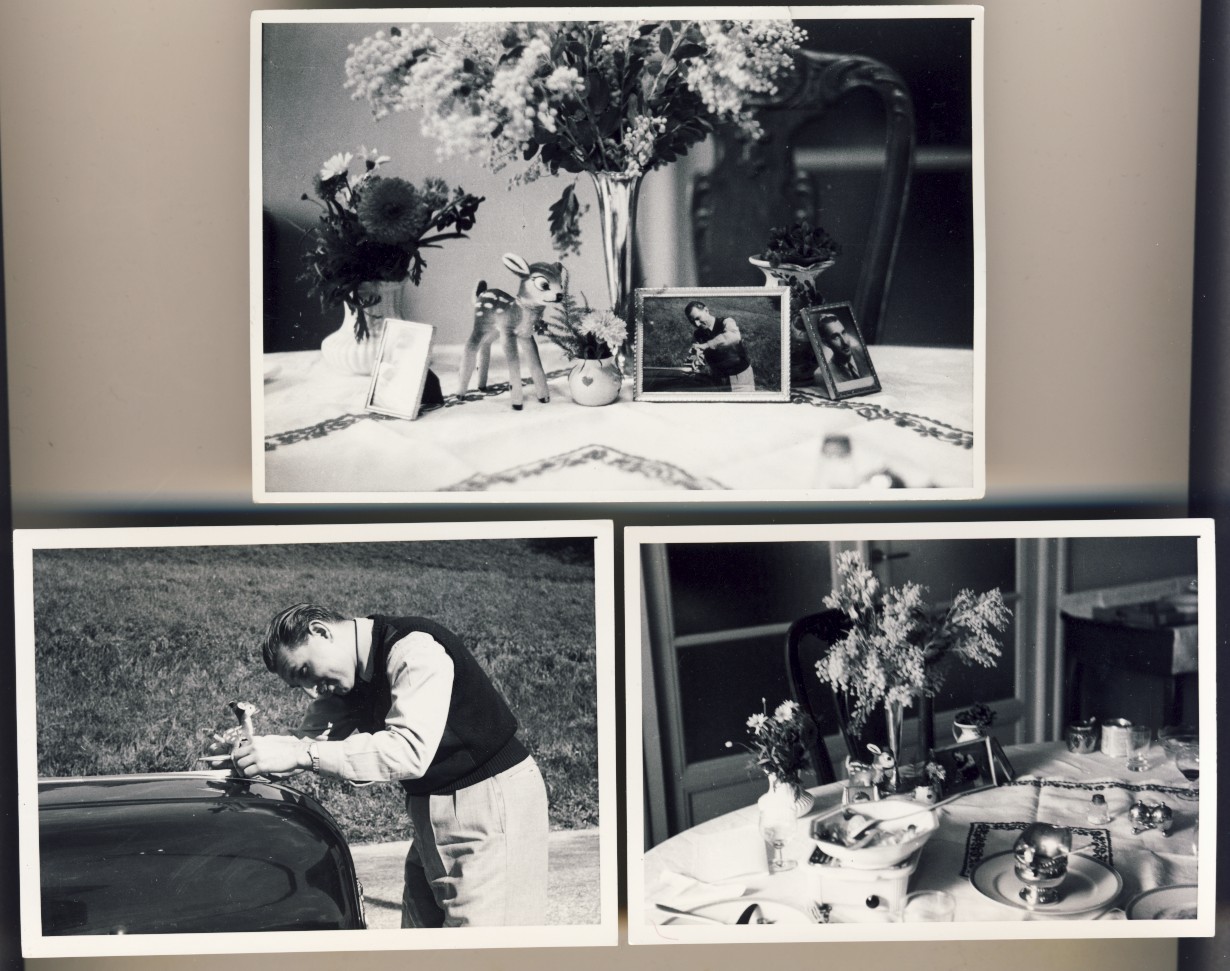
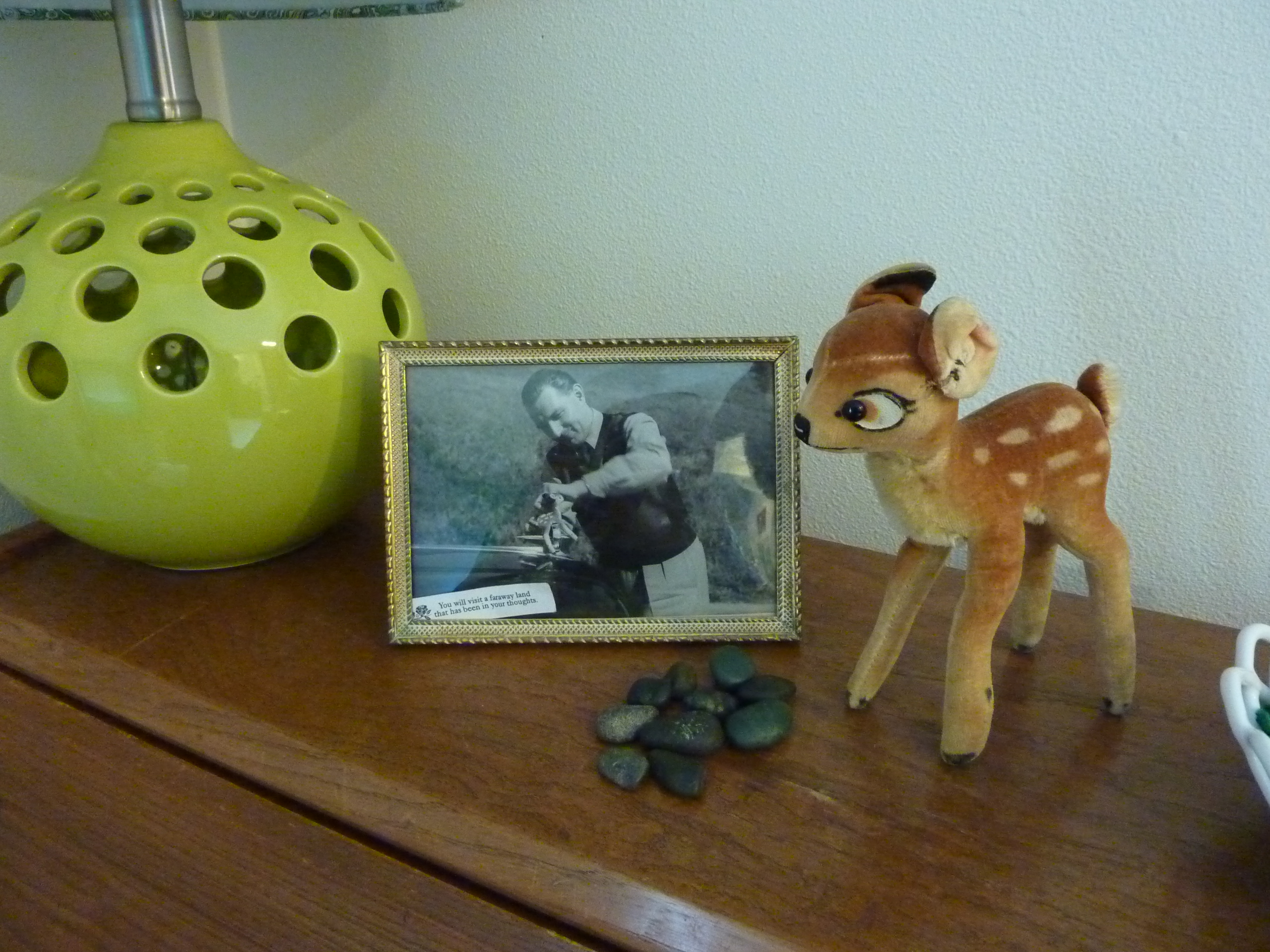
When I first began to sort through the family papers, I found a little stuffed “Bambi”, with a necklace around it’s neck, and a bright green four-leaf clover with a tiny red ladybug hanging from the chain. Then I found the photo of Vlado securing Bambi to the hood ornament of his Buick, which I use as my header on this blog. The Fabry family called themselves “the four-leaf clover”, because they knew they were lucky; and in the books of Olga Fabry, I found hundreds of four-leaf clovers, falling out of the pages. This totally charmed me, because I love to collect four-leaf clovers, too. I’ve been wearing the necklace ever since I found it, and I keep Bambi on my desk.
This is a photo of Dr. Pavel Fabry with Bambi:
Fabry Archive - Selected Photographs (191)
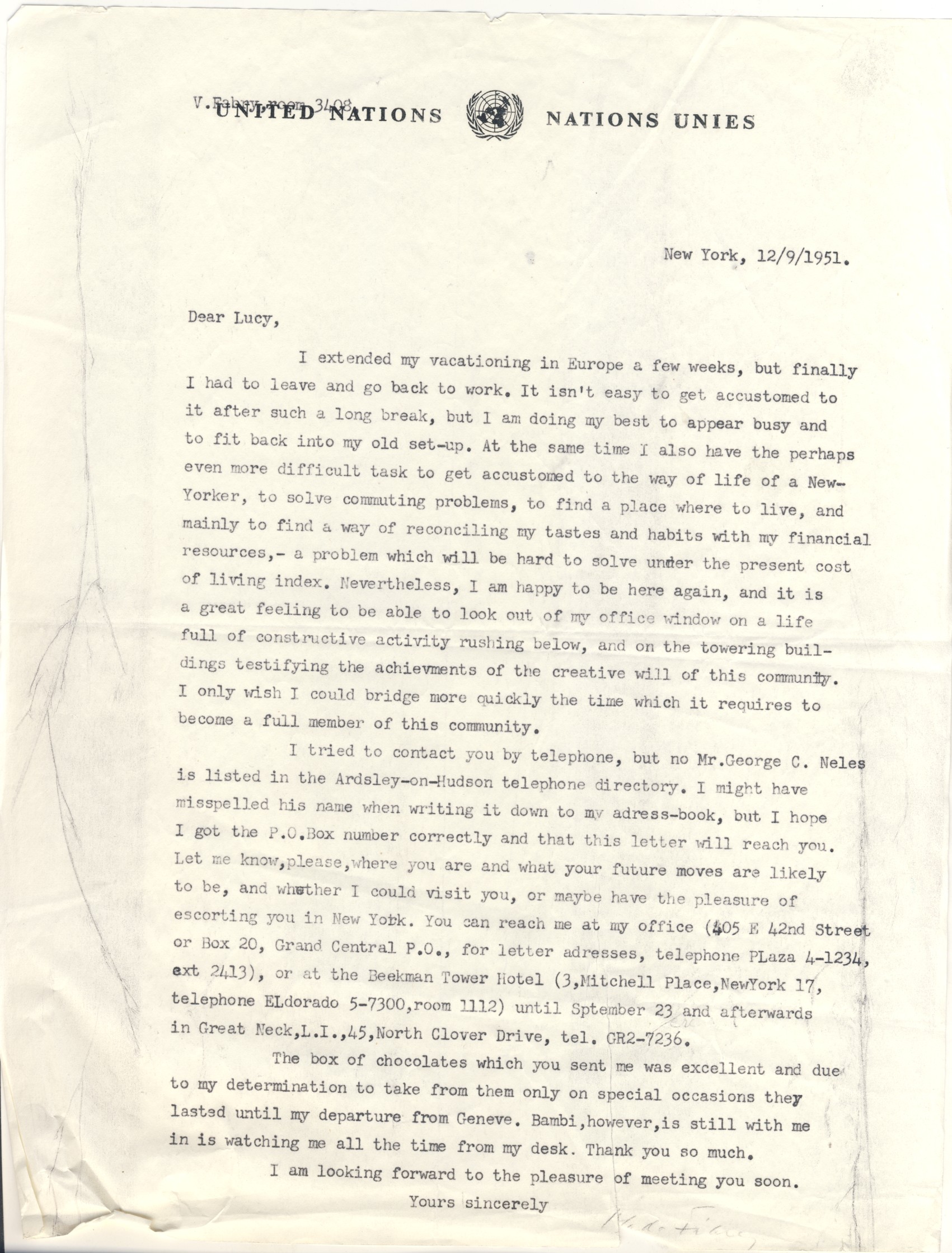
This is a letter to Lucy T. Briggs, who gave Bambi to Vlado – I don’t know who she is yet, but she gave him the gift before she’d even met him (click image to read):
Vlado Letter 1
I found these other pictures of Bambi being displayed with the photo, right after I took almost the same photo.
Fabry Archive - Selected Photographs (202)
Vlado photo with Bambi

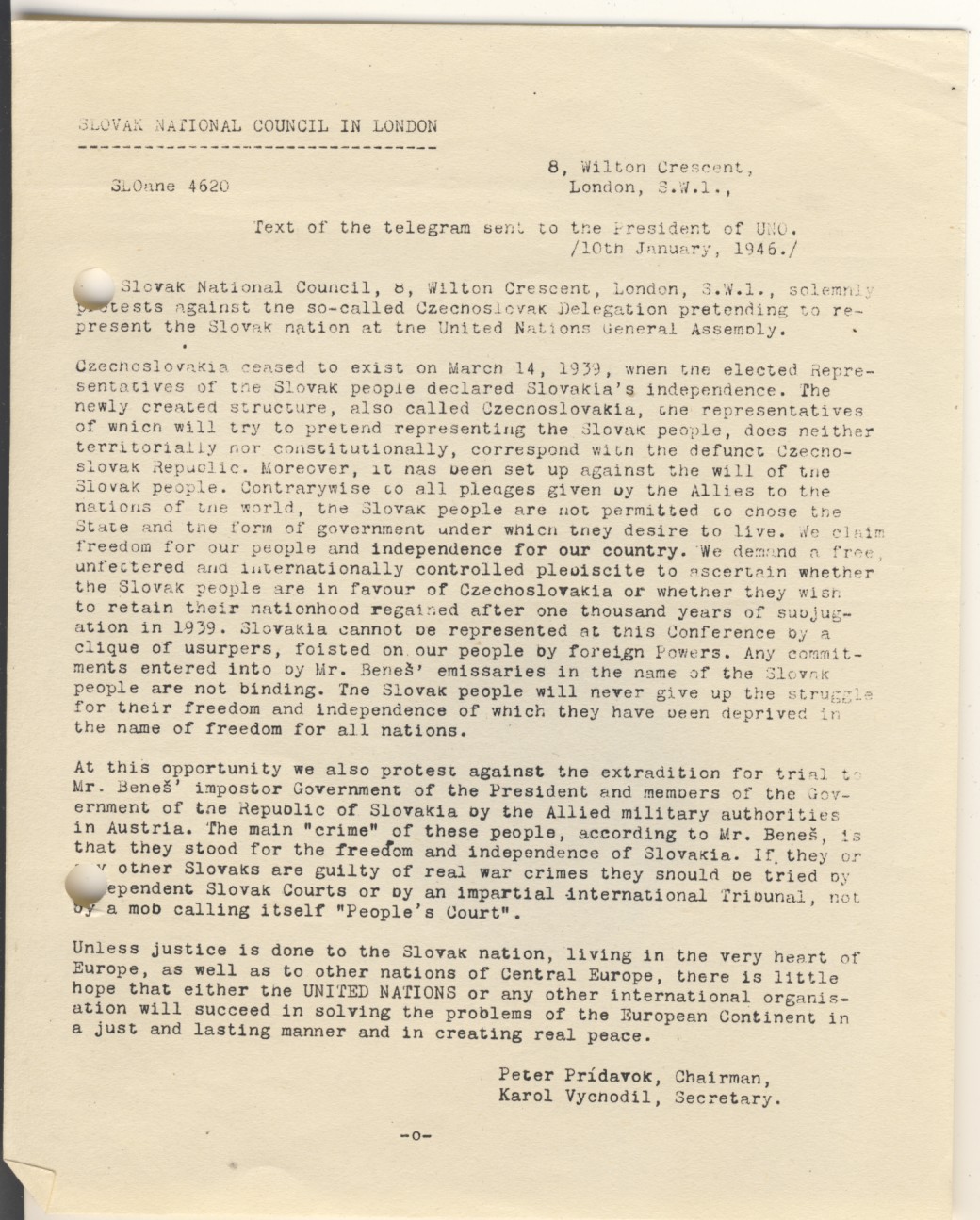
Slovak National Council in London, January 10, 1946

This photocopied document was found among the testimonies of many different refugees that Dr. Pavel Fabry represented:
Slovak National Council Telegram to UNO

SLOVAK NATIONAL COUNCIL IN LONDON
8, Wilton Crescent,
London, S.W.1.

Text of the telegram sent to the President of UNO.
10th January, 1946

The Slovak National Council, 8, Wilton Crescent, London, S.W.1., solemnly protests against the so-called Czechoslovak Delegation pretending to represent the Slovak nation at the United Nations General Assembly.
Czechoslovakia ceased to exist on March 14, 1939, when the elected representatives of the Slovak people declared Slovakia’s independence. The newly created structure, also called Czechoslovakia, the representatives of which will try to pretend representing the Slovak people, does neither territorially nor constitutionally, correspond with the defunct Czechoslovak Republic. Moreover, it has been set up against the will of the Slovak people. Contrarywise to all pledges given by the Allies to the nations of the world, the Slovak people are not permitted to [choose] the State and the form of government under which they desire to live. We claim freedom for our people and independence for our country. We demand a free, unfettered and internationally controlled plebiscite to ascertain whether the Slovak people are in favor of Czechoslovakia or whether they wish to retain their nationhood regained after one thousand years of subjugation in 1939. Slovakia cannot be represented at this Conference by a clique of usurpers, foisted on our people by foreign powers. Any commitments entered into by Mr. Benes’ emissaries in the name of the Slovak people are not binding. The Slovak people will never give up the struggle for their freedom and independence of which they have been deprived in the name of freedom for all nations.
At this opportunity we also protest against the extradition for trial to Mr. Benes‘ impostor Government of the President and members of the Government of the Republic of Slovakia by the Allied military authorities in Austria. The main “crime” of these people, according to Mr. Benes, is that they stood for the freedom and independence of Slovakia. If they or any other Slovaks are guilty of real war crimes they should be tried by independent Slovak Courts or by an impartial international Tribunal, not by a mob calling itself “People’s Court”.
Unless justice is done to the Slovak nation, living in the very heart of Europe, as well as to other nations of Central Europe, there is little hope that either the UNITED NATIONS or any other international organization will succeed in solving the problems of the European Continent in a just and lasting manner and in creating real peace.
Peter Pridavok, Chairman
Karol Vycnodil, Secretary

Statement of Samuel Bellus, November 30, 1956

I don’t know who Samuel Bellus is yet, but here is his statement on behalf of Mrs. Olga Fabry – Vlado’s mother:

I, Samuel Bellus, of 339 East 58th Street, New York 22, New York, hereby state and depose as follows:
That this statement is being prepared by me at the request of Mrs. Olga Viera Fabry, nee Palka, who formerly resided in Bratislava, Czechoslovakia, but since 1948 has become a political refugee and at present resides at 14, Chemin Thury, Geneva, Switzerland;
That I have known personally the said Mrs. Olga Viera Fabry and other members of her family and have maintained a close association with them since the year 1938, and that I had opportunity to observe directly, or obtain first hand information on, the events hereinafter referred to, relating to the persecution which Mrs. Olga Viera Fabry and the members of her family had to suffer at the hands of exponents of the Nazi regime;
That in connection with repeated arrests of her husband, the said Mrs. Fabry has been during the years 1939 – 1944 on several occasions subject to interrogations, examinations and searches, which were carried out in a brutal and inhumane manner by members of the police and of the “Sicherheitsdienst” with the object of terrorizing and humiliating her;
That on a certain night on or about November 1940 Mrs. Fabry, together with other members of her family, was forcibly expelled and deported under police escort from her residence at 4 Haffner Street, Bratislava, where she was forced to leave behind all her personal belongings except one small suitcase with clothing;
That on or about January 1941 Mrs. Fabry was ordered to proceed to Bratislava and to wait in front of the entrance to her residence for further instructions, which latter order was repeated for several days in succession with the object of exposing Mrs. Fabry to the discomforts of standing long hours without protection from the intense cold weather and subjecting her to the shame of making a public show of her distress; and that during that time humiliating and derisive comments were made about her situation in public broadcasts;
That the constant fear, nervous tension and worry and the recurring shocks caused by the arrests and deportations to unknown destinations of her husband by exponents of the Nazi regime had seriously affected the health and well-being of Mrs. Fabry during the years 1939 – 1944, so that on several such occasions of increased strain she had to be placed under medical care to prevent a complete nervous breakdown; and
That the facts stated herein are true to the best of my knowledge and belief.

Letter of Appointment to the UN, 1946

I am just beginning to learn about the first UN Secretary-General, Trygve Lie, who resigned from his office on November 10, 1952, after seven years of service.
On April 7, 1953, Trygve Lie stepped down and Swedish diplomat Dag Hammarskjold was elected UN Secretary-General. The transcript of the General Assembly that day is most interesting, if only to see how different the view of Soviets are from the rest of the assembly in their response to the resignation of Mr. Lie.
In 1950, the UN General Assembly voted to extend Lie’s term for another 3 years, but the Soviet Union refused to recognize Lie as Secretary-General because of his support of the UN intervention in Korea in 1950 (The Soviets didn’t get along with Hammarskjold either, and wanted to have “troika” at the UN, rather than just the one Secretary-General, because they believed Hammarskjold was a puppet of the US).
Trygve Lie also lost his support from the United States, after Senator Joseph McCarthy accused him of appointing staff “disloyal” to the US. Perhaps McCarthy didn’t like that Lie once gave Leon Trotsky permission to settle in Norway after he was exiled from the Soviet Union. In any case, Joe McCarthy was insane, and he was the one disloyal to the US – he didn’t care who he destroyed for his own political gain.
And on that note, here is a scan of Vladimir Fabry’s appointment to the UN in 1946, signed by Trygve Lie.
(click photo to enlarge)
Vlado UN letter of appointment

Statement of Dr. Fedor Hodza

Dr. Fedor Hodza made this statement at the service for Dr. Vladimir Fabry at the Lutheran Church, Geneva, Switzerland, on Thursday, September 28, 1961:

The Slovak family, dispersed all over the wide world, bows in painful grief over the mortal remains of one of her distinguished sons. Once again a Slovak life has been extinguished, a noble life – already successful and which still promised so much – the life of your friend and mine, Mr. Vladimir Fabry.
It is a difficult and sad task for me to bid him farewell. Difficult, because I would not like to say more than his modesty would bear without dismay. Sad, because I had a great affection for him.
Yet his modesty and our sorrow must give place to the truth. And the truth is that the tragic death of Vladko Fabry is a cruel and woeful loss, not only for his mother and sister, not only for his relations, not only for his friends. It is a loss for his larger, national family as well as for that high humanitarian ideal which he served with such devotion.
Though today we are sorrowfully thinking of his untimely end and grieved as we are, we should not forget his life which should be a consolation to his loved ones and an example to us.
As a young and inexperienced lawyer he worked his way up in a relatively short time to a position of responsibility in an institution of such importance as the United Nations. He advanced with success amid older and more experienced colleagues from all parts of the world. He won confidence for his firm character, esteem for his good work, affection for his pleasant disposition. Within a short time he was entrusted with difficult, responsible and often dangerous tasks. The evidence of his personal success are the missions which he carried out in critical times, in widely differing regions of the globe, in India, in Indonesia, in the Near East, and finally in the unfortunate Congo.
It can be said that there was hardly a situation in the international development of the last ten years where Vladko was not present as a worker, defender and soldier in the service of peace among nations. Whenever and wherever this uncertain peace which is our lot was threatened, we saw him among those who were sent to pacify, to counsel, to persuade and help to preserve it.
By his talent and education, by work and experience so grimly won, by his conviction and energy, Vladko rose above the circle of narrower interests and lower aims and engaged himself fully in the service of higher good and loftier ideal.
It is not easy to be an officer of the highest international institution if it does not live – because it cannot – according to the letter and still less according to the spirit of its charter; when the peace which it is called to preserve is not a just peace – and there is no other; when freedom and independence of nations – which is the basis of its existence and the main purpose of its mission – are denied to those who already know the art of government and given to those who have still to learn.
But Vladko Fabry was not just an officer of an institution created to help humanity to live in peace and harmony. Personally, in his conscience, he considered himself to be a servant of probably the highest and most precious accomplishment of Western civilization, which prescribes that laws have to respect the good of all and that they have to be administered without regard to personal, class and even national interests.
The convinced patriot that he was, Vladko joined the ranks of the pioneers of constructive internationalism. He was aware that by helping to secure and protect the precarious independence of the new nations he was working at the same time for his own homeland, hoping that freedom and justice would return again to his beloved Slovakia.
He also participated directly in the great experiment of international life, and experiment which was designed to complement by deed the traditional debates and resolutions of the United Nations which too often remain unheeded. One such deed was the intervention of international armed forces in the Congo. It seems that the world is not yet ripe for actions of this kind. Vladko was among those who gave their lives on the altar of a new era in the life of humanity, and era full of promise but hardly yet born.
Let it please our Lord that his sacrifice was not in vain. Dead martyrs often achieve more for the ideals they believed in than living prophets.
So this is how we see Vladko Fabry, as man, worker, fighter. Such was his short but fruitful life.
How could we forget his love of nature and especially of mountains which seemed to attract him irresistibly? Was not his love an expression of that idealism which inspired all his endeavors? Were not the mountains to him a kind of challenge to accomplish a difficult and dangerous task, in solitude, in silence, without spectators and their acclaim? For him the mountains were not just a place of repose or sport. They were a kind of spiritual necessity. Up there he felt at home, there he was happy. Perhaps they reminded him of his native land Liptov, and Turiec and of our High Tatras.
As he was demanding in his work so he was modest in his private life. He disliked luxury and ostentation. His searching mind was forever disclosing new vistas, enlarging his horizons, acquiring new knowledge and experience. He learned because he wanted to know, he thought because he was aiming for excellence.
His gentle manners and good heart won him many friends in all parts of the world and today, on this last journey, he is accompanied by the affection and gratitude of so many.
In this last moment of farewell we remember also his late, eminent father who by the force of his personality marked the national life of Slovakia and contributed to her political and economic growth. We bow with profound respect before the grief so courageously borne by his loving mother and sister. If words are unable to soothe their pain perhaps the knowledge that Vladko lived a beautiful, rich and useful life will give them a measure of consolation until merciful time heals the deep wound.
Dear Vladko, it is time to say good bye. We remember you such as you were and hold you in our thoughts: A loving son, an affectionate brother, a devoted friend, a faithful child of your country, who dedicated his life to the service of humanity.

Vlado and Guapa Mia

This is one of many letters from Vlado to “Guapa Mia” in Madrid (He writes to her in English, she writes back to him in French), dated 28/7/1953:

Guapa Mia,
This time it is not entirely my fault for not writing so long,- I had to wait for your new address in Madrid. June was a very bad month for me; lots of work, financial worries caused by the declining/ and sometimes plummeting/ stock market, a round of social functions and the heat added to my natural antipathy to writing, and by the time I decided that I simply MUST make myself to write, I realized that it was too late for the letter to reach you in Geneva.
I was glad to hear that you have taken so well to your new “part-time” job/ I would never admit that to work six hours a day could be considered full employment/- and I am sure that under the brilliant sun and society of Madrid you will shine even more than ever with radiant beauty. Also, I believe, the gallant and temperamental caballeros will be a more deserving background against which your charm can find the proper appreciation, than Geneva’s dullish “burghers”. Spain seems to be in a big vogue among the city’s smart set, everybody who is somebody seems to be on his or hers way there this year, I wonder whether they have already learned that you have moved there?- I get stinking mad every time I learn of some lucky bird who is on his way to fly over, and wish to be in his place. But no luck,- with the special session of the General Assembly due in August, I will have no vacation at all this summer.
I got bitten by a reading bug lately – all my free evenings this month I spent here in my office/ which is air-conditioned, cool and dry/ reading and average of one book per evening. I reread Ortega y Gassett‘s Revolt of the Masses yesterday, and found it/ apart from fascinating reading/ a wonderful apology for my way of life. It looks as if he had exactly known what my thoughts, ambitions and ways of life will be when he depicted the non-common man and I found great comfort in his philosophy. It’s a pity that more people do not agree with his ideas, I might be better off if they would. Otherwise I am in the throes of my periodically recurring struggle to find absolute moral standards of behavior by reason – a wearisome substitute for faith or the ability to conform to conventions. This time I am following the approach of analyzing the progress of life in the universe, mans position in it, the characteristics by which his development to the present position was achieved,- and trying to deduce from the past road the direction in which the road ahead should lie, and which landmarks to take as guides. It’s all much more complicated than simply being able to accept revelations, dogmas of a church or the party-line, but it also is much more satisfactory.
As far as my body is concerned, I am trying to make up the enforced lack of exercise/ I can’t go riding in this heat, and living in the city I do not have the possibility to go for a round of golf before coming to the office/ by a strict reducing diet. I have only half-a-dozen oranges, a steak, or some chops, and two or three eggs in the morning,- no pancakes, bacon or ham, and no bread, butter or marmalade,- nothing for lunch except, if I am working late, some yogurt or fruit in the afternoon and lots of coffee without sugar, and only meat or fish, raw vegetables, salad or fruit for dinner,- no potatoes, soup, cheese or dessert,- and I drink skimmed milk with my meat instead of wine or beer. I lost 27 lb in the last five weeks, and can count all my ribs now. The only thing that throws me back from time to time is if I am invited to dinner- but everybody has left town now for holidays, so it does not happen more often than once or twice a week.
Most of my weekends i spend lately within 200 miles of New York,- somehow I lost enthusiasm for moving around. Only once I went to Northern Maine, some 1000 km from here, where friends of mine have bought an island with the most beautiful forests of huge pine trees, and marvelous cliffs falling hundreds of meters into the open Atlantic Ocean. They keep there a horse-breeding farm and have excellent thoroughbreds, a small fleet of yachts and sailing boats, and a small private golf-course, so there is plenty of things to do there during the weekend. They have five daughters, which all had their boy-friends visiting them/ I am a friend of the parents and was rather peeved at the deferrent and respectful way with which they treated me, as if I was fifty and not thirty-two/; each of the girls has her own little house, the three eldest had theirs completed last year, and the other two are being built this year from prefabricated parts, all is done without the help of a single laborer or architect. I helped in putting up the roof of one house and installing bathroom plumbing in the other. So it was quite instructive, apart from being good fun and a bit of muscle stretching.
Well, that’s about all that is to be reported about the dull life of an old bachelor. I am now looking forward to hear more how you are getting on. By the way, my parents send me your most amusing letter in which you described how you were tested in the office, I received it the same day as your letter directly to me.
With best wishes of much happiness,- and be good.
Love and Kisses,
Vlado

Letters of Condolence

So much of my time is spent sorting through a lot of dusty old papers, but what amazing things I find. Here is a telegram from the first African-American Nobel Peace Prize winner, Ralph Bunche – political scientist, academic and diplomat – with a message from the King of Sweden (Bunche’s work includes the creation and adoption of the UN Declaration of Human Rights):
(click photos to enlarge)
Fabry Condolence 1

And this letter – I’m not sure who Major General Amin Hilmey II is, but perhaps someone reading this will give me a clue:
Fabry Condolence 2

Congressional Record September 25, 1961

Since I’m not finished translating a document in German, I will give you a document written in English, from the Monday, September 25, 1961 Congressional Record: “Extension of Remarks of Hon. William W. Scranton of Pennsylvania in the House of Representatives”

Mr. SCRANTON. Mr. Speaker, in the tragic air crash in which the world lost the life of Dag Hammarskjold, we also suffered the loss of the life of Dr. Vladimir Fabry, the legal adviser to the United Nations operations in the Congo.
In the following statement by John C. Sciranka, a prominent American Slovak journalist, many of Dr. Fabry’s and his esteemed father’s attributes and good deeds are described. Dr. Fabry’s death is a great loss not only for all Slovaks, but for the whole free world.
Mr Sciranka’s statement follows:

Governor Fabry (Dr. Fabry’s father) was born in Turciansky sv. Martin, known as the cultural center of Slovakia. The Communists dropped the prefix svaty (saint) and call the city only Martin.
The late assistant to Secretary General Hammarskjold, Dr. Vladimir Fabry, inherited his legal talents from his father who studied law in the law school at Banska Stavnica, Budapest, and Berlin. The old Governor before the creation of Czechoslovakia fought for the rights of the Slovak nation during the Austro-Hungarian regime and was imprisoned on several occasions. His first experience as an agitator for Slovak independence proved costly during his student days when he was arrested for advocating freedom for his nation. Later the military officials arrested him on August 7, 1914, for advocating a higher institute of education for the Slovakian youth in Moravia. This act kept him away from the front and held him back as clerk of the Bratislava court.
He was well equipped to aid the founders of the first Republic of Czechoslovakia, which was created on American soil under the guidance and aid of the late President Woodrow Wilson. After the creation of the new republic he was made Governor (zupan) of the County of Saris, from which came the first Slovak pioneers to this city and county. Here he was confronted with the notorious Communist Bela Kun, who made desperate efforts to get control of Czechoslovakia. This successful career of elder Governor Fabry was followed by elevation as federal commissioner of the city of Kosice in eastern Slovakia.
But soon he resigned this post and opened a law office in Bratislava, with a branch office in Paris and Switzerland. The Governor’s experience at the international court gave a good start to his son Vladimir, who followed in the footsteps of his father. During World War II the elder Fabry was imprisoned by the Nazi regime and young Vladimir was an underground resistance fighter.
Dr. Vladimir Fabry, 40-year-old legal adviser to Secretary Dag Hammarskjold with the United Nations operation in Congo, who perished in the air tragedy, was born in Liptovsky Svaty Mikulas Slovakia. He received his doctor’s degree in law and political science from the Slovak University in Bratislava in 1942 and was admitted to the bar the following year. He was called to the United Nations Secretariat in 1946 by his famous countryman and statesman, Dr. Ivan Kerno, who died last winter in New York City after a successful career as international lawyer and diplomat and who served with the United Nations since its inception. Dr. Vladimir Fabry helped to organize postwar Czechoslovakia. His family left the country after the Communist putsch in February 1948. His sister Olga is also in the service of the United Nations in New York City [as a Librarian.-T]. His father, the former Governor, died during a visit to Berlin before his 70th birthday, which the family was planning to celebrate on January 14, 1961, in Geneva.
Before going to the Congo in February, Dr. Fabry had been for a year and a half the legal and political adviser with the United Nations Emergency Force in the Middle East. In 1948, he was appointed legal officer with the Security Council’s Good Offices Committee on the Indonesian question. He later helped prepare legal studies for a Jordan Valley development proposal. He also participated in the organization of the International Atomic Energy Agency. After serving with the staff that conducted the United Nations Togaland plebiscite in 1956, he was detailed to the Suez Canal clearance operation, winning a commendation for his service.
Dr. Vladimir Fabry became a U.S. citizen 2 years ago. He was proud of his Slovak heritage, considering the fact that his father served his clerkship with such famous Slovak statesmen as Paul Mudron, Andrew Halasa, Jan Vanovic, and Jan Rumann, who played important roles in modern Slovak history.
American Slovaks mourn his tragic death and they find consolation only in the fact that he worked with, and died for the preservation of world peace and democracy with such great a leader as the late Dag Hammarskjold.

Translating the Fabry Family

Vlado and Pavel Fabry
When my Slovak mother-in-law passed away, she left behind a trove of family documents dating back before the creation of Czechoslovakia in 1918. This blog is where I piece together the clues of her family – the Fabry family: Vlado, her only brother – member of the United Nations from 1946 until 1961, when he died in a plane crash on a peace mission with U.N. Secretary General Dag Hammarskjold; Pavel, her father – a lawyer, politician, and son of wealthy industrialists, and one of the first to be imprisoned and tortured in the concentration camp llava, in Czechoslovakia; Olga, her mother – daughter of land-owning aristocrats, who watched as her home was seized from her, and eventually turned into the Russian Consulate, in Bratislava, where it remains today still. My mother-in-law, whose name is also Olga, never gave up trying to get back her home – she even put it in the will, she was adamant that it be returned to the family.
Fabry Archive - Selected Photographs (114)
All of them were prolific letter writers. I am in the process of making order of nearly 25 archival boxes, translating the most intriguing documents as I go. Google Translate isn’t perfect, but I am using it to help make sense of the letters in German, French, and Slovak – not much written in English, but I am hoping to learn these languages better in time.
So far in my research, I am learning about Bela Kun, Franz Karmazin, the Comintern, Lenin Boys, Count Mihaly Karolyi, the Hlinka Gaurd, and Jozef Tiso. Czechoslovakia had both Nazis and Communists invading them, just one horror after another.
Fabry Archive - Selected Photographs (45)

Vlado and Sheila

When looking up the name “Vlado Fabry” on the internet, the only thing I find, other than the details of the plane crash with Dag Hammarskjold, where he is called by his proper name, “Vladimir”, is a memoriam to Mary Sheila Dean Marshall(written by her son Chris Marshall) born in Argentina on July 18th, 1929, to British parents Austin and Ada Deane. It is also posted on the Rockville Consortium for Science website, where Sheila was founder and president . Here is the paragraph that made me laugh out loud:

“Sheila considered her time in New York to be some of the happiest days of her life. She roomed with her dearest friend, a gorgeous Czechoslovakian socialite named Desa Pavlu. The two of them must have left a trail of broken hearts throughout Manhattan. Sheila had a proposal of marriage from a young man named Arthur Gilkey . She declined, and shortly thereafter, he perished while ascending K2. Sheila was also courted by a chap named Vladimir “Vlado” Fabry. Vlado died with Dag Hammerskjold[sic] in The Congo[sic]. It seems that Vlado may have been connected with the CIA. Sheila said she could never see herself marrying Vlado because he had a “very round bottom.”

I was only a little annoyed that someone was using the words of one dead person to slag off another dead person, because it was just too funny to read about Vlado’s “very round bottom” on the internet. I would like to point out to Mr. Marshall, though, that his statement that “Vlado may have been connected with the CIA” is, as yet, an opinion; but Mr. Marshall’s father – Sheila’s husband – was a CIA operative from 1952-1967, and that’s a fact. But now that he’s got me wondering, I’ll be checking that out, too.

In a letter, sent from Vlado in New York to his father in Geneva, December 20, 1954, he says about Sheila:

“I decided I must look Sheila over a bit better. She seems to fit not only my bill but also that of maman; gaiety, naturalness, nine years younger than me, etc, — and at the same time poise, intelligence, dependability and brains; she is of mixed culture too, — part Argentinian, part English, part US. So I shall investigate. But nothing more, don’t worry!”

I’m going to try and avoid making untrue statements here. I’ll be writing things down as I make my discoveries, which means I’ll be learning as I go – and there is much to learn. And because I appreciate the discovery of Chris Marshall, and his mother, I want to share the letter of condolence I found that Sheila wrote to my mother-in-law, and to Mrs. Fabry, after Vlado’s death (Mr. Pavel Fabry, Vlado’s father, had died only a year before this tragic event, so I can only imagine the grief of the two women); dated October 26th, 1961, and sent c/o N.I.S.E.R., University College, Ibadan, Nigeria:

My Dear Olga and Mrs Fabry,

Ever since I heard the awful news I have been meaning to write to you, but what with getting Mike’s [Sheila’s husband] three children off to boarding school, packing up the house, leaving London on Oct. 1st and then straightening our stomachs out here, this is the first day that I feel like myself again. Your letter, Olga, arrived yesterday and I was very glad to have it but of course most upset at your obvious and quite natural distress.

All the time I was packing and sewing on name tapes and travelling down I had one thought at the back of my mind:–what can I say to the Fabrys? How can anything help? But there are things to be said and I’m sure that what I have to say will have been said by Vlado’s other friends but they bear repeating this once and even more times.

The first thing is that you of all people should have been spared this tragedy and Vlado was a man that the world and his friends needed. However, I have long ago found out and I’m sure you did before me, that it is useless to question Fate or God’s judgement or what you will call it. Admitting this, we are left only one consolation, that of remembering the pleasure that we derived from sharing part of Vlado’s life. He had great personality and made an impression on many lives. In his short life he managed to accomplish far more that many do in twice the time.

The second thing that immediately comes to mind is his great generosity of spirit. Surely, remembering this, and how sad it would make him to see you so desolate, you must for his sake continue, as much as you can, to show the Fabry spirit. How difficult this will be for you! For Olga it is not so much of a challenge as for Mrs. Fabry. Time helps the young and the young must help the older ones. And I am sure, knowing Olga, that she will have the courage, perhaps not quite yet, to pick up the pieces and build up again the remnants of a very fine family. We all need people like the Fabrys.

The third thing is that none of us who knew Vlado will forget him. He leaves behind him a memory of a warm hearted, generous and very good friend. His zest for life and its challenges was amazing and a source of great inspiration to us. He was a man very much driven by a sense of destiny and how well he fulfilled his role. His capacity was enormous and he never fell short of what was expected of him, although he often expressed disatisfaction at not having been able to do more.
My parents were most distressed at the bad news and have asked me to pass on their deepest sympathy to you both.
The enclosed are letters [I have not located these letters yet.-T] I received from time to time from Vlado. At the last minute I saved them from the consignment that we have sent down here. The photographs you asked for were packed before that but I shall get them out together with others I might have when our belongings arrive in about 3 weeks.

The news photograph [have not located this photo yet.-T] I was able to get by calling up the Daily Express just before I left. They were reluctant to let me have it as it is not only the last one of Vlado but also of Hammerskjold. They said it was for your own personal use. I asked if they had any other in which Vlado might have appeared but they said not.

Thank you for your good wishes – I’ll write about my affairs later.

Lots of love to you both and all prayers for your wellbeing.
From Sheila

Last Image of Vlado Fabry

This is the final film footage of Dag Hammarskjold, on his way to attempt cease-fire negotiations – September 17, 1961 – before the plane “crashed” near Ndola, Northern Rhodesia, now Zambia. This is also the last footage of Vlado Fabry; legal advisor to the UN in the Congo, and my deceased mother-in-law’s only brother; who can be seen boarding the plane between the 19-23 second mark, turning his head for one last look behind him.